Residential real estate is the ideal investment to protect your portfolio from a stock bear market—on paper.
In practice, however, it leaves much to be desired. That’s because it’s impossible for an individual investor to gain exposure to the asset class as a whole, and as the English proverb goes, “there’s many a slip twixt the cup and the lip” when attempting to approximate that exposure.
To appreciate how good a job—theoretically—that residential real estate does as a hedge against U.S. stock bear markets, consider the Case-Shiller U.S. National Home Price Index. In the 15 U.S. equity bear markets from the mid-1950s through the bursting of the internet bubble in the early 2000s, this index rose in all but one. And in that lone one in which the index fell, it did so by just 0.4%.
The Global Financial Crisis (GFC) stands as an exception to this pattern, and it was a doozy: From its pre-GFC peak to its post-GFC low, the Case-Shiller index fell by 28%.
Read: Are you nearing retirement? Here’s how to transition your portfolio from growth to income.
Since the GFC, however, residential real estate has largely returned to its pre-GFC pattern. The latest reading of the Case-Shiller index is 5.4% higher than where it stood when the current bear market began in January 2022, for example. In this bear market, in contrast, both the S&P 500 and long-term U.S. bonds have fallen by double-digit amounts.
The real world
If only we could invest directly in an index fund benchmarked to the Case-Shiller index. But there isn’t. A number of years ago an ETF benchmarked to it was created, but it no longer exists. Futures contracts do exist that are based on the index, but they are illiquid and trade infrequently. Almost all of the real-estate funds and ETFs that do exist are dominated by commercial real estate and municipal infrastructure rather than residential real estate.
There are a couple of exceptions. Unfortunately, they appear to be more correlated with the stock market than with the Case-Shiller index—and thus not very helpful as hedges against equity bear markets.
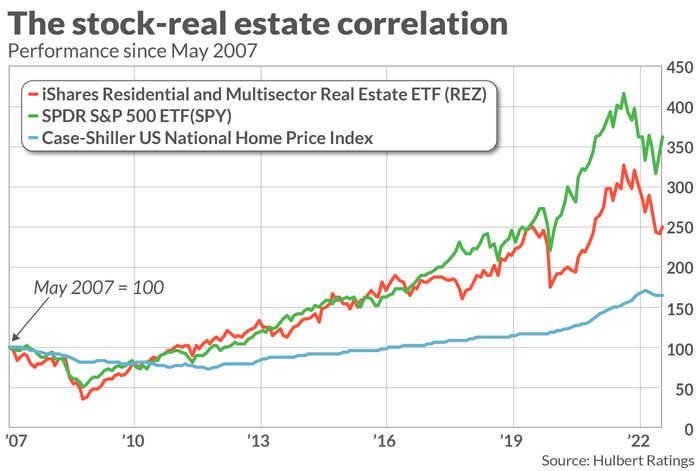
The ETF that perhaps comes closest to representing the residential real estate asset class is the iShares Residential and Multi-Sector Real Estate ETF
REZ,
which was created in May 2007. Its cumulative performance since then is plotted in the accompanying chart, along with the S&P 500’s
SPX,
total return and the Case-Shiller index. Notice the striking correlation between REZ and the S&P 500—and the absence of much of a correlation between it and the Case-Shiller index.
There no doubt are many different factors that account for the absence of a strong correlation between REZ and the Case-Shiller index. But one big one is that the stock market is forward looking, discounting what appears to be coming down the road several quarters or years hence. So it makes sense that investors would stop bidding up REZ’s price well in advance of when the Case-Shiller index slows its pace of growth or declines.
The bottom line: There is no easy way for investors to gain exposure to residential real estate as an asset class. But that doesn’t mean you shouldn’t try. Your challenge will be to perform as well, or better, with your particular real estate investment than the asset class’s overall average. Good luck!
Mark Hulbert is a regular contributor to MarketWatch. His Hulbert Ratings tracks investment newsletters that pay a flat fee to be audited. He can be reached at mark@hulbertratings.com.