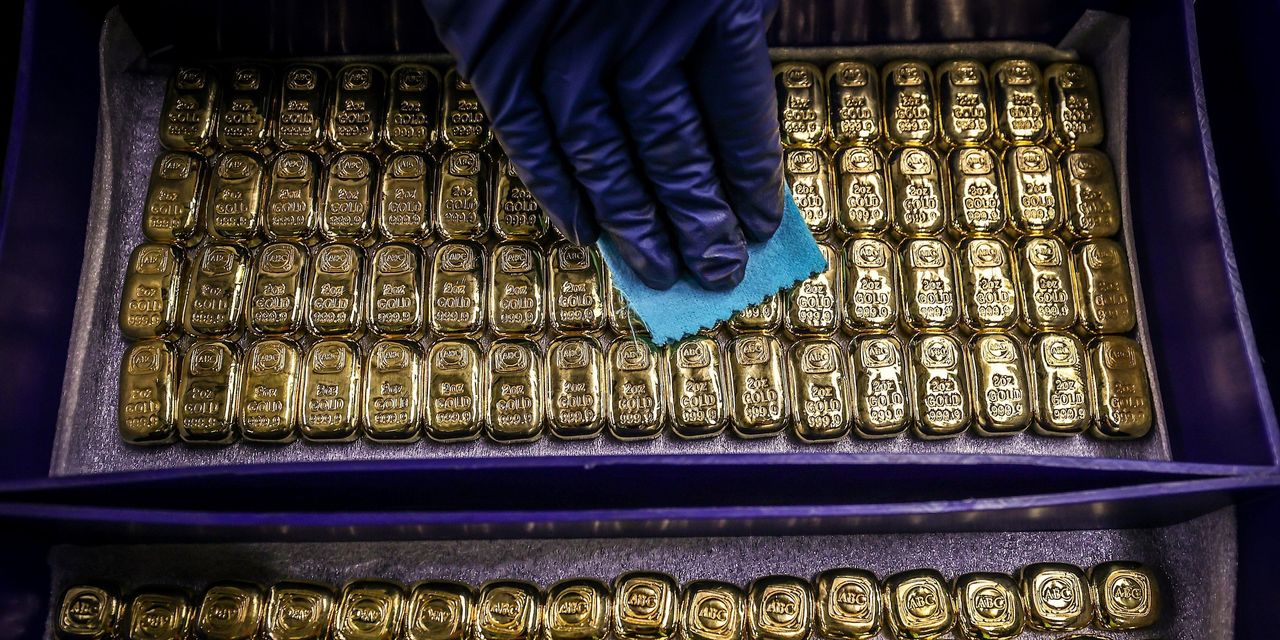
Gold futures headed higher on Thursday, looking to recoup losses from a day earlier that pulled prices to their lowest finish in just over a week.
The precious metal found support from weakness in the U.S. dollar following U.S. data showing a weekly rise in the number of people who applied for unemployment benefits to a nearly two-year high.
Price action
-
Gold for August delivery
GC00,
+1.22% GCQ23,
+1.22%
rose $22.50, or 1.2%, to $1,980.90 an ounce on Comex after losing 1.2% on Wednesday. -
July silver
SIN23,
+3.45%
was up 73.1 cents, or 3.1%, at $24.26 an ounce. -
July platinum
PLN23,
-0.65%
fell 0.5% to $1,019.20 an ounce, while September palladium
PAU23,
-0.82%
was down 0.5% at $1,381 an ounce. -
July copper
HGN23,
+1.09%
rose 0.5% to $3.774 a pound.
Market drivers
U.S. jobless claims rose 28,000 to 261,000 for the week ended June 3, the Labor Department reported Thursday.
The ICE U.S. Dollar index
DXY,
declined by 0.6% to 103.51 following the data, raising the appeal of dollar-denominated gold.
The rise in jobless claims help support the possibility that the Federal Reserve will not increase interest rates at their policy meeting next week.
“Expectation is mounting that the U.S. central bank will hit pause on its interest rate hikes,” said Rupert Rowling – Market Analyst, Kinesis Money, in market commentary, ahead of the jobless claims data. However, “investors and traders are reluctant to fully commit their funds until this does indeed prove accurate.”
“The fact that gold continues to trade at such high levels, that although they may be about $100 lower than gold’s early May peak, are still at a range seen only a handful of times in the precious metal’s long trading history, reflects the fragile state of market confidence,” he said.
He believes “gold looks set to slide slowly but steadily lower over the coming weeks and months, proving the barometer of investors’ true confidence in the global economic outlook.”
A series of Fed rate hikes that have taken the fed-funds rate from near zero to 5% to 5.25% since March 2022.
A rate rise by the Bank of Canada on Wednesday, ending a lengthy pause, underscored fears that U.S. rates may still have room to rise in the face of stubborn inflation, analysts said.
Read: Why U.S. stock-market investors were rattled by the Bank of Canada’s surprise rate hike
In a research note dated Wednesday, strategists at Citi Research, led by Aakash Doshi, said “equity [volume] compression, the recent back-up in Treasury yields and bounce [in the U.S. dollar] amid a resolution to an imminent U.S. debt ceiling breach provide a potential cap on near-term gold market cheer.”
They reduced their zero- to three-month gold price-point target to $1,915 an ounce from $2,100.
Gold remains “a viable macro portfolio tail hedge,” historically and during the current post-pandemic era, despite the hawkish [Federal Reserve] regime, they said. “We believe bullish bullion sector tailwinds will reemerge before end-2023.”
Ipek Ozkardeskaya, senior analyst at Swissquote Bank, meanwhile, warned that gold is trading near the 100-day moving average around the $1,940 level and that losses could accelerate if that’s violated.
“The next reasonable target for gold bears is $1,905, the major 38.2% Fibonacci retracement on November to May rally, and which should distinguish between the actual positive medium term trend, and a bearish reversal,” she wrote in a note.
Many technical analysts pay attention to what’s known as the Fibonacci ratio, attributed to a 13th century Italian mathematician known as Leonardo “Fibonacci” of Pisa. Technical analysts see key retracement targets for a rally from a significant low to a significant peak at 38.2%, 50% and 61.8%, while retracements of 23.6% and 76.4% are seen as secondary targets.