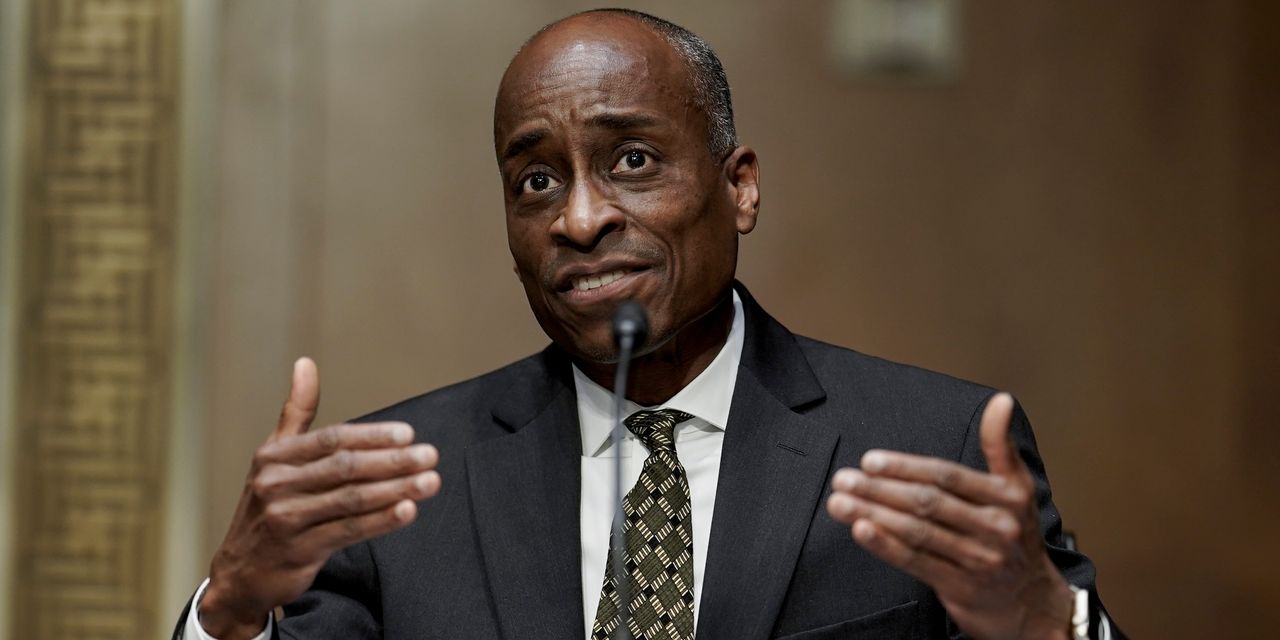
One of President Joe Biden’s new appointees to the Federal Reserve on Monday said he doesn’t support raising the central bank’s 2% inflation target.
In a talk to students at Harvard University, Fed. Gov. Philip Jefferson said that raising the inflation target “would damage the central bank’s credibility.”
The Fed formally adopted a 2% inflation target in 2012. For many years, the central bank had trouble raising inflation to that target.
But in the aftermath of the pandemic, inflation has soared, with the central bank’s favorite inflation gauge hitting a 7% annual rate in June before coming down to 5.4% in January.
Many economists worry that the Fed will have to cause a severe economic downturn to get inflation back to the 2% target and so have been calling for the Fed to be pragmatic and accept a higher target. They have been hoping for some support from the new Biden Fed appointees like Jefferson.
In his remarks, Jefferson said changing the target would cause deeper damage.
It would “introduce an additional risk by calling into question the [Federal Open Market Committee’s] commitment to stabilizing inflation at any level because it might lead people to suspect that the target could be changed opportunistically in the future,” he said.
That reputational damage would undermine the Fed’s ability to fight economic downturns without causing high inflation, he said.
“Moreover, if the purpose of a higher inflation target is to increase the ability of the central bank to deal with the severe recessions that follow financial crises, then a better strategic approach might be to rely on more vigorous supervisory
and macroprudential policies that could help reduce the likelihood of such events,” he said.
In December, Fed Chair Jerome Powell said the bank wasn’t thinking about changing its inflation goal. He said that “there may be a longer-run project at some point, but that is not where we are at all.”
The Fed conducts reviews of its monetary policy strategy roughly every five years. The next review could start in 2024.
Stocks
DJIA,
SPX,
were higher at the start of trading on Monday. The yield on the 10-year Treasury note
TMUBMUSD10Y,
slipped a bit to 3.91%.