£5,000 invested in a SIPP 5 years ago could now be worth…

Investing in a Self-Invested Personal Pension (SIPP) is a terrific way to build medium-to-long-term wealth. Even in the last five years, with all the volatility investors have endured, the stock market has delivered some fairly robust returns. So with that in mind, let’s take a look at how a £5,000 portfolio has performed since April 2020.

Transformative gains

The level of returns enjoyed by investors ultimately depends on where the money has been invested over the last five years. Here in the UK, large-cap stocks have been outpacing small- and mid-caps by a significant margin when looking at the FTSE 100 and FTSE 250. Meanwhile, across the pond, the S&P 500 and Nasdaq 100 are reaping the rewards of stronger economic growth.

Index 5-Year Total Return Annualised Return Portfolio Value
FTSE 100 55.6% 9.2% £7,780
FTSE 250 27.6% 5.0% £6,380
S&P 500 96.4% 14.5% £9,820
Nasdaq 100 119.8% 17.1% £10,990

Clearly, the US tech sector’s been the star of the show. But what’s interesting is that, when excluding the FTSE 250, each index notably outperformed its historical average return. For reference, the FTSE 100 typically generates an 8% annual gain, while the S&P 500 and Nasdaq 100 stand at 10% and 13% respectively.

There are a lot of different factors at work here. However, one of the biggest is the fact that five years ago today, the stock market had just gone through the 2020 Covid Crash.

This goes to show that buying proven high-quality businesses at a time of fear, uncertainty, and doubt can lead to market-beating returns. So could investing another £5,000 today achieve similar market-beating returns over the next five years?

Looking for opportunities

It’s impossible to know for certain what’s going to happen over the next five years. The tariff situation will undoubtedly cause chaos in the short term. However, I remain optimistic for the long run as quality companies adapt to the new landscape.

As such, looking at proven industry leaders with healthy balance sheets might be a prudent move to consider right now. And one business I’ve had my eye on for a while is Nvidia (NASDAQ:NVDA).

The chip designer has already seen almost a third of its market-cap wiped out since the start of 2025. However, as a result, the stock’s finally trading at a far more reasonable valuation of just 21 times forward earnings. And given semiconductors have been excluded from the recent tariffs, is Nvidia a no-brainer buy?

Well, not quite. While semiconductors have indeed been given an exemption, a 25% tariff has been put on steel and aluminium. Nvidia relies significantly on these two commodities for its data centre products.

In terms of impact, Nvidia’s margins are likely going to take a hit since the AI accelerator chip landscape is becoming increasingly competitive. And subsequently, earnings could fail to meet analyst expectations, pushing the forward P/E higher than it seems right now.

However, with $43bn of cash on its balance sheet right now, Nvidia appears to have more than enough financial flexibility to weather this storm. That’s why I think it might be a great long-term addition to my SIPP while its shares tumble to a discounted price.


Looking for dividend stocks? Here’s a discounted investment trust to consider!

Today investors can pick up a wide range of investment trusts ‘on the cheap.’ Recent stock market volatility means many now trade at a large discount to their net asset values (NAVs), and rising dividend yield makes them attractive candidates for those seeking dividend stocks.

Here is one of my favourites, and especially at the moment as economic uncertainty grows.

Trust the process

Real estate investment trusts (REITs) are designed in a way that can make them ideal candidates for passive income. In exchange for tax reductions, these investment vehicles must pay at least 90% of yearly rental profits out in dividends.

This doesn’t guarantee that shareholders will enjoy a large and/or growing second income, as cash rewards are still tied to earnings. But it does mean the business has less flexibility to decide to limit, reduce, or eliminate dividends than other shares.

Please note that tax treatment depends on the individual circumstances of each client and may be subject to change in future. The content in this article is provided for information purposes only. It is not intended to be, neither does it constitute, any form of tax advice.

On top of this, some property trusts provide added peace of mind to investors by operating in defensive sectors. This is why I think Social Housing REIT (LSE:SOHO) is worth serious consideration right now.

Stable sector

As a provider of residential property — and more specifically for adults with care and support needs — rental income and occupancy rates tend to be more stable than those of trusts operating in more cyclical sectors.

In addition, the rents it receives are effectively funded by local authorities, who pay housing benefit to approved providers who lease its properties. Changes to government funding could impact this favourable funding model. But I’m optimistic that this is unlikely given the huge savings that trusts like this provide the taxpayer.

According to Social Housing REIT,

Residents living in specialised Supported Housing cost the government about £200 less per week than being in a residential care home and nearly £2,000 less per week than remaining in in-patient care.

As a consequence, the trust estimates that its own portfolio saves the government around £71.6m each year.

With a large portfolio of properties, too — it has around 3,400 homes on its books across 500 supported housing properties — it’s well placed at group level to absorb any problems that might arise.

8.9% dividend yield

I don’t think these qualities are reflected in the cheapness of Social Housing REIT’s shares.

At 61.9p per share, the trust also trades at an 45.8% discount to its estimated NAV per share of 114.1p.

The investment trust also offers excellent value from a passive income perspective. Its forward dividend yield of 8.9% is one of the highest across the REIT asset class. To put that into context, the FTSE 100 average sits way back at 3.9%.

Social Housing REIT’s share price has been negatively impacted by higher interest rates in more recent years. This has depressed the value of its assets and driven up borrowing costs.

While it remains sensitive to future rate movements, I believe that — on balance — this investment trust is an attractive dividend payer to consider today.

2 small-caps on the London Stock Exchange to consider for passive income 

Small-cap stocks listed on the London Stock Exchange often get overlooked by investors searching for income. Perhaps that’s understandable, as established blue-chip names like Lloyds and Vodafone normally hog the limelight.

Moreover, there’s often an assumption that smaller enterprises don’t have the financial clout to support rising payouts. While that may broadly be true and payouts aren’t guaranteed, there are some quality small-caps that offer potentially attractive income streams.

Here, I’ll highlight two of them that are worth considering.

Surging bullion prices

The first is Ramsdens (LSE: RFX), which has a market-cap of £76m. The firm operates 169 stores and specialises in pawnbroking loans, jewellery retail, foreign currency exchange, and the purchase of precious metals. 

The stock’s almost doubled in five years, and jumped nearly 10% on 8 April. This came after the firm raised its profit outlook for the full year, driven by the surging gold price.

Pre-tax profit’s expected to be at least £13m, higher than the £12m previously expected by analysts. In its last fiscal year (which ended in September), Ramsdens’ pre-tax profit was £11.4m on revenue of £95.6m.

Gross profit in its precious metals segment increased 50% year on year in H1. This was driven by the rising gold price, coupled with a 5% increase in the weight of gold purchased. To take advantage of this trend, the firm launched a dedicated gold-buying website last month. 

Meanwhile, gross profit at its pawnbroking and jewellery retail businesses increased by 10% and 15%, respectively. Foreign currency gross profit was flat though, partly because the Easter holiday period is later this year. But Ramsdens says its multi-currency card is performing well and an international money transfer service is now live. 

Risks here include a sharp decline in gold prices or a spike in inflation. While the latter might boost its pawnbroking and precious metals businesses, less disposable income could also impact demand for jewellery and holidays (currency exchange services).

Rising profits obviously bode well for dividends though. The dividend yield for the current year is a respectable 5.5%, with the payout comfortably covered 2.3 times by prospective earnings.

Finally, the valuation looks attractive. The forward price-to-earnings ratio is just 8, which isn’t high for a consistently profitable company with a strong balance sheet.

Building income through bricks

Next is Michelmersh Brick (LSE:MBH), a penny stock with an £89m market-cap. The company makes over 125m clay bricks and pavers each year. It also owns a number of premium brick brands, which tend to have higher margins.

At 95p, the share price is down 35% over the past four years, largely due to higher interest rates putting pressure on UK housebuilding. The risk here is that this weakness persists longer than expected.

Taking a longer view however, the brick maker’s prospects appear bright. The government had pledged to build 1.3m homes by 2029 to ease the chronic housing shortage, while the Office for National Statistics projects that net migration will average 340,000 a year from 2028.

These are very supportive trends for housebuilding (and therefore bricks). Michelmersh says that positive momentum in its order intake from 2024 continued into Q1 of this year, leaving it well positioned for a market recovery.

The well-supported forward dividend yield is around 5%.

Can Aston Martin shares make it through to end of the year?

Aston Martin Lagonda (LSE:AML) shares have continued to make headlines over the past two years. Investors were sold a fairly smooth path to profitability, but that simply hasn’t been the case.

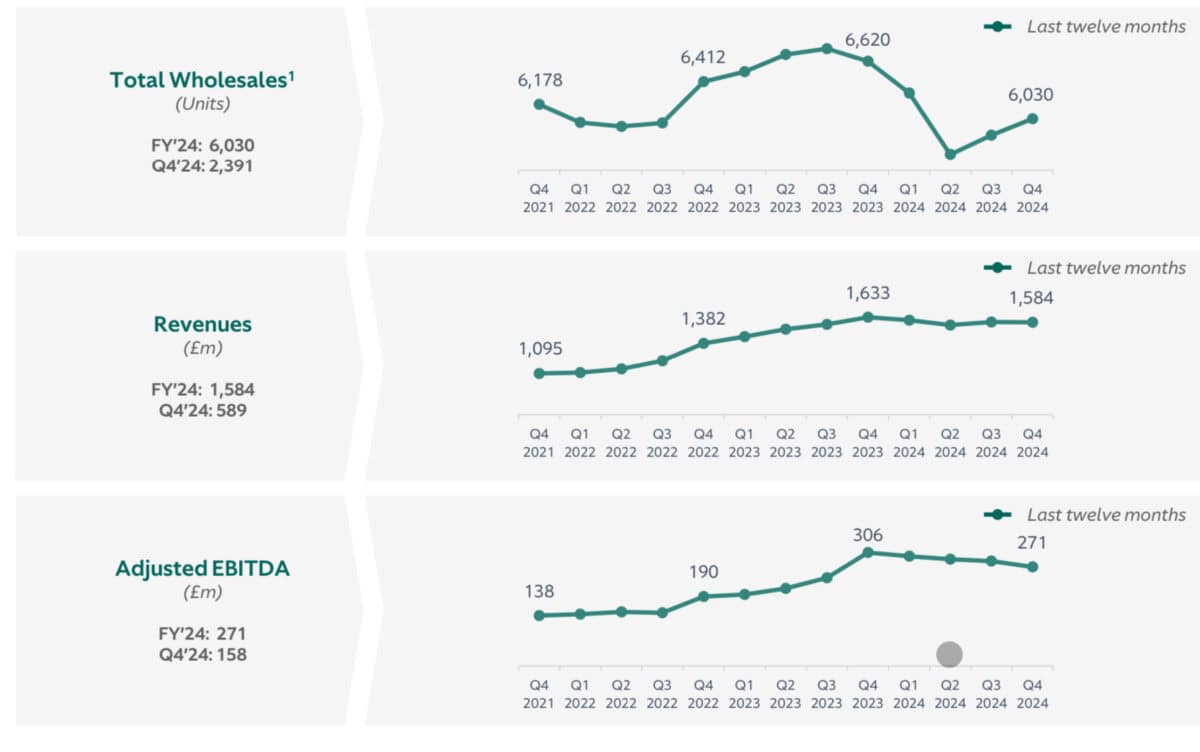
In 2024, the company reported a pretax loss of £289.1m, widening from £239.8m in 2023. This was reported alongside a decline in revenue by 3% to £1.58bn. It was a painful year for the iconic carmaker, as wholesale volumes also fell 9%, reflecting supply chain disruptions and weaker demand in key markets like China.

Despite these setbacks, Aston Martin managed to achieve a rare positive cash flow in the final quarter of 2024. New product launches and improved sales of high-margin models drove this achievement.

Source: Aston Martin 2024 Results

Failing to impress the market

The company’s share price has mirrored its financial struggles, plummeting by over 96% since its flotation in 2018. As of April 2025, shares are trading near their 52-week low of 56p, down significantly from their year-peak of 172.8p in April 2024.

Rising debt levels, which ballooned to £1.16bn at the end of 2024, have compounded Aston Martin’s challenges. To address these financial woes, the company has cut jobs and scaled back production plans. Additionally, it has received continued financial backing from Lawrence Stroll’s Yew Tree Consortium, which recently increased its stake to 33% through a £52.5m investment.

Another promise

In 2023, Aston Martin Lagonda set ambitious financial targets as part of its turnaround strategy. Executive Chair Lawrence Stroll planned to achieve £2bn in revenue and £500m in adjusted EBITDA (earnings before interest, taxation, dividends, and amortisation) by 2024/25.

Initially, these goals were tied to selling 10,000 vehicles annually. However, CFO Doug Lafferty later expressed confidence that the company could meet these objectives with just 8,000 units per year.

However, this just hasn’t happened. The business is still making promising though. New CEO Adrian Hallmark has outlined plans for a “materially improved” financial performance in 2025, with expectations of positive adjusted EBITDA and free cash flow in the second half of the year. The launch of the Valhalla, Aston Martin’s first mid-engine plug-in hybrid, is expected to play a crucial role in this turnaround.

Now, the group plans to achieve revenue of £2.5bn and adjusted EBIT of £400m by 2027/28. However, given its historic struggles, it’s unclear whether it can acheive these targets.

High risk, high reward

I had previously been an investor in Aston Martin, but it’s not for me anymore. Aston Martin’s journey remains fraught with risks. What’s more, the company ships around 2,000 vehicles to the Americas on average. Trump’s tariffs put these numbers in peril. Finally, while management is taking steps to stabilise operations and improve profitability, the company’s long history of financial troubles and increasing reliance on external funding are huge concerns. I do think it’ll survive the year, but it needs a turnaround to guarantee its future.

£5,000 in savings? Here’s how an investor could aim for £12k annual passive income

With a small pot of savings set aside, there are several avenues to explore passive income opportunities. One of the most effortless is investing in dividend-paying companies. It’s a hands-off approach that lets time do the heavy lifting.

While it’s not a foolproof formula, many legendary investors have successfully tapped into this method. The key lies in following a few smart strategies to help tip the odds in your favour.

Cutting costs

Taxes can take a bite out of your investment profits, so finding ways to reduce that impact is a smart starting point. For UK investors, one of the most effective tools is the Stocks and Shares ISA.

This account lets you invest up to £20,000 a year without paying tax on any gains — a powerful advantage when building long-term wealth. Best of all, opening one is straightforward, with most high street banks and a range of online platforms offering easy access.

Please note that tax treatment depends on the individual circumstances of each client and may be subject to change in future. The content in this article is provided for information purposes only. It is not intended to be, neither does it constitute, any form of tax advice. Readers are responsible for carrying out their own due diligence and for obtaining professional advice before making any investment decisions.

The strategy

A solid passive income portfolio often strikes a balance between growth stocks and dividend-paying shares. Growth stocks offer the chance for higher capital gains, while dividends deliver a more consistent income stream — each brings something valuable to the table.

And here’s where the magic happens: reinvesting those dividends can spark the power of compounding, steadily accelerating returns over time.

Smart investors tend to spread their investments across different sectors and global markets, helping to cushion against industry slumps or regional downturns. Many focus on growth stocks to begin with, often achieving between 7% and 8% returns. Even a modest £5,000 investment could snowball into around £30,000 over 20 years. 

Adding just £200 a month along the way, and the pot could swell to £166,000 in that time. Shifting that into a portfolio with an average 7% yield would return yearly income of roughly £12,000.

The sooner one starts the better — imagine what it could deliver after 30 years?

What to look for

When building a portfolio for passive income, it’s important to consider where a company may be in 10 or 20 years. Will there still be demand for its products or services? Does it have a long history or reliable management? Is it in an industry with a sustainable future?

Consider British American Tobacco (LSE: BATS), a company that’s built a reputation for consistently delivering reliable and generous dividends. Even during challenging economic periods, it maintains a strong commitment to rewarding shareholders.

It has a consistently high yield, which, over the past 12 months, has fluctuated between 7% and 10.4%. Plus, its share price is up 35% in the past year, which is unusually high growth for a dividend-focused stock.

But its earnings have been volatile lately, with a £15.8bn loss in 2023 offset by a £2.73bn gain in 2024. It also faces significant risks from regulatory and legal challenges to smoking, most recently a £6.2bn charge in Canada. These challenges mean the company has an uncertain future. 

For this reason, it’s an example of a company that isn’t ideal for a long-term investment strategy. For that goal, it may be wiser to consider more sustainable dividend-paying companies like Aviva, HSBC, or National Grid.

£9K of savings? Here’s how an investor could target £490 a month of passive income

There are lots of different ways to try and earn passive income, some more passive and income-generating than others.

The approach I use is to buy shares in proven blue-chip companies that pay dividends. With the stock market experiencing a lot of turbulence over the past couple of weeks, buying such shares now could prove more lucrative than just a short while ago.

With a spare £9,000, someone could use this approach to target a monthly passive income of £490 on average.

Here’s how!

Share price and yield are connected

How much passive income a share earns depends on two factors – the size of the dividend per share and what someone pays for that share.

For example, if a share pays a 5p dividend annually and an investor buys it for £1, the yield is 5%. But if that price halves and the investor buys more shares, he will earn a 10% yield for those shares even though the dividend per share is the same.

So, when the stock market pushes share prices down – as happened for many shares at some point this week – it can offer the opportunity of earning a higher yield.

Look out for the risks, not just the rewards

That presumes the dividend is maintained, which is never guaranteed. A tumbling stock market can reflect City nervousness about how businesses are set to perform. If they do badly, they may cut or even cancel their dividend.

To try and manage that risk, an investor ought to diversify their portfolio. And £9,000 is ample to do that.

It is also important to focus on buying into quality companies at an attractive share price and only then consider the yield, rather than just investing in high-yield shares without properly understanding them.

One share to consider

For example, asset manager M&G offers a 10.9% yield. But that alone is not why I think investors should consider it.

While M&G aims to maintain or grow its dividend per share each year, it may not. It has been battling with investors pulling more money out of its core business than they put in. A nervous stock market could exacerbate that trend, hurting revenues and profits.

However, I think it has some helpful tools in its arsenal.

It operates in a large market with resilient customer demand and has a customer base in the millions. It has a strong brand and a business model that has proven excellent at generating surplus cash, the stuff of which dividends are made.

Taking the long-term approach

My example presumes a lower average yield than M&G’s 8.5%.

That 8.5% is still well over double the FTSE 100 average, but I think it is achievable in the current market, where some blue-chip shares have tumbled in price. Indeed, the M&G share price is almost a fifth cheaper than at its high point last month.

Reinvesting dividends (known as compounding) can boost passive income streams for the long-term investor. Compounding £9k at 8.5% annually for 25 years, for example, should produce £490 of dividends per month.

A shorter timeframe could still work, although the target income would be lower.

Either way, a useful first step would be identifying a suitable share-dealing account or Stocks and Shares ISA through which to invest the £9k.

I’m taking Warren Buffett’s advice for handling volatile stock markets

It has been an odd and unnerving week in the stock market. While some investors may be experiencing such turbulence for the first time, one who is not is billionaire Warren Buffett.

Buffett has experienced multiple dramatic stock market swings over decades – and used them to his advantage.

As the stock market has swung around this week, I have been bearing in mind some of Buffett’s advice about such moments – one piece in particular.

Imagine the market knocking at your door daily

Buffett got the idea from his teacher Ben Graham and it is one I think is simple, but powerful.

He talked about a person called Mr Market. Nowadays we might also say Ms Market, but here I’ll just refer to him/her as ‘The Market’.

Each day (or at least each day the stock exchange is open), it offers to buy shares from you at a certain price – or sell you the same share at a similar price.

As an investor, you can buy, sell, or do nothing. Year after year, decade after decade, you have the same option.

Here’s why this idea is so powerful

That may sound like a pretty obvious insight. In fact, I do not think so.

Consider the property market, for example. In a tough market, you may list a property for months or years without finding a buyer.

In the art market, you may want to buy a painting. But there is only one and, no matter what you offer, its owner is unwilling to sell.

By contrast, the stock market allows you to buy, sell or simply sit out the storm, as you choose.

So, just because shares tumble in price does not mean an investor needs to do anything when The Market offers a price for selling or buying.

Instead, if they think the investment case is unchanged, they can simply sit back, ignore the market noise and take a long-term view. It is no coincidence that Warren Buffett has described his ideal holding time as “forever”.

Bargain hunting, when it suits you

Equally, an investor can go shopping for bargains when The Market offers a share at a much lower price than before.

This week, I did exactly that and took the opportunity of a sharp fall in price to add to my holding in Filtronic (LSE: FTC).

Over the past year, the share price more than doubled. On a five-year timeline, it has grown over 1,000%. That is the sort of performance even Warren Buffett struggles to achieve!

It reflects the company’s sales and profits growth due to a number of deals for its specialist communication equipment, notably from SpaceX. Last year, revenue leapt 56% while a net loss the prior year gave way to a £3.1m profit.

With the potential for further orders from SpaceX – which has invested in Filtronic – I reckon the business outlook is rosy. But the share price had risen sharply to reflect that.

So, when The Market suddenly offered a much cheaper Filtronic share price this week, I bit its hand off.

The heavy reliance on a single customer is a clear risk and could mean revenues slump if SpaceX stops ordering. So I want to buy at a price I think reflects such risks. Briefly, I had the opportunity!

Here’s where I think the Lloyds share price could be at the end of 2026

The Lloyds (LSE:LLOY) share price has endured a volatile start to 2025. It’s been weighed down by the motor finance mis-selling scandal and renewed tariff threats from Donald Trump. These twin pressures have cast a shadow over the bank’s outlook, with regulatory uncertainty and geopolitical risk shaking investor confidence.

Despite a relatively stable macro backdrop in the UK, Lloyds now finds itself navigating a more complex environment. It’s an environment where litigation risk and international trade tensions threaten to eclipse the steady progress seen in its core retail and commercial banking operations.

Looking beyond the noise

Despite recent volatility, Lloyds shares may be poised for a re-rating over the next 24 months. Remember, the stock is up from where it was a couple of years ago, but it’s down over 10 years. The stock just hasn’t had the right conditions to grow.

The current forward price-to-earnings (P/E) ratio of 10.2 times appears elevated due to analysts factoring in provisions for a potential fine (£1.2bn has been set aside) related to the motor finance investigation. However, looking ahead, the forward P/E should decrease to 7.5 times in 2026 and further to 6.2 times in 2027, based on projections, indicating potential undervaluation as earnings normalise.

UK GDP growth forecasts support this optimistic outlook. The Office for Budget Responsibility projects real GDP growth of 1% in 2025, 1.9% in 2026, and 1.8% in 2027. Similarly, S&P Global anticipates GDP growth of 1.5% in 2025, 1.6% in 2026, and 1.5% in 2027. This steady economic expansion could bolster Lloyds’ core retail and commercial banking operations.

With a price-to-book ratio of 0.94 times and an enterprise value to EBIT (earnings before interest and taxation) multiple of 5.04 times, Lloyds shares appear cheap compared to their counterparts. As regulatory pressures subside and the UK economy returns to a more normalised growth trajectory, the stock may experience significant gains.

The interest rate conundrum

Lloyds faces a mixed picture in regards to the interest rate environment through 2027. The bank must balance potential challenges from declining rates while taking opportunities arising from its strategic hedging practices.

The Bank of England’s base rate, currently at 4.5%. This is projected to decrease over the coming years. Currently, most forecasts suggest a move to 3.5% by the end of the year, but there’s a lot of economic data that could influence that.

Oxford Economics anticipates a further decline to 2.5% by 2027. The group note structural factors like demographic shifts and subdued productivity growth. These projections suggest a prolonged period of lower interest rates, which could compress net interest margins for banks reliant on traditional lending.

However, Lloyds and its UK peers have proactively managed this risk through structural hedging strategies. By employing interest rate swaps to balance liabilities such as customer deposits and shareholder equity, Lloyds aims to stabilise revenues amid rate fluctuations. This approach, often referred to as ‘the caterpillar’, allows for consistent replacement of swaps, making interest income more predictable.

Personally, I’m being quite cautious during this period of volatility. However, I still believe Lloyds shares aren’t overpriced. Assuming no major hiccups, I’d expect to see the stock trading around 80p-85p. That’s based on a forward P/E of 7.5-8 times for 2027 — using the current forecast.

“£10k invested in Aston Martin shares a year ago is now worth…” [VIDEO]

Aston Martin Lagonda (LSE:AML) shares recently plunged on fears over US tariffs on car imports. Two Fools talk about whether this could be a buying opportunity to consider.

Note: return data correct as of time of recording.

Transcript:

CHRIS: Hi Fools, Chris Nials here and I’m joined by Motley Fool analyst Zaven Boyrazian. Morning Zaven!

ZAVEN: Hello!

CHRIS: We’re going to be talking about Aston Martin today, and how fears over US tariffs on car imports have sent its share price tumbling. Zaven, what’s been happening?

ZAVEN:  Well Chris, we’ll get to the tariff talk in just a moment, but before we do it’s important to point out that Aston Martin Lagonda shares have actually been stuck in reverse (if you’ll excuse the pun) over the last year or so.

The FTSE 250 carmaker now deals at 70.2p per share, a whopping 59.5% lower than it was 12 months ago. So someone who bought £10,000 worth of shares back then would have seen the value of their investment tumble to £4,046. They wouldn’t even have received any dividends to help soften the blow, either.

But while Aston Martin’s share price sits significantly below the 661.9p it was at five years ago, there’s no doubt that it could yield sterling potential returns if it recovers. But that looks like quite a significant ‘if’ to me right now.

CHRIS: That sounds somewhat ominous!  So do you think that investors should consider buying Aston Martin shares today?

ZAVEN:  Well I think it’s easy on one hand to see the company’s incredible appeal. Its products are the epitome of style, speed. sophistication, and let’s face it, sex appeal.

Aston Martin’s had an association with the likes of James Bond since the mid-1960s, and the brand’s involvement in the dynamic world of Formula One haven’t done it any harm, either.

But while its label and products are highly desirable, the same certainly can’t be said for the company itself, at least in my view. So what’s the problem?

The issue is that Aston Martin is fighting fires on a number of fronts. Last year, pre-tax losses rose by 21% to £289.1m, partly due to a 9% drop in wholesale volumes. Sales declined on the back of supply chain disruptions and tough conditions in China, troubles that still persist.

As a result, net debt — which was already pretty concerning — shot up sharply. At the end of 2024, Aston had net debt of £1.2bn, up 43% year on year. And so the spectre of fresh rights issues and debt issuances still looms large.

CHRIS: And as if Aston Martin didn’t have enough problems, President Trump has of course drawn global carmakers further into his escalating trade battle, and AML are certainly not immune to these.

ZAVEN: Yes that’s right – so as everyone watching will no doubt have seen, the US has slapped heavy tariffs on all imported cars, putting a hefty premium on already-expensive marquee car manufacturers like Aston Martin.

On the plus side though, the delays to previously announced tariffs from the US may suggest that this thumping import tax isn’t a done deal. In addition, the UK chancellor Rachel Reeves has said the government is “in intense negotiations” with Washington to avoid any car tariffs.

But just the mere threat of trade tariffs is enough to chill my bones and I’m sure that’s the same for any investors watching who own shares in Aston Martin. Last year, sales to the Americas — dominated by demand from US customers — accounted for 40% of group revenues, making it by far the company’s single largest market.

With all of its manufacturing located in the UK, Aston Martin would be especially vulnerable to any ‘Trump Tariffs.’

CHRIS: Ok great – thanks so much for the insight Zaven, So what’s next for Aston Martin then?

ZAVEN: Well it’s hoped that a string of new car launches (including the recently revamped Vanquish and the upcoming Valhalla) could revive the company’s fortunes. But the highly competitive nature of the car market means that success is by no means guaranteed.

And on top of that, Aston Martin’s recovery is made even more difficult given those challenging economic conditions in key markets that we’ve already talked about. On balance, I believe that this is a FTSE 250 share that investors should strongly consider steering well clear of.

CHRIS: Thanks so much again Zaven, and thanks so much to everyone watching. Fool on!

After falling 17% in a month, Tesco shares yield 4.3% with a P/E of just over 11!

Tesco (LSE: TSCO) shares have taken quite a tumble, falling 17% in the last month alone. That’s big for a company many think of as one of the safer picks on the FTSE 100, but we all know the reason. 

In this volatile new world sparked by Donald Trump’s latest round of tariffs, even reliable, cash-generating businesses like Tesco are feeling the squeeze. Over the past year, the shares are now up just 6%, and that gain is fast evaporating.

For bargain hunters, this could be the opportunity they’ve been waiting for. Tesco’s price-to-earnings ratio has dropped to just 11.3. Just a few weeks ago it was trading closer to 15 or 16 times earnings.

Is this FTSE 100 star a bargain?

Meanwhile, the dividend yield has crept back up to 4.28%. Tempting as that may sound, nothing’s without risk in these mad times.

We got an early signal from Kantar on 1 April when it reported that annual sales growth at UK supermarkets had slowed to their weakest pace in 10 months.

There were promotions aplenty as retailers fought for shoppers’ wallets. Despite that, Tesco managed to increase its market share to 27.9% with sales of £9.68bn over the period. By contrast, Asda saw its sales fall 5.6%, so the competitive pressures are real and biting hard.

Tesco’s own update on 10 April was a mixed bag. While 2024 profits rose 10.6% to £3.13bn the board warned things might not be so rosy amid rising “competitive intensity” and the added cost of employer’s National Insurance hikes, Minimum Wage increases, packaging taxes, and more.

Commentators were split. Garry White at Charles Stanley was concerned by warnings that management expects profit will fall in the current year. “Tesco’s guidance could prove to be conservative, but it will be a while before we know”, he said.

Tesco facing margin squeeze

Aarin Chiekrie at Hargreaves Lansdown highlighted Tesco’s strong position and loyal customer base, suggesting that despite a “slight pullback in its share price of late, the underlying story looks good as revenue and profits motor higher”.

Even if the price war intensifies, customers should stay loyal “helped by the Aldi price match and Clubcard prices keeping customers loyal”, Chiekrie added.

The 13 brokers offering one-year share price targets have a median estimate of just under 395p. If that plays out, it would mark a healthy gain of more than 22% from current levels. 

Of the 16 analysts offering ratings, 10 say Strong Buy, three say Buy, and three Hold. Nobody’s calling it a Sell.

Broker predictions can never be relied upon, of course, and most will have been made before Trump lit the tariff fuse. The next year or two could be volatile for just about every stock, and Tesco won’t be exempt. If a recession takes hold, shoppers will feel the pinch and so will Tesco.

Still, with a lower valuation, decent dividend and market leadership, Tesco shares are worth considering today. As ever, investors should aim to hold for a minimal of five years, while hoping the outlook is a little brighter by then.

Financial News

Daily News on Investing, Personal Finance, Markets, and more!

Financial News

Policy(Required)