£10,000 invested in the FTSE 100 10 years ago is now worth…

The last 10 years have been quite eventful for the FTSE 100. The UK’s flagship index has gone through two major corrections in 2018 and 2022, along with two market crashes in 2020 and now 2025. Yet despite all this volatility, long-term investors have been rewarded with some notable gains.

When factoring in the additional returns from dividends, FTSE 100 index investors have reaped an 85% total gain. On an annualised basis, that’s the equivalent of 6.4% per year.

Compared to the S&P 500’s 182% gain over the same period, UK shares seem to have been left behind. Yet, it’s worth pointing out that volatility has been significantly lower here compared to the US. And these gains are still sufficient for a £10,000 initial investment to almost double to £18,500.

But what if instead of investing in a low-cost index fund, investors had bought individual large-cap stocks?

Explosive winners

While some have underperformed, despite being some of the largest London-listed companies, several other FTSE 100 stocks have vastly outperformed their parent index.

AstaZeneca’s steady stream of new drug approvals and portfolio expansion has delivered a total annualised return of 7.5%. At the same time, demand for RELX’s data collection has pushed up revenue and margins, resulting in an 11.8% average annualised return. However, it’s the actual company behind the UK stock market, the London Stock Exchange Group (LSE:LSEG), that’s stealing the show with a 15.4% annual gain!

To put this into perspective, £10,000 invested in the stock in April 2015 is now worth £41,995. And that might just be the tip of the iceberg. A newly signed partnership with Microsoft to bring the firm’s data and analytics tools to the cloud opens the door to new growth opportunities, including AI applications.

The expected long-term benefits of this 10-year deal are likely why analysts are overwhelmingly bullish on the future of this enterprise, with 17 out of 20 recommending the stock as either a Buy or Outperform.

Of course, with this deal being a big driver of expected future growth, the stock may be doomed to tumble if the benefits fail to materialise. This risk is only amplified by the elevated valuation today at a forward price-to-earnings ratio of 26.1, even after the recent stock market tumble. But I still feel it’s worth considering.

Not everyone is a winner

Picking stocks is a challenging process. And even the most promising ideas can fail to deliver on expectations. Shareholders of Ocado (LSE:OCDO) know this all too well. The troubles at the online grocery store turned robotics automation business has been so severe that it actually lost its FTSE 100 status back in 2021.

While Ocado shares were seemingly off to a great start, management’s decision to aggressively ramp up its investments in automated warehouse technology sent earnings plummeting into the red. And while peak capital expenditure is now finally in the rearview mirror, the share price is still around 25% lower than where it stood a decade ago.

Ocado’s story certainly isn’t over. And its latest results did reveal a welcome surge in underlying earnings and free cash flow – two steps in the right direction. However, it highlights the potential risk of investing in bad stock picks, even when looking at FTSE 100 companies.

How much would a Stocks & Shares ISA investor need to invest each month to retire comfortably?

By providing protection from wealth-sapping taxes, the Stocks and Shares ISA can substantially boost an investor’s chance to build a robust fund for retirement.

But how much would someone need to invest each month in a Stocks and Shares ISA to retire comfortably? Let’s take a look.

Please note that tax treatment depends on the individual circumstances of each client and may be subject to change in future. The content in this article is provided for information purposes only. It is not intended to be, neither does it constitute, any form of tax advice. Readers are responsible for carrying out their own due diligence and for obtaining professional advice before making any investment decisions.

Compund returns

The first thing to say is the earlier someone gets started on their investment journey, the better. Time in the market allows for exponential growth through the power of compounding, which can turn even modest long-term contributions into a substantial retirement fund.

Let’s say someone has £100 to invest each month in their Stocks and Shares ISA. If they can achieve a 6% average annual return, here’s what their nest egg could look like by the State Pension age of 68, according to the date at which they began investing:

Age Retirement pot (excluding broker fees)
25 £242,251
30 £174,426
35 £124,141
40 £86,863
45 £59,225
50 £38,735

As you can see, the differences are vast, illustrating the enormous effect of compound gains. Starting at 25 instead of 30 leads to nearly £68,000 more by retirement, just for beginning five years earlier.

The difference is even more striking when comparing a start age of 25 to 40. That’s a gap of around £155,000, despite contributing the same £100 each month.

Yet this isn’t to say that someone who starts investing later on can’t build a decent retirement fund. Even someone in middle age could conceivably retire in comfort with the right investment strategy.

A £51k passive income

It’s important to say that there’s no guaranteed return by investing in shares, trusts and funds. But history shows us that stock markets can be extremely effective way to target long-term wealth.

For instance, despite bouts of recent volatility, the average annual return of the FTSE 100 and S&P 500 indices over the last decade are 6.4% and 12.9% respectively.

Based on these figures, a 40-year-old who can invest £500 each month equally in these indices stands a good chance of achieving a Stocks and Shares ISA worth £854,877 by the time they reach 68.

If they then invested this in 6%-yielding dividend shares, they’d have a healthy £51,293 passive income to live off.

A top fund

There are many ways that investors can seek to build retirement capital, of which this is just one example. But a fund like the HSBC S&P 500 (LSE:HSPX) could be a good option to consider given the excellent long-term returns of US stocks that I’ve described.

Index funds like these provide excellent diversification across hundreds of companies, helping investors capture a multitude of opportunities while also allowing them to spread risk.

This particular fund holds high-growth shares like semiconductor maker Nvidia, online retailer Amazon and social media specialist Meta. Defensive shares such as telecoms provider Verizon, drinks manufacturer Coca-Cola and healthcare company Johnson & Johnson also provide steel.

It’s a combination that could deliver a blend of healthy capital gains, dividend income and long-term resilience.

A ramping up of global trade tariffs could well impact future returns. But US shares have a proven record of bouncing back from economic crises, which makes an S&P 500 fund a solid opportunity to think about.

10.1% and 12.9% dividend yields! 2 ETFs to consider for a second income

Investing for a second income is a tricker task than usual right now. With the global economy facing significant challenges and uncertainties, it’s tough to predict how corporate earnings and investor dividends will hold up in the months and years ahead.

However, investors can lessen the chances of their passive income sinking by investing in a variety of different stocks. This can be achieved easily and cheaply by purchasing one or more dividend-paying exchange-traded funds (ETFs).

Some such funds are geared specicially towards paying high dividends. They can also hold companies that have strong records of dividend growth. By holding a basket of shares, ETFs can be a better way to target a dependable passive income over time, though it’s important to remember that dividends are never, ever guaranteed.

With this in mind, here are two dividend-paying ETFs I think are worth considering today.

A US-focused fund

As the name implies, the iShares US Equity High Income ETF (LSE:INCU) is geared towards generating income from North American assets (218 in total). For this financial year, its dividend yield’s huge, at 10.1%.

Perhaps surprisingly, it comprises a large section of tech stocks (including Nvidia, Microsoft and Apple). Around 28.3% of the fund is devoted to the information technology space.

But this iShares ETF holds classic defensive sectors, too, to give it added steel and exposure to higher dividend yields. Real estate, healthcare and telecoms also feature prominently.

In addition, the fund also generates income from US government-backed securities and cash. The BlackRock ICS US Treasury Fund’s the single largest holding here.

The ETF’s pure focus on US assets could leave it vulnerable if investor confidence in the States begins to dim. But right now, I still believe it offers decent diversification for dividend chasers.

X marks the spot

The Global X SuperDividend ETF (LSE:SDIP) holds 100 of some of the highest-yielding dividend stocks out there. As a consequence, its forward yield’s now 12.9%, which puts it in the top three largest-yielding ETFs.

In total, it has holdings in 105 businesses, which provides reslience even if one or two dividend shares deliver disappointing cash rewards. It’s also well diversified by geography — the US is its largest single territory by share exposure, comprising 30.5% of the fund. And its holdings span multiple sectors including financial services, mining, real estate and utilities.

Major holdings include satellite operator SES, food manufacturer Marfrig and telecom business Proximus.

GlobalX does have high weightings in cyclical industries. For instance, financial services companies and energy producers account for 27.5% and 23.6% of the fund respectively. This carries higher danger during economic downturns than ETFs that are focused on more defensive industries.

Yet the fund’s ability to deliver a large and constant stream of passive income during previous crises helps soothe any concerns I have. Its unbroken record of delivering monthly distributions dates back to 2012.

Could £300 a month invested in US and UK shares reach a million by retirement?

Investing in a mix of US and UK shares with a long-term outlook can be a road to a luxurious retirement. By sticking to a plan and dedicating a sizable amount of income each month, it’s possible to bring in considerable returns — and achieve generational wealth.

I know it’s an overused phrase but it’s worth repeating: the sooner one starts, the better. The miracle of compounding returns means there can be a huge difference between 20 years and 30 years. The snowball effect means the returns grow exponentially, with each extra year resulting in even more rapid growth.

However, that doesn’t mean it’s easy — or guaranteed. There’s a myriad of different geopolitical factors to consider that can send global markets soaring or tanking. At times, it can be a nerve-wracking experience that requires patience and dedication — but the reward may be worth the risk.

Let’s do some calculations.

The road to riches

The S&P 500 has returned 12% on average in the past decade, with dividends included. The FTSE 100 has returned only 6.3%. That suggests investors should focus purely on US stocks but a mix of both is a good way to protect a portfolio against a market downturn in one region.

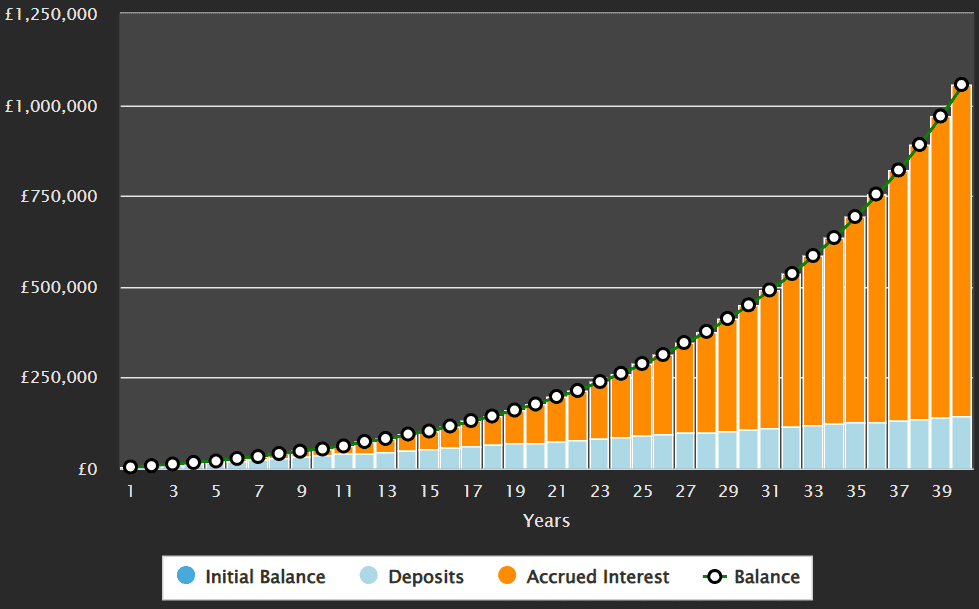
It’s realistic to assume a well-balanced portfolio of UK and US stocks could return 8% on average. A monthly investment of £300 into an 8% portfolio could grow to £177,884 in 20 years. Keep going for another 20 years and the compounding returns would bring the total up to £1,054,284.

That’s a long time but if a dedicated investor started at 30, they could reach it soon after retirement. Even a late starter at 40 could reach almost half a million in 30 years.

Created on thecalculatorsite.com

Top UK growth stocks

The S&P 500 may have hosted some impressive growth stocks in recent years but the FTSE 100 shouldn’t be ignored. Stocks like Games Workshop and Alpha Group have enjoyed spectacular growth in recent years.

However, I’m more partial to well-established companies with proven track records of long-term growth potential. One that I think UK investors should consider is 3i Group (LSE: III), an international investment company primarily focused on private equity and infrastructure.

Its portfolio includes stable, cash-generating businesses that support consistent dividend payments. Its flagship holding, Action, is a European discount retailer that has delivered exceptional growth.

The stock has steadily increased from 460p per share to 3,874p. That’s a 742% increase, representing an annualised growth of 11.2% per year.

It’s dividend growth is even more impressive, increasing a compound annual rate of 32% over the past 15 years. That shows strong dedication to returning value to shareholders.

However, there are drawbacks to consider. As a private equity firm, 3i’s earnings can be volatile and closely tied to economic cycles. Performance fees and asset valuations fluctuate with market sentiment, which can impact dividend stability. Additionally, its reliance on a few key assets, like Action, introduces concentration risk.

Still, the company has consistently delivered strong performance, reflected in its rising net asset value (NAV) and growing dividends. Its investment in infrastructure, especially, provides reliable income over time, making it appealing to passive income seekers.

Is £800 enough to start an ISA?

Last week saw the dawn of another tax year and with it, for many investors, a brand new ISA allowance.

A lot of attention gets paid to the £20,000 maximum annual contribution many people can make to an ISA. But of course not everyone has a spare £20k lying around – or anything near it.

The good news is that that is just a maximum. It is possible to start investing in an ISA with far less.

Please note that tax treatment depends on the individual circumstances of each client and may be subject to change in future. The content in this article is provided for information purposes only. It is not intended to be, neither does it constitute, any form of tax advice. Readers are responsible for carrying out their own due diligence and for obtaining professional advice before making any investment decisions.

Putting £800 to work

I reckon £800 is ample to get going.

For example, an important though simple principle of risk management for stock market investors is diversification. That basically means not putting all of your eggs in one basket.

Another consideration is whether fees and costs will eat up a disproportionately high percentage of an ISA. I think £800 is enough that that need not be the case, though to try and avoid that risk it makes sense for an investor to compare different Stocks and Shares ISAs to see what one suits their needs best.

Setting an objective

Different people have different goals when they invest.

For some, earning passive income in the form of dividends is the name of the game. For others, buying shares that look undervalued and holding them for the long term in the hope of serious share price gain is what they want. Some investors aim for both dividends and share price growth at once.

Even with £800 I think it makes sense to get clear about objectives and then make investment choices based on that.

Finding shares to buy

Having an objective is one thing – how about bringing it to life?

The recent stock market turbulence has thrown up some potentially excellent buying opportunities for an ISA in my opinion.

But it can be an unnerving time for any investor, let alone a new one. Sticking to an area one understands makes sense. Rather than just comparing the price of a share now to what it was before, I think the approach is the same as a savvy investor always uses: looking for shares that are priced well below what the business outlook suggests they ought to be worth over the long run.

One share to consider

As an example, one share I think investors should consider for an ISA at the moment is Scottish Mortgage Trust (LSE: SMT).

This is an investment trust, meaning it holds stakes in a variety of different companies. So it can offer some level of diversification even to an investor with just a few hundred pounds to spare. It can also buy stakes in private companies that do not typically sell shares to small private investors. For example, Scottish Mortgage has a stake in rocket company SpaceX.

Scottish Mortgage shares have moved around a lot over recent months due to the trust’s large exposure to tech shares like Nvidia and ASML. With the tech sector still reeling from US tariff uncertainty and cooling investor enthusiasm, I see a risk that that will hurt the net asset value of Scottish Mortgage further – and its share price.

I see investing as a long-term activity, however. Scottish Mortgage has a proven ability to find tech winners early on.

3 reasons Tesla stock may be a long-term bargain

It has been a simply wild week for Tesla (NASDAQ: TSLA) on the stock market, with price swings that would be unusual for a much smaller company let alone one with its market capitalisation. I have long wanted to buy some Tesla stock for my portfolio if I could do so at a price that I felt was attractive, so have been waiting for such a moment.

For now, though, I have not made a move.

I continue to think Tesla is badly overvalued. As an investor, however, I try to see both sides of a situation. After all, a market is composed of both buyers and sellers at the same time.

As part of that, here are three reasons that could suggest Tesla stock may be a long-term bargain – and why I do not find them persuasive at the current price level.

1. Potentially enormous end markets

The basic way to think about a company’s prospective future sales is to consider how big its target markets are and what sort of share of those markets.

Tesla is already huge when it comes to sales. Last year, it reported $98bn in revenues.

The end market potential is enormous. Cars alone make for a large market, but Tesla has ambition to extend into other types of vehicles, from lorries to what are basically minibuses.

It also wants to extend into offering automated taxis. Taxi provision is another big market.

On top of that, Tesla has a fast-growing business in power generation. That market is vast and also resilient.

As if that was not enough, Tesla plans to compete in robotics.

2. Tesla has a lot of competitive advantages

Recently, a lot of investors have focussed on some of the risks Tesla faces.

Its chief executive’s high political profile could put off some customers. Tax credits in key markets could come to an end. The electric vehicle market has become much more competitive, leading to pressure on profit margins across the industry.

Those risks are all real in my opinion – and significant.

But risk is part of business and Tesla has long proven that it can navigate challenging commercial environments.

As well as risks, it benefits from a range of competitive advantages that might help it grow market share in those large end markets I mentioned above – something it has been doing in power generation recently.

Its high profile helps build awareness of the brand at low cost. It has deep expertise in automotive software, power storage, vertically integrated manufacturing, and a host of other areas. If it can convert its competitive advantages to profits, that could be good news for Tesla.

3. Proven earnings growth capability

For now, the price of Tesla stock puts me off buying. The price-to-earnings ratio of 124 is far too high for my tastes.

The risks I mentioned above could mean Tesla’s earnings fall sharply again, as they did last year.

But what if they go the other way? Not necessarily soon but in, say, five or 10 years?

Tesla went from being a heavily loss-making company for years to one that turned an annual profit in the billions of dollars. If it can grow its earnings enough in the long term, today’s stock price could turn out to be a bargain.

Nvidia stock is a lot cheaper than before – or is it?

I have been eyeing the opportunity to buy into chipmaker Nvidia (NASDAQ: NVDA) for a while but was put off by the price. As Nvidia stock fell recently, I was warming up more to the price – and this week saw it move around wildly.

Around a fifth cheaper than at the start of the year (but up 1,537% over the past five years!), has Nvidia now hit the sort of point where I would be ready to add it to my ISA?

Defining value can be difficult

It might seem as if I ought not to have a dilemma.

After all, I was waiting for the stock to get markedly cheaper – and the price has now fallen significantly.

But the thing is, value and price are not necessarily the same thing. As billionaire investor Warren Buffett has said, price is what you pay and value is what you get.

Nvidia now trades on a price-to-earnings (P/E) ratio of 37.

But that is based on last year’s earnings. As an investor, one way I can aim to build wealth from owning shares is to look for companies likely to have sizeable earnings (relative to what I pay) in future.

The main reason Nvidia stock has been falling lately is the fear of the potential impact US tariffs may have on its business. US policy in this area remains unclear and is fast-changing. But I continue to see a real risk to Nvidia’s sales revenues and profits from the proposed US tariff regime and retaliatory moves by other nations.

That could hurt earnings, meaning the prospective P/E ratio may be higher than 37.

So, while it may seems as if the stock has become cheaper, in fact what has happened is that the price has fallen. Those two things are not necessarily the same.

Not ready to buy yet

Time will tell. For now, though, I see significant risks for Nvidia (as well as other chipmakers) from US tariff policy.

The company faces other risks too, with the US government increasingly shutting off some avenues for growth in China. The stock market turbulence has likely made some large companies postpone or cancel decisions on capital expenditure. That could mean lower AI budgets, leading to weaker demand than previously expected for Nvidia chips.

I still like Nvidia as a business. It is massively profitable, has a large installed user base and thanks to a variety of proprietary designs it is able to offer some chips to customers with no effective competition.

But a P/E ratio of 37 offers me insufficient margin of safety for my comfort as an investor. Meanwhile, growing risks to the business mean that the prospective P/E ratio could actually turn out to be higher than that, meaning the current valuation would be even less attractive to me.

I am happy to buy shares during market turbulence — and have been doing so with other companies over the past fortnight.

But when it comes to Nvidia, the number of moving parts mean that I prefer to wait for some of the dust to settle – and I’m still not persuaded by the valuation. So, for now, I will not yet be buying.

3 FTSE stocks Fools are eyeing up for choppy markets

Choppy markets may present buying opportunities for high-quality stocks at discounted prices.

Some Fools might consider adding to their positions in companies they have strong conviction in; others might view volatility as an opportunity to start a position in a company they previously deemed too expensive.

Admiral Group

What it does: Admiral Group provides car, home, and travel insurance, plus loans and financial services in the UK and beyond.

By Mark Hartley. When markets get choppy, it can help to shift a portfolio toward stocks with a low beta – a measurement of comparable price volatility. Admiral Group (LSE: ADM) has one of the lowest 5-year beta scores on the FTSE 100. 

As a leading UK motor and home insurer, it benefits from a steady stream of premium income, making its earnings less susceptible to economic downturns compared to more cyclical sectors. It also operates in a tightly regulated industry, reducing its exposure to risk-taking activities.

Its forward price-to-earnings (P/E) ratio dropped to 14 recently, so it looks undervalued.

However, high interest rates have impacted profitability in the past, wiping 50% off the share price in 2021/2022. Recently, this trend has reversed but a return to high rates could hurt the price again.

Mitigating this risk is an attractive 4.9% yield, with a decent track record of dividend payments. 

Mark Hartley does not own shares in Admiral Group.

Games Workshop

What it does: Games Workshop manufactures products for tabletop gaming enthusiasts including miniatures, paints and books.

By Royston Wild. I’ve steadily drip fed money into Games Workshop (LSE:GAW) shares since I first invested in 2020.

I topped up my position again in late January, and I’ll buy more if market turbulence causes the tabletop gaming giant to slump February’s record highs.

Games Workshop shares have proven an excellent long-term investment, up 2,750% in the last 10 years. I’m confident the next decade will be another highly successful one too.

The Warhammer maker still has plenty of room for growth in its bread-and-butter operations as global expansion continues and broader interest in fantasy wargaming booms. Core revenues rose an impressive 14.3% in the six months to November.

It’s looking to supplement this with supercharged royalty revenues through major media deals (such as the film and TV tie-up currently in the works with Amazon). Such agreements also have the potential to substantially boost demand for Games Workshop’s traditional products.

I think it’s a top stock to consider even as the threat of US trade tariffs looms.

Royston Wild owns shares in Games Workshop Group.

Games Workshop

What it does: Designs and manufactures plastic miniatures for tabletop wargames in the Warhammer and Lord of the Rings universes.

By Zaven Boyrazian. Few FTSE stocks can hold a candle to the tremendous track record of Games Workshop. While there have been ups and downs, the business is among the best-performing investments of the last 20 years in the UK. And it’s not hard to see why.

Pairing an addictive hobby with a dedicated community is an excellent recipe for pricing power. And its one that management has cooked up perfectly, with operating profit margins sitting just above 40% with a staggering 65% return on equity.

This strong performance has continued throughout 2025 as new miniatures are quickly getting sold out by popular demand. And while the threat of at-home 3D printing is becoming more prominent, the firm’s pricing power remains intact.

With that said, it should come as no surprise that Games Workshop shares trade at a premium valuation. But in a choppy market, even the best businesses can get sold off. And that could be a terrific opportunity to snap up more shares at a discount.

Zaven Boyrazian owns shares in Games Workshop.

GSK

What it does: GSK is a global biopharma company that specialises in developing medicines and vaccines.

By Paul Summers. Gravitating to strong and stellar – if somewhat dull – defensive stocks makes a lot of sense in uncertain times. That’s why I’m currently running the rule on pharma giant GSK (LSE: GSK).

Sure, the shares have underperformed the FTSE 100 index over the last twelve months thanks to legal challenges relating to its heartburn drug, Zantac. Cost pressures have also played a role.  

However, things are looking up. Back in February, the company lifted its 2031 sales target to over £40bn. Q4 sales also beat estimates. 

As I type, the shares can be picked for a little under nine times forecast FY25 earnings. That’s cheap relative to the market and healthcare stocks in particular. There’s also a 4.4% yield, comfortably covered by expected profit. 

GSK won’t shoot the lights out but it should provide some stability to a portfolio going forward.

Paul Summers has no position in GSK.

A £10,000 investment in Rolls-Royce shares last week is now worth this…

Rolls-Royce (LSE: RR) shares are the toast of the FTSE 100 and with good reason. They’ve surged a staggering 635% over the last three years, including a 70% rise in the past 12 months alone.

The FTSE 100-listed engineering group has delivered one of the great stock market comebacks of recent times. When CEO Tufan Erginbilgiç took the reins in January 2023, many were still questioning the group’s long-term future. 

Today, it’s a completely different story. He’s taken a sprawling, sluggish engineering giant and turned it into a leaner, meaner machine, and investors have reaped the rewards.

Can this FTSE 100 star fly even higher?

Resurgent demand for international travel has helped drive growth in the firm’s civil aerospace division. 

Stronger Western defence spending has given it another boost. Donald Trump’s brand of economic turmoil has helped by spurring NATO nations to step up investment.

Rolls-Royce isn’t immune to global jitters though. This past week has delivered a reality check.

Over just five trading days, the share price has fallen by around 7%. That means anyone who put £10,000 into Rolls-Royce shares a week ago is now looking at a paper loss of £700. Their investment would be worth roughly £9,300 today.

In the grand scheme of things, that isn’t a disaster. We’ve seen some violent swings across the market lately, and Rolls-Royce has held up better than most. But it’s a reminder that no stock rises in a straight line.

The share price drop might even present a second chance for investors who felt they’d missed their moment. 

At the time of writing, Rolls-Royce is trading on a price-to-earnings ratio of about 34. That’s rich compared to the FTSE 100 average of around 16, but arguably fair for a company that’s shown it can grow at this pace.

Still, I wouldn’t be piling in too enthusiastically just yet.

Valuations like this bring pressure. When expectations are so high even a small bit of bad news could send the share price plunging.

Dividends, growth, and share buybacks

And while Rolls-Royce is diversified, its bread and butter remains aircraft engines. More specifically, the real money is in long-term maintenance contracts, which depend on how much flying takes place. A global recession could put a dent in that.

Then there’s the long-awaited decision on its small nuclear reactors, or mini-nukes. This could be a huge growth avenue, but until governments give the go-ahead, we just don’t know.

Analyst sentiment is broadly positive though. Of the 18 experts covering the stock, 10 rate it a Strong Buy, three rate it a Buy, and just one calls it a Sell. Some of those views likely pre-date this latest wobble, although are unlikely to have changed much.

In my view, anyone considering buying Rolls-Royce today should forget about dazzling recent performance. It’s historic. In the past. Over. 

The future’s likely to be a slower grind and as much about dividends as dazzling share price gains. The forecast 2025 yield is a modest 1.13%, although the ongoing £1bn share buyback is a nice bonus.

It’s still a great company. though. And still well worth considering, but with a long-term view.

Prediction: in 2 years these S&P 500 stocks will be much higher than they are today

Many high-quality S&P 500 stocks are well off their highs right now. So there are a lot of opportunities for long-term investors like myself.

Here, I’m going to highlight two S&P stocks I believe are worth considering at the moment. I think that in two years, these two stocks are likely to be trading at much higher levels than they are today.

Double-digit gains?

Let’s start with ‘Magnificent 7’ stock Microsoft (NASDAQ: MSFT). It’s currently trading for around $381, about 19% below its all-time high of $468.

While this company is one of the largest in the world, it still has plenty of growth potential. It’s one of the world’s most dominant players in cloud computing, and this industry is forecast to grow by more than 10% a year over the next decade.

Microsoft is also a leading player in artificial intelligence (AI), video gaming, and business productivity software. And these industries have a lot of growth potential too, especially in AI.

For the year ending 30 June (FY26), analysts expect earnings per share (EPS) to be around $14.90, up 14% year on year. Let’s say that the company can grow its earnings at 10% a year over the following two years.

That would take EPS to around $18 by FY28. Stick an earnings multiple of 27 on this (roughly the price-to-earnings ratio right now) and we have a price target of $486.

That equates to a gain of about 28% from here. If the stock was to get there in the next two years, it would translate to a return of about 13% a year (14% when dividends are included) – not bad for a large-cap stock.

Of course, my forecasts here could be way off the mark. If the global economy weakens significantly in the next two years, cloud spending could drop sharply and Microsoft’s earnings growth could stall.

I’m optimistic about the long-term growth story though. I just bought some more Microsoft shares for my own portfolio.

Enormous potential

Another S&P 500 stock I believe has potential to perform well over the next two years is Palo Alto Networks (NASDAQ: PANW). It’s the largest player in the cybersecurity industry.

The cybersecurity market looks set for huge growth in the years ahead, and this company is well positioned to benefit. Recently, it has been pivoting to a ‘platformisation’ model where it can offer comprehensive protection to its customers via several different platforms (instead of providing individual solutions).

This pivot has slowed growth in the short term. But in the long run, it should support it. Currently, analysts expect revenue and earnings growth of 15% and 14% respectively for the year ending 31 July. If the company can continue to grow at that pace (and it may not as cybersecurity is a competitive industry and the company is up against the likes of CrowdStrike and Fortinet), its share price could rise significantly.

It’s worth noting that the average analyst price target for Palo Alto Networks is currently $211. That’s about 26% above the current share price.

That’s the 12-month price target however. If global markets recover over the next two years, and the company sees strong revenue and earnings growth, the share price could be even higher in 2027.

Financial News

Daily News on Investing, Personal Finance, Markets, and more!

Financial News

Policy(Required)