Prediction: 12 months from now, the easyJet share price could turn £5,000 into…

The easyJet (LSE:EZJ) share price has tumbled by almost 30% over the last 12 months. Yet, despite what this trajectory might suggest, the underlying business is delivering solid results. Bookings for the next three quarters are already ahead compared to a year ago. And management believes the company’s on track to reach a pre-tax profit of £709m – 16.3% projected increase year-on-year.

Does this mean the easyJet share price is massively underappreciated right now? And if so, how high could the stock climb over the next 12 months? Here are the latest analyst forecasts.

easyJet to take off?

As of 4 April, 15 of the 21 analysts following easyJet currently have a Buy or Outperform recommendation. And this strong conviction is also reflected in the 12-month share price targets for this business. The average consensus expects the airline stock to rise to 680p by April 2026, with even the most pessimistic outlook projecting 570p.

Considering the shares are currently (10 April) trading at around 435p, there seems to be ample potential for price rises for any investors who consider jumping in today. If these projections prove to be accurate, investing £5,000 right now could grow to £7,907 by this time next year.

While exciting, that sounds a bit dubious. Don’t forget the stock market typically offers annual returns near the 10% mark, not 60%. So is this a realistic expectation?

The bull case

A quick glance at the valuation certainly implies a large growth potential. The firm’s forward price-to-earnings ratio currently sits at a dirt cheap 5.9. By comparison, the stock’s 10-year average is closer to 12.5.

Seeing such a steep discount usually implies something’s wrong. The latest trading update issued a warning that revenue in the second quarter has started “modestly” softer compared to a year ago. That’s certainly not brilliant. However, digging deeper, the issue appears to stem from management’s investments to expand capacity that are expected to deliver results during the next winter period and beyond. In other words, this looks like nothing more than a speed bump.

Meanwhile, the profit picture’s looking far rosier. The firm’s first quarter usually lands in the red, just like most airlines. However, the losses this time around landed at £61m versus £126m a year ago – a 52% improvement. Pairing all this with more flights flown, higher passenger volumes, and a boosted load factor, easyJet appears to be chugging along very nicely.

What could go wrong?

The company has certainly made a solid start to its 2025 fiscal year ending in September. And while performance in the second quarter might be a bit weaker, this appears to be nothing more than short-term pain for long-term gain. However, easyJet’s still susceptible to fluctuations in oil prices, which impacts the cost of jet fuel.

At the same time, while US tariffs were put on pause last week, a global trade war could still break out three months from now. And any retaliatory tariffs from Europe could impose higher costs on consumers, adversely impacting demand for travel. But with £2.8bn of cash & equivalents on its balance sheet, the company appears relatively well-positioned to weather the storm.

With that in mind, I think investors seeking exposure to the short-haul travel sector may want to take a closer look at easyJet.


Prediction: 12 months from now, the Vodafone share price could turn £5,000 into…

The last five years have been quite rough for the Vodafone (LSE:VOD) share price. Despite being one of Britain’s leading telecommunication businesses, the stock’s down over 40%. And while new leadership was brought on board in April 2023, the stock’s continued its downward trajectory by another 30%.

It seems Margherita Della Valle has yet to impress investors with her turnaround strategy. This pessimistic attitude isn’t entirely surprising given that this isn’t the first time Vodafone has changed CEOs to try to fix the slowly leaking ship.

However, despite appearances, the company’s making some notable progress. And looking at analyst projections, it seems the lacklustre share price performance may have created a buying opportunity.

What the ‘experts’ think

Of the 20 analysts following this business, 14 currently have a Hold recommendation. This ‘wait and see’ attitude towards Vodafone is nothing new. However, in terms of share price projections, the average consensus for the next 12 months suggests Vodafone’s share price could reach just shy of 85p.

By comparison, the FTSE 100 stock’s currently trading closer to 64p, indicating a potential 30% gain for investors who buy shares today. That suggests the market’s overly punished Vodafone shares. And if accurate, a £5,000 investment today could grow to £6,500 by this time next year.

A value opportunity or trap?

Let’s start with the positives. The company’s quarterly results reported a welcome 5% increase in total revenue to €9.8bn. Operations in the UK have just been injected with some fresh life. You see, the company received the green light to merge with Three, adding over 10 million new customers to its roster. And the €8bn disposal of its Italian operations was completed with the proceeds being used to begin tackling the €56bn pile of debt.

Pairing these milestones with continued double-digit growth in its African markets and stable organic growth in Türkiye, Della Valle’s delivering results. However, based on the Vodafone share price, investors are still not satisfied, mainly because of what’s happening in Germany.

Germany is Vodafone’s biggest market. It’s responsible for over a third of its total revenue, along with around half of its underlying earnings. Yet customers keep steadily walking out of the door in favour of cheaper competitors. That’s a serious problem that Della Valle hasn’t managed to solve. At least not yet.

The bottom line

Vodafone’s restructuring is steadily helping improve the state of the balance sheet and reduce interest rate pressure on the bottom line. But there’s still a long way to go. Its non-German operations appear to be chugging along nicely, but these are still not significant enough to offset the damage of a shrinking customer base.

All things considered, keeping Vodafone on a watchlist seems the most prudent for now. If German performance finally starts heading back in the right direction, then the stock may be worth a closer look. So despite the positive outlook for the Vodafone share price, this isn’t a company I’m rushing out to buy right now.

Prediction: 12 months from now, the Aviva share price could turn £5,000 into…

The Aviva (LSE:AV.) share price has taken a hit in recent weeks as turmoil in the stock market doesn’t bode well for the insurance giant’s investment portfolio. However, that doesn’t seem to have shaken analyst confidence in the long-term potential of this enterprise. In fact, compared to a month ago, the share price forecasts for Aviva have actually increased.

Rising analyst projections

A central piece to management’s strategy is to reach £2bn in operating profits along with £1.8bn in Solvency II operating fund generation by 2026. At the same time, Aviva is aiming for more than £5.8bn in cumulative cash remittances between 2024 and 2026. For reference, these figures stood at £1.77bn, £1.66bn, and £1.99bn respectively, as of the end of 2024.

So far, Aviva appears to be on track to deliver. As such, its 12-month share price target now sits at 580p, up from 565p in March. Pairing this boost to outlook with a drop in the stock price following the recent stock market turmoil, investors are looking at a potential 18% gain from today’s prices. And to top things off, these prospective capital gains also come paired with a tasty-looking 6.8% dividend yield.

In other words, if this yield’s reinvested, a £5,000 investment today could be worth £6,240 by this time next year.

Can Aviva deliver?

In 2024, elevated interest rates sparked fresh life into the annuity market, driving Aviva’s profits higher. At the same time, management’s tactics of diversifying into more cash-generative property & casualty insurance also helped boost the level of gross premiums written to a record £12.2bn.

With that in mind, it’s not surprising that the stock rallied by almost 20% over the first three months of 2025. But then came the announcement of global tariffs from the US. And suddenly, almost all these gains were wiped out.

Aviva isn’t directly impacted by trade tariffs, but the indirect effects are still problematic. Should the recent 90-day pause on import tariffs end without resolution, the potential inflation on goods and services could drive up the cost of paying insurance claims. For example, higher steel and aluminium prices will drive up the cost of home construction and maintenance. It’s a similar story for car parts and vehicle repairs, putting pressure on Aviva’s margins.

As a result, customers are likely going to face higher insurance premiums as management adjusts for this risk. However, for existing insurance plans, claims could get far more expensive than expected when they were first issued. And that’s potentially bad news for Aviva’s bottom line over the next 12 months.

The bottom line

Needless to say, tariffs just hit the insurance sector with a fresh wave of uncertainty. It explains why Aviva, along with other insurance businesses, took a tumble this month.

However, it’s worth pointing out that Aviva’s Solvency II ratio sits at 203%. That’s firmly ahead of the regulatory requirement of 100% as well as the industry average of 184%. In other words, the business is well funded, more so than its competitors.

That’s likely why analysts remain bullish on this enterprise. While there may be some short-term volatility, the long-term outlook remains promising. So for investors seeking exposure to the insurance sector, Aviva may be worth checking out.

Prediction: 12 months from now, the BAE share price could turn £5,000 into…

With most stocks taking a tumble in recent weeks, the BAE Systems (LSE:BA.) share price seems to be an exception. The British aerospace and defence business has seen its valuation surge by over 35% since 2025 kicked off. And looking at the latest analyst forecasts, this upward trajectory could continue over the next 12 months.

Bullish analyst opinions

Just over half the institutional analysts following this enterprise currently have a Buy or Outperform recommendation on BAE shares. And it’s not exactly difficult to see why.

Amid growing geopolitical tensions worldwide, the company posted a record order backlog valued at £77.8bn – an £8bn increase versus 2023. This was predominantly driven by renewed demand for its Hunter Class frigates in Australia, CV90 combat vehicles in Denmark and Sweden, along with 25 and 24 new Typhoon aircraft orders for the Spanish and Italian Air Forces respectively.

Combined, this surge in orders translated into a 14% boost in revenue and underlying operating profits. Free cash flow did underperform by comparison, coming in essentially flat year-on-year at £2.5bn. However, that’s still significantly larger than the £1.5bn management was aiming for courtesy of higher-than-expected customer advanced payments paired with “strong operational cash conversion”.

What’s more, demand’s expected to continue growing as Europe begins to ramp up its defence spending. So with all that in mind, it’s not entirely surprising that one analyst expected the BAE Systems share price to rise to as high as 2,450p over the next 12 months. That’s a 58% potential increase from today’s valuation, suggesting that a £5,000 initial investment could grow to £7,903 by this time next year.

Taking a step back

The prospect of making just over £2,900 over the next year is understandably exciting. However, it’s important to remember that forecasts aren’t set in stone.

Furthermore, this outlook’s the most optimistic among analysts. And when taking the average of all current projections, the BAE share price is expected to reach just 1,540p. That’s roughly in line with where shares are trading right now. This implies that all the expected growth from higher EU spending and order growth has already been baked into the stock price.

Another risk that seems to be going ignored is the potential for a cut to the US defence budget. Suppose Europe is more capable of defending itself. In that case, America may be able to achieve some cost savings within the military to fund proposed tax cuts as well as pay down the national debt. And with almost half of BAE’s revenue stream coming from across the pond, growth could stall as defence spending redistributes from one country to another.

Nevertheless, BAE’s substantial order book should keep it busy for many years to come. And even at current levels, the valuation on a forward price-to-earnings basis is a fairly reasonable 21, behind the European industry average of 25.8. As such, while investors aren’t getting a massive bargain, BAE shares could merit further research by those seeking exposure to the aerospace and defence industry.

Up more than 50% in a month! What’s going on with the Greatland Gold (GGP) share price?

Despite the turmoil of the past few days, the Greatland Gold (LSE:GGP) share price is currently (11 April) over 53% higher than it was a month ago.

Some of this resulted from a positive reaction to the news that the gold and copper miner has commenced a capital reorganisation. If the proposal is approved by shareholders, it will result in a newly-established parent company being listed on the Australian stock market (ASX). The group will also retain its current status on the UK’s Alternative Investment Market.

The group’s directors claim that Australia is “a natural listing venue for mining companies”. As a consequence, the plan — which is expected to be effective from June — is intended to improve liquidity and generate more investor interest in the stock. In conjunction with the restructuring, the company’s reserved the right to raise additional funds. Although, any rights issue will be restricted to 2.5% of the issued share capital.

What else is happening?

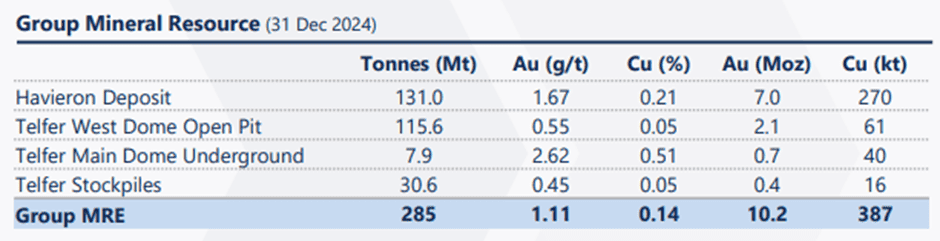
It’s been an eventful few months for the group. In December 2024, it acquired full control of the Telfer and Havieron projects.

The former is a working mine, which means the group’s moved from being a pure exploration company to a part-producer.

However, the latter requires substantial investment before it becomes commercially viable. Fortunately, the group’s entered into a non-binding letter of support to secure a debt facility that will “fund costs and expenses of the construction, development and operation of Havieron, corporate costs and any other expenses until project completion”.

Source: Investor presentation prepared by the company (March 2025) / Au = gold, Cu = copper

What do I think?

The group’s clearly going in the right direction.

It appears to be fully funded, which means the significant dilution that longstanding shareholders have experienced looks to be a thing of the past.

And when it gets Havieron up and running, the group claims that it will have the second-lowest all-in sustaining cost of any ASX-listed Australian mine. If true, it will be one of the most profitable in the country.

However, I fear the group’s share price performance is becoming increasingly disconnected from its underlying business. And I suspect the recent gold price rally is to blame. Since the start of the year, it’s set a number of new record highs. Global uncertainty is behind this momentum.

Of course, this means Telfer’s output is worth more than previously. And it’s increasing the value of the group’s reserves.

But Haverion isn’t producing yet. Even if everything goes to plan, it won’t be generating revenue until the first half of 2027. Who knows what the price of gold will be in two years’ time?

And to get to this position, the group’s going to face numerous challenges. From an operational perspective, mining is possibly the most difficult industry to get right. This means valuing companies in the sector is difficult, especially ones that aren’t fully commercialised.

A quick look at the price targets of the three brokers covering the stock — 11p, 20p, and 21p — doesn’t help very much. The group’s current share price is 13.9p. To me, this simply reflects the uncertainty of buying shares like these.

Therefore, at the moment, I think Greatland Gold’s stock is one to keep on my watchlist rather than invest in.

Prediction: 12 months from now, the IAG share price could turn £5,000 into…

2025’s been a rough start for the International Consolidated Airlines (LSE:IAG) share price. The long-haul airline group has seen close to a quarter of its market-cap get wiped out over the last couple of months. Yet, despite what the direction of the stock suggests, the underlying business seems to be chugging along nicely.

So much so that analyst projections are calling for some exceptional growth across the next 12 months.

IAG transformation programme delivers

Following IAG’s latest results, shareholders were greeted with some pretty phenomenal numbers. Revenue across 2024 came in 9% higher. But it’s the operating profits that are stealing the show with a 27% surge even after ignoring one-time events.

Digging deeper, we see that these results were driven by a 7% boost in passenger volumes along with new efficiencies from its £7bn transformation programme. Subsequently, operating margins expanded by 430 basis points. And as of December, IAG’s profitability stands at 13.8% – on track to reach management’s medium-term target of 15%.

Even at current levels, the firm’s margins stand out when compared against its leading competitors:

Airline Stock Operating Margin
Deutsche Lufthansa 4.1%
Air France 4.7%
Turk Hava Yollari 10.6%
Ryanair 12.4%
easyJet 6.3%

With more money flowing to the bottom line, the group’s free cash flow surged from €1.3bn in 2023 to €3.6bn in 2024. And that’s even after reinvesting €2.8bn into its own operations. And subsequently, shareholders were rewarded with a €1bn share buyback scheme.

With that in mind, it’s hardly a surprise to see bullish sentiment come from City analysts. As of 3 April, 13 institutional analysts have recommended this stock as a Buy or Outperform, with only four putting the shares on Hold and one as a Sell. And this positive opinion has also spilt over into the 12-month IAG share price forecast.

Right now, the average consensus among analysts is that this airline stock will reach 403p. That’s a 69% increase from current levels – enough to transform a £5,000 initial investment into £8,430 by this time next year!

What could go wrong?

Earning almost three and a half grand from a single investment today sounds pretty awesome. But it’s critical to remember that forecasts are ultimately just educated guesses. Consequently, there’s always an element of inaccuracy, meaning that the IAG share price may not rise as expected. In fact, it could fall.

Capital expenditures in 2024 were notably lower than in 2023. Part of this comes from the previously mentioned efficiencies. However, it was also driven by reduced deliveries of new aircraft. As a result, capex in 2025 is actually expected to rise from the current €2.8bn to €3.7bn.

There are also fuel costs to consider. Currently, analysts are expecting the price of jet fuel to fall and stabilise during 2025 to around $87 a barrel. For reference, the average price in 2024 was closer to $99 a barrel.

Obviously, that’s good news for IAG as it helps management strive towards its 15% margin target. However, should these projections prove wrong, or a disruption in fuel production causes prices to rise, the IAG’s profitability in 2025 may disappoint, leading to a lower share price.

All things considered, this industry leader appears to be taking the proper steps to build value for shareholders. So even with the risks, investors may want to consider taking a closer look.

Prediction: 12 months from now, the BP share price could turn £5,000 into…

April has been rough for the BP (LSE:BP.) share price. In fact, since this month began, shareholders of the energy giant have seen close to 25% of their investment wiped out as of last week. But given the long-term demand for energy isn’t going anywhere, does this present a buying opportunity for long-term investors?

Analysts have mixed opinions

There are a few factors behind the recent slide in the BP share price. Fears of a global recession courtesy of President Trump’s tariff announcement sparked a general sell-off in the markets. However, the impact was compounded by Saudi Aramco’s decision to cut the price of oil per barrel by $2.30 for May deliveries to Asia.

Pairing this with the announcement that OPEC+ is boosting production to 411,000 barrels per day next month triggered an 11% downfall in crude oil prices. For reference, this is three times more than the production hike analysts were expecting.

Needless to say, as an oil & gas producer, falling oil prices are not good news for a business like BP. Even more so, given management’s recent pivot back to fossil fuels away from renewables earlier this year.

With that in mind, it’s not so surprising to see 14 of the 24 analysts following this enterprise issue a Hold recommendation. Despite this neutral opinion, the average 12-month share price target for BP stands at 470p. That’s around 30% higher than where the stock’s currently trading, suggesting that a £5,000 investment today could be worth £6,530 by this time next year.

But if the bulk of analysts are saying to Hold, why are the shares projected to climb?

Digging deeper

One possible explanation behind the chunky expected capital gain is that BP shares are relatively cheap at the moment. On a forward price-to-earnings basis, the stock’s only trading around 8.4, offering a notable 6.9% dividend yield to boot.

Alternatively, the share price forecasts may simply be out of date. These latest projections were made on 3 April before the tariff and oil price shenanigans entered the picture. And if oil prices remain depressed throughout the rest of 2025, BP’s revenue and bottom line could fail to meet full-year targets.

This uncertainty explains the relatively neutral position analysts are taking right now. However, this may not be a massive issue. The proceeds from selling its underperforming renewables projects today are raising some welcome capital that’s earmarked for debt reduction. With a stronger balance sheet, BP’s better positioned to weather through cyclical downturns of oil & gas prices.

Overall, I think BP’s future still looks bright. But whether now’s the right time to jump in remains uncertain. Investors seeking exposure to the energy sector will need to weigh the risks against the potential for a BP share price rebound.

14.2% dividend yield! Is this FTSE income stock worth considering in 2025?

When it comes to double-digit dividend yields, investors are often told to stay away as it’s usually a warning sign that something’s wrong. But there are some rare exceptions. And SDCL Energy Efficiency Income Trust (LSE:SEIT), also known as SEEIT, just released a trading update that not only confirmed it can afford its 14.2% yield but that it’s already on track to hit its sixth consecutive year of dividend hikes.

The last five years have been pretty rough for this enterprise, with the share price tumbling more than 50% – a trend that’s continued in 2025. That certainly helps explain why the yield’s so high today. But is there a reason why investors are jumping ship? Or is this secretly an exceptional income opportunity?

Investing in energy efficiency

There are a lot of different ways to invest in the energy sector. However, rather than being dependent on fluctuating oil prices, SEEIT offers a unique opportunity for investors to help boost the efficiency of energy infrastructure.

The firm owns a fairly diversified portfolio of projects scattered across the globe in technologies like solar & storage, district energy systems, gas distribution networks, electric vehicle charging, biomass, and industrial process efficiency solutions, among others.

Despite what the share price would suggest, the operational performance of the group’s flagship projects is actually quite encouraging.

For example, its Primary Energy segment, which provides energy services to US blast furnaces, is meeting earnings targets while also positioned to benefit from the new US tariffs as domestic steel production rises. At the same time, the Red-Rochester division, which specialises in district energy systems, is actually beating internal expectations. It’s a similar story for its Onyx business, which focuses on deploying on-site solar and storage solutions for commercial customers.

With all that in mind, why is the stock price falling?

Investigating the yield

Clean energy assets have been particularly unpopular among investors in recent years. Higher interest rates make these capital-intensive businesses less desirable. And it explains why other similar trusts like Greencoat UK Wind and Foresight Solar Fund have also suffered a share price decline.

This interest rate risk appears to be one of the primary concerns investors have regarding this enterprise. While the prospect of future tariffs may be beneficial for some of its projects, if the inflation they cause proves not to be transitory, interest rate cuts could be delayed and possibly reversed.

At the end of September 2024, SEEIT only generated £48m in free cash flow after debt servicing costs. That was enough to afford shareholder dividends, but the coverage ratio was pretty tight at 1.1. Should any disruption occur to cash flow generation, either internally or externally, today’s impressive dividend yield might end up getting cut.

The bottom line

For now, SEEIT’s 14% payout’s here to stay. But, there’s a significant risk of a dividend cut later in 2025 if the group’s operations are disrupted. Personally, this isn’t a risk I’m willing to take for my income portfolio. However, for investors comfortable with a higher risk dividend opportunity, this enterprise may be worth a closer look.

£5,000 invested in the S&P 500 at the start of 2025 is now worth…

After a stellar finish to 2024, the S&P 500 seemed as if it was primed to continue surging in 2025. Yet following the announcement of worldwide tariffs, the US stock market has subsequently proceeded to plummet, with its flagship index down more than 15% since the start of the year and over 12% since the start of April. At least that was the case until last week when tariffs were delayed, and US stocks shot back up.

Year to date, the S&P 500 was still down almost 9% as of 11 April. However, ignoring the recent rebound, any investor who put £5,000 to work at the start of the year with an index fund would only have £4,250. And the situation was even worse for those who concentrated on the Magnificent 7. On an equal-weighted basis, shares of Alphabet, Amazon, Apple, Meta, Microsoft, Nvidia (NASDAQ:NVDA), and Tesla crashed. They were down over 25%, taking a £5,000 initial investment all the way down to £3,750.

There’s no denying it was a painful start to the year, especially for newer investors. Yes, last week’s upward surge helped take some of the pain away. But plenty of S&P 500 stocks are still trading lower today compared to the start of the year.

Investing during volatility

When investing in a volatile environment, ensuring we have some dry powder is often a prudent move. Apart from providing some helpful savings during economic turmoil, this cash offers the flexibility. It can allow investors to start buying shares when prices are in freefall. After all, some of the biggest gains we can make are during a stock market crash.

Another handy tactic is keeping a list of top-notch stocks to buy once the share price looks more attractive. That way, investors don’t need to spend countless hours investigating opportunities when disaster strikes. By being prepared, there’s a lower risk of missing out on potentially lucrative investments.

US stocks to consider in 2025?

It’s impossible to know for certain when the latest round of volatility will reach its bottom. As such, deploying a dollar cost-averaging buying strategy is likely prudent. And one Mag 7 business that I’ve got my eye on in this market is Nvidia.

The GPU chip designer is proving to be the dominant business in the AI infrastructure landscape, with some phenomenal growth under its belt. And despite US economic concerns, spending on AI-accelerator chips is set to reach $315bn in 2025.  

Semiconductors have been excluded from the announced US tariffs. While the same isn’t true for other raw materials that go into Nvidia products (like steel and aluminium), customers might still just pay the higher cost to get their hands on Nvidia hardware.

After its 30% tumble this year, Nvidia shares now trade at a forward price-to-earnings ratio of 21. That’s significantly cheaper than its historical average of 52. With that in mind, assuming that AI adoption doesn’t hit a wall, steadily drip-feeding capital into the S&P 500 stock might be an investment worth considering throughout 2025.

£10,000 invested in the FTSE 250 10 years ago is now worth…

Despite being the UK’s flagship growth index, the FTSE 250 has notably underperformed over the last decade. Even when factoring in dividends, this collection of 250 UK stocks has delivered only a total gain of 34%.

Admittedly, this result is offset by the recent volatility in the financial markets. However, even ignoring the price fluctuations of April 2025, the FTSE 250’s gains are still only 47%. On an annualised basis, that translates to just 3.9%. That’s a massive slowdown compared to the long-term 11% historical return of the index.

That means anyone who invested £10,000 10 years ago would only have around £14,700 today. That’s compared to the £18,500 offered by the FTSE 100 over the same period. However, while the FTSE 250 as a whole has underperformed, the same can’t be said for all of its constituents.

A big winner

Over the last decade, there have been plenty of successful growth stories of FTSE 250 companies making it into the top 100 UK stocks by market cap. However, the one business that seems to have stolen the show is Diploma (LSE:DPLM).

Even after joining the growth index in 2011, the industrial products distribution company continued its upward momentum. And after 12 years of market cap expansion, the business was promoted in late 2023 to the FTSE 100.

Investors who held on throughout this journey were rewarded with some pretty staggering returns. In fact, assuming dividends paid were reinvested, the total return over the last decade from this stock sits at 340%! That’s an annualised rate of return of 15.9%, outpacing even the S&P 500’s 12% over the same period. And a £10,000 initial investment would now be worth £43,804.

Still worth buying today?

Looking at Diploma’s 2024 results, management’s guidance for 2025 appeared to be quite flat versus its historical performance. Specifically, it predicted organic revenue growth of 6%, with an extra 2% coming from acquisitions. Skip ahead to the first quarter of 2025, and the business seems to be outpacing these targets. Organic sales are up 7% and acquisitive sales have jumped 5% after currency exchange impacts.

Obviously, that’s an encouraging sign. Yet management’s guidance for the full year remained unchanged. With uncertainty surrounding US tariffs, Diploma is seemingly keeping its expectations conservative. That’s not entirely surprising given the impact these import taxes could have on its complex international supply chains.

Investors sighed in relief last week when President Trump announced a 90-day pause on its global tariffs (with the exception of China). That certainly created a welcome rebound in the stock market. But with the threat of 10% tariffs still on the horizon, potential disruptions to Diploma’s business continue to loom ahead.

Nevertheless, top-notch businesses have a habit of adapting to a shifting economic landscape. That’s why, despite this risk, I remain optimistic for the long run. That’s an opinion seemingly shared by most analysts tracking this enterprise, which currently has an average 12-month share price target of 5,100p – 40% higher than current levels.

In other words, investors looking for fresh long-term growth opportunities in 2025 may want to consider buying Diploma. While past performance is no indicator of future returns, the now-FTSE 100 stock does have a habit of beating expectations.

Financial News

Daily News on Investing, Personal Finance, Markets, and more!

Financial News

Policy(Required)