As stocks dive, is this a rare chance for ISA investors to build generational wealth?

The last couple of weeks have been a whirlwind. And despite preparing for a downturn, I’m among the millions of investors who have seen their ISAs hit. There’s almost nowhere to hide in the current market.

Investors looking at general market trends may be tempted to suggest that global stocks will recover in the coming years. However, I’d add a word of caution. If Donald Trump’s tariffs remain in place as they are (as we understand them to be), stocks still look overvalued. There’s also a lot of uncertainty.

However, I expect to most tariffs rolled back. Simply put, the cost of leaving tariffs in place is staggering. Economists estimated that the 2 April tariffs alone will raise consumer prices by 2.3%, equating to an average household loss of $3,800 annually. Lower-income households face losses of $1,700, exacerbating inequality. 

The US economy is projected to shrink by 0.6% in the long run due to these tariffs, representing a $160bn annual reduction in GDP. These figures underscore the likelihood that Trump will roll back tariffs to mitigate long-term damage.

Investing during dips

History suggests that market dips can provide generational opportunities for wealth creation. For example, hypothetical investments during major market sell-offs since 1980 have consistently outperformed over the long term.

The broader market trends also offer reassurance. Despite intra-year declines averaging 16% since 2001, full-year losses occurred in only five of the past 24 years. Over time, markets have grown substantially, proving resilient through volatility. This historical resilience suggests that patient investors who weather downturns — and strategically invest during dips — may benefit from significant long-term gains.

Of course, many novice investors will be advised to maximise ‘time in the market’ rather than trying to ‘time the market’. While that’s certainly true, I prefer to try to find the best entry points for my favourite stocks.

One of my favourite stocks

One stock I’ve been strategically buying is Jet2 (LSE:JET2). In fact, it’s the only UK stock I’ve topped up on since Trump’s tariffs were introduced. The AIM-listed airline is vastly undervalued in my opinion, trading with a market cap of £2.7bn. That’s only marginally ahead of its net cash position of £2.3bn. In other words, the market is pricing the UK’s no.1 tour operator at just one times net income when adjusted for net cash.

Of course, it’s not all rosy. The firm’s margins are thinner than the likes of IAG, and its fleet a little older. This does mean it’s more exposed to downward pressure on demand and has less capacity to absorb costs. In fact, the October Budget could add £25m in costs.

However, for me, it all comes down to the valuation. At such a huge EV-to-EBITDA discount to its peers, it’s clearly overlooked. What’s more, the company’s fleet replacement plan appears to be financially prudent and there appear to be supportive trends in fuel prices, which typically account for 25%-30% of operational costs.

Could buying today create generational wealth? Well, it may put an investor on the right track, and potentially beat the market. This could be a great start for someone looking to create generational wealth.
2 ultra-cheap shares to consider right now!

Looking for the best cheap UK shares to buy right now? Here are two I think deserve serious attention right now.

RWS Holdings

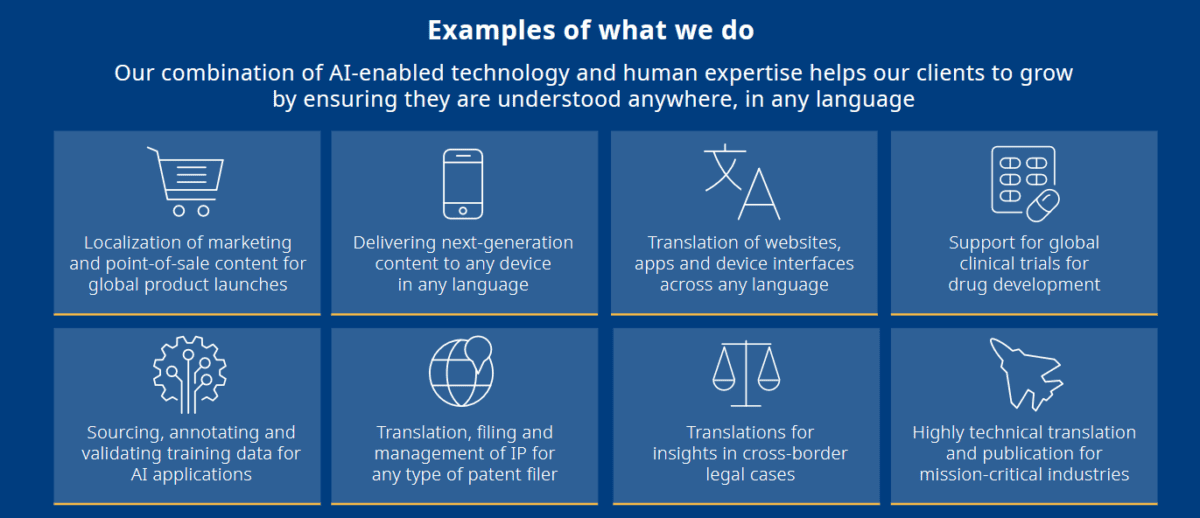
The projected rise of artificial intelligence (AI) poses a risk to a vast range of companies. This includes RWS Holdings (LSE:RWS), which provides translation and localisation services to businesses around the globe.

Yet, while this disruptive threat demands serious attention, I think the company may not be as affected as some fear. This is because some of the sectors it covers — think legal services, life sciences, and aerospace and defence, for instance — require 100% content accuracy all of the time.

Source: RWS Holdings

For instance, any inaccuracies in jet design documentation could compromise safety, leading to costly mistakes or even catastrophic outcomes. Is it likely that companies will want to entrust such responsibilities AI? I’m not so sure, meaning businesses that have specialist technical knowledge like RWS will remain in high demand.

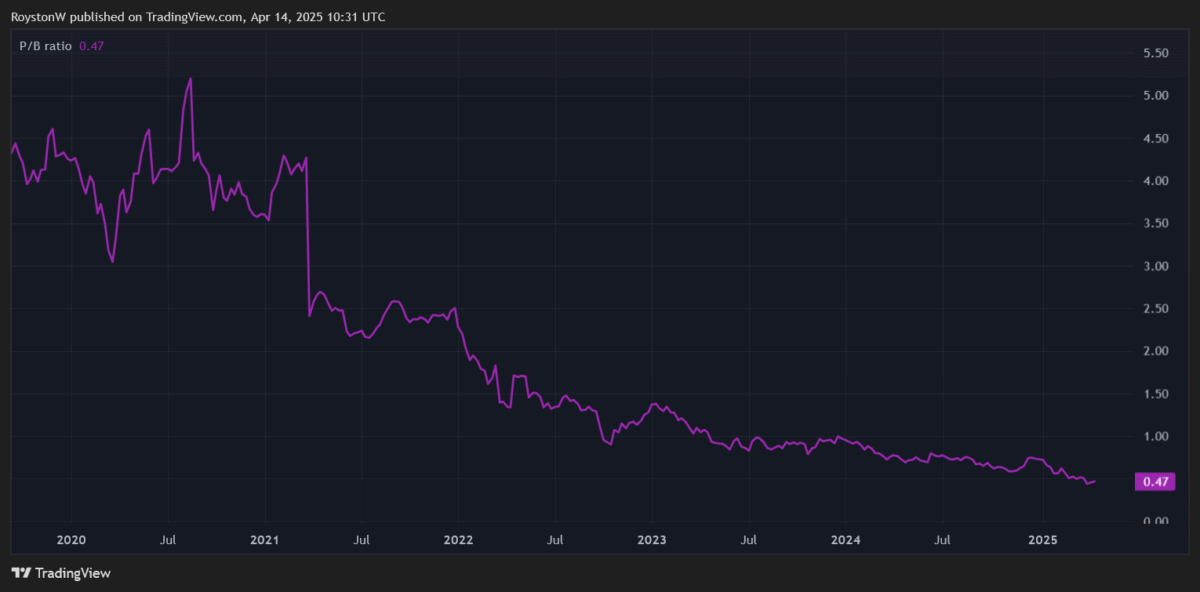
At current prices, I think the company could be a brilliant bargain share to consider. At 115p, it trades on a forward price-to-earnings (P/E) ratio of 5.7 times, and its price-to-book (P/B) ratio is under 0.5.

Any P/B below one indicates that a share is cheap relative to the value of its assets.

Source: TradingView

Finally, with an 11% forward dividend yield, RWS shares have one of the highest dividend yields on the London stock market today. Cash payouts here have risen consistently since 2016.

It’s important to note that RWS’ sliding share price has pumped the yield up to current levels. I’m optimistic that they’ll rebound, but there could be more turbulence in the near term if worries over AI and the broader economy grow.

The Renewables Infrastructure Group

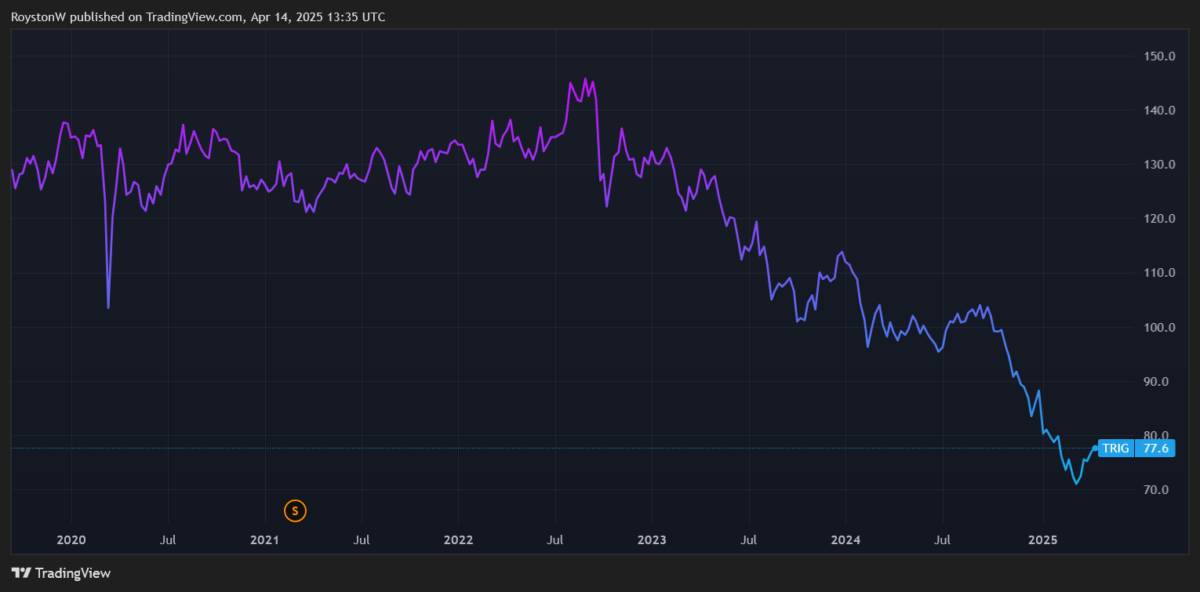
Utilites stocks like Renewables Infrastructure Group (LSE:TRIG) have been hit badly by higher-than-usual interest rates since late 2022. And while rates are beginning to come down, signs of returning inflation could hamper any further plans by central banks to loosen monetary policy.

Yet it’s my belief that this threat to Renewables Infrastructure is more than baked into the cheapness of its shares. Today, the company trades at 77.9p per share, which is 33.4% lower than its estimated net asset value (NAV) per share.

On top of this, its forward P/E ratio is an undemanding 9.6 times. And the firm’s corresponding dividend yield is a huge 9.7%.

Source: TradingView

I think extreme price weakness in recent years may have created an attractive buying opportunity for patient investors. While the company may endure some near-term turbulence, I think profits could soar longer term as global energy demand increases.

The International Energy Agency (IEA) forecasts that power demand from data centres alone will double between now and 2030, a sum equivalent to the entire electricity consumption of Japan today. With countries taking steps to reduce their fossil fuel uptake, renewable energy stocks have considerable earnings potential.

Renewables Infrastructure is one of my favourite plays on this theme. With solar, wind, and battery storage assets covering the breadth of Europe in its portfolio, it provides a diversified (and therefore lower risk) way for investors to gain exposure.

Legal & General Group shares go ex-dividend on 24 April – time to grab that 9% yield?

Legal & General Group (LSE: LGEN) shares go ex-dividend on 24 April. As someone with a big stake in the high-yielding FTSE 100 stock, the date is marked on my calendar.

Personally, I won’t be rushing to buy more before the deadline, but only because I already hold a hefty chunk. Also, buying just before an ex-dividend date isn’t always a win. The share price typically drops by the value of the dividend on the day, so investors aren’t getting something for nothing. Still, for long-term investors looking to take a position, today may be a good time to consider buying.

As an insurer, pensions, and asset management firm, Legal & General is naturally exposed to stock market volatility. Compared to others in the sector, it’s held up tolerably well. The shares are down around 6% over the past month and about 7% year on year. Not ideal, but hardly a disaster in the current climate.

The Legal & General share price has drifted sideways for years. What makes it stand out is that mouth-watering 9.02% trailing yield, roughly double what I’d get from bonds or savings accounts. The difference is that my capital is at risk. Plus concerns over whether such a generous payout can be maintained.

Is this FTSE 100 stock a bargain today?

Full-year results in March were reassuring. The group confirmed a £500m share buyback programme for 2025, part of a wider plan to return over £5bn to shareholders across three years. That’s roughly 40% of its market cap. The trade-off is that annual dividend growth will slow from around 5% to 2%. Given the high yield, I’d be relieved if they managed that.

A few weeks ago, I’d have said the dividend looked pretty solid. Today, I’m a little more cautious. As trade wars spook markets, there’s no telling what’s next. Dividend cover is also thin at just 1.1. Another concern is that three years of sliding earnings per share have driven up the price-to-earnings ratio to a staggering 80.

Legal & General is expanding in the US. In February, it announced a £2.3bn deal with Meiji Yasuda to sell its US protection business and launch a joint venture focused on pension risk and asset management. That sparked some excitement, although today’s craziness may take the edge off it.

I can see why some investors might consider buying the recent dip. The company’s strong cash generation, robust balance sheet, and clear strategy make it one of the more comforting holds in my portfolio right now. Although, there isn’t much competition on that front at the moment!

The 16 analysts tracking the stock have a median 12-month price target of just under 266p. That’s more than 12% above today’s 237p. Add in the dividend, and the potential total return creeps above 20%. That sounds great but in this market forecasts are flimsier than ever. I’d be thrilled to get that kind of return from here.

Still, my dividend lands on 5 June, worth 15.36p for each share I own. I’ll reinvest it straight back into Legal & General. And I’ll continue doing that every six months for years — decades if I’m lucky. I’m crossing my fingers that one day, the share price springs into life too.

3 FTSE 100 dividend stocks to consider buying while they’re on sale

The last few weeks haven’t been good for investors’ collective blood pressure. But the market mayhem wrought by President Trump’s on again, off again approach to tariffs has left some of our biggest companies trading on lower valuations and offering lovely income streams, at least on paper. Accordingly, here are three dividend stocks to consider buying today as part of a diversified portfolio.

Stonking yield!

Housebuilder Taylor Wimpey‘s (LSE: TW) share price hasn’t been immune from the sell-off. Recent volatility has left it down 13% for 2025 so far.

Still, the stock now changes hands at a price-to-earnings (P/E) ratio of 12. That’s below the average valuation in the FTSE 100. The dividend yield also sits at a monster 9.2%.

So, what’s not to like? Well, that brilliant yield isn’t expected to be covered by profit in 2025. Until the housing market gets it mojo back, Taylor Wimpey may need to tap its cash reserves to make up the difference. That can only go on for so long. Concerningly, the company recently posted a 32% fall in annual pre-tax profit to £320m — far worse than the market was expecting.

However, a larger-than-expected drop in interest rates by the Bank of England in an effort to support businesses could lead to more property transactions going through.

In the meantime, the order book stood at almost £2.3bn in February. That’s up on the £1.95bn a year earlier.

Down…but not out

Oil giant BP (LSE: BP) also looks an interesting proposition.

Granted, this might seem an odd pick. The price of ‘black gold’ is down 15% year-to-date with analysts predicting that weaker global economic growth could reduce demand for fuel at a time when supply is already expected to rise. Supporting this, Goldman Sachs believes Brent Crude will drop to $58 a barrel in 2026. That’s not ideal for debt-laden BP.

However, I think this is now priced in. The shares are down 14% in 2025 and history shows that buying when the chips are down is potentially very lucrative. When demand fell during Covid-19, for example, the stock fell below 200p. In early 2023, it had bounced to 560p.

A forecast 7.5% yield — double what an investor would get by tracking the FTSE 100 index — could be considered adequate compensation for staying patient.

Green energy play

A third FTSE 100 stock that arguably screams ‘value’ right now is mega-miner Rio Tinto (LSE: RIO). A P/E of less than nine could prove to be a steal in time if/when confidence returns. In the meantime, the shares yield 6.6%.

Of course, there’s no free lunch here. Risks with Rio Tinto include the inevitable volatility in commodity prices. The firm has also faced accusations of workplace misconduct and environmental damage.

On the other hand, I’d say the global shift towards renewable energy looks nailed on, even if the pace may be slower than previously expected. Since it’s one of the world’s largest producers of iron ore, copper and aluminium, Rio could be quids in. As a sign of things to come, it was recently announced that the company would supply 70% of the iron ore needed for a new hydrogen-based steelmaking plant in Austria.

A robust balance sheet also makes a dividend cut look unlikely for now.

2 cheap passive income shares to consider buying right now

2018 was apprently the best year for passive income investors ever, with a record total of £85.2bn paid in dividends by FTSE 100 companies.

According to AJ Bell‘s Dividend Dashboard, which surveys analyst forecasts, 2025 is unlikely to beat that. But it could come close, with projections for £83bn. We also have £28.9bn in FTSE 100 buyback plans so far. That’s more than half of 2024’s total, and we’re only just past the first quarter.

Forecasts suggest this could lead into a new all-time record in 2026. Passive income investors might never have had it so good.

Check the track record

Dividends are never guaranteed. And a dividend cut can often be one of the first remedies when a company is feeling the pinch one year.

So I reckon the best way to try to reduce our risks is to look for two more things in addition to a decent yield. One is to see the mooted dividend cash covered by forecast earnings. And a good track record record of consistent payouts helps.

Taylor Wimpey (LSE: TW.) scores well on both. Forecasts suggest a 9% dividend yield with cover of around 1.6 times by earnings. And the company has kept its dividend going through these past few tough years.

Along with the rest of the UK’s house builders, Taylor Wimpey still faces pressure from high interest rates and expensive mortgages. But we’re already seeing lenders dropping their rates. It comes as expectations grow for deeper Bank of England cuts in response to US tariff protectionism.

2025 outlook

Taylor Wimpey reached the end of 2024 with net cash of £565m on the balance sheet, ahead of expectations. That helps support the company’s policy of returning 7.5% of net assets per year as ordinary dividends.

The 2024 dividend was slightly short of 2023’s, though, even with a high yield. Further interest rate pressure and potential asset weakness could be among the threats this year. And I suspect we could see further share price weakness until we have some serious interest rate cuts.

But with a long-term view, if I didn’t already hold housebuilder shares I’d be wanting some Taylor Wimpey now. In fact, I still might buy.

Insurance cash

The insurance business can be cyclical. And quite often, dividends can go a few years without being covered by earnings. But at Aviva (LSE: AV.) we’re looking at a forecast 7.2% yield covered 1.2 times by projected earnings.

Cover isn’t up with some in the FTSE 100. But it’s pretty respectable for the sector. I like the look of the 9.3% expected from Legal & General too. But its weaker expected cover of 0.9 times gives Aviva the edge for me just now.

Aviva has kept its dividend going through these high-inflation years too, as it comes through its restructuring process in apparently good shape.

The ever-present cyclical risk is here. And financial stocks in general tend to suffer in an economic downturn, which US trade wars could thrust upon us.

But for long-term passive income, I see it as another strong one to consider.

Down 15% in a month, this FTSE 100 dividend share offers investors a stunning 10.8% yield

This FTSE 100 ultra-high-yield dividend share has taken quite a bruising in recent market turbulence, but to be fair, most stocks have.

Wealth manager M&G (LSE: MNG) is in the business of actively managing investment funds, which means it’s on the front line of stock market volatility. When things get choppy, it feels the pain. And lately, it’s been feeling a lot of it.

The share price has slumped by 14.5% in just a month. Over the last year, it’s down 10%. The asset management sector has been out of fashion, and M&G hasn’t been spared.

Can M&G deliver growth as well as income?

Across the financials sector, we’ve seen a familiar pattern of low valuations, sky-high dividends and too little love from the market for quite some time.

I’m a huge admirer though, and hold Legal & General Group and Phoenix Group Holdings alongside M&G. So far, it’s been a mixed bag but there’s a silver lining.

Right now, M&G is offering a huge 10.78% trailing yield. That’s eye-catching and it might even get better.

I’ll get my next dividend from M&G on 9 May, and it will be a bumper one. I’ll reinvest it straight back into the stock, buying even more shares if the price is still low.

Last month, the board lifted its full-year dividend by a modest 2% from 19.7p to 20.1p. The board has been looking to increase future shareholder payouts by a similar percentage.

Given recent extreme volatility, this could prove in ambitious. Dividends are never guaranteed. These days, nothing is.

On 19 March, M&G reported a £347m loss before tax for 2024. That sounds alarming but was mostly down to unrealised fair value losses on annuity assets and interest rate hedges. 

Strip that out and adjusted operating profit actually rose 5% to £837m, beating expectations. That came on the back of a strong 19% jump in asset management profits and some energetic cost cutting.

Operating capital generation, a key metric for paying dividends, dipped 6.3% to £933m but still beat forecasts. 

This stock will remain bumpy

M&G expects to generate £2.7bn over the next three years, so the dividend still looks well supported. The board aims to grow adjusted profits by 5% or more per year through to 2027. But that was all reported in mid-March, which feels like a long time ago now!

Another risk is that as an active manager, M&G faces huge competition from low-cost passive exchange traded funds (ETFs), which continue to suck in investor cash. Net outflows totalled £1.9bn last year, although ssets under management edged up £2.4bn to £345.9bn.

The 12 analysts covering the stock see a median target price of just over 234p. That’s more than 25% higher than today’s 187p. Throw in the yield and it would lift the total return closer to 35%. Which would be lovely were it true but I find that difficult to picture today.

I bought the stock with an ultra-long-term view, and any investor considering adding it to their portfolio today should do likewise. The short term is bound to be bumpy, but I’d buy more if I wasn’t already heavily exposed to this sector.

3 reasons I just bought Nvidia for my Stocks and Shares ISA

April has been a crazy time for the stock market. It has either been plunging or surging, depending on what President Trump says on social media. As many Foolish investors probably did, I used the recent sell-off to buy a few stocks, including Nvidia (NASDAQ:NVDA).

I invested in the chipmaker at $95 last week after its share price plunged 15% in the space of a couple of days. This meant the stock was back where it had been around 12 months earlier.

Here are three reasons I took the opportunity to pounce on Nvidia.

Valuation

The first reason was that the valuation looked more attractive than it had done for quite a while. When I invested, it was trading at just 21 times forecast earnings for this financial year.

For context, that price-to-earnings multiple was less than Nike, whose revenue and profits have been falling sharply. In contrast, Nvidia is expected to report 50% increases in both the top and bottom lines this year. Then 23%+ next year!

I should mention that Nvidia stock is higher than $95 now. As I type today (14 April), it’s set to open at $114. Therefore, the stock is up 19% in the past few days, driven higher as Trump has rowed back on many tariffs. This makes the valuation a bit more pricey.

Also, there is a risk here that the consensus earnings forecast is overly rosy, especially with all the uncertainty around tariffs and supply chains. At this stage, we basically have no idea where any of this is heading.

The AI revolution is still real

What is more certain though is that Nvidia’s key customers are set to continue making huge investments in building out artificial intelligence (AI) infrastructure this year.

For example, Amazon CEO Andy Jassy wrote in his annual letter to shareholders last week that the massive investments will be worth it. He said: “Generative AI is going to reinvent virtually every customer experience we know…if your mission is to make customers’ lives better and easier every day, and you believe every customer experience will be reinvented by AI, you’re going to invest deeply and broadly in AI.

Amazon plans to invest upwards of $100bn this year, most of it on AI-related projects. Meanwhile, Alphabet plans to spend about $75bn, with CEO Sundar Pichai saying just last week that “the opportunity with AI is as big as it gets.”

Real-world robotics

Finally, the opportunity set is much broader than just AI-powered chatbots. Amazon’s chief executive also pointed this out in his letter.

Increasingly, you’ll see AI change the norms in coding, search, shopping, personal assistants, primary care, cancer and drug research, biology, robotics, space, financial services, neighbourhood networks—everything.

Andy Jassy.

Nvidia is systematically positioning itself to benefit from many of these mega-trends, especially robotics. And this includes not just humanoid robots, but also self-driving cars (Tesla, Waymo, etc), robotic warehouses, and more.

With humanoid robots, the opportunity lies well upstream of the finished product. Before a robot can function, there has to be a deep stack of AI infrastructure. And once it’s up and running, it will require deep inference to see, move, and interact.

The future of robotics will rely on high-performance GPUs, a domain where Nvidia still rules the roost.

Looking at Tesla stock? Consider this Warren Buffett-held EV rival instead

Tesla (NASDAQ: TSLA) stock continues to be a popular investment. And I can understand why – currently it’s nearly 50% off its highs.

For those looking to invest in electric vehicles (EVs) and autonomous vehicles however, I think it’s worth considering another stock. This one’s held by legendary investor Warren Buffett, and today it trades at a far more attractive valuation than Tesla.

BYD’s sales are surging

The stock I’m talking about is BYD (OTC: BYDD.Y). It’s a Chinese EV manufacturer that has stock market listings in both China and the US.

You may have seen BYD’s EVs around in recent years. They are pretty slick, and becoming very popular with consumers. This popularity is illustrated by the company’s recent sales figures. In 2024, the company sold 1.76m EVs, an increase of about 10% year on year. Overall, it sold a record 4.3m vehicles in 2024, up 41% year on year.

As for Tesla, it sold 1.79m cars in 2024 (all EVs), a decrease of about 3%.

Here in the UK (where it launched its EVs in March 2023), BYD sold 9,271 cars in the first quarter of 2025. That figure exceeds the company’s entire 2024 UK sales volume. So its cars are clearly popular with Britons. Turning to Tesla, its UK sales have been weak this year – in January they were down 7% year on year.

Zooming in on revenues, BYD’s are surging. For 2024, its top line jumped by 29% to CNY777bn ($107bn). This topped the $97.7bn reported by Tesla. Note that Tesla’s 2024 revenue was only up 1% year on year.

A lot to be excited about

Looking ahead, there are plenty of reasons to be bullish. Recently, BYD launched a low cost model (the Qin L) to take on Tesla’s Model 3. Meanwhile, earlier this year the company launched new battery charging technology, which can charge an EV in just five minutes. It also announced that its advanced driver-assistance technology (‘God’s Eye’) would be available free in all its models.

Low valuation

Perhaps the best thing about BYD stock however, is its valuation. Currently, it trades on a price-to-earnings (P/E) ratio of 25, falling to 21 using next year’s earnings estimate. That’s a much lower valuation than Tesla has, which is currently trading at 98 times this year’s forecast earnings and 73 times next year’s.

So on a relative basis, there appears to be a lot of value here.

Risks to consider

Of course, there are plenty of risks to consider with BYD. One is competition from other manufacturers. Today, pretty much every major auto manufacturer is producing EVs and competition’s intense.

Another is tariffs. EU tariffs on its passenger cars, and US tariffs on its buses and trucks could hurt profits. A major global recession is another risk. When economic conditions weaken, consumers tend to hold off on the purchase of new vehicles.

All things considered however, I think this stock has a lot of potential and is worth looking at. For me, it’s a safer bet than Tesla.

Up 18% in the past week, I think this FTSE 100 share could keep soaring!

It’s no shock that Fresnillo‘s (LSE:FRES) been one of the FTSE 100‘s best performers over the past week. The Mexican miner’s risen 17.8% as heightened macroeconomic fears have driven gold and silver prices through the roof.

Can Fresnillo share prices continue to take off, however? Let’s take a look.

Leveraged play

Fresnillo’s most famous as the world’s largest silver miner, producing 56.3m ounces of the stuff last year. But its range of gold assets has helped it to deliver a better return than silver so far in 2025, up 53.2%.

Gold’s hit new peaks of around $3,245 per ounce in recent days, another new high. It’s up 23.1% in the year to date, while silver’s also risen a healthy 11.5%.

You’ll notice, however, that the Fresnillo share price has risen far more sharply than both these precious metals in 2025. This is because miners provide leveraged exposure — in other words, when commodity prices appreciate, their profit margins rise more rapidly as their fixed costs mean any revenue inceases have an outsized impact on earnings.

Operational strength

Fresnillo’s rocketing share price also reflects the company’s robust operating performance in recent times. Revenue and EBITDA leapt 29.3% and 136% respectively, in its latest year, results which perfectly demonstrate the ‘leverage’ effect in action.

The bottom line was bolstered too by $40m worth of cost savings, which pulled adjusted production costs 2.6% lower. On the production front, both silver and gold output rose, the latter by 3.6% and beating expectations.

Fresnillo also continued to demonstrate its reputation as an impressive cash creator, which meant it finished 2024 with net cash of $458.3m. It had recorded net debt of $304.4m a year earlier.

As well as giving it financial headroom to invest for growth, this is also allowing the business to furnish investors with some tasty dividends.

Fresnillo raised the ordinary dividend on its shares to 32.5 US cents per share from 5.6 cents in 2023. It also delivered a special dividend of 41.8 cents.

Risk vs rewards

This is not to say everything’s is perfect at the FTSE 100 miner.

Operational issues at Peñoles‘ Sabinas mine impacted Fresnillo’s proceeds under the ‘Silverstream’ contract last year. It’s possible that the contract’s book value could be substantially reduced later in 2025.

It’s also important to remember the complexity and unpredictability of metals mining, and that while the company is thriving today, the threat of production outages, soaring costs, and disappointing exploration results are a constant threat.

Yet on balance, I’m optimistic Fresnillo’s profits (and therefore its share price) can keep soaring. This is thanks chiefly to favourable conditions that could continue fuelling precious metal prices.

Tension over global trade wars — the primary driver for gold and silver more recently — isn’t likely to go away any time soon. Concerns over intensifying inflation and their impact on interest rates could also worsen, while growing geopolitical instability and escalating military conflict also looms in the background.

While it’s not without risk, I feel Fresnillo could be one of the best stocks to consider in the current climate.

2 top growth stocks to consider buying for the next phase of the AI revolution

 
In late 2022, ChatGPT was released into the world and ignited the generative artificial intelligence (AI) boom. This immediately benefitted many growth stocks on the hardware side, especially chipmaker Nvidia, whose shares are up 659% since January 2023.

The second foundational layer of the AI revolution is made up of platforms that enable the technology. Think cloud giants such as Amazon Web Services (AWS) or Microsoft Azure.

Now though, we’re increasingly seeing companies integrate cutting-edge AI into their products. This application phase is where transformative impacts are likely to emerge. Here are two growth stocks that are rolling out impactful AI-powered products. Both are worth a look, in my opinion.

Axon

The first is Axon Enterprise (NASDAQ: AXON). This company is best known for its Taser stun guns and body cameras used by law enforcement agencies.

However, the secret sauce is that these devices are connected through a public safety operating system. Indeed, Axon now has over 1m software users.

In Q4, the firm’s revenue grew 34% year on year to $575m, representing its 12th consecutive quarter of 25%+ growth. Q4 was also when it released its AI Era Plan, which bundles existing and future AI products into a single subscription service.

One is Draft One, a generative AI tool that transcribes audio from Axon’s body cameras and produces draft reports within minutes of an incident. While police officers are required to review the AI-generated reports before submission, this still holds the promise of game-changing productivity gains.

In February, CEO Rick Smith said: “These [AI products] are the fastest-growing adoption products we’ve ever had, and it’s not by a small margin.”

One risk here is wide-ranging US budget cuts, which could hurt Axon’s ability to win further federal contracts.

However, the stock’s fallen 20% inside two months. While that doesn’t make it cheap — it’s still trading at a lofty 88 times forward earnings — I reckon the pullback’s worth considering.

Duolingo

The second stock is Duolingo (NASDAQ: DUOL), the online language learning leader that now has over 116m and 40m monthly and daily active users respectively.

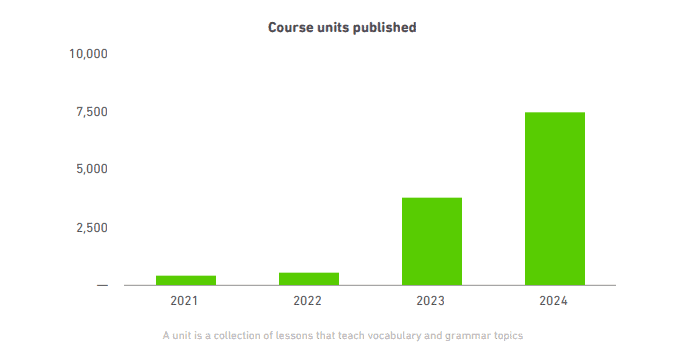
Generative AI is benefitting Duolingo in a number of ways. For starters, it is using the technology to massively accelerate content generation at minimal extra cost. In 2024, it deployed 7,500 course units, up from just 425 in 2021. 

Source: Duolingo.

Second, it has launched an AI-powered video call feature that enables learners to have real-time, spontaneous conversations with a virtual character. This addresses two common challenges in language learning: the lack of opportunities to practise with native speakers and removing the embarrassment when making errors with human tutors. 

The video call feature is available exclusively to Duolingo Max subscribers (its highest-priced tier). Yet it already accounted for 5% of paid subscribers in Q4. And it’s proving a hit with English language learners, who often need real-world English speaking skills for work or study.

As for risks, a potential global recession could cause some users to downgrade from premium subscriptions. So this is worth monitoring.

Longer term though, there is an enormous opportunity with English learners. They represent roughly 80% of the 2bn or so language learners worldwide, but only 46% of Duolingo’s 40m daily active users.

After a 25% fall since mid-February, I think the stock is worth further research.

Financial News

Daily News on Investing, Personal Finance, Markets, and more!

Financial News

Policy(Required)