Are these the best UK shares to consider buying as US stocks whiplash?

US stocks took a pretty big tumble as April kicked off, only to reverse course as the threat of tariffs got put on pause. By comparison, UK shares are proving to be a better safe haven from all the volatility. The FTSE 100 has taken a hit, but it pales in contrast to the recent downward trajectory of the S&P 500 and Nasdaq.

And with US investors potentially exploring international opportunities, the UK stock market might be a popular destination for new capital. So which UK shares could be good buys right now?

Exploring options

Global tariffs put a lot of pressure on businesses with complex supply chains. But there are plenty of British enterprises that don’t have this sort of exposure. For example, Safestore Holdings (LSE:SAFE) owns and operates a portfolio of self-storage facilities in the UK and Europe with next-to-no direct ties to the US economy.

Similarly, Howden Joinery operates within the UK and Europe. While the firm imports a significant amount of wood, lumber was explicitly excluded from proposed US tariffs. Then there’s also AstraZeneca. The pharmaceutical giant relies on the US healthcare market for a large chunk of its revenue stream. But, just like lumber, pharmaceuticals were also excluded from the tariff list, leading to minimal disruption.

The list of UK shares that could have minimal or no impact from US tariffs is quite substantial. And these companies are likely where most investors could find refuge from volatility.

Tariffs could cause indirect damage

Just because a business won’t get directly caught in the crossfire of a potential global trade war doesn’t mean the stock’s an instant buy. Investors still need to do their due diligence and look at the operational risks as well as potential rewards. With that in mind, let’s take a closer look at Safestore.

The company’s in the middle of navigating a cyclical downturn in the self-storage market, with its 2024 performance landing pretty flat. Thankfully, investors did see a welcome return to growth in the first quarter of 2025. However, while not directly exposed to the US market, Safestore could still be indirectly impacted.

Retaliatory tariffs from the UK or Europe could drive up domestic costs, resulting in both businesses and individuals seeking to save more money. That could translate into Safestore customers ending their leases, putting more pressure on the firm’s cash flow in the short term.

Stay focused on the long run

Tariffs will undoubtedly cause headaches in the business world if they end up being implemented in markets beyond China in the next 90 days. However, in the long term, high-quality businesses will adapt. And in my opinion, Safestore seems perfectly capable of doing just that.

This isn’t the first time it has had to navigate a downturn in its target market. And while most of its competitors are being more conservative, management continues to invest in its European expansion to perfectly position the firm for when the cycle eventually ticks back up.

In fact, it was this strategy that saw Safestore become the industry leader in the UK. And if management can replicate its success in Europe, the stock could have a long way to climb in the long run. That’s why I’ve already added this business to my defensive income portfolio.


Have we reached the bottom of this stock market correction?

With a global trade war having kicked off earlier this month, the US stock market, along with other markets around the world, started crashing.

In the few days following President Trump’s announcement, both the S&P 500 and Nasdaq plummeted by over 10%. Meanwhile, looking at the international landscape, Hong Kong’s Hang Seng index cratered by almost 12% along with Japan’s Nikkei 225.

The UK and Europe seem to have fared a bit better, with the FTSE 100 only down 6% and the DAX shrinking by 8%, yet that’s still a painful tumble in less than 72 hours.

Since then, shares have started to bounce back as the US reversed course and implemented a 90-day pause on its tariff programme (excluding China). This volatility is obviously gut-wrenching. But could stocks be heading down further in the coming months?

Here’s what the forecasts say

Let’s zoom into where this all started – the US. The latest projections from The Economy Forecast Agency reveal that the S&P 500 could still be on a downward trajectory despite the recent bounceback. In fact, the index could reach as low as 4,434 points by July. If that’s true, then America’s flagship index could see another near-20% clipped off in the coming months.

The timeline certainly seems plausible. July’s the summer earnings season and would reveal the impact of trade disruptions either from the US or other markets like China. So should investors use the recent rally to sell up and buy back into the market in July?

While this may seem wise on paper, in practice, history’s shown countless times that trying to time the market is a losing strategy.

July could indeed be the ‘true’ bottom. But what if the trade war is resolved faster than expected? Then the bottom could be much sooner. Similarly, if negotiations fail, then a protracted trade war could drag stock prices even lower later than July. There’s simply no way of knowing right now.

A better way to invest during volatility

Instead of trying to throw money into the stock market at the lowest point, investors can likely achieve better results if they use ‘dollar cost averaging’.

Take Palo Alto Networks (NASDAQ:PANW) as an example. The cybersecurity enterprise has already seen close to 20% of its valuation wiped out since mid-February, even after enjoying a rebound. And with the shares still trading at a lofty price-to-earnings multiple of 87, the stock could continue to tumble from here.

The company manufactures its hardware products in the US. But don’t forget it’s reliant on a global supply chain, including sourcing components from countries like China, which are facing some of the steepest tariffs.

Having said that, cybersecurity isn’t something businesses can really skimp on, even during economic turmoil, giving Palo Alto flexibility to pass on the higher import costs to customers. After all, that’s exactly what management did in the last China trade war in 2018-2019.

Through dollar cost averaging, investors could buy shares today, securing a 20% saving versus a few months ago. Yet if the stock continues to fall, then there’s still capital available to buy more at an even bigger saving, bringing the average cost per share down. It may be worth considering.

Investing £10,000 in income stocks will generate a passive income of…

With US growth stocks in free-fall, dividend shares and the passive income they can generate are proving to be a popular refuge from volatility. Even some UK shares are being impacted by the prospect of a prolonged trade war, yet that’s also pushed dividend yields much higher. And providing those dividends can keep flowing, investors may be looking at a rare opportunity to supercharge their passive income.

So let’s say an investor has £10,000 to spend. How much income could they unlock right now and in the future?

Profiting from higher yields

Today, the FTSE 100 offers an average yield just shy of 3.8%. Yet it’s actually the FTSE 250 offering the higher payout right now at almost 4%. So if an investor were to just snap up shares in a low-cost index tracker, a £10,000 investment could instantly start generating £400 a year.

Alternatively, instead of relying on an index fund, what if investors were to just split the £10,000 across the 10 highest-yielding income stocks in the FTSE 250? In that case, the dividend yield would average out to a massive 11.9%, or £1,190.

But that’s just right now. What if investors were to reinvest these dividends over time and grow the income portfolio? Assuming yields stay the same after:

  • 5 years – £18,077 portfolio generating £2,151 passive income.
  • 10 years – £32,678 portfolio generating £3,888 passive income.
  • 20 years – £106,790 portfolio generating £12,708 passive income.

Let’s be realistic

There’s no denying that the prospect of using £10,000 to earn more than £10,000 every year in the long run is exciting. But there are some pretty large assumptions going into this calculation. Firstly, yields never stay the same since they’re affected by stock prices that change constantly (for better or worse).

What’s more, high yields are only attractive if the dividends can keep flowing. And across the top highest-yielding FTSE 250 stocks today, there are plenty of risks that could prevent that from happening. Take Ithaca Energy (LSE:ITH) as an example.

The oil & gas producer offers a 13.9% payout right now as its production efforts ramp up, beating analyst expectations in 2024. This momentum has seemingly spilt over into 2025, putting the firm on track to continue growing earnings and dividends despite recent weakness in oil & gas prices.

Dividends being backed by earnings is an encouraging sign. However, if that’s the case, why aren’t more investors taking advantage? There are undoubtedly several factors at play. However, one of the biggest concerns is the location of Ithaca’s operations.

With new development projects located in the North Sea, the company’s facing increasing political, legal, and activist pressure that could result in its long-term growth becoming compromised. And if earnings dry up, dividends are likely to follow.

The bottom line

There are a lot of passive income opportunities in the stock market right now, especially as prices tumble on fears of a global trade war. However, it’s essential for investors to do plenty of research when looking for stocks to buy, even among historically ‘safer’ dividend stocks.

What should the Helium One share price be?

With no revenue, it’s hard to know what the Helium One Global (LSE:HE1) share price should be. Since April 2024, it’s bounced around between 0.5p and 2.15p. Today (11 April), the stock changes hands for 0.96p, valuing the company at £56m.

Theory and practice

Those who believe in the efficient market hypothesis — which says that current asset prices reflect all publicly available information — will claim that the group’s present market cap is equal to its intrinsic value.

And this is a good starting point.

We know that the company has a 50% interest in a project in Colorado, at which test drilling is currently underway. Revenue from the mine is expected in the first half of the year.

Also, the group recently formally accepted the offer of a mining licence for its larger Rukwa project in Tanzania. Additional funding of $75m-$100m is required to fully commercialise this one.

Armed with this information, investors believe the group’s worth just over £50m.

Can this be justified?

The most common valuation techniques require the preparation of a cash flow forecast.

In December, for its Pegasus project in America, the company said there were “indications of $2m per annum accruing to the Company over a period of five years”. In addition, extra revenue could come from the sale of carbon dioxide.

This is a relatively modest sum. In fact, it will just about cover the group’s present level of overheads for a year. And when discounted to reflect what this cash is worth today, it contributes very little to the group’s current market cap.

It’s the group’s African operations that really matter.

However, the company’s given no clues as to what the future inflows and outflows might be from Tanzania.

That’s probably because, at the moment, there’s no indication as to the potential volume of gas that could be extracted. During testing, up to 7.9% helium – 5.5% on a sustained basis — has flowed to the surface. According to the company, this makes it the fourth-biggest helium concentration in the world. However, there’s no indication as to what this means in terms of total reserves or cash.

And without any idea of the volume of gas that’s underground, other valuation measures cannot be used including, for example, the total acquisition cost. This comprises the cost of buying, building, and operating the mine divided by the expected output.

Another valuation

In the absence of detailed information, Panmure Liberum has done some sums and come up with an estimate of what Helium One should be valued at.

The bank’s set a price target of 3.6p – a potential premium of 275% to today’s share price. The broker’s analyst described recent updates as “very encouraging” and suggests there’s “substantial upside on offer from the development of the resources in Tanzania“.

But in the absence of further information, I don’t think it’s possible to come up with an accurate valuation for Helium One. On this basis, making an investment would be too speculative for me. I have no doubt there’s a growing market for the gas. And supply restrictions should keep upward pressure on prices. But there are presently too many moving parts, not least questions over how the group’s going to fund its expansion. For these reasons, I don’t want to invest right now.

Here’s how a stock market crash may help an investor to retire early

The UK market is in correction territory (a drop of over 10% in short order) with the blue-chip index — the FTSE 100 — falling around 12% from its peak. It’s not a stock market crash (down 20% or more). However, US stocks have come much closer to a crash, with the S&P 500 nearing a bear market earlier in the week.

These are scary events. With some investors seeing thousands wiped off their portfolio in a matter of days, it can be hard to stay positive. However, this kind of volatility can also create rare openings.

When quality companies are sold off indiscriminately alongside weaker names, it gives long-term investors the chance to buy some of their favourite stocks at knockdown prices. In these moments, fundamentals often take a backseat to fear. And that’s precisely when opportunity strikes. The ability to distinguish between temporary noise and lasting value becomes critical.

Staying calm during these downturns isn’t easy, but history consistently rewards those who do. For those with a clear strategy and the patience to act when others are panicking, these turbulent periods can lay the groundwork for some of the best long-term returns. As Warren Buffett says “be fearful when others are greedy, and greedy when others are fearful”.

What’s on my watchlist?

During these events, it’s always useful to have a watchlist. This allows me to keep a close eye on stocks I may be interested in buying or adding more of to my portfolio. So, what’s on my watchlist?

Well, let’s start with companies with a strong economic moat — this is a a distinct advantage a company has, allowing it to protect its market share and profitability. These are Arm Holdings, the British chip designer, ASML, the lithography machine producer, and Ferrari, the luxury car brand with sky-high margins and brand value. These companies have strong profit margins that also make them more resilient in times of economic distress. Ferrari’s drop has been modest, but Arm and ASML are down 50% and 40% from their peaks, respectively.

Two I’ve bought

I’m also taken the chance to buy two stocks on my watchlist. The first is Alphabet. The Google parent company is trading with a price-to-earnings-to-growth (PEG) ratio of 1.1, which puts it at a huge discount to its information technology peers.

I’ve also topped up my position in Jet2 (LSE:JET2). The UK no.1 tour operator is actually sitting on shed loads of cash. With £2.3bn in net cash, and a market cap of £2.7bn, the market is valuing the business at just £400m — that’s equal to the company’s projected net income for 2025.

Unlike ASML and Ferrari, Jet2’s margins are much thinner. And this makes its more vulnerable to economic downturns. And yes, higher minimum wages and National Insurance contributions will increase costs by as much as £25m.

However, the net cash position provides something of a backstop for the share price, and jet fuel prices have fallen significantly. The latter should provide a major boost. Spot prices have fallen more than 10% since 2 April.

What’s more, its fleet overhaul plan — replacing older Boeing aircraft with more modern and fuel-efficient Airbus models — appears measured and financially prudent. I may continue to top up on this one.

Is Aston Martin’s share price too cheap for savvy investors to ignore?

I’m looking for the best bargains to buy following recent share price turbulence. After doing some initial research, it seems that Aston Martin Lagonda‘s (LSE:AML) share price may warrant a close look.

At 61.3p per share, the FTSE 250 stock’s dropped more than a quarter in value over the past month, and 61.6% over a one-year horizon.

Aston’s not tipped to generate any profits over the next couple of years. So the price-to-earnings (P/E) ratio doesn’t give us an idea about whether its shares offer decent value for money.

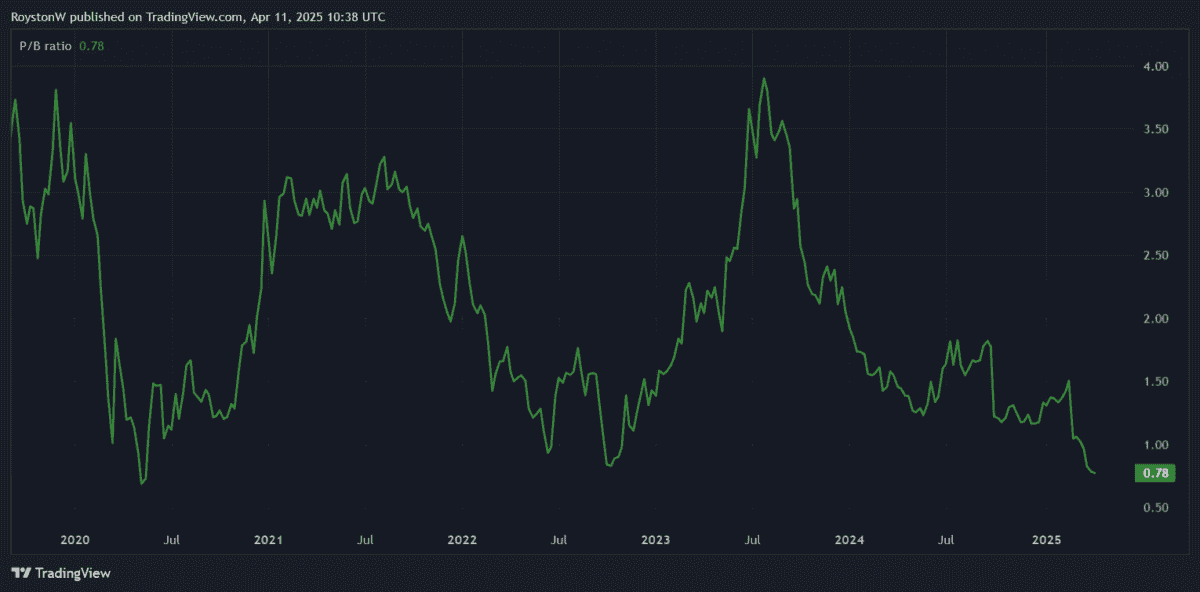
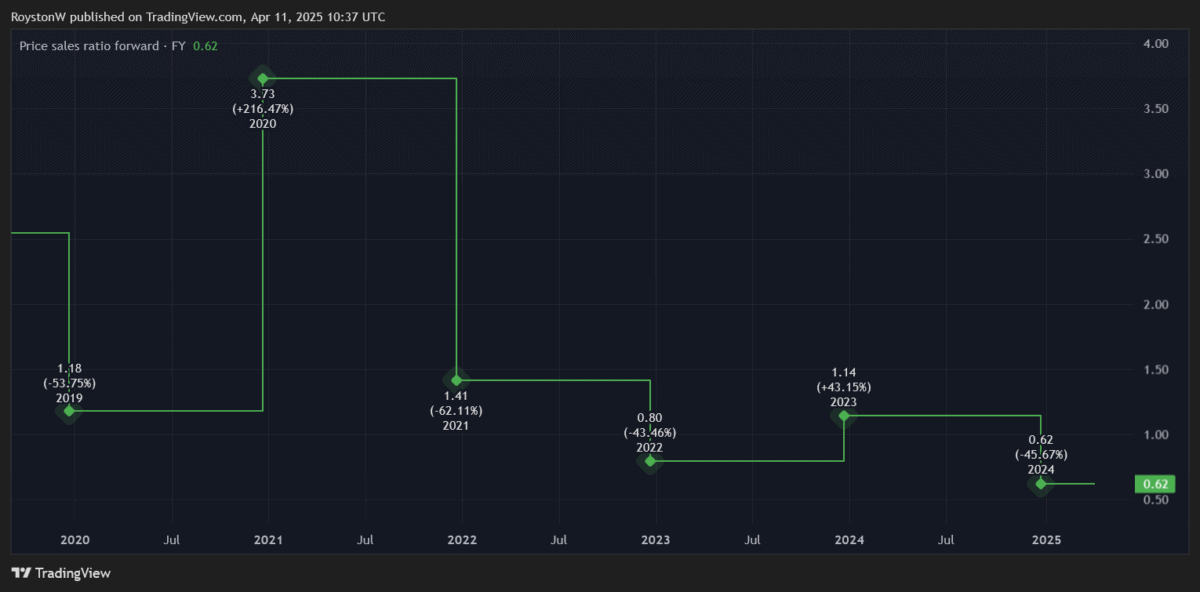
The price-to-book (P/B) multiple and price-to-earnings-to-growth (PEG) ratios, on the other hand, do. As you can see, both of these metrics fall well inside value territory of 1 and below:

Source: TradingView
Source: TradingView

However, it’s important to consider that Aston’s low valuation may reflect the level of risk it poses to investors. So what’s the story, and should invidividuals consider buying the business at today’s price?

Bumps in the road

Few carmakers on the planet have the lasting appeal that Aston Martin enjoys. Offering a tasty combination of luxury and speed, its products are among the hottest status symbols out there. And as the number of global millionaires rapidly grows, turnover could skyrocket if the company finds the right formula.

Yet while Aston’s products may glisten, the same can’t be said for the business itself. Supply and manufacturing issues, product development delays, a merry-go-round of CEOs, and high debt (net debt was £1.2bn in December) have left the Warwickshire firm in dire straits.

It’s also currently failing to reach customers in the highly competitive sports car market as effectively as other prestigious marques like Ferrari right now.

Worrying readacross

Aston’s task isn’t made any easier as the tough economic environment crushes demand for expensive cars. Competitor Porsche‘s first-quarter update on Tuesday (8 April) underlined the huge challenges that high-end manufacturers currently face.

This showed sales in Europe and Asia fall sharply in quarter one, with sales in China — a key market for Aston — down 42% year on year.

US sales rose 37%, but this reflected artifically low sales in Q1 2024 when units were held at US ports due to component issues. Even factoring this in, Porsche’s worldwide sales dropped 8% in the last quarter.

With the critical markets of China and the US embroiled in a fierce trade war, and the spectre of import taxes weighing on other regions, things could get worse for the carmakers before they get better. Aston’s own sales volumes dropped 9% in 2024, latest financials showed.

The threat of a 25% tariff on US auto imports presents a more specific risk for the company, too.

Longer-term threats

In another worrying omen for Aston Martin, Porsche announced a substantial pickup in electric vehicle (EV) sales in that first-quarter statement. Some 38.5% of all units that rolled out of showrooms were either fully electric or hybrid models.

This is significant because Aston has delayed the planned launch of its own EVs by three years, to 2030. By relying on combustion engine cars in the meantime, it risks losing relevance in an increasingly eco-conscious market.

And it is, in my opinion, another damning indictment of Aston’s turnaround strategy. While its cars still sparkle, I think investors should consider avoiding Aston Martin shares despite their current cheapness.

2 shares I just bought for my ISA during the stock market sell-off

The stock market has sold off sharply since the start of April, with some shares falling 20% or more. I’ve been using this weakness to add to a couple of holdings in my Stocks and Shares ISA.

So here are two that I bought in recent days.

Mining mayhem

One of the worst-hit sectors lately has been mining. The Glencore (LSE: GLEN) share price, for example, has plunged 20% in a month, bringing the two-year loss to 50%!

This makes sense, of course, as the Trump administration’s tariff war with China could weaken demand for raw materials. Mining is cyclical, so a major slowdown in the global economy is a risk to the sector here.

However, as well as being a major copper producer, Glencore is also one of the world’s biggest commodity traders. This means its trading division can make big profits during periods of massive turbulence, like in 2022, and possibly now.

Longer term, I fail to see how surging demand for copper — which is used in everything from electric vehicles (EVs) to solar panels and turbines — when combined with constrained supply will not lead to much higher prices. Therefore, Glencore’s profits should one day be significantly higher than they are today.

So why didn’t I buy this FTSE 100 stock then? Well, I tend to avoid individual mining stocks as they’re a bit risky for my liking. Production at strategically important mines can run into trouble, for example.

But the FTSE 250‘s BlackRock World Mining Trust offers diversification through a range of companies and metals, including gold. It has Glencore as one of its top holdings, as well as other copper giants such as BHP and Freeport-McMoRan.

The current dividend yield is 5.14%, which is higher than Glencore’s 3.63%. I see it as a less risky option for my portfolio.

Of course, the same risks apply here. Another sell-off in metals could cause future earnings to dip sharply across the sector. However, analysts at Jefferies recently said that hammered mining stocks could now be attractive “for those who can ride out the near-term volatility”.

I agree, so I bought more shares of BlackRock World Mining at 395p.

Shocking Shopify sell-off

Another stock I bought after a massive dip was Shopify (NASDAQ: SHOP). The stock lost 23% in just two-and-a-half days near the start of April!

Shopify’s platform allows businesses to easily set up and run an online store. Last year, its share of the US e-commerce market reached an impressive 12%, while international revenue grew 33%.

In 2023, the company sold its capital-intensive logistics business, a move that has markedly improved profitability. Its free cash flow margin grew sequentially each quarter last year, reaching 22% by Q4. And for the full year it reported an operating profit of $1.1bn on revenue of $8.9bn (26% year-on-year growth).

Now, I accept this is an incredibly volatile holding, even more so when a global recession could impact growth. Also, the stock’s still pricey, even after the recent 23% pullback.

However, the global e-commerce market is projected to expand at a compound annual rate of 15.2% from 2024 to 2033, according to Precedence Research. And Shopify’s revenue is tipped to soar above $19bn by 2028. I remain bullish.

These 4 FTSE shares have crashed hard. Which do I like today?

Wow, what a week (and month) it’s been for stocks. After hitting record highs in February, stock markets have plunged on fears of a new trade war. Even after Thursday’s (10 April) big rebound, the FTSE 100 index is down 6.3% in a week and 7.6% over a month. Meanwhile, the US S&P 500 has dropped 0.4% and 6.2% over those periods, respectively.

My family portfolio is heavily weighted to US stocks and UK shares, so it’s taken a few hard knocks. Indeed, some of our holdings have fallen so far and fast, I’ve been baffled by these recent market moves.

My biggest FTSE fallers

Earlier today, I produced a list of the 20 biggest FTSE 100 fallers over the past month. Alas, I found four of my family’s blue-chip holdings in this list of laggards and losers. Here they are (sorted from biggest to smallest price decline over the past month):

Company Business Market value (£bn) One month One year Five years
Barclays Bank 37.6 -19.1% 27.9% 147.6%
BP Energy 55.4 -19.5% -35.6% -0.8%
Glencore Miner 30.2 -25.4% -49.6% 64.6%
Anglo American Miner 25.5 -25.9% -19.5% 20.7%

Two of these worst-hit stocks are from the same sector: mining. With Trump’s trade tariffs predicted to cause a global economic slowdown, miners, oil & gas, and banking stocks have all taken a beating. Indeed, the wider list of Footsie losers over one month is dominated by companies in the financial and commodity sectors.

Of course, the reason for the sharp declines in share prices is President Trump’s threat of hefty trade tariffs on imports to the US. Sadly, the US has tried trade/tariff wars of this kind before — most notably in 1828 (the ‘Abomination tariffs’) and 1930 (Smoot-Hawley tariffs). Both contributed to long, deep US recessions, including the Great Depression that began with the Wall Street Crash in October 1929.

And when the American economy sneezes, other countries usually catch cold, which is stoking fears of a potential global recession in 2024/25. Hence the slump in stocks right across the globe, less than two months since stock markets hit record highs.

I like the look of Barclays

As mentioned, my wife and I own all four of the stumbling shares above. I’m wary of buying commodity-related stocks in the current turmoil, so three of these slumpers are not for me right now.

However, I can’t see big British bank Barclays (LSE: BARC) suffering savagely from US trade tariffs. As I write (11 April), the Barclays share price stands at 258.4p, valuing the Blue Eagle bank at £37.1bn. At its one-year high, this stock hit 316p, so it’s fallen steeply from this top.

After this latest setback, this FTSE share trades on a multiple of just 7.4 times earnings, generating an earnings yield of 13.5% a year. Thus, the bank’s dividend yield of 3.3% a year is covered a juicy 4.1 times by trailing earnings. To me, this offers a huge margin of safety, giving confidence that future cash payouts will be similar or even higher.

Then again, nothing is certain in financial markets, including future dividends. Also, if this stock-market swoon continues, Barclays’ investment-banking revenues might plunge. And a UK recession could lift loan losses and bad debts. Even so, I have no intention of selling this FTSE 100 stock at current price levels!

1 FTSE 250 stock that analysts are calling a ‘Strong Buy’

Oxford Nanopore Technologies (LSE:ONT) is an exciting FTSE 250 stock and is massively undervalued according to analysts. However, despite its groundbreaking technology and recent collaborations, the stock has slumped. Unlike many of its peers, the slump actually has very little to do with Donald Trump’s tariffs.

A DNA pioneer

For those unfamiliar, Oxford Nanopore is a pioneer in third-generation DNA sequencing technology. The company’s devices use nanopores — these are tiny protein-based structures — to sequence DNA or RNA in real time by detecting electrical changes as molecules pass through these pores. This technology is all available on handheld devices.

Its technology is used across multiple fields, ranging from infectious disease analysis to genomic surveillance in remote locations. For instance, its devices were used during the Ebola outbreak in 2015 to sequence viral genomes rapidly.

However, things haven’t gone to plan since listing in late 2021. Oxford Nanopore’s share price has plummeted by over 80%, reducing its market capitalisation to over £1bn. This dramatic decline stems from a combination of factors, including persistent losses, heightened competition, and macroeconomic challenges such as rising interest rates. Analysts have also flagged concerns about slower-than-expected growth and a worsening funding environment.

Analysts call this a ‘Strong Buy’

Despite the collapsing share price, analysts seem remarkably bullish. Of the 10 analysts covering the stock, four have Buy ratings and four have Outperform ratings. What’s more, the average share price target is now 69% higher than the current share price. This is typically a good sign. Incidentally, the highest share price target is 138% above where we are today.

However, shrewd investors will need to question this call. The company’s operating loss has nearly doubled to £152m since 2019, and the forecast suggests it won’t reach adjusted EBITDA breakeven until 2027. For 2025, analysts expected negative earnings per share (EPS) of 15.9p. That’s not insignificant for stock valued at 114p per share.

The saving grace is the net cash position which currently stands at £292m and is set to fall to £158m by the end of 2026 based on the forecast. That means it does have some runway until its long-awaited profitability.

Of course, it may not reach profitability in its current state. Ongoing losses and a falling share price have made the stock vulnerable, with some suggesting it could become a takeover target for larger players like Thermo Fisher Scientific or Danaher.

The bottom line

On 9 April 2025, Oxford Nanopore announced a strategic collaboration with Cepheid to develop automated sequencing solutions for infectious diseases. The could expand into other areas like cancer diagnostics and human genetics, potentially opening new revenue streams.

However, investors should be wary that Oxford Nanopore is a classic high-risk, high-reward investment. Its innovative technology and strategic collaborations position it well for future growth, but I’m reluctant to throw my own money behind it. Nonetheless, I’ll continue to keep a close eye on developments.

I asked ChatGPT to name 5 FTSE shares for the perfect SIPP. Here’s what it picked

Recent stock market volatility could be a good opportunity for long-term investors to fill up a Self-Invested Personal Pension, or SIPP.

Pension investing is a long-term game. Loading up on shares when prices are down like today may be the perfect time to start, for those who can withstand short-term risks.

With that in mind, I decided to have a bit of fun by asking ChatGPT to name five FTSE 100 stocks to create the perfect SIPP. I asked to spread my risk across five different sectors, to avoid doubling up.

Unilever is a defensive stock

I should start by saying that ChatGPT is not a stock picker or adviser. It just hoovers up other people’s opinions from the web, and must be approached with caution.

It played safe by coming up with five of the biggest UK blue-chip shares. While all are worth considering, at least three are far riskier than ChatGPT made out.

The first pick was consumer goods specialist Unilever (LSE: ULVR), which owns a portfolio of household name brands, including Dove, Hellmann’s, and Ben & Jerry’s, that people keep buying in good times and bad. 

“It’s highly cash generative and pays a consistent dividend”, ChatGPT purrs, adding, “Global reach and brand power mean it can pass on inflation through price increases”.

The Unilever share price has dipped 3% in the last month, but that’s pretty decent given today’s market volatility. Over 12 months, it’s up almost 20%. The trailing yield is 3.2%.

Unilever lost its way as the group became too sprawling, while the cost-of-living crisis squeezed consumers and drove up input costs. ChatGPT didn’t mention that. Investors must do their own research before buying, and see what human experts have to say.

Its second pick was financial services firm Legal & General Group, which now boasts a bumper trailing 9.25% yield.

My robot buddy neglected to mention that long-time share price performance has been poor. Personally, I would favour more sure-footed rival Aviva.

Next, ChatGPT picked electricity and gas infrastructure operator National Grid, highlighting its regulated earnings and reliable dividend yield.

These FTSE 100 have hidden risks

It claimed the utility “has growth potential from investing in clean energy infrastructure“, neglecting to mention that it must invest tens of billions to get there. Last year, it called on investors for more cash. Personally, I wouldn’t buy it (despite that juicy 5.6% yield).

My bot bro’s next pick is high on the risk scale: spirits giant Diageo. It shares are down 30% over one year and 50% over three.

While ChatGPT points to its “strong margins and pricing power in the premium drinks segment”, it doesn’t mention Diageo’s profit warnings or that young people are drinking less alcohol. Buyer beware here – don’t blindly follow the robots.

The final pick is oil giant BP, which ChatGPT claims is “investing heavily in renewables to future-proof the business as the energy landscape evolves”.

That’s plain wrong. BP has just dumped net zero plans to focus on fossil fuels. ChatGPT also claims BP remains “a cash machine“, but I fear share buybacks and dividends will slide from here as oil prices slide.

Like every stock, all five listed here have pros and cons. A quick search on ChatGPT isn’t enough. I’ll continue to research my own stocks, rather than relying on robots.

Financial News

Daily News on Investing, Personal Finance, Markets, and more!

Financial News

Policy(Required)