1 beaten-down FTSE 100 share I just bought again — and again!

As Warren Buffett says, when others are fearful it is the time for an investor to be greedy. Fear has been stalking the markets in the past few days and many leading FTSE 100 shares have been on the sharp end of a wave of selling.

One well-known FTSE 100 share has seen its price collapse 39% over the past year alone.

It is a share I have held for a while already. But last week I took the opportunity of a tumbling price to buy some more – and this week, as the price headed even lower, I did the same again.

Keeping a rational head in turbulent markets

That sort of behaviour can be wealth-building, but it can also be risky. While stock market turbulence pushing down a share price can lead to a bargain-hunting opportunity, it might also be reflecting some simple economic realities. Maybe the driver for a stock market correction has also reduced the long-term value of a business, something that is then reflected in its share price.

During market turbulence, there might not be time to do detailed research. So I think a smart investor is always prepared in advance, ready to pounce when they see a buying opportunity that may be short-lived.

Defying the wider market

The specific share in question, by the way, is JD Sports (LSE: JD). As the wider FTSE 100 tumbled last Wednesday (9 April), it defied the gloom and moved up sharply following a trading update.

That came after some sharp falls in the weeks before – and that was when I made my purchases.

At face value, the trading update might not seem great. The sportswear retailer said it was too early to provide clear guidance on what US tariffs may mean for its business. It reported that last year’s performance came in line with expectations and that the current year’s outlook is for a decline in like-for-like revenues.

Why was the market excited, then? Following multiple profit warnings and downgraded expectations, JD simply delivering in line with revised expectations for last year. And that was a relief.

Looking ahead, while like-for-like sales may decline, the FTSE 100 firm still expects significant revenue growth (around 14%), thanks to prior acquisitions and an expanded store footprint.

Meanwhile, JD plans to reduce its future store estate expansion activity. That should mean lower capital expenditures, so hopefully a higher proportion of operating profits will feed into the post-tax profit.

Quality company at a knockdown price

Despite that, JD Sports has a market capitalisation of less than £4bn. The retailer ended its most recent financial year with net cash, before lease liabilities. It expects 2026 profit before tax and adjusting items to be in line with consensus estimates, of £920m.

That price-to-earnings ratio looks very low to me for a solidly profitable FTSE 100 company with strong growth prospects.

Yes, tariffs are a risk given JD’s large US footprint. A weak economy could hurt consumer confidence, damaging sales and profits. But as a long-term investor I am looking beyond the short-term economic outlook.

I reckon JD Sports is a FTSE 100 bargain hiding in plain sight and have been building up my shareholding because of that.

At what point would the Rolls-Royce share price become a bargain buy?

I always keep a list of shares I would like to own if I could buy them at an attractive price. During the market turbulence in recent weeks, I have bought some of those shares, such as JD Sports and Filtronic. Rolls-Royce (LSE: RR) is also on my list. But the Rolls-Royce share price has not yet fallen to a point where I think it is attractively enough priced to add to my portfolio.

Why not?

Thinking about risks and rewards

All shares offer (or appear to offer) some potential for reward, otherwise investors would not buy them.

But all shares also involve risk. In some cases that is far, far higher than in others. But it is important to remember that even the most stable of shares involves risks.

Rolls-Royce faces risks of external demand shocks

If you do not know what an external demand shock is, the past couple of weeks have provided a very helpful practical demonstration.

A demand shock is when a market for a product or service suddenly encounters less collective demand from would-be customers. That can be because of things it has done itself, such as raising prices or reducing its distribution.

But it can also be because of an external factor. Tariffs are one and they are certainly a risk for Rolls-Royce, given its global footprint.

But there are other potential external demand shocks that I see as risks for both revenues and profits at Rolls-Royce.

Pandemic-era travel restrictions illustrates this perfectly. Demand for civil aviation cratered, driving down demand for aircraft sales and servicing. Rolls-Royce lost lots of money — and its share price was in pennies.

A fundamentally attractive business model

How times change!

The Rolls-Royce share price has soared 471% in the past five years, even when allowing for a 16% correction since the middle of last month.

Fundamentally, I think there is a lot to like about the aircraft engine business. High technical and capital requirements act as barriers to entry, giving manufacturers pricing power. Rolls has a large installed base of engines, helping provide substantial servicing revenues.

It has a strong reputation and is also benefiting from increased defence spending by many governments.

I’m still not ready to buy…

But while those factors make the business attractive to me, I would only want to invest at a price I feel offers me sufficient margin of safety when considering the risks Rolls faces.

The current price-to-earnings ratio of 23 looks high to me, although it partly reflects City expectations of earnings growth.

At a couple of pounds a share, I would be happy with the margin of safety on offer – and quite possibly also at £3 a share if business performance stayed as strong as it has lately.

Currently, though, the Rolls-Royce share price is closer to £7. For now, it will remain on my watchlist but I will not be investing.

A £10,000 investment in IAG shares a year ago’s now worth…

International Consolidated Airlines (LSE:IAG) shares have delivered a tasty return over the last year. Someone who invested £10k in the FTSE 100 business 12 months ago would have seen the value of their investment rise to £13,817.

They’d also have received dividends totalling roughly £147 in that time.

But IAG shares have been in a sharp descent in recent weeks, reflecting worries over the economic environment and mounting competition.

Can the British Airways owner rise once again? And should investors consider buying IAG shares for their portfolios?

US threats

Airlines are among the most cyclical companies out there. So it’s no surprise to see them falling sharply in value as intensifying trade wars have darkened an already fragile outlook for the global economy.

In December, The International Air Transport Association (IATA) had predicted revenues and passenger numbers above $1trn and 5bn respectively for the first time in 2025. Now those forecasts are looking shaky, and particularly so as recessionary risks mount in the US, the industry’s most profitable market.

IAG, which has significant exposure to the US through its British Airways, Iberia, Level and Aer Lingus brands, would be especially vulnerable to a US downturn. Just under a third of the company’s air capacity is allocated to its Stateside routes.

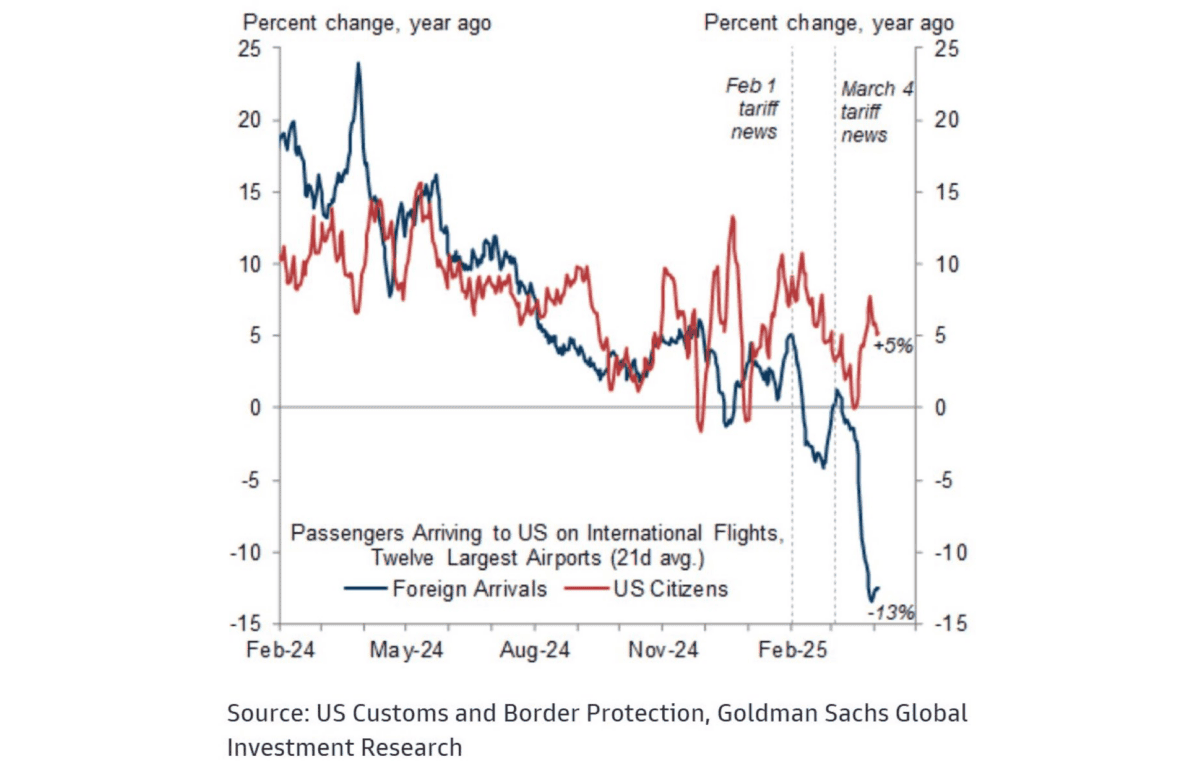
There’s a good chance IAG’s already witnessing weakening transatlantic demand. Tigher immigration rules, and widescale criticism of the controversial Trump presidency, are leading to reduced bookings on US-bound flights across the industry:

Source: Goldman Sachs

Other challenges

Other significant obstacles for IAG and its share price are more traditional. Industry competition remains a substantial threat to revenues and airlines’ profit margins.

This danger took on added significance for the FTSE 100 firm in March too, as it agreed to concessions on lucrative routes to and from Boston, Miami and Chicago. IAG’s British Airways, Aer Lingus and Iberia plan to surrender London airport slots aims to soothe concerns of the UK competition watchdog.

Finally, company profits are vulnerable to travel infrastructure problems over which they have no control. Strikes by airport staff have long been a problem across IAG’s routes. Power outages at Heathrow — and subsequent flight cancellations said to have cost airlines up to £100m — have been a more recent hazard.

Risk vs reward

Yet investing in IAG shares also comes with some opportunities. The global commercial aviation market is tipped to grow substantially over the long term, driven by booming emerging markets. And heavyweight brands like British Airways give the Footsie company a great chance to exploit this.

Airbus also forecasts global air traffic will more than double over the next 20 years.

Yet on balance, I still believe IAG shares carry too much risk, even at current prices. The company now trades on a price-to-earnings (P/E) ratio of 4.2 times, which I think fairly reflects the huge challenges it faces.

There’s no shortage of cheap quality shares to buy following recent market volatility. So I think investors should consider adding other shares to their portfolios.

How much passive income could a £20k Stocks and Shares ISA earn?

Stuffing a Stocks and Shares ISA with dividend-paying shares is one way to set up passive income streams. It can potentially be lucrative – but how lucrative?

That depends on a few factors. Let’s go through them in turn.

How much to invest

The first is the amount invested. In this example I use £20k. If someone had less, they could use the same approach to earn passive income from a Stocks and Shares ISA, on a smaller scale.

The investing timescale

Next is the question of how long they will invest for. There are two ways of looking at this and they produce different results. The first is simply to take the dividends out as they come.

A second approach is to reinvest them (known as compounding). That would mean no dividends for some time, during which the investment would hopefully grow, increasing the annual flow of dividends down the line for the patient investor.

Dividend yield

To bring that to life, I will introduce another factor that affects how much passive income an investor could hope to generate from a Stocks and Shares ISA, namely dividend yield.

Yield is basically the annual dividends earned expressed as a percentage of the investment. At the moment, the current FTSE 100 dividend yield is 3.4%. In today’s market, while sticking to quality blue-chip shares, I think it is possible to target a 7% yield.

If drawing dividends as they come, a 7% yield on a £20k Stocks and Shares ISA would mean £1,400 in annual passive income. Compounding for 20 years without withdrawing dividends though, the ISA would grow to a point where 7% each year would equal £5,654 in passive income each year.

That example presumes constant share prices and dividends, by the way. In practice, either could move up – or down. That is one reason I think it is wise to diversify across different shares. And £20k is enough to do that.

Finding shares to buy

One share I think investors should consider is Legal & General (LSE: LGEN). The FTSE 100 financial services powerhouse plans to grow its dividend by 2% annually in years to come. Whether it manages to do that depends on business performance. One risk I see is turbulent markets scaring investors and leading them to withdraw funds, hurting profits.

But the company has a large target market, sizeable customer base and powerful brand build over centuries. While earnings have weakened in recent years and the company has a proven business model and is solidly profitable.

Note that I did not start with yield. Remember, dividends are never guaranteed and my primary focus is identifying solid companies with attractive share prices. Only then do I pay attention to yield.

Still, Legal & General’s 9.3% dividend yield is well above the 7% target in my example.

Keeping fees and costs under control

Another variable is how much of the Stocks and Shares ISA gets eaten up with fees, charges, commissions, stamp duty and other costs. So it makes sense for an investor to compare some of the many Stocks and Shares ISAs available when deciding which one is most appropriate for their own circumstances.

1 S&P 500 stock to consider buying in a recession

The standard way to invest in a recession is to buy shares in companies that make things people need and stay away from cyclicals. But with the S&P 500, things aren’t so simple.

There’s no question the US has some quality defensive names, but these often come with prohibitively high price tags. There’s one however, that I think’s worth a look. 

Rubbish

Even in a recession, people keep producing rubbish. And Waste Management‘s (NYSE:WM) the biggest business that makes money by dealing with this.

As its name suggests, the company collects and processes waste products. And its no secret that the firm has a dominant market position in an industry that’s likely to grow over time.

The stock generally trades at a price-to-earnings (P/E) ratio well above the S&P 500 average. But despite this, it has generated terrific returns for long-term investors. Over the last five years, the stock’s up 127%, compared to 89% for the index. So the firm’s predictable cash flows haven’t come at the expense of total returns.

Growth and competition

Waste Management might be one of the most difficult businesses to compete with in the S&P 500. Possibly the firm’s biggest competitive advantage is its scale. An extensive network of collection vehicles and processing infrastructure gives the firm an edge when it comes to costs. And it creates a barrier major for competitors.

Waste Management also has scope for growth that shouldn’t be underestimated. Part of this involves increasing prices to offset inflation, but its prospects go much further than this. A global push towards sustainability incentivises the firm to develop initiatives that support this. And this looks like a durable trend that could support long-term growth. 

Risks

It’s difficult to see much to dislike about Waste Management from an investment perspective. It’s hard to compete with and demand isn’t going away. 

The biggest risk, in my view, is regulation. Changing legislation around the way things are disposed of could force the company to invest to change its existing practices. Waste Management isn’t directly regulated like a utilities company. But there’s enough interaction with local governments for this to be a meaningful risk for the firm.

In other words, while the regulated nature of the industry has the effect of raising the barrier to entry for competitors, it’s also a challenge. And investors should keep this in mind. 

Recession resistance

It’s very rare that I think investors should consider paying a high price for predictable earnings. But Waste Management is the exception that proves the rule. The fact a business has been successful in the past is no guarantee of future returns. But it’s hard to see a meaningful challenge to the company’s position any time soon.

That’s why I think the stock might be one for investors looking for recession protection to consider. A strong position in a predictable industry is an asset in any environment.

I own the FTSE 350’s highest-yielding dividend share. So why am I concerned?

On paper, Harbour Energy (LSE:HBR) is the best dividend share to own right now. Based on its 2024 payout of 26.19 cents per share (19.96p at current exchange rates), the stock’s currently (11 April) yielding an impressive 12.9%. According to Trading View, this beats all others on the FTSE 350.

As a shareholder, this should make me happy. After all, where else could I earn a return like this? At the moment, high-interest savings accounts, government bonds and rental yields don’t come close to this figure.

But I’m not happy. In fact, I’m a little concerned.

Difficult times

That’s because the stock’s current yield is only relevant for those who buy today.

I first invested a few years ago, when the share price was much higher. Since April 2020, it’s fallen by 75%. Although I’m not sitting on such a big paper loss, my yield’s closer to 6%.

Okay, this is still much better than the FTSE 250 average of 3.65%. But the generous dividends I’ve received don’t adequately compensate me for the loss of capital.

And the sharp decline in the share price shows no sign of slowing. Over the past six months, it’s down over 40%.

Some will point to a fall in the oil price as the principal cause. But this isn’t the full story. Sometimes, stocks fall out of favour for no obvious reason.

Brent crude only started to tumble as a result of President Trump’s on-off tariff policy. Since the start of April, it’s tanked 15%. Until then, it had been relatively stable over the past year or so. However, the threat of a global ‘trade war’ is weighing heavily on the price of oil.

And a falling oil price means lower earnings for Harbour Energy. In March, the group confirmed that, for its 2025 financial year, it intended to return at least $455m to shareholders by way of dividend.

This was underpinned by an expectation — based on an oil price of $80 a barrel and a European gas price of $13 per mscf (thousand standard cubic feet) — that it would generate $1bn of free cash, before shareholder distributions.

However, the company also disclosed that this level of cash will change by +/- $100m for every $5 movement in the oil price and $1 variation in the gas price.

Brent crude is currently trading at $63. If this persists for 12 months, the group’s free cash flow will be $340m lower. Fortunately, gas remains in line with the group’s planning assumption.

What does this mean?

In my opinion, this highlights the biggest risk associated with investing in energy stocks, namely potentially volatile earnings. This makes dividends particularly precarious in the sector.

I still think Harbour Energy has plenty going for it. Following its recent acquisition of the Wintershall Dea portfolio, it’s no longer reliant on the North Sea. Some of its earnings now fall outside the scope of the UK government’s ‘windfall tax’. Also, its operating costs have fallen as a result of the deal.

And although I’m not earning a near-13% yield, income investors could consider the stock for its generous return. However, they should be aware of the industry-specific risks and be mindful that if the oil price remains at its current level (or lower), the group’s dividend may come under pressure.  

Here’s the FTSE 100 stock UK investors have been buying and selling this week

Volatile share prices have created a lot of stock market interest this week. But while the big moves have come from the US, UK investors have been focusing on the FTSE 100

Data from AJ Bell and Hargreaves Lansdown indicates that UK retail investors have been focusing on a handful of names. And one in particular stands out.

Buying and selling

In terms of what investors have been buying, the lists are identical. Barclays and Rolls-Royce (LSE:RR) appear in opposite orders, but the five FTSE 100 names are the same.

Most popular shares bought by number of deals

AJ Bell Hargreaves Lansdown
1 Barclays Nvidia
2 Nvidia Rolls-Royce
3 Legal & General Legal & General
4 Rolls-Royce Barclays
5 BP BP

Where things get really interesting though, is in terms of what investors have been selling. Rolls-Royce also appears to be the stock with the most sell orders from customers this week.

Most popular shares sold by number of deals

AJ Bell Hargreaves Lansdown
1 Rolls-Royce Rolls-Royce
2 Nvidia Nvidia
3 BAE Systems Lloyds Banking Group
4 Lloyds Banking Group International Consolidated Airlines Group
5 Amazon Scottish Mortgage Investment Trust

It’s been an interesting week for the Rolls-Royce share price. The stock fell 21% before staging a 35% comeback, so investors have had chances to make – or lose – money in the short term.

For those with a long-term outlook though, I think it’s a reminder of the risks with the business. The stock’s been outstanding recently, but things can turn around quickly.

Recession risk

The possibility of a recession in the US is a significant risk for Rolls-Royce. Demand for air travel’s likely to drop in an economic slowdown and this is the company’s largest division.

In terms of tariffs, the picture’s a bit less clear. The company does have a significant manufacturing base in the US, which should help reduce the effect of tariffs.

Despite this, it’s probably worth noting that its largest competitor – GE Aerospace – has a bigger presence. So tariffs might tilt things in favour of the FTSE 100 firm’s rival. 

Most importantly, none of this is under Rolls-Royce’s control. While all businesses face risks, it’s worth noting the extent to which the company depends on something it can’t influence.

Long-term investing

Investors with a long-term perspective however, might take a different view. When I buy shares, I intend to hold them for decades and I think a recession’s likely at some point. 

That’s not to say the issue can be ignored entirely. If the company’s going to make less money because of a difficult macroeconomic environment, that’s relevant to what the stock’s worth.

My view with Rolls-Royce is that things are rarely as good or as bad as they seem. The firm operates in an industry where demand is naturally cyclical and investors have to factor this in.

Even with the big drop earlier this week, the stock still traded at a price-to-earnings (P/E) ratio of around 20. Given that things have been going well for the firm recently, I think that’s high. 

Independent thinking

I’ve been taking the opportunity to buy a FTSE 100 stock for my portfolio this week — but it isn’t Rolls-Royce. I can understand the recent interest, but I think there are better options available for me.

Should I buy US or UK stocks for my SIPP portfolio?

A Self-Invested Personal Pension (SIPP) can be a great way to boost a retirement pot. These DIY pension accounts offer a wide range of investing options, including exchange-traded funds (ETFs), investment trusts, and stocks.

But is it best to buy UK or US stocks? Here’s what I think.

New York

Put simply, there’s no right or wrong answer. But a lot will depend on what age someone is. I still have a couple of decades left before retirement age, so my own SIPP’s still largely oriented towards growth stocks, many of which are in the US.

Why not UK growth stocks? Because there are just not as many options for growth-focused investors this side of the pond. Most of the world’s best growth companies — those changing the world around us — are listed in New York.

Having said that, I do have a small handful of UK growth stocks in my SIPP, including subsea rental firm Ashtead Technology and DP Poland (the owner of the Domino’s Pizza brand in Poland). But these are small holdings compared with the rest.

A stock example

One of my largest SIPP holdings is Axon Enterprise (NASDAQ: AXON). This stock’s done really well for me over the past eight years or so. It’s up nearly 150% in the past two years alone!

What attracted me to Axon was the strength of its competitive position. It sells Tasers to law enforcement agencies around the world, as well as body cameras and various software solutions.

The newer Taser models can activate the body-worn cameras when fired by officers, directly sending the footage to Axon’s cloud-based evidence management platform. Needless to say, this creates a powerful ecosystem, making Axon’s products mission-critical to thousands of law enforcement and public safety agencies worldwide.

In 2024, the company’s revenue jumped 33% year on year to $2.1bn, while total future contracted bookings surged to $10.1bn. For context, Axon now puts its total addressable market at $129bn.

Even if that proves overly optimistic, it shows the magnitude of the opportunity ahead of the firm over the next couple of decades. Its rapid entry into artificial intelligence (AI) is also exciting, as it has mountains of real-world data with which to build AI products and solutions.

Of course, the stock’s not risk free. It’s trading at 85 times forward earnings. At this rich valuation, a lot of future growth is baked in. This means Axon will have to deliver on that growth or the valuation could pull back sharply.

However, this is exactly the type of high-growth company I want in my retirement portfolio over the long term.

Leaning into London

As I get older though, I’ve started to add more dividend stocks to the mix. This is the UK market’s strong point, as it’s packed full of income shares.

My FTSE 100 holdings include Legal & General, Aviva, and British American Tobacco. These yield 9.3%, 7.2% and 7.7% respectively.

According to AJ Bell, FTSE 100 companies are expected to dish out a whopping £83bn in dividends this year, up 5% from 2024. This puts the blue-chip index on a forward dividend yield of 3.7%.

Obviously I can’t spend the dividends I receive in my SIPP. So I put the cash back to work by reinvesting it into more stocks.

ChatGPT just recommended this potentially explosive penny stock

When exploring the world of penny stocks, tools like ChatGPT can be helpful in discovering under-the-radar stocks. And upon asking it about the best UK penny stocks to buy, the artificial intelligence (AI) model suggested taking a look at Helium One Global (LSE:HE1).

A few years ago, this enterprise was getting a lot of attention, with its shares surging by over 500% in less than a year following its IPO in late 2020. The momentum was driven almost entirely by the hype surrounding the group’s helium exploration projects that could position the firm to become a global industry titan in the long run.

Sadly, following the 2022 stock market correction, the hype fizzled out as investors started to realise the group still had a long way to go. Now, three years later, the stock’s down over 95% from its 2021 peak. And even in the last 12 months, the shares have continued their downward trajectory, falling by 50% to less than 1p.

However, could that soon be about to change?

Production on the horizon

One of the biggest risks surrounding this enterprise is a lack of a revenue stream. With no active production generating cash flow, management’s entirely dependent on external equity financing and its residual cash on the balance sheet.

As of December, the firm had just $10m in the bank. Needless to say, that’s not enough to fund the high cost of exploration and project development. So it should come as no surprise that the number of shares outstanding over the last five years has skyrocketed by over 2,700%, due to management raising more money by issuing shares.

However, this equity dilution may soon be coming to an end. 2025 has proven to be a solid year of operational milestones. In March, the company secured its mining license in Tanzania for its flagship Rukwa project. A few weeks later, intermediate drilling at the Jackson-29 well (in which Helium One has a 50% working interest) was sucessfully completed.

In terms of the next steps, Jackson-29 will undergo safety tests to verify well integrity which, if successful, will make it ready to enter and move into the production phase. In other words, Helium One’s finally on track to gain revenue stream.

Taking a step back

Reaching production is an impressive milestone that most young exploration companies fail to achieve. And while Helium One still has some challenges to overcome, it appears to be taking the right steps. However, it’s important to remember that this transition process won’t happen overnight.

Even if everything goes smoothly at Jackson-29, building a production facility could potentially take years, especially if infrastructure (roads, power, water, etc) also needs to be built out. And it’s a similar story to the other projects in Helium One’s portfolio.

There’s no denying the explosive potential of Helium One’s share price. After all, helium gas is steadily rising in demand thanks to its aerospace and medical applications. But a lot of things have to go right before the firm can realise this potential.

So while ChatGPT’s bullish, I’ll be waiting on the sidelines until this penny stock makes more progress.

With yields of 7.6%, 9% and 9.3%, here are 3 juicy passive income stocks to consider!

I think those on the hunt for healthy passive income streams could take a closer look at these FTSE 100 dividend stocks. Although returns to shareholders may fluctuate with earnings, the track records of these blue-chip companies suggests they’re in a good position to cope with whatever challenges they may face.

Going up in smoke?

Ethical investors look away now but, over the past four quarters, British American Tobacco (LSE:BATS) has returned 236.7p to shareholders by way of dividends. This implies an impressive yield of 7.6%.

The group has a long track record of increasing payouts too. By selling an addictive product that’s cheap to make, it’s able to generate huge amounts of surplus cash.

However, for health reasons, the company’s transitioning to making things other than cigarettes. This requires significant capital expenditure. Also, these so-called ‘reduced-risk products’ are more expensive to produce. Over the longer term, this could mean less cash for dividends.

But despite these challenges, the company increased its earnings per share in 2024. This suggests that reports of the death of the tobacco industry have been greatly exaggerated.

Raising the roof

Despite well-documented problems in the housing market, Taylor Wimpey (LSE:TW.) still declared a dividend of 9.46p in respect of its 2024 financial year. That’s a 10.2% increase on 2021. And it means the stock’s currently yielding 9%, the fourth-highest on the FTSE 100.

The company aims to return 7.5% of net assets, subject to a minimum of £250m, to shareholders each year. It’s able to do this as it has very little debt on its balance sheet.

However, the housebuilder’s payout could come under threat if interest rates don’t fall as anticipated. The availability of affordable mortgages is a key driver of housing market growth. Also, building cost inflation remains stubbornly higher than the general rate of price increases.

But the government’s planning reforms — and reliance on the construction sector to get the UK economy growing again — should help Taylor Wimpey maintain its dividend in the medium term. Analysts are expecting payouts of 9.4p (2025) and 9.5p (2026) over the next couple of years.

One for a rainy day?

Legal & General (LSE:LGEN) last cut its dividend in 2008. For 2024, it’s declared 21.36p a share. In cash terms, that’s 21.6% higher than in 2020. Coupled with a stagnant share price performance over the past five years, this has helped push the yield to 9.3%. The directors of the financial services group have pledged to increase this by 2% a year from 2025-2027.

But earnings (and its dividend) could be impacted by falling interest rates. This would make annuities less attractive to pensioners. Also, it carries over £200bn of equities on its balance sheet. Volatile markets could weaken its financial position.

However, the group has an enormous pipeline (£44bn) of pension funds that it’s looking to acquire. And its store of future profit from its insurance arm is currently worth more than the group’s market-cap. Also, the UK’s ageing population could boost the demand for retirement products.

For these reasons, although there are never any guarantees, its dividend looks secure for now.

Financial News

Daily News on Investing, Personal Finance, Markets, and more!

Financial News

Policy(Required)