This ETF has soared 40% in 2025! Is it a safe haven from stock market sell-offs?

Stock market investors have been treated to a white-knuckle ride in April. It’s been a month characterised by moments of fear, euphoria, wild volatility, and enormous share price swings thanks to Trump’s tariffs roller coaster. Consequently, both the FTSE 100 and S&P 500 are in the red for 2025 thus far.

But one ‘safe haven’ asset is proving its mettle amid massive stock market turbulence. The gold price recently reached a new record high above $3,200 per ounce. Many analysts believe bullion could continue to rise in the months and years ahead.

VanEck Junior Gold Miners UCITS ETF (LSE:GDXJ) is an exchange-traded fund (ETF) that offers exposure to the gold mining sector. Here’s why it’s worth considering in today’s challenging investing environment.

A unique form of gold exposure

Investing in gold mining stocks presents different opportunities and risks than buying the pure commodity itself. Naturally, there’s a strong correlation between the price of gold and the share prices of companies that mine the precious metal.

But gold miners can sometimes outperform or underperform price movements in physical gold. Due to operational performance, production costs, and leveraged gold exposure, mining firms have distinct dynamics for investors to bear in mind.

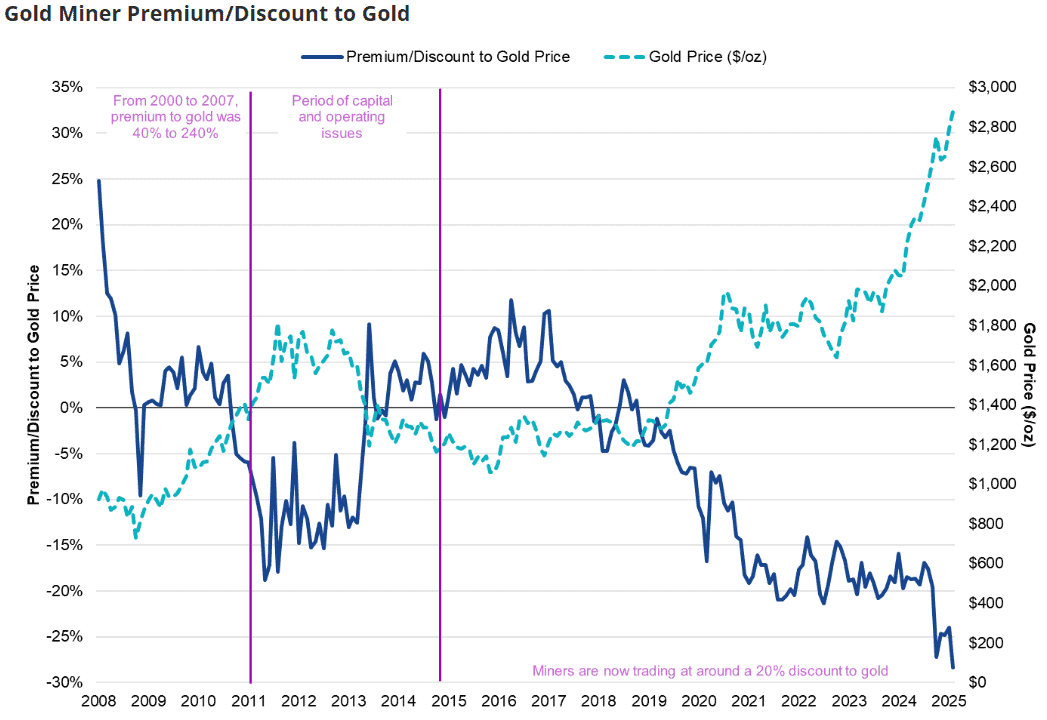
In recent years, a significant discount has emerged between gold miners and the yellow metal. This suggests there could be a potential value investment opportunity in gold mining shares today. The gulf may start to narrow.

Source: VanEck, Scotiabank

Investing in early-stage miners

The VanEck Junior Gold Miners UCITS ETF is the only fund of its kind available in Europe. It offers exposure to smaller mining stocks, “some of which are in the early stages of exploration“.

Just under 59% of the 84 companies in the ETF’s stock market portfolio are defined as mid-cap stocks, valued between $3bn and $20bn. Some familiar examples from the FTSE 100 index include Endeavour Mining and Fresnillo. The remaining share holdings have market caps below $3bn.

Investing in companies in the early stages of their growth cycles can be attractive since there’s potential for takeovers by larger producers. Often, shareholders stand to benefit from such moves. Acquisition targets can experience share price spikes during negotiations, although this isn’t always the case.

However, such firms also have higher share price volatility than more mature miners. They also carry greater risks of default and can be less competitive.

Shelter from the stock market storm?

Gold mining stocks often experience price fluctuations that are independent of broad market cycles. In times of uncertainty, these firms can benefit from investor anxiety. As we’ve seen this year, capital can rapidly flow from other areas of the market into safe haven assets.

That said, VanEck’s ETF isn’t immune to current difficulties. Nearly 48% of the portfolio is concentrated in Canadian gold mining companies. These businesses rely on the US as a major export destination.

Trump’s decision to impose 25% tariffs on Canadian imports could make gold from the country inordinately expensive for American refiners and jewellers.

Nonetheless, I think this ETF could be a handy portfolio addition to consider. I wouldn’t want to be overly exposed to gold miners, but they can offer useful diversification for investors concerned about wealth preservation in today’s choppy stock market.


Is it too late to buy this surging FTSE 100 stock?

In the two trading days following Liberation Day (2 April), the Fresnillo (LSE: FRES) share price fell 14%. That turned out to be an incredible buy-the-dip moment, as this FTSE 100 stock has risen 29% since then. But is the move over, or can it continue to move higher?

Star performer

I have been banging the drum on Fresnillo for some time now. In just over a year, it has risen 142%, making it one of the FTSE 100’s best performers. As gold prices have surged to successive record highs, investors are beginning to wake up to how cheap the stock is.

At its FY24 results back in March, the miner highlighted just how much of a cash cow it had become. Net cash from operating activities surged 205% to $1.3bn.

Last year, the average realised price for the gold it sold was $2,453, and for silver it was $28.78. To me, that provides some perspective about where its future earnings are heading.

Gold prices have consistently sat above $3,000 for some time. For each troy ounce of gold it mines, its all-in sustaining cost is $1,800. Adding on treatment and refining charges and ancillary expenses, and I estimate that Fresnillo’s profit today is in the ballpark of $1,000.

Silver move

In 2024, revenues between gold and silver were pretty much split 50:50. This is because it mines about 100 times more silver than gold. Indeed, it’s the world’s largest primary silver producer.

As a continued silver bull, what I find quite amazing is that Fresnillo’s price has stalled over the last few months. Who knows when its big move will come. But I remain convinced that it will pop. And history has taught us that when it does move, it’s literally a blink-and-miss movement.

Silver is a far more versatile metal than gold. As an industrial metal, it finds use in a multitude of different applications. With its excellent electrical conductivity, it’s a key component of solar photovoltaics, EVs, and supporting infrastructure for EV charging stations. It’s also a vital component of electronic goods and 5G networks.

Risks

The stock has moved so explosively lately, that any sizeable pullback in precious metals prices is likely to lead to a decline in the share price.

If metal prices should continue their inexorable rise, though, there is a real risk that governments may remove mining concessions or add burdensome regulations. We have already seen China halt exports of rare earth minerals to the US. As geopolitical tensions rise, gold and silver are increasingly becoming important strategic assets for nation states.

Ultimately, I believe that the stock will push higher in the years ahead. Should silver really break out, that’s when I would expect a major move. In the wake of the global financial crisis, soaring silver prices propelled the stock 22 times higher in just two years.

Over the past 10 years, sentiment towards precious metals miners has been atrocious. This is rapidly undoing, though, as more investors realise just how cheap the entire industry has become. I certainly have no intention of selling my holding any time soon. Indeed, if I didn’t hold such a sizeable position in my Stocks and Shares ISA, I would definitely be buying more.

Down 50%, this penny stock could reward patient investors

Chapel Down Group (LSE:CDGP) is a penny stock listed on the London Stock Exchange. As with any penny stock, the investment risks are heightened. These are small companies that offer high-growth opportunities, but with plenty of risks attached. They can be volatile, but trading volume is typically low.

Personally, I think this company has built such a strong brand that it shouldn’t fail. Served at royal weddings and as the sponsor of the Boat Race, it has cemented itself as a household name among its socio-economic target market. There are no guarantees, of course, but let’s take a closer look.

A growing business

Benefitting from climate change, which allows Chardonnay and Pinot Noir grapes to thrive in English vineyards, Chapel Down has emerged as the largest UK producer. It holds approximately 10% of the UK’s total planted vineyard acreage with 1,024 acres.

Net sales revenues totalled £16.4m in 2024. That’s down 5% on the year before, but fourth-quarter sales were up 7% year on year. In fact, excluding the now-exited spirits business,  fourth-quarter revenues would have been 10% higher than last year. According to management, this positive momentum is said to have carried into the new year.

Looking forward, the forecasts provided by analysts suggest that revenue could reach £19m in 2025 and £22m in 2026. This would reflect strong double-digit earnings growth. This is a core sign of the strength of the brand and health of the business.

The weather plays a role

Unsurprisingly, weather still plays a massive role in wine production. The 2024 harvest at Chapel Down was significantly smaller than the previous year, with approximately 1,875 tonnes produced, compared to 3,811 tonnes in the “exceptional” 2023 harvest. Thankfully, what we’ve had already in 2025 could be fairly conducive to a good harvest this year.

That was one thing that weighed on the share price. Another is that plans to put the company up for sale have been abandoned, placing downward pressure on the stock. This is still very much a business in the growth phase. And some investors had been holding on until a larger business bought the company, hopefully for a handsome premium. And with a market cap of £66m, it’s certainly not a big business.

However, the current owners are taking the firm forward themselves. The company’s expansion plans, including the £32m Canterbury winery expansion, aim to increase production capacity to 9m bottles annually by 2032, up from 1.5m in 2021. This is a significant investment, which will see net debt grow from around £9m to around £14.6m by 2026.

But this could deliver the economies of scale that Chapel Down needs to be successful and grow into its valuation.

The bottom line

It’s a stock I’ve been interested in. That’s partially because shareholders with 2,000+ shares receive a 33% discount on full-priced wines purchased directly from Chapel Down. Moreover, noting around £33m in net assets, there’s evidence it could start to look undervalued in the near future if its sales growth is sustained — which I think it will be.

One concern, however, is the trading volume. It’s not really on many investors’ radar and it may take a while for good news to be recognised within the stock price. Personally, I’m just keeping a close eye on this one for now.

Where next for the Tesla share price? 2025 is set to be a make or break year

Volatility has been widespread in recent months, but the Tesla (NASDAQ:TSLA) share price has been exceptionally choppy. In fact, the company’s market cap peaked at $1.54trn in December, and has since fallen below half that figure. Just take a minute to think about the sheer flow of capital in and out of the stock. It’s astonishing.

Why is 2025 so important for Tesla?

2025 is turning into a significant year for Tesla. It’s a year that’s already marked by both challenges and bold ambitions. First, the company is facing its steepest decline in vehicle deliveries to date, with sales plunging 13% in the first quarter. That’s its largest drop ever. Tesla delivered 336,681 vehicles in the first three months of 2025, down from 386,810 a year earlier. What’s more, it saw a staggering 49% fall in European sales in January and February, even as the EV market on the continent grew. This downturn is attributed to growing competition, a backlash against CEO Elon Musk, and public protests, all of which have dented Tesla’s appeal and market share.

Despite these setbacks, 2025 is also the year Tesla needs to deliver on its future value-drivers: autonomous vehicles and robotics. The company continues to make progress in Full Self-Driving (FSD) technology, with its vehicles now autonomously navigating factory lots and accumulating over 50,000 driverless miles between its California and Texas facilities. Tesla is also preparing to launch its first Robotaxi network. It aims to be the first to offer a generalised, pure AI solution to autonomy, which could redefine urban mobility and transportation economics.

Equally transformative, but often overlooked, is its push into robotics. The company plans to produce 10,000 Optimus humanoid robots this year. They’re initially for factory use but with ambitions for broader industrial and commercial deployment. Robotics is arguably the next big tangible development in artificial intelligence (AI) and Tesla believes it can lead, with the company targeting a sub-$20,000 price point as production scales.

It won’t be easy

My concern with the Tesla valuation, which is around 100 times forward earnings, is the assumption that the company can execute its plans flawlessly. It’s worth remembering that Waymo, owned by Alphabet, is already operating its robotaxi fleet in five locations around the US. Additionally, Chinese carmakers are also developing their own autonomous vehicle projects. Tesla’s non-LiDAR (vision only) approach will have to outperform its peers if the company is going to truly dominate.

And with regard to robotics, I need to see more to believe adoption is going to be game-changing. The latest update video, released in April 2025, shows Optimus walking with a much more human-like gait. This is thanks to reinforcement learning rather than hand-coded choreography. The robot now weighs 138 pounds and is powered by a 2.3kWh battery using Tesla’s high-density 4680 cells. It can operate for 8-10 hours continuously, recharging itself autonomously in just 10 minutes.

As has long been the case, I want Tesla to succeed. However, I’m struggling to put my own money behind it. If it fails to execute, this expensive stock could tank.

2 UK shares that could be significantly impacted by the new tariff rumours

On Monday (14 April), the US announced new semiconductor and pharmaceutical import probes. This is likely a precursor to sector-specific tariffs from the Trump administration. Although exact details on tariff sizes are yet to be confirmed, some UK shares could be negatively affected. Here are two that are at the top of my list.

Supply chain issues

AstraZeneca (LSE:AZN) is one of the most prominent global players in the pharmaceutical space. The stock is down 14% in the last month and down 7% in the past year. The short-term move already reflects some concern from investors about the impact of the new US trade policies.

In short, the US is AstraZeneca’s largest market. The company manufactures and exports a range of drugs to the US, including treatments for cancer and respiratory diseases. Therefore, President Trump’s proposed tariffs on pharmaceutical imports could directly affect revenue.

Historically, drugs have been exempt from global tariffs due to their life-saving nature. Yet this doesn’t appear to apply right now, with chatter over the past week indicating that import levies are definitely going to happen for this sector.

The company does indeed have US manufacturing facilities, such as in Maryland and Delaware. It could respond by expanding domestic production to limit import charges. Further, it could look to absorb the tariff costs, meaning that consumer demand stays high. However, I think it’s going to be a tough year ahead for the company to navigate the supply chain workarounds.

Penny stock woes

A second company in the spotlight is IQE (LSE:IQE). The penny stock has a market cap of £92m and has lost 66% of value in the past year. IQE is a leading supplier of semiconductor components used in various electronic devices.

The company has significant operations and customer bases in the US, including partnerships with major tech firms. For example, it supplies products directly to companies, which then add components and sell to Apple. So, the impact that Apple is feeling right now, with tariff headaches with China, could filter down to lower demand for IQE.

Aside from this, the tariffs will impact the company more directly from its exports to the US. It’s not a large business, so I struggle to see it being able to invest in making a new production facility in America (it currently is based in Cardiff).

On the other hand, the share price could rally in the future as the products are in demand for various AI projects. This is the future, so some significant contract wins could cause investors to get excited. However, right now I think the import levy concerns are front of mind for many.

Overall, I’m staying away from both companies given the current headline news and feel there are better investing options elsehwere.

2 UK dividend shares that look dirt cheap right now

I’m always hunting for cheap dividend shares to add to my passive income portfolio. When prices rise, yields dip — but when the opposite happens, dividend stocks become very attractive. Grabbing some high-yielding, undervalued shares just before the ex-dividend date1 can lead to a handsome payout! 

But it’s also important to think long term. If an undervalued stock doesn’t have recovery potential, it could be all for nothing.

With that in mind, here are two UK dividend stocks that look cheap right now. I’m keen to find out where they might be in a year.

Imperial Brands

Imperial Brands (LSE: IMB) is a UK multinational tobacco company known for Winston cigarettes and Backwoods cigars. It’s been pivoting towards less harmful next-gen products (NGPs) like vapes and e-cigarettes. The dividend yield is a decent 5.3% with a payout ratio of 51% — more than enough coverage.

But declining smoking rates and evolving regulatory landscapes are challenges the company has faced. Although the transition to NGPs is promising, they’re currently loss-making and their long-term profitability is uncertain. Subsequently, the company has run up £9bn in debt which puts profits (and dividend payments) at risk.

Still, earnings beat expectations last year and its net margin has increased from 9% to 14% since 2022.

With a below-average price-to-earnings (P/E) ratio of only 9, it looks like it has space for more growth. Plus, it’s trading at 44% below value using a discounted cash flow model. That’s impressive, considering the stock is up 69% in the past year – somehow, it still looks cheap!

If that performance continues, it could be a lucrative passive income machine in the future. So I think it’s a strong dividend stock that’s worth looking into now.

Paypoint

Paypoint (LSE: PAY) is a £444m FTSE 250 company specialising in multichannel payment and retail services. Many Britons use its services on a daily basis without even realising it.

The business operates across four main divisions: shopping, e-commerce, payments and vouchers.​ It provides digital solutions and payment services to small and medium-sized enterprises (SMEs), along with Open Banking services for payments via direct debit, cards and cash.

Being in the finance sector, it faces specific challenges from economic downturns and regulatory changes, not to mention strong competition. It’s also at risk of technological advancements that could render its services obsolete.

Performance in 2024 was impressive though, with underlying EBITDA up 32.6% and profit before tax up 21.5%. The dividend yield sits at 6.3% and it has a trailing P/E ratio of 11.43. Its otherwise solid dividend track record was dented by reductions in 2019 and 2021. However, dividends have still grown at an annual rate of 4.84% over the past 15 years.

To further affirm its dedication to shareholders, it recently announced a three-year £20m share buyback programme.

Why these stocks?

The above stocks were chosen based on their dividend history, financial performance and low valuation. Plus, their future return on equity (ROE) is forecast to be above 30%.

These metrics are used to reveal companies that are trading below their intrinsic value and have good growth potential. I believe they are both well worth considering as part of a long-term passive income investment strategy.

1 The ex-dividend date is the date before which an investor buying shares will qualify for that period’s dividend.

Here are the latest forecasts for Lloyds shares out to 2027

Lloyds Banking Group (LSE: LLOY) shares have had a rocky couple of weeks since the US fired a salvo of tariffs at its key trading partners around the world.

The Lloyds share price has been moving up and down almost as quickly as the words from the White House have been changing.

Forecast uncertainty

It makes things tricky for private investors. And it’s good to remember that the City’s professional analysts don’t really have it any easier at times like this.

Forecasts for the current year put Lloyds shares on a price-to-earnings (P/E) ratio of about 10.5. In normal circumstances I’d see that as cheap. I expect banks to be valued more lowly than the FTSE 100 average in tough economic times, as they can’t really do anything other than sit there and take the hit. But that might be too little.

Is it lower because of the risk from the car loan mis-selling case at the Supreme Court? I’m sure it is, but I don’t know by how much. I’d presume the brokers have allowed for the £1,150m the bank has already set aside.

How many have allowed for further damage, to cover fears that the case could cost a lot more than that? It’s impossible to tell. But in their place I’d be lowering my outlook to some degree based on the worst case.

Unknown unknowns

How much of the US tariff uncertainty has been included in the current City outlook? I’d suspect none yet, as it can take weeks for them to work out their new projections and set new targets. Or decide which finger to stick in the air this time, depending on one’s take on their methods!

The one thing I’m sure of is that I’ve no idea what the Trump administration will come up with next. And never mind the answers to any questions, I don’t even know what the next questions might be.

With all this uncertainty, I’d want to see a valuation for Lloyds that leaves a fair bit of safety margin. And it actually might be there.

Forecasts see earnings per share (EPS) rising enough in 2026 to take the P/E down to under eight. And for 2027 we see forecasts dropping it to 6.5. Unless things go catastrophically wrong, that could make the current share price turn out to be a steal.

What can go wrong?

The trouble is, the UK’s banks seem to be adept at pulling a fresh catastrophe out of the bag when it’s least expected. I’ve changed from hoping there’ll never be another mis-selling scandal to wondering what the next one might be.

With so much in the air, I’m not surprised some analysts have moved to Hold from Buy on Lloyds. I echo them. Right now, I intend to hold my Lloyds shares. And I won’t consider buying more until at least July. That’s the soonest the Supreme Court said to expect its judgement.

The consensus price target stands at 76p, just 8.6% ahead of the price at the time of writing. It seems they’re not expecting much short-term share price action.

2 beaten-down FTSE 100 growth shares that could stage explosive recoveries

If there’s one good thing to come from all the trade tariff shenanigans we’ve witnessed in April, it’s that a number of quality UK growth shares now trade at pretty irresistible prices. Let’s touch on two from the FTSE 100 that might just recover very strongly in time and are worth considering.

Poor form

Shares in JD Sports Fashion (LSE: JD) weren’t exactly in fine fettle before the general market sell-off. Reduced profits at US titan Nike — which makes up approximately half of the UK’s company’s sales — was already taking a toll.

Since then, things have only gone from bad to worse as investors have fretted over the impact of tariffs on production costs and supply chains should Donald Trump follow through on his original plan.

As of today (15 April), JD is trading around 55% below the value it hit back in September 2024.

On a glass half-full note, this abject performance leaves the stock changing hands at a forecast price-to-earnings (P/E) ratio of less than six for FY26. That’s very low relative to the UK market as a whole. It’s also way down on the firm’s average P/E of 20 over the last five years.

So, there’s a chance new holders of this stock could make a magnificent return.

The key word in that last sentence is ‘could’. JD shares might move even lower. Even if those higher tariffs never materialise, there’s no guarantee that Nike will be able to address recent sales declines in quick fashion, especially if consumer confidence remains fragile.

Having said this, some reassuring commentary in May’s full-year numbers might be all that’s needed to bring out the buyers. Longer term, management’s efforts to expand JD’s presence in international markets (particularly North America) could pay off handsomely.

Another encouraging sign is that there seems to be very little interest from short sellers — those betting the shares have further to fall.

Right strategy, wrong time

Scottish Mortgage Investment Trust (LSE: SMT) certainly hasn’t fared as badly as JD Sports Fashion. The shares have fallen 9% year-to-date, only slightly worse than the S&P 500 index across the pond. Notwithstanding this, the price is down a lot from the 52-week high set in February when the US market peaked.

Most of the recent fall can surely be explained by the trust’s focus on finding and holding innovative growth stocks. Such a strategy was never going to be popular when many analysts turn bearish on the global economy.

I also wonder if its biggest holding — Elon Musk’s SpaceX — might be affecting sentiment. Regardless of how one feels about him, it’s tough to deny that Musk’s involvement in Donald Trump’s administration has taken his attention away from his various businesses.

Time to load up?

Again, it’s possible Scottish Mortgage shares could sink lower, especially if the public backlash against Musk continues. But does this invalidate its strategy in the long term? I’m not convinced. The rapid growth of all-things AI shows no sign of abating and could lead to the disruption of many sectors in the years ahead. The trust’s diversified portfolio should be able to take advantage of this.

Throw in the substantial discount to net asset value (NAV) and I think the shares warrant consideration.

Down 61%, is the Tullow Oil share price a potential bargain for contrarian investors?

The Tullow Oil (LSE:TLW) share price has fallen to just 14p as I write. That’s down from over £10 in the early part of the 2010s, and around £2 before the pandemic. Buy-and-hold investors over the past 15 years would have seen their investments reduced to almost nothing.

A different business model

Tullow Oil’s business model is distinct due to its focus on frontier hydrocarbon economies, largely in Africa. The company looked to leverage local skills and invest in their development, with hundreds of Ghanaian workers going on rotation to its Chiswick offices to gain more experience. The logic was that using local employees and suppliers was cheaper and gave back to the economy. I actually wrote my PhD on the topic and studied the company’s operations in Uganda.

Tullow had hoped to position itself as a nimble operator with a unique growth strategy tailored to emerging markets. However, things haven’t exactly gone to plan. Operating in frontier economies can be challenging, and taking Uganda as an example, progress toward first oil simply took too long. Uganda is expecting first oil this year, some 20 years after the discovery of commercial quantities of crude oil in the Albertine Graben basin. Tullow has since exited the market.

What’s happening now?

Tullow Oil made progress in 2024. The company returned to profitability with a $55m profit after tax, reversing a $110m loss in 2023. This turnaround was driven by strategic delivery, production optimisation, and debt reduction efforts. Revenue slightly declined to $1.54bn from $1.63bn, but adjusted EBITDAX remained stable at $1.15bn. Net debt was reduced to $1.45bn, lowering gearing to 1.3 times EBITDAX, while free cash flow reached $156m.

Operationally, Tullow optimised production at its Jubilee and TEN fields in Ghana, achieving 97% FPSO uptime — the time the FPSO was operational — and bringing five new wells onstream ahead of schedule and under budget. This represented a saving $88m. The company also resolved a $320m tax arbitration in Ghana and extended its revolving credit facility to mid-2025.

Clearly, lots of positives as the firm looks to bring its balance sheet under control and rationalise its operations. Looking ahead, Tullow plans to sell its Gabon assets for $300m and expects 2025 production to average 50,000–55,000 barrels per day.

A slave to global markets

I’m not perfectly sure what Tullow’s breakeven point is in 2025. However, estimates I’ve found online put it around $45 per barrel. Regardless of the exact figure, we can’t ignore the general weakness in oil prices at the moment. President Trump’s trade policies have put downward pressure on oil, and this, if sustained, will likely feed through to earnings later in the year. This is makes me a little concerned when we consider Tullow’s huge net debt position.

Personally, I think there’s too much risk here. Trump has vowed to keep oil prices low throughout his presidency. This could hurt indebted producers like Tullow more than others. That’s why I’m not buying.

Up 4% in a week, is this the end of the slump for Tesla stock?

After hitting its lowest level since the US Presidential election, Tesla (NASDAQ:TSLA) got a much-needed pop higher last week. So far in 2025, the stock is still down 34%, but over a broader one-year period, it’s up 56%. The volatility in the share price might put off some investors, but given the potential for a sharp move higher from here, it’s worth considering whether the worst of the rout is now behind us.

The case for staying away

Some might feel this is a short-term relief rally that will fade in the coming weeks. One reason for this is that the uncertainty that exists with the US tariff situation hasn’t gone away. Almost every day, there seem to be headlines about a change of direction. This is driving the higher and lower swings and movements in Tesla stock. So, although the past few days have brought relief with a 90-day tariff pause and hopes of trade deals, this could quickly revert to fears around trade wars with other nations like China.

Tesla is exposed to the overall tariff uncertainty because China is the largest EV market globally. Higher import levies will make the company less competitive. The other problem is that Tesla relies on importing some car parts from abroad, from countries that could face higher tariffs. This could increase the cost of production, even for cars sold within the US. Again, this could hurt earnings further down the line.

Finally, some investors might be worried about the distraction for CEO Elon Musk given his close ties and roles within the US government. If his focus is diverted from Tesla, it could be bad for the US stock.

The case for buying

On the other hand, this could be considered a great purchase right now. The business has already taken steps to counter potential tariff impacts. For example, it has removed some models for sale from the Chinese website. To try and stimulate demand back in the US, a new cyber truck variant has been released, which is $10k cheaper than the existing base model.

Further, Tesla is pushing rapidly ahead with other projects that reduce its reliance on selling conventional EVs. This includes the increased adoption of robotaxis, along with the development of Optimus, the humanoid robot. These, and other, initiatives should diversify investor risk by offering other sources of revenue in the coming years. It creates a larger target market size, which in turn increases the potential earnings and therefore company valuation.

Making a call

Right now, there’s too much uncertainty regarding tariffs to safely say that Tesla will not be negatively impacted going forward. It may not be the end of the stock’s slump. Therefore, it’s too risky for me to buy. However, some investors who have a high risk tolerance or who are very convinced that tariff concerns will fade away might want to consider it.

Financial News

Daily News on Investing, Personal Finance, Markets, and more!

Financial News

Policy(Required)