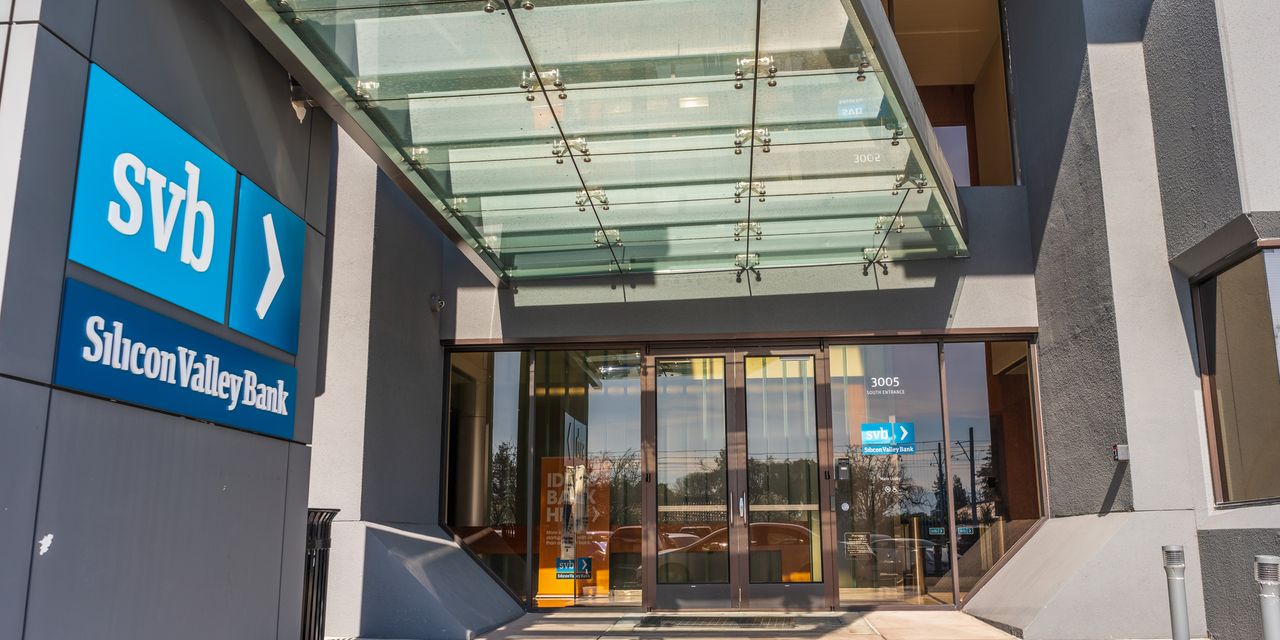
The collapse of Silicon Valley Bank is the “latest frontier” in a “market reckoning” according to independent equity research firm New Constructs.
On Friday Silicon Valley Bank was closed by the California Department of Financial Protection and Innovation, which appointed the FDIC as receiver. Reports emerged this week of funds advising their clients to pull their money from Silicon Valley Bank, which helps fund tech startups backed by venture-capital firms.
Citing people familiar with the matter, Bloomberg News reported that Founders Fund, the San Francisco-based venture-capital fund co-founded by Peter Thiel, had advised companies to pull their money from Silicon Valley Bank amid concerns about its financial stability.
Related: Silicon Valley Bank closed by California regulator and FDIC named receiver
The bank, which was in a liquidity crisis, had been scrambling to shore up its finances. On Wednesday Silicon Valley Bank said it had taken “strategic actions” to strengthen its financial position, which included a $21 billion sale of its securities portfolio at a loss of $1.8 billion.
Shares of Silicon Valley Bank parent SVB Financial
SIVB,
tumbled more than 66% in premarket trades Friday and trading was halted after CNBC reported the company was putting itself up for sale.
David Trainer, CEO of equity research firm New Constructs believes that Silicon Valley Bank’s problems serve as a cautionary tale. “The bank’s issues show that companies, including banks, need to be much more discerning about whom they do business with,” he said, in a statement emailed to MarketWatch. “The market has been punishing companies that have no business models since the bear market began in January 2022 and SVB’s woes are the latest frontier in the market’s reckoning.”
“The market is tired of companies that do business with unprofitable companies or that are unprofitable themselves,” he added.
Specifically, Trainer pointed to the risks posed by some tech startups. “Many tech startups are actually zombie companies with no business models and aren’t worthy of receiving any kind of loan,” he said. “SVB is now learning this the hard way.”
As of Dec. 31, 2022, nearly half of U.S. venture-backed technology and life science companies banked with Silicon Valley Bank, according to the bank’s website. The bank’s assets at that time were $212 billion.
Related: Treasury monitoring a few banks ‘very carefully’ amid Silicon Valley Bank’s woes, Yellen says
New Constructs maintains a list of “zombie” stocks, which it says are at risk of declining to $0 a share, many of which are in the tech sector. The research firm uses machine learning and natural language processing to parse corporate filings and model economic earnings, although its research has encountered pushback.
Trainer does not expect to see a domino effect whereby Silicon Valley Bank’s problems infect other banks. “We do not believe there is contagion risk for the rest of the banking sector on the heels of SVB’s struggles,” he wrote. “The deposit base from the major banks is much more diversified than SVB and the big banks are in good financial health.”
Indeed, Silicon Valley Bank’s struggles create an opportunity for investors to buy shares of JPMorgan Chase & Co.
JPM,
according to Trainer, which he describes as New Constructs’ favorite bank stock. “JPMorgan Chase is built to last,” he said. “It is involved in multiple business lines and it provides stability and cash flow for investors.”
JPMorgan’s stock, which slid with bank stocks Thursday, rose 2.2% Friday.
Additional reporting by Steve Gelsi, Tomi Kilgore, Vicktor Reklaitis, and Claudia Assis