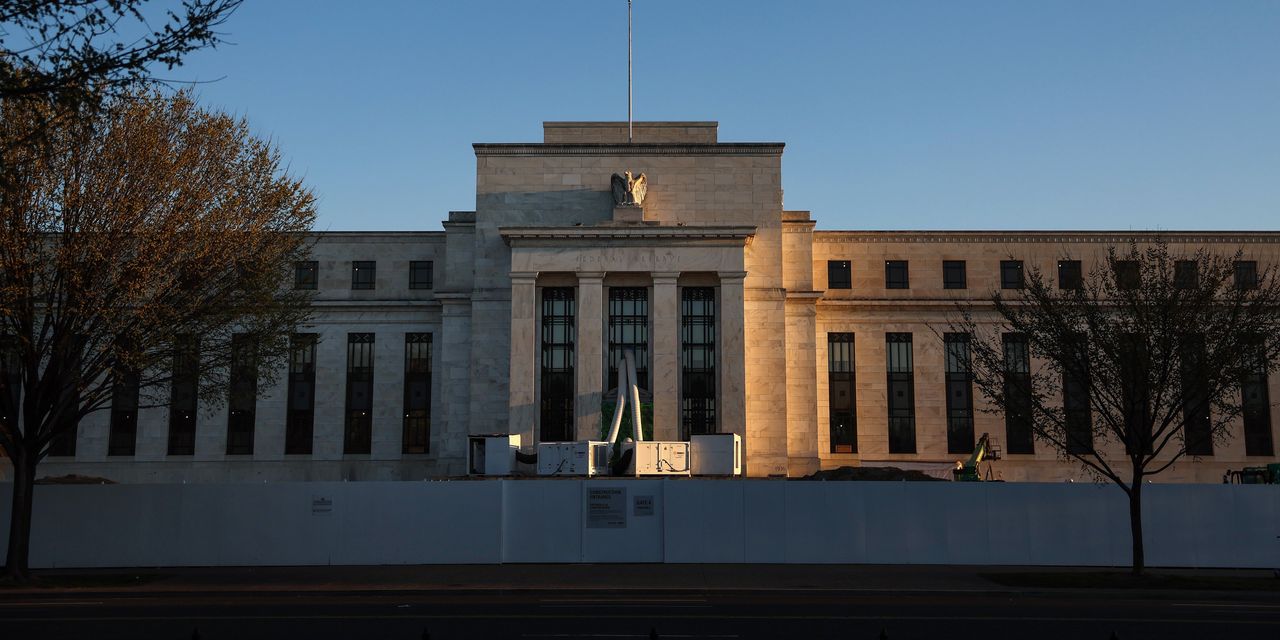
U.S. stock futures dipped as traders eyed the difficult rate-setting choice facing the Federal Reserve on Wednesday.
How are stock-index futures trading
-
S&P 500 futures
ES00,
-0.06%
dipped 9 points, or 0.2%, to 4027 -
Dow Jones Industrial Average futures
YM00,
-0.02%
fell 73 points, or 0.2%, to 32701 -
Nasdaq 100 futures
NQ00,
-0.17%
eased 47 points, or 0.4% ,to 12820
On Tuesday, the Dow Jones Industrial Average
DJIA,
rose 316 points, or 0.98%, to 32561, the S&P 500
SPX,
increased 51 points, or 1.3%, to 4003, and the Nasdaq Composite
COMP,
gained 185 points, or 1.58%, to 11860.
What’s driving markets
Attention is focused on the Federal Reserve’s interest rate decision, due at 2 p.m. Eastern. Fed Chair Jerome Powell will hold a press conference half an hour later.
Futures markets are pricing in an 89% probability of a 25 basis point hike to a range of 4.75% to 5%.
However, that high level of conviction belies the intense uncertainty over monetary policy in recent weeks as investors have tried to gauge how the central bank will navigate the need to maintain the battle against inflation, that is still running at three times its 2% target, with a desire not to pile further interest rate pressure on a fragile banking sector.
“There’ll be plenty of focus on whether the Fed hikes today, but just as important will be how they’re looking at the current turmoil and whether they still expect any more rate hikes after today,” said Henry Allen, strategist at Deutsche Bank.
“Our U.S. economists think that the [European Central Bank’s] decision last week offers a relevant blueprint for the Fed: raise rates in line with expectations, drop forward guidance, but signal a continued tightening bias,” Allen added.
The S&P 500 closed on Tuesday above the level seen before the banking crisis began with news of troubles at Silicon Valley Bank just two weeks ago. The stock barometer is again back in the middle of its four-month trading range between 3,800 to 4,200.
Investors have welcomed easing tensions in the financial sector while hoping the subsequently tighter credit conditions will help slow the economy and thereby bring forward the time when the Fed can start cutting borrowing costs again.
But futures dipped early Wednesday when the difficulty of the challenge facing central banks was highlighted by inflation data in the U.K. which showed price rises accelerating again and remaining in double digits. The Bank of England will deliver its rate decision Thursday.
“As inflation remains well above the BoE target, there’s now a stronger case for the BoE to press ahead with a rate hike, even in a period of greater financial market uncertainty,” said Richard Flax, chief investment officer at Moneyfarm.
“It will be interesting to see how the BoE and the Fed consider the dynamics between fighting inflation and managing financial stability. The ECB has already indicated that it sees no contradiction between those two goals,” Flax added.