Might Joe Biden’s plummeting approval rating be good news for the stock market?
This question is not as off the wall as it might otherwise appear. Not only have researchers discovered a correlation between the stock market and presidential approval ratings, with one major exception that correlation is inverse. That would mean that what’s bad politically for Biden could be good for Wall Street.
Contrarians believe that extreme positions are, at a minimum, exaggerated—whether in politics or economics. That’s why, a year ago, they were not inclined to believe Biden was the savior that many commentators assumed. By the same token, they now don’t think he’s the disaster that many believe.
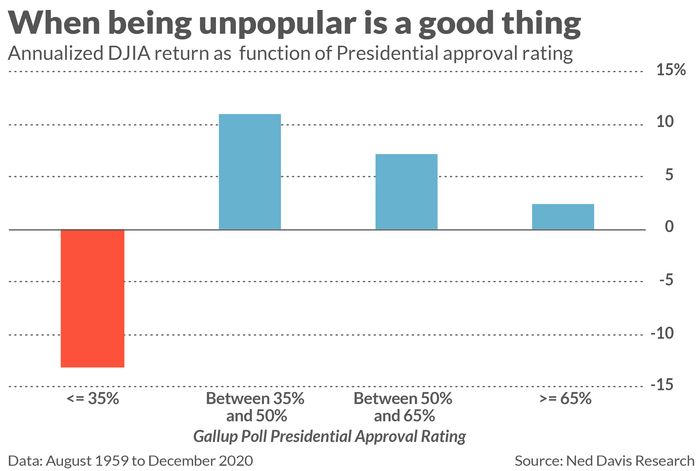
The notion that exaggerated political beliefs might have an impact on the stock market traces to work conducted by Ned Davis Research. The firm has found that, except for when the presidential approval rating is particularly low (below 35%), there is an inverse relationship between it and the return of the Dow Jones Industrial Average.
DJIA,
(See chart below.)
Currently, according to the presidential approval tracker at FiveThirtyEight.com, just 42.4% of Americans approve of the Biden’s job performance — with 52.2% disapproving. This 42.4% approval rate sits almost precisely at the midpoint of the 35%-to-50% range that historically has been associated with the best stock market performance.
Why would a president’s approval rating be inversely correlated with the stock market? One plausible theory is that a high approval rating is associated with unrealistic expectations generally — not just politically but also in the markets. It’s not just Monday morning quarterbacking for me to point this out. Consider the contrarian interpretation I provided one year ago in reaction to the much-higher approval rating Biden then enjoyed:
“Given the intense polarity in our country right now, it certainly seems plausible that Biden will have difficulty advancing his ambitious agenda. There is a non-political reason for [potential] disappointment as well, given that so much is riding on ending the pandemic — an outcome that is by no means assured to happen in 2021.”
Today, in contrast, many have an equally exaggerated, but opposite, view of the political and economic environment. This may very well set up the preconditions for surprises to be on the upside in the coming year.
Mark Hulbert is a regular contributor to MarketWatch. His Hulbert Ratings tracks investment newsletters that pay a flat fee to be audited. He can be reached at mark@hulbertratings.com