Oil prices climb on Wednesday, trading at two-month highs, with U.S. crude inventories posting a decline for a seventh straight week and traders mostly upbeat on the outlook for the economy and oil demand.
“Crude prices continue to set new highs for 2022, with prompt benchmarks now near their highest point since November last year,” said Robbie Fraser, global research & analytics manager at Schneider Electric. “The current bullishness is a mixture of crude fundamentals and more macro factors tied to the broader economic outlook.”
Inventory data will “continue to be key through the early weeks of 2022 as the market eyes any signal that balances are improving, and that the market could see a run of more oversupplied conditions,” he said in a daily note.
On Wednesday, however, the Energy Information Administration reported a 4.6 million-barrel fall in U.S crude supplies for the week ended Jan. 7.
That marked a seventh-straight weekly decline, based on the EIA data, and came in well above the average 1.6 million barrel decreased expected by analysts polled by S&P Global Platts. The American Petroleum Institute on Tuesday reported a 1.1 million-barrel decline.
West Texas Intermediate crude for February delivery
CL00,
CLG22,
rose $1.16, or 1.4%, to $82.38 a barrel on the New York Mercantile Exchange. March Brent crude
BRN00,
BRNH22,
the global benchmark, was up 78 cents, or 0.9%, at $84.50 a barrel on ICE Futures Europe. Prices for both front-month contracts were poised to finish the session at their highest since Nov. 9, FactSet data show.
The EIA also reported weekly inventory increases of 8 million barrels for gasoline and 2.5 million barrels for distillates. The S&P Global Platts survey expected supply gains of 3 million barrels for gasoline and 2 million barrels for distillates.
On Nymex Wednesday, February gasoline
RBG22,
tacked on 1% to $2.381 a gallon and February heating oil
HOG22,
rose 1% to $2.589 a gallon.
The decline for crude inventories was “overshadowed by a massive build in gasoline stocks,” said Fraser. So while the headline number “may have tilted in favor of the bulls, the report as a whole indicates more bearish conditions.”
“From here, demand during this seasonally weak travel period will be key, along with the length of any unplanned outages in countries like Libya and Kazakhstan,” he said.
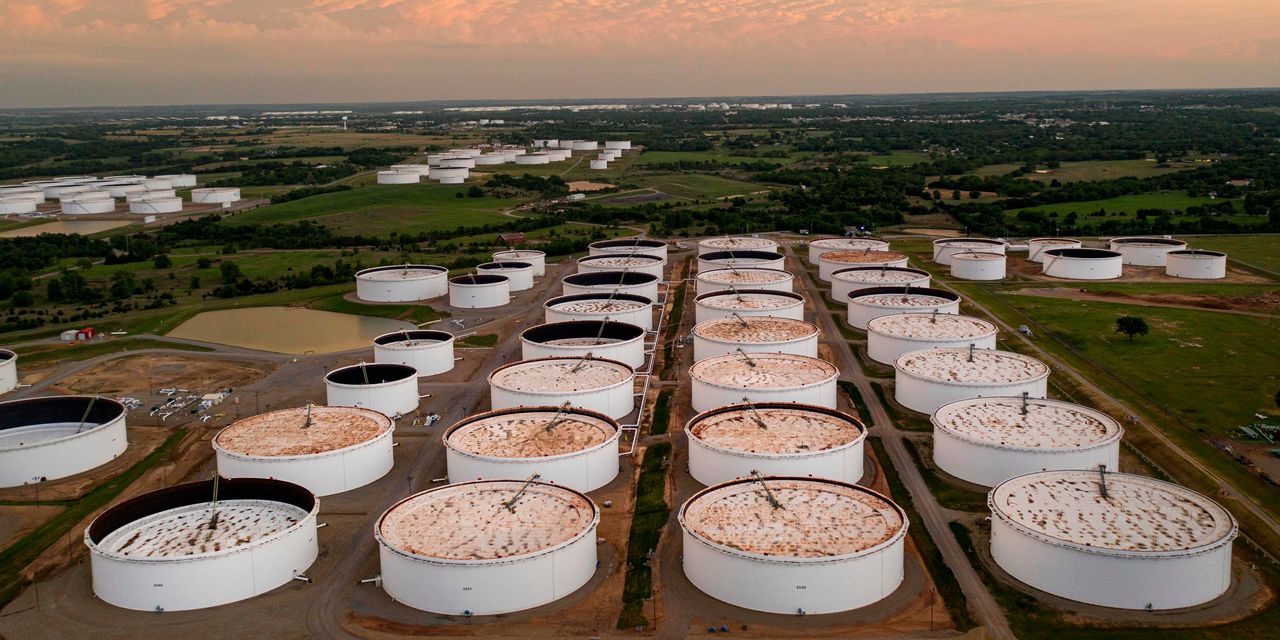
The EIA data, meanwhile, showed crude stocks at the Cushing, Okla., Nymex delivery hub edged down by 2.5 million barrels for the week, while total domestic petroleum production fell 100,000 barrels to 11.7 million barrels per day. Crude oil stocks at the Strategic Petroleum Reserve fell modestly to 593.4 million barrels, down 300,000 barrels for the week.
Remarks Tuesday by Federal Reserve Chairman Jerome Powell, testifying at a Senate confirmation hearing, have contributed to the firm tone, analysts said. Powell, who is expected to win confirmation from the full Senate to serve a second term as Fed chief, described the effect of the omicron variant of the coronavirus on the U.S. economy as short-lived, while arguing the central bank’s plans to tighten monetary policy in an effort to rein in inflation won’t derail the economy.
“Participants on the oil market drew their own conclusions from [Powell’s testimony] and bought up oil forward contracts in anticipation of continued robust oil demand,” said Carsten Fritsch, analyst at Commerzbank, in a note. “In addition, there was increased risk appetite, as reflected in rising stock markets.”
Rounding out action in the energy markets, natural-gas futures moved up sharply, with the rally so far this week “driven by colder weather forecasts for the Northeast and Midwest through late January,” said Christin Redmond, commodity analyst at Schneider Electric.
February natural gas
NGG22,
traded at $4.604 per million British thermal units, up 8.3%, with prices poised for their highest settlement since Nov. 29.
On average, analysts expect the EIA on Thursday to report a natural-gas supply withdrawal of 177 billion cubic feet for the week ended Jan. 7, according to a survey conducted by S&P Global Platts. That compares with a five-year average decline of 155 billion cubic feet.