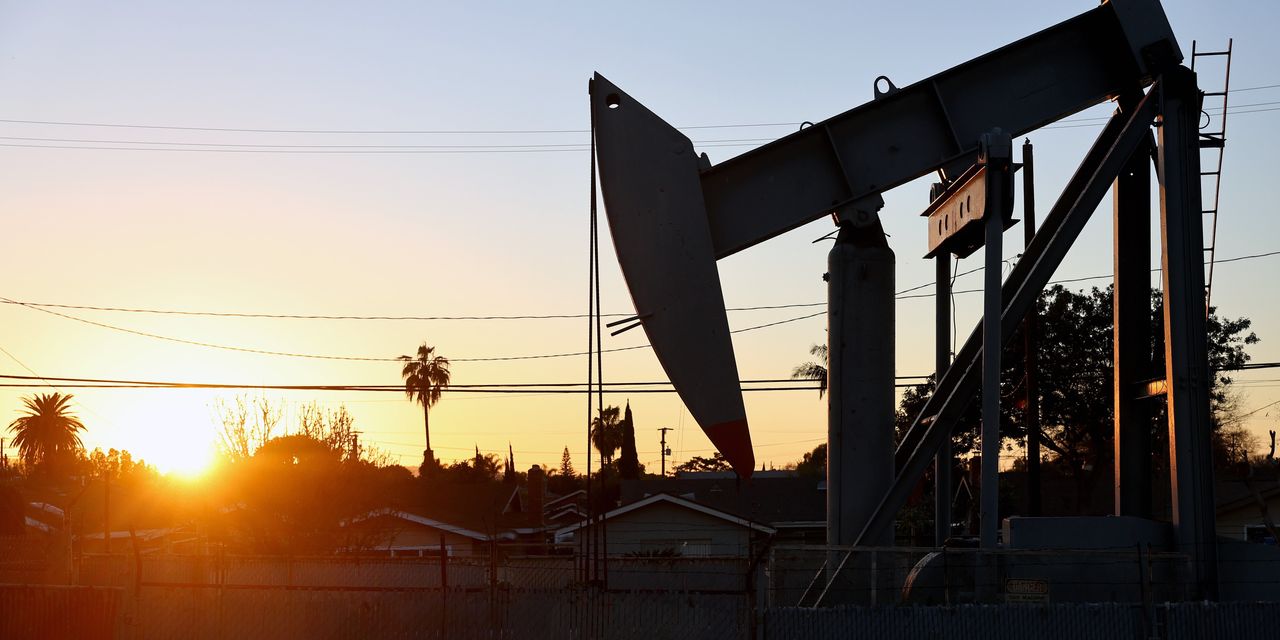
Oil futures headed higher on Tuesday for a second straight session, extending a bounce off 15-month lows, as worries over the U.S. banking sector continued to ease fears of a recession.
Price action
-
West Texas Intermediate crude for April delivery
CL.1,
+1.58% CLJ23,
+1.58%
rose $1.16, or 1.7%, to $68.80 a barrel on the New York Mercantile Exchange ahead of the contract’s expiration at the end of the session. May WTI
CL00,
+1.55% CLK23,
+1.55% ,
the most actively traded contract, was up $1.10, or 1.6%, at $68.92 a barrel. -
May Brent crude
BRN00,
+1.44% BRNK23,
+1.44% ,
the global benchmark, rose $1.14, or 1.5%, to $74.93 a barrel on ICE Futures Europe. -
Back on Nymex, April gasoline
RBJ23,
-0.13%
traded up by 0.4% at $2.5452 a gallon, while April heating oil
HOJ23,
-0.13%
shed 0.4% to $2.6767 a gallon. -
April natural gas
NGJ23,
-1.89%
declined by 2.9% to $2.158 per million British thermal units.
Market drivers
Oil found its footing Monday, and continued higher Tuesday, after ending last week at a 15-month low as U.S. stocks, especially bank shares, moved higher. Crude prices tumbled last week as worries over the banking sector amplified fears of a global economic downturn that could crimp demand for crude.
“Worries about a banking collapse have eased following the rescue of Credit Suisse
CS,
being taken over by UBS
UBS,
” StoneX’s Kansas City energy team, lead by Alex Hodes, wrote in Tuesday’s newsletter.
“Banking jitters are not yet gone however, and if the Federal Reserve decides to raise rates [Wednesday], it will add fuel to concerns that more regional banks will be in jeopardy,” the team wrote. “The current expectation is that the Fed will raise rates by 25 basis points. If the Fed pauses rate hikes, oil will likely run tomorrow. If the Fed sticks with its original plan of a 50-basis point increase, the oil will likely slide further.”
U.S. benchmark stock indexes gained in Tuesday dealings, with oil also following suit. In regard to the banking crisis, U.S. Treasury Secretary Janet Yellen on Tuesday said the “the situation is stabilizing” after steps by the government to backstop deposits at banks.
“The price slide is chiefly attributable to concerns that oil demand could weaken as a result of the latest market turmoil, even though there has been no sign of this happening as yet,” said Carsten Fritsch, commodity analyst at Commerzbank, in a note.
Commerzbank lowered its midyear forecast for Brent to $80 a barrel from $95.
“Though the latest price slide is due for the most part to higher risk aversion following the market turmoil, it is not probable that this will be quickly and completely reversed,” Fritsch wrote. “After all, fundamentals such as market balance and stock levels no longer look as price-positive as the [International Energy Agency] had previously predicted.”
Commerzbank, however, still expects the oil price to rise in general because the Organization of the Petroleum Exporting Countries and its allies, known as OPEC+, “is unlikely to stand idly by while the oil price continues to plunge, and will no doubt reduce supply if necessary.”
If the oil market stabilizes, its also likely the U.S. government will move to replenish its strategic reserves, he wrote, and the oil market still appears on track to be significantly undersupplied in the second half of the year.