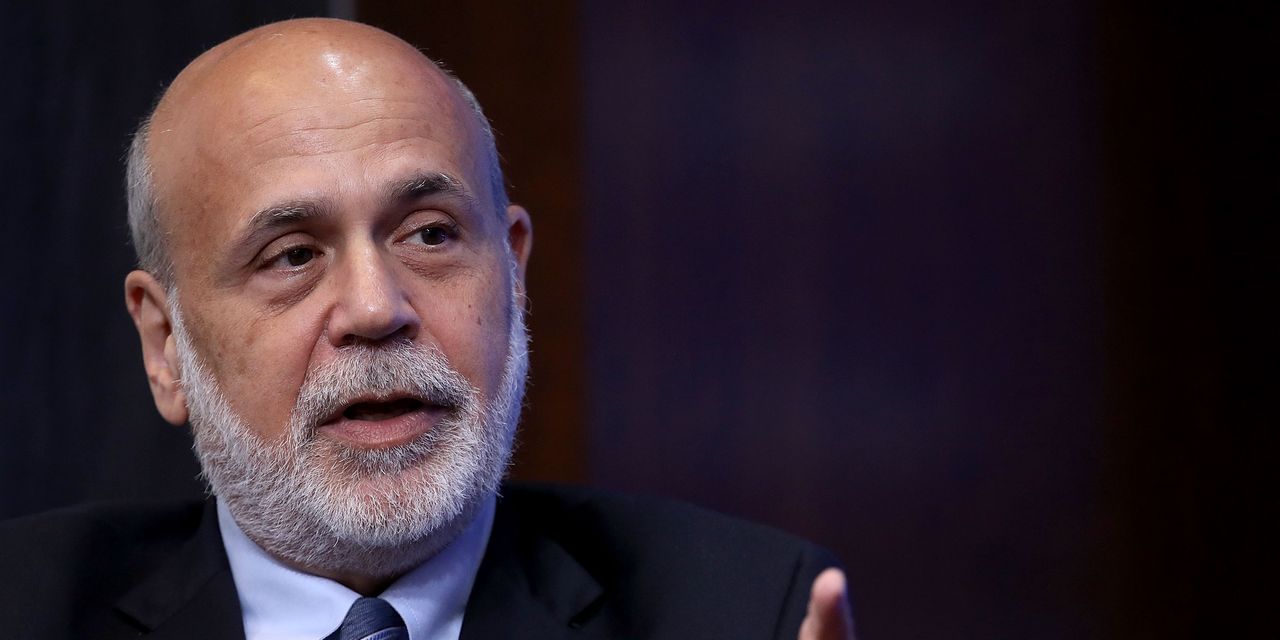
Former Federal Reserve Chair Ben Bernanke and two others were awarded the Nobel economics prize for their research into how banks operate during financial crises.
Bernanke, Douglas Diamond and Philip Dybvig in the early 1980s produced pioneering research into the field.
“Their analyses have been of great practical importance in regulating financial markets and dealing with financial crises,” the Nobel committee said.
Diamond and Dybvig developed theoretical models that explain why banks exist, how their role in society makes them vulnerable to rumors about their impending collapse, and how society can lessen this vulnerability, the committee said.
Diamond participated in the awards ceremony, and said that while banks are in much better shape now than they were in 2008, the problem is financial crisis can come from anywhere. He cited the recent problems the U.K. has had with pension fund investments as an example, though he said it’s probably impossible to eliminate the possibility of them.
“We will always be subject to low-probability” financial crises, Diamond says.
Bernanke demonstrated how failing banks played a decisive role in the global depression of the 1930s, the worst economic crisis in modern history, the committee added.
“Before Bernanke published his article, the conventional wisdom among experts was that the depression could have been prevented if the U.S. central bank had printed more money. Bernanke also shared the opinion that a shortage of money probably contributed to the downturn, but believed this mechanism could not explain why the crisis was so deep and protracted,” the Nobel committee said.
“Instead, Bernanke showed that its main cause was the decline in the banking system’s ability to channel savings into productive investments.”
Bernanke put research to work
Bernanke was able to put his research into use during the 2008 financial crisis when he led the U.S. central bank. Under his leadership, the Fed not only cut interest rates to zero, but engaged in an unprecedented bond-buying spree.
The U.S. did fall into a severe recession, but the financial system did not collapse.
Bernanke’s selection did trigger a critical reaction by some on social media.
More positively, Tyler Cowen, a professor at George Mason University, said Bernanke’s 1983 paper has held up very well. “Earlier, Milton Friedman had stressed the import of the contraction of the money supply, but Bernanke’s work led to a much richer picture. This article also shows the integration between Bernanke’s work and that of Diamond and Dybvig,” he wrote.