Friends don’t let friends drive drunk. Only you can prevent forest fires. Rosie the Riveter.
These and other national public-service campaigns have been effective in changing behavior and beliefs. But even as other nations tackle the prejudice, so far there’s no comprehensive effort in the U.S. to fight ageism, which is expected to cost the economy trillions of dollars by 2025.
“Ageism is the prejudice that’s hidden in plain sight,” according to Carole Easton, chief executive of the London-based Centre for Ageing Better. “We see and hear casual ageism every day. It’s embedded in our society and even accepted as normal by many of us who are older.”
Public-service announcements can be influential and take on issues of societal importance, such as drunk driving, drug abuse, forest-fire prevention and literacy. But while other countries are taking a stand against ageism, the U.S. isn’t. Social scientists, advocates and economists say that’s a mistake, because in addition to being a bad thing to do because we’re hurting ourselves on a personal level as we grow older, it’s also bad for the economy.
The lost economic activity from older Americans not being able to find work, change careers or earn promotions because of age discrimination cost the U.S. economy $850 billion in lost gross domestic product in 2018, according to AARP. By 2050, that figure could climb to $3.9 trillion, AARP found.
A Yale University study found that discrimination based on age increased healthcare costs by $63 billion annually.
Some countries are publicizing the problem. A new national campaign to fight ageism has started in England, and a countrywide anti-ageism strategy already exists in Australia, which is leading the way with high-profile organizations and individuals forming a coalition called EveryAGE Counts.
Meanwhile, the World Health Organization has an effort called the Global Campaign to Combat Ageism, which is an initiative supported by the WHO’s 194 member states. The campaign aims to “change the narrative around age and aging and help create a world for all ages.”
Public-service campaigns can be effective at raising awareness and get people talking, but there are challenges in determining the target audience and goals of the campaign, the right message and metrics of success, said Jeff Weiss, chief executive of Age of Majority, a marketing consultancy focused on aging consumers.
Read: ‘Ageism may be the most normalized and socially accepted form of prejudice,’ but there is hope
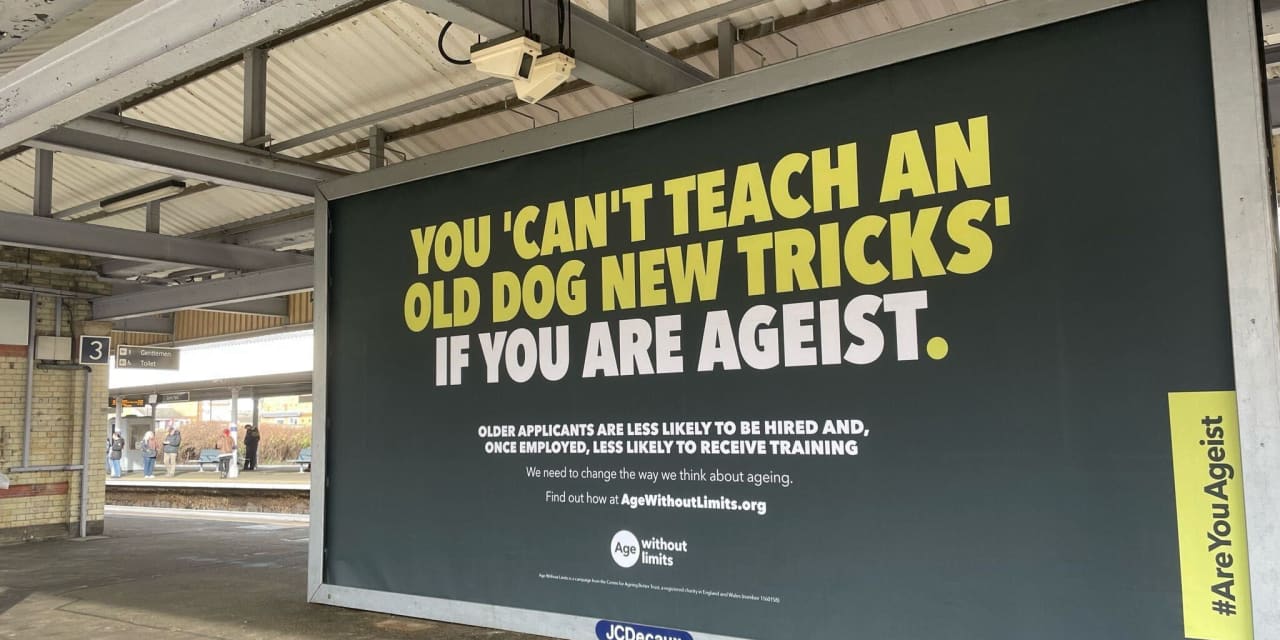
England’s first-ever anti-ageism campaign by the Centre for Ageing Better — called Age Without Limits — is a new effort highlighting the harm of ageism. Globally, one in two people are ageist against older people, according to a United Nations report.
The Centre for Ageing Better found that half of adults aged over 50 in England have experienced age discrimination in the last year. For those in their 50s and 60s who experienced discrimination because of their age in the past 12 months, this happened most commonly in work (37%), followed by social media and television, movies or news reports (32%), and as a consumer (32%).
For people over age 70, age discrimination was most keenly felt on social media, television, movies or news reports (44%), as a consumer (43%) and in health- or social-care settings (29%), the Centre said.
Other areas of life where both age groups experienced age discrimination included social situations (highlighted by 22% of people in their 50s and 60s) and public transportation (mentioned by 23% of people aged over 70), according to the Centre.
The three-year campaign in England will use advertising, public relations and social media to spark debate and conversation about what ageism is and to challenge the way people think about aging. A new website will provide information, tools and resources, including a quiz meant to answer the question, “Are you ageist?”
There will also be a national day of action across England for individuals, organizations and communities to participate.
“Ageism scars lives,” Easton said. “It is often dismissed as being harmless, but if you look at the research or speak to people whose lives have been affected by ageism, you will soon realize ageist ideas or beliefs can be incredibly damaging for us as individuals and for wider society.”
In the U.S., smaller efforts have been made to tackle ageism.
The state of Maine has a goal to stamp out ageism within 10 years; the program is being replicated in Oregon and New Hampshire and aims to expand it further. Meanwhile, a program called Changing the Narrative works to raise awareness about ageism through workshops educating the public about ageist language, beliefs and practices.
“We have all of these idioms: ‘You can’t teach an old dog new tricks,’ ‘Put out to pasture,’ ‘You’re a dinosaur.’ And we internalize them,’” said Jess Maurer, executive director of the Maine Council on Aging.
Read: ‘Americans don’t believe ageism is real.’ This state wants to stamp it out.
“We are living longer than ever before worldwide and we’re holding on to archaic, 1950s views on aging. Kids born today will live to 100, so how we learn, play, work and live will change,” Maurer said. “Ageism is holding us back from realizing the potential of our own longevity.”
Adopting a positive mindset and shifting your internal thoughts on aging can give you 7.5 more years of life with less anxiety and depression, according to the findings of Becca Levy, a Yale University professor of public health and psychology and the author of “Breaking the Age Code.”
“We have this long-standing, internal, institutional and systemic idea that young equals better, faster, smarter, fresh ideas and digital native,” said the Maine Council on Aging’s Maurer. “There are two views of older adults: They’re either living their best lives on a sailboat or golf course or they’re nearly dead. It’s either virility or frailty, with nothing in between.”
Read: Yes, ageism is actually bad for your brain. Here’s how to reverse it.
However, anti-ageism activists are skeptical about a national campaign in the U.S. taking hold anytime soon.
Janine Vanderburg, co-founder and senior strategist of Changing the Narrative, said the anti-ageism campaign in England may be more effective because it’s a smaller country, whereas a national campaign in the U.S. may be less feasible.
Maurer said a nationwide campaign is needed, but would face some challenges to execute. And for such an effort to succeed, she said it would have to be carefully tailored and driven by research.
“You have to start the conversation,” Maurer said. “Everybody’s ageist. Everybody’s going to be a victim. It’s the one bias we all have. People say when they see it, they can’t unsee it. You have to talk about it.”