Hello! In this week’s ETF Wrap, you’ll get a look at ETF flows in 2022’s bear market in stocks and bonds and a view of how some assets have fared as investors look ahead to 2023.
Please send feedback and tips to christine.idzelis@marketwatch.com. You can also follow me on Twitter at @cidzelis and find me on LinkedIn.
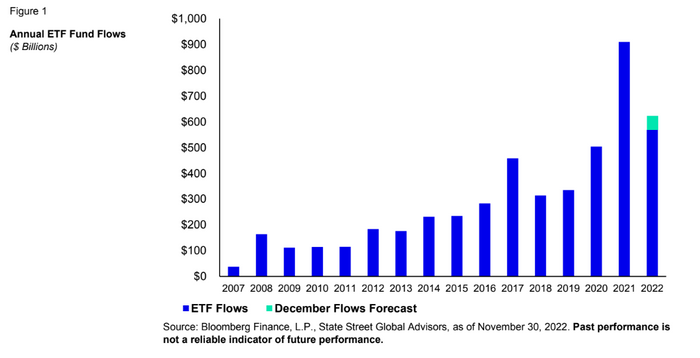
This year’s bear market isn’t keeping the flow of capital into exchange-traded funds from rising to historically high levels, even if inflows have slumped from 2021.
At the end of November, U.S.-listed ETFs had attracted $568 billion in 2022 and were on track for annual inflows of $622 billion based on average December flows over the past decade, according to a State Street Global Advisors report. That would be the second time flows exceeded $600 billion in a calendar year, with 2021 being the first instance, the report says.
“The bear market has accelerated the great migration out of mutual funds into ETFs,” Matthew Bartolini, head of SPDR Americas research at State Street Global Advisors, said by phone.
For many investors, it’s been “a catalyst to act” because they’re “sitting on losses” or returns small enough to be “palatable” when hit with capital gains taxes in making the switch to ETFs, which tend to be cheaper and more tax efficient than mutual funds, Bartolini explained.
STATE STREET GLOBAL ADVISORS REPORT DATED NOV. 30, 2022
The ETF industry had around $6.6 trillion of assets under management at the end of November, according to Bartolini. That’s down from $7.3 trillion last year, but still above levels seen in recent years. For example, U.S.-listed ETF assets have swelled from $3.4 trillion in 2017 and so far this year remain up from $5.5 trillion in 2020, emailed data provided by Bartolini show.
The pace of monthly ETF inflows has recently picked up. The State Street report says the $174 billion of inflows seen on a rolling three-month basis through November rank “in the 91st percentile historically” and among the top 20 ever for such a rolling span of time.
Bartolini, who authored the State Street report, wrote that bond ETFs were “one of the bigger drivers of this accelerated pace.” By phone, he said that investors showed interest in high-yield corporate bonds in a “giveback” of assets over the last two months after earlier outflows.
But he also said it’s hard to get too enthusiastic about high-yield debt, or so called junk bonds, for 2023 due to concerns over a potentially looming recession. High-yield is more vulnerable to default than investment-grade bonds. Bartolini said he prefers short-duration, investment-grade corporate bonds for 2023, pointing to maturities of one to three years and yields of around 5.5%.
Government debt pulled in the most within fixed-income flows in the three months through November, the State Street report shows. Short-term bonds attracted nearly three-quarters of the capital flowing into government debt during that period.
Still, equity ETFs have dominated inflows this year through November, raking in more than twice the assets flowing into fixed income, according to State Street. Meanwhile, commodity ETFs have suffered year-to-date outflows, the report shows.
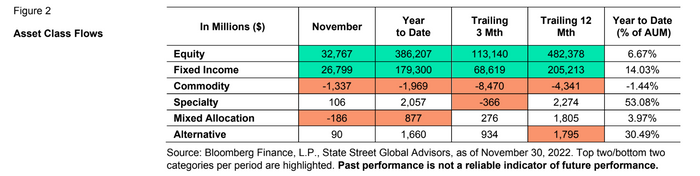
STATE STREET GLOBAL ADVISORS REPORT DATED NOV. 30, 2022
Within equities, “the bias is toward defensiveness,” Bartolini wrote, with defensive sectors in November posting inflows for a record 13 straight months.
State Street found that healthcare and consumer staples were “the main areas of interest” within defensive sectors last month. The report shows that ETFs focused on those two areas saw by far the biggest sector inflows in November.
Meanwhile, dividend funds continued to attract investors last month, with ETFs focused on dividend-paying stocks seeing a 27th straight month of inflows, according to the report.
“Dividend strategies have this unique combination of value and quality,” which may work well in an environment with concerns over corporate earnings, Bartolini said by phone.
But dividend stocks aren’t “100% defensive,” he said. “There’s a decent amount of cyclical exposure,” he added, saying the strategy might also benefit in “a cyclical surprise to the upside.”
Shares of the iShares Select Dividend ETF
DVY,
were down just 0.5% this year through Wednesday, with a total return of 2.1%, according to FactSet data. By contrast, the SPDR S&P 500 ETF
SPY,
Trust lost 16.3% over the same period on a total return basis.
Within equities, ETFs focused on U.S. stocks have seen the most interest from investors this year but State Street has seen recent demand for other regions, according to Bartolini.
In November, “investors started to look overseas,” potentially amid concern that the U.S. market appears “priced for perfection” from a valuation perspective, he said by phone.
Shares of the Xtrackers Harvest CSI 300 China A-Shares ETF
ASHR,
have plunged about 26% this year through Wednesday, while the iShares MSCI Emerging Markets ETF
EEM,
dropped almost 21%, FactSet data show. The iShares MSCI EAFE ETF
EFA,
which tracks an index of developed-market stocks in Europe, Australia and the Far East, was down around 15% over the same period.
Next year, Bartolini said he expects U.S.-listed ETFs could see around $500 billion to $600 billion of inflows, despite looming recession concerns.
As usual, here’s your look at the top- and bottom-performing ETFs over the past week through Wednesday, according to FactSet data.
The good…
| Top Performers | %Performance |
|
PIMCO 25+ Year Zero Coupon US Treasury Index ETF ZROZ, |
6.0 |
|
KraneShares CSI China Internet ETF KWEB, |
5.6 |
|
Vanguard Extended Duration Treasury ETF EDV, |
5.3 |
|
Invesco China Technology ETF CQQQ, |
3.8 |
|
iShares 20+ Year Treasury Bond ETF TLT, |
3.5 |
| Source: FactSet data through Wednesday, Dec. 7, excluding ETNs and leveraged products. Includes NYSE, Nasdaq and Cboe traded ETFs of $500 million or greater |
…and the bad
| Bottom Performers | %Performance |
|
iShares Currency Hedged MSCI EAFE ETF HEFA, |
-18.4 |
|
Xtrackers MSCI EAFE Hedged Equity ETF DBEF, |
-13.2 |
|
AdvisorShares Pure Cannabis ETF MSOS, |
-12.3 |
|
United States Oil Fund LP USO, |
-9.7 |
|
ARK Next Generation Internet ETF ARKW, |
-9.7 |
| Source: FactSet |
New ETFs
-
Tidal Financial Group said Dec. 6 that it launched the Senior Secured Credit Opportunities ETF
SECD,
-0.50% ,
an actively managed fund that invests in senior secured loans and secured bonds. Tidal, an ETF investment and technology business, said the new fund is managed by Gateway Credit Partners. -
Dimensional Fund Advisors announced Dec. 7 the listing of the Dimensional US Large Cap Value ETF
DFLV,
+0.24%
and Dimensional Global Real Estate ETF
DFGR,
+0.60%
on the NYSE Arca.