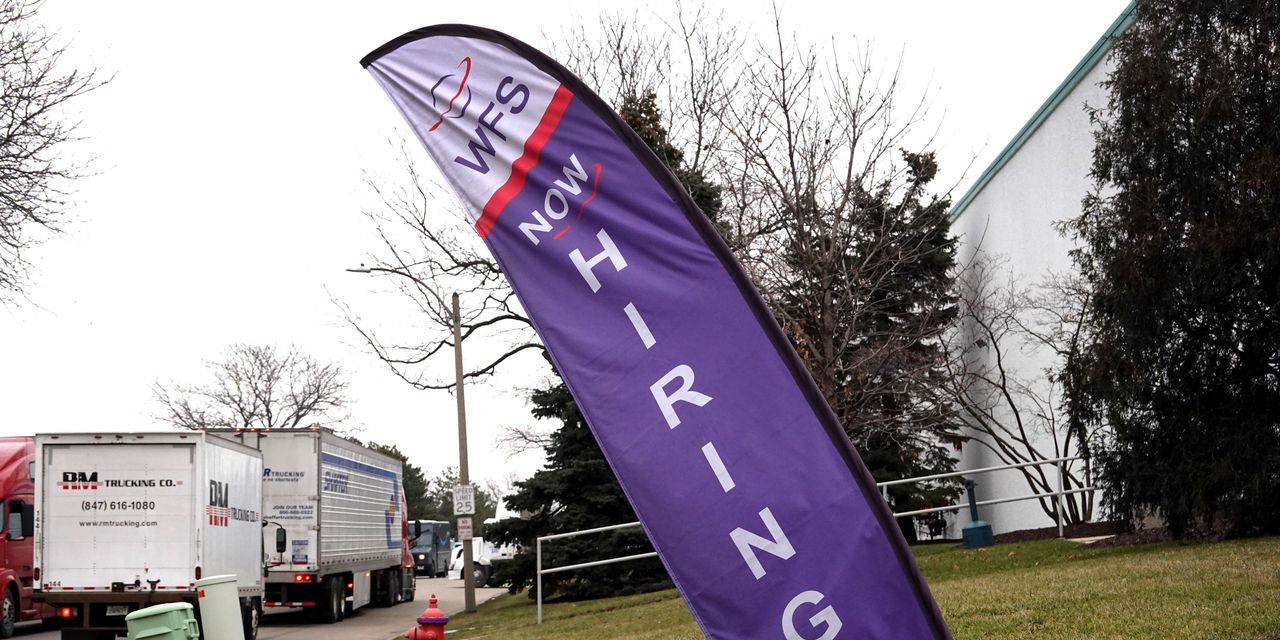
The numbers: Job openings in the U.S. climbed in April to a three-month high of 10.1 million, another sign the economy hasn’t cooled enough to forestall more interest-rate increases by the Federal Reserve.
Job listings rose from a revised 9.7 million in March, the Labor Department said Wednesday.
Economists polled by the Wall Street Journal had forecast job listings to total 9.5 million.
The number of job openings is seen as a sign of the health of the labor market and the broader U.S. economy. Job postings have dropped from a record high last spring, but they are still much higher than the Fed would like.
The Fed wants to see job openings and hiring slow even further to ease the upward pressure on inflation.
The number of people quitting jobs, meanwhile, fell slightly, to 3.79 million. Quits dipped below 4 million in January for the first time since mid-2021, but they have moved sideways since then.
By virtually every measure, the job market is still historically strong.
Key details: Job openings rose the most in retail, health care, transportation and warehousing — parts of the economy that have led the way in hiring.
Listings fell in manufacturing, government and leisure and hospitality.
While many openings are never actually filled, economists view the trend in job postings as a rough gauge of how strong the labor market is.
The number of job openings for each unemployed worker rose to 1.8 in April from 1.7 in the prior month, keeping it well above prepandemic levels of 1.2.
The Fed is watching the ratio closely and wants to see it fall back to prepandemic norms.
The so-called quits rate among private-sector workers was unchanged at 2.7%. It peaked at 3.3% one year ago.
People quit more often when they think it’s easy to get a better job and tend to stay put when the economy weakens.
The U.S. is forecast to add a solid 188,000 new jobs in May. The May jobs report comes out on Friday.
Big picture: The Fed is worried that a tight labor market — too many jobs and not enough workers — will make it harder to get inflation under control.
Companies are paying more to attract talent and are passing those costs along to customers. Labor is the biggest expense for most businesses.
Recent U.S. inflation readings and reports on consumer spending have also been stronger than expected.
The result: The Fed could be forced to consider whether to raise rates again at its June 13-14 meeting instead of skipping an 11th straight increase. Senior central bank officials had been hoping to hold tight for a time in order to judge the effects of previous rate hikes on the economy.
Looking ahead: “In short, labor demand has moderated but is still torrid,” said chief economist Stephen Stanley of Amherst Pierpont Securities.
Market reaction: The Dow Jones Industrial Average
DJIA,
and S&P 500
SPX,
extended losses in Wednesday trading after the job-openings report. Bond yields
TMUBMUSD10Y,
slipped to 3.67%.