Even with signs that the Federal Reserve’s harsh strategy to combat inflation is beginning to bear fruit, there is a lot to be said for the lessons investors learned in 2022 — especially those investors who didn’t live through the economic turmoil of the 1970s.
David Schassler, who manages the VanEck Inflation Allocation ETF
RAAX,
is understandably dedicated to a strategy that lowers investors’ inflation risk, but he also makes a good case for keeping some of a long-term investment portfolio focused on the types of “real assets” that hold up well during periods of rapid price increases.
The VanEck Inflation Allocation ETF has $126 million in assets and is about 28% allocated to gold bullion and related stocks. The exchange-traded fund alters its asset mix over time. During an interview, Schassler called gold “the ultimate hedge against fiat currencies.”
Schassler said that gold works best as a hedge “late in the inflation cycle.”
We cannot know how early or late we are in the current cycle of rising prices, with so many inputs, including a labor market that remains tight despite layoffs and other mixed economic signals.
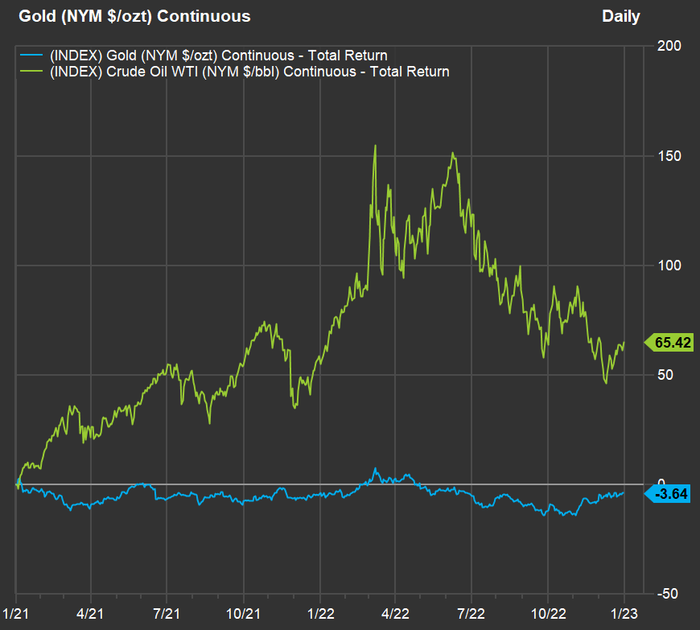
But this chart, showing the percentage movement of forward-month contract prices for gold
GC00,
and West Texas Crude Oil
CL.1,
on the New York Mercantile Exchange since the end of 2020, backs what Schassler said about the timing of commodity price flows.
Oil prices have pulled back from two peaks in 2022, while the price of gold has barely moved since the end of 2020.
FactSet
“Gold doesn’t have the utility of other commodities,” Schassler said. “So when inflation first presents itself, other commodities, such as oil, respond to supply and demand imbalances.” Later in a cycle of high inflation, investors pile into gold when “they are tired of losing their ability to spend,” he said.
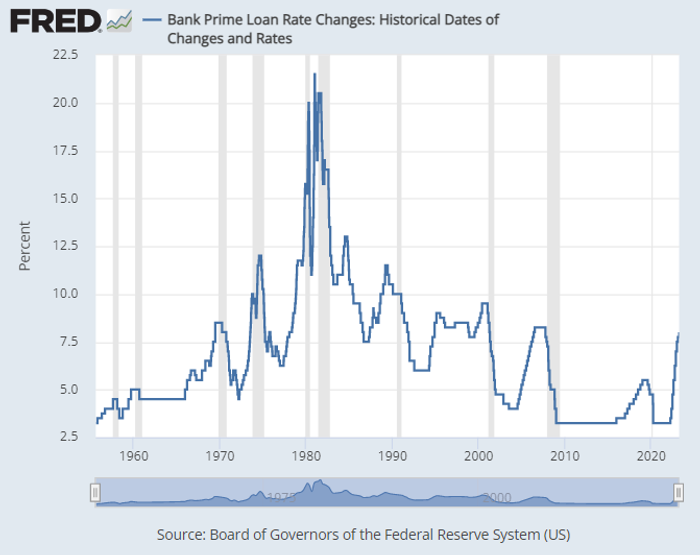
He compared the current inflationary economy to that of the second half of the 1970s, when inflation was ultimately quelled after the prime rate for banks shot up to 21.5% in 1980.
Federal Reserve Bank of St. Louis
The above chart of banks’ prime rates since 1955 shows what an incredible effort it took to bring down inflation after it spiked in the late 1970s.
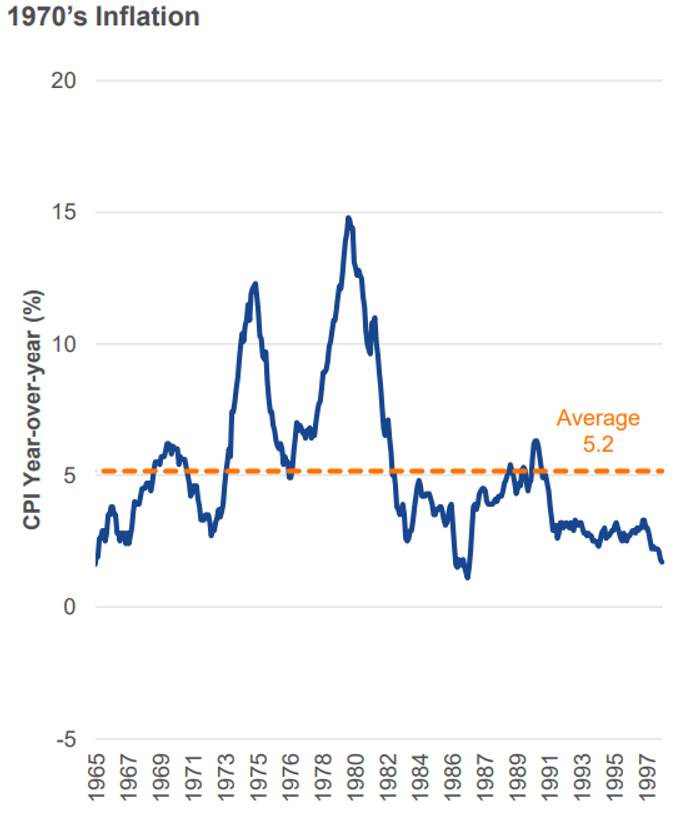
Schassler provided this chart, showing the course of inflation rates:
Van Eck Securities Corp., using data provided by Bloomberg.
He said that the past two major inflationary cycles in the U.S. (in the 1940s and 1970s) each “took over a decade to resolve.”
Part of a decision on whether or not to allocate some money to a fund that invests in hedges to inflation must rest on your own opinion of where the economy is headed. But having a moderate allocation to these assets at all times can make for an all-weather hedge.
Right now the VanEck Inflation Allocation ETF is heavily weighted to “sensitive real assets,” including gold and other commodities, Schassler said. But during periods of price stability, the fund will be more heavily weighted to real estate, infrastructure and cash-flow plays, such as pipeline partnerships.
The allocation case
Schassler suggests that a 15% allocation to real assets is a reasonable way for a typical long-term investor with a 60%/40% allocation to stocks and bonds to hedge against inflation over the long term. (The remaining 85% of the portfolio would still be mixed 60/40 or however you would otherwise want the mix to be.)
“Our work shows that during the 1970s, that 15% allocation, if you had allocated to diversified real assets, would have given you a modest annual return of 3% to 4% in excess of inflation,” he said.
Those returns weren’t really modest if you look at how high the inflation rates were (see above).
“Alternatively, the stocks and bonds in your portfolio, the 85%, are positioned to perform well when interest rates fall,” he said.
The VanEck Inflation Allocation ETF is actively managed and has a five-star rating (the highest) within Morningstar’s U.S. Fund Allocation — 50% to 70% Equity category.
During 2022, when the SPDR S&P 500 ETF Trust
SPY,
fell 18%, the VanEck Inflation Allocation ETF returned 1.5% (both with dividends reinvested). For five years through April 19, the SPDR S&P 500 ETF’s average annual return has been 10.9%, while the average return for the VanEck Inflation Allocation ETF has been only 3.4%, according to FactSet. It will be fascinating to see how that comparison will look a few years from now.
The VanEck Inflation Allocation ETF uses a “fund of funds” approach, with most of its portfolio invested in focused exchanged-traded funds. Here are its largest 10 holdings:
| ETF | Ticker | % of portfolio |
| VanEck Merk Gold Trust |
OUNZ, |
20.8% |
| iShares Global Infrastructure ETF |
IGF, |
19.3% |
| VanEck Gold Miners ETF |
GDX, |
12.8% |
| Vanguard Real Estate ETF |
VNQ, |
8.1% |
| Energy Select Sector SPDR Fund ETF |
XLE, |
6.7% |
| VanEck Energy Income ETF |
EINC, |
5.5% |
| SPDR S&P Oil & Gas Exploration & Production ETF |
XOP, |
5.4% |
| VanEck Agribusiness ETF |
MOO, |
4.3% |
| VanEck Oil Services ETF |
OIH, |
3.6% |
| VanEck Steel ETF |
SLX, |
3.2% |
| Source: VanEck Securities Corp. | ||
The VanEck Inflation Allocation ETF has annual expenses of 0.87% of assets. Expenses are waived for the other VanEck ETFs it invests in.
Click on the tickers for more about the ETFs.
Don’t miss: 10 dividend stocks yielding at least 4.5% that are rated ‘buy’ by most analysts