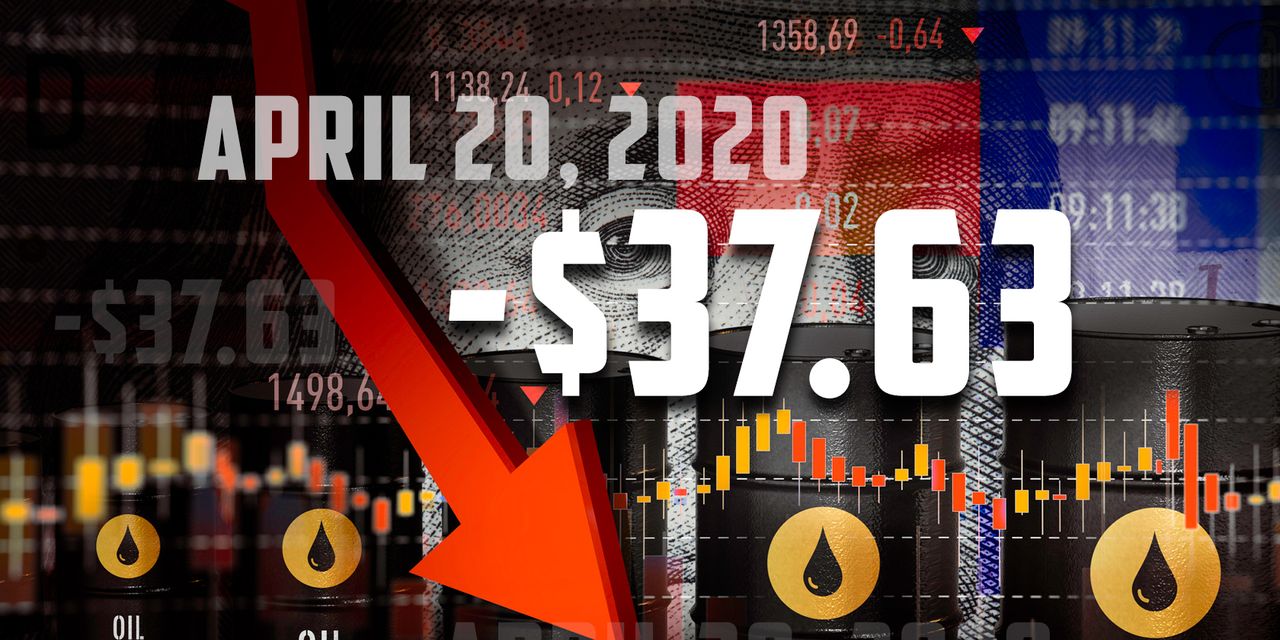
Three years to the day, U.S. benchmark West Texas Intermediate crude futures settled at a negative price for the first time on record. The oil market is again struggling with signs of a slowdown in the global economy that could lead to a drop in energy demand.
The U.S. benchmark’s May 2020 crude futures contract fell 306% on the New York Mercantile Exchange to settle at a negative $37.63 a barrel on April 20, 2020. That was the biggest one-day drop based on records going back to 1983 and the lowest-ever settlement for a Nymex front-month contract.
At the time, the world was dealing with the early months of a global pandemic that slowed or shut down many parts of the economy, easing demand for oil and leading to a surplus of oil in storage. A price war between Saudi Arabia and Russia also contributed more crude to oversupplied markets.
Oil changes
“A lot has changed in the last three years on the supply, demand and refinery side of oil,” said Vikas Dwivedi, global oil and gas strategist at Macquarie Group.
In terms of supply, the biggest change has been a “more cautious approach to production growth” from large integrated oil companies, independent exploration and production companies, and national oil companies, he told MarketWatch. On the demand side, the biggest change is “permanent loss of demand from work from home dynamics and reduced business travel.”
Meanwhile, more recently, fear that Russian sanctions would dramatically reduce the country’s oil exports were “wrongheaded in our view,” said Dwivedi. Oil supply “typically finds a way out and… it was clear that neither the United States nor Europe wanted the oil off the market.”
“Oil supply typically finds a way out and… it was clear that neither the United States nor Europe wanted the oil off the market.” ”
— Vikas Dwivedi, Macquarie Group
After a post COVID-19 rebound, oil markets are again dealing with the potential for an economic slowdown that could hurt demand for oil.
The oil market is “struggling with OECD recessionary concerns — hence OPEC’s move to pull down supplies,” Matthew Parry, head of long-term analysis at Energy Aspects, told MarketWatch.
The Organization of the Petroleum Exporting Countries and their allies, together known as OPEC+, unexpectedly announced plans on April 2 to further reduce oil production starting in May.
OPEC+ said the planned reduction was “aimed at supporting the stability of the oil market.”
Ironically, the move came in the same month three years ago when WTI oil crashed below zero dollars a barrel.
The day of the negative oil price is long gone and on Thursday, May 2023 WTI crude futures
CLK23,
CL.1,
fell 2.4% to settle at $77.29 a barrel on the contract’s expiration day. Prices ended at their lowest so far this month.
Just over a week ago, on April 12, WTI settled at $83.26, the highest front-month contract finish since November 2022.
Still, there aren’t guarantees negative oil prices are gone for good. “It would take a massive demand event in the form of another pandemic or financial crisis that would sharply reduce oil consumption” to bring back a negative oil price, said Dwivedi at Macquarie.
‘Rolling epiphany’ and demand concerns
“Lots of pundits are having what I might call a rolling epiphany these days,” said Tom Kloza, global head of energy analysis at the Oil Price Information Service, a Dow Jones company. “There are troubles looming for the bulls and I believe that’s rooted in soft demand for diesel, jet fuel, and even gasoline.”
In the fourth-quarter earnings calls in January and February, oil refiners talked about strong demand for diesel and other petroleum products resurfacing at the beginning of the second quarter, he said. “Their premise suggested that the embargoes against Russia crude and products would be felt in April and May” and too much product had been stockpiled in midwinter.
However, “Russian crude and refined products are getting to markets, albeit with shadow fleets and to countries that normally wouldn’t receive barrels from that country,” said Kloza.
As a result, there’s a “contraction in the epic diesel and gasoline margins that prevailed for most of the last 12 months,” he said. Demand for diesel is down 8% to 9% from last year and “shows no sign of rebounding,” while gasoline demand is “struggling” to hit 2022 levels and is well below the 2019 pre-pandemic levels.
Outlook
Looking ahead, Energy Aspects’ Parry expects a lot of volatility over the next month or so for oil, given all the uncertainties at the macro, or global economy, level.
The “next fortnight may even see risk appetite return if [economic] data releases continue to suggest a soft landing” as they did last week, he said. “Easing inflationary pressures in the U.S. got the market excited last week.”
Even so, any bearish data release could quickly see prices correct lower, said Parry. And if oil rises too quickly, fears that the U.S. Federal Reserve “will have no choice but to further raise interest rates and induce a hard landing will resurface,” he said.
That would raise expectations for an economic recession, which may reduce energy demand.