Chinese stocks may have finally found a bottom after their worst week in nearly a year, according to several Wall Street analysts.
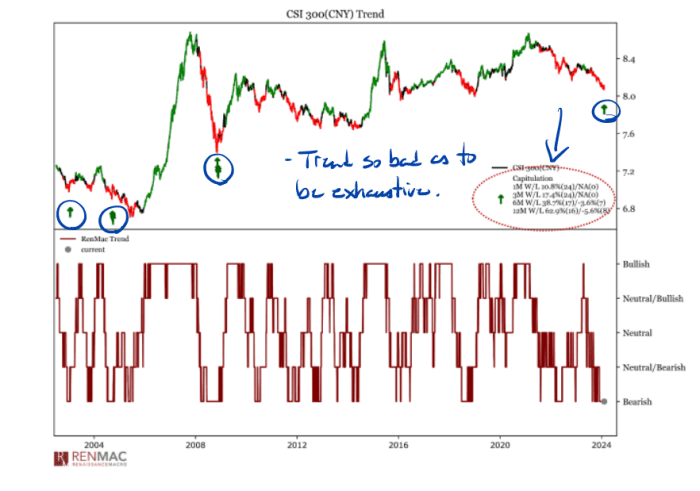
After booking their biggest weekly drop since March last week, Chinese stocks sent a clear “capitulation signal” for the first time since the depths of the financial crisis in 2008, said Jeff deGraaf, a market technician at Renaissance Macro.
RENAISSANCE MACRO
The China CSI 300
XX:000300,
an index of large-cap stocks trading in Shanghai and Shenzhen, fell 4.6% last week, touching a five-year low, as investors expressed skepticism about Chinese authorities’ efforts to arrest the market’s decline.
Chinese markets are already rebounding this week following reports that Chinese President Xi Jinping met with China’s Securities Regulatory Commission.
News of the meeting helped boost investors’ confidence that the country’s leadership intends to take more direct action, including potentially launching a market-stabilization fund that will directly intervene in the market, according to Kelvin Wong, a Singapore-based senior market analyst at Oanda.
The CSI 300 rose another 1% on Wednesday, bringing its week-to-date advance to 5.2%, after Chinese authorities announced the removal of the head of the securities regulator and his replacement with the former head of the Shanghai Stock Exchange.
See: China removes its securities regulator after slide in the stock market
The score assigned to Chinese stocks by a proprietary model maintained by deGraaf and his team fell into the bottom half of a percentile of historical readings, signaling potential capitulation.
DeGraaf explained in a note to clients that the extremely weak performance in Chinese stocks has sparked a public outcry in China, which should get the attention of the country’s leaders, prompting them to act aggressively to curb the market’s decline.
“Some are quick to comment that it isn’t the capitulation signal that will work, but the stimulus program being initiated by the state to create a floor for equities. That logic is out of sequence with history and markets, as policy makers are traditionally reactionary, not prescient in their policies,” he said.
“Some are questioning the ability of policy makers to arrest the decline, capitulation signals suggest to us, they’ll do ‘whatever it takes,’” deGraaf added.
The team at Renaissance Macro aren’t the only ones on Wall Street who believe the pain in Chinese markets is over. Analysts at Fundstrat, including head of research Tom Lee and head of technical strategy Mark Newton, said that Chinese markets may have found a bottom this week, in a note to clients viewed by MarketWatch on Wednesday.
In the note, Fundstrat said that Chinese stocks bottoming could signal that the world’s second-largest economy might be exiting its malaise, which in turn could have positive ramifications for the U.S. economy and for corporate earnings of large U.S. multinationals.
Forecasts of a turnaround in Chinese markets are coming at an auspicious time, with China’s Lunar New Year holiday set to begin on Feb. 10.
Chinese stocks have been sliding for three years, weighed down by problems in the country’s real-estate sector, broad economic malaise following China’s emergence from the COVID-19 pandemic and ongoing tensions with the United States.