Up 12% in a month! This FTSE 250 stock is still cheap with a P/E of just 11 and yields 8%+!

FTSE 250 stock aberdeen group (LSE: ABDN) has endured a torrid time since its ill-fated 2017 merger between fund managers Standard Life and Aberdeen.

After touching 485p in the giddy aftermath of the tie-up, the shares headed relentlessly south. Today, they trade at just 175p. While dividends have softened the blow, they haven’t come close to offsetting the capital destruction.

Poor fund performance, investor outflows and the widely mocked vowel-free rebrand to aberdeen in 2021 all took their toll.

The aberdeen share price is bouncing back

It hasn’t suffered alone. FTSE 100 financials like Legal & General Group, M&G and Phoenix Group Holdings have also endured years of share price volatility as rising interest rates lured investors towards safer returns from cash and bonds.

Many had written aberdeen off, but suddenly there are signs of life. First, it’s finally ditched the ridiculous name. Well, almost. It now insists on being called ‘aberdeen group’, with a lowercase ‘a’, which is a little irksome.

That was announced alongside full-year results on 4 March, which finally gave investors something positive to chew on. Despite ongoing market volatility, the aberdeen share price is up 12% in the past month and 15% over the last year.

aberdeen swung back into the black in 2024, posting a pre-tax profit of £251m. That’s a nifty turnaround from a £6m loss the year before. Adjusted operating profit edged up 2% to £255m, driven by cost-cutting, better markets and strong growth at acquisition Interactive Investor, a rare bright spot in troubled times. Assets under management rose 3% to £511bn, while net outflows narrowed dramatically, from £17.6bn to £1.1bn.

CEO Jason Windsor was keen to highlight the company’s return to growth, but does that make it a buy?

A cheap stock with a high yield

Jumping on a stock right after a strong set of results is always a risk. Excitement can fade, and profit-takers may drag the price down. That said, aberdeen looks good value trading at a price-to-earnings ratio of just over 11. And it offers an eye-catching dividend yield of 8%+.

Chastened by recent troubles, management will continue to focus on cost discipline and strengthening core businesses, while the name change signals a desire to move on from past missteps.

Challenges remain. Outflows in its asset management division persist, while active fund managers generally are still losing ground to passive investing. With inflation stubbornly high, interest rates could stay elevated, meaning investors can secure decent returns from cash and bonds without risking capital on dividend shares like this one.

Analysts are more positive

Structural pressures on active fund management aren’t going away, and brokers remain wary. Of 15 analysts offering one-year share price forecasts, the median target is just over 166p, about 5% below today’s price.

However, most of those forecasts will predate the latest results. On 6 March, Jefferies upgraded its target to 215p and issued a Buy rating.

As someone who owns Legal & General, M&G and Phoenix, I’m already heavily exposed to this sector. But for those who aren’t, aberdeen could be worth considering. Especially for investors willing to pick their moment and hold for the long term.


The Legal & General share price reacts to the group’s 2024 results

Those hoping that the group’s 2024 results would kickstart the Legal & General (LSE:LGEN) share price will have been disappointed in early trading today (12 March). Investors appeared unmoved by the announcement of a 6% increase in core operating profit to £1.62bn.

But due to its complicated insurance contracts, the group’s numbers can be difficult to interpret. Looking at the results, the difference between the statutory figures (as required by accounting standards) and the management team’s preferred metrics (alternative performance measures) is particularly wide.

A confusing picture

For example, the headline in the press release refers to a 6% increase in its basic core operating earnings per share (EPS) to 20.23p. But the accounts reveal a post-tax EPS of 3.24p. And compared to 2023, the latter’s fallen by 58%.

Most of the disparity is explained by removing the investment variance, which includes one-off costs and the impact of some modelling changes as required by the bean counters.

However, this makes it extremely difficult to value the company. Depending on which figure is used, the stock’s current price-to-earnings ratio could be anywhere from a very reasonable 12, to an eye-watering 75.

Maybe that’s why there was such a muted response to the results announcement. But I think the stock continues to offer good value.

Some analysts use discounted cash flow techniques to assess companies. Due to the nature of its business, Legal & General’s already done much of the work. At 31 December, its store of future profit was £14.9bn.

This is around £500m higher than its current market-cap. And this excludes its asset management division which contributed 23% to operating profit in 2024. This business unit has $1.1trn of assets under management.

What about the dividend?

With its 8%+ yield, I suspect most investors will be keen to know whether the dividend is safe. Well, the directors have kept their promise of increasing it by 5% this year to 21.36p. They plan to raise it by 2% per annum from 2025-2027. Additionally, they intend to buy back more of the group’s shares. The company claims that between now and 2027, the cost of dividends and share purchases will be equal to around 40% of its current market-cap. Of course, dividends are never guaranteed.

Encouragingly, current trading appears to be in line with expectations. The company’s chief executive refers to “positive commercial momentum”. In particular, the group’s pension risk transfer business appears to be growing quickly. This division takes on third-party pension schemes and manages them on behalf of the members. The group’s currently pricing deals with a value of £17bn and has “further visibility” of another £27bn.

However, the group’s just as vulnerable to a ‘Trump Slump’ as the rest of us. At 31 December it had £496bn of investments on its balance sheet, including £201bn of equities. And it operates in a very competitive industry.

Overall, I think the results demonstrate that the company’s moving in the right direction. Those looking for a stock with solid growth prospects — and one offering a steady stream of reliable income — could consider adding Legal & General to their long-term portfolios.

I bought Lloyds shares in June and September 2023 – here’s what they’re worth now

When I invested in Lloyds (LSE: LLOY) shares in 2023, they weren’t exactly red hot. I bought them in June that year and again in September, at an average entry price of 43.9p.

They’d actually fallen by half since peaking at 88p in 2015 as the sluggish UK economy and Covid took their toll. I decided they were too cheap to ignore any longer, with a price-to-earnings (P/E) ratio of around six or seven.

I wasn’t expecting fireworks, I just thought it was a good time to take a position in a core portfolio building, at a decent price.

Can this FTSE 100 bank continue to grow?

Lloyds has beaten expectations. Today, the shares trade at 67.5p, up an impressive 54%. If I’ve known that was going to happen, I’d have bought a lot more.

A large chunk of that growth came over the last year, with the shares up 37%. FTSE 100 rivals Barclays and NatWest did notably better though, rocketing 63% and 67% respectively.

The UK banking sector has enjoyed a long overdue re-rating, but Lloyds trailed due to its outsize exposure to the motor finance mis-selling scandal. That could cost it as much as £3bn in compensation, according to some estimates, while Barclays and NatWest have much less exposure.

Lloyds made a brighter start to 2025 but the last week has been bumpy for all three, as the world takes stock of Donald Trump’s tariff threats.

Inflation’s another worry, as it remains sticky. While this will help Lloyds maintain its net interest margins, it may hit economic activity and the property market. If more businesses fold, the housing market dips and people lose their jobs, this will hit the bottom line at Lloyds. So will the motor finance scandal, if it drags on and proves costly.

I bought Lloyds shares with a long-term view. Ideally, I hope to hold them for the rest of my life, and use the dividends to top up my State Pension.

I’m getting lots of dividends too

There’s no guarantee this will happen. Who can say which companies will still be around in 20 or 30 years’ time? But if Lloyds does last (and its history stretches all the way back to 1765), then my capital and dividends should be worth a lot more than they are today.

It’s the dividends that excite me most. I’ve received three so far, in September 2023, May 2024 and September 2024. Once I include those, my total return jumps from 54% to 66%. There’s more to come. My next Lloyds dividend lands on 20 May.

I’ll instantly reinvest the latest payout to buy more Lloyds stock, as I did with all the others. If Trump turmoil sends the Lloyds share price lower, my reinvested dividends will pick up more shares as a result. Which is some consolation.

The trailing yield has fallen to 4.7%, largely due to the rising share price, but it’s forecast to hit 5.1% this year, and 6% in 2026. So I’m not just getting a brilliant income, I’m getting a rising one too. Plus growth, with luck. I’m glad I bought Lloyds shares.

Of all UK stocks, I think this could be the most undervalued…

Jet2‘s (LSE:JET2) one of my favourite UK stocks at this moment in time. The airline and package holiday company is currently trading at 7.4 times forward earnings. But this figure falls to just 1.2 times when we account for net cash on the EV-to-EBITDA ratio.

In fact, the company’s half-year 2025 results showed that Jet2 had amassed a net cash position of £2.3bn. That’s a huge figure given the £3bn market-cap. And this cash position provides a firm foundation for increasing gross capex and repaying debt.

Interestingly, analysts believe this net cash position will continue to expand throughout the medium term. The current forecast suggests that Jet2 will have £2.7bn in net cash by 2027.

Could this be the catch?

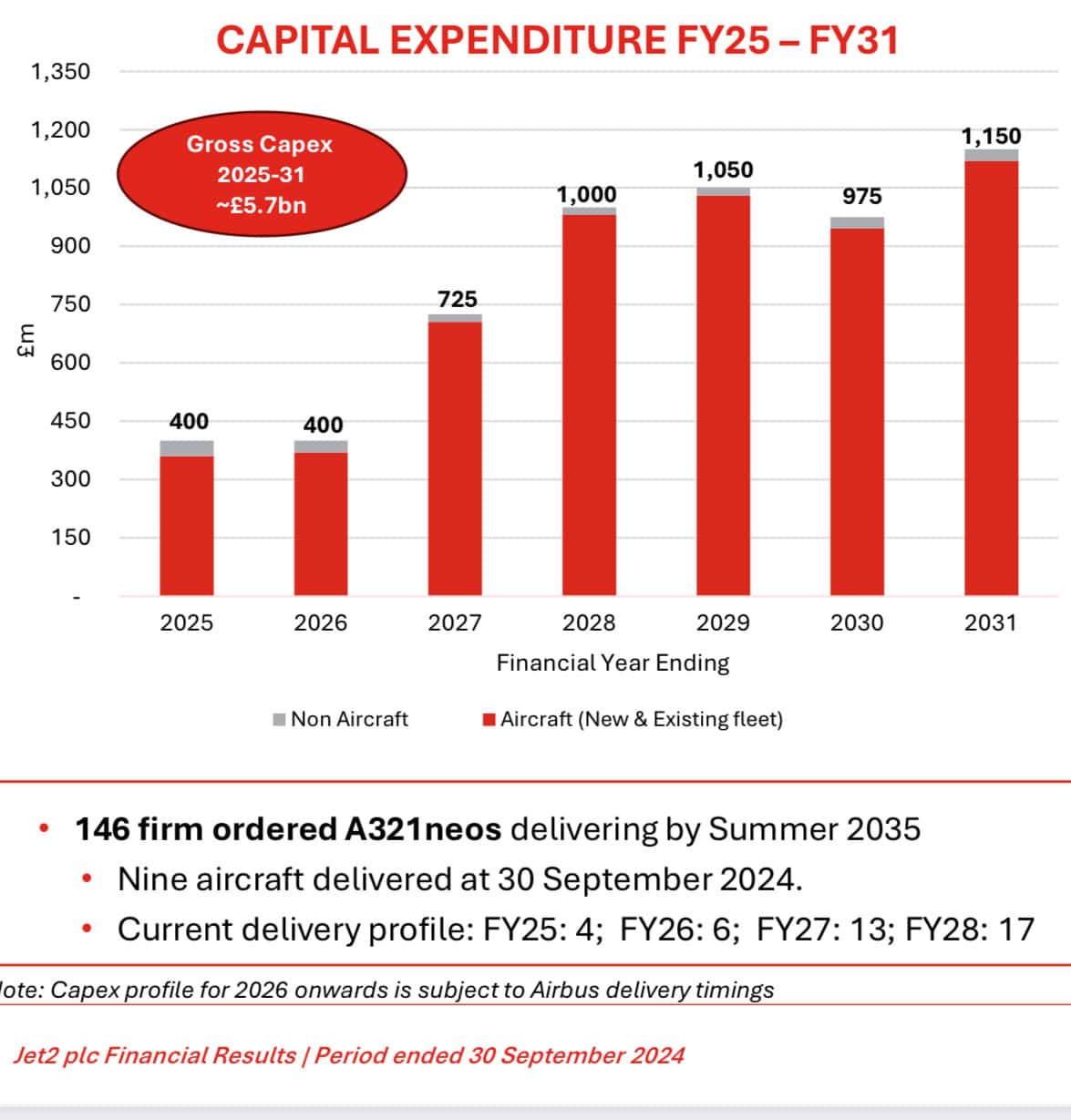
The data’s still excellent. But investors should recognise that Jet2 will be spending £5.7bn between 2025 and 2031 in order to upgrade and expand its fleet. The current Jet2 fleet’s actually a little older than some of its Western airline counterparts, but not by much. Nonetheless, there’s a transition ahead as the company aims to increase its fleet size from 135 to 163 by 2031 and tilts to a majority Airbus fleet. I do wonder if this could be weighing on the share price.

This is a considerable investment, but it’s also not unusual for the aviation industry. In fact, this figure equates to £833m annually. This broadly aligns with industry norms as airlines typically spend ~12% of revenue on capex.

Net sales for 2025 are projected to come in at £7.2bn, so this suggests the annualised capex figure represents just 11.4% of revenue. What’s more, revenue’s projected to increase to £8.6bn by 2027, further reducing this capex spend ratio.

Source: Jet2 H1 2025

As we can see, the net spend on new aircraft is actually weighted towards the far end of the forecasting period. The 146 A321neo aircraft ordered offer 20% lower fuel consumption per seat and 23% more capacity than older models, boosting operational efficiency.

Willing to overlook recent concerns

I like companies with momentum that are beating guidance. I’m willing to make an exception here because the valuation’s so good. However, Jet2 tumbled in February as it projected an 8-10% rise in full-year pre-tax profits to £560m-£570m but warned of material cost increases that could pressure margins. Rising wages, airport charges, and aircraft maintenance costs are key concerns. Higher National Insurance contributions will also weigh on growth.

Despite these concerns, Jet2’s strong market positioning — no.1 tour operator in UK — and strategic investments in new aircraft and bases position it well for long-term growth. The stock’s recent dip, driven by profit margin concerns, may offer an attractive entry point given its robust fundamentals and resilience in the leisure travel market.

And despite the cost warnings, the earnings projections are still very positive — earnings per share will grow from £1.83 in 2025 to £2.08 in 2027. Combined with a growing cash position, this forecast suggests it will be trading at 0.25 times EV-to-EBITDA for 2027. This suggests that the stock is vastly undervalued. The consensus forecasts infers a 50% undervaluation, but I believe it could be much greater.

In short, this is why I’ve recently added it to my portfolio.

Just released: the 3 best growth-focused stocks to consider buying in March [PREMIUM PICKS]

Premium content from Motley Fool Share Advisor UK

Our monthly Fire Best Buys Now are designed to highlight our team’s three favourite, most timely Buys from our growing list of growth-focused Fire recommendations, to help Fools build out their portfolios.

“Best Buys Now” Pick #1:

Pearson (LSE:PSON)

  • A former diversified publishing giant, it has repositioned itself as a pureplay education business. 
  • The company, whose portfolio is now roughly 82% digital or digitally enabled, is learning to operate more as a software business so that it can innovate faster and offer new learning experiences that are personalised and accessible”.
  • In its latest fiscal year, underlying sales grew by 3% to £3.6bn, while adjusted operating profit climbed by 10% to £600m due to operating leverage and cost efficiencies.
  • Potentially, its assessment and qualifications business could see a tailwind if people need to reskill to meet future labour needs in the face of technological changes. 
  • The company has long sought to take advantage of AI, which students should increasingly use to master Pearson’s courseware and which Pearson reckons should improve the efficacy of its education products.
  • While artificial intelligence tools might also pose a threat to Pearson’s business, in our view it’s unlikely educators – who trust Pearson to help students achieve the best outcomes – will embrace unproven technologies at the expense of a trusted provider like Pearson.
  • We reckon Pearson’s digital credentials are continuing to improve. It recently agreed strategic partnerships with Amazon and Microsoft to use AI tools for learners, educators and employers, helping validate Pearson’s claim to be a major software business.

“Best Buys Now” Pick #2:

Redacted

Want All 3 “Best Buys Now” Picks? Enter Your Email Address!

After yesterday’s results, here’s what I’m doing with my Persimmon shares

I first bought Persimmon (LSE:PSN) shares just before Covid-19 became a thing. And as a result of the post-pandemic collapse in the housing market, it means I’m sitting on a large paper loss. In these circumstances, it’s psychologically difficult to let go. After all, nobody likes to admit they got something wrong.

But after yesterday’s (11 March) results, I think the company (and the housing market as a whole) may have turned the corner.

Let’s take a closer look.

An improving picture

In 2024, completions were 10,664, a 742 (7.5%) increase on 2023. The group’s operating profit was 14% higher and there was a 10% increase in profit after tax. And despite the squeeze on incomes, it managed to boost the average selling price of its properties.

It also has plenty of land on which to build. At 31 December 2024, it had 82,084 plots under its control. More importantly, 49% of them had detailed planning consent. Based on its current run rate, this should be enough for three years’ building. The government’s emphasis on planning reform is to be welcomed but it’s not going to help Persimmon in the short term.

Looking ahead, the company’s expecting further growth in 2025. It plans to build 11,000-11,500 new homes. But the top end of this range is still 9.6% lower than the 2020-2024 average.

Encouragingly, at 2 March, it had an order book of 7,377 units. And in 2025, it’s expecting its underlying operating margin percentage to improve slightly.

Not so impressive

But despite this positivity, there’s no way to sugar coat the performance of the Persimmon share price in recent times. It’s been dire.

There was a post-election rally in 2024, when optimism about the government’s pro-house building agenda gained momentum. But this soon evaporated when the chancellor decided to increase employer’s National Insurance. To compound matters, she reduced the threshold at which stamp duty must be paid for first-time buyers.

Income investors should be happy

I was first attracted to the company’s shares by the healthy dividend on offer. And as expected, it’s committed to a full-year payment of 60p. This means the shares are currently yielding 4.9%, although my yield’s much lower as I bought at a higher price. But I’m still looking forward to July when the final payout will be made.

Personally, I think the directors could have been more generous. The dividend for 2024 is equal to around 65% of earnings per share (92.1p). In good times, the company’s been known to return well over 90% of profits to shareholders.

But I guess its directors are being cautious. They are probably mindful that there’s no guarantee of a housing market recovery given the apparently fragile state of the UK economy, although lower interest rates should help. However, I shouldn’t be too greedy. The current yield’s still comfortably above the FTSE 100 average.

Overall, I remain positive about the prospects for the company and the sector as a whole. With its strong balance sheet (it has no debt), an average selling price lower than its FTSE 100 rivals, and strong pipeline of both land and orders, I think Persimmon’s well-placed to benefit from the anticipated recovery in the housing market.

For these reasons, I plan to hold on to my shares.

2 high-yield dividend shares to consider as ‘Trump tariffs’ loom

The stock market carnage continues as investors ponder the economic impact of intensifying trade wars. With major global indexes slumping, the high dividend yields on many top stocks have now shot through the stratosphere.

However, this doesn’t necessarily mean it’s ‘fill your boots time’ for share pickers seeking a large passive income. The threat of ‘Trump tariffs’ and reciprocal action from the US’s major trading partners could hammer corporate profitability and, in the process, leave dividend forecasts in the near term and beyond on shaky ground.

Investors need to be extra careful today when selecting dividend stocks to buy. With this in mind, here are two I think are worth considering in these uncertain times.

Aviva

A financial services company like Aviva (LSE:AV) might not be an obvious safe haven for dividend chasers to consider. Sales can dry up when economic conditions worsen and people cut back on discretionary protection, wealth and retirement products.

But the FTSE 100 company has a powerful weapon in its arsenal. With a Solvency II capital ratio of 203% — more than twice the regulatory requirement — it has the financial strength to continue paying large dividends even if earnings disappoint.

Aviva has another trick up its sleeve that reinforces dividends: a large general insurance division. Spending on buildings, content, pet — and especially motor, which is a legal requirement for drivers — policies remains stable at all points of the economic cycle.

The steady stream of premiums Aviva receives allows it to in turn pay a reliable dividend to shareholders.

General insurance premiums here leapt 14% in 2024, even as consumer spending across Aviva’s UK, Irish and Canadian markets remained under pressure. This resilience is also thanks to the firm’s impressive brand power and the huge sums it’s spent to digitialise its operations.

Today the company’s forward dividend yield is a whopping 7.1%. That’s almost double the FTSE 100 average of 3.6%.

Primary Health Properties

Real estate investment trusts (REITs) like Primary Health Properties (LSE:PHP) can also be great shares for generating a passive income. They’re required to pay at least 90% of rental profits each year out by way of dividends in return for tax breaks.

Please note that tax treatment depends on the individual circumstances of each client and may be subject to change in future. The content in this article is provided for information purposes only. It is not intended to be, neither does it constitute, any form of tax advice.

This doesn’t necessarily mean a large and reliable payout every year though. Rent collection can slip during tough economic times, while occupancy levels can also slump.

Primary Health Properties doesn’t suffer from any such issues, however. This is because — as its name implies — it is focused on the highly defensive medical property market.

It lets out more than 500 first contact healthcare properties across the UK and Ireland. And the lion’s share of its rents are effectively guaranteed by government bodies like the NHS. This in turn has underpinned 29 straight years of annual dividend growth.

I think it’s a great safe haven to consider, despite the threat of high interest rates on its profits. For 2025 it carries a high dividend yield of 7.3%.

Want to become an ISA millionaire? These 3 top tips could help!

We all dream of becoming a millionaire with some shrewd investments on the stock market. Thanks to the existence of the Stocks and Shares ISA, the chances of hitting that financial target are higher than without it.

With a healthy annual contribution limit of £20k, and investor protection against capital gains tax and dividend tax, our ability to build long-term wealth is boosted.

Don’t just take my word for it, though. Fresh data from interactive investor (ii) — which styles itself as “the UK’s second largest DIY investment platform” — illustrates how the ISA has led to a boom in the number of UK millionaires.

Please note that tax treatment depends on the individual circumstances of each client and may be subject to change in future. The content in this article is provided for information purposes only. It is not intended to be, neither does it constitute, any form of tax advice. Readers are responsible for carrying out their own due diligence and for obtaining professional advice before making any investment decisions.

Millionaire’s row

According to ii, there were 1,607 Stocks and Shares ISA millionaires using its platform as of 28 February. That was up a whopping 61% from the 1,001 recorded at the end of January 2024.

It said that “ISA millionaires have likely benefitted from a strong year for investments,” with these investors enjoying an average return of 11.2% last year. This compares with the 9.5% median return for customers with lower-value portfolios.

Want to know where these high-net-worth individuals invested last year? Here’s a breakdown:

Asset class Portfolio split of ii’s ISA millionaires Portfolio split of all ii’s ISA customers
Investment trusts 40.92% 34.46%
Stocks 35.11% 25.85%
Funds 13.28% 22.41%
Exchange-traded products (ETPs) 5.18% 8.93%
Cash 4.82% 7.39%
Bonds and gilts 0.68% 0.94%
Other 0% 0.02%

Three top takeaways

Looking further into the data, it becomes clear that:

Investing early in the tax year can pay off handsomely. According to ii, 32% of contributions from ISA millionaires were made between 6 and 30 April 2024, giving their money more time to grow.

Patience is key to building long-term wealth. The average age of ii’s ISA millionaires is 73.

Diversification can deliver spectacular returns. As the table above shows, spreading capital across asset classes can mitigate risk and provide exposure to a multitude of investing opportunities.

A top trust

With 75% of ISA millionaires investing in shares or investment trusts, it goes without saying that targeting the same asset classes seems to be worth serious consideration.

I like the idea of the investment trust specifically because it’s the ultimate in good diversification, is simple and low-cost. One doesn’t have to spend a fortune on lots of individual shares to achieve this.

The Alliance Witan (LSE:ALW) trust is one such vehicle I think is worth a close look. Last year it was the most popular investment among ISA millionaires, beating out blue-chip shares like Lloyds, Shell and National Grid.

In total, the trust holds shares in 237 different companies across North America, Europe, Asia and the UK. And these span a multitude of sectors: major holdings here include Amazon, Microsoft, Visa, Diageo and Eli Lilly.

As with any shares-focused trust, Alliance Witan is vulnerable to broader stock market performance. Indeed, it’s slumped in recent days as fears over ‘Trump Tariffs’ have shaken investor confidence.

But over the long term it’s proven its mettle, rising 83.7% in value over the past five years. I’m optimistic that it’ll continue delivering the goods for patient investors.

Here’s how much stock markets are down this month (and what I’m doing as a long-term investor)

Major stock markets around the world have been hit with short-term losses as the impact of US trade tariffs take hold. Since the beginning of March, several global indexes have suffered declines, leaving analysts to question what’s the best game plan.

The FTSE 100 is down 4.3% and the more domestically-focused FTSE 250 is down 3%. That equates to a loss of approximately £85bn in market capital for FTSE 100 companies and £9.5bn on the 250.

In the US, the S&P 500 is down 6.5% and the Dow Jones has lost 900 points, down 5.6%. On Monday, the tech-focused Nasdaq suffered its worst single day since 2022, slipping 4%. Overall, the US market is said to have lost around $4trn since recent highs in February.

Major European indexes also experienced declines, reflecting concerns about the broader economic implications of the US-Canada trade dispute. Similar losses have been seen in India, Australia and Japan. Only Hong Kong’s Hang Seng index seems to be doing well, up 3.3% this month.

Safe havens

Brokers are scrambling to rebalance assets into safe havens, leading to a boost for gold and government bonds. But it seems there’s no end in sight for the bleeding, as Trump remains defiant about trade tariffs.

But there’s no need to panic and such times also come with opportunities. UK investors may consider adopting defensive investment strategies to mitigate potential risks.

Defensive companies typically provide consistent dividends and stable earnings regardless of the overall state of the market. They’re often less susceptible to economic downturns and recessions.

Examples of good defensive industries include healthcare, consumer staples and utilities. No matter how bad the economy gets, people need the services provided by these companies.

UK investors looking to add more defensive stocks to their portfolio may want to consider National Grid, Unilever, AstraZeneca and Tesco (LSE: TSCO). As the UK’s largest supermarket chain, Tesco is a particular favourite of mine.

Let’s see why.

A market leader

Selling essential goods like food and household items makes supermarkets more resilient than cyclical businesses that rely on discretionary spending. Tesco’s market dominance puts it in a good position to withstand economic headwinds.

Price action has been impressive of late, up 85% since a five-year low in late 2022. On 14 February 2025, it hit a five-year high of almost 400p but has slipped to 370p since.

Yet, despite being highly defensive, it’s not without risk. The company employs 300,000 staff, so the recent budget increases in National Insurance and wages ramped up costs. The threat of food inflation is another risk that could send cash-strapped shoppers looking for cheaper alternatives.

Price-matching programmes have been implemented to challenge this but they are only so effective. One big plus is the company’s Clubcard scheme, which helps keep its 23m+ members loyal to the store.

It’s trading at fair value, with a price-to-earnings (P/E) ratio of 13 and a low price-to-sales (P/S) ratio of 0.4. That suggests revenue is good and growth potential is moderate.

This is reflected in the stock’s 12-month price targets, which all sit in a tight range between 375p and 440p. When analysts have close agreement on price targets, it’s generally a good sign of consistent, reliable gains.

That’s why it has always been a core part of my defensive portfolio!

How much would investors need in a Stocks and Shares ISA to earn a £2k monthly income?

Many investors dream of generating a reliable passive income, and a Stocks and Shares ISA can be a powerful tool to achieve that goal. But how much would an investor actually need in their ISA to generate a decent amount, say £2,000 a month?

To generate a sustainable income, building a well-diversified portfolio is essential. Investing in a mix of dividend-paying stocks can help balance risk and reward. Some shares offer high yields but come with volatility, while others provide steadier growth but lower immediate income.

Building a spread of FTSE 100 shares

An ideal portfolio would contain 15-20 quality FTSE 100 stocks across different industries, giving it stability and reducing exposure to any single company or sector. Stocks in sectors such as banking, consumer goods, utilities and commodities can be particular handy.

One company worth considering for an income-focused portfolio is Rio Tinto (LSE: RIO). As one of the world’s largest mining groups, it produces essential commodities such as iron ore, aluminium and copper. 

Like many commodity stocks, Rio Tinto has hit by the slowdown in China, and the global economy generally. All this talk of trade tariffs isn’t helping.

Rio’s full-year 2024 results, published on 20 February, showed underlying EBITDA slipping 2% to $23.3bn, mostly due to falling iron ore prices. Analyst expected better. The share price has now fallen 3.5% over the last year. However, it’s actually up 37% over five years. With all dividends on top of that.

The Rio Tinto share price looks good value today, with a price-to-earnings (P/E) ratio of just 9.3. Mining stocks are inherently cyclical due to fluctuating commodity prices, so I reckon it’s better to buy them when they’re down rather than up.

Taking a long-term view is essential. Investors should aim to hold for a minimum five years, but ideally much longer than that.

Dividends are great but aren’t guaranteed

Now let’s say someone puts together a portfolio with an average yield of 6% a year. To hit a target income of £2,000 a month, or £24,000 a year, an investor would need around £400,000. That’s not the kind of sum investors can build overnight.

An investor who set aside £333 a month (£4,000 a year) for 30 years could get there, assuming an average total return of 7% a year. If their shares perform better, or they invest more, they’d get there faster.

With an annual ISA annual limit of £20,000, it’s possible to reach this goal using only a fraction of the tax-free allowance.

Please note that tax treatment depends on the individual circumstances of each client and may be subject to change in future. The content in this article is provided for information purposes only. It is not intended to be, neither does it constitute, any form of tax advice. Readers are responsible for carrying out their own due diligence and for obtaining professional advice before making any investment decisions.

While building a six-figure ISA portfolio takes time and discipline, the rewards are significant. A well-structured investment plan, focusing on reinvesting dividends and allowing compounding to do its work, can transform relatively modest monthly contributions into substantial wealth over time.

Patience, consistency and a long-term mindset are key to making it happen. Picking shares is the fun part. Given current volatility, there are plenty of bargains on the FTSE 100 right now. Just give them time to recover, and for those dividends to roll up.

Financial News

Daily News on Investing, Personal Finance, Markets, and more!

Financial News

Policy(Required)