After plunging 20% in a month, is the IAG share price back in deep value territory?

The IAG (LSE: IAG) share price doubled last year, making it the best performer in the FTSE 100. Investors who wanted to add the stock to their portfolio may have regretfully decided they’d missed their chance as a result.

Now they have a second chance. Shares in International Consolidated Airlines Group, parent company of British Airways, Iberia, Aer Lingus and Vueling, have suddenly dropped 20% in the last month. They’re still up 80% over 12 months though.

Investors who like buying good companies on bad news may be tempted. I think this is a good share. The question is, how bad can the news get?

Is the FTSE 100 dip a buying opportunity?

IAG was obviously hammered by the pandemic that grounded its fleets, and left the company with hefty debts. For years, its price-to-earnings ratio was one of the lowest on the FTSE 100, at around three or four.

Then last year investors decided it had suffered enough. As the US economy boomed they spotted a big opportunity in transatlantic travel, which IAG could tap into via British Airways.

On 28 February, full-year results appeared to justify their confidence. Q4 revenue jumped 11% to €8bn, beating expectations of €7.7bn, while underlying operating profit soared by 91% to €961m. Consensus had suggested just €754m.

With free cash flow jumping 29% to €3.6bn, the board felt confident enough to announce a €1bn share buyback. It clearly felt there was still plenty of value in the stock.

Enter Donald Trump. Markets fear European trade tariffs and the potential US recession will hit transatlantic flight demand. Hence that dip.

Many will be tempted, despite the dangers. IAG’s P/E ratio is back below six, suggesting that the stock is seriously undervalued relative to its earnings potential. 

Even if the shares flounder, investors can now look forward to dividends. The trailing yield is 2.74%, but is forecast to hit 3.36% this year and 3.83% in 2026.

Dividends and share buybacks too

Dividends aren’t guaranteed, of course, and shareholder payouts could take a hit if IAG’s profits do. Any slowdown in earnings could also hamper progress on paying down the group’s debt, which still stands at £5.7bn.

Market analysts remain optimistic. The 26 analysts offering one-year share price forecasts have produced a median target of 390p. If accurate, this projection represents an increase of more than 40% from current levels. 

However, most of these forecasts were probably made before recent volatility, and may not fully account for Trumpian challenges.

An investor considering IAG shares today has to take a view on how the trade war will pan out. The problem is nobody knows, probably not even Trump. Today’s uncertainty does look like a buying opportunity, but only for investors who plan to hold the shares for at least five years, and ideally longer.

Hopefully by then, today’s eruptions will have calmed. But it’s also worth noting that airlines seem to be on the frontline of every economic, geopolitical and meteorological disturbance. IAG may remain bumpy but to answer my own question, I think we’re seeing deep value today.

9% dividend yield! Is this FTSE 250 energy stock a passive income earners dream?

There are a lot of high-yielding dividend stocks on the FTSE 250, making it difficult to pick the winners. Many are fresh additions that lack the long and reliable dividend track records seen on the FTSE 100.

So it can take a bit of digging to uncover those with long-term passive income potential. With Greencoat UK Wind (LSE: UKW), I think I may have found one. 

As one of the more reliable dividend stocks on the index, this renewable energy investment trust has attracted income investors seeking stable, inflation-linked returns. Its yield currently stands at around 9% and has been growing steadily at a rate of 5% per year.

But with the share price slipping 18% over the past year, is it still a great opportunity to consider — or a potential value trap?

What does Greencoat UK Wind do?

Greencoat UK Wind is a renewable infrastructure fund that invests in wind farms across the UK. Its portfolio comprises over 50 wind farms, bringing steady cash flow from long-term contracts and government-backed subsidies. The company’s revenue is largely protected from market fluctuations, as a significant portion comes from fixed-price contracts and inflation-linked subsidies.

This can be both an advantage and a disadvantage, as we’ll soon discover.

Why has the share price fallen?

Despite a solid business and clean balance sheet, the share price has struggled to grow recently. Since early 2023, its been dropping and is now down 18% in the last 12 months.

The decline could largely be attributed to rising interest rates. As a yield-focused investment trust, it competes with bonds and other fixed-income assets. When interest rates rise, investors demand higher yields, putting pressure on share prices.

If inflationary fears push discount rates higher, it reduces the current value of its future cash flows, further impacting the stock price.

Can it recover?

As we can see from the above, a key factor in UKWind’s potential recovery is the outlook for interest rates. If inflation continues to ease and the Bank of England begins cutting rates later this year, sentiment towards the stock could improve.

Its assets remain highly profitable and the dividend is well-covered by cash flow. Moreover, the UK government’s commitment to renewable energy provides long-term potential for the sector.

Key attraction: the dividend

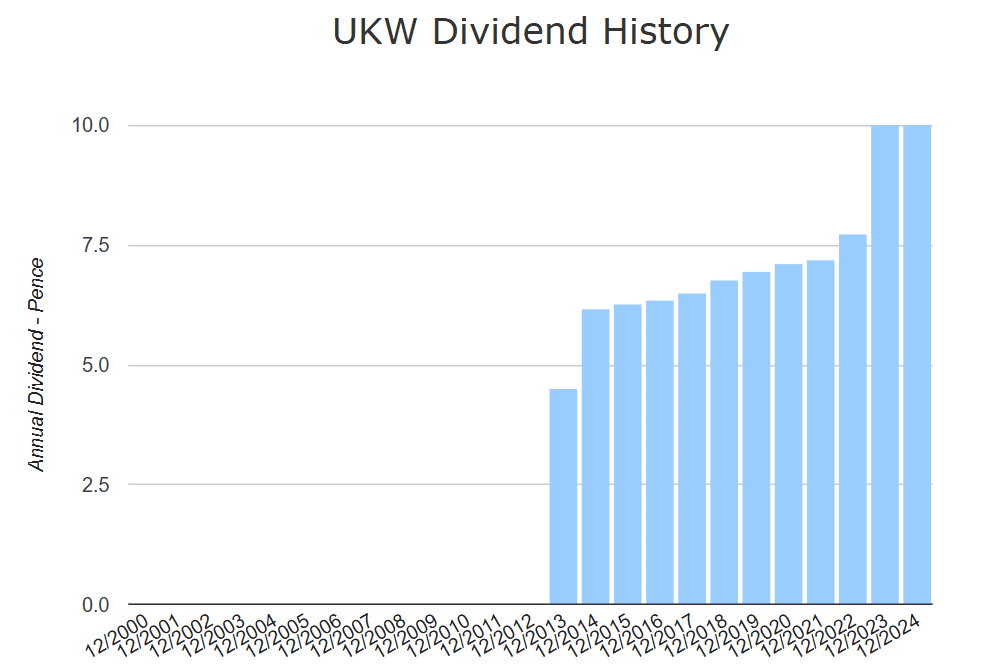
With inflationary pressures limiting price growth, the key attraction here is the dividends. Before 2024, the company had a 10-year track record of increasing its dividends in line with inflation. In 2024, it maintained the same 10p annual dividend it paid in 2023, pausing its policy of inflation-linked growth.

Screenshot from dividenddata.co.uk

Still, the 9% yield could translate to a lucrative quarterly income stream. 

Unlike traditional stocks, its dividends are backed by operational wind farms generating stable revenues. This makes the income stream more predictable compared to companies with volatile earnings.

My verdict

Investors seeking passive income should consider UK Wind as it offers an attractive yield on the FTSE 250. The stable, inflation-linked dividends provide a compelling reason to hold the stock. 

However, the near-term risk remains tied to interest rate movements. To some degree, the current price dip could be a good opportunity but in current market conditions, it’s difficult to predict a recovery. 

Those with a risk appetite to ride out the volatility could benefit from a high-yielding, defensive asset with long-term growth potential.

I asked ChaGPT to name a top UK dividend stock for my 2025 ISA – and was thrilled!

I’m looking to take advantage of the FTSE 100 dip to buy a dividend stock or two for this year’s Stocks and Shares ISA. I’ve done a lot of research but fancied a second opinion. So I called in artificial intelligence.

Like a lot of people, I like to play around with ChatGPT, but never take its conclusion seriously. As the chatbot itself confesses, it makes mistakes.

It also admits it’s not a stock-tipping service. Since I would never rely on a robot, that’s fine by me. Ultimately, I use my own judgement

It gave me three FTSE 100 shares

I told my robot buddy I was looking for a stock yielding at least 4%, with a track record of increasing shareholder payouts. Ideally, I wanted something trading at a reasonable valuation. A spot of potential share price growth would be nice too. ChatGPT said: “No problem!”

Then it picked FTSE 100 insurer Legal & General Group, which was a problem, because I both own it and have written about it a lot lately.

I asked again and got Taylor Wimpey, which I also own and have written about a lot. So I asked ChatGPT to give it a third shot and this time it suggested insurer Phoenix Group Holdings (LSE: PHNX). Which I also own! I was thrilled to see AI and I are on the same page when it comes to dividend shares. That has to be a good thing, right? Maybe, although it’s clear the AI is just aggregating the views of real humans who write about stocks.

Still, I haven’t actually written about Phoenix lately, so here goes.

Inevitably, ChatGPT immediately zoned in on its stunning 10.2% yield, the highest on the FTSE 100. It also highlighted its “strong track record of progressive dividend increases and plans to continue delivering sustainable payouts”.

It added: “In its full-year 2023 results, Phoenix announced a 3% increase in its annual dividend, in line with its commitment to steady, inflation-beating income for shareholders.”

Phoenix publishes 2024 results on 17 March, so we’ll know on Monday whether it’s still sticking to that commitment.

Double-digit yields are famously fragile. While the board remains committed to shareholder payouts, I wouldn’t be surprised to see it freeze or cut the dividend unless conditions improve.

Will the share price ever grow?

Continued stock market volatility will hammer the value of the massive £290bn of assets Phoenix manages. But as ChatGPT points out, it has a trick up its sleeve. It specialises in managing closed-book life insurance and pension funds, which “means it generates steady, predictable cash flows, even in uncertain economic conditions.”

My chatbot chum also highlighted a reasonable price-to-earnings ratio of around nine. That seemed low to me. On checking, I get 15.5 times. Like ChatGPT says, it can make mistakes.

I was wary when I bought Phoenix last year. The stock has fallen 10% in the last six months, although it’s flat over one year.

I think Phoenix is worth considering for income seekers, but despite owning the stock, I’m not expecting much share price growth in the next few years.

I will look elsewhere for my ISA dividend stock purchase. Maybe one with a lower yield, and higher growth prospects. And this time I’ll do my own research.

How to identify FTSE 100 shares with unusually high trading volume

Certain metrics can be used to gauge when FTSE 100 stocks are experiencing heavy trading volume. High volume is often the result of some notable development, such as an earnings call.

Financial news sites are usually the go-to for punters keen on the latest juicy gossip. But while they’re useful to a degree, they typically only cover companies that promise attention-grabbing headlines.

In the investment world, some of the best opportunities are found in lesser-known companies that seldom make the news. That’s why it pays to know which stocks are experiencing unusually high trading activity at any given moment.

Understanding relative volume

Normal trading volume is a measure of how much money is changing hands for a certain stock. On the Footise, Lloyds is almost always at number one, with Vodafone, BP or Barclays near the top. Many such mega-cap stocks experience high volume even when nothing interesting is happening.

However, to find out which stocks are unusually popular in a given week, I check the relative volume (RVOL). This indicator calculates current volume in comparison to average volume over a certain period. A factor of 1 means it’s trading at the usual rate. Anything higher or lower indicates a discrepancy.

For example, if a stock is experiencing volume that’s 50% higher this week than average, its weekly RVOL will be 1.5. The timeframe can be anything from a minute to a month.

FTSE 100 stocks with high weekly RVOL

This week, the three Footsie stocks with the highest weekly RVOL were Melrose Industries (LSE: MRO) (1.68), Londonmetric Property (1.65) and Intermediate Capital Group (1.58). Londonmetric took a hit from BlackRock, which decreased its voting rights, and ICG got a boost after JPMorgan put in an Overweight rating on the stock.

But of the three, Melrose experienced the largest daily gains yesterday, up 6.45%. Those two metrics together tell me something big is happening at the aerospace and defence company.

Let’s have a look.

Missed expectations

Melrose released its FY2024 earnings data last week, leading to a 92% daily spike in trading volume. However, it was mostly selling, which wiped 11.7% off the share price before this week’s mild recovery.

The company posted a statutory pre-tax loss of £106m and only £3.47bn in revenue — 2.48% below expectations. Subsequently, it lowered revenue estimates for the mid-term, which likely led to the brief sell-off.

Overall, I don’t think the results are too bad and the price will probably bounce back quickly. My main concern is the potential impact of US trade tariffs. CEO Peter Dilnot feels confident they “aren’t a material threat” but I’m wary of President Trump’s unpredictable nature. And there’s the added risk of US defence budget cuts, which could hurt profits.

I was surprised to see that most analysts haven’t adjusted their outlook. Their average 12-month price target is still around 713p — a 36% increase. That’s almost four times higher than when I last covered Melrose in December.

Plus, it raised dividends by 20% from 5p per share to 6p – a strong indication of its dedication to shareholders. I must say, the low price and 20% dividend boost make it attractive. If tariffs threats ease off, it’s certainly a stock worth considering.

Relative trading volume can be a quick way to mentally shortlist stocks with recently notable events.

Why has Warren Buffett built a $318bn war chest?

Famously known as the ‘Oracle of Omaha’, Warren Buffett’s investment prowess invites comparisons to that of a gifted visionary. Yet the esteemed CEO of Berkshire Hathaway is no fortune teller, rather a careful and conscientious investor that makes calculated decisions.

He has long been recognised for his astute investment strategies and insightful perspectives on the stock market. And the results speak for themselves, with Berkshire Hathaway growing to become one of the most successful businesses in the world.

So when Buffett acts, it’s a good idea to pay close attention. Which brings us to the company’s latest action.

A $318bn cash reserve

As of the end of 2024, Berkshire Hathaway’s cash reserves have soared to around $318bn, nearly doubling from the previous year. This massive chunk of cash puts the company in a good position amid the current stock market downturn, where the S&P 500 has declined by 4% for the year, and many blue-chip stocks have dropped by over 15%.

Berkshire’s cash stockpiling has been widely reported for months and now it seems we know why. As usual, Buffett’s strategy appears to have paid off, leaving him with excess capital to keep in reserve as a protection against a possible market downturn.

Historically, Buffett’s exercised caution when making investment decisions for Berkshire. This strategy was particularly evident in 2022 and 2023, when the company sold lots of stock. Notably, it offloaded $5bn worth of Bank of America shares and $3bn of Citigroup, and cut holdings in companies such as NU Holdings and Liberty Formula One.

This approach has resulted in Berkshire ultimately holding the largest cash reserve of any US company. 

The reasons behind this cautious approach are now clear, given recent market declines, geopolitical trade tensions and inflation concerns. Yet, despite the market slump, Buffett maintains that the majority of Berkshire’s holdings remain in equities, suggesting his continued confidence in the market long-term.

What lessons can investors take from this?

The question on everyone’s lips is: when markets dip, what should investors do to safeguard themselves? Besides building a cash reserve, we could take some inspiration from one of Berkshire’s recent purchases.

Last year, the company stocked up on shares of Heico Corporation (NYSE: HEI), a US aerospace and electronics manufacturer. The business aligns closely with Buffett’s investment philosophy, so it’s one to consider for fans who hope to emulate his success.

As a leading provider of aerospace components, it benefits from a strong market position, catering to both commercial and defence aviation sectors. With a $30.57bn market-cap, it’s a mid-sized firm in US terms, equivalent to that of Zscaler or Delta Air Lines.

Financials look solid and earnings growth is strong, reinforcing its position as a key player in the aerospace and electronics sectors. However, it depends on airline spending and defence budgets, both of which are cyclical.

A slowdown in air travel or a reduction in defence budgets could hurt its profits. In addition, it trades at over 50 times earnings, suggesting it’s still expensive despite high earnings growth.

Still, its portfolio is diversified enough that it can easily adapt to industry changes and mitigate risks associated with market fluctuations. In the current market conditions, that’s a big plus, so I think it’s a stock worth considering during the current economic uncertainty.

This FTSE 250 share looks ripe for a rebound!

After a strong run beginning before Christmas, UK shares have pulled back from recent peaks. Since closing on 3 March, the blue-chip FTSE 100 index has lost 3.9%. Meanwhile, its mid-cap cousin, the FTSE 250, has held up better, slipping only 2.5% since then.

These declines are far smaller than those seen in the US, where two major market indexes entered correction territory (down 10%+). The S&P 500 index currently stands 9.1% below its 19 February high, having fallen 10% below this level on Tuesday, 11 March. The tech-heavy Nasdaq Composite index has fared even worse and now lies 12.9% below its 16 December 2024 peak.

Cheap shares get cheaper

Warren Buffett, my investment hero, once posed this question to investors: “If you’re going to eat burgers for the rest of your life, do you want the price to go up or down?” Obviously, any sensible person would want the price of goods they buy to go down, making them easier to afford.

For me, the same applies to shares — when stock prices fall, I don’t get upset. Instead, I get excited during Mr Market’s occasional meltdowns, as they allow me to buy into great companies at better prices. Thus, when share prices slump, I go hunting for value and income shares to add to my family portfolio.

A FTSE 250 faller

One London share I’ve watched slide is that of Man Group (LSE: EMG). Starting out as a trading house in 1783, Man has grown to become the world’s largest publicly traded hedge-fund provider. Man offers actively managed investment funds in public and private markets to both institutional and private investors.

Man’s shares have slumped over the past year, falling steadily since their one-year high of 279.23p on 4 April 2024. As I write, they trade at 207.86p, down more than a quarter (-25.6%) in 11 months. However, they have easily beating the wider FTSE 250 over the past five years, surging by 106.2%, versus 27.6% for the mid-cap index.

One reason for Man’s share-price weakness could be a decline in its assets under management. At end-2024, these totalled $168.6bn, down from $178.2bn at mid-2024. This was partly due to a $7bn autumn withdrawal from one institutional client.

A dividend delight

Despite its weak shares, Man reported higher pre-tax profits of $398mn for 2024, up 43% on 2023. This success allowed the group — whose market value is £2.5bn — to lift its cash dividend and also launch a share buyback programme worth $100m.

This FTSE 250 firm’s shares now offer a market-beating dividend yield of 6.5% year. That’s well ahead of the FTSE 100’s cash yield of 3.5% a year. And it’s this juicy payout that prompted me to add this stock to our family portfolio in August 2023.Though we are slightly down on this trade, Man’s dividends have pushed this deal into profit.

Of course, as a hedge-fund manager, Man’s strategies can fare badly during market meltdowns and spiking volatility. These conditions caused its stock to plunge in Covid-hit 2020, before it rebounded strongly. Nevertheless, trading on a low multiple of just 10.7 times earnings, this FTSE 250 share looks too cheap to me. Hence, I won’t be selling our stock anytime soon!

£10,000 invested in HSBC shares 1 year ago is now worth…

HSBC (LSE:HSBA) shares are up 46% over 12 months despite being down 8% over the past week. Even with this seemingly stellar performance, this is a laggard among FTSE 100 banks. The sector has had an incredible year.

So, £10,000 invested in HSBC shares one year ago would now be worth £14,600. And the shareholder would have received around £550 in the form of dividends. Certainly not to be sniffed at, but equally it’s a sector underperformer.

What’s driving the price higher?

HSBC’s 46% surge over the past year was driven by its resilient earnings, strategic initiatives, and macroeconomic support. The bank’s fourth-quarter results highlight this strength. Underlying pre-tax profit reached $7.3bn, translating to a robust 16% return on tangible equity (RoTE).

Despite one-off items causing some volatility in reported figures, HSBC’s core profitability remains solid, supported by its focus on wealth management, fee-based income, and cost efficiency. The bank’s wealth segment, in particular, saw a 20% increase in fee income, with double-digit growth expected annually over the next three years.

Macroeconomic factors have also played a significant role. Asia’s economic recovery, especially in China and India, has driven growth in trade and investment flows, benefitting HSBC’s transaction banking and wealth divisions. While declining interest rates have weighed on net interest income, HSBC’s proactive hedging strategy has helped stabilise earnings. Additionally, higher rates earlier in the year expanded the bank’s net interest margins, though this is expected to moderate as rate cuts progress.

HSBC’s commitment to shareholder returns, including a $2bn buyback and a 43% dividend increase, alongside its cost-saving initiatives, has further strengthened investor confidence. These factors justify the stock’s re-rating and support its premium valuation.

Elevated valuation but still discounted

HSBC remains cheaper than its US peers despite its recent rise. The price-to-earnings (P/E) ratio of 8.9 times for 2024, 7.9 times for 2025, and 7.2 times for 2026 compares favourably versus US banks. 

However, this lower valuation reflects concerns over certain aspects of its business, particularly its exposure to China and the impact of a global rate-cutting cycle, which has pressured its net interest margins. 

Nonetheless, it’s worth noting that this China concern is also a key plus point for some investors. HSBC is continuing its shift to Asia. In fact, it recently said it was cutting investment banking jobs in London as part of a restructuring plan.

The bank aims to reduce costs by $1.5bn by 2026 and wind down its investment banking operations in the West, particularly in Europe and the Americas. In short, HSBC’s strategy underscores its commitment to Asia, its most profitable market, while scaling back less lucrative Western operations.

Personally, I’m sitting on the sidelines. I appreciate the dividend is sizeable. But I’m actually more worried about geopolitical concerns in the near and medium term. This is especially the case with Donald Trump in the Oval Office.

A strong dividend share I’ve bought to target a huge second income!

Dividends are never, ever guaranteed. And in uncertain economic times like these, the threats to investors’ second income can be especially high.

Happily, however, investors can to boost their chances of receiving healthy dividends. Purchasing shares in defensive sectors (like utilities, consumer staples, and defence) can be an effective tactic.

So can choosing stocks whose predicted dividends are well covered by expected earnings. Selecting companies with robust balance sheets is also often essential.

REIT benefits

With this in mind, I think Target Healthcare REIT (LSE:THRL) is worth a serious look today. For the next two financial years — to June 2025 and 2026 — the company carries enormous dividend yields of 6.4% and 6.6%, respectively.

To put that in context, the average forward dividend yield for FTSE 100 shares is way back at 3.6%.

Real estate investment trusts (REITs) like Target Healthcare are popular destinations for dividend hunters. In return for corporation tax breaks, they must distribute at least 90% of annual rental income in the form of dividends.

This doesn’t necessarily make them no-brainer investments, however. Their overall profits can slump when interest rates rise and net asset values (NAVs) come under pressure.

Yet despite this threat to Target Healthcare (and its share price), I think that overall it’s a great stock to consider right now for dividend income. It’s why I hold the business in my own Stocks and Shares ISA.

Please note that tax treatment depends on the individual circumstances of each client and may be subject to change in future. The content in this article is provided for information purposes only. It is not intended to be, neither does it constitute, any form of tax advice.

Strength in depth

As its name implies, the FTSE 250 business operates in the highly defensive medical care market. More specifically, it operates 92 care homes across the UK, a sector in which rental growth and collection remains robust across the economic cycle.

Despite tough times for Britain’s economy, rent collection here was still a robust 99% in the 12 months to June, while like-for-like rental growth was a healthy 3.7%.

On top of operating in a stable sector, Target Healthcare has one of the strongest balance sheets in the REIT sector. So even if earnings disappoint, it has the financial headroom to pay a large (and growing) dividend.

As of December, its loan-to-value (LTV) was just 22.7%. LTV measures the amount of debt a real estate company has relative to the market value of its assets.

The cost of servicing its borrowings should remain low over the medium term too. Its weighted average cost of debt (WACD) was 3.95%, and its weighted average debt term 4.7 years, as of the end of 2024.

A long-term buy?

While I consider it an attractive lifeboat in these uncertain times, I believe Target Healthcare also has considerable long-term investment potential.

Britain’s rapidly ageing population and rising healthcare needs are driving substantial growth in the care home sector. This looks set to continue, with the Office for National Statistics (ONS) predicting a 74% rise in the number of people aged 65 and over between 2022 and 2072, to 22.1m.

Given this opportunity, I think Target Healthcare is a great share to consider for a long-term second income.

Investors’ confidence is sinking! What should they do as stock markets plummet?

It’s not a shock to see investor confidence crashing right now. UK shares are on the ropes as the market weighs up the impact of ‘Trump Tariffs’, matching sharp falls on global stock markets.

According to Nutmeg, almost a third (31%) of 1,000 investors it surveyed say they “don’t feel confident about the prospect of positive investment returns this year“.

The number is even grimmer for experienced investors. Some 38% of those with a decade or more of stock picking experience said they “lack confidence in the investment outlook“.

Notably, the survey was taken between 9 and 16 January, before worries over trade wars hit fever pitch and stock markets plunged. It’s reasonable to expect that these numbers would be far worse today.

Keeping calm

The ride may remain bumpy for some time given the broader economic and political backdrop. Fears over the global economy and stubborn inflation were high even before tariff talk exploded. The evolving geopolitical landscape also throws up uncertainties.

At times like this, though, it’s critical to look past the noise and focus on the long term. Past performance is not always a reliable guide to the future. But history shows us that stock markets have always recovered from volatile periods to reach new record peaks.

Take the FTSE 100, for example. In the 21st century alone, it has weathered foreign wars, a banking sector meltdown, a eurozone debt crisis, and a pandemic. Yet over the period it has still risen 24% in value, striking new closing highs of 8,871 points just this month.

The S&P 500‘s performance has been even more impressive, rising 292% since 1 January 2000.

Thinking long term

I believe that the long-term outlook for global stock markets remains extremely bright. And I’m far from alone in my thinking.

James McManus, chief investment officer at Nutmeg-owned JP Morgan, says that “we see plenty of opportunities and reasons for optimism for investors that are able to keep a cool head and remain focused on the long term“.

He notes that “many of the building blocks for long-term investment performance – such as real term wage growth, high employment levels, strong company earnings and stabilising, lower inflation – are in place“.

Diversifying for success

By creating a well-diversified portfolio, individuals stand a better chance of riding out bouts of volatility and maximising their long-term returns, too.

Investment trusts such as the City of London Investment Trust (LSE:CTY) are extremely popular vehicles for investors looking to diversify. These exchange-listed companies invest in a variety of other businesses in order to spread risk and caputure different investment opportunities.

The City of London trust has holdings in 80 large, medium, and small companies, and has a 60% portfolio bias towards bigger firms, which provides it with added robustness. It is well spread by sector, too (as shown below), and major holdings include HSBC, Unilever, and BAE Systems.

With four-fifths of the trust tied up in UK shares, it carries more geographical risk than more global funds. But on balance, I still think it’s an excellent option for investors to diversify.

Since 2020, it has delivered a healthy average annual return of 8.4%.

Financial News

Daily News on Investing, Personal Finance, Markets, and more!

Financial News

Policy(Required)