With gold above $3,000, is it time to consider buying this FTSE miner?

Generally speaking, economic instability isn’t good for FTSE 100 stocks. During difficult times, investors tend to abandon equities and look for other assets in which to invest.

One favourite is gold. It has a reputation for being a reliable store of wealth. Because of this, it’s often viewed as an effective hedge against inflation.

And as a result of President Trump’s erratic ‘on-off’ approach to tariffs, fears of slowing global economic growth and continuing regional conflicts, the precious metal is doing rather well at the moment.

So far in 2025, its price has set a number of record highs and this morning (14 March) it broke through the $3,000/oz barrier for the first time. It’s taken less than five years to get from $2,000/oz.

How times have changed.

Nearly 25 years ago, my first investment was in a unit trust specialising in precious metals. At the time, gold was trading at $300/oz. Unfortunately, I sold up long ago.

One possible beneficiary

But there’s one FTSE 100 stock, Endeavour Mining (LSE:EDV) that should benefit from a rising gold price.

In 2024, production from its mines in West Africa was 1,103koz (thousand ounces). For 2025, it’s forecasting a range of 1,110-1,260koz. At the top end, this would be 14% more.

The group claims that it has a “class-leading” cost of production. Miners use All-In Sustaining Cost (AISC) to measure this. In the last quarter of 2024, Endeavour Mining said its AISC was $1,141. And with gold above $3,000, there’s clearly plenty of profit to be made.

Also, in my opinion, there are other positives. Unlike gold, the stock pays a healthy dividend. Its declared payout for 2024 is $0.98 (75.8p at current exchange rates). This means the stock’s presently yielding 4.5% and that puts it in the top quartile of Footsie members.

Of course, payouts are never guaranteed.

Then and now

Since 14 June 2021, when the company first listed in London, its share price has risen by just under 5%. Yet, over the same period, the price of gold has rocketed 67%. Initially, this was a bit of a puzzle to me. However, a closer look at the numbers explains why the group’s stock market valuation has stagnated.

As a result of selling some of its non-core assets, it’s now producing less than it was previously. And its earnings are largely unchanged.

In 2024, the 1,103koz of gold that it mined generated revenue of $2.68bn. Its adjusted net earnings per share (EPS) from continuing operations was $0.93 (72p).

In 2021, production was 1,524koz resulting in turnover of $2.78bn. Its EPS was $0.92.

Final thoughts

Despite the plus points, I don’t want to invest.

A rising gold price is a double-edged sword. Yes, it should help increase the group’s margin and earnings. However, a higher price is like to affect demand. This could be impacted further if the fears driving the gold price higher come true.

And despite its recent bull run, the price of gold can be volatile.

Also, from an operational perspective, I reckon mining is the most difficult industry in the world. At the time of its listing, Endeavour Mining’s prospectus devoted 23 pages to a detailed explanation of the challenges that the group faces.

For these reasons, the stock’s too risky for me.

3 possible ways to generate a £1k monthly second income in the stock market

The idea of earning a second income by owning dividend shares is not new or radical – but it can be financially lucrative.

If someone wanted to target an average £1,000 monthly second income buying dividend shares, here are three possible approaches they could take.

Approach 1: invest in a top index tracker fund

£1,000 a month adds up to £12k in a year. At the moment, the FTSE 100 index of leading companies yields around 3.4%. So to hit that target immediately, someone could invest around £353k into a FTSE 100 tracker fund.

Most people do not have a spare £353k and even if they did, they may prefer not to invest it all at once, but instead utilise their annual allowance over time in a Stocks and Shares ISA.

This approach does have some possible advantages though. The second income could start flowing within months and it would be generated by a broad-based basket of blue-chip businesses.

A range of index trackers is on offer. It would make sense to compare them, as they may charge in different ways for monthly income withdrawals.

Please note that tax treatment depends on the individual circumstances of each client and may be subject to change in future. The content in this article is provided for information purposes only. It is not intended to be, neither does it constitute, any form of tax advice. Readers are responsible for carrying out their own due diligence and for obtaining professional advice before making any investment decisions.

Approach 2: drip feed money into blue-chip shares

Another approach is to start from zero and invest an affordable amount monthly into an ISA or share-dealing account.

No dividend is ever guaranteed, but I see value in sticking to blue-chip shares with proven businesses. Rather than just tracking the FTSE 100 though, an investor could buy a diversified portfolio of selected individual shares. Doing that, I think it is possible to target a 7% yield in the current market.

One share investors could consider is British American Tobacco (LSE: BATS). The owner of brands including Lucky Strike has a highly cash generative business that helps fund a big dividend. The dividend per share has grown annually for decades and the current yield is 7.4%.

British American has a strong brand portfolio, proven business model and large customer base. However, I do see risks. Cigarette sales are declining in many markets, eating into revenues and profits. Non-cigarette products like vapes may replace some of those sales volumes. But that remains to be seen — and how profitable they will be over the long run.

Still, the cigarette market remains substantial and I expect it will be around for a good while yet. British American has proven able to generate lots of excess cash and willing to divvy it up among shareholders.

If an investor put £500 a month into blue-chip shares yielding an average 7%, their second income hopefully ought to grow annually and within 29 years they should be earning £1k each month.

Approach 3: unleash the financial power of compounding dividends

That 29-year wait to hit the target could be cut to just 16 years using the same approach — with one difference. Rather than taking out the dividends along the way, an investor putting in the same £500 each month at an average 7% yield could initially reinvest the dividends.

Then, once the portfolio was big enough (after 16 years), they could start receiving the dividends as a second income. This approach is known as compounding – and is a simple way to try and grow a sizeable second income from dividend shares faster.

Is the booming BAE Systems share price a deadly trap?

After a disappointing 2024, the BAE Systems (LSE: BA.) share price is rising at speed. 

The FTSE 100 defence manufacturer’s shares have rocketed 28% in the last month and are up 23% over the past year. 

Investors are piling in, buoyed by concerns over Russia’s ongoing war in Ukraine and Donald Trump’s radical shift of US foreign policy,as he pressures European nations to ramp up their military spending.

European-listed defence contractors, including BAE Systems, have been major beneficiaries but have they rallied too far, too fast?

What next for this FTSE 100 stock?

We’re seeing seismic changes. Germany is now considering scrapping its self-imposed debt brake to fund a large-scale military rebuild. The UK is also pushing for increased defence spending, albeit at a more modest level.

This is happening at a time when BAE Systems is already in an enviable position. Full-year results, published on 19 February, showed sales soared 14% to £28.3bn in 2024. Underlying profit grew by a similar percentage to £3.02bn. 

Even better, the company’s order backlog hit an all-time high of £77.8bn, up 11% year on year. That should provide stunning revenue visibility for years to come.

Investors were also treated to a 10% dividend hike. The trailing yield is a modest 2.1%, but would be much higher if the shares hadn’t grown so fast.

However, there was a slight concern in the results: free cash flow slipped by £88m to £2.51bn, which could be something to watch.

Despite BAE’s success, there are risks. While Europe is accelerating defence spending, Trump has signalled potential cuts to the US military. 

Given that BAE generates around 45% of its revenues from the US, any shift in Pentagon spending could hit orders.

Also, while European governments have made ambitious promises, following through is another matter. 

The UK, for example, has pledged only a modest increase in defence spending and remains financially constrained. If economic conditions worsen, budget priorities could shift away from military expansion.

The P/E ratio is a little high

There’s also the wildcard factor of peace talks. If discussions around the hoped-for Russia-Ukraine ceasefire gain traction, governments might seize the opportunity to scale back spending.

The BAE Systems share price, which has surged on expectations of long-term conflict-driven demand, could slip if we see meaningful progress (although I don’t think we will, much as we long for it).

I have another worry. The shares are a little expensive with a price-to-earnings (P/E) ratio of more than 23. Investors are pricing in a lot of growth here.

Defence stocks have historically been cyclical, and while the world is currently in a period of heightened military investment, events can turn quickly. Investors considering buying BAE Systems today should proceed with caution. 

The fundamentals are strong, the outlook promising and I still think this is a brilliant long-term buy-and-hold. I’m just worried that today’s rally has already priced in a best-case scenario. To be clear, I have absolutely no plans to sell my shares. I just won’t add to my position at today’s price.

Thank you stock market: a rare chance to consider buying Nvidia stock?

In January, the DeepSeek-induced sell-off sent shockwaves through the artificial intelligence (AI) and semiconductor sectors, with Nvidia’s stock taking a significant hit. However, this presented a rare buying opportunity for investors.

Despite the initial panic, Nvidia’s position as a linchpin in future large language model (LLM) developments, driven by its market-leading AI accelerator chips, remained intact. The growing Sovereign AI movement and intensified hyperscalers’ capex trends has further supported this.

Since then, Nvidia has partially recovered its losses, but the broader market correction since mid-February 2025 has weighed on its valuation. The stock shed over $1trn in value from its peak, reflecting the broader pain in the tech sector. This pullback, exacerbated by the intensified tariff war and potential tighter US export controls, has created some concerns about the Nvidia’s investment thesis. For example, Asia, which accounts for 47% of its FY2024 revenues, remains a critical market, and any disruptions could further impact growth.

No clear signs of a slowdown

Despite these challenges, Nvidia’s reports and guidance remains strong. The firm reported a double beat in Q4 of 2025, with revenues of $39.3bn (up 77.9%) and adjusted EPS of $0.89 (up 71.1%). The data centre segment, which now comprises 90.4% of sales, continues to drive growth.

Looking ahead, Nvidia continues to innovate and is seemingly some way ahead of its peers in the AI/data centre market. It’s the key partner of hyperscalers and the ramp up of its Blackwell architecture is driven by substantial demand. We also appear to be in a period of rapid innovation and adoption where replacement cycles are very short. This is also driving growth.

Are there risks to the thesis?

There are clearly risks and concerns, hence the two recent sell-offs. While Nvidia recovered from the DeepSeek-engendered chaos, investors are seemingly worried that the more Chinese tech innovations could upset the balance and Nvidia’s dominance. It’s also true to suggest that, for now, Nvidia’s reliant on hyperscalers. The democratisation of AI will change this but, for now, it’s hyperscalers buying all the chips.

What’s more, at the time of writing (14 March), Hon Hai — a Nvidia supplier — has just missed profit expectations. This may suggest some weakness at Nvidia, although there’s been plenty of positive data recently.

Valuation reflects concerns

From a valuation perspective, Nvidia appears attractive. According to renowned fund manager Peter Lynch’s price-to-earnings-to-growth (PEG) ratio, the stock is cheap, with a forward PEG Non-GAAP of 0.78, significantly below the sector median of 1.62. What’s more, the forward price-to-earnings (P/E) Non-GAAP of 25.7 times also suggests the stock’s trading at a discount to its historical averages.

Personally, I believe market forces have provided investors with a unique opportunity to invest. Of course, no investment comes without risks. However, everything considered, I’m thinking about topping up. Admittedly, the daily volatility isn’t making it easy to find an entry point.

Time for a Berkeley Group share price recovery as FY guidance is confirmed?

Berkeley Group Holdings (LSE: BKG) posted its latest trading update on Friday (14 March), and the share price moved up a couple of percent in early trading.

The shares had been sliding since last September’s trading update, though the outlook back then seemed reasonable.

December’s interim results didn’t do much to help, as the company said it was “on track to achieve our pre-tax profit guidance of £525 million for the full year and at least £450 million for FY26.” A forecast profit fall from 2025 to 2026 wasn’t what investors wanted.

Guidance reinforced

In the latest update, Berkeley said it “reaffirms its earnings guidance” at those same predicted 2025 and 2026 levels.

The company also said it’s “seen the modest improvement in sales reservations that we noted at the time of the interim results continue through this trading period with sales rates ahead of those achieved last year.

We also saw praise for “the government’s planning reforms and housing delivery ambitions.” The company is, however, concerned by the extent and pace of regulatory changes introduced following the Grenfell disaster. It says the new rules “place significant pressure on the delivery of new homes.

Berkeley looks fine on liquidity, with “net cash anticipated to be around £300m at 30 April 2025.” It’s down from the £474m reported at 31 October 2024, but it seems that’s due to land creditor settlements and share buybacks.

And to me, few things suggest management confidence more than a buyback programme.

Rebound chances

I see other signs that the Berkeley Group share price could bounce back in 2025. The current crop of analyst forecasts is one, putting the price-to-earings (P/E) ratio at under 10 and with a generally bullish consensus.

The expected earnings fall in 2026 is the real fly in the ointment though. And even the modest return to growth pencilled in for 2027 seems too far ahead to make much difference right now.

The forecast dividend yield at less than 2% doesn’t scream out to income investors. At least, not when Taylor Wimpey can boast a forecast 8.3% with Persimmon on 5%.

I do see an advantage for Berkeley. It focuses its development mostly on relatively large-scale urban redevelopments in the London area. That’s where I see a housebuilding recovery mostly likely to start.

And the company prioritises brownfield regeneration, with some prime land holdings, and that accounted for 92% of its first-half housing completions. It’s got to be the way forward for urban development.

Maybe more wobbles

In the long term, I’m bullish about Berkeley Group’s future, along with the rest of the sector. And it does seem to have the cash needed to withstand today’s pressures.

Can the share price bounce back this year? I think it could, if we see the return of economic growth coupled with more interest rate cuts. The weaker year forecast for 2026 could keep the share price down for longer though. And the low dividend is an issue that might keep some investors away. Positive outlook, but short-term wobbles ahead, I suspect, but definitely one to consider.

Down 40%, is the Greggs share price poised to soar again?

After falling by 40% in six months, the Greggs (LSE: GRG) share price is looking deeply unloved. Investors have taken fright as the sausage roll specialist has reported slowing sales growth.

It’s not a pretty picture. But the stock market is known for its dramatic mood swings. Has the recent sell-off gone too far? I can certainly see some reasons to think so.

On a forward price-to-earnings ratio of just 14, my research suggests Greggs shares are currently cheaper than they’ve been for 10 years.

The company’s operating profit margin also remains above average for this sector, at 10%. Efficient operations and a lack of bank debt helped the business generate a return on equity of 28% last year – a very strong figure.

And the business is still growing. Sales rose by 11% last year to just over £2bn, supporting an 8% rise in pre-tax profit to £204m. These numbers are very respectable and do not seem to suggest a business that’s in decline.

So why have Greggs shares been falling?

The stock market is all about the future, not the past. As far as I can see, the main reason why Greggs’ share price has been falling is that investors are starting to wonder if the company’s growth has peaked.

After all, last year’s 11% sales rise was supported by 145 net new store openings.

Sales in stores that have been open for more than a year rose by just 5.5%. That compares to an equivalent growth figure of 13.7% in 2023.

Worse still, the company said that in the first nine weeks of 2025, so-called like-for-like sales growth slowed to just 1.7%. It blamed bad weather in January, but sales growth has now been slowing for more than a year.

I wonder if Greggs could be reaching a natural limit on its size. After all, the company now has more than 2,600 shops in the UK. That’s roughly the same as Costa Coffee and nearly 50% more than McDonald’s.

Why I’m tempted to buy

Yet I think Greggs is an excellent food-to-go operator and a brilliant marketing organisation. I expect it will remain successful.

Although I do expect growth to slow over the coming years, I think the shares could still be a profitable investment at the right price.

So, is the price right for me today? The shares are currently trading on a forward P/E of 14 with a 3.6% dividend yield. As I mentioned at the start, I reckon this is probably the cheapest they’ve been for around 10 years.

However, I can’t ignore the possibility that Greggs could face a difficult year ahead, perhaps triggering a cut to earnings forecasts.

It’s possible that I’m being too cautious. But for an extra margin of safety, I’d like to see some sign that slowing sales growth has levelled out before I decide to invest. Greggs will stay on my watchlist for a little longer.

Is it finally time for me to buy this FTSE 250 stock?

I’ve had an eye on shares in FTSE 250 drinks company AG Barr (LSE:BAG) for a while and my view has been that I’d like to buy the stock at or below 600p. As I write this, it’s trading at 589p.

The trouble is, it’s been at this level before and I’ve always thought there were better opportunities for me elsewhere. But I think there’s a very strong case to be made for considering it at today’s prices.

Investment thesis

The core of my investment thesis for AG Barr is simple – I think earnings per share (EPS) are heading towards 39p in the next 18 months. And if that happens, I think the stock is undervalued.

My actual price target for the stock is around £7.88. This is based on 39p in earnings per share and a price-to-earnings (P/E) ratio of 20, which is roughly its historic average. 

That’s around 33% higher than the stock’s current level and it doesn’t include anything in terms of revenue growth or dividends. It’s where my margin of safety comes from. 

The stock currently trades at a P/E multiple of 18.5, but I’m expecting this to increase if profitability increases. The big question, though, is are margins going to expand?

Integration

In 2022, AG Barr acquired BOOST Drinks Holdings in a deal worth £20m. The impact on revenues was immediate – since then, sales increased from £269m to £411m. 

Profits, however, have taken longer to catch up. Costs have been incurred during the integration process and operating margins fell from 15.6% to 12.3% as a result.

At the start of last year, however, the company indicated that margins should reach 13.3% by January of this year and 14.5% in 2026. And the latest report showed good progress in this regard.

AG Barr’s January update reported margins of 13.5%, putting the company ahead of schedule. But the stock is roughly back where it was last July, which looks like my opportunity. 

What could go wrong?

Given the fact that Irn Bru is somehow both wildly popular in Scotland and desperately difficult to export anywhere else, I’m not that worried about US tariffs. That might be a mistake, but I’m relaxed.

A bigger concern, in my view, is the possibility of inflation. Since my thesis for AG Barr is focused on the company’s ability to expand its margins, higher input costs are the most obvious threat.

There’s not a lot the company can do to try and ward this off. I think the best move for investors is to try and look for a margin of safety in the share price in case things don’t go to plan.

I think that’s there at the moment. With a potential 31% gain even with no contribution from revenue growth or dividends, the stock looks very attractive to me anywhere below 600p. 

Is this my time to buy?

Last time shares in AG Barr were at this price, I missed out because a there were other investments that I thought were more attractive. But I’m hopeful to avoid this happening again.

With share prices falling, a lot of stocks that have made their way on to my buying radar recently. However, if the AG Barr share prices stays below 600p, it’ll be the next stock I buy.

3 heavily discounted UK shares… and I think only 1 is worth considering this month

The FTSE 100 is down 3.5% this month as UK shares suffer losses due to market uncertainty. But as the Footsie had such a great start to the year, the minor dip has only brought it to a six-week low. 

As a value investor, I’m more interested in high-quality shares that are at their lowest in years – 30% to 50% down from their 52-week high.

I’ve found three that fit the bill but I’m interested in just one of them.

JD Sports Fashion

It’s JD Sports (LSE: JD.), a leading British multinational retailer specialising in sports fashion. It has a significant global presence and historically strong performance. Revenue was over £10bn in the latest results, with almost £1bn profit and a decent 9.3% operating margin.

So why is the stock down 55% from its 52-week high?

The business struggled during the 2024 holiday season, reporting a 1.5% decline in like-for-like revenues across November and December. A “challenging and volatile market” with increased promotional activity. Consequently, the company downgraded its full-year pre-tax profit forecast by almost 10%, to between £915m and £935m.

Will it recover?

Through it all, JD still focused on aggressive expansion, acquiring US company Hibbett for $1bn. This strategic move is part of a plan to increase its global market share, which could equate to long-term growth – so there’s a decent chance and I’m considering it.

Persimmon

Persimmon (LSE: PSN) is one of the UK’s leading housebuilders. For FY24, it reported a 7% increase in completions, delivering 10,664 more new homes than in 2023. Group revenue increased 6% and underlying operating profit rose 14%.

So why is it down 32.4% from its 52-week high?

Stubborn inflation remains the key issue affecting the UK property sector, affecting share prices across the board.

Add to this increasing national insurance contributions which could amount to £15m in expenses. Both these issues weigh on investor sentiment.

Will this one recover?

Looking ahead, Persimmon plans to build between 11,000 and 11,500 homes in 2025. CEO Dean Finch has called on the UK government to reintroduce support for first-time buyers to meet the national target of 1.5m new homes by 2029. He suggested a shared equity scheme to assist buyers with deposits — a significant barrier to home ownership.

However, inflation will likely be the deciding factor for its recovery. For now, it’s too early for me to tell.

Berkeley Group

Berkeley Group (LSE: BKG) focuses on residential developments in London and the South East. For the half-year ending October 2024, the company reported a 7.7% decline in pre-tax profits to £275.1m, down from £298m the previous year. Despite this, there has been a slight increase in sales recently, indicating a potential market recovery.

So why is the stock down 35.6% from its 52-week high?

CEO Rob Perrins has pinned the limited supply of new homes to industry challenges, like stringent planning regulations and elevated mortgage rates. 

As with Persimmon, inflation is a big risk along with potential new tax levies. 

Can it recover?

Berkeley is acquiring new sites for the first time since early 2022, signaling confidence in a market rebound. It plans to invest £2.5bn in land under a new 10-year strategy, which sounds promising. 

However, stubborn inflation will again be the deciding factor, so for now, I can’t say for sure.

Here’s how much an investor needs in a Stocks & Shares ISA for a £5,000 monthly passive income

For me, leveraging a Stocks and Shares ISA and following a disciplined investment strategy is the very best way to try and achieve a £5,000 monthly passive income. The beauty of an ISA lies in its tax-free benefits, allowing investments to grow unhindered by capital gains or dividend taxes.

Please note that tax treatment depends on the individual circumstances of each client and may be subject to change in future. The content in this article is provided for information purposes only. It is not intended to be, neither does it constitute, any form of tax advice. Readers are responsible for carrying out their own due diligence and for obtaining professional advice before making any investment decisions.

Stocks and Shares ISAs outperform savings accounts

Most Britons still rely on savings accounts, but with annualised returns typically below 3%, their money isn’t growing fast enough. By contrast, investing in stock markets has historically delivered significantly higher returns.

For instance, the FTSE 100 has averaged an annual return of 6.4% over the past 20 years, while the S&P 500 has averaged 10.5% since its inception. Even more impressively, the Nasdaq 100 has posted an average return of 19% over the last decade.

Stay with me…

To generate £5,000 monthly, or £60,000 annually, investors would typically need at least £1.2m in their ISA. This assumes a 5% withdrawal rate. And this can be achieved by investing in dividend-paying stocks or bonds within a Stocks and Shares ISA. And while this £1.2m figure might sound daunting, it’s very achievable. And remember, this is £5,000 a month, tax free. So it’s a goal worth aiming for.

Let’s say someone starts by investing £500 a month in a Stocks and Shares ISA. Over 30 years, assuming an average annual return of 10.5% (matching the S&P 500’s historical performance), these investments could grow to over £1.2m. Of course, the younger an investor starts, the more time they have to leverage the power of compounding.

Index trackers and other diversifiers

The problem however, is that many novice investors lose money. They invest poorly chasing big bucks and see the value of their investments collapse. This is why many advisors will recommend they buy index-tracking funds. These are funds that attempt to track the performance of indexes like the FTSE 100 or S&P 500 for a small fee.

While index-tracking funds are a solid choice, I prefer selecting individual stocks, trusts, and funds. This approach allows me to potentially outperform the market by focusing on high-quality dividend payers and growth stocks.

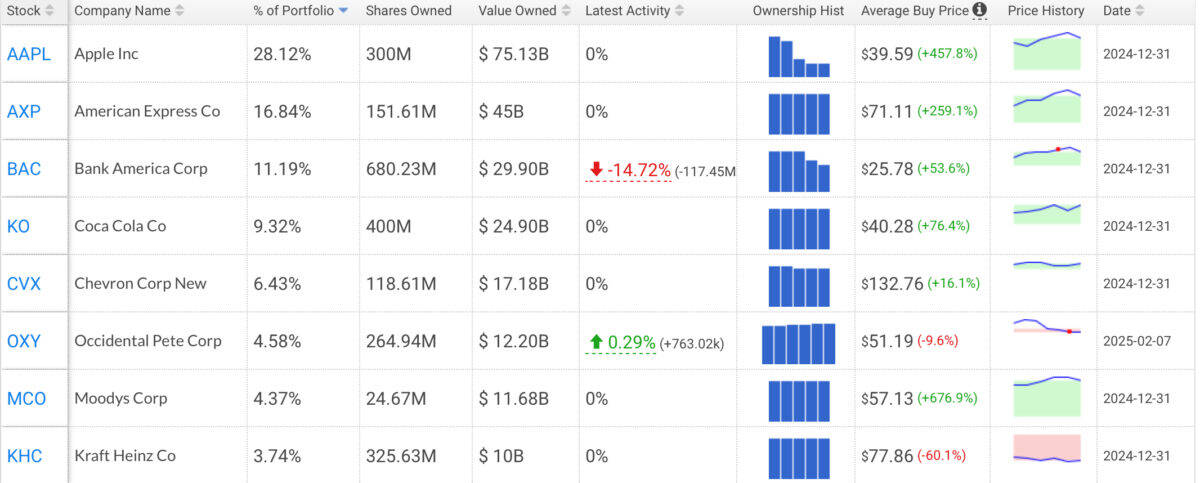
One place I’ve recently been putting my money is Berkshire Hathaway (NYSE:BRK.B). This Warren Buffett conglomerate has been making headlines over the past year for selling holdings and hoarding cash. And as market volatility picks up, investors are looking at Buffett’s strategy keenly and asking what he’s going to do with $334bn. While I don’t have a crystal ball, history shows us that Buffett has a great track record of making the right investment at the right time.

One risk of this investment is its US focus. Buffett invests in the backbone of the US economy, which has outperformed during his career, but there’s no guarantee this will continue. And it’s this concentration that arguably reflects one of the biggest risks of investing in Berkshire.

Source: Hedgefollow.com — Berkshire’s top holdings

Nonetheless, I’d simply point to the conglomerate’s track record for outpacing index growth and delivering returns for shareholders over the long run. Buffett also isn’t limited to investing in the US. It’s simply been his preference. This could change if he sees better value elsewhere.

I’m considering increasing my stake in this FTSE 100 dividend share! Here’s why

It’s fair to say that my investment in Persimmon (LSE:PSN) hasn’t gone to plan, so far. I bought the FTSE 100 housebuilding share at around £22.10 back in June 2022. Today, it’s changing hands for just £11.92.

Falling inflation — and buoyant hopes of sector-boosting interest rate cuts — allowed the housebuilder to pick up momentum around summer 2023. But Persimmon’s rebound didn’t endure, its share price entering a fresh slump late last year as worries over Bank of England (BoE) policy returned.

Despite its underperfomance, I’m not wringing my hands with angst. I buy shares with a long-term view, and I’m confident the company will eventually deliver robust returns.

In fact, as a keen dividend investor, I’m considering increase my stake after the price weakness of recent months.

Dividend growth

For income chasers, Persimmon shares have been a disappointing investment in recent times. In response to the housing market slump, it hacked the full year dividend back from 235p per share in 2021 to 60p per share the year after. It’s kept cash rewards locked at those levels too, amid ongoing industry uncertainty.

But with homes demand back in recovery, City analysts are expecting dividends to start growing again from this year:

Year Dividend per share Dividend growth Dividend yield
2025 64.89p 8.2% 5.4%
2026 70.79p 8.1% 5.9%

There’s a couple of important things to note here. Firstly, these forecasts suggest dividends could grow ahead of the broader FTSE 100. AJ Bell, for instance, believes total dividends from the UK’s blue-chip index will rise 6.5% year on year in 2025.

Secondly, current dividend projections on Persimmon shares leave it with yields that smash the Footsie average of 3.6%.

However…

But before we get ahead of ourselves, it’s critical to remember that dividends are by no means guaranteed. And especially in uncertain economic times like these.

As with the broader FTSE, dividend forecasts could be blown off course by outside events. In Persimmon’s case, I’m particularly nervy about a sustained pickup in inflation, and what this could mean for future interest rates and home sales.

Yet a string of strong sector updates — including from Persimmon — have boosted my confidence that dividends may be on the up and up.

Improving outlook

In its full-year trading statement on Tuesday (11 March), Persimmon said completions and pre-tax profit rose 7% and 10% respectively in 2024. Indeed, profits of £395.1m came in ahead of analyst expectations.

Encouragingly for 2025 and beyond, the builder’s got the new year off to a flyer too. Average selling prices rose 3% in the first nine weeks of 2025, while net weekly private sales per outlet were up 14%.

This means Persimmon’s order book is up a whopping 27% year on year, at £1.15bn. It’s now targeting 11,000-11,500 completions in 2025, up from 10,664 last year.

There are risks to these forecasts, which I’ve mentioned above. But on balance, I’m optimistic the company may have turned the corner. I’m expecting BoE interest rate policy to remain supportive over the short-to-medium term, with inflation moving lower and policymakers acting to support the economy.

And with a strong, debt-free balance sheet — Persimmon recorded cash of £258.6m as of December — I’m hopeful the company can make good on the City’s juicy dividend forecasts.

Financial News

Daily News on Investing, Personal Finance, Markets, and more!

Financial News

Policy(Required)