2 investment trusts to consider as confidence in the UK and Europe surges

Could we be embarking on a golden age for UK and European shares, funds and investment trusts? It’s early days. But a client survey from Hargreaves Lansdown suggests it may be a possibility, as economic policy from the Trump administration turns off investors.

According to the trading platform, investor confidence in North America has sunk 17% in March, as its customers baulked at the impact that some of the new president’s policies appear to be having on markets“.

The company’s survey, on the other hand, showed confidence in the UK spiked 16% this month. The improvement in Europe was even greater, up 48%.

For Europe, Hargreaves said that “after some difficult months, [our] investors seem to have faith that the political situation is settling down“. It added that confidence in the UK economy has also surged in recent weeks.

It commented that “investors continue to favour global funds,” but added that its clients “are now starting to look at European and UK funds too“.

It’s important to say that confidence in Britain and Mainland Europe is rising from a low base. And what’s more, the US stock market still carries considerable opportunities for investors, which means interest is unlkely to fall off a cliff.

But for individuals looking to buy more local assets today, here are two top investment trusts I think are worth consideration.

1.Schroder European Real Estate Investment Trust

Years of underperformance means Schroder European Real Estate Investment Trust (LSE:SERE) trades at a 35.2% discount to its estimated net asset value (NAV) per share.

This could provide further scope for it to rise following recent gains. It was recently trading at at 67.8p per share.

Schroder’s trust owns assets in what it describes as “winning cities” like Paris and Berlin. We’re talking locations with good infrastructure, differentiated economies, wealthy populations and excellent retail and leisure facilities.

It’s an approach that — despite persistent interest rate risks — could deliver excellent long-term returns.

This investment trust may be an especially attractive pick for dividend investors. Under real estate investment trust (REIT) rules, it must pay at least 90% of yearly rental income out in the form of dividends.

For this financial year (to September) its dividend yield is a whopping 7.5%.

Please note that tax treatment depends on the individual circumstances of each client and may be subject to change in future. The content in this article is provided for information purposes only. It is not intended to be, neither does it constitute, any form of tax advice.

2. Supermarket Income REIT

Supermarket Income REIT‘s (LSE:SUPR) another property trust trading extremely cheaply today. At 73.8p per share, it’s dealing at a 17% discount to its NAV per share. An 8.3% dividend yield provides further appeal for value investors.

As with other REITs, it’s vulnerable to a spike in interest rates. It also faces a more specific threat in the steady growth of online retail.

But on the whole, Supermarket REIT’s a rock-solid trust, in my eyes. Its focus on the highly stable food retail market provides excellent earnings and dividend visibility. It also lets its properties to industry heavyweights like Tesco and Sainsbury’s, further mitigating the threat of occupancy issues and missed rent collections.

I think it could be a great long-term investment as the UK’s increasing population drives food retail growth.


My latest FTSE stock investment is undervalued by 80%, according to 1 analyst

Jet2 (LSE:JET2) is a FTSE stock that recently caught my eye. And after a couple of weeks following it, I decided to invest. But it’s not just me who’s bullish. There are 12 positive analyst ratings on this stock and just one Hold rating. What’s more, the average price target is 57% higher than the current share price. And the most bullish analyst believes the stock is undervalued by 80%.

Why is it so undervalued?

I can’t say definitely why the undervaluation might be that extreme. But UK stocks have been overlooked for some time and travel stocks are cyclical, so not always a favourite among investors. However, we’ve seen IAG surge over the past year while Jet2 has lagged. It’s possible that Jet2 is overlooked as it’s AIM-listed rather than a constituent of the FTSE 100. It’s likely also a reflection of recent results. IAG has beaten consensus estimates while Jet2’s recent guidance disappointed.

I’d add to that by suggesting that as a lower-margin airline and tour operator, it’s more susceptible to cost inflation. Recent rises in employer National Insurance contributions and the minimum wage will likely impact Jet2 more than IAG. This has probably contributed negatively to investor sentiment.

Cash rich and growing

Despite the above, the long-term investment thesis is intact. Unlike many airlines, Jet2 has a lot of cash. In fact, with £2.3bn in net cash and a market cap of £2.9bn, the enterprise value of this highly profitable airline is just £600m. What’s more, the company is highly profitable. The stock is trading at 7.1 times projected earnings for 2025 or just 1.05 times EV-to-EBITDA. It’s phenomenally cheap. Here’s a comparison to demonstrate that.

Net cash/debt P/E EV-to-EBITDA Fleet age
Jet2 £2.3bn 7.1 1.05 13.9
IAG £-6.1bn 5.2 3.17 12.5
TUI £.1.4bn 5.8 2.11 9.2

According to the EV-to-EBITDA ratio — which is adjusted for net cash/debt — Jet2 is vastly cheaper than its peers. Yes, its fleet is a little older than IAG’s and package holiday peer TUI’s, but its EBIT margins are actually stronger than the latter.

On the matter of its fleet, Jet2 does have plans to overhaul it through to 2035. It’s planning to expand it from 135 to 163 aircraft by 2031, with a shift towards a predominantly Airbus line-up.

The scale of this investment is substantial, amounting to approximately £833m annually. Yet this level of capital expenditure is not out of the ordinary in the aviation sector, where airlines typically allocate around 12% of their revenue to such investments. Jet2’s projected net sales for 2025 stand at £7.2bn, meaning its annual capex would account for just 11.4% of revenue.

Furthermore, with revenue expected to grow to £8.6bn by 2027, this ratio is likely to decrease, easing the financial burden over time. This strategic investment aligns with industry standards and positions Jet2 for long-term efficiency and growth.

Despite my bullishness, I’m aware that Jet2 may need to start outperforming earnings expectations before awareness and sentiment pick up. Nonetheless, I’ll continue adding to my position with the stock trading at these levels.

Here’s how a stock market crash could help investors retire 10 years earlier

The idea of a stock market crash can be quite scary. After all, no one enjoys seeing their portfolio going into freefall. However, for investors who know how to keep their cool in a time of crisis, sudden downturns in the market can be quite lucrative in the long run, boosting investment returnsbyCapitalising on a crash could even be the key to enjoying an earlier retirement!

Buy when there’s blood on the streets

During a market crash or correction, most investors enter panic mode, selling off everything to avoid taking on losses. And this flight to safety often results in phenomenal businesses seeing their valuations tank, often for no good reason. This is the behaviour smart investors seek to exploit.

While investing in a down market can be tough, sucessfully identifying and buying sold-off, high-quality businesses can unlock pretty phenomenal returns both in the short and long term. Case in point: Let’s take a look at what happened at Games Workshop (LSE:GAW) in 2020.

When Covid-19 hit the financial markets, stocks worldwide collapsed. Among these was Games Workshop, whose valuation crumbled by over 50% in the space of a few short weeks. That’s obviously scary. But it seems investors were overly focused on the short-term, and they overlooked the fact that global lockdowns meant far more time at home to get obsessed with the Warhammer hobby.

What followed was almost five years of record-breaking results and an exploding stock price to boot! But that’s not all. With the shares taking a nosedive, investors were able to lock in a higher 4% yield. And with rapidly expanding financials paving the way to dividend hikes, that yield’s now grown to a massive 14.6%!

In total, opportunistic investors have reaped more than 260% gains so far compared to the FTSE 100’s 95% return (including dividends) over the same period.

Retiring earlier

Earning a 95% return with a FTSE 100 index fund over a five-year period is pretty impressive. It’s the equivalent of earning a 14% annualised return. This is almost double what the UK’s flagship index has historically offered. But even at this rate, it pales by comparison to the 29% annualised return the Games Workshop shares have generated.

For reference, over 15 years, it’s the difference between a £1,000 investment being transformed into £8,067 and £73,572! In this scenario, index investors would have to wait a total of 31 years to catch up, demonstrating how picking top-notch stocks in a time of crisis can lead to a much earlier retirement.

Of course, even terrific businesses like Games Workshop have their weak spots. International expansion’s adding considerably more currency exchange risk to its earnings. Meanwhile the rise of at-home 3D printing is putting pressure on its pricing power.

Nevertheless, with such an impressive track record, it’s a stock I’ll be buying more of in the next stock market crash.

If investors buy £500 of stocks each month, here’s how much passive income they could earn

Unlocking a chunky passive income is a financial goal shared by many. After all, who doesn’t love the idea of earning money without having to work for it?

Investing in the stock market is one proven method to make this dream a reality. And despite popular opinion, it doesn’t require a considerable sum of capital to get the ball rolling. In fact, with just £500 a month, investors can achieve pretty remarkable results over the long term.

Building a second salary

Many income investors like focusing on dividend stocks. These businesses are typically more mature and suffer less volatility than younger growth enterprises. As such, indices like the FTSE 100 often end up being the ideal hunting ground for income-generating opportunities.

Since its inception in 1984, the FTSE 100 has delivered an average annualised return of around 8%, half of which comes from dividends. Assuming the index continues to deliver similar a performance moving forward, investors can leverage low-cost index funds to replicate such returns with next-to-no effort.

By taking this approach, a £500 monthly investment could reach millionaire territory given enough time – even when starting from scratch. And from there, it’s just a matter of taking the 4% return from dividends as cash instead of reinvesting it. That way, even when earning a passive income, an investor’s portfolio continues to grow steadily.

Years Potential Portfolio Value Potential Passive Income
10 £91,473 £3,659
15 £173,019 ££6,921
20 £294,510 £11,780
25 £475,513 £19,021
30 £745,179 £29,807
35 £1,146,941 £45,878

Aiming higher

The prospect of becoming a millionaire earning almost £50k a year from doing nothing is undeniably exciting. However, it’s important to remember that this calculation’s based on the assumption that the FTSE 100 will continue to deliver 8% returns in the future. And lately, the UK’s flagship index has been lagging, with the average return over the last decade closer to 6%.

Six percent’s still notably higher than what savings accounts can offer. However, the 2% difference can add years to the wealth-building process. This is where stock picking can come to the rescue. Rather than relying on an index fund, investors can craft their own portfolio of individual FTSE 100 stocks, opening the door to potentially far superior returns.

Take Tesco (LSE:TSCO) as a prime example to consider. By leveraging its Clubcard scheme, price-matching budget groceries with discount retailers, and offering more premium options, the UK’s largest retailer has been slowly expanding its market share over the last couple of years.

The impact of this is made clear when looking at the group’s financials, which show revenues and underlying profits steadily rising. And when paired with a previously undervalued stock price, Tesco shares have delivered returns of almost 90% since October 2022. By comparison, index investors have only reaped 33.7% gains over the same period – not bad, but far behind Tesco.

Of course, past performance doesn’t guarantee future results. And with intense competition within the UK grocery space, Tesco’s rivals aren’t sitting still with plans to recapture their lost market share. If Tesco can’t defend its newly secured ground, then shares could slump.

Nevertheless, while it involves more risk, stock picking could be the wiser long-term move for securing a larger passive income if investors have the skill and knowledge to execute such a strategy.

£20k to invest? 2 FTSE 100 shares to consider for a £1,770 passive income

March’s mini stock market crash has given investors a great opportunity to supercharge their passive income.

The London stock market is home to many top-quality dividend shares. And recent share price weakness has sent the dividend yields on many of these through the roof.

Here are two from the FTSE 100 that I feel merit a close look:

Passive income share Forward dividend yield
Legal & General (LSE:LGEN) 9%
Taylor Wimpey (LSE:TW.) 8.7%

While cash rewards are never guaranteed, I’m optimistic that these dividend heroes will meet brokers’ healthy forecasts.

If I’m correct, a £20,000 lump sum investment across them will provide £1,770 in passive income this year alone. As time progresses, I’m expecting dividends on them to steadily increase as well.

Here’s why I think they’re worth serious consideration.

Legal & General is the third-highest-yielding share on the FTSE 100 today. But predicted dividends here are by no means ‘pie in the sky’ forecasts.

As a financial services company, its earnings are highly sensitive to broader economic conditions. And right now things are looking hugely uncertain as new trade tariffs put fresh strain on the global economy.

Yet I still believe Legal & General’s in great shape to keep growing dividends. This is thanks to its immense cash flows and rock-solid balance sheet.

Its Solvency II capital ratio, in fact, continues to strengthen despite tough trading conditions. This was 232% as of December, remaining more than twice the level that regulators require.

The firm’s financial robustness is underlined by its decision this week to launch a huge £500m share buyback programme.

In total, Legal & General is confident of returning around 40% of its £40bn+ market cap to investors over the next three years through a combination of dividends and stock repurchases.

I hold the Footsie firm in my own portfolio to generate long-term passive income. I’m confident dividends will remain substantial as an ageing global polulation drives demand for its retirement, protection, and wealth products sharply higher.

Taylor Wimpey

Like Legal & General, housebuilder Taylor Wimpey is highly sensitive to broader economic conditions. A sustained pickup in UK unemployment and weak consumer confidence could significantly dampen housing demand.

On balance, though, I’m hopeful that sales volumes and property prices will continue their recent recovery as interest rates fall. A blend of falling inflation and economic stress means the Bank of England is expected to cut rates a further two or three times this year alone.

The pace of the market pick-up following recent rate cuts has already been highly encouraging. Taylor Wimpey’s weekly net private sales rate was up 12% year on year — at 0.75 — between 1 January and 23 February. Remember, though, that upcoming Stamp Duty changes may impact future growth.

Yet even if profits disappoint, the builder has robust net cash (£564.8m as of December) it can deploy to help it continue paying juicy dividends.

I think Taylor Wimpey could be a lucrative long-term dividend stock, with rapid population growth driving demand for its newbuild properties.

3 reasons I’m avoiding cheap Lloyds shares like the plague

Lloyds (LSE:LLOY) shares have surged almost 27% since the start of the year. Yet despite these gains, Lloyds’ share price still offers excellent value on paper. It trades on a price-to-earnings (P/E) ratio of 9.5 times for 2025, while it also carries a sub-1 P/E growth (PEG) multiple of 0.7.

Yet even at current prices, I’m by no means tempted to add Lloyds shares to my portfolio. In fact, I believe recent price strength leaves the retail bank in danger of a sharp correction.

Here are three reasons why I think the share price of the Black Horse Bank might sharply reverse.

1. Gloomy economy

Unlike some other FTSE 100 banks, Lloyds relies solely on the UK to drive earnings. This is a major worry as economic conditions at home remain bleak.

This was illustrated perfectly by the latest official GDP data on Friday (14 March). This showed the economy contract 0.1% in January, when expansion by the same percentage had been predicted.

In this climate, retail banks like Lloyds could struggle to grow revenues, while they may also book a steady stream of fresh loan impairments. Things could get even worse for Britain’s economy, too, if it’s hit by growth-denting US trade tariffs.

The Bank of England (BoE) can support economic activity by cutting interest rates. But this scenario would create additional risks for banks by slicing their net interest margins (NIMs) — the difference between the interest they charge borrowers and pay savers — still further.

Lloyds’ NIM is already at alarmingly low levels, dropping to 2.95% in 2024.

2. Home discomforts

Supported by recent interest rate cuts, the housing market has sprung back to life in recent months. And I’m confident this upturn can continue with further BoE trimming likely in the months ahead.

But a prolonged recovery is by no means a dead cert. And this poses an extra, major risk to Lloyds given its dependence on a strong housing sector (it’s by far the UK’s largest mortgage provider).

As well as interest rate risks as inflation picks up, there’s also possible turbulence as Stamp Duty rises for first-time buyers come into effect next month. Latest data from the Royal Institution of Chartered Surveyors (RICS) showed homebuyer demand dropped to its weakest since November 2023 last month.

3. Car crash

The biggest potential threat to Lloyds’ share price in 2025, however, is a whopping penalty if it’s found to have mis-sold motor finance.

News on this front has been rather less than encouraging in recent months. Last month, Lloyds announced it has set aside £1.2bn to cover costs, which relate to claims of unlawful payments made to car retailers.

Estimates suggest this could be far below the final bill, however. Investment firm Keefe, Bruyette & Woods puts the eventual cost at more than three times this figure, at £4.2bn.

On the bright side, the case is due to be reviewed by the Supreme Court next month. And if it rules that said discretionary commissions were in fact lawful, this could have a significant positive impact on Lloyds and its share price.

However, given the current uncertainty — combined with those other major risks facing the bank — I think Lloyds shares are a risk too far.

£20,000 invested in an ISA could make this much passive income per year…

The Stocks and Shares ISA deadline is looming. This means any unused allowance for the 2024/25 tax year must be deposited before midnight on 5 April, or it will be lost forever.

Of course, then the new £20,000 annual allowance kicks in. How much tax-free passive income could a stock investor generate from that amount? That’s the topic I want to explore here.

Please note that tax treatment depends on the individual circumstances of each client and may be subject to change in future. The content in this article is provided for information purposes only. It is not intended to be, neither does it constitute, any form of tax advice. Readers are responsible for carrying out their own due diligence and for obtaining professional advice before making any investment decisions.

Index average

The answer depends on what investments an individual buys. Each one will have its own dividend yield, contributing to the portfolio’s overall yield.

If an investor sticks their 20 grand into the Vanguard FTSE 100 UCITS ETF (LSE: VUKE), the yield would be 3.46% (as of 28 February).

The FTSE 100 has dipped a bit in March, so let’s call that 3.5%. What this means is that £20k invested in this FTSE 100 index fund would be expected to earn about £700 back in dividends.

Is that any good? Not if we’re just talking about income — fixed-rate Cash ISAs are still offering interest rates of 4.4%. This means £20,000 in a Cash ISA could safely yield £880 annually, surpassing the dividend income from the FTSE 100 index fund.

However, the FTSE 100 also has the potential for capital appreciation, whereas a Cash ISA offers safety but no growth potential.

For example, the Vanguard FTSE 100 ETF is up 12% in the past year. So if an investor had invested £20,000 12 months ago, they’d now have roughly £23,100. That’s a solid return. 

Global trade headaches

However, there’s no guarantee the blue-chip Footsie will do as well this year. It’s a truly global index, meaning many companies within it face the prospect of navigating a trade war. This could negatively impact earnings and send the FTSE 100 lower from its current level.

Take Diageo, which owns spirits brands like Johnnie Walker, Gordon’s, and Tanqueray. It would feel the impact of US tariffs on tequila imported from Mexico and whisky from Canada. Its brands in these categories — Don Julio, Casamigos, and Crown Royal — are among its most popular with American consumers. So this situation is far from ideal for the drinks giant.

Longer term though, I’m optimistic the FTSE 100 can keep steadily chugging higher. Large constituents like AstraZeneca, HSBC, Rolls-Royce, and data analytics firm RELX have very strong competitive positions and attractive long-term growth opportunities.

But this year’s trajectory is very unpredictable, meaning there is more to consider than just passive income when buying the index.

Aiming for a higher yield

Alternatively, an investor could decide to deploy their £20k into a portfolio of individual UK stocks that yield much higher than the average.

Admittedly, this adds risk because companies have individual challenges and they’re not assured to pay out dividends. But income investors are blessed because there are so many options across the UK market.

Investment firm M&G, for example, is sporting a mighty 9.6% yield for 2025, while insurer Legal & General is offering a 9% payout. If an investor puts £10k into each stock, they could expect £1,860 in passive income.

Of course, owning just two dividend stocks is not advisable. But given the smorgasbord of options available, I think it’s possible to build a diversified £20k Stocks and Shares ISA that yields 6.5%. That would generate £1,300 a year in passive income.

Here’s how a 50-year-old could aim for £1,400-a-month passive income from an ISA

Many people in the UK aged 50 or over have no savings, and no plans for earning passive income above their state pension. But it’s not too late to get started investing in the UK stock market.

But firstly, I want to put one idea to rest. I’ve no idea what the next big winner will be, and I don’t know any get-rich-quick shortcut.

Look at all the great names in investing. Warren Buffett, Benjamin Graham, the other ones… How many did it super quick? I don’t see any.

Face challenge with optimism

A 50-year-old will face a tougher challenge than someone with a couple more decades ahead of them. But we oldies are tough and up to the the task, aren’t we?

We might need to keep working a bit longer, perhaps until 70. But that can instantly switch us to a more optimistic outlook. How much more inspiring is it to ask “With 20 years ahead of me, what can I achieve?” than “I’m 50 already, is it too late?

Bear in mind that income from shares isn’t guaranteed. And as share prices sometimes fall, we could lose some of our investment too. That makes diversification essential, even more than for someone with 50 years investing potential ahead of them.

Instant diversification

That’s why I love investment trusts. I think every stock market newcomer should consider them ahead of anything else. An investment trust spreads its shareholders’ cash across a range of investments, significantly reducing the risk associated with individual stocks.

City of London Investment Trust (LSE: CTY) is one of my favourites. It aims for income from UK stocks, having raised its dividend for 58 years in a row. Forecasts put the dividend yield at 4.7%. The trust invests in HSBC Holdings, Shell, BAE Systems, AstraZeneca, British American Tobacco… Those are just five of its top 10 holdings, and already we can see the diversification we’re getting.

There’s still no safety guarantee, so I’d buy others to go with it. The biggest danger is possibly missing its dividend rise one year, as that could spook investors into selling up.

As well as dividends, we’re looking at a 40% share price gain in the past five years. And it’s almost doubled the FTSE 100 return since 1985. The trust predates the index by some way, having launched as long ago as 1891.

Likely returns?

I think this is the kind of stock that could at least come close to future long-term Footsie returns, which have averaged 6.9% per year. So if our 50-year-old can match that, through this or other investment trusts or through individual stocks, what might they achieve?

Someone who could afford to invest £500 per month could end up with a pot of £252,000 after 20 years if they can average that annual 6.9%. And then that could be enough to earn over £17,000 passive income at the same yearly rate, or around £1,400 per month.

Still think it’s too late to open a Stocks and Shares ISA and start investing?

After hitting a new 52-week low can the Diageo share price ever recover? See what the experts say

The Diageo (LSE: DGE) share price has been on a relentless downward spiral for the past 18 months, and it just won’t stop.

This is a huge blow for investors who bought the stock after the profit warning in November 2023, thinking they were bagging a bargain. They weren’t, as I know to my cost. I was one of those bargain seekers.

I saw the initial drop as a temporary setback caused by slowing sales and inventory issues in just one of its markets, Latin America and the Caribbean. But what started as a minor correction has turned into a full-scale rout. 

Diageo shares have plunged 30% over the last year and are now breaking yet another 52-week low after dropping 6% in the last week alone.

Can this former FTSE 100 hero fight back?

The global economic crisis has played a major role, triggering a shift away from premium spirits as consumers downgrade to cheaper tipples.

Troubles in China, a key growth market, have added to the pressure. On top of that, younger generations are drinking less alcohol, raising concerns about long-term demand.

All this has significantly dented investor confidence, mine included, driving Diageo’s price-to-earnings ratio down from around 24 times earnings to 15.5 times today. 

On the bright side, the lower valuation means the shares now look more attractively priced. They also offer a 3.8% dividend yield, which is relatively high by Diageo’s standards. Diageo still has a brilliant range of drinks brands, including the most fashionable in the world right now, Guinness.

There have been flashes of optimism amid the gloom. On 5 December, Jefferies upgraded the stock from Hold to Buy, raising its price target from 2,300p to 2,800p. Today, the shares trade at 2,037p.

Just a week later, UBS issued a rare double upgrade, moving its recommendation from Sell to Buy and hiking its price target from 2,300p to 2,920p. It said Diageo “is towards the end of its earnings downgrade cycle”.

Still a volatile investment

I’m not sure we can say that today though. Just when Diageo looked like it might be stabilising, a new threat emerged – Donald Trump’s trade tariffs, particularly on Mexico and Canada.

They could hit Diageo’s tequila brands Don Julio and Casamigos, and whisky brand Crown Royal Canadian.

Yesterday, Trump threatened to slap a 200% tariff on all alcoholic products coming out of the EU. Of course we don’t know if he will, or whether that would extend to the UK, but it’s another worry.

Yet for now, analysts remain hopeful. The 21 experts offering one-year share price forecasts have produced a median target of 2,528p. If correct, that’s an increase of almost 22% from today’s 2,073p. We’ll see. Forecasting is precarious at the best of times. In today’s crazy world, it’s close to nonsensical.

As a Diageo shareholder, all I can do is sit tight and keep telling myself it’s always darkest before the dawn. But I’m less optimistic about its short-term recovery prospects than those analysts.

As this downturn drags on, I believe investors will need to be very, very patient while they wait for Diageo to fight back. At some point, the recovery should come. Probably out of the blue. Possibly at speed. I just have no idea when.

Should I cash in my Rolls-Royce shares?

The word ‘Rocky’ should be added to the end of Rolls-Royce (LSE: RR), given the mighty comeback the shares have staged since Covid.

In fact, this story has all the ingredients of a Hollywood film. Facing a mighty adversary in the form of a global pandemic, an iconic company is engulfed by spiralling debt and a loss of investor confidence, with its very survival on the line. Then a saviour in the form of a new leader arrives on the “burning platform”, rallies the troops and orchestrates an epic turnaround (and 750% rise in the share price).

However, Hollywood blockbusters normally have a sequel (or three), where the protagonist is struggling once again. In other words, another plot twist might be on the horizon for Rolls-Royce-Rocky.

Should I cash in my shares while the going is good?

Seemingly high valuation

To make up my mind, I’m going to consider a couple of things here. First, the valuation. Rolls-Royce stock is currently trading at 33 times forecast earnings for 2025 and 28 times for 2026.

At first glance, that appears high for a mature FTSE 100 stock. And if the firm was just selling engines for commercial aircraft, I might take my gains and move on. Especially as the income on offer from the restored dividend isn’t particularly high, with a yield under 1%.

However, the company has another division that looks set for high growth over the next five to 10 years.

Era of European rearmament

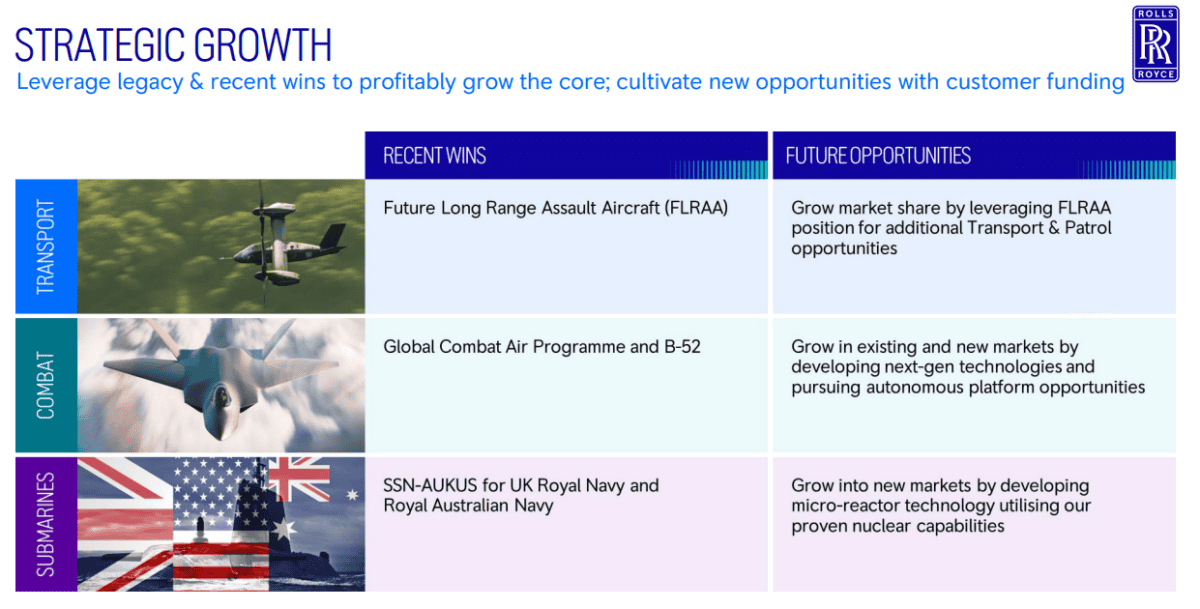
I’m speaking about defence, which makes up around 25% of the group’s total revenue. Rolls-Royce supplies advanced propulsion and power systems across air, sea, and land, with deep expertise in fighter jet engines, military transport, and nuclear power for submarines.  

Source: Rolls-Royce

In January, the Ministry of Defence awarded the company a £9bn contract to design, manufacture, and support nuclear reactors for the Royal Navy’s submarine fleet over an eight-year period. ​

Yet this is unlikely to be the last contract it wins. That’s because European countries are now set to rearm rapidly, alarmed by Washington’s decision to suspend all military aid to Ukraine.

Due to this sudden uncertainty over US commitment to security, the EU is now proposing to spend at least €800bn on defence over four years. Earlier this month, the European Commission president said: “Europe is ready to massively boost its defence spending.”

Moreover, European asset managers are under pressure from some clients and politicians to increase their allocations to defence firms. In other words, loosen ESG considerations to get behind the continent’s rearmament efforts. 

For example, the UK’s largest institutional investor, Legal & General, is now planning to increase exposure to the defence sector. UBS and Allianz are also reviewing their policies, while sustainable funds are even being encouraged to get on board.

Of course, we don’t know whether these asset managers will open or increase positions in Rolls-Royce specifically. But it’s a seismic shift.

My decision

Rolls-Royce keeps warning about supply chain issues in relation to engine parts and maintenance components. So this risk is worth considering. Meanwhile, the brewing global trade war could be inflationary, impacting travel and airline spending on new aircraft. 

However, given that the company is highly likely to win more defence contracts in Europe in the coming years, I’m going to keep holding my shares.

Financial News

Daily News on Investing, Personal Finance, Markets, and more!

Financial News

Policy(Required)