£30k to invest? 3 FTSE 100 and FTSE 250 dividend shares to target a £2,190 passive income

Looking for the best dividend shares to buy for a huge passive income? You may be in luck, as severe weakness on stock markets has given dividend yields on UK shares a big boost.

Here are three high yield shares that have caught my attention:

Dividends are never, ever guaranteed. But if broker estimates are correct, a £30k lump sum invested equally across these FTSE 100 and FTSE 250 shares will provide a £2,190 passive income this year alone.

Here’s why I think they’re worth serious consideration right now, as part of a diversified portfolio.

M&G

M&G is just one of two Footsie shares whose dividend yields for this year sit just below 10%. This reflects in large part its rock-solid balance sheet, which analysts expect to yield more juicy cash rewards.

It Solvency II capital ratio was up 7% in the 12 months to June, at 210%. This is more than double the level that regulators require, and gives the business the confidence and the means to pay large dividends even if earnings get blown off course.

I’m expecting full-year financials next week (19 March) to show the firm’s financial foundations remain rock solid.

M&G’s share price could suffer if tough economic conditions persist, denting demand for discretionary financial services. But I feel the possibility of more mighty dividends still makes it a top stock to consider for 2025.

Urban Logistics REIT

As a real estate investment trust (REIT for short), Urban Logistics has to pay at least 90% of profits from its rental operations out in dividends. This is in exchange for sizeable tax perks.

This doesn’t necessarily make it a dead cert for delivering a large passive income. Theoretically, earnings can suffer if economic conditions worsen, denting property occupancy and hampering rent collections.

But on balance Urban Logistics looks in good shape despite the tough economic outlook. Its tenants are locked down on long multi-year contracts (the weighted average annual lease term (WAULT) was 7.6 years as of September).

On top of this, more than half (56%) of its tenants’ credit ratings are categorised low or low-moderate risk. This further reduces the possibility of earnings turbulence.

Please note that tax treatment depends on the individual circumstances of each client and may be subject to change in future. The content in this article is provided for information purposes only. It is not intended to be, neither does it constitute, any form of tax advice.

Rio Tinto

Mining giant Rio Tinto has, in response to plunging commodity profits, cut annual dividends for three years in a row. Yet with a 6%-plus dividend yield that sails above the Footsie average (of 3.6%), I still think it’s worth a close look.

I actually own the company in my own portfolio. I’m confident that, over the long term, it will deliver robust capital gains and dividend income as metals demand heats up. This will be driven by phenomena including the growing digital economy, emerging market urbanisation, and decarbonisation investments.

In the meantime, a strong balance sheet underpins Rio Tinto’s impressive dividend projections for this year. Its net debt to underlying EBITDA ratio stands at just 0.2.

I think it worth considering despite uncertainty surrounding near-term commodities demand.

3 proven strategies to help build generational wealth in the stock market

The stock market has long been a powerful tool for building wealth over time. Indeed, by starting early and following smart investment principles, an individual could create a lasting financial legacy for future generations.

Here are three market strategies that could help secure financial freedom.

Passive investing

Passive investing is where someone invests in index funds that track the overall market rather than picking individual stocks. This is a simple, hands-off way to steadily grow wealth.

John Bogle was the pioneer of index fund investing. He argued that “the winning formula for success in investing is owning the entire stock market through an index fund, and then doing nothing. Just stay the course”. 

While this approach might sound boring, it’s proven its worth. Someone who invested £25,000 in the S&P 500 index 30 years ago would now have over £300,000, adjusted for exchange rate changes.  

Admittedly, we don’t know what returns this index will produce in future. But if it returns just 7.5% with dividends (rather than 9-10%), then £300,000 would become £1m inside another 17 years. 

If this person invested £400 a month on top of the initial £25k across these 47 years, they’d end up with almost £3.2m! This calculation assumes an average 8% return.

Investors could also diversify beyond US stocks and consider ETFs that track the UK’s FTSE 100 and Europe’s STOXX 600.

Dividend reinvesting

Next, there’s dividend investing. This involves actively picking stocks that pay out dividends. Now, this approach is more risky because things can go wrong at individual companies and dividends are never guranteed.

However, it also has the possibility of turbocharging the compounding process when high-yield dividends are reinvested. Let’s use British American Tobacco (LSE: BATS) as an example. This dividend stock offers a 7.5% yield, which is well above the FTSE 100 average (currently around 3.4%).

Operating in over 180 countries, the firm owns cigarette brands such as Dunhill and Lucky Strike. While smoking is in overall decline, the firm’s also seeing growth in next-generation products, with brands like Vuse (vaping), Glo (heated tobacco), and Velo (oral nicotine). 

Of course, falling cigarette sales presents risk. Projections suggest the number of smokers worldwide could fall to 1bn by 2040, down from 1.3bn in 2021. However, that’s still a massive market, and the firm continues to make enough profit to pay high-yield dividends.

Putting £5k into the stock should make £375 in dividends after one year. After 20 years, assuming the same yield, share price and reinvested dividends, the investment would grow to £21,240. At that point, the yearly passive income would be around £1,600. 

This approach requires the building of a diverse portfolio of income stocks. But it has serious wealth-building potential.

Growth investing

Finally, there’s growth investing, which has the potential for blockbuster returns. Just consider the 15-year returns of the five well-known stocks below. Admittedly I’ve cherry-picked them, but owning just one across this time would have lit up an investor’s portfolio.

15-year share price return*
Nvidia 26,800%
Tesla 18,700%
Netflix 8,750%
Amazon 2,840%
Apple 2,490%
*accurate on 14 March 2025

This approach is high-risk, high-reward though because growth companies that suddenly stop growing can quickly unravel.

However, investing £800 a month in growth stocks that collectively average 12% would build a £1m portfolio in just under 23 years starting from scratch. It would take a lot longer with lower percentage returns, but it does show what could be achieved.

£25,000 invested in Rolls-Royce shares 3 years ago is now worth…

£25,000 invested in Rolls-Royce (LSE:RR) shares three years ago would now be worth around £210,000. Hurts to say that because I did have a sizeable Rolls-Royce holding, which was reduce for a house purchase. Nonetheless, I’m thankful for having some exposure to this 738% rally.

What’s behind the rally?

The remarkable bounce in Rolls-Royce shares stems from a combination of strategic leadership, operational improvements, and favourable market conditions. CEO Tufan Erginbilgiç, who took the helm in 2023, spearheaded a transformative era for the company, focusing on aggressive cost-cutting, efficiency gains, and strategic investments.

In 2023, Erginbilgiç launched a comprehensive restructuring programme, streamlining operations and optimising procurement. These efforts paid off in 2024, with Rolls-Royce reporting a 16% revenue increase to £17.8bn and a 57% jump in operating profit to £2.5bn, surpassing expectations.

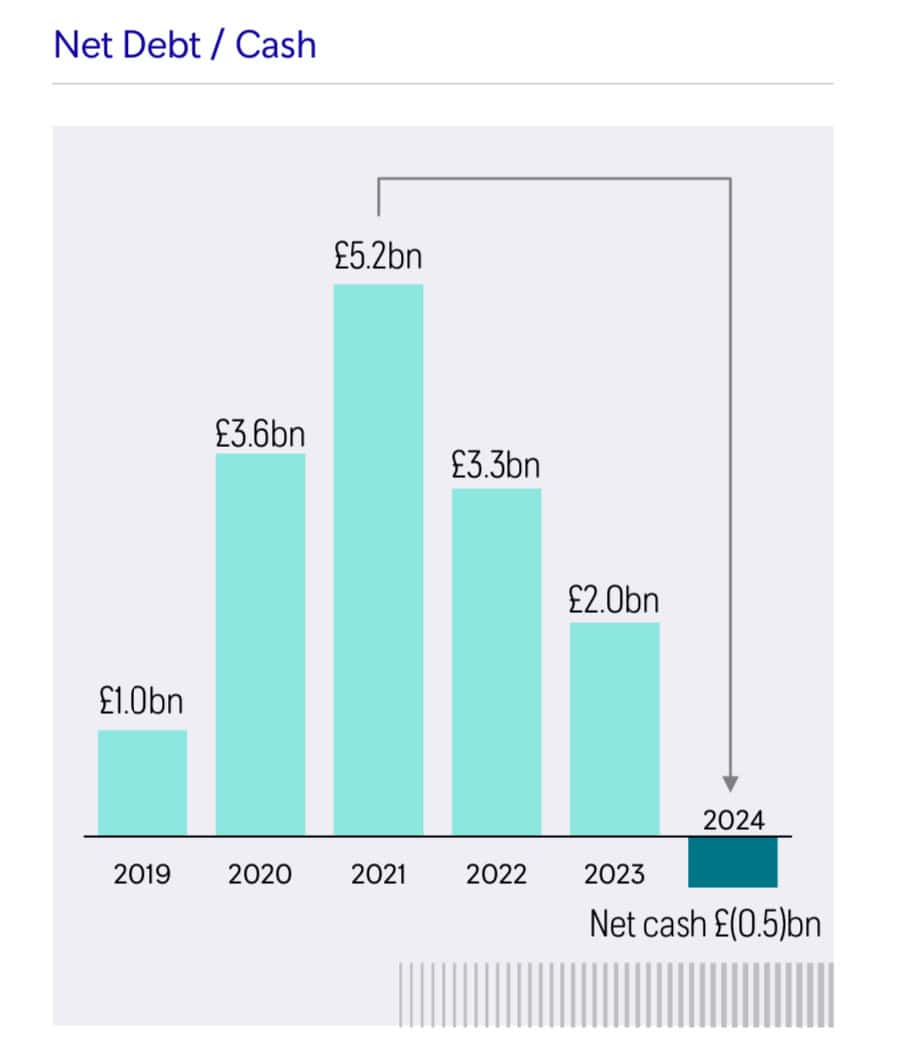
The company also reduced its net debt significantly. Net cash stood at £475m at the end of 2024. This compares to a £2bn net debt position at the end of 2023.

Source: Rolls-Royce FY2024

The post-pandemic recovery of the aerospace sector played a pivotal role, with large engine flying hours reaching 80-90% of 2019 levels by 2024. Rolls-Royce also secured major defence contracts, including a £9bn deal with the UK Ministry of Defence, further boosting investor confidence.

Defence stocks have surged since Donald Trump’s return to office. His demands for NATO members to raise defence spending have created a favourable environment for European defence companies, with the Datastream euro area defence index climbing 25% since his inauguration.

What’s more, in February, Rolls-Royce announced a £1bn share buyback and reinstated dividends, marking its first payouts since the pandemic. These moves, combined with a strong outlook for 2025, have cemented its position as a top-performing FTSE 100 stock.

Are things still looking up?

Things are undoubtedly looking up for Rolls-Royce, with business booming across all sectors. The company has seen a remarkable post-pandemic recovery, driven by strong performance in civil aviation, defence, and power systems. In light of the above, its defence revenue is projected to grow at an 11% compound annual growth rate (CAGR) through 2029.

Meanwhile, its operating margins are expected to rise from 14.2% to 15.9%. Additionally, Rolls-Royce’s small modular reactor (SMR) initiative has generated significant excitement. Developments have positioned the company as a leader in next-generation nuclear technology.

However, the stock’s forward price-to-earnings (P/E) ratio of 31.9 times suggests it may appear expensive. That’s especially compared to the broader market, particularly as it exceeds the FTSE 100 average. But General Electric, a key competitor, trades at a higher forward P/E of 35.8 times. This suggests Rolls-Royce’s valuation isn’t an outlier in its niche sector.

One risk to consider is the company’s reliance on civil aviation earnings, which were acutely highlighted during the pandemic. Any future disruptions in the aerospace sector could impact Rolls-Royce’s performance, despite its current momentum. Investors should weigh these factors carefully as the stock continues its upward trajectory.

Personally, I’m a little hesitant to add to my position at this elevated level. Nonetheless, I think it’s an excellent company. I wouldn’t be surprised to see more catalysts.

Down 21% since February, this winning FTSE 100 stock now looks interesting

The high-flying FTSE 100 has come off the boil in the past couple of weeks as the risk of a global trade war rises. One Footsie stock that has fallen more than most is InterContinental Hotels Group (LSE: IHG). Now at 8,600p, it’s down 21% in just over a month.

Taking a longer-term view however, IHG stock has been a big winner. It’s still up 160% over the past five years, not including dividends. In my eyes though, the firm remains an attractive investment proposition, making this a potential dip-buying opportunity for my portfolio.

Capital-light model

IHG operates more than 6,600 hotels worldwide across 20 brands, covering the luxury, premium, and midscale segments. These include InterContinental, Regent, Kimpton, Crowne Plaza, and Holiday Inn. 

The firm primarily follows an asset-light franchise and management model, meaning it doesn’t own most of its locations but earns money through fees paid by hotel owners. This is enabling it to expand faster around the world.  

Unlike US rivals Marriott and Hilton, which have a stronger emphasis on luxury, IHG has established a strong presence in the midscale segment. This strategy allows it to cater to a wide range of travellers.

Solid progress

In mid-February, the company released its 2024 results. It reported $2.3bn in revenue from its core franchise and management business, up 7% year on year. Core operating profit jumped 10% to $1.12bn.

IHG added 371 new hotels (59,100 rooms) in 2024, a 23% increase, with a global pipeline of 2,210 hotels (325,000 rooms).

Revenue per available room (RevPAR) increased 3% globally, driven by 6.6% growth in EMEAA (Europe, Middle East, Africa and Asia) and 2.5% in the Americas. However, Greater China fell 4.8% and remains a weak market. Higher RevPAR means hotels are charging more per night and/or filling more rooms. The 3% figure was higher than what analysts were expecting (2.6%).

Meanwhile, the firm hiked the dividend by 10% and announced a new $900m share buyback programme. The forward-looking dividend yield here though is a modest 1.7%.

Why’s the stock down?

Now for the not-so-good bits. Net debt increased to $2.78bn, largely due to shareholder returns. And there were higher interest payments, with adjusted interest expense rising from $131m to $165m.

In 2025, IHG says its adjusted interest expense will be between $190m and $205m, surpassing analysts’ estimates of $174m. This issue led some analysts to downgrade the stock, especially as it was trading at a premium valuation above 10,000p. 

Another concern here is the growing possibility of a recession in the US, IHG’s largest market. This could thwart growth and impact earnings.

Foolish perspective

Looking to the long term though, I think there’s a lot to like here. Many of the company’s brands are very established and it has an attractive business model that produces high margins and recurring revenue.

Meanwhile, leading global hotel brands are expected to continue a long-term trend of taking market share. The valuation also seems reasonable. Right now, the stock is trading at around 22 times this year’s forecast earnings.

Finally, IHG plans to expand in numerous high-growth markets over the coming years, including India and the Middle East. I think the stock will recover and do well long term, which is why I’m considering buying it.

3 high-yield dividend shares to consider buying for a retirement portfolio

When searching for dividend shares to buy, the dividend yield is a key financial ratio to consider. For retirees living off their portfolio income, investing in high-yield stocks can help them beat inflation and maintain their desired lifestyle.

However, there’s a caveat. Shareholder distributions aren’t guaranteed and higher yields can be challenging to maintain. Dividend sustainability’s crucial too.

With those considerations in mind, here are three dividend shares worth contemplating that offer better yields than the 3.6% average across FTSE 100 stocks.

British American Tobacco

Sin stock British American Tobacco (LSE:BATS) might raise ethical concerns for some investors. However, its juicy 7.5% yield shouldn’t be ignored lightly.

Combining a low forward price-to-earnings (P/E) ratio below nine with a consistent dividend growth history, there’s a strong investment case for the FTSE 100 cigarette colossus. That’s bolstered by the group’s commitment to execute a £900m share buyback programme this year.

Granted, investing in tobacco companies carries risk. Fewer people are smoking each year and governments around the world continue to hammer the industry with higher taxes and stricter regulations.

Nonetheless, a return to profitability in FY24 suggests British American Tobacco isn’t down and out yet. In addition, smokeless products now account for 17.5% of total revenue. That’s a testament to the firm’s efforts to futureproof its business.

Promisingly, the company’s commitment to dividend growth in sterling terms looks credible based on expectations that it can generate £50bn of free cash flow by 2030.

Staying within the FTSE 100, Legal & General (LSE:LGEN) shares offer a mammoth 8.8% dividend yield.

The financial services giant’s a longstanding favourite among UK dividend investors. Considering the business aims to deliver £5bn over the next three years in dividends and share buybacks, I don’t see that changing anytime soon.

This target’s underpinned by a sturdy balance sheet. The group’s Solvency Coverage Ratio — an important indicator of financial strength — climbed from 224% to 232% in FY24, beating forecasts. A rise in pre-tax profit from £76m to £332m is another positive sign.

However, dividend coverage of 1.1 times expected earnings doesn’t provide much safety for investors. A low coverage ratio isn’t abnormal for Legal & General, but it’s still a concern.

That said, I’m pleased the group plans to buy more defence stocks, which are often shunned by asset managers. Amid elevated geopolitical tensions, the sector might outperform in the coming years, which could boost growth for the Legal & General share price.

Victrex

Finally, specialty chemicals company Victrex (LSE:VCT) is a FTSE 250 dividend share worth considering. It boasts a 6.1% yield.

This firm specialises in manufacturing PEEK, a high-performance thermoplastic often used as a metal substitute in engineering. Recently, trading conditions have been tough. Consequently, Victrex’s share price has lost nearly half its value in five years.

Given the business relies on cyclical demand from the manufacturing industry, it’s vulnerable to economic shocks. That’s a concern amid Trump’s tariff chaos.

However, there are reasons for optimism. A new Chinese factory began commercial production last year, capable of producing 1,500 tonnes of PEEK annually. China’s a critical market for the company, so this might mark a revival in its fortunes.

Following a solid Q1 performance, it’s worth pondering buying this dividend stock on the cheap.

Tesla stock has halved. Could it now double – or halve again?

I am certainly glad I did not buy Tesla (NASDAQ: TSLA) stock at its high point in December. In under three months, it has crashed by 50%.

Still, that leaves the car maker with a market capitalisation of $754bn, compared to $38bn for Ford and $47bn for General Motors.

So, does Tesla potentially still have a lot further to fall? Or is this an opportunity for me to buy Tesla stock and potentially double my money if it simply gets back to where it stood in December?

Valuations can stay inflated for a long time, but not forever

A share can sell for much more (or less) than it is really worth for a surprisingly long time in some cases. But, sooner or later, reality usually bites. Typically, the valuation gap between what the company is worth and what it sells for is then reduced, or closes altogether.

So, is Tesla worth $754bn, let alone a higher number?

Last year, Tesla generated net income of $7bn. But the prior year it had been $15bn. At that higher level, the current price-to-earnings (P/E) ratio would be 50. That looks high to me and is well above what I would pay.

Taking the long-term view

However, looking out across the next five to 10 years as a long-term investor, what  if earnings do not only get back to the 2023 level but surpass it?

Reasons for that could include higher car sales due to new product launches, improved profit margins thanks to economies of scale, and also contributions from areas like self-driving taxis and robots. Meanwhile, the fast-growing power generation business could also help.

Even doubling 2023 profits over the next five years, though, the prospective P/E ratio at the current stock price is still 25.

For Tesla stock to double from here, I think it would need some additional earnings fillip. That could be from one of its new business projects (like self-driving taxis) significantly outperforming expectations.

Things might get worse

That might conceivably happen.

The Tesla stock price has long moved in fairly wild ways and is up 563% over the past five years despite its recent crash.

But Tesla has a chequered track record when it comes to delivering new projects anything close to on time.

Meanwhile, earnings did not halve last year for no reason. Increased competition in the electric vehicle space has meant pricing pressure, leading to lower profit margins. That could change as the market matures, or lower margins might simply become a permanent feature.

On top of that, vehicle tax credits in markets including the US may wind down. Against that backdrop, Tesla could struggle just to get back to 2023 levels of profitability, let alone do better.

But there is more.

Its car sales fell last year for the first time. Tariff disputes and boss Elon Musk’s high-profile political interventions are also a risk to car sales volumes (although they do provide free publicity of sorts for a business that does not pay to advertise).

To me, Tesla stock still looks highly overvalued.

If sales look like they may fall steeply, I expect the share price to follow. I reckon another 50% drop is possible given how high the current P/E ratio is.

For now, I continue to avoid the stock.

Trump administration sends a clear message to the oil and gas industry: ‘You’re the customer’

  • Interior Secretary Doug Burgum and Energy Secretary Chris Wright made clear this week they want to make it as easy as possible to drill on federal land and waters.
  • Burgum said he views companies developing resources on federal lands as “customers” who are contributing to the national “balance sheet.”
  • “You’re the customer,” the interior secretary told oil, gas and mining executives at a conference in Houston.

HOUSTON — The officials leading President Donald Trump’s energy agenda made clear to oil, gas and mining executives this week that they have an ally in Washington who intends to make it as easy as possible for them to drill in federal lands and waters.

Interior Secretary Doug Burgum told executives gathered for the world’s largest energy conference that the Trump administration does not view climate change as an existential threat. Energy Secretary Chris Wright said rising global temperatures are simply a byproduct of developing the country’s national resources to support economic growth and national security.

Burgum leads Trump’s recently established National Energy Dominance Council and Wright serves as his deputy on the interagency body tasked with boosting production. Burgum was effusive in his praise of the oil and gas industry during remarks delivered at CERAWeek by S&P Global conference.

“I’m going to share two words that I do not think that you have heard from a federal official in the Biden administration during the last four years. And those two words are thank you,” said Burgum, who previously served as governor of North Dakota, a state that produces 1.2 million barrels of oil per day.

Burgum leaned on his experience as software company executive to lay out his view of the interior department’s role. The department under his leadership views the companies developing resources on federal lands as “customers” who are contributing revenue to the nation’s “balance sheet,” Burgum said.

“If someone was sending me revenue, they weren’t the enemy. They were the customer,” Burgum said. The administration loves anyone who wants to harvest timber, mine for critical minerals, graze cattle, or produce oil and gas on federals, the interior secretary said.

Royalties sent from lease agreements on federal land will help the U.S. pay down its national debt and balance the budget, Burgum said. “You’re the customer,” the interior secretary told the executives.

The value of nation’s abundant natural resources far outweighs its $36 trillion in debt, Burgum said. If financial markets understood the value of America’s natural resources, the 10-year long-term interest rate would come down, Burgum claimed.

“The interest rates right now are one of the biggest expenses we have as a country,” Burgum said. “So one of the things that we have to do is unleash America’s balance sheet, and President Trump is helping us do that,” he said.

Burgum slammed the Biden administration’s focus on climate change as an “ideology.” He said the Trump administration views Iran acquiring a nuclear weapon and China winning the artificial intelligence race as the two existential threats facing the U.S. rather than global warming. Wright said Biden had a “myopic” and “quasi religious” belief in reducing emissions that hurt consumers.

Burgum and Wright dismissed policies that support a transition from fossil fuels to renewable energy, arguing that wind and solar won’t be able to meet rising energy demand in the coming years from artificial intelligence and re-industrialization.

“There is simply no physical way that wind, solar and batteries could replace the myriad uses of natural gas. I haven’t even mentioned oil or coal yet,” Wright said at the conference. Wright previously served as CEO of oilfield services company Liberty Energy and a board member at nuclear startup Oklo.

Oil execs see allies in Washington

Oil executives are enthusiastic about the change of administrations in Washington, returning the praise they received from Trump’s energy team during the week.

ConocoPhillips CEO Ryan Lance said Wright and Burgum “understand the business,” describing them as the best energy team the U.S. has seen in decades. TotalEnergies CEO Patrick Pouyanné said he was “impressed by the quality of our counterparts.” Chevron CEO Mike Wirth said the industry is “seeing some reality come back to the conversation.”

“For years, my message has been, we need a balanced conversation about affordability, reliability and the environment, and focusing only on climate leads us to ignore the first two,” Wright said.

Energy Sec. Wright: We can get to no or very low tariffs, but it's got to be reciprocal

The executives all referred to the Gulf of Mexico as the Gulf of America, following Trump’s executive order to rename the body of water. The president issued an order on his first day to repeal Biden’s ban on offshore drilling in 625 million acres of U.S. coastal waters.

BP CEO Murray Auchincloss briefly slipped before correcting himself when discussing how generative AI is helping with exploration: “We started doing this in the Gulf of Mexico, uh America, and we spread that to other nations as well.”

But Trump’s calls to “drill, baby, drill” are running up against market reality. The CEOs of Chevron and Conoco said U.S. oil production will likely plateau in the coming years after hitting new records under the Biden administration.

“Chasing growth for growth’s sake has not proven to be particularly successful for our industry,” Wirth said. “At some point, you’ve grown enough that you should start to move towards a plateau, and you should generate more free cash flow, rather than just more barrels.”

Lance sees U.S. oil production plateauing later this decade and then slowly declining.

“Maybe it’s time to go back to exploring the Gulf of America,” Pouyanné said. “The new administration is opening the Gulf. It has been slowed down after the Macondo drama,” he said, referring the Deepwater Horizon oil spill, the largest in the history of marine drilling operations.

U.S. oil producers are scheduled to meet with Trump next week, industry lobby group American Petroleum Institute said in statement.

Does it make sense to start buying shares as the stock market wobbles?

It has been a busy week in the financial markets, with the US S&P 500 index entering a correction. That is not as bad as a crash (a correction is a fall of 10% in short order, while a crash is double that) – but it does not bode well. Could this really be a good time for a stock market novice to start buying shares for the first time?

I think the answer may be yes – here’s why.

What happens when the market suddenly falls

A stock market correction can make headlines – but for many investors it does not matter.

There are two key reasons for that.

First is the difference between the market and a portfolio of individual shares.

Looking from afar at a forest does not typically tell you much about how individual trees in it are doing. It is the same with the market: a crashing market does not mean that all shares go down, just as when the market soars some stocks go in the other direction.

The second reason market turbulence may not matter for an individual investor is that falling prices reflect what buyers are now willing to pay. But there is (aside from certain situations, such as an agreed takeover) no obligation for a shareholder to sell. They can hang on and the price may recover (or more) in future.

Timing the market is not for beginners (if anyone)!

I do not think it is worth trying to time the market, as nobody knows what will happen next.

I can understand why some people decide not to start buying shares until they feel more confident about the direction the market might take.

But I think that misses the point. If an investor is not “buying the market”, the overall picture can be completely irrelevant.

In fact, I think the question is the same whether for a new or experienced investor, in a market that is doing well or badly: are they getting more value than they are paying for when buying individual shares?

On the hunt for value

That can be in a literal sense. For example, shares in Scottish Mortgage Investment Trust are selling at a discount of 10% or so to their net asset value.

But I am thinking in more of a conceptual, forward-looking sense.

Like Warren Buffett, I aim to buy shares that, even allowing for the cost of tying up money for years, cost significantly less today than I think they are worth when considering the underlying potential of the business concerned.

For example, one share I recently added to my portfolio is Greggs (LSE: GRG). The Greggs share price has fallen a third over the past year.

The City is nervous about risks including slowing sales growth, a weak economic outlook hurting consumer spending, and increased labour costs imposed by the Budget eating into profits.

But that means the baker’s valuation fell to a level where I decided to start buying Greggs shares for my portfolio.

After all, the market for convenient, cheap food is huge and resilient. Greggs has an extensive shop network, economies of scale, proven business model, and unique items that help set it apart from rivals.

Taking a long-term approach, the share looks undervalued to me.

£15k of passive income a year? It’s possible with the right dividend strategy!

Many people dream of earning passive income while sleeping but few understand the specific strategies to reach that goal.

There’s actually a wide range of options, some that are fairly easy and others extremely difficult. Setting up a business, for example, can be lucrative, but it’s risky and takes a lot of initial time and effort.

Investing in dividend stocks is much easier but still involves time, money and a side order of risk.

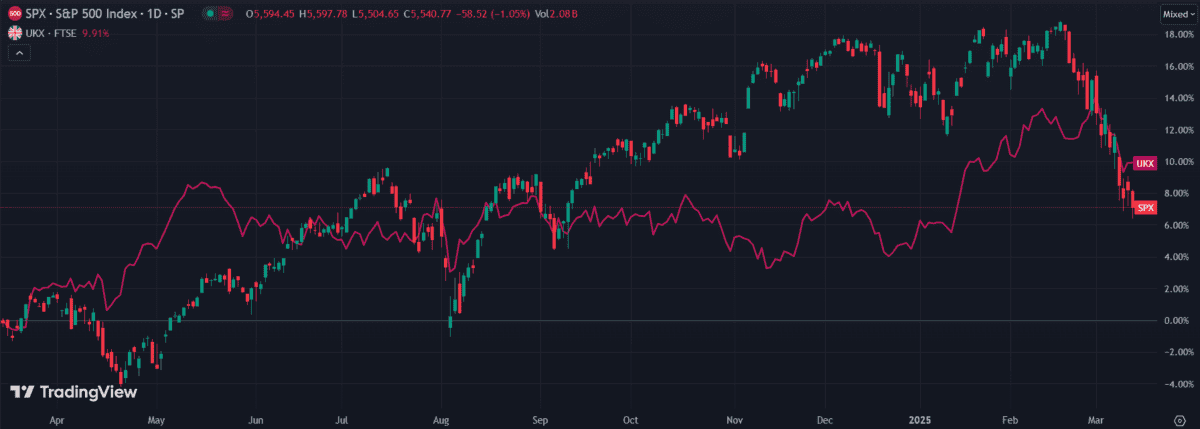
Right now, the UK market looks like a great place to get started. For a rare moment in history, the FTSE 100 is outperforming the S&P 500 over a 12-month period.

Created on TradingView.com

Yet there are still many high-yield dividend stocks selling at discount prices.

Grab your calculator

Ok, so £15,000 a year — that’s a hefty chunk of passive income. How many dividend stocks are needed to achieve that? Well, dividends differ from stock to stock but we can get an idea of their value from the yield. This is the percentage each one pays on the share price.

A £100 share with a 7% yield pays out £7 each year and a portfolio of shares worth £20,000 with a 7% yield pays out £1,400.

A few quick calculations tell me that about £214,000 is needed to return £15,000 a year.

That’s a lot of dividend stocks!

Which stocks might be best?

In my portfolio, I try to aim for stocks with yields between 5% and 9% so that my average yield is around 7%. I think this is a realistic target for the average investor.

Take Legal & General, for example, with its 9% yield. It’s quite possibly the most popular dividend stock in the UK — and for good reason. It has a very long history of proving its dedication to shareholders by consistently increasing dividends.

For income investors, this is usually the most important factor. When a company cuts or reduces dividends, it can devastate a passive income strategy. L&G never misses a beat, raising dividends by around 5% to 20% every year.

Yes, it has some risks (as do they all). For example, as an asset manager, it’s heavily exposed to market movements — if asset prices slump, so could its share price.

To help counter this, it regularly buys back its own shares to boost the stock’s value. Currently, it’s planning a further £500m on top of a previous £1bn.

But it’s just one stock worth considering. Other good examples include Aviva, HSBC and Imperial Brands. Building a portfolio of 10 to 20 similar high-quality dividend stocks is the first step in this strategy.

But what about the £214,000?

That’s the slow part. To reach that goal requires regular investment, patience and compounding returns.

Say an investor puts £300 a month in a 7% portfolio with moderate 4% price appreciation. Even with dividends reinvested, it’s going to take over 20 years to reach £214k.

But as they say — time is money. So get started as soon as possible and who knows, maybe one day both time and money will be available in abundance!

Here at The Motley Fool we’re always exploring new and exciting ways for investors to achieve their passive income dreams.

As US markets wobble, I’m listening to Warren Buffett!

It has been a choppy few weeks in the US stock market, especially for some well-known tech names like Tesla and Nvidia.

Will that nervousness spread elsewhere? It may do, although trying to predict what happens next in markets can never be done with certainty.

Whether or not global markets experience turbulence, I am listening to some advice from billionaire investor Warren Buffett.

A good night’s sleep is priceless

When markets are booming and it can seem easy to make money, lots of people can do well. As Warren Buffett says, it is when the tide goes out that you can see who has been swimming naked.

Rocky markets can trouble a lot of people, as they get nervous about their portfolios and how much money they might be losing.

Not, it seems, Warren Buffett. He said, “when forced to choose, I will not trade even a night’s sleep for the chance of extra profits.”

By taking a careful approach to balancing potential rewards with risks, Buffett does not lose sleep worrying about what might be going on in the markets.

See the market as a servant, not a master

How can he stay that calm? After all, over his long career to date, Buffett has experienced some pretty steep losses.

One thing that I think helps is the way he thinks about the stock market. He borrows his teacher Ben Graham’s idea of a person called (in less gender-inclusive days) ‘Mr Market’. Essentially, Mr or Ms Market offers to sell you shares (or buy them from you) at a certain price each day. You can buy, sell or do nothing.

What is so powerful about that as a way of thinking for an investor?

It strikes me as a great reminder about what is going on when the market is tough.

Just because a share price crashes does not force us to sell it. One option is simply to do nothing.

By treating the stock market as his servant, Warren Buffett seems not to worry too much about its twists and turns. He can treat a crash as a buying opportunity, while ignoring a steep price fall if he does not think the underlying investment case for a share he owns has changed.

Invest for the long term

After all, Warren Buffett is a long-term investor.

Consider his stake in financial services company American Express (NYSE: AXP).

He bought into the business when its share price plummeted in 1964 following a scandal involving a third party falsifying levels of commodities that meant American Express did not have the quantity of a commodity (salad oil) it believed it did.

That may sound arcane, but Amex shares plunged – and Warren Buffett pounced as he sensed the opportunity in what he saw as market overreaction. As he says, “be greedy when others are fearful” (although understanding why they are fearful matters).

Over the course of the decades since, his belief in the company’s strong brand, unique business and proven business model has certainly been proved right.

American Express faces risks – a turbulent market could lead to higher consumer credit defaults, eating into profits.

But with his eye firmly on the long term, Warren Buffett focuses on the underlying quality of a business over the economic cycle, not short-term market noise.

Financial News

Daily News on Investing, Personal Finance, Markets, and more!

Financial News

Policy(Required)