How much would Tesla stock be worth if it was valued like Nvidia?

In mid-December, Tesla (NASDAQ: TSLA) stock was trading at over $470. As I write, the share price is around $240. That’s a drop of almost 50% in three months.

As an investor, it’s difficult to make sense of this. Are Tesla shares now too cheap? Were they too expensive before? Or has something else now changed?

I’ve been taking a closer look at this situation and considering how I might value Tesla.

Pressure on profits

On 13 March, the Financial Times published details of an anonymous letter from Tesla to the US government. In it, the electric vehicle (EV) company effectively warned that President Trump’s tariffs could hit profits for Tesla (and other US car makers).

Another problem that’s already putting pressure on Tesla’s earnings is that global consumers just aren’t buying as many new cars as they were. Profits have fallen at most of the big car manufacturers. Tesla’s operating profit fell by 20% last year.

Although forecasts suggest a return to growth this year, Wall Street analysts keep cutting their estimates. Broker forecasts for Tesla’s 2025 earnings have been cut by around 15% since the end of 2024. Forecasts for 2026 have also been trimmed.

How should I value the shares?

The funny thing is that Tesla shares are still trading on a 2025 forecast price-to-earnings (P/E) ratio of 88 even after falling by nearly 50%. Most of the other big car manufacturers are trading on single-digit price-to-earnings multiples at the moment.

However, comparing Tesla to regular car manufacturers seems pointless. Although I might think it’s just a large car company, the market seems to value the business more like a high-flying tech stock.

In addition, Tesla’s expected to continue delivering much stronger earnings growth than its legacy rivals. Broker forecasts suggest its earnings will rise by an average of 29% a year over the next two years.

I think Tesla does deserve some kind of premium valuation. The question is, how much? To get a different point of view, I decided to try comparing Tesla’s valuation with that of tech star Nvidia.

Tesla vs Nvidia: what’s a fair price?

The AI boom has made chip giant Nvidia hugely profitable. Growth prospects for the next few years seem strong. Broker forecasts suggest its earnings could rise by an average of 40% over the next two years. Even so, Nvidia still looks a lot cheaper than Tesla:

Broker forecasts Tesla Nvidia*
2026 P/E 66x 20x

*Nvidia’s financial year ends on 31 January, so I’ve used 2026/27 forecasts

If the market decided to value Tesla on the same P/E ratio as Nvidia, the former’s share price could fall by two-thirds to around $75. Ouch!

Am I missing the bigger picture?

Tesla’s valuation has always been about more than next year’s earnings. Founder Elon Musk has built a dedicated following and encouraged the view – rightly or wrongly – that Tesla’s much more than just a car company.

I won’t be buying Tesla stock, because the financials just don’t add up for me. But in unusual situations like this, it’s always worth doing the research and considering different viewpoints.


This ex-penny stock skyrocketed 900% in 2020! Is it about to surge again?

Most penny stocks fail to live up to expectations. But in 2020, it seemed as if ITM Power (LSE:ITM) could do no wrong. Shares of the hydrogen enterprise skyrocketed. And by January 2021, investors who bought shares just a year earlier reaped a jaw-dropping 883% return!

Such gains in such a short space of time are almost non-existent within the world of large-cap FTSE 100 enterprises. That’s why penny stocks remain so popular despite their extreme levels of risk. But while ITM Power surpassed a market-cap of over £2bn, momentum eventually faded.

Investor excitement turned to frustration as the company struggled to transition from research to commercial production. Order delays and missed earnings targets resulted in a steady trickle of investors selling up and moving on. And the once £3bn+ enterprise with a 717p stock price now sits at a £166m market-cap trading at just 27p per share – a 96% decline.

Such are the risks of investing in unproven businesses regardless of their long-term potential. However, despite what the direction of the share price suggests, ITM Power’s actually been making a lot of promising progress. So are we potentially looking at the start of yet another near-quadruple-digit surge?

Demand’s heating up

It seems demand for green hydrogen is on the rise in Europe. ITM Power has signed new contracts with customers for its Neptune electrolyser system, resulting in a record contract backlog of £135m. At the same time, revenue over the six months leading to October jumped by 74.2%, reaching £15.5m. And management continued to reiterate its full-year sales targets of £18m-£22m.

Profits aren’t expected to materialise, but the group’s cash position is on track to improve, reaching £185m-£195m, giving management ample financial flexibility to continue executing its strategy.

Is a share price surge coming?

If ITM Power can continue building its order book and fulfil its obligations to customers, I wouldn’t be surprised to see the almost-penny stock start climbing again. Having said that, I doubt investors are going to see yet another near 1,000% rally in 2025.

Hydrogen-demanding projects across Europe are seemingly receiving the green light to reach the final investment decision stage of project planning. This undoubtedly offers ITM Power a welcome tailwind on which to capitalise in the coming years. And with limited exposure to the US markets, the firm’s future growth shouldn’t be heavily impacted by the cutting of environmental spending under the new US administration.

However, even CEO Dennis Schulz said: “Gone is the unrealistic hype that the hydrogen economy would develop overnight”, suggesting that an investment in ITM Power today is a long-term buy-and-hold commitment, not a short-term buy-low-sell-high trade.

The bottom line

Having been a critic of ITM Power’s surge in 2020, my opinion on this enterprise has improved over the years, both due to the more reasonable valuation and actual tangible results being delivered. However, even after falling by over 90%, the small-cap enterprise is still trading at a premium relative to its cash flow.

For now, I’m sitting on the sidelines, patiently watching to see if management can continue capturing the developing hydrogen market.

Looking for cheap shares to buy in March? Here are 3 to consider

When it comes to hunting for cheap shares to buy, British investors are spoilt for choice. Compared to other markets like the US, UK stocks are trading at far lower multiples, creating the opportunity to snap up terrific companies at fantastic prices.

This month, three businesses have caught my attention: Rightmove (LSE:RMV), Safestore, and Greencoat UK Wind. None are without flaws, but with each trading at attractive multiples or tasty-looking dividend yields, it’s hard not to be tempted, in my opinion.

Targeted for acquisition

The underappreciated nature of British stocks hasn’t gone unnoticed by private equity and international investors. In total, 19 FTSE 350 companies received takeover bids. And Rightmove is on that list, along with Anglo American, Darktrace, DS Smith, Hargreaves Lansdown, Ascential, Britvic, Centamin, Currys, and Redrow, among others.

Some offers were accepted, others are still being negotiated. However, in the case of Rightmove, attempts by Australian rival REA Group to take over its operations were firmly rejected. It seems even Rightmove’s management believes its stock’s being significantly underappreciated by markets right now, both by the rejection of four takeover bids and the continued repurchasing of its own shares.

For reference, Rightmove shares are currently priced at a forward price-to-earnings ratio of just 23. By comparison, its closest US competitor, CoStar, is sitting at a massive 72 times forward earnings. So relative to its peers, the stock looks like a bargain, especially when considering activity in the housing market appears to be picking up in 2025.

More than 140,000 properties across the UK were listed in January, according to the latest data from TwentyEA – a 7.3% increase year on year. And subsequently, Rightmove has already reported an uptick in listings on its platform for the first two months of 2025, as have alternative websites like Zoopla.

In other words, Rightmove’s growth might be set to accelerate despite what the relatively cheap valuation implies. That’s why I’m taking a closer look at the business as a potential candidate for my top shares to buy list this month.

What could go wrong?

Rightmove appears to have promising prospects. But that doesn’t make it a guaranteed winner. One of the big reasons why CoStar’s trading at a much loftier valuation is because it has announced plans to challenge Rightmove’s industry-leading status in the UK. And it seems investors are baking the success of the strategy into the share price.

CoStar recently acquired rival platform OnTheMarket with the intent of stealing market share with lower prices and undercutting Rightmove’s pricing power. Considering CoStar has a market-cap of $33.5bn (£25.6bn) versus Rightmove’s £5.4bn, this threat is one that most investors aren’t ignoring.

But this isn’t the first time a business has tried to dethrone Rightmove. And for over a decade, the group has defended and expanded its position while rivals crumbled. Looking again at the valuation, it seems that investors are underestimating Rightmove’s defensive capabilities – a mistake that’s proven costly in the past.

Personally, given the firm’s impressive track record, I remain bullish. This isn’t just for Rightmove, but for Safestore and Greencoat as well. Each firm’s dealing with its own challenges. Yet it seems the market’s underestimating their value-building capabilities, potentially creating a lucrative buying opportunity for long-term shareholders.

That’s why I think these are investing opportunities worthy of consideration.

How much would an investor need in an ISA for a £1,999 monthly passive income?

Passive income’s often seen as the holy grail of investing. And for good reason. For an investor, the idea of £1,999 landing in their bank account every month without active effort is undeniably appealing.

With a Stocks and Shares ISA, this goal becomes much more achievable, provided the investor’s willing to embrace a long-term strategy and let compound returns do the heavy lifting.

The appeal of a Stocks and Shares ISA

A Stocks and Shares ISA is one of the most tax-efficient ways to grow wealth in the UK. Unlike a Cash ISA, which typically offers minimal returns, a Stocks and Shares ISA allows investments in equities, funds, and other assets that have historically delivered far superior returns.

Over the past decade, the average annual return for a Stocks and Shares ISA has been around 9.64%. This kind of growth can transform a modest investment into a reliable source of passive income.

Please note that tax treatment depends on the individual circumstances of each client and may be subject to change in future. The content in this article is provided for information purposes only. It is not intended to be, neither does it constitute, any form of tax advice. Readers are responsible for carrying out their own due diligence and for obtaining professional advice before making any investment decisions.

Running the numbers

To generate £1,999 a month — or £23,988 a year — an investor would need a portfolio of roughly £479,760. This assumes a dividend yield of 5%. While this is a significant sum, it’s not an unattainable goal. With consistent monthly contributions, reinvested dividends, and time, even smaller portfolios can grow to this size.

For instance, starting with £20,000 and contributing £250 a month, it would take around 24.5 years to reach £479,760, assuming a 9.64% annual return. The earlier the investor starts, the less they’ll need to save each month, thanks to the power of compound interest.

Building the portfolio

The key to success lies in patience and discipline. An investor should focus on building a diversified portfolio of quality stocks, exchange-traded funds (ETFs), or funds that align with their risk tolerance. While £479,760 might seem daunting initially, it’s important to remember that every investment journey begins with a single step.

Starting small, staying consistent, and allowing time and compounding to work their magic can make this goal a reality.

However, many novice investors lose money. That’s because they chase quick gains and don’t diversify. With that in mind, novice investors may want to consider a diversified trust like The Monks Investment Trust (LSE:MNKS).

This trust, managed by Baillie Gifford, focuses on long-term capital growth through a diversified global equity portfolio of growth stocks. It targets innovative businesses addressing specific challenges, aiming to reduce costs or improve service quality. Over the past decade, the trust has delivered strong returns, with a 10-year share price total return of 200.4% and a net asset value (NAV) growth of 186.5%.

However, like all investments, it carries risks. One significant risk is gearing (or leverage) — the trust borrows money to make further investments, which can amplify losses if the value of those investments falls. This leverage increases the potential for volatility and capital erosion, particularly during market downturns.

Despite this, the trust’s patient, growth-oriented approach has historically rewarded long-term investors. Nonetheless, I’ve added this one to my daughter’s Self-Invested Personal Pension (SIPP).

3 of the safest dividend stocks in the UK?

No investment is ever entirely risk-free, but some dividend stocks have proven themselves to be pretty reliable sources of passive income over the years. Companies like BAE Systems (LSE:BA.), Diploma, and British American Tobacco have been consistently paying and increasing shareholder payouts for decades.

As such, these three stocks are among some of the most popular British income investments. But will investors continue to enjoy decades worth of future dividend hikes?

Zooming in on BAE

As a leading player in the global defence industry, BAE’s getting a lot of attention from investors right now. Rising geopolitical tensions and new defence spending commitments from European nations are transforming into powerful growth tailwinds. And investors have already started taking notice.

Following its latest results, the group’s order book has surged to a record high of £77.8bn. This is largely thanks to its 2024 performance coming in ahead of expectations, as well as a few key new contracts, such as a $2.5bn deal to supply Sweden and Denmark with new CV90 combat vehicles.

Pairing all this progress with a revenue forecast for 2025 indicating BAE’s top line will surpass £30bn in 2025, it’s not so surprising to see the share price surge by 35% since the start of the year. A higher stock price is welcome news for shareholders. But more importantly, the continued expansion of cash flow and earnings paves the way for larger dividends.

After these latest results, BAE Systems is now sitting on a 21-year streak of continuous dividend hikes with an average payout growth rate of 7.3%.

Defence spending is cyclical

Right now, increased tensions between nations are catalysing larger defence budgets. This is especially prominent among NATO countries now that the US is pushing for less reliance on its military. But as we’ve seen in the past, surges in defence spending eventually wear off as conflicts are resolved.

This pattern’s made perfectly clear when looking at BAE System’s long-term financials. Dividend growth was notably slow in the years prior to the Iraq war. Growth accelerated during the conflict before once again grinding to low single digits after the war ended.

Today, growth has re-entered double-digit territory. However, once the conflicts in Ukraine and Gaza are resolved (hopefully peacefully), the same pattern’s likely to follow once tensions cool. And with shares trading at a price-to-earnings ratio of 25, a slowdown could translate into notable share price volatility.

The bottom line

All things considered, I feel that BAE Systems is worthy of a closer look. And just like BAE, Diploma and British American Tobacco also have impressive track records that make for an interesting investment case. However, they’re not immune to disruption and are far from risk-free.

Prudent capital allocation from their respective management teams has kept the dividends flowing, but there have been plenty of periods where the stock price has suffered. That’s why investors need to carefully examine the risks as well as rewards before committing to an investment decision.

£10,000 invested in Lloyds shares 3 years ago is now worth…

Lloyds (LSE:LLOY) shares are up 50% over three years. The FTSE 100 stock is close to its five-year highs, but there’s been a lot of volatility since the pandemic. It’s been an unloved stock, and one that has been heavily impacted by macroeconomic challenges.

Nonetheless, £10,000 invested three years ago is now worth £15,000. What’s more, a shareholder would have received around £1,700 in dividends during the period. All in all, it would have been a pretty strong investment return.

Reflecting economic strength like no other

As the UK’s largest mortgage provider, Lloyds’s performance and share price are closely tied to the country’s economic health. Historically, the stock has been sensitive to macroeconomic shifts, particularly in the housing market and the broader financial backdrop. However, recent developments have bolstered investor confidence, driving the share price higher.

Recession risks have receded, with the UK economy showing resilience despite earlier concerns. This has alleviated fears of widespread defaults or significant impairments on Lloyds’ mortgage book. Additionally, the worst-case scenarios for loan impairments have largely passed, with the bank reporting improved arrears rates and a stable loan-to-value ratio of 43.7% in 2024. More than two-thirds of its book was on a pay rate of higher than 3%.

Net interest income, a key driver of profitability for banks, remains elevated compared to historic averages. While Lloyds’ net interest margin has declined slightly to 2.95% in 2024, it continues to benefit from higher interest rates, which have supported earnings growth. The bank’s mortgage portfolio expanded by £6.1bn in 2024 to £312bn, with a 20% flow market share, reflecting its dominant position in the sector.

These factors, combined with a rebound in the first-time buyer market and improved lending to energy-efficient properties, have contributed to Lloyds’ improving share price. While challenges remain, including potential fluctuations in mortgage rates and economic uncertainty, the current environment supports a positive outlook for the stock.

Don’t worry about interest rates

Some of my peers talk about concerns of falling margins, but I’m not worrying. Lloyds operates a structural hedge to mitigate interest rate volatility and protect margins. In 2024, the hedge generated £4.2bn in total income, a significant increase from £3.4bn in 2023, reflecting the benefits of reinvesting balances in a higher rate environment. This contributed to a net interest margin (NIM) of 2.95%, slightly down from 3.11% in 2023.

The hedge’s notional balance stood at £242bn at the end of 2024, with a weighted average duration of approximately 3.5 years. Analysts project further growth in hedge earnings, with estimates of £1.2bn and £1.5bn increases in 2025 and 2026, respectively. This strategic tool not only safeguards Lloyds’ profitability but also positions the bank to capitalise on future opportunities.

A ‘slam dunk’ buy?

I’ve been bullish on Lloyds for some time. However, I’m no longer as bullish as I used to be, believing it to be undervalued by around 15%. In other words, there’s a smaller margin of safety than there was previously. Given it’s also one of my larger holdings, I won’t be adding more. Nonetheless, I’ll continue to collect the dividend and hope that it continues to push towards fair value.

As growth stocks turn volatile, it’s time to heed Warren Buffett’s advice

Warren Buffett’s a prime example of an investor who knows how to navigate volatile market conditions. Since the 1960s, he’s led his investment firm, Berkshire Hathaway, through numerous market crashes and countless corrections. And subsequently, Berkshire’s investment portfolio has yielded an average annualised return just shy of 20% a year – double the US stock market’s average of 10%.

For the most part, UK shares have been fairly resilient over the last few weeks. But across the pond, it’s been a very different story. The S&P 500‘s tumbled more than 9% since the middle of February, with some of the most popular picks like Nvidia and Tesla (NASDAQ:TSLA) seemingly crashing by 20% and 35% respectively.

The return to volatility comes as investor fears surrounding US tariffs and stubborn inflation become increasingly elevated. And subsequently, the post-US-election gains in the stock market have seemingly evaporated. So with that in mind, what advice does the ‘Oracle of Omaha’ have to offer investors in navigating these choppy waters?

Focus on the business, not the stock

Stock prices are driven by short-term investor sentiment. But in the long run, it’s the company behind the stock that ultimately drives returns for shareholders. And as a long-term oriented investor, Buffett always remains focused on what the business is up to.

Specifically, Buffett looks for top-notch enterprises with clear competitive advantages that form a protective moat against rivals. Having an upper edge in the form of a reputable brand or industry-leading margins and efficiencies can make an enormous difference in the long run. And when companies with these winning traits are sold off by panicking investors, Buffett begins to prepare for a shopping spree.

Is Tesla a buy to consider right now?

Applying Buffett’s quality and long-term approach to Tesla, is the electric vehicle (EV) manufacturer a worthwhile investment right now?

Looking at the latest results, there are some encouraging figures to get excited about. Despite what the share price indicates, Tesla’s brought down its average cost of goods sold per vehicle to under $35,000. That’s subsequently translated into a 27.4% expansion of free cash flow, giving management the flexibility to invest aggressively in artificial intelligence (AI) and other technological innovations.

That certainly sounds like a high-quality enterprise. However, Tesla also has its fair share of problems that Buffett definitely wouldn’t overlook.

For example, the polarising political statements from CEO Elon Musk have recently triggered a number of protests outside Tesla showrooms, some of which have even turned violent. At the same time, vehicle registrations for Teslas in Germany, Australia, and China all appear to be moving in the wrong direction despite a steady increase in EV adoption. All of this suggests the company may be having a bit of a PR crisis among customers, creating opportunities for rival manufacturers.

Buffett doesn’t appear interested in buying Tesla shares right now. And neither am I. However, it’s not the only US stock to have been sold off recently. And there could be terrific investment opportunities just waiting to be uncovered as prices continue to wobble.

If a 50-year-old puts £750 a month into a SIPP, here’s what they could have by retirement

Investing within a Self Invested Personal Pension (SIPP) is one of the most effective ways to build retirement wealth. A regular savings plan paired with a sound investment strategy are key steps to build a large nest egg. However, by leveraging the tax advantages of this special investment account, the wealth-building process can be put on steroids.

So let’s break down how effective this strategy can be for a 50-year-old investor putting aside £750 each month.

Crunching the numbers

It’s important to remember that when it comes to investing, there are never any guarantees. However, a proper investment strategy can reasonably be expected to generate an annual return of around 8-10%. At least that’s what the overall stock market has historically provided.

Assuming a 50-year-old investor is aiming to retire at 65, investing £750 each month at this rate would yield a portfolio worth between £259,528 and £310,853. That’s not bad. But watch what happens when we introduce the SIPPs most powerful feature – tax relief.

The amount of relief received depends on the income tax bracket. But let’s assume an investor is paying the Basic rate, resulting in a tax relief of 20%. That means for every £750 added to a SIPP, there’s actually £937.50 worth of capital to invest. When factoring that in, an investor’s nest egg could surpass the previous figures, reaching between £324,410 and £388,566.

Please note that tax treatment depends on the individual circumstances of each client and may be subject to change in future. The content in this article is provided for information purposes only. It is not intended to be, neither does it constitute, any form of tax advice. Readers are responsible for carrying out their own due diligence and for obtaining professional advice before making any investment decisions.

Building a winning strategy

As previously mentioned, the success of an investment portfolio largely depends on the success of the strategy. A badly constructed portfolio or even a well-built one that’s badly managed can yield returns that fail to reach the 8-10% target. In some cases, a portfolio might even generate losses resulting in the destruction of wealth rather than its creation.

Finding top-notch stocks to buy can be a challenging task. Even if a strong business is uncovered at a reasonable price, it may still be a poor investment, depending on an investor’s objectives and risk tolerance. Looking at my own SIPP, the strategy I’ve chosen is focused on dividend growth opportunities like Safestore Holdings (LSE:SAFE).

Self-storage enterprises are currently enduring adverse market conditions that make growth a challenge. That’s translated into pretty disappointing share price performance in recent years. But with such highly cash-generative operations, management’s busy expanding internationally and positioning itself to thrive for the eventual market recovery.

This isn’t the first time Safestore has navigated macroeconomic headwinds. And the last time, prudent capital allocation decisions resulted in a 15-year streak of dividend hikes and robust share price returns totalling 677%. That’s an annualised return of 14.6% – firmly ahead of the stock market average.

At this rate, a £750 monthly investment into a SIPP could transform into a massive £602,410 nest egg after tax relief! Of course, there’s no guarantee of a repeat performance spanning the next 15 years. And for investors seeking to capitalise on growth rather than income opportunities, Safestore could be a bad fit.

At the same time, the self-storage industry is far more competitive today, creating further challenges for management to overcome. Nevertheless, for dividend-searching SIPP investors, this is a business I think deserves a closer look.

Could 1 ISA, £20,000, and 5 FTSE 100 stocks generate £12,517 of passive income a year?

Passive income is a means of generating cash from doing very little. One way in which I try to earn a second income is to invest in the UK stock market.

But in some respects, the term can be misleading. Personally, I think it’s worthwhile spending time researching which stocks to buy. Once chosen, I think that’s the best time to be passive. In other words, ignore day-to-day movements in their prices and take a long-term view. Importantly, don’t keep buying and selling (that’s trading, not investing). And have confidence that, generally speaking, quality companies should consistently deliver above-average returns over several decades.

Those in a position to add money to their Stocks and Shares ISA this year have until 5 April. The maximum amount that can be added every 12 months is £20,000. The advantage of using this particular investment vehicle is that any gains and income are tax-free.

Please note that tax treatment depends on the individual circumstances of each client and may be subject to change in future. The content in this article is provided for information purposes only. It is not intended to be, neither does it constitute, any form of tax advice. Readers are responsible for carrying out their own due diligence and for obtaining professional advice before making any investment decisions.

One strategy

Those with £20,000 to spare could consider investing in the FTSE 100. But I don’t think it would be sensible to put the full amount into one stock. Diversification helps spread the risk. Determining the number of shares to buy is a matter of personal preference. Some experts suggest 10-15.

Personally, I would pick a handful. But what sort of passive income could be generated from FTSE 100 stocks over a period of 40 years?

Let’s crunch some numbers.

While there’s no guarantee that history will be repeated, since February 2020, the average annual return of the FTSE 100 has been 7.4%. This assumes all dividends are reinvested, a process known as compounding.

If this rate of growth continues, a £20,000 lump-sum would grow to £347,697 after four decades. Based on the Footsie’s current dividend yield of 3.6%, this would generate annual passive income of £12,517.

Green shoots of a recovery

Those looking for a FTSE 100 stock to include in a well-balanced portfolio could consider Persimmon (LSE:PSN).

Due to a higher interest rate environment and a post-pandemic squeeze on disposable incomes, the housing market has been through a rough timely lately. Not surprisingly, the housebuilder’s share price has tanked as a result. Since March 2020, it has fallen 42%.

However, there are signs that things could be on the turn. In 2024, Persimmon built 10,664 homes, a 7% increase on 2023. For 2025, it’s forecasting 11,000-11,500.

Looking forward, an anticipated fall in interest rates should help stimulate demand. And the government has promised a series of planning reforms to help get Britain building again.

There’s also some talk that regulators have been tasked with making mortgages more accessible to first-time buyers. With a lower average selling price than it peers, this could be hugely beneficial to Persimmon.

However, there’s no guarantee that the housing market will recover, although history suggests it probably will. Of some concern, building costs are rising faster than general inflation. And the government’s decision to increase employer’s national insurance contributions has further damaged industry profitability.

But on balance, I think Persimmon’s well placed to grow over the coming years. It has no debt and plenty of land on which to build. And it’s yielding 5%. For these reasons, I think it’s a stock that investors could consider adding to their portfolios as part of a strategy to generate a healthy level of passive income.

If a 30-year-old puts £300 a month into a Stocks & Shares ISA, here’s what they could have by retirement

The earliest an investment journey begins, the better. If a 30-year-old began making monthly contributions of a few hundred pounds in a Stocks and Shares ISA today, they could — by the time they hit State Pension retirement age — potentially get a seat on millionaire’s row.

This is thanks to the mathematical miracle of compounding. Making a return on past returns can, over decades, result in transformational wealth.

Let me show you how.

Sage words

Investing in shares, trust and funds can be a bumpy ride. As we’ve seen in recent days, stock markets can sharply reverse depending on geopolitical and maroeconomic conditions.

In this case, share prices have dropped amid fears of growth-crushing trade tariffs between the US and its major trading partners, and the potential impact of these import taxes in fuelling inflation.

Yet it’s also important to remember that, over the long term, share prices tend to recover and grow, rewarding patient investors who stay the course.

I’m reminded of billionaire investor Warren Buffett‘s wise words on the stock market’s remarkable bouncebackability. The so-called ‘Sage of Omaha’ once pointed out that:

In the 20th century, the United States endured two world wars and other traumatic and expensive military conflicts; the Depression; a dozen or so recessions and financial panics; oil shocks; a flu epidemic; and the resignation of a disgraced president. Yet the Dow rose from 66 to 11,497.

Today, the Dow Jones sits around 41,453 points.

A £1.6m pension pot

This is a perfect example of how investing with a long-term approach can pay off.

Since its inception in 1957, the S&P 500 has also delivered mighty shareholder profits. Its average annual return is an impressive 10.2%. If this continues, a 30-year-old regularly investing in the index in a Stocks and Shares ISA could build a life-changing retirement fund.

Let’s say they invest £300 each month between now and their State Pension age of 68. Thanks to the wealth-building power of compounding — and the tax-saving qualities of the ISA — they’d have generated a whopping £1,639,317 to retire on (excluding broker fees).

Remember though, that 10.2% return I’ve described isn’t guaranteed.

Taking the simple route

By creating a diversified portfolio, our investor could stand a much better chance of retiring with a substantial nestegg. Purchasing shares across a variety of industries, sub-sectors and geographies can help them mitigate risk and capitalise on many different investment opportunities.

To target that 10.2% average annual return simply, our 30-year-old could choose to buy an exchange-traded fund (ETF) that tracks the performance of the S&P. The HSBC S&P 500 (LSE:HSPX) is the one I hold in my own portfolio.

With its ongoing charge of 0.09%, it’s one of the most cost-effective index-tracking funds out there.

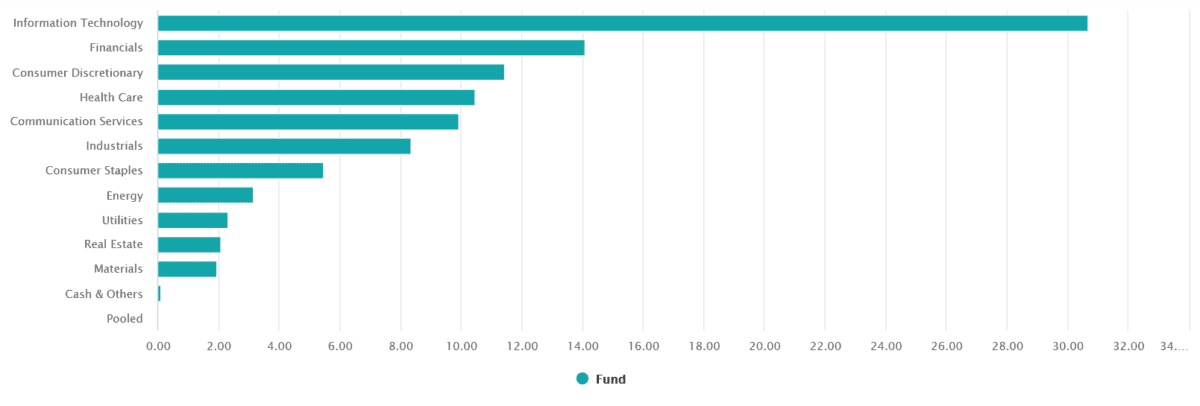
Source: HSBC

As you can see from the breakdown, the fund allows investors to effectively diversify across a range of sectors. And with tech shares like Nvidia, Microsoft and Apple making up a large portion of the fund, it also has significant long-term growth potential as the digital revolution rolls on.

The fund could face headwinds if sentiment towards US shares as a whole weakens. But overall, I think it’s a great one to consider as a way for investors to aim for a large retirement pot.

Financial News

Daily News on Investing, Personal Finance, Markets, and more!

Financial News

Policy(Required)