Forecast earnings growth of 17% a year but down 12%, is now the time for me to buy this heavyweight FTSE stock?


There was only one reason I did not buy shares in the FTSE’s Smith & Nephew (LSE: SN) after its 31 October Q3 results release.

Aged over 50 now, I focus on stocks that pay very high dividends. My aim is for these to keep generating a high income so I can continue reducing my working commitments.

My minimum annual yield requirement is 7%+, while the medical technology giant currently delivers 2.7%.

However, I would have bought the shares on Q3 results day if I had been even 10 years younger. And I would have been right to do so, I believe. The full-year 2024 results released on 25 February looked even better to me.

That said, it is still not too late for investors whose portfolio it suits to consider the stock, according to my analysis.

The key risk in the business

The catalyst for the share price drop after the Q3 2024 results was the firm’s reduction in revenue growth guidance to around 4.5%from 5%-6%.

The reason for this was the continued rollout of China’s Volume Based Procurement (VBP) programme. In this, the government bulk-buys drugs via tenders to secure the lowest prices.

This means that Smith & Nephew will have to increase production to drive revenue higher there, which will take time. The VBP effect is forecast to continue this year, and I see it as a key ongoing risk for the firm.

Strong results nonetheless

Despite this drag on revenue, Smith & Nephew posted good Q3 2024 results, in my view.

But its full-year 2024 results were even better. Revenue rose 4.7% year on year to $5.81bn (£4.59bn), with a 7.8% Q4 increase over the same period last year. Operating profit soared 54.6% to $657m, with operating margin jumping 47% to 11.3%.

Earnings per share leapt 56.3% to 47.2 cents, and cash generated from operations rose 50.2% to $1.245bn.

Analysts forecast Smith & Nephew’s earnings will rise 17% each year to the end of 2027. It is this growth that powers a firm’s share price and dividends higher over time.

How undervalued are the shares?

Smith & Nephew trades at just 2.2 on the key price-to-sales ratio against a 3 average for its peers. These consist of EKF Diagnostics at 2, Carl Zeiss Meditec at 2.4, ConvaTec at 2.9, and Sartorius at 4.8. So, it is cheap on that basis.

The same is true of its 2.3 price-to-book ratio against a competitor average of 3.4. And it is also the case with Smith & Nephew’s 40.1 price-to-earnings ratio against the 72.5 average of its peers.

I used a discounted cash flow analysis to pin down what these all mean in share price terms. Including other analysts’ numbers and my own, this shows the shares are technically 34% undervalued at their current price of £10.95.

Therefore, given the current price of £11.10, the fair value for the shares is £16.59. Market unpredictability may push them lower or higher than that, of course. But it underscores to me how much value is left in the stock.

Consequently, if I were not focused on high-yield shares, I would buy this high-growth stock today and see it as worth further research for other investors.


Prediction: in 12 months, the easyJet share price might be…

Since 2025 kicked off, the easyJet (LSE:EZJ) share price hasn’t delivered the best of performances. However, looking at the latest analyst forecasts, it seems institutional sentiment’s becoming increasingly bullish, with one analyst predicting the stock could climb to as high as 900p over the next 12 months!

So what’s behind this 80% potential jump? And should investors be considering the short-haul airliner for their portfolios?

Firm-wide double-digit growth

Despite having a rocky few years, easyJet’s business appears to be back on track. Its latest quarterly results for the three months ending in December showed a massive improvement in pre-tax losses, which landed at £61m compared to £126m over the same period a year ago. At the same time, top-line performance surged, with double-digit growth reported across all segments.

Leading the charge is the group’s Holiday division, with sales rising by 36% to £247m and a 39% boost to pre-tax profits landing at £43m. And management anticipates this momentum will continue into 2025 with an expected 25% boost to customer growth.

Overall, easyJet anticipates hitting £709m in pre-tax profits by the end of its 2025 fiscal year – a 16% increase compared to performance in 2024. But is that enough to warrant a near doubling of the share price, as suggested by some forecasts?

While a lot has to go right for the easyJet share price to deliver such impressive gains, it’s not a completely wild expectation. After all, the shares are currently trading at a dirt cheap forward price-to-earnings ratio of just 7. That’s around half of the group’s five-year average, suggesting the stock’s presently underappreciated by investors.

What could go wrong?

Not every analyst following this business is as optimistic. And of the 19 following easyJet, the average consensus forecast is for the share price to reach 700p by this time next year. That’s still a pretty solid 42% potential rise. But, like all predictions, nothing’s set in stone.

As a business, easyJet’s bottom line is highly sensitive to the price of oil since it’s a primary ingredient of jet fuel. In recent weeks, oil prices have been falling. But should that trend reverse, profit margins are likely to start getting squeezed.

Similarly, if economic conditions worsen across the UK and Europe, passenger volumes may stumble as fewer families venture on holidays. And combined, these headwinds could cause easyJet to fall short of its £709m pre-tax profit target.

Time to buy?

The depressed valuation, paired with improved financials, certainly makes easyJet an attractive investment proposition. And it’s a business I’ve slowly been warming up to. However, personally, I believe there are other opportunities to be back elsewhere that offer similar growth potential at lower risk levels.

So easyJet isn’t a business I’m rushing to buy right now. But for investors seeking exposure to the travel industry, this business might be worth a closer look.

Prediction: in 1 year, the Vodafone share price could be…

The last five years have been pretty rough for the Vodafone (LSE:VOD) share price. Crippling debt, a change in management, and a corporate restructuring have all caused the shares of the telecommunications giant to tumble by over 30%. And yet, looking at the analyst projections for 2025, there’s a chance that Vodafone shares are on the verge of a comeback.

A return to profitable growth

Under new leadership, Vodafone has been shedding its non-core businesses to raise funds and pay off its troublesome debt pile. The latest of these disposals is its Italian operations, which are being sold to Swisscom for €8bn (£6.75bn).

However, as of December, the Competition and Markets Authority (CMA) gave the green light for the long-awaited merger of Vodafone’s UK business with Three. This was partially based on the condition that Vodafone invests £11bn into the UK’s 5G network infrastructure – something management agreed to do.

However, a big problem with rolling out telecommunication infrastructure such as 5G networks is the high cost. Having a large number of customers makes this far more affordable as the expense is spread out over more customer accounts. Luckily, that’s exactly what this merger deal provides for Vodafone. 

With the scale of its UK operations now in a far more favourable position, the fixed-cost nature of its expenses should pave the way for higher margins. And that brings Vodafone one step closer to returning to profitable growth.

Problems in Europe

Despite encouraging progress in the UK, Germany – Vodafone’s core market – remains troublesome. Further price increases have led to another 88,000 customers walking out the door while also dragging the top line in the wrong direction.

The continued lacklustre performance in Germany has also resulted in 3,100 employees getting put on the chopping block to reign in costs. While it’s good to see management keeping a close eye on expenses, this also signals that Vodafone doesn’t expect German growth to return anytime soon. In the meantime, there’s still almost €60bn (£50.6bn) of debt on the balance sheet to worry about.

Share price predictions

While Vodafone still has a long list of improvements it needs to make, the success of the Three merger should help solve a lot of headaches. And looking at the most optimistic outlook from analysts, the Vodafone share price could hit up to 143.01p over the next 12 months. In other words, the stock might have doubled by this time next year!

As exciting as that prospect sounds, not everyone’s in agreement. More pessimistic outlooks indicate shares could, in fact, fall by another 20% to 58.89p should things go badly.

All things considered, I’m not tempted to invest right now. Instead, I’m waiting to see whether the merger will deliver on its performance promises.

Want a 9% dividend yield? This lucrative income stock might be one to consider

When it comes to high dividend yields, the London Stock Exchange is filled with ample opportunities for income investors to capitalise on. And even after the FTSE 100 has been on the march for the last two years, there are still plenty of stocks trading at discounted valuations. That includes Greencoat UK Wind (LSE:UKW) whose share price is down almost 20% over the last 12 months.

This downward trajectory is far from pleasant for shareholders like myself. However, with the renewable energy trust still generating ample free cash flow, the dividends remain in place. As such, investors now have the opportunity to lock in a jaw-dropping 9% dividend yield!

The fall of renewables

The new-ish Labour government has outlined its goals to transition the British energy grid to reach net zero emissions by 2030. It’s an ambitious target that, by current estimates, will require a doubling of on-shore wind farms, a quadrupling of off-shore sites, and heavy investment in other renewable energy infrastructure as well.

That suggests there are a lot of growth opportunities for companies like Greencoat to capitalise on in the coming years. And yet renewable energy investment trusts seem to be in the gutter right now. Beyond Greencoat, other green stocks like Foresight Solar Fund, NextEnergy Solar Fund, and Renewables Infrastructure Group are all in the red over the last five years.

There are slightly different circumstances at each business. However, a leading theme that seems to be a massive turn-off for investors right now, is the level of leverage. Building out renewable energy infrastructure isn’t cheap. And with interest rates rising rapidly in recent years, the financial pressure of outstanding debts is mounting. Combining this with falling energy prices leads to an understandable concern among investors.

Worth the risk?

Despite appearances, Greencoat’s still generating sufficient cash flow to fund its dividend. Ignoring non-cash items (such as the change in value of wind assets on paper), the net cash generated from the group’s wind portfolio was £278.7m in 2024. Meanwhile, the total cost of dividends landed at £221.2m, indicating they are indeed still affordable even at a 9% yield.

The question income investors have to ask is whether this will continue to be the case moving forward.

From management’s perspective, Greencoat’s prospects continue to look good. The firm has announced its goal to return £1bn of capital to shareholders over the next five years while also improving dividend cover. And as a further sign of confidence, the company has launched a new £100m share buyback scheme to capitalise on its currently discounted share price.

Debt is a prominent weak spot for this enterprise. Yet, while the high leverage is unattractive, it has not yet reached the stage of being unmanageable. And with the amount of outstanding loans starting to shrink slowly, the group’s financial health appears to be on track to recover throughout 2025 and beyond. Of course, this is assuming interest rates don’t start rising again.

Overall, given the dirt cheap valuation and impressive yield, I think the risk’s worth taking. That’s why I plan on topping up my position once I have more capital at hand.

£20,000 invested in the S&P 500 at the start of 2025 is now worth…

The S&P 500 has been on quite an impressive run, rising by over 60% between the start of 2023 and the end of 2024 when factoring in dividends. To put this in perspective, the UK FTSE 100 has only delivered 17.5% total returns. That’s not bad, but it’s a far cry compared to the US stock market.

Sadly, the upward momentum of US stocks has hit a bit of a wall in recent weeks. With concerns surrounding US trade policies and economic conditions, uncertainty’s on the rise. And, as many investors have learned in recent years, uncertainty plus the stock market isn’t a great combination.

In total, after accounting for the gain from dividends, the S&P 500 has shrunk by over 4% since 2025 kicked off. And the index is now trading close to the same level as October 2024. In terms of investment losses, a £20,000 portfolio at the start of the year is now worth less than £19,200. And should the current downward trajectory of US stocks continue, this figure will continue to head in the wrong direction.

Assessing the damage

A 4% decline in the space of just over two months is far from a disaster, especially considering the tremendous performance stocks had delivered for two years in a row. Don’t forget that, on average, the markets fall once every three years.

However, the pain of this recent volatility is far more significant for stock pickers, especially those with large investments in the tech sector. A prime example of this is Advanced Micro Devices (NASDAQ:AMD), whose share price has tumbled by over 20% since the start of January.

That means a £20,000 investment in AMD has shrunk to £16,000 in the space of two and a half months – a painful loss. But why?

Beyond the general volatility of tech stocks right now, the semiconductor enterprise is struggling to protect its ground in the data centre market. With its chief rival Nvidia making headway with its AI accelerator chips, AMD’s more diversified suite of solutions doesn’t appear to be as popular right now as reflected by its latest revenue figures.

AMD’s data centre sales in the fourth quarter of 2024 came in 69% higher at $3.86bn. That’s nothing to scoff at. But by comparison, Nvidia’s growth landed at 93%, reaching $35.6bn! And pairing this lagging performance with a premium valuation is an open invitation for volatility.

What now?

The S&P 500 is likely to stay volatile for now until the tensions of trade wars and geopolitical conflicts start to settle down. That could be just a few weeks away or much longer. It’s impossible to know for certain. However, despite all the chaos, the long-term outlook for the US stock market continues to look encouraging, in my opinion.

As for AMD, after its tumble, its share price is now trading at a far more reasonable level on a forward price-to-earnings (P/E) basis. In fact, this valuation multiple now sits at just 21, roughly in line with the S&P 500 compared to a few months ago.

Competition from Nvidia isn’t likely to get any easier. However, with the data centre market expected to almost double by 2030, there could be plenty of room for multiple winners in this industry. Therefore, AMD might be worth a closer look.

£20,000 invested in the FTSE 250 at the start of 2025 is now worth…

So far, 2025’s been a bit of a weak starter for the FTSE 250. Despite its older sibling, the FTSE 100, delivering robust growth, the same can’t be said for the UK’s actual growth index. Even after factoring in dividends, the index has shrunk by 3.1%.

This isn’t an earth-shattering loss. And it’s a notably better performance compared to the S&P 500 across the pond, down almost 10% in the last few weeks and 4% since 2025 kicked off. Nevertheless, someone who invested £20,000 at the start of the year into a low-cost index tracker is now sitting on around only £19,380 before fees.

So what’s causing FTSE 250 stocks to stumble? And could things start moving in the right direction throughout the rest of 2025?

Ties to the economy

While the FTSE 250 is home to some of the largest businesses in Britain, it still contains a wide range of small- and medium-sized enterprises. And such companies are far more sensitive to local economic conditions versus large international titans found in the FTSE 100.

That’s terrific news for growth investors when an economy’s booming but not so much when economic progress is far slower than anticipated. Despite a strong start under a new budget, the Labour government’s attempts to re-spark the British economy haven’t exactly worked out as planned, with GDP expansion sitting at just 0.1% in the last quarter of 2024. And at the same time, CPI inflation has actually been rising, reaching 3% in January.

That’s particularly troublesome since it could be an early indicator of stagflation. However, as concerning as this sounds, the UK economy’s still far from reaching this troublesome scenario. And even in weaker economic environments, there are plenty of British businesses finding success.

Biggest winner in 2025 so far

As one of the largest businesses in the FTSE 250, Babcock International (LSE:BAB) is enjoying the benefits of having larger coffers compared to other constituents. For reference, the stock’s up over 40%. And a £20,000 investment at the start of 2025 would now be worth around £28,100 before dividends.

The aerospace and defence company is also reaping the benefits of higher defence spending worldwide, especially in countries across Europe. For example, management recently secured a new €800m (£675m) 17-year contract with the Direction Générale de l’Armement for the provision of military training for France’s Air and Space Force as well as its Navy.

But in particular, Babcock’s nuclear submarine and infrastructure solutions are proving to be particularly popular right now. The segment helped deliver double-digit growth in its 2024 half-year report. Skipping ahead to its third-quarter trading update, this momentum has continued, resulting in revenue and operating profits that come in ahead of expectations.

Of course, it’s important to remember that, like with any defence-oriented enterprise, the market’s cyclical. Should geopolitical tensions in Eastern Europe and the Middle East start to be peacefully settled, Babcock’s recent growth’s likely to slow. Nevertheless, the group’s recent performance suggests the stock is worth a closer look, in my opinion.

After crashing 30%, is now the time to buy this FTSE 100 giant?

The last couple of months have been relatively strong for the FTSE 100 index. However, not all its constituents have enjoyed upward trajectories. In particular, the advertising and marketing giant WPP (LSE:WPP) has seen its share price crash following its latest results after already heading south since December. As a result, the shares are now a third cheaper than a few months ago.

But as an investor who loves a good bargain, is this potentially a long-term buying opportunity? Let’s take a closer look at what’s going on.

Underwhelming results

Going into WPP’s full-year results for 2024, investor sentiment seemed to be quite positive. After all, the firm’s been busy throughout the year securing new accounts and opportunities with global titans such as Amazon, Unilever, and Starbucks, among others. And yet despite this progress, growth still fell short.

Like-for-like revenue in the fourth quarter shrank by 2.3%, a big part due to a 21.2% slowdown in China. And, consequently, this caused the group’s overall sales less pass-through costs to shrink 4.2% year-on-year. To make matters worse, management’s guidance for 2025 indicates further contraction could lie ahead, with underlying revenue growth expected to be flat or fall by 2%.

Considering analyst forecasts were anticipating growth guidance of at least 1.7%, investors were understandably less than pleased. And even at this level, that’s still lower than WPP’s medium-term target of delivering 3% annualised organic growth. With all that in mind, the stock’s sell-off starts to make sense.

It’s not all bad news

One bright spot in the report was the welcome improvement in operating margins, which expanded slightly from 14.8% to 15%. That’s despite a £250m investment in developing its artificial intelligence (AI) platform WPP Open.

Digging deeper, WPP’s made encouraging progress on its goal to deliver £125m of annualised savings by the end of 2025, with £85m already realised in 2024. Consequently, cash generation improved, growing free cash flow by 17% to £738m. Total borrowings fell from £4.7bn to £4.3bn, while cash & equivalents were topped up to £2.6bn from £2.2bn.

The end result is a stronger balance sheet, offering management more flexibility to execute its strategy. And following the slide in valuation, this FTSE 100 stock’s actually looking pretty cheap with a price-to-earnings ratio of just 13. By comparison, the average across Europe’s closer to 21 as of January.

Time to consider?

While WPP shares appear undervalued, the sell-off’s been driven by a failure to meet expectations, which aren’t exactly very high to begin with. Organic growth remains far behind where management promised. And while the steady recovery of economic conditions worldwide is a welcome catalyst for growth, I think it would be prudent to consider waiting until management’s able to demonstrate more progress.

Do real estate investment trusts (REITs) make great dividend shares?

Imagine a dividend share that returns at least 90% of its profit to shareholders each year. Well, I reckon most experienced investors would probably say this isn’t sustainable and warn that the payout’s likely to be cut.

However, there’s one particular type of stock – a real estate investment trust (REIT) — that must do this to avoid having to pay corporation tax. And with this potentially lucrative privilege available, perhaps not surprisingly, there are many REITs listed on the UK stock market.

One that’s recently grabbed the headlines is Care REIT, which specialises in healthcare properties. On 10 March, its share price soared 32.5% after news of a takeover approach was revealed. CareTrust, a US-listed equivalent, sees the acquisition as a means of gaining entry to the UK market. However, even with the jump in its share price, the stock still trades at a discount to its net asset value (NAV).

Please note that tax treatment depends on the individual circumstances of each client and may be subject to change in future. The content in this article is provided for information purposes only. It is not intended to be, neither does it constitute, any form of tax advice.

Undervalued or unloved?

And this appears to be a common problem with REITs.

Despite the attractive yields on offer, their stock market valuations tend not to fully reflect the value of their underlying assets. On the plus side, this could represent a buying opportunity. But it might also be a sign that sceptical investors have concerns about the prospects for the notoriously cyclical property market.

Take Tritax Big Box REIT (LSE: BBOX) as an example to consider. It invests in large distribution centres (warehouses), and boasts Amazon and Ocado among its tenants. Yet despite forecasts predicting that the global logistics market will be worth $6trn by 2030, this particular REIT trades at a 22% discount to its NAV.

But the trust has ambitious growth plans. In January, as part of its intention to expand into the AI market, it submitted a planning application to build a £365m data centre near Heathrow airport.

However, as with all REITs, it’s vulnerable to a slump in the property market caused by a wider economic slowdown. Unoccupied premises and tenants failing to pay rents on time is a potentially disastrous combination.

And although Tritax Big Box’s yield (5.4%) is above the FTSE 250 average, there are other REITs that offer a better return.

Passive income opportunities

Warehouse REIT also specialises in the logistics sector and is currently yielding 6.1%.

Based on its last four quarterly dividends, Supermarket Income REIT is presently offering a yield of 8%.

Similarly, Regional REIT is yielding 7.6%. But its share price has struggled since the pandemic. That’s because its portfolio comprises mainly offices and business parks. And with the move towards increased working from home, the demand for its properties has fallen. Rents in the sector have also come under pressure. Regional REIT’s share price fell heavily in the summer of 2024, after it announced a £110.5m rights issue to help refinance some of its debt.

With their above-average dividends, REITs can be attractive for income investors. Of course, payouts are never guaranteed. And if interest rates stay higher for longer, this could reduce earnings. That’s because these trusts generally borrow to fund property acquisitions. Higher finance costs are therefore likely to impact on the level of dividends paid.

Despite these challenges, I think investors looking for exposure to the property market could consider REITs. Their generous dividends could make them a good option for those looking for a healthy income stream.

Up 85% from its 1-year low with earnings forecast to grow 11% annually. How much value is left in this FTSE 100 star?

FTSE 100 bank Standard Chartered (LSE: STAN) has soared 85% from its 17 April 12-month traded low of £6.35.

Such a jump might deter some investors who think the stock cannot possibly rise much higher. Others may feel compelled to buy the shares for fear of missing out on future gains.

As a longtime private investor and former senior investment bank trader, I know neither view is conducive to making consistent investment gains.

I am only interested in whether there is any value left in a stock.

Is there any value left in the shares?

My starting point in any stock’s share price evaluation is comparing its key valuations with its competitors.

Standard Chartered trades on a price-to-earnings ratio of 10.1. This is overvalued against its competitors’ average of 8.8.

The group comprises NatWest and Barclays at 8, HSBC at 8.7, and Lloyds at 10.7.

That said, the stock looks undervalued on its 0.7 price-to-book ratio compared to its peers’ 0.9 average.

And the same is true of its price-to-sales ratio of 1.9 compared to its competitors’ 2.5 average.

To get to the bottom of its valuation, I ran a discounted cash flow (DCF) analysis using other analysts’ figures and my own. This pinpoints where a stock’s price should be, based on future cash flow forecasts for the firm.

The DCF shows Standard Chartered is 48% undervalued.

Given the current £11.73 share price, the fair value for the stock is technically £22.56, although market vagaries might push it lower or higher.

Does the core business support this view?

A risk for the bank remains a squeezing of its net interest income (NII) as rates in key markets fall. This is the difference in money made on loans given out and deposits taken in.

However, its 2024 results released on 21 February showed NII rose 10% year on year to $10.4bn (£8.23bn). This results from the bank operating in many countries where interest rates are not declining.

Over the same period, non-NII income jumped 20% to $9.3bn. This occurred as Standard Chartered continues to expand its fee-based rather than interest-based business.

Most notable here was a record performance from its Wealth Solutions business. This saw a 29% rise in income growth and net new money increase 61% by $44bn.

The fee-based Global Markets and the Global Banking businesses also saw strong income growth of 15%.

Overall, the bank recorded a 20% jump in underlying pre-tax profit to $6.8bn.

Analysts forecast its earnings will increase by 11% a year to the end of 2027. And it is this growth that ultimately drives a firm’s share price (and dividend) over time.

Indeed, so strong were the 2024 results that Standard Chartered announced a $1.5bn share buyback rather than the $1bn expected. These tend to support share price gains.

It also increased its dividend 37% to 37 cents. The 29p sterling equivalent of this gives a current yield of 2.5%.

Will I buy the stock?

I already have shares in HSBC and NatWest, so owning another bank stock would unbalance my portfolio.

However, if I did not have these, I would buy Standard Chartered shares as soon as possible and believe it is worth others considering. Its strong earnings growth and forecasts could push the share price and dividend much higher, in my view.

Here’s the growth forecast for Games Workshop shares through to 2027!

Games Workshop (LSE:GAW) remains (to my mind) one of the UK’s most exciting growth shares. It’s why the now-FTSE 100 company takes pride of place in both my Stocks and Shares ISA and Self-Invested Personal Pension (SIPP).

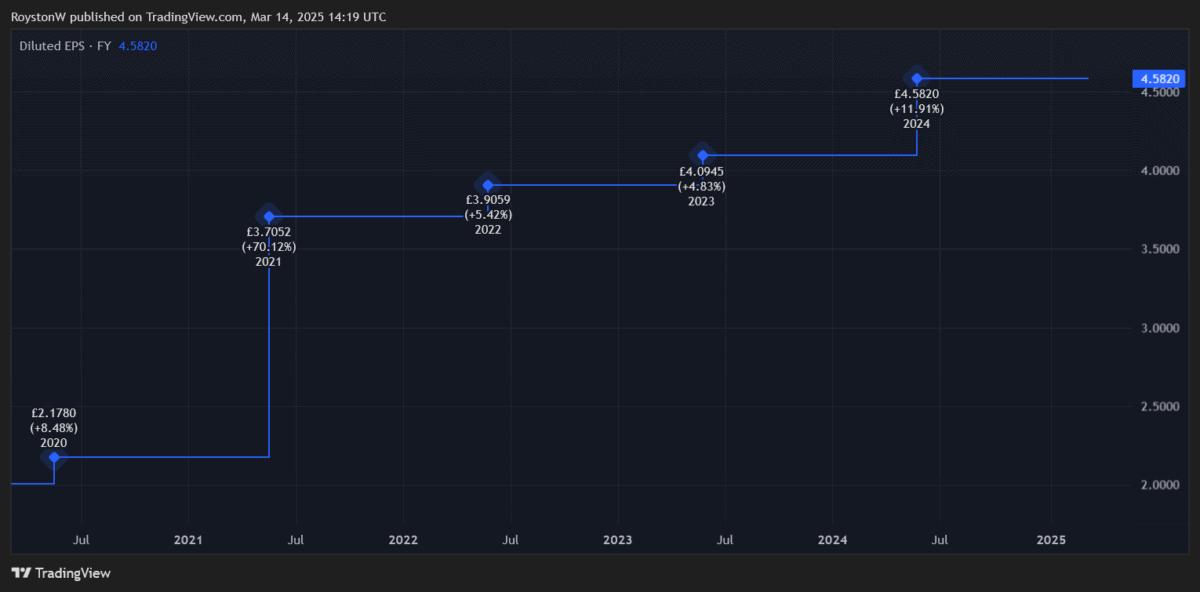
Earnings soared at the business during the Covid crisis, with lockdowns providing the perfect opportunity for new (and old) hobbyists to build, paint and then do battle with their model armies. Profits have continued rising strongly since then:

Games Workshop’s earnings history. Source: TradingView

Yet Games Workshop is no flash in the pan. Growing interest in fantasy tabletop gaming has been powering profits higher for decades. It’s a market that’s tipped for further substantial growth too.

That’s not to say earnings will continue soaring in a straight line. The prospect of a global economic slowdown — and a subsequent fall in consumer spending — is a significant threat over the short-to-medium term. US trade tariffs might exacerbate spending declines too, and create supply chain issues for the company.

With this in mind, here are the growth forecasts for Games Workshop shares for the next few years.

Mixed outlook

Financial year ending May… Predicted earnings per share Annual movement
2025 514.74p + 12%
2026 512.37p – 1%
2027 554.10p + 8%

As you can see, Games Workshop’s long streak of earnings growth is set to stall, with a rare profit drop forecast for 2026 by City brokers.

But this isn’t a signal of worsening trading conditions, an expected jump in costs or other issues at the company. Instead, the predicted bottom-line decline for financial 2026 reflects an empty slate of major product launches.

Sales this year were boosted by the latest edition of the Warhammer: Age of Sigmar games system hitting shelves. Additionally, high-margin licensing revenues are tipped to cool next year after the stunning success of the Warhammer 40,000: Space Marine 2 video game launched last September.

These create tough comparatives for Games Workshop to go up against.

With a raft of new product releases likely in financial 2027, the business is tipped to move back into rapid growth.

Gold standard

As a long-term investor, I remain pretty upbeat about what returns I can expect from Games Workshop shares.

It’s not just the fact that it operates in a steadily growing market. As the success of its video games and books also show, the company’s Warhammer franchises are hot properties that continue to expand their fan base and cultural influence.

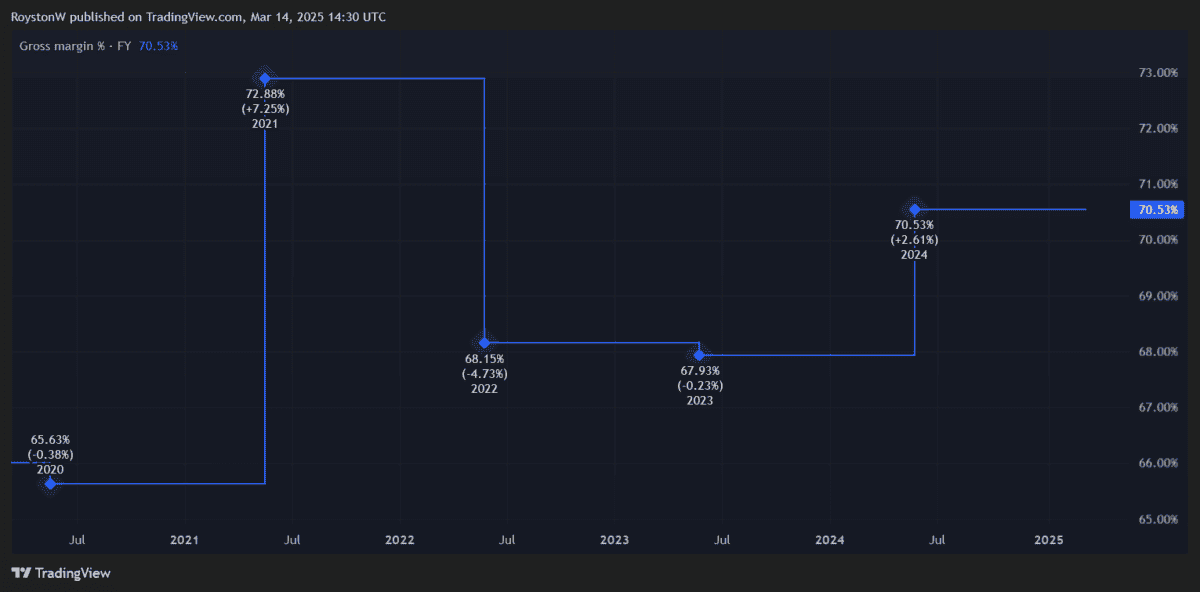
This strong brand appeal is also reflected in the high prices the company charges for its product, and as a consequence its enormous profit margins:

Games Workshop's gross margins
Games Workshop’s gross margins. Source: TradingView

Branching out

As well as expanding its core operations, Games Workshop is also taking steps to boost the licensing side of the business.

It’s deal with Amazon to make films and TV content could take revenues through the stratosphere. But this isn’t all, with a follow up to last year’s money-spinning Space Marine 2 game also in the works.

Production on both is likely to take years however, so investors will need to be patient.

Today Games Workshop shares don’t come cheap. As the table further up shows, they trade on a forward price-to-earnings (P/E) ratio of 28 times.

But I believe the business — which has delivered an average annual return of 41.6% over the past decade — deserves such a premium and is worth considering.

Financial News

Daily News on Investing, Personal Finance, Markets, and more!

Financial News

Policy(Required)