I asked ChatGPT for the best FTSE 100 investment trust to buy… here’s what it said

There are only a few investment trusts listed on the FTSE 100 and it seems that ChatGPT’s top investment trust to buy on the index is also my own. Scottish Mortgage Investment Trust (LSE:SMT) is a Baillie Gifford-managed entity investing predominantly in US tech. Its long-run performance is impressive.

What ChatGPT said

I asked ChatGPT to give me a summary of its thesis for investing in Scottish Mortgage, and here’s what it said: “The Scottish Mortgage Investment Trust is a top choice due to its exceptional long-term growth, driven by investments in high-growth global companies, particularly in tech, healthcare, and renewable energy.

It goes on to highlight that the firm has achieved significant success by investing in innovation and disruptive sectors. Noting companies like Tesla and Amazon, ChatGPT said that the trust’s exposure to high-growth companies is arguably unmatched on the index. The artificial intelligence (AI) platform also praised Scottish Mortgage’s relatively low fees and historically strong performance.

Broadly, I agree with the bullishness. Low fees and a great track record for an actively managed fund. However, ChatGPT’s information did prove to be a little outdated in some cases.

An impressive track record

Many Britons see Scottish Mortgage as their main exposure to the fast-moving technology sector. However, there’s more to it than that. It’s an actively managed portfolio and the fund managers have an impressive record of picking the next big winners.

For example, Scottish Mortgage first took a position in Amazon back in 2004, long before the e-commerce giant became the global powerhouse it is today. This early investment capitalised on Amazon’s disruptive potential in retail and cloud computing, which has since delivered significant returns.

Similarly, the trust invested in Tesla in 2013, well before the electric vehicle (EV) revolution gained mainstream traction. Tesla’s stock price surged over the following decade, making it one of Scottish Mortgage’s most successful holdings and contributing substantially to its portfolio performance. Management appears to have lowered the fund’s stake recently, potentially capitalising on the stock’s pre-Christmas surge.

In recent years, Scottish Mortgage has also made strategic investments in private companies, including SpaceX. The trust first invested in Elon Musk’s rocket company in 2018, recognising its potential to revolutionise space exploration and satellite technology.

SpaceX has since become Scottish Mortgage’s largest holdings, with its valuation soaring to $350bn in 2024, up from $255bn in 2023 and $27bn in 2018. This investment has provided a significant boost to the trust’s net asset value (NAV).

Of course, past performance isn’t a guarantee of future success, but it’s good to see.

Not without its risks

Scottish Mortgage’s use of gearing (borrowing to invest) amplifies both gains and losses. While it can enhance returns in rising markets, it increases losses during downturns. Additionally, its significant exposure to unlisted private companies (27% of the portfolio) adds liquidity and valuation risks, making it more volatile and sensitive to market conditions. Nonetheless, it’s an investment I continue to pursue, having recently added to my position. There’s plenty of reason to believe it will perform over the long run.

How much should investors put in an ISA to achieve the average UK wage in passive income?

Achieving financial independence through passive income is a top priority for many UK investors. And with the average UK salary projected to hit £37,000 in 2025, I’m wondering how much someone needs to invest in an ISA to generate this amount.

The numbers behind the dream

To earn an annualised £37,000 annually, an investor would need around £740,000 in an ISA. That’s based on the assumption that an investor could achieve an average dividend yield of 5%. This would mean earning a passive income without drawing down the balance of the portfolio. While £740,000 might sound like a lot of money to reach, it’s achievable. The only thing is, it takes time.

Stocks and Shares ISAs have outperformed their cash counterparts, offering an average return of 11.9% in the year leading up to February 2025, compared to just 3.8% for Cash ISAs. This significant difference underscores the potential of equity-based investments for long-term wealth generation.

However, it’s important to note that investing in stocks carries risks, and past performance is no guarantee of future returns. Diversification and a long-term strategy are key to mitigating these risks and maximising returns.

The road to £740,000

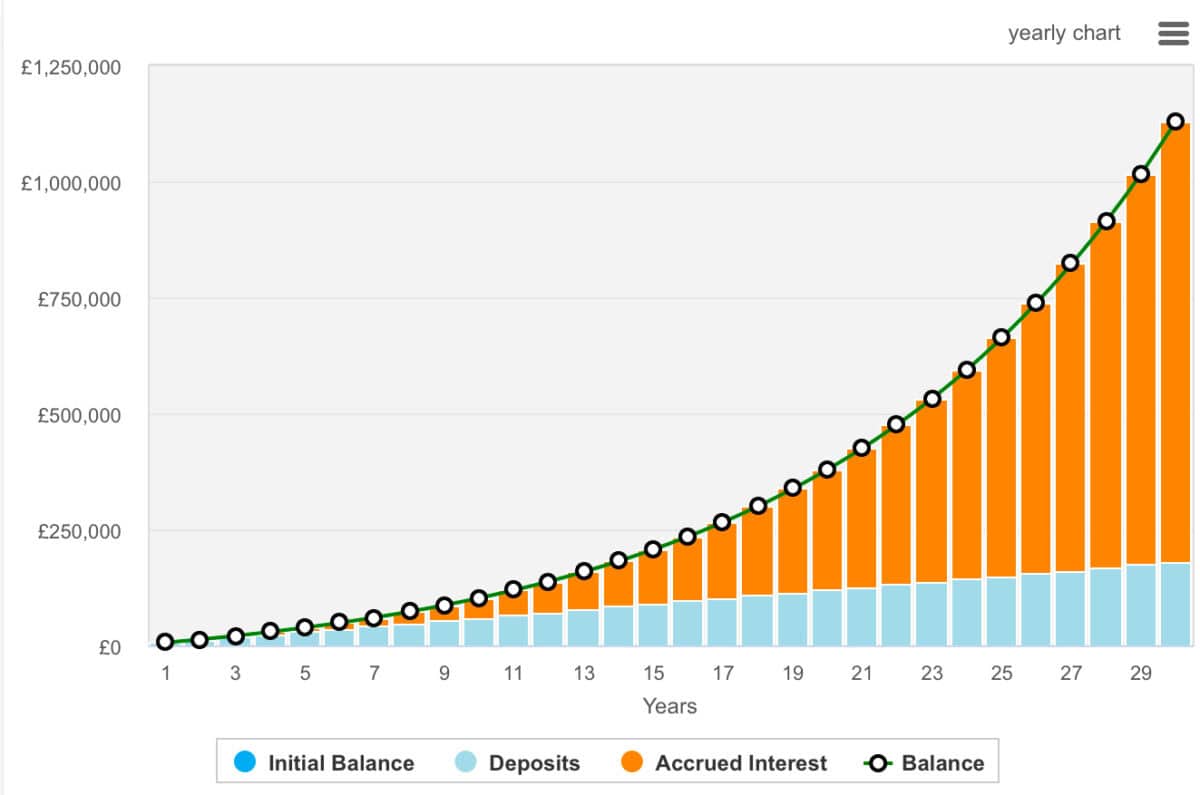
For most investors, accumulating £740,000 is no mean feat. It requires consistent saving, disciplined investing, and a clear financial plan. That’s just the start. It also requires investors to invest wisely, and as Warren Buffett states, to avoid losses. In the example below, I’ve assumed £500 of monthly contributions and a 10% annualised return. Under these circumstances it would take 26 years to compound to £740,000.

Created at thecalculatorsite.com

However, not everyone can achieve 10% annually. With 8% growth, it would take 30 years and lower percentage returns would take even longer.

A reality check

While the idea of earning the average UK wage passively is enticing, it’s crucial to approach this goal with realistic expectations. Market volatility, inflation, and unforeseen expenses can impact investment returns. It’s also the case that, assuming a constant inflation rate of 2.5% per year, £37,000 today will feel like approximately £19,558.47 in today’s money after 26 years.

An investment to consider

Here’s one from my daughter’s SIPP that investors may want to consider.

The Monks Investment Trust (LSE:MNKS) is a globally-focused investment trust managed by Baillie Gifford, aiming to deliver long-term capital growth through a diversified portfolio of growth-oriented equities. Its strategy emphasises adaptability, investing in companies positioned to thrive amid structural and cyclical changes.

The trust’s approach includes identifying businesses that innovate to reduce costs or improve service quality, ensuring resilience across market cycles. Over the long term, Monks has performed well, with a net asset value (NAV) total return of 173.2% over 10 years as of March 2025. 

However, the trust employs gearing (borrowing to invest), which can amplify returns but also increases risk. If investments underperform, the cost of borrowing can lead to significant losses, particularly during market downturns.

Despite this, the trust’s disciplined risk management and focus on long-term fundamentals make it an attractive option. It’s something I may buy more of, for my daughter’s SIPP at least.

2 cheap FTSE dividend stocks to consider buying for an ISA

There’s no time limit when it comes to investing money that’s held within a Stocks and Shares ISA. However, evidence has consistently shown that time ‘in the market’ leads to better returns than ‘timing the market’. Moreover, the value of any cash on the sidelines will be gradually eroded by inflation. One option is to invest that money in FTSE dividend stocks to generate passive income.

The perfect dividend stock?

FTSE 250 member IG Group (LSE: IGG) is a very attractive option, in my opinion.

First off, there’s the size of the dividend yield. Based on current analyst estimates, this comes in at 5.1%. For comparison, companies within the mid-cap index yield 3.5% on average.

Now, a higher-than-average yield counts for little if a firm is in financial difficulty. It’s often the first thing to be cut. But since FY25 profit is expected to cover the cash distribution twice over, I think this is very unlikely with IG. It also has a huge amount of net cash on the balance sheet.

Another thing worth noting is that, after a few years of not moving at all, the total dividend is growing again. That usually a sign of confidence. And no wonder! The online trading platform provider reported a 12% jump in quarterly revenue last week. It is now expected to breach the £1bn mark for the full year.

Still cheap

Of course, no dividend stream is ever nailed on, hence why having a diversified ISA portfolio can make a lot of sense. Threats to IG include ongoing regulation and intense competition from rivals. Interestingly, business also tends to suffer when markets are calm and clients spot fewer opportunities to trade.

Still, I think these risks are in the price. The shares trade at just nine times forecast earnings. That’s despite rising nearly 30% in the last 12 months.

Stonking yield

A second FTSE stock worth considering is PayPoint (LSE: PAY). The mid-cap enables payments and commerce for the public and private sector.

Like IG Group, this seems to be a business in good health. Back in January, it reported “further progress in the third quarter […] despite a more challenging overall trading environment and a stalled recovery in consumer confidence“. As a consequence of this and further investment, management thinks £100m EBITDA (earnings before interest, tax, depreciation, and amortisation) will be achieved by the end of FY26.

As encouraging as this is, it’s PayPoint’s income credentials that are of interest here. On this front, it all looks pretty stellar to me.

Analysts reckon the total payout for FY25 will come to 38.8p per share. This gives a stonking yield of 6.2%. Another small increase is expected in FY26, easily covered by anticipated profit.

Great value

Again, nothing can be guaranteed and calculations may need to be adjusted as time goes on. PayPoint holders could see their dividend payments reduced if, for example, some of the retailers it works with go under or sever ties. Things might also get tricky if consumer confidence dips for longer than predicted.

But this £441m cap still smacks of value. Right now, shares change hands on a forward price-to-earnings (P/E) ratio of just eight. That looks a bargain for a company that achieves margins far above the market average.

£20k in a Stocks and Shares ISA? Here’s how an investor could target £1,342 in passive income each month

A Stocks and Shares ISA can be a platform for long-term investment. Not only might that mean capital growth, it can also mean sizeable income streams.

Such an approach requires patience among other things. But long-term investment is all about patience, so that is no surprise.

This approach can be highly lucrative.

As an example, here is how an investor could put a £20,000 Stocks and Shares ISA to work in an effort to build monthly passive income streams of well over £1,000.

Understanding how shares build income

Even £1,000 a month would be £12,000 a year. To earn that now from a £20,000 ISA would take a dividend yield of 60%, which I see as improbably high. Few FTSE 100 shares even offer a double-digit yield and most are far lower (the average is 3.4%).

But over time, reinvesting dividends (known as compounding) can help build bigger income streams.

For example, if the ISA compounds annually at 8%, after three decades, it should be worth over £201,000. At an 8% yield, that should generate monthly dividends of roughly £1,342 on average.

Building the right sort of portfolio

An 8% compound annual growth rate might not sound too challenging.

But remember, over the course of 30 years, the stock market is likely to have down years as well  as up years.

Still, in today’s market I think it is achievable. For example, one FTSE 100 share with a standout yield (9.4%) is insurer Phoenix Group (LSE: PHNX). It announced today (17 March) in its annual results that it will increase its annual dividend by 3%.

The company has a policy of aiming to grow its dividend per share annually. Last year, operating cash generation grew by over a fifth, meaning that not only is the dividend covered, but Phoenix expects to produce around £300m of excess cash annually.

Not all years will necessarily be as strong as that, admittedly. Phoenix faces risks. Last year, for example, it noted “higher outflows due to consumer behaviour in response to the UK budget uncertainty in the year“. If economic uncertainty continues, I see a risk that policy holders could keep pulling out funds, hurting profits.

But with a proven business model and cash generation capability, I see Phoenix as a company income-seeking investors should consider for their Stocks and Shares ISAs.

Sticking to proven principles

Any share can disappoint, of course. That is why diversification is an important risk management strategy. £20K is ample to allow for it.

The 8% compound annual growth rate could come from a mixture of dividends and capital gain. But dividends are never guaranteed and share prices can move down as well as up, so I think a smart investor will stick to high-quality businesses they understand.

First of all, of course, is choosing a Stocks and Shares ISA. With plenty of options available, it pays to take some time to decide what one looks best.

Millions are missing out on ISA account benefits! Here’s what I’m doing now

The Stocks and Shares ISA is a great account for individuals looking to build long-term wealth. Substantial tax savings give individuals more money to invest each year for superior compound gains.

Yet a huge number of people are being left behind. Here’s why I think investors should consider buying shares in an ISA today.

Fallen through the gaps

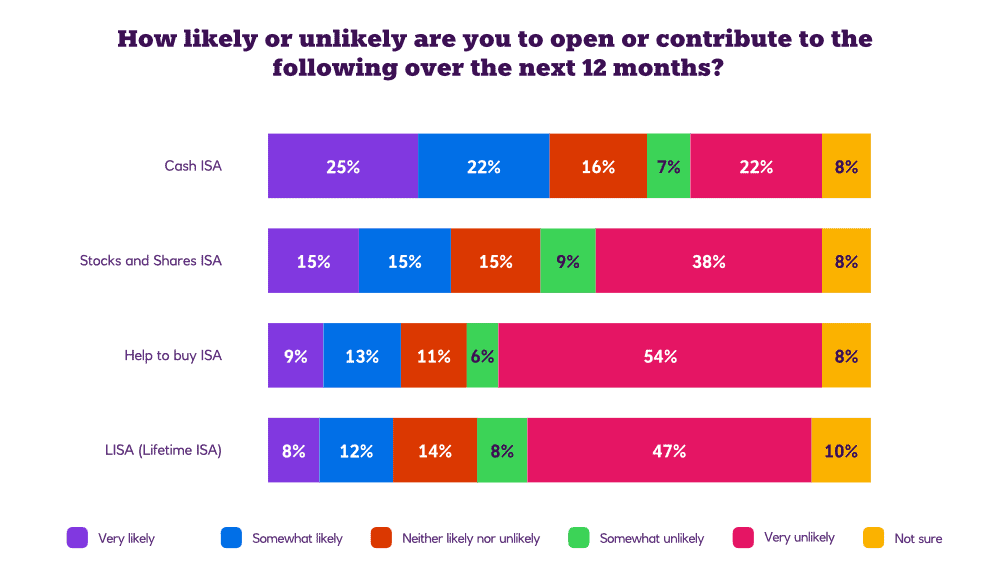
According to NatWest‘s latest Savings Index, a whopping 62% of people have no plans to either open or contribute to any sort of ISA product over the next 12 months.

This reflects to some extent a lack of awareness of the range of ISAs and how they work.

Of the 10,000 people quizzed, 73% of people knew about the existence of the Cash ISA versus 60% for the Stocks and Shares ISA. Even fewer (38%) said that they understood how the Stocks and Shares ISA works.

As a consequence, just 30% of respondents said it was likely they’d use one of these products in the next year.

Source: NatWest Savings Index

NatWest’s results were even gloomier for the Lifetime ISA, a product which can also be used to buy shares, funds, and investment trusts.

Just 44% of people know these exist, and 20% of people intend to use one in the following 12 months.

Last-minute buys

This is a missed opportunity given the massive advantages these products offer. I myself own a Stocks and Shares ISA and a Lifetime ISA to invest. With the latter, investors also receive a £1 government top-up for every £4 they invest.

I myself have maxed out my £4,000 Lifetime ISA allowance this year. But I have some contribution room left in my Stocks and Shares ISA, so I’m looking for some last-minute additions before 5 April’s annual deadline.

Any of my £20,000 annual allowance I don’t use can’t be rolled over to the next year.

Following recent weakness on global stock markets, now could be a particularly good time to find last-minute bargains. Associated British Foods (LSE:ABF) is one that’s currently on my watchlist.

A FTSE 100 bargain?

I don’t need to actually buy shares to utilise any allowance I have left. I merely need to deposit the cash in my ISA account.

But given the cheapness of ABF shares today, I see no reason to delay. The FTSE 100 company trades on a forward price-to-earnings (P/E) ratio of 9.6 times.

That’s significantly below the five-year average P/E of 21-22 times, and reflects fears over increased competition for Primark and — more recently — the impact of US trade tariffs.

But I believe that, on balance, ABF remains a highly attractive stock at current prices. Primark still has significant room to grow as estate expansion continues, and especially in fast-growing North America and Central and Eastern Europe. Primark opened 22 net new stores last year to take the total to 450.

I’m also optimistic that rising investment in online shopping will help it effectively exploit the growing fast-fashion segment. Click & Collect is now available in 113 of its stores.

With many other quality blue chips also looking underpriced, I think now’s a great time to go ISA shopping.

Here’s my plan to survive and thrive in a stock market correction

The US stock market has entered correction territory, which gives investors something to think about. All of a sudden, the shares they own are worth less than they were a few weeks ago.

At times like this – or in a full-blown crash – investors need a strategy for long-term success. And mine draws inspiration from some unusual sources.

Defending

The undefeated 2003-04 Arsenal football team is probably the best in Premier League history. And that’s not fun to admit as a Spurs fan who grew up watching Arsenal when the team was dubbed the Invincibles.

But even the Invincibles had to go through some difficult times. They had to defend and there were times things didn’t go their way – but they persevered and refused to be beaten.

I think this is true of virtually everything in life, including investing. Challenges are inevitable, but being willing to show the character to not give up in tough times is crucial to success.

In the stock market, even the best and most resilient companies have times when their shares come under pressure. Rolls-Royce (LSE:RR) is a great example. 

The stock fell 77% at the start of the pandemic as travel demand evaporated, earnings turned negative, and debt increased. That can’t have been much fun for investors at the time.

Those who sold, however, missed out on a recovery from the business that sent the stock up 1,300%. Being able to hang in there when the pressure is on is key to those long-term returns.

Seizing the opportunity

Avoiding the temptation to sell when prices are falling is essential when it comes to the stock market. But the best investors are able to do more than this and buy when shares are cheap.

One way of being able to do this involves keeping cash in reserve. But this isn’t an approach that I like – I think the risk of prices rising sharply makes this a risky strategy.

There is, however, another way to take advantage of a stock market correction. And that involves taking a look at which shares have fallen more than others.

As an example, Adobe (-15%) has fallen much more than Microsoft (-4%) over the last month. As a result, investors might wonder whether selling one to buy the other is a good idea.

The question isn’t straightforward – it depends on whether artificial intelligence is a long-term threat or an opportunity for Adobe. But there is now a significant difference in valuation.

The general point, though, is that buying shares when prices are low doesn’t depend on holding on to cash and waiting for a crash. Reassessing a portfolio can reveal opportunities.

Investment opportunities

I’m mindful that selling because a stock might go lower is almost always a mistake. But so is holding on to a good investment if it comes at the cost of not being able to make a great one. 

Returning to Rolls-Royce, I wonder whether investors who own the stock might consider selling to invest elsewhere. The company is expecting to reach £4.5bn in free cash flow in 2028.

At today’s prices, that implies a return of around 6.5% and this is still three years away. A volatile stock market across the Atlantic means there could be better opportunities available.

This ex-penny stock is up 135% from 26p! Should I buy it?

Shares of Seraphim Space Investment Trust (LSE: SSIT) popped 11.8% on 14 March, finishing the day at 61p. This brought the gains for this former penny stock to 135% since it bottomed out at 26p in July 2023.

Seraphim is an investment trust with a £146m market cap that focuses on early and growth-stage private businesses involved in space technology. It therefore offers investors exposure to the booming space industry. 

But should I invest in it? Let’s explore.

Good progress

Seraphim has about 22 holdings spread across areas like satellite communications, Earth observatory technology and space-related data analytics. As most of these are small private companies, they aren’t well-known.

Top 5 holdings (December 2024)

Company Sub-sector % of portfolio
ICEYE Earth observation 21.9%
D-Orbit In-orbit services 13.5%
ALL.SPACE Ground terminals 11.9%
HawkEye 360 Earth observation 9.2%
LeoLabs Space traffic monitoring 5.5%

The share price jump last week came after the trust’s results for the six months to 31 December. The fair value of the portfolio grew 7.3% to £216.3m, helping drive the net asset value (NAV) by 5.1% to £239.7m.

This was mainly due to an increase in the fair value of ICEYE and a new funding round for Skylo, which raised $158m. In the period, the trust invested £5.1m into four existing positions.

Half of the portfolio representing 71% of fair value had over 12 months of cash left. And one holding called Voyager Technologies is planning a US IPO, which could boost the trust’s valuation. 

Meanwhile, holding Skylo has partnered with telecoms giant Verizon to launch satellite-based mobile messaging in the US.

Seraphim finished the year with £23.6m in cash and £14.1m in potential liquidity through some listed holdings. So it has capital to make further investments.

Will Whitehorn, Chair of the trust, highlighted two big space trends that are playing out. The first is the US administration’s push for innovative solutions for “manned missions to Mars and greater efficiency in defence spending“.

At the same time, Europe is bolstering its own defence capabilities. Whitehorn commented: “The prospect of Europe potentially no longer being able to rely on the US’s intelligence and communications capabilities for its security plays directly to the pressing need for Europe to develop more sovereign space capabilities as quickly as possible.”

As a result, its three largest holdings should benefit. The trust says they’re European companies with “world-leading capabilities” that are already being procured by departments of defence in both Europe and the US.

Wide discount

Now, some portfolio companies only have a few months of funding left. This means follow-on funding rounds will be necessary, increasing bankruptcy risks if access to capital evaporates.

Also, the global space market is very competitive, with established names as well as many upstarts. So there’s no guarantee the trust’s holdings will succeed, even if the overall space economy expands.

Currently at 61p, the shares are trading at a massive 40% discount to the underlying NAV per share (101p). While this gap could indicate a bargain, it also highlights how investors are potentially cautious of the prospects here.

Risky play

Morgan Stanley estimates that the global space industry could surge to over $1trn by 2040, up from $350bn 2020. So this is an area I’d like to invest in.

However, I think this space trust is a little too speculative for me. I’d prefer to see more evidence of commercial progress at the top holdings before I consider investing.

As the S&P 500 enters correction territory, here are the growth stocks I’m eyeing

Late last week, the S&P 500 pulled back over 10% from recent highs. This technically means it’s in a correction, which some investors might view as a red flag. However, a drop of that magnitude presents opportunities, especially with growth stocks. Here’s part of my watchlist that I’ve built over the weekend.

Potential in payments

PayPal (NASDAQ:PYPL) is down 12% in the past month. Over a longer one-year period, it’s up 10%. The global digital payments platform generates revenue through multiple streams. Most of it comes from transaction fees, charged to merchants when payments are made. It also makes money from foreign exchange, premium services and credit provisions.

I’ve put the stock on my watchlist because I think it could do well this year. CEO Alex Chriss has recently focused on improving profitability by cutting operational costs and enhancing AI-driven automation. I like this push to make use of new tech, such as integrating AI-powered fraud detection and smart payment solutions. Ultimately, this should drive deeper engagement with customers and make them more comfortable to spend more using PayPal.

One risk is the increasingly competitive payments sector. It’s no longer enough to offer a good payment solution. Other companies are providing more add-ons and enhancements to woo clients. PayPal needs to focus on constantly innovating in order to not get left behind.

Backing active management

Another company on my list is T Rowe Price Group (NASDAQ:TROW). The stock has taken a 14% hit in the last month and is down 19% in the last year. Last week it hit fresh 52-week lows.

One reason for the drop is that investors have increasingly favoured low-cost index funds and exchange-traded funds over actively managed funds like T Rowe Price offers. After all, given the performance of the past couple of years from the S&P 500, some have decided to buy an index tracker.

However, I think this may change this year. The sharp drop in the S&P 500 shows that an index tracker might not be the best move during volatile times. Rather, this is the environment where active stock-picking can really outperform. Further, I expect the US Federal Reserve to continue cutting interest rates this year. With a lower base rate, more money should move out of cash and into the stock market. This could help to increase the assets under management for T Rowe Price.

Of course, I do have concerns with the stock. With a lot of uncertainty at the moment around tariffs, as well as ongoing conflicts in Europe and the Middle East, investors might continue to move money out of T Rowe Price and sit in cash. This would be negative for company revenues.

I have both growth shares on my watchlist right now. I’m going to monitor how the S&P 500 performs over the coming few weeks. If the sell-off shows signs of easing, I’d strongly consider buying these two for my portfolio.

As gold passes $3,000, I think these UK stocks could benefit the most

On Friday (15 March), the gold price made a fresh all-time high, breaking above $3,000 per oz. This is a huge psychological barrier to have hit, with a lot of investors focused on the news. Yet the benefit of this move could be felt via higher share prices this year for some specific UK stocks. Here are two for investors to consider.

A gold miner

Fresnillo (LSE:FRES) could stand to gain on the gold price spike. While primarily a silver miner, it has substantial gold production too, generating significant revenue from higher gold prices.

Over the last year, the stock is up a whopping 97%. Part of this can be attributed to the move higher in gold and silver prices before the latest barrier was smashed. Fundamentally, revenue from the producer is impacted by the end selling price. So it doesn’t surprise me that the 2024 results showed a 26.9% increase in revenue versus 2023. EBITDA more than doubled!

Aside from just the price rises, the CEO spoke about “operational discipline and a continued focus on cost efficiencies.” This is great, and should help the company regardless of what happens to precious metal prices this year. Yet with gold hitting $3,000, I believe Fresnillo will feel the benefits, with elevated selling prices further boosting revenue this year.

One risk going forward is production trouble at the Sabinas mine. This cropped up late last year, with any further issues negatively impacting finances this year as production output has to be adjusted lower.

Thinking outside the box

A second idea is HSBC (LSE:HSBA). The global banking share has risen by 48% over the past year. Yet some might wonder why I think a bank could do well with rising gold prices. Stay with me.

The first reason is due to the fact that it has exposure to gold trading and investment products. If gold prices surge, demand for gold-backed ETFs and financial products should rise, benefitting the bank’s trading revenues.

Another reason is understanding why gold prices are rallying. It’s mostly due to investors rushing to buy a safe-haven asset, due to uncertainty in the world right now. With people worried, another sign will be increasing cash holdings. This will benefit the business, as it pays a modest amount of interest on deposits, while it receives interest close to the bank base rate. This profit should increase if people keep holding cash.

I’m conscious that the company could be negatively impacted by further interest rate cuts from the UK and US this year. If this happens, the net interest margin will shrink, putting pressure on profits later in 2025.

Ultimately, I think both stocks are worth considering for an investor who wants to take advantage of the recent gold move.

How a stock market crash could boost investors’ passive income by over 40%

Last week, the S&P 500 entered correction territory. Even though the FTSE 100 has held up reasonably well by comparison, there are concerns that the worst isn’t over and that a larger crash is coming.

Even though no one can predict this outcome, if it does happen, it could provide an opportunity when it comes to passive income potential. Here’s what I mean.

How a crash boosts yields

A stock market crash doesn’t have to fall a set percentage to be characterised as such. I usually say a correction is a drop of 10% in a short space of time. A crash is when the fall’s 20% or more.

If this were to happen, stocks within the index could drop more or less than the 20%. Some shares might only dip 10%, with others falling 30%. Yet the market decline might not specifically impact some stocks. Instead, the fall could be more to do with souring investment sentiment.

And this is the sweet spot of opportunity when it comes to income shares with elevated dividend yield potential.

For example, let’s assume there’s a company that isn’t overly impacted by the reasons for the crash. But investors still rush to sell stocks and hold cash. Let’s say its dividend share has a yield of 5%, with the share price at 100p and then drops by 30% to 70p. Under the premise that general business operations aren’t impacted, the dividend per share shouldn’t really fall. As a result, the share price decline would increase the dividend yield to 7.14%. The increase in that yield is 42.8%!

As a result, owning the same stock after a crash versus before could increase the passive income potential for an investor significantly.

One to consider?

If an investor thinks that the current fall in the stock market will continue to become a full-on crash, one dividend stock to consider having on a watchlist is Pets at Home Group (LSE:PETS). The stock is down 9% over the past year and has a current dividend yield of 5.55%.

Part of the fall over the past year has come as we’ve seen a continued market adjustment after the pandemic pet-owning boom. The steady decline since then has negatively impacted demand for Pets at Home. This is a risk going forward, although I see this as a natural adjustment to historically normal pet ownership levels.

Financial performance recently has eased investor concern. In January, a trading update showed consumer revenue was up by 2.3% versus the same period last year. In addition to maintaining full-year profit guidance, it had an impressive 27% jump in the percentage of revenue that came from consumer subscriptions.

The company has been steadily increasing the dividend per share in recent years. Further, I feel most of the drop in the FTSE 100 and FTSE 250 recently has come due to tariff and trade concerns with the US. Yet this shouldn’t really impact Pets at Home. Therefore, if a crash does push the share price down, I don’t see the dividend as being under threat.

As a result, I think the stock’s worth considering to have on a list for an investor who’s preparing for some income ideas if the market keeps falling.

Financial News

Daily News on Investing, Personal Finance, Markets, and more!

Financial News

Policy(Required)