How much would an investor need in dividend shares to make £1,000 a month?

Dividend shares are a popular way for investors to build a second income. It’s true that there’s no guarantee of future dividends, but with a diversified mix of stocks in a portfolio, it can be possible to bank regular income over time. Based on the end goal of making a grand a month, here’s how I worked backwards to figure out the strategy and numbers.

Getting the ducks in line

Before we get to the figures, the most crucial element is getting the strategy right. After all, it’s pointless to be putting more and more money into something that isn’t fundamentally working.

From my experience, an investor would be best placed to regularly put some money aside for income stocks. Of course, a large lump sum injection is never a bad thing. But in reality, personal cash flow needs often mean it’s easier to invest a smaller amount on a monthly basis.

The advantage of this method is that it allows an investor to take advantage of opportunities as they arise. One month, a stock might bump up the dividend per share, making it attractive to consider buying. Another month, a positive trading update might put a company on track for higher-than-expected earnings. Again, this could make it a good option to add to the portfolio.

Over a couple of years, this should allow the person to have a broad portfolio of stocks with varying yields. As a result, if one company has a problem and cuts the dividend, it shouldn’t have a material impact overall that would throw off the progress for the end goal.

Generous yield and dividend cover

If an investor is already in the process of building a portfolio, an opportunistic stock to consider buying could be ZIGUP (LSE:ZIG). The share price is down 16% over the last year, with a current dividend yield of 8.53%.

The lower stock price makes it a potentially attractive option, especially when I consider the reasons behind the fall. Part of it has come from the drop in reported underlying profit before tax for the half-year ended October. It fell by 17.2% versus the same period last year. Yet some of this was due to lower profit made from the disposal of assets, which was unusually high last year. So this doesn’t really relate to normal business operations.

Further, the business is still profitable, with a dividend cover of 2.9. This means that current earnings can cover the dividend several times over. Therefore, I see this as a sustainable income share to consider going forward.

Looking forward, the report mentioned that “we have seen a good supply of new vehicles coming through since the year-end, reducing the fleet age and strengthening our asset base.” This should help to retain existing clients. The main risk I see is if profitability keeps moving lower due to higher costs of adding new vehicles.

The numbers

Let’s say an investor can put £500 a month towards buying dividend stocks with an average yield of 8%. After 14 years, the pot size could be at £155,538. This means that in the following year, it could pay out £1,036 a month, even without adding in any fresh cash.


Defence spending is on the rise and this UK growth stock could be set to cash in

In the UK – and across Europe more generally – governments are looking to increase their military spending. And this could be a big boost for one UK stock in particular.

Names like BAE Systems and Rolls-Royce are obvious beneficiaries. But neither of these is the company that I think stands to be the big winner from increased military spending.

National security

The US has been putting pressure on NATO countries to start meeting their spending commitments. This involves investing at least 2% of GDP on defence each year. 

On top of this, US foreign policy is somewhat volatile at the moment. So other countries aiming for a more self-sufficient military operation is potentially desirable regardless. 

Britain currently does meet its spending commitment, spending 2.3% per year. But, its plan is to increase this to 2.5% and then 3%, which would be the largest increase since the Cold War. 

That doesn’t sound like much, but it would amount to a 30% increase in the defence budget. So I think it’s only natural for investors to be interested in the implications of this.

UK defence

BAE Systems sells a broad range of products and services to the UK government. This includes warships, aircraft, and munitions, as well as cybersecurity systems.

The thing is, though, the UK only makes up just over a quarter of revenues at BAE Systems. So other things being equal, a 30% increase in defence spending only translates into 7% sales growth for the firm.

With Rolls-Royce, its entire defence division only accounts for 24% of total sales. And while I’m a big fan of diversification, I think this means the impact of the UK increasing its military spending is likely to be even more limited.

Furthermore, only 14% of total revenues (across all three of its major divisions) come from the UK. So again, I think the biggest impact on growth is going to come from elsewhere.

Cohort

The stock that stands out to me in this context is Cohort (LSE:CHRT). With a market cap of £589m, it’s much smaller than BAE Systems, but around 54% of its sales come from the UK.

Cohort is actually a collection of smaller businesses focused on military technology. And even without governments committing more GDP to defence, it has some strong growth prospects.

This comes from its ability to acquire other companies and add them to its existing operations. This can be a risky strategy and the possibility of making a bad investment can’t be ignored.

Despite this, the firm’s relatively small size means it has a lot of scope to keep expanding. And demand for its products has climbed sharply over the last few years. 

Defence spending

The shares trade at a price-to-earnings (P/E) ratio of 26. That’s clearly high compared to other UK stocks and reflects a degree of optimism about the company’s growth prospects.

With almost 55% of sales coming from the UK though, a 30% increase in government spending could be significant. If the firm maintains its market share, revenues could rise around 16%. This makes the stock worth considering, I feel.

£11,000 in savings? Here’s how investors could use that to target an annual passive income of £12,892 over time!

I am a big fan of passive income as it is money made with minimal effort on my part. And the best way I have found of generating it is through dividends paid by shares.

All I need do is to pick the right stocks initially and then monitor their progress periodically after that.

Constructing a strong portfolio of high-yielding shares has given me a much better lifestyle than I would have enjoyed otherwise. And it should allow me to keep reducing my working commitments to an early retirement.

What are the ‘right stocks’?

The first of my three key criteria in picking my passive income shares is an average annual yield of 7%+. This figure reflects the compensation I want for taking the additional risk of investing in shares over the ‘risk-free rate’. This is the yield on 10-year UK government bonds, which is currently around 4.6%.

My second criterion is that the stock should look undervalued to me. This reduces the chance of my losing money on the price should I ever sell the share. Conversely, it increases the possibility that I will make money on the share price in that event.

The third quality I look for is that the underlying company has strong earnings growth potential. It is ultimately this that will power its share price and dividend higher over time.

An enduring passive income gem

Legal & General (LSE: LGEN) has been a core passive income stock holding for me for a long time.

To begin with, the financial services giant currently yields 8.7% compared to the average FTSE 100 return of 3.5%. That said, analysts forecast that its dividend will increase to 8.9% this year, 9.1% next year, and 9.2% in 2027.

Secondly, a discounted cash flow analysis shows the stock is 55% undervalued at its present price of £2.45. So the fair value for it is £5.44, although market vagaries might push it lower or higher.

A risk to this is a continued rise in the cost of living that may cause some customers to cancel their policies.

However – and my third passive income stock requirement met – analysts forecast its earnings will increase 29.3% each year to end-2027.

How much passive income can be generated?

Investors considering a holding of £11,000 (the average UK savings) in Legal & General would make £957 in first-year dividends.

Over 10 years on the same average yield, this would rise to £9,570, and over 30 years to £28,710.

This is a lot more than could be made from a standard UK savings account. But it could be vastly greater if the dividends were reinvested back into the stock – known as ‘dividend compounding’.

The magic of dividend compounding

By using this standard investment practice with the same average yield, dividends after 10 years would be £15,174, not £9,570.

And after 30 years on the same basis, this would increase to £137,188 rather than £28,710.

The total value of the holding would be £148,188, which would pay £12,892 in annual passive income by then.

I also believe its strong earnings growth potential should drive the share price and dividend much higher over time.  Therefore, I will be adding to my holding in Legal & General very soon.

Down 10% and 15% in a month! 2 cheap shares investors might consider buying with £2k today

The stock market has been bumpy lately, and while the FTSE 100 has avoided the worst, it’s still throwing up plenty of opportunities to buy cheap shares.

I’ve spotted two blue chips whose share prices have dropped significantly in the last month, largely due to forces beyond their control. Patient investors might consider this a buying opportunity.

Sainsbury’s shares are being squeezed

The Sainsbury’s (LSE: SBRY) share price has dropped 10% in the last month and is down 6% over the past year. A key reason for the recent decline was a worrying update from rival grocer Asda on 14 March, which has vowed to recover lost ground against rivals by cutting prices, even at the cost of its short-term profitability.

If Asda lowers prices to compete with discount chains like Aldi and Lidl, Sainsbury’s may feel pressure to follow suit, squeezing its profit margins too. They’re already wafer thin at 1.6%, but had been forecast to increase to 3.2%. The broader supermarket sector is under strain due to the cost-of-living crisis, rising inflation, and uncertainty over the wider impact of trade tariffs on consumers.

Sainsbury’s remains the UK’s second-largest supermarket with a 15.7% market share, according to Kantar. That’s ahead of Asda’s 12.6%. The company posted a strong 3.8% rise in Christmas sales and expects full-year underlying retail operating profit to increase by 7%. That should see it hit the mid-point of its £1.01bn to £1.06bn guidance range.

The risk is that it falls short, hitting sentiment. Retail is a tough sector at the best of times, and these are not the best of times. Especially with employer’s national insurance and minimum wage hikes landing in April.

Yet the valuation looks attractive with a price-to-earnings (P/E) ratio of just 10.6. Meanwhile, its dividend yield has climbed to a juicy 5.65%.

Long-term investors might consider this a good chance to buy into a well-established business at a discounted price.

My second cheap pick is Intermediate Capital Group (LSE: ICG), an alternative asset manager specialising in private equity and debt investments.

Its shares have dropped 15% in the past month and are up just 3.6% over the last year. However, they’ve still surged 97% over five years, demonstrating their long-term growth potential.

Latest Q3 results, released on 22 January, showed assets under management (AUM) grew by 5.1% to $107bn. That’s a year-on-year increase of 27.5%. Fee-earning AUM rose 8.1% year on year to $71bn, reflecting strong demand for its investment strategies.

Intermediate Capital Group also reported $7.2bn in new fundraising during Q3, bringing its total for 2024 to $22bn. That’s more than double the 2023 number. This highlights its ability to attract capital and gives it a solid foundation for future earnings growth.

ICG could be hit by trade tariffs, an economic slowdown and subsequent drop in market sentiment. Private equity can be a volatile sector at the best of times. High interest rates don’t help, and inflation isn’t licked yet.

Yet for an investor waiting for an entry point into a high-quality alternative asset manager, this could be the moment to consider it. There’s a 3.85% trailing yield too.

Stock market volatility can be unsettling, but it often creates opportunities. Sainsbury’s and Intermediate Capital Group have both suffered setbacks, but their underlying businesses remain strong. With £2,000 to invest, an investor might consider splitting it between these two companies.

Here’s how £350 a month could put a stock market beginner on the road to wealth!

In my youth, I dreamt of making money on the stock market. But for years, the fear of losses combined with a lack of knowledge held me back.

Like so many others, I thought stock trading was reserved for the mega-wealthy.

In fact, it’s easily accessible to anybody — even with just a few hundred quid to start. 

The knowledge part, however, is crucial. Considerable time should be dedicated to researching investment best practices. Fortunately, there’s a wealth of information available online covering topics like budgeting, diversification and risk assessment. 

Consider this strategy for a beginner to get started with just £350. 

Managing expectations

Every investor’s journey is different so don’t make comparisons with sensational news stories. Very few investors — if any — become overnight millionaires by trading stocks.

Plan to invest with a 20-to-30-year outlook and be realistic about expected returns. Envision a goal like a slightly more comfortable retirement or a down payment on a home.

Choosing an optimal investment account

Investments often attract a variety of different fees which must be accounted for. Depending on the platform used, buying and selling can attract fees and many ETFs and investment trusts also have ongoing charges. These are usually unavoidable.

One big expense that can potentially be reduced is tax. A Stocks and Shares ISA offers a way for UK residents to invest up to £20k per year with no tax levied on the capital gains.

Please note that tax treatment depends on the individual circumstances of each client and may be subject to change in future. The content in this article is provided for information purposes only. It is not intended to be, neither does it constitute, any form of tax advice. Readers are responsible for carrying out their own due diligence and for obtaining professional advice before making any investment decisions.

How much to invest

Experts recommend allocating 15% of pre-tax income to investments. The average UK salary in 2024 was £2,334 a month, 15% of which is £350.

Investing that every month into a portfolio returning 10% on average could grow to over £255,000 in 20 years. Rebalancing the portfolio towards stocks with an average 7% yield would pay out £17,878 a year in dividends.

That leaves a healthy nest egg for emergencies and a decent bit of passive income to complement a pension.

Of course, these averages are illustrative and not guaranteed but are realistic based on historical market returns. 

A good beginner stock?

Yes, I know — stock picking can be daunting! Even a simple financial summary delivers a shock of confusing metrics, with hidden risks seemingly behind every corner.

Fortunately, several well-established FTSE 100 ‘starter stocks’ are considered low risk. One popular choice to consider is the insurance giant Admiral (LSE: ADM). 

The share price enjoys steady, consistent growth, up 100% in the past 10 years. Plus, it has a decent 4.7% dividend yield, providing added value for income investors.

Insurance can be tricky, especially during times of economic crisis and high interest rates. If consumers curb spending, Admiral’s share price could take a hit — as it did in 2022. It also risks losing market share to Aviva, which recently acquired fellow motor insurance firm Direct Line.

But those threats haven’t impacted the share price recently — it’s up 13% this year!

Revenue has been rising rapidly since 2020, up from £1.3bn to £5.2bn. After a big dip in 2022, earnings improved, with the net margin now up to 12.58%. In the second half of 2024, earnings per share (EPS) came in at £1.39, beating expectations by a massive 23%.

When searching for starter stocks, aim for well-established market leaders with steady growth and earnings.

The 5 most popular FTSE 100 shares on the AJ Bell trading platform

Between 1 January and 28 February, the top five FTSE 100 shares with AJ Bell’s clients were (in order) Glencore, Phoenix Group Holdings, Taylor Wimpey, JD Sports Fashion (LSE:JD.), and SSE. The list is based on the net inflows of funds so it also takes into account those selling each stock.

In my opinion, it’s never a good idea to buy shares just because they are popular with others. There’s no substitute for doing your own research. After all, how do I know that those backing a particular stock have taken the time to study the company’s prospects and those of the industry in which it operates? However, league tables of popular shares can be a good starting point for picking shares.

Bargain hunting

Four of the stocks are currently (17 March) trading within 6% of their 52-week lows. It looks to me as though investors are seeking out bargains.

Stock Share price (pence) 52-week low (pence) % above 52-week low
Glencore 321 309 3.9
Phoenix Group Holdings 568 473 20.0
Taylor Wimpey 113 107 5.6
JD Sports Fashion 74 71 4.2
SSE 1,521 1,447 5.1
Source: London Stock Exchange / data at lunchtime on 17 March 2025

JD Sports is the closest to its one-year low. And to be honest, I’m pleased that it’s on the list. That’s because I already own shares in the sports leisure retailer. I first bought them in the summer of 2024. Two profit warnings later, I’m now sitting on a large paper loss. At the time, I thought they were a bit of a bargain. Now, I think they are even more so.

And if I’d some spare cash, I’d buy more.

Pros and cons

For the year ending 1 February 2025 (FY25), the company’s expecting a profit before tax and exceptional items of £915m-£935m. If this proves to be correct, earnings per share (EPS) will be around 12.2p. And this implies a forward price-to-earnings (P/E) ratio of 5.95.

On 31 May 2024, when the company published its FY24 results, it reported EPS of 10.45p. Then, its P/E ratio was 12.2.

If the company was valued on the same basis today, its share price would more than double.

But the outlook for retailers, particularly in the UK, looks uncertain. The economy appears fragile and inflation is still above the Bank of England’s target. Also, JD Sports’ dividend is tiny.

However, the group has recently expanded into the US and Europe so it’s less exposed to the UK than previously.

And despite facing fierce competition, the company managed to increase its margin during the third quarter. This tells me that the brand remains strong. It didn’t engage in discounting over the Christmas period yet saw an increase in like-for-like sales, compared to 2023.

A quick look at the others

At 10.8%, Phoenix Group’s shares are the furthest away from their 52-week low. This has been helped, in part, by yesterday’s upgrade to its 2025-2026 earnings forecasts. Another reason for its popularity could be its generous dividend. Based on the amount declared for 2024, it’s yielding a very impressive 9.3%.

At 8.4%, Taylor Wimpey’s the next best. I reckon those buying the stock are confident of a housing market recovery.

As with all miners, Glencore’s earnings are at the mercy of volatile commodity prices. To address what they believe is an under-appreciation of what the group’s worth, its directors are threatening to move its listing to the US.

Finally, with its emphasis on renewable energy, SSE is hoping to benefit from the transition to net zero.

Why isn’t everyone aiming for £37m in stocks and shares?

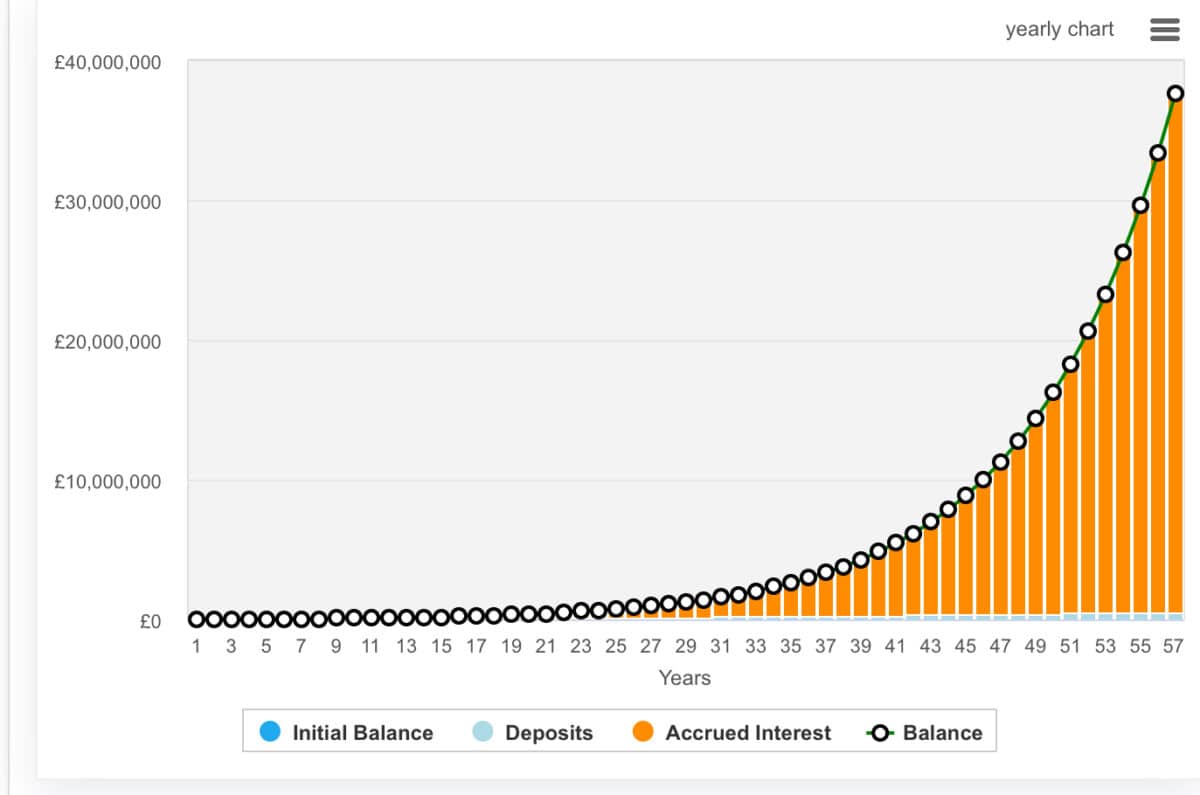
My one-year-old daughter has a Junior ISA and a SIPP (Self-Invested Personal Pension). These are accounts and tax wrappers that allow us to invest in stocks and shares and leverage the power of compounding for long-term growth. But what about this £37m figure? Well, the maths tells us that it’s possible.

In fact, this is a calculation I’ve run for my daughter’s SIPP:

  • A total of £320 in monthly contributions, consisting of £240 from my own funds and £80 from HRMC.
  • I’ve accounted for this figure increasing by 3% annually, assuming a rising threshold.
  • A 12% annualised growth rate, which is about the rate of growth I think I can achieve for her. Other investors may wish to take a slightly lower figure.
  • As of 2028, the minimum age to withdraw from a SIPP is 57 years. So, I’ve accounted for 57 years of investing and reinvesting.

Adding all this together, we come to the figure of £37m. As we can see from the graphic below, most of the growth is coming towards the end of the period. That’s compounding. Compounding really comes into its own when we invest for the very long run. I appreciate this requires a very long-term perspective. But I’m surprised more people don’t do this.

Created at thecalculatorsite.com

Please note that tax treatment depends on the individual circumstances of each client and may be subject to change in future. The content in this article is provided for information purposes only. It is not intended to be, neither does it constitute, any form of tax advice. Readers are responsible for carrying out their own due diligence and for obtaining professional advice before making any investment decisions.

This is how Warren Buffett made it

This isn’t a new strategy. In fact, Warren Buffett‘s wealth is a testament to the power of compounding and time. At age 30, his net worth was $1m, growing to $25m by 39. By 56, he became a billionaire, and by 66, his wealth surged to $17bn. Remarkably, 99% of his wealth was accumulated after age 50, with $84.2bn earned post-50 and $81.5bn after 65. Today, he’s worth $160bn.

Buffett’s strategy of reinvesting profits and focusing on long-term investments allowed his wealth to snowball over decades. For example, his $1bn investment in Coca-Cola in 1988 grew to over $20bn through reinvested dividends. This exponential growth underscores the importance of starting early and letting compounding work over time.

Investing for long-term growth

With Buffett in mind, one stock to consider for long-term investing is his Berkshire Hathaway (NYSE:BRK.B) conglomerate.

Berkshire Hathaway, under Warren Buffett’s leadership, has consistently demonstrated its ability to deliver long-term growth through disciplined investing and compounding. From 1965 to 2023, the company achieved a compound annual growth rate (CAGR) of 19.8%, significantly outperforming the S&P 500’s 10.2% over the same period.  

Moreover, its diversified portfolio, spanning insurance, utilities, and railroads, provides stability and resilience across economic cycles. This is why it was one of the first investments in my daughter’s SIPP.

In 2024, Berkshire reported more positive results, supported by strong insurance operations and a $334bn cash reserve. This financial strength allows Berkshire to capitalise on market opportunities, such as its recent investments in Japanese trading houses.

However, risks include its reliance on Buffett’s leadership, with succession concerns looming. Additionally, its massive size may limit agility in volatile markets, although its cash position may suggest the opposite.

Despite these challenges, Berkshire’s proven track record, wide economic moat, and conservative capital allocation make it an enticing proposition for long-term investors. Analysts maintain a Buy rating, with a 12-month price target of $511, reflecting confidence in its continued growth.

Here’s how much an investor needs in an ISA to generate a £27,500 second income

Millions of Britons invest for a second income. We invest, ideally through a Stocks and Shares ISA, over a long period of time with the aim of building a portfolio that’s large enough to sustainably generate an income. It doesn’t happen overnight, but in the end, it’s worth it.

So, why £27,500? Well, based on data from the Annual Survey for Hours and Earnings (ASHE) by the Office for National Statistics (ONS), the net average monthly earnings (this is after tax) are £2,297 (or £27,573) in the UK.

Here’s how it might be achieved by investing.

Playing the long game

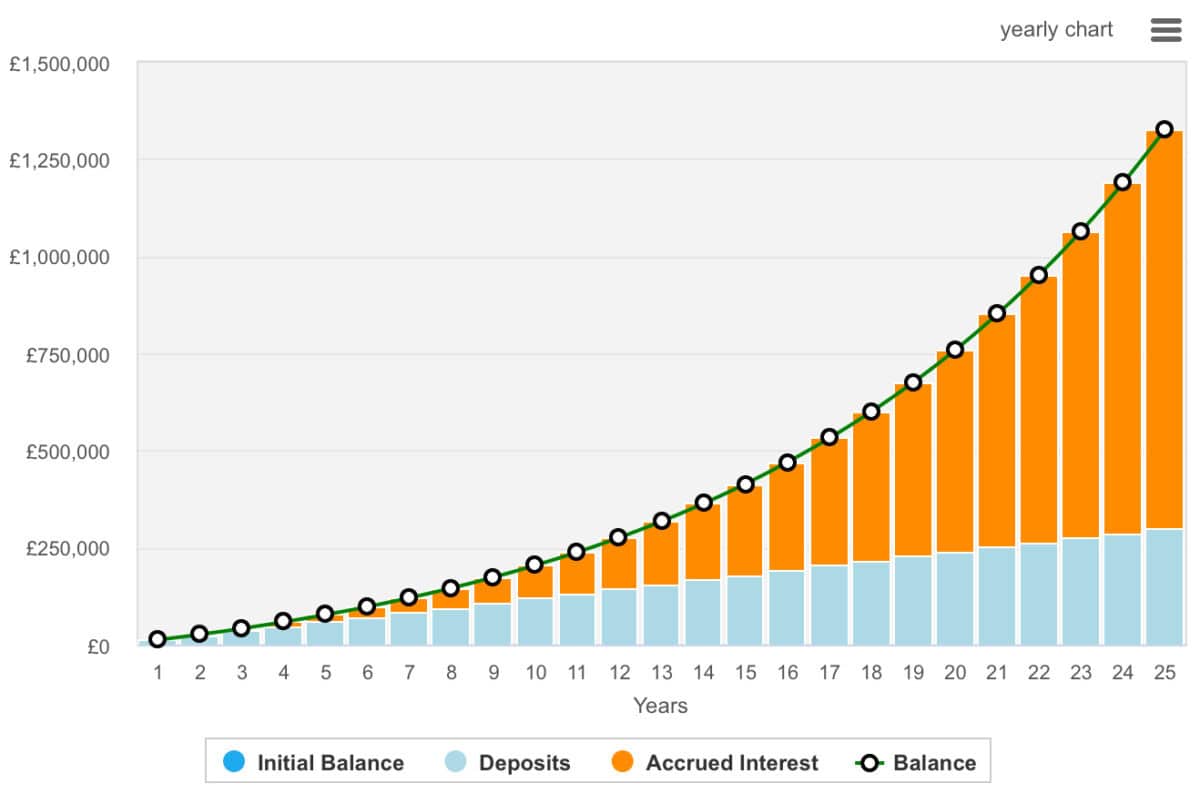
In order to generate £27,500 a year from a Stocks and Shares ISA, someone needs £550,000 invested and to achieve a 5% annualised dividend yield. Now, this might sound a like a hard ask, especially if we’re starting from nothing. But I assure you, it’s entirely feasible.

There are lots of hypothetical or mathematical ways of getting to £550,000. However, all of these equations require investors to make consistent contributions and to reinvest the proceeds of capital gains and dividends.

In this example, a £550,000 portfolio could be achieved by investing £1,000 per month while achieving an annualised return of 10% over 17.5 years. At this point, an investor could move to a dividend-focused portfolio, or bonds, in order to take a tax-free second income.

Source: thecalculatorsite.com

However, we should remember the power of compounding. If an investor continues with the strategy for a longer period of time, the rate of growth would expand.

Please note that tax treatment depends on the individual circumstances of each client and may be subject to change in future. The content in this article is provided for information purposes only. It is not intended to be, neither does it constitute, any form of tax advice. Readers are responsible for carrying out their own due diligence and for obtaining professional advice before making any investment decisions.

Investments to consider

Of course, there’s a caveat. Invest poorly and people will lose money. With this in mind, novice investors are typically advised to take a diversified approach. This often means investing in an index tracker — a fund that aims to replicate the performance of an index.

However, some actively managed funds or trusts could give investors a better chance of beating the market. One option to consider could be Berkshire Hathaway (NYSE:BRK.B). It’s neither a fund nor trust, but a conglomerate with businesses in railroads and insurance, and stock holdings in companies like Apple, American Express, and Visa. In short, it invests in the backbone of the American economy.

While we’re currently seeing turmoil in US markets amid Trumpian uncertainty and recession fears, Berkshire Hathaway stock hasn’t been sold off. That might sound strange for a company that’s so tightly linked to the US economy. But there’s a good reason. The business has been slowly selling positions in its holdings over the past 18 months. Amazingly, it now has $334bn in cash.

Investors have been questioning why the Warren Buffett-controlled company has been turning to cash. However, with a recession becoming more likely and due to a huge selloff in US stocks, Buffett may be well positioned to make strategic acquisitions or initiate new positions in stocks.

Of course, there’s a risk with Berkshire, as there is with every investment. The risk is that Berkshire’s portfolio is incredibly concentrated on the US economy. During Buffett’s career, the US economy has outperformed, but there’s no guarantee that will continue forever. Nonetheless, I’ve recently become a Berkshire shareholder myself.

Here’s the Tesco share price forecast for the next 12 months!

Food retailers are often popular safe havens in turbulent economic times like this. Yet Tesco‘s (LSE:TSCO) share price has slumped over the past week, first on fears of the potential impact of global trade wars, and more recently on signs that the industry’s ‘price wars’ are about to intensify.

At 324.4p per share, Tesco shares were last dealing 4.4% lower on Monday (17 March). They’re now at their cheapest level since last summer.

City analysts, however, think Britain’s biggest retailer will soar in value over the next 12 months. So should I consider opening a stake in the FTSE 100 company to capitalise on a price recovery?

A 26% rebound?

As with most stocks, the price outlook for Tesco shares takes in a broad range of highs and lows. On the most pessimistic side, one analyst believes the business will fall 2.6% from current levels over the next year, to 316p per share.

At the other end of the scale, one especially bullish broker thinks the supermarket will rise 35.7% from current levels to 440p.

On the whole, City analysts are pretty optimistic over the direction of Tesco’s share price between now and March 2026. The average price target among 15 brokers with ratings on the business is 407.2p.

That represents an 25.5% premium to today’s price.

Cheap on paper

Following Monday’s drop, Tesco shares are now down a sizeable 14.2% over the past week. This means that they now trade at a valuation far below the five-year average.

The retailer’s changed hands on a trailing price-to-earnings (P/E) ratio of 19 to 20 times on average since March 2020. Today that figure sits at a far more modest 12.3 times.

To fans of the FTSE stock, such a low valuation may leave scope for a sharp price rebound.

It’s not a view I share, however. I believe Tesco shares merit a lower valuation. I also think there’s a good chance the business will continue to drop.

Huge competition

As described at the top, Tesco’s share price dropped on signs that industry competition will jump a notch or two.

On Friday, Asda — the UK’s third-largest supermarket — pledged to use its “pretty significant war chest” to invest in prices to revive sales. Price wars are nothing new in the grocery sector, but it adds extra intensity to a market already squeezed by discount chains Aldi and Lidl.

Supermarkets can choose not to chase prices lower at the expense of revenues. Or they can join the fight and watch their margins be whittled away.

This is a major concern given how thin Tesco’s profit margins already are (4.5% between March and August last year, latest financials showed).

The tough economic climate makes the threat posed by discounting even sharper as shoppers chase value. With the aforementioned German operators committed to long-term expansion, too, the problem isn’t going away any time soon.

The verdict

For these reasons, I’m not tempted to buy Tesco shares for my portfolio, even as brokers tip a sharp price rebound.

On the plus side, the firm’s wholesale and banking divisions provide good opportunities for it to grow earnings. It also carries considerable brand power and customer loyalty through its Clubcard programme.

But on balance, I think the business carries too much risk, even at today’s beaten-down prices.

Just released: March’s higher-risk, high-reward stock recommendation [PREMIUM PICKS]

Premium content from Motley Fool Share Advisor UK

Investors following the Fire style are accepting higher risk with the goal of attaining higher returns over time. So this approach requires a higher risk tolerance, and the willingness to accept significant volatility in share prices. In October 2019, we also expanded the range of our Fire shares to also include potential recommendations from the US stock market, which tends to include a better variety of “growth” stocks.

We suggest that investors that primarily buy Fire shares should be particularly mindful of diversification in their portfolios. With sufficient diversification investors should still be able benefit from any upside, while limiting the damage to their portfolio when situations don’t turn out as we hoped.

We don’t consider Fire investing to be gambling or a get-rich-quick scheme, though. We aim to be long-term owners of these businesses and reap the rewards from their success. Our investing time horizon for these shares is measured in years and decades, not weeks and months.

“The stock has pulled back to the point where it offers a discounted valuation relative to its long-term growth opportunity. Competitive risks may be heightening, but the recent retreat from last year’s peak appears to be an overreaction.”

Ian Pierce, Share Advisor

March’s Fire recommendation:

Redacted

Want The Full Recommendation? Enter Your Email Address!

Financial News

Daily News on Investing, Personal Finance, Markets, and more!

Financial News

Policy(Required)