Stock market correction! 1 growth share down 53% to consider buying now

The tech-driven Nasdaq 100 index remains more than 10% down from a recent high, keeping it in correction territory. As a result, some tech shares now look more attractive for investors considering buying them than they did a few months ago.

Here’s one Nasdaq share that has lost half its value in a short space of time. I think it’s now worth a look for long-term growth investors.

The Trade Desk

The stock is The Trade Desk (NASDAQ: TTD). This is an advertising technology company that operates a programmatic platform allowing businesses to buy digital ads across various channels.

Programmatic advertising is the automated buying and selling of digital ads in real time. Basically, AI analyses data to place the right ad in front of the right audience at the right time.

This data-driven approach is meant to be much more efficient than the traditional spray-and-pray marketing methods (print newspaper ads, billboards, etc). 

Capitalising on this digital advertising trend, particularly in connected TV, The Trade Desk has grown rapidly. Revenue has jumped from $836m in 2020 to $2.44bn last year. The company is also profitable, achieving a 16% net profit margin in 2024.

However, the stock has been smashed recently — down 53% in just over one month.

Why has it crashed?

There are two main reasons for this collapse. The first relates to this comment from CEO Jeff Green about Q4: “For the first time in 33 quarters as a public company we fell short of our own expectations.”

Specifically, the company reported revenue of $741m rather than the $756m it previously said it would. This unexpected miss spooked investors.

Second, there’s suddenly fear that the US economy is heading for a recession due to uncertainty around President Trump’s tariff policies. If so, companies could pull back on advertising spend, negatively impacting The Trade Desk’s growth. This is a risk here.

Perspective

Taking a long-term view however, I think the stock at $56 now looks attractive. The quarterly miss was clearly concerning, but management says it was self-inflicted and measures have been taken to address the problems.

I think after beating its own guidance for 32 out of 33 quarters, management deserves the benefit of the doubt here.

Moreover, the company puts its total addressable market at $935bn, and still appears to have a strong competitive position. Traditional TV advertising is shifting to streaming platforms, many of which have introduced ad-supported subscription tiers to supplement their traditional paid services.

More advertising slots available on streaming platforms is great news for The Trade desk, which has partnerships with Disney, Netflix, and Roku. So connected TV remains a huge long-term growth market for the company.

Moreover, Q4 revenue of $741m still represented 22% year-on-year growth, which isn’t exactly pedestrian. For this year and next, analysts are currently pencilling in revenue growth of about 20%.

My Foolish takeaway

I own shares of The Trade Desk, so it hasn’t been nice to see them nosedive like this. However, I have no intention of selling and think this may well prove to be a blip.

The stock still isn’t cheap, trading on a forward price-to-earnings (P/E) ratio of 51. However, that is a significant discount to its historical average.

After its 53% crash, I think this growth stock is worth considering.

Here’s why the Tesco share price has dropped 18% in a month!

The Tesco (LSE: TSCO) share price dipped 4.4% yesterday (17 March), making it the FTSE 100′s biggest daily loser. This means the supermarket stock has now fallen around 18% in just one month!

Zooming further out though, the share price is still up 13% over one year and 32% over two. The dividend payouts have been ticking up nicely too.

Might this recent volatility be a dip-buying opportunity to consider for income investors? Let’s check out what’s been going on.

Price war fears

The sell-off in Tesco shares in recent days relates to developments at rival Asda. After years of falling sales and market share, the supermarket is ready to fight back with price cuts. And Asda’s management says it has “a pretty significant war chest” to do it with.

The old ‘Rollback’ advertising campaign recently made a comeback, with Chairman Allan Leighton saying Asda aims to be 5%-10% cheaper than its rivals. It’s ready and willing to take a hit on profits to claw back customers.

This has stoked fears of a price war among the major supermarkets. As a result, the Sainsbury’s and Marks and Spencer share prices are down 11.4% and 10.5%, respectively, in the past month.

The risk for Tesco shareholders is lower future profits if the firm also cuts prices to stay competitive. It already operates on thin margins (around 4.5%).

Meanwhile, costs are rising, with the company’s National Insurance bill set to rise by an extra £1bn over the course of the next four years.

Inflation also remains stubborn, adding to the uncertainty, and there’s UK economic stagnation. Cash-strapped shoppers might start tightening their belts again this year.

Valuation

Despite all this, the stock now looks decent value to me. For Tesco’s 2025/26 financial year, which started last month, the price-to-earnings (P/E) ratio is around 11.

That’s a tad more than Sainsbury’s (9.4) and Marks and Spencer (10.3), but Tesco is the undisputed leader with market share above 28%. In my eyes, the stock isn’t overpriced.

Moreover, the forward dividend yield is 4.5%, above the FTSE 100 average and well covered by earnings. Payouts aren’t guaranteed though, as some investors will remember from the accounting scandal that shredded both the share price and dividend around a decade ago.

However, Tesco has done well to rebuild trust, and its grocery market share recently hit a seven-year high. Speaking personally, I won’t be tempted to switch to Asda, as I’m kept loyal by the powerful Clubcard programme.

Worth a look

I’ve been impressed by Tesco’s market share gains and how it managed to navigate the cost-of-living crisis following Covid. Notably, newer entrants to the UK grocery scene like Amazon, Ocado and Hellofresh haven’t come close to luring away Tesco’s customers.

Last April, Tesco committed to buying back an additional £1bn worth of shares by next month. This means that it will have bought back £2.8bn worth of shares since the start of the programme in late 2021.

In the near term, there could be a bit of pressure on the share price as investors monitor the potential competitive risks. Over the long run though, I think the stock will bounce back and is worth considering for income growth investors.

Looking for cheap stocks to buy? Here’s one of my favourites to consider for ISA season

Stock markets have fallen sharply in recent weeks. But on the plus side, it’s given ISA investors stacks of great cheap shares to consider buying before next month’s investment deadline.

Here’s one I think looks like a brilliant bargain.

Pawn star

Pawnbrokers like H&T (LSE:HAT) can be classic lifeboats for investors during troubled times. Demand for their credit services typically booms when consumers struggle to source money elsewhere. People also often turn to the second-hand goods they sell when inflation rises and their disposable incomes shrink.

Finally, these companies tend to deal heavily in gold, an asset which often spikes in value during tough economic periods (just today the precious metal struck new record peaks of around $3,031 per ounce).

Profits boom

These qualities were on full display when H&T released its full-year trading statement on Tuesday (18 March). Pre-tax profit leapt 10% in 2024, to £29.1m, due to continued strength for its core pawnbroking operations.

H&T’s pledge book — its record of loans and pawned items — leapt 26% year on year to £127m. The business said it enjoyed “record levels of new customers borrowing from us for the first time“.

Boosted by the buoyant gold price, H&T also saw revenues and gross profits from retail jewellery and watch sales leap 27% and 34% respectively. These came out at £61.8m and £19.3m last year.

Trading landscape

H&T’s clearly making impressive progress in these favourable times. With 285 stores, it’s the UK’s largest pawnbroker and it continues to grow market share.

Can it continue to make waves though? Even if it continues to make strong strategic progress, sales and profits could be undone by an uptick in the domestic economy that dents loan and retail demand.

Yet for the moment, trading conditions look set to remain favourable over the short term at least. This is reflected by recent GDP downgrades by the Organisation for Economic Co-operation and Development in recent hours.

The body now expects UK growth of just 1.4% in 2025 and a slower 1.2% next year. I feel estimates could be set for further downgrades too, as business confidence dives and US trade tariffs loom.

Cheap as chips

Through steady expansion, H&T remains committed to capitalise on this opportunity, not to mention drive long-term growth. It added seven new stores to its estate in 2024 and embarked on a further 48 store refits.

A strong balance sheet gives the business scope to continue investing for growth while continuing to reward shareholders with a growing dividend too. In 2024, it hiked the total payout 6% year on year to 18p per share.

For the current financial year — which H&T has changed the end date of to September — the business trades on a forward price-to-earnings (P/E) ratio of 7.1 times. With a 5.1% dividend yield too, H&T’s share price offers excellent all-round value, in my view.

Despite the threat of rising costs and a possible change in economic conditions, I think H&T shares are worth serious consideration at current prices.

Down over 30% in 2025, is this FTSE 250 stock now an unmissable bargain?

After a pretty volatile few weeks for stock markets around the world, the FTSE 250 is now trading slightly down for the year to date. As disappointing as this is, it’s nothing compared to the shockingly poor performance of some of its members.

Today, I’m looking at one heavy faller in particular and asking whether it now presents as a potentially canny contrarian buy.

Big loser

The stock in question is online travel platform and ticket seller Trainline (LSE: TRN). Despite enjoying a significant jump in price towards the end of 2024, the mid-cap’s value has plunged over 30% in 2025, so far.

That might seem odd based on the company’s most recent trading statement. Back on 13 March, Trainline revealed an 11% year-on-year rise in revenue to £442m. Total net ticket sales also climbed 12% to £5.9bn.

The trouble was that both numbers were lower than some analysts were expecting and the market was in an unforgiving mood.

Is the sell-off overdone?

Now, such a significant tumble in the share price is bound to get value hunters sniffing around. And I can see why many might be attracted to Trainline.

Sure, the aforementioned figures failed to impress on the day. But they did fall within the company’s previously upgraded guidance range. So does the recent news flow warrant such a steep decline?

This is before we’ve even considered the strong possibility that digital tickets are only likely to become increasingly popular going forward. With 18 million customers already, the firm’s ongoing expansion into Europe could also help the shares recover in time.

There’s another thing I’ve noticed.

While there’s some interest in the stock from short sellers — those betting the share price has further to fall — this is fairly insignificant compared to other FTSE 250 stocks such as online grocer Ocado and pizza delivery firm Domino’s Pizza. Put another way, it doesn’t seem most traders have serious concerns about the earnings outlook.

But could this be set to change?

Increased competition

A lingering concern is what impact a state-backed ticketing platform (run by the proposed ‘Great British Railways’ governing body) will have on Trainline’s revenue in the UK. As things stand, nothing’s expected to be introduced until the end of 2026 at the earliest. However, investors might not be willing to wait around to find out.

The company’s aforementioned growth plans could also come a cropper if the travel industry encounters headwinds, even just as a result of reduced consumer spending. Another extreme event like a pandemic? I really hope not. It can’t be ruled out though.

At 14 times forecast FY26 earnings, the stock isn’t all that cheap relative to the Consumer Cyclicals sector or the wider UK market either. However, I do accept that it’s a lot lower than it once was.

One last thing to be aware of is the lack of dividends. Sure, this is to be expected from a growth-focused company. Even so, it does mean that investors won’t be compensated if the stock moves sideways from here, or continues falling.

All things considered, Trainline’s an interesting investment proposition. But I’m not sure it can be considered an unmissable bargain.

I’m happy to sit this one out.

If an investor put £10k into red-hot Vodafone shares 1 month ago here’s what they’d have now…

Is it time for me to eat humble pie over Vodafone (LSE: VOD) shares? I’ve been turning my nose up at them for years. Suddenly, they’re on fire.

The Vodafone share price is up 14.5% in the last month. If a smart investor had put £10,000 into the FTSE 100 telecoms giant at the start of that run, they’d have £11,450 today. That’s a bumper paper profit of £1,450. Over 12 months they’re up 7%.

Nice. But also a real shock, if you’re me. Possibly even embarrassing.

Is this now a brilliant FTSE 100 recovery play?

I turn my attention to Vodafone from time to time. Usually, I give it a quick swipe in passing, then move on after declaring I’d never, ever buy it. Which has been a pretty rational way to approach the stock, given that its share price has been on the slide since peaking at 548p on 10 March 2000, during the dot-com boom.

During that time it’s been one of the most generous dividend income stocks on the FTSE 100. Yet its eye-catching yield was mostly down to the falling share price, while the income was wiped out by the long-term capital loss.

So I felt I was right to be dismissive. And yet so wrong. On these pages on 13 February, I asked: “Why on earth are investors still buying Vodafone shares?”

I just couldn’t see it. I warned the yield wasn’t all it seemed. In May 2019, the board cut the dividend per share by 40% to 9 euro cents, then halved it to just 4.5 euro cent from this month. The first cut was down to €7.6bn loss on the sale of Vodafone India, and stiff competition in Italy and Spain. The second was part of a broader strategy to streamline operations, slash debt and invest in costly 5G infrastructure.

Neither cut surprised me. On both occasions, the yield was touching double digits, the highest on the FTSE 100.

Can it offer growth as well as income?

I knew everything about Vodafone, or so I thought. The one thing I didn’t know was what would happen next. Which is that the shares would suddenly rocket. No big news. No results. The wider market was turbulent. Yet Vodafone bounced. Why?

On 14 March, Liberty Global reportedly offered €2bn to buy Vodafone’s stake in its Dutch joint venture VodafoneZiggo. The cash would come in handy, given Vodafone’s €33bn net debt in 2024, but doesn’t explain the spike.

Another factor may be that the shares hit a 52-week low of 65p in February. Perhaps bargain seekers were taking advantage. Yet Vodafone shares regularly hit year lows. Where’s the novelty?

Investors won’t give up on Vodafone, which continues to attract robust trading volumes, with 131.8m shares traded on Monday (17 March) alone. They don’t look poor value either, trading at 11.9 times earnings. Plus the forecast yield’s 5.17% this year, despite this month’s cut rising to 5.24% in 2026.

I’m surprised by the jump, but it doesn’t change my view. CEO Margherita Della Valle still has a huge turnaround job on her hands. Vodafone shares may be red-hot today, but I remain cool and won’t consider them.

Rolls-Royce shares are up almost 500% in 2 years! Will the bubble burst?

It’s hard to believe but an investment of just £10,000 into Rolls-Royce (LSE:RR.) shares two years ago would be worth a massive £57,000 today!

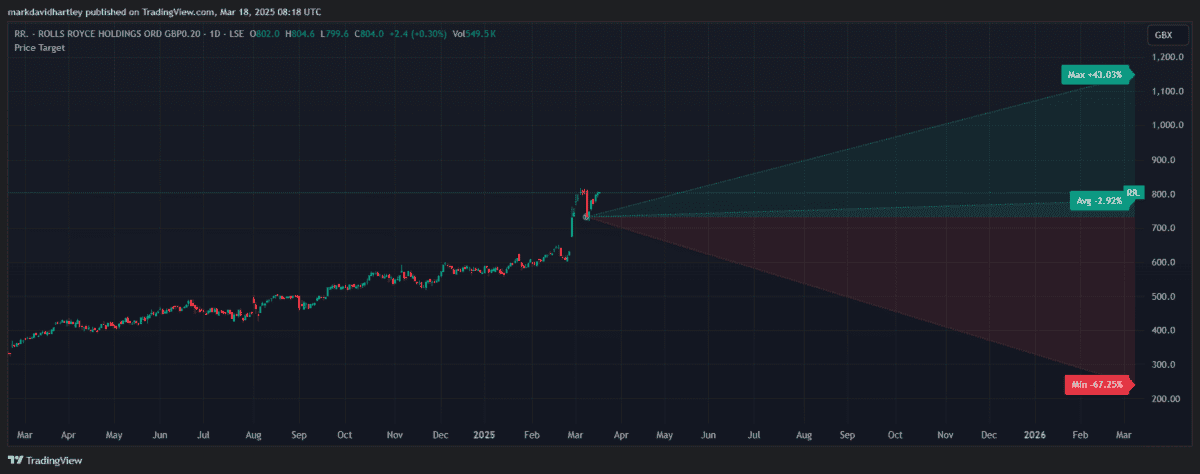
The parabolic growth has left some analysts confused, feeling the price action’s irrational. Subsequently, 12-month price forecasts vary widely. Some predict it’ll reach £11.50 by next March, others expect a fall to £2.40.

Creating on TradingView.com

The huge discrepancy averages out to an expectation of a 2.4% drop in the next 12 months. But if history’s anything to go by, that gives us very little direction. Many, including myself, have been expecting a correction for months — all have been proven wrong.

So is it a bubble, or can it keep going? Let’s weigh up its chances.

Powerful management

An over-arching theme in the news lately has been the exceptional leadership of CEO Tufan Erginbilgiç. Since taking up the reins in 2023, his unique management style has transformed the company. It went from a struggling stock down 80% to the FTSE 100‘s biggest success story.

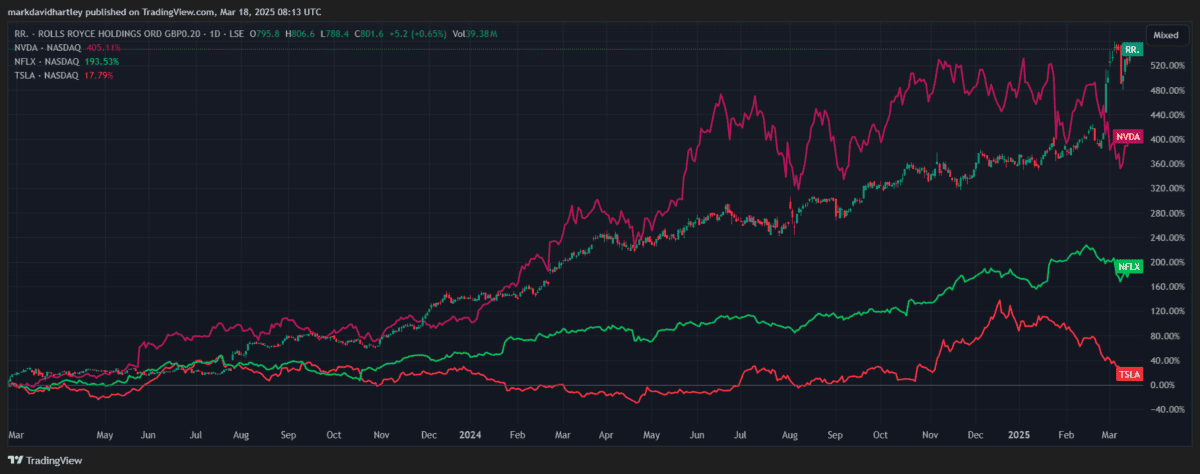
Over the past two years, it’s outperformed Nvidia, Tesla and Netflix.

Rolls-Royce shares 2 years
Created on TradingView.com

Naturally, it’s the top performer on the FTSE 100 by a long margin — the second is 3i Group, up by only 142%.

Erginbilgiç feels he has what it takes to keep this rally going, noting in a recent update: “We have made good progress but we are not done yet.”

While I admire his optimism, I can’t help but wonder just how far the stock can climb. After breaking the 800p mark earlier this month, it experienced a sharp pullback. Yet already it looks like a new all-time high is imminent.

Waning momentum

The operational changes and cost-cutting exercises put forward by Erginbilgiç have worked spectacularly. By streamlining operations and optimising processes, he boosted 2024 revenue by 16% and profit by 57%.

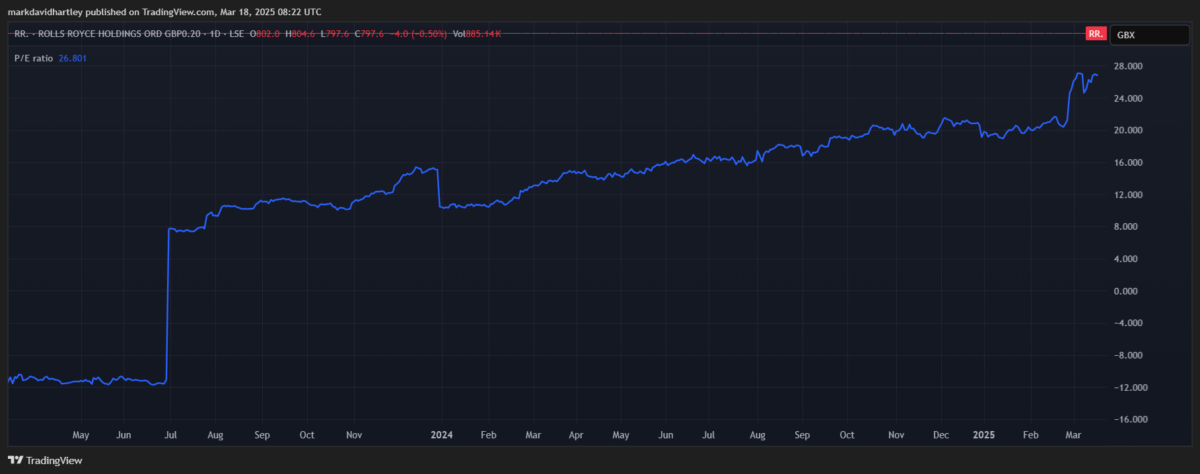
Debt has all but been wiped out and the company finally has enough spare cash to reintroduce dividends. But there is only so much streamlining and cost-cutting to be done. With the price-to-earnings (P/E) ratio now up to 26.8, the stock’s looking increasingly overvalued.

The price is also now 3.5 times revenue per share — a metric that should ideally remain below 1. Neither ratio suggests more room to grow.

Rolls Royce price to earnings ratio
Created on TradingView.com

A steady keel

If the economic fallout of the US trade war seeps into the UK, Rolls could take a hit. There’s already a risk of supply chain disruption and potential losses if Europe reduces defence spending.

What might keep it growing is small modular reactors (SMR). These tiny nuclear power stations have been tipped as the future of energy. There’s already significant interest in the UK and the boost for the company could be huge.

Right now, it feels unrealistic to expect the stock to keep climbing. But as recent history’s proven, there’s a good chance that is exactly what will happen.

As famous economist John Maynard Keynes would say: “Markets can remain irrational longer than you can remain solvent“.

Those who like taking chances may want to risk it — but it’s not a stock I’m considering at this point in the cycle.

3 actionable takeaways from Warren Buffett’s latest letter for stock market investors

Each year, legendary investor Warren Buffett releases a shareholder letter. In it, he talks through his thinking on the current state of the stock market, alongside reviewing the performance of his public company Berkshire Hathaway (NYSE:BRK). I finally got around to reading the letter that came out a few weeks back, with three key takeaways that I gleaned.

Record cash holdings

The annual accounts for the company in 2024 showed a whopping $334.2bn in cash and cash equivalents. This was up from $325.2bn in the third quarter. That’s a big number for any business.

Yet Buffett quickly addressed this in his letter, noting that “despite what some commentators currently view as an extraordinary cash position at Berkshire, the great majority of your money remains in equities.”

I think this is really telling, in that during volatile markets like right now, it makes sense to not panic and remain in stocks, but also to keep some cash on the side. As a result, if the market keeps falling, it provides me with the opportunity to use the dry powder to pick up cheap stocks.

Keep a long-term horizon

Berkshire stock is up 26% over the past year, during which time it recorded operating earnings of $47.4bn. Buffett is quick to emphasise this measure of profitability rather than the GAAP-mandated earnings that are also reported. The reason for this is that operating earnings excludes capital gains or losses on the stocks and bonds the business owns. Put another way, it cuts out the short-term unrealised profit or loss from fluctuations in share prices.

The reason for this is to prevent short-term panic or greed. Buffett said “our horizon for such commitments is almost always far longer than a single year. In many, our thinking involves decades.”

The takeaway here is that it’s easy to get elated or spooked over rapid movements in the stocks owned. Yet to shift that thinking towards decades (as hard as this can be) can provide a more objective viewpoint.

Acknowledging mistakes

During 2024, 53% of the 189 operating businesses under Berkshire reported a decline in earnings. There were various reasons for this, and it remains a risk to owning the stock going forward.

Yet Buffett explained that in fact, “the cardinal sin is delaying the correction of mistakes.” It doesn’t matter if mistakes happen, because they will. This might relate to weaker than expected financial performance, or managerial errors at Berkshire. But the real error comes in not correcting mistakes once discovered. This is what sets Buffett apart from others in business. He’s happy to make changes at Berkshire if something isn’t going right.

The same applies to my portfolio. Even though I believe in the long-term performance of stocks, occasionally I do make a mistake and buy something that’s likely going to drop in value even more. In these select cases, it can be better for me to cut my loss and pick a better stock to buy.

I asked ChatGPT how I should invest £1,000 in UK stocks. Here’s what it said!

Many veteran investors will remember how they used their first £1,000 to buy UK stocks. For my part, I enjoyed some success but also made plenty of mistakes.

Today, investors are increasingly turning to artificial intelligence (AI) tools for inspiration — something I couldn’t do back then! But, is ChatGPT any good at helping individuals make the right decisions in their wealth-building journeys?

Here’s what OpenAI’s chatbot would do with a cool grand to invest in UK shares.

A broadly solid framework

My virtual assistant started well, offering sound advice right off the bat. It preached about the benefits of diversification and the importance of establishing clear investing goals. ChatGPT also stressed that buying UK stocks carries risks, including capital losses.

Overall, it’s hard to fault my cyber companion’s run-through of Investing 101. If I was being picky, it would have been nice to see references to the merits of tax-free investment vehicles like Stocks and Shares ISAs or Self-Invested Personal Pensions (SIPPs). Regretfully, ChatGPT was silent on this subject.

Please note that tax treatment depends on the individual circumstances of each client and may be subject to change in future. The content in this article is provided for information purposes only. It is not intended to be, neither does it constitute, any form of tax advice. Readers are responsible for carrying out their own due diligence and for obtaining professional advice before making any investment decisions.

UK stock picks

But, how did the chatbot fare on specific stock market picks?

Well, it’s a fan of the FTSE 100. A string of large-cap shares formed the bulk of its selections. They included pharma titans AstraZeneca and GSK and dividend stocks Diageo, Unilever, and BT.

My robotic pal didn’t completely limit its ambitions to the Footsie. For instance, growth shares Ocado and Deliveroo also star in the collection. Curiously, so does Nvidia. ChatGPT acknowledged this isn’t a UK stock, but cited its popularity among British investors as justification for its inclusion.

All of these companies face risks and opportunities. I’m bullish on some of the digital genie’s choices, less so on others. In fairness, I think it’s a largely credible and balanced basket of UK shares for a £1,000 investment.

However, I have a bone to pick with ChatGPT’s final idea.

Buyer beware

The last UK stock to make the cut was online cosmetics and dietary supplements retailer THG (LSE:THG), which owns brands such as Myprotein, Cult Beauty, and LOOKFANTASTIC.

The THG share price chart makes for ugly viewing. A disastrous 95% collapse over five years means long-term shareholders are nursing deep wounds. So, what does ChatGPT see in the beaten-down e-commerce stock?

Well, it referenced the company’s “strong revenue growth since its inception“. That sounds great. The problem is, it isn’t true. Not only did THG experience an 8.7% revenue slump in FY23, but that trend continued in FY24 with a further 2.5% decline to £1.7bn. To make matters worse, it continues to be a loss-making business.

In addition, a forward price-to-earnings (P/E) ratio above 68 means the stock isn’t particularly cheap either. That said, there’s some cause for optimism. A strategic demerger of its technology services arm, Ingenuity, was completed this year. Some analysts hope the new streamlined outfit will be more cash-generative and less capital-intensive, but it’s not enough to convince me to buy the shares yet.

Although it produced some pearls of wisdom, the fact that ChatGPT spews out false information is a huge red flag. I’d always take what the AI bot says with a pinch of salt and conduct my own due diligence before investing any cash.

£10,000 invested in NIO stock 1 year ago is now worth…

NIO (NYSE:NIO) stock is quite frankly a disappointment. There was so much faith in this electric vehicle (EV) challenger with its innovative battery-swapping technology. However, it’s flopped.

The stock’s down 10% over a year. As such, a £10,000 investment then would be worth, well, around £8,950. That’s also because the stock’s denominated in dollars and the pound has strengthened slightly.

However, this is nothing compared to the losses an investor would have sustained if they’d invested during the pandemic tech bubble. The stock’s now down 91% from its highs.

Things are getting a little better

Despite the falling share price, some things are getting better at NIO. The firm reported a 62.2% year-on-year increase in February deliveries, reaching 13,192 vehicles. This growth includes 9,143 units from the NIO brand and 4,049 from its family-oriented ONVO brand, which has been steadily gaining traction since its launch. 

The company’s also expanded its infrastructure, opening another NIO House — seemingly a sort of club house — and deploying 36 Power Swap Stations and 24 charging stations globally in February. This brings the total to 3,201 Power Swap Stations and 4,395 charging stations worldwide. During the Chinese New Year, NIO’s power network facilitated over 1.7m battery swaps. Over 80% of highway energy replenishments were achieved through swaps.

Burning cash like few others

NIO’s burning cash. In 2023, its financials showed a net loss of CNY21.2bn/$2.9bn, a 46.6% increase from 2022. This reflects ongoing operational inefficiencies and high costs, particularly in R&D and administrative expenses, which totalled CNY13.4bn/$1.9bn and CNY9.3bn/$1.3bn, respectively.

This is exacerbated by a relatively low gross profit margin, around 10.8%, which is behind many of its peers. This comes despite NIO operating in the higher end of the market, where we typically see higher margins. The company also has a large infrastructure spend — building out battery-swapping stations — which is unique among its peer group.

For Q4 2024, NIO is expected to report a net loss of CNY5.1bn/$710m. This is a slight improvement compared to Q3 2024, where the net loss was CNY5.3bn/$738m. However, the company’s financial challenges persist, with cumulative losses continuing to weigh on its profitability outlook. NIO’s set to release its unaudited Q4 2024 and full-year financial results on 21 March. This will provide further insights into its performance and cash burn trends.

Looking further ahead, analysts project that NIO will not achieve profitability until 2027. And even for 2027, the stock’s trading at 37 times projected earnings for the year.

A new threat

BYD‘s currently the dominant player in the EV market, and it has just introduced new charging technology that can provide 400km of range with only five minutes of charging. This could signal a major shift in how customers view EVs, especially by alleviating concerns about range anxiety.

However, I’m also wondering how this will impact NIO’s battery swapping system, which can replace a battery in as little as three minutes. This was a significant advantage when charging times were much longer, but with new technologies like BYD’s, that edge may not last for much longer.

In short, this isn’t an investment for me.

Down 37% from May, does Glencore’s near-£3 share price look cheap to me?

Glencore’s (LSE: GLEN) share price is down 37% from its 20 May 12-month high of £5.05. Such a drop could indicate that the stock is fundamentally worth less than it was before. Or it may signal a bargain-basement buying opportunity for investors whose portfolios it suits.

To ascertain which is true here, I took a deep dive into the core business outlook and relative stock valuations.

The short-term view

The commodity giant’s preliminary 2024 results released on 19 February looked broadly poor to me.

Adjusted earnings before interest, taxes, depreciation, and amortisation fell 16% year on year to $14.358bn (£11.36bn). And last year’s $4.28bn net income attributable to equity holders swung into a $1.634bn loss.

Breaking these numbers down operationally, its Marketing division’s earnings before interest and taxes fell 8% to $3.2bn. And its Industrial division’s earnings fell 20% to $10.6bn.

The Marketing division is responsible for selling, buying, and transporting commodities. The Industrial division’s focus is mining, extracting and processing commodities.

The long-term view

The main reason for much of the decline in these key numbers was lower average thermal coal prices. This is coal used to generate heat rather than that used in steel making and chemicals.

The World Bank expects the price of energy coal to decline by around 12% this year and next.

That said, Glencore sees income from coal mining as the best way of creating value for shareholders. And it believes this revenue can be used to fund opportunities in its transition metals business, notably steel and copper.

The principal risk here for Glencore is that China’s uncertain economic recovery from its Covid years. However, last year its economy grew 5%, and the same target is in place this year. India – which together with China accounts for over two-thirds of global coal consumption – is forecast to see GDP growth this year of 6.5%.

Overall, analysts estimate Glencore’s earnings will increase by a stunning 43% a year to the end of 2027. And it is this growth that ultimately drives a firm’s share price (and dividend) higher.

Are the shares undervalued?

My starting point in evaluating Glencore’s share price is to compare its key valuations with its peers.

On the price-to-sales (P/S) ratio, Glencore is way behind its 2.2 peer group average – at just 0.2. These peers comprise Anglo American at 1.3, Rio Tinto at 1.9, BHP at 2.4, and Antofagasta at 3.3. So, it looks extremely undervalued on this measure.

The same is true of its 1.2 price-to-book (P/B) ratio compared to its competitors’ average of 2.2.

The second part of my assessment looks at where Glencore’s share price should be, based on cash flow forecasts for the firm.

Using other analysts’ figures and my own, the resulting discounted cash flow (DCF) analysis shows the shares are 47% undervalued at £3.20.

Therefore, their fair value is technically £6.04, although market forces may push them lower or higher than that.

I think strong earnings growth should push Glencore’s share price and dividend much higher. However, as I already have other commodities-sector holdings I will not buy it right now.

If I did not have these, I would take a holding in Glencore as soon as possible and believe it is worth investors considering.

Financial News

Daily News on Investing, Personal Finance, Markets, and more!

Financial News

Policy(Required)