3 top AIM stocks to consider buying before they recover

The Alternative Investment Market (AIM) doesn’t have the best reputation. As well as containing a lot of unprofitable businesses that are more likely to fold than expand, AIM stocks can be very volatile. However, I think there are at least a few diamonds in the rough to consider buying.

Tanking share price

Bioventix (LSE: BVXP) is arguably one example. Shares in the developer and commercial supplier of monoclonal antibodies have tumbled over 40% in the last 12 months. While some of this is likely the result of broader market concerns, a lot is surely down to the company overstating revenues by £327,000 as a result of a customer error. In reality, the firm’s actual revenues came in below market expectations.

This news has clearly shaken confidence and pushed the stock down to a multi-year low.

However, I reckon this could be a great time to think about loading up. As worrying as recent form has been, this is still a company that reeks of quality. Margins and returns on capital remain sky-high, thanks in part to having very few employees. While this has led to the shares trading at a premium to the wider market, the current price-to-earnings (P/E) ratio of 16 is already significantly lower than the firm’s five-year average of 27.

Half-year numbers — due on 24 March — will be worth reading. I reckon it will take only a small chink of light to get the shares moving in the right direction again.

Sales down

Another niche AIM-listed company to consider that’s been battered is laser-guided equipment manufacturer Somero Enterprises (LSE: SOM). Its share price has fallen nearly 20% in 2025 already.

So what’s gone wrong here? Well, investors have become increasingly concerned about the general economic outlook, particularly in the US (where the company’s based) which makes up three-quarters of sales. There’s a chance that things will go from bad to worse if interest rates stay higher for longer and force clients to delay purchasing the company’s cement-levelling tech.

Like Bioventix however, this is another small-cap that scores consistently well on quality metrics. Supported by a strong balance sheet and very experienced management, Somero is also a market leader in what it does. Although never guaranteed, the dividend yield currently stands at a meaty 6.8% too.

Monster dividend yield

A final AIM stock that’s worth pondering is base metals producer Central Asia Metals (LSE: CAML). Like the other two mentioned here, its shares have fallen in recent times, down 14% or so in the last 12 months.

Again, much of this appears to be the result of general geopolitical concerns. That said, demand for lead has been lower. The company drills for this (and zinc) at its mine in North Macedonia. It also has copper operations in Kazakhstan.

On a more positive note, the shares now yield an incredible 10% for FY25. Quite whether investors will see all of this cash is open to debate if costs continue to rise. However, the total dividend is expected to be covered by profit as things stand. The stock looks very cheap too, changing hands at a P/E of just seven for FY25.

Full-year numbers are due tomorrow (20 March). It will be interesting to see how current holders react.


The M&G share price soars 5% as it raises its dividend outlook despite £1.9bn in outflows

M&G’s (LSE: MNG) share price was up 5% in early morning trading (19 March) after the company released its 2024 full-year results. Now at around 230p, it’s already up 15% this year and only 6.8% below its all-time high set in June 2021.

This morning’s report included £837m in adjusted operating profit before tax up from £797m in 2023. Capital generation fell slightly to £933m from £996m in 2023 and the total dividend per share was raised to 20.1p from 19.7p.

However, the most notable revelation with today’s results was £1.9bn in net outflows from open business. This is a considerable drop from £1.7bn inflows in 2023. 

The outflows were attributed to stubbornly high interest rates that make alternative options such as cash and annuities more attractive.

Looking ahead

Along with today’s announcement, Group CEO Andrea Rossi highlighted the 5% rise in operating profit and noted his ongoing dedication to strengthening the foundations of the business.

We are today announcing two new targets for 2025-2027: to grow adjusted operating profit before tax on average by 5% or more per annum, and to generate £2.7 billion of operating capital,” he said.

M&G’s a well-known savings and investment firm that demerged from Prudential in 2019 but has operated in some form since 1931. Its products include insurance, pensions and wealth management services. Recently, it began re-exploring the capital-heavy Bulk Annuity market, an improving sector with lots of potential. 

However, it may need to weigh up how to allocate the necessary funds without threatening shareholder returns. Lately, it’s been struggling with securing and retaining capital from large institutions. If it continues to suffer further outflows, the resultant losses could threaten its core attraction: dividends.

A powerful income stock 

With a 9% yield, the big draw for M&G is its potential for passive income from dividends. It only has a short five-year history of paying dividends but its track record is good. It’s increased its final dividend from 11.92p per share to 20.10p per share in that short time — equating to compound annual growth of 11%.

But there’s one small issue. With basic earnings per share (EPS) at only 7p, its payout ratio’s an eye-watering 276.9%. That means it’s paying out almost three times more than it’s earning.

You don’t need an MBA to know that’s unsustainable.

Additional risks

Aside from the risk of dividend unsustainability, M&G has several other hurdles to overcome. The company’s revenue model relies heavily on assets under management (AUM), which fluctuates with financial markets. In light of the current global unrest, this is a considerable risk to consider.

Similarly, interest rate changes can affect its profitability from fixed-interest investments.

Today’s report highlighted these risks, along with geopolitical uncertainty and market volatility. The company aims to “navigate this uncertain environment by leveraging its balanced and integrated business model“.

All things considered, it seems to be on the right track to improve its market position and building on the existing business. As such, I think it’s a smart stock to consider for income-focused investors. The ability to turn a profit and raise dividends despite outflows suggests strong management and market resilience.

Down 12% in a week! Here’s what I’m doing about the Tesco share price

At 2.05pm on 14 March,  Asda issued a press release. Two-and-a-half hours later, the Tesco (LSE:TSCO) share price had fallen 8.7%. Such large movements are unusual for FTSE 100 shares — especially supermarket stocks — which tend to be more stable.

But the negative reaction of investors continued into the next trading day when the share price of Britain’s largest grocer fell another 4.4%.

Asda reported a 3.4% drop in like-for-like (LFL) sales in 2024. However, according to analysts, what appeared to spook investors most about the announcement was the suggestion of a ‘price war’.

The supermarket’s chief executive said the group “will add thousands more products to Rollback at regular intervals during the year as part of its strategic shift to move its entire product range to a new low ‘Asda Price’ by the end of 2026”.

Separately, he was widely quoted as saying: “This is an investment warning, not a profit warning.” It’s all part of the group’s strategy to reduce profitability in the short term with a view to gaining market share over the next couple of years.

Déjà vu

Personally, I don’t know what the fuss is all about. We’ve been here before. The grocery market is one of the most competitive industries around and I don’t think it’s an exaggeration to say that these kinds of stories appear on a monthly basis.

Here are just two examples (and there are more going back decades):

“Supermarket price war leads to fall in grocery inflation” (Sky News, April 2024)

Who will survive the brutal new supermarket price wars?” (London Evening Standard, January 2025)

One person’s trash is another’s treasure

But the pullback in Tesco’s share price presented an opportunity that I couldn’t refuse. I saw it as a chance to buy a quality stock at a knockdown price. So I did.

And my thought process was a very simple one.

Despite repeated attempts by its rivals — including Lidl and Aldi (the so-called ‘discounters) — to knock it from its number one spot, Tesco continues to dominate the market.

According to the latest figures from Kantar, it has a 28.3% share of the grocery market in Great Britain. And it’s ranged between 26.5%-28.5% over the past five years. This tells me that Tesco has successfully overcome previous threats. Together, J Sainsbury and Asda have 28.3%.

And unlike Asda, the supermarket giant had its “biggest ever” Christmas. Across the group, LFL sales were 3.8% higher. In Central Europe, they were up 4.7%.

But I acknowledge there are risks. Asda has deep pockets – it’s owned by a billionaire family and a private equity firm. And in a sector where margins are wafer thin, even a small loss of market share could have a big impact on earnings.

And to be honest, I suspect Tesco’s share price will remain in the doldrums for a while now. Investors will probably want to see some evidence that it’s business as usual before confidence is restored.

However, until then, I’ll take comfort that the stock’s currently (19 March) yielding 3.9%, a little above the FTSE 100 average. But I accept there are no guarantees when it comes to dividends.

Time will tell whether I’ve made the right decision. But for now at least, I’m pleased to include Tesco in my Stocks and Shares ISA.

How many cheap BT shares does an investor need to get £100 in monthly ISA income?

After years of struggle, BT (LSE: BT.A) shares are suddenly performing like a monster growth stock.

I’m pleased but also frustrated. I wrote about it again and again last year, summoning up the courage to buy what was a troubled recovery play with an uncertain future. Then bottled it.

Well, now the future’s arrived (or at least, the last 12 months of it), and it’s bright. The shares have rocketed 55% over the last year, and the momentum continues, with another 10% jump in the last month alone.

And that’s happening in a volatile market, when investors might be expected to shy away from riskier plays like BT Group. 

Can this FTSE 100 stock maintain its momentum?

The shares got a further lift on 18 March following reports that Indian billionaire Sunil Bharti Mittal has hinted he may increase his stake in the company. Mittal already holds 24.5% of BT.

BT has had a brilliant year as it continues its restructuring efforts under CEO Allison Kirkby, but it’s far from risk free. On 30 January, it reported a 3% drop in Q3 revenues to £5.18bn, due to weaker phone sales and struggles in its business unit.

Its Openreach broadband network has swallowed up billions and while the capital investment phase is largely complete, competition’s fierce as smaller, nimbler rivals eat into BT’s customer base.

Lest we forget, there’s the pension scheme, a hefty legacy obligation that still looms over the balance sheet. Net debt’s a hefty £20bn. BT’s market-cap is just £15.6bn.

The company’s plan to replace tens of thousands of staff with artificial intelligence (AI) may also be more ambitious than the board realises.

BT isn’t just about growth. Today, the stock offers a trailing dividend yield of 4.96%. Sadly, that’s lower than the 6-7% yield seen a year ago. That’s down to the share price rally. 

In 2024, BT paid a full-year dividend per share of 7.7p, with forecasts predicting a 6% rise to 8.16p this year.

The dividend yield’s dropped

So how many BT shares would an investor need to generate £100 a month in their Stocks and Shares ISA? Crunching the numbers, they’d need 13,937. At today’s price of 161.45p, that would require an outlay of roughly £22,500, more than the annual ISA allowance. That’s a significant sum for any private investor to put into a single company.

With the shares still trading at a modest price-to-earnings ratio of just 8.7, BT still looks tempting for investors willing to park smaller sums in the stock.

The 16 analysts covering BT have issued a median price target of 189.8p for the next year. If accurate, that’s an increase of almost 18% from today. Combined with the yield, this could offer investors a total return of 23%.

That’s enticing but forecasts are never guaranteed and BT may struggle to maintain its momentum, given wider economic struggles and competitive pressures.

BT Group’s worth considering for investors seeking both income and growth, but I’d advise caution. The stock’s come a long way in a short time, and given the challenges it will take a lot to sustain its recent pace. 

Up 55% and yielding 8.6%! Legal & General shares are suddenly running riot!

Legal & General (LSE: LGEN) shares are on fire. Or so it seems, judging by their impressive 55% jump over the last five years.

Since I hold the shares I’m thrilled to see that, but also suspicious. So I checked the last piece I penned on the FTSE 100 insurer and asset manager on 8 March and found the five-year return was a mere 2.8%. That’s quite a difference over 12 days!

Then I got it. Five years ago, global stock markets were in turmoil, amid the first pandemic lockdowns. That means today’s metrics start from a notably low base. Which applies to every stock, and makes me even more sceptical about past performance figures.

Especially since they don’t account for dividends, which in the case of Legal & General, are stellar. The trailing yield’s 8.6%.

Is this FTSE 100 stock as good as it looks?

The board’s commitment to rewarding shareholders was underlined on 12 March when full-year 2024 results included a £500m share buyback, beating the £450m forecast. This is part of a broader plan to return more than £5bn to shareholders over the next three years.

Legal & General reported a 6% rise in core operating profit to £1.62bn, amid record retail annuity sales. That dividend isn’t just high, it’s rising, with the full-year payout hiked 5% to 21.36p.

Despite all that, the share price grew just 0.5% over the last year, albeit with plenty of volatility in between.

One factor is that both inflation and interest rates have remained higher than hoped, slowing the economy and allowing investors to get a decent yield from cash and bonds, without chancing their capital on dividend stocks. Current stock market volatility will hit the value of Legal & General’s assets under management, and slow customer inflows too.

Legal & General’s strategic push into the US market doesn’t look quite as exciting in the short run, as Wall Street slips. Trade tariffs add another layer of uncertainty. Annuity sales may retreat when interest rates do.

Another notable Legal & General metric that has shifted dramatically is the price-to-earnings (P/E) ratio. A couple of years ago, the shares traded at around eight times earnings. Last year, the P/E climbed to 31 and has now rocketed to 85 times. 

This reflects the fact that in 2022, earnings per share (EPS) fell 62% to 19.4p, then another 43% to 7.35p in 2023 and 61% to just 2.89p in 2024. Swings in underlying asset valuations aren’t helping here.

I’m focusing on those dividends

The board has committed to driving up EPS, but I’ll keep a close eye on that. Happily, it’s generating plenty of cash, and the dividend looks secure despite that dizzyingly high yield. I struggle to get excited about share buybacks, but others might.

Looking ahead, 16 analysts have provided one-year share price forecasts have set a median target of 265.3p. If accurate, this represents a modest increase of around 6.75%. I don’t take forecast seriously, but that sounds about right to me. Combined with the yield, that would give me a total return of 15%. I’d be happy with that.

I get my next dividend on 8 June and, like all the others, it will reinvested to buy more shares in Legal & General, which will pay more dividends. I’ll treat any share price growth as a bonus.

Is £500,000 enough to generate a £43,000 annual second income?

The stock market can be a great place to turn excess savings into a second income. And the best bit about being an investor is that it doesn’t involve any work. 

According to the Pensions and Lifetime Savings Association, a single person needs just over £43,00 a year to retire comfortably. But is a mighty £500,000 savings pot enough to generate that kind of cash?

Dividends

Right now, the FTSE 100 as a whole has a dividend yield of 3.5%, so a £500,000 investment today would return £17,500. That’s not enough to generate a £43,000 second income – at least, not yet.

An investment in UK stocks, however, has potential to grow. Over the last 20 years or so, the FTSE 100 has generated an average annual return of 6.89%

That level of return isn’t guaranteed to continue in future. But if things continue as they have done, someone who has managed to assemble £500,000 in cash (admittedly, no easy task) could be generating £43,000 per year within 14 years.

To aim for better results, though, investors might look to be more selective about where they invest. And there are a couple of strategies for doing this.

Phoenix Group

One approach involves looking for stocks that have higher yields. With a 9% dividen yield, Phoenix Group (LSE:PHNX) is one that might be worth considering.

The firm operates in the pensions and insurance industry, which can be risky. With annuities, future returns are always uncertain due to interest rates and increasing life expectancy.

Investors should note, though, that Phoenix Group just reported 31% growth in operating profits. And it’s expecting to generate £5.1bn over the next three years. 

That’s almost the company’s entire market cap. So I think it’s certainly worth thinking about whether the current share price overestimates the risks inherent with the business. 

Bunzl

A very different type of stock is Bunzl (LSE:BNZL). The current dividend yield is just 2.5% but I’ve recently bought it for my own portfolio and I think it’s worth considering at today’s prices.

The firm is aiming to deploy £700m – around 7.2% of its current market value – per year into growth and shareholder returns. I’m expecting this to result in higher dividends over time.

A lot of Bunzl’s growth has come through buying other businesses, which means there’s always a danger of overpaying. That’s the biggest long-term risk with the stock, as I see it right now.

Management, however, thinks the current opportunity set is encouraging. And the chance to repurchase shares if targets don’t emerge means investors aren’t just relying on acquisitions.

A ‘comfortable’ retirement

It goes without saying that anyone with £500,000 should think carefully before deciding what to do with it. But in my theoretical scenario, the the 9% dividend yield from Phoenix shows that it’s strictly enough to earn a £43,000 second income. That’s worth thinking about for those of us building our portfolios over time.

There is, however, something else investors should think about. While £43,000 per year might be what someone needs for a comfortable retirement, a portfolio with only one stock in it might well make someone feel anything but relaxed.

I think being genuinely comfortable involves building a diversified portfolio of shares. And combining dividend shares with growth stocks looks like an attractive plan to me.

I asked ChatGPT to name 2 cheap FTSE 250 stocks with huge recovery potential. I got these!

FTSE 250 stocks have been caught up in recent stock market volatility, with the index falling 4% in the last month. While some may see this as a shame, I see it as a buying opportunity.

I always use my own intel before buying any stock, and would never rely on the artificial kind. But I’m also curious. So I asked ChatGPT to name two FTSE 250 stocks it felt had the ability to recover after struggling for some time.

Can Marshalls shares fight back?

Its first pick was UK-based landscaping and building products supplier Marshalls (LSE: MSHL). It’s certainly been struggling. The shares are down 18% over one year, and 60% over five.

My first thought is that it’s been struggling a bit too much for my liking. Yet it’s undeniably cheap, with a price-to-earnings (P/E) ratio of just 7.57.

ChatGPT said Marshalls has posted “significant growth during previous economic upturns, reaching a market value of £1.5bn”. The cost-of-living crisis has inevitably hit it hard.

2024 revenues fell 7.7% to £671m, which “reflects lower demand from housebuilders and continued subdued activity in private housing repairs, maintenance and improvements”, according to Marshalls.

The board did cut net debt by 23% to £134m, and expects adjusted 2024 pre-tax profit for 2024 to be within markets expectations of £52m to £53.7m. The trailing yield has climbed to 3.38%.

Do I agree with AI? I’m afraid not. Inflation and interest rates to remain stubbornly high, which will hit housing market activity. Marshall has to absorb employer’s national insurance and minimum wage hikes from April. I think there’s a recovery play here, just not yet.

Breedon shares are bouncing

ChatGPT’s second pick was in the same sector, so I assumed it would be subject to the same challenges. But instead, its shares have been on a tear.

Building materials company Breedon Group (LSE: BREE) doesn’t fit the criteria I gave ChatGPT at all. Its shares are up 27% over the last year, and a staggering 545% over five. It’s a momentum stock, rather than a recovery play. ChatGPT responses remain as erratic as ever.

Breedon has “grown significantly over 17 years through strategic acquisitions”, my unreliable robot buddy tells me. It’s defied the domestic UK gloom by expanding into the US, acquiring BMC Enterprises for $300m and Lionmark Construction for $238m.

Today, it’s the US stock market that’s struggling, although Breedon has avoided the recent sell-off. Its share price is up 7% in the last month. Yet the P/E is a relatively modest 13.88.

Breedon was boosted by full-year 2024 results, published on 5 March, which showed underlying EBITDA up 11% to £270m. However, volumes fell 6% due to the weaker UK market (made worse by our dodgy weather).

Another concern is that net debt increased by £235m to £405m, mostly due to the BMC acquisition. Breedon is a banger, but I wouldn’t call it a recovery stock. Also, I feel like I’ve missed out on the excitement.

ChatGPT’s picks are a curious brace. They’re at very different stages of their growth cycles. Both are worth considering, but I wouldn’t buy any stock based on AI’s web trawling. I’ll do my own research, and see what human beings think too.

A 6.4% yield but up 25% from last April, are Aviva shares worth me buying now?

Aviva (LSE: AV) shares are trading around their highest level since May 2018. This follows a 25% rise from their 16 April 12-month low of £4.49.

Such strength in its share price is a relatively new experience for me. I bought the stock a while back for its 7%+ dividend – the minimum requirement for my passive income-oriented holdings. During much of that time, Aviva struggled to break and hold above the key £5 level.

A stock’s yield is inversely related to its price, given the same annual dividend. So this lack of share price gains did not bother me, as I was still receiving a 7%+ annual yield.

Now that the share price has risen to such an extent, the yearly dividend return for new investors is down to 6.4%. That said, the overall return is now much higher, as it factors in the stock price jump.

The question for me now is whether to buy more shares around the current price. Essentially, this boils down to whether there is any value left in the stock. If there is not then it may fall in price, leaving me with a slightly higher yield but a much bigger share price loss.

How does the stock valuation look now?

Price and value are not the same thing. And being able to spot the difference between the two is where big consistent profits are found, in my experience.

Despite its price rise this year, Aviva still only trades at a price-to-earnings ratio of 23.4 This is cheap compared to the average 36.6 of its peer group of insurance and investment firms.

The same is true of its 1.8 price-to-book ratio against a 3.8 competitor group average. And it also looks cheap on its 0.7 price-to-sales ratio compared to its peer average of 1.8.

I ran a discounted cash flow analysis to ascertain where Aviva’s price should be, based on future cash flows.

This shows the stock is still 40% undervalued at its current £5.60 price. Therefore, the fair value for the shares is £9.33, although market forces might move them lower or higher than that.

A risk to realising fair value is the cut-throat competition in its business sector, which may squeeze its profit margins.

That said, analysts forecast Aviva’s earnings will increase 14.5% each year to the end of 2027. And it is this that drives a firm’s share price (and dividend) higher over time.

Moreover, its 2024 results released on 27 February showed operating profit rise 20% to £1.767bn. It now projects this to increase to £2bn by 2026.

What about the yield?

Analysts forecast Aviva’s dividends will increase to 37.6p in 2025, 40.3p in 2026, and 43p in 2027. These would generate respective yields of 6.7%, 7.2% — back above my minimum requirement — and 7.7%.

Consequently, I intend to buy another £5,000 of Aviva shares very shortly. On an average 6.4% yield using ‘dividend compounding’ to turbocharge my returns I would make £4,466 in dividends after 10 years, not £3,200. And after 30 years on the same basis, the dividends would be £28,931 rather than £9,600!

At that point, my new £5,000 Aviva shares could be worth £33,931. This could be paying me £2,172 a year in passive income.

At around £8 now, Rolls-Royce’s share price looks cheap to me anywhere under £12.42

Rolls-Royce’s (LSE: RR) share price has jumped 108% from its 19 March 12-month traded low of £3.88.

Such a rise might deter many investors who fear it could not possibly increase much more. Others may see the momentum as unstoppable and buy on a fear of missing out.

As a former senior investment bank trader and longtime private investor, I know neither view helps generate consistent profits over time.

My principal concern in growth stocks is whether there is any value left in them.

How much value remains in these shares?

The first part of my standard share price analysis involves comparing a stock’s key valuations with its competitors.

Rolls-Royce is undervalued at a price-to-earnings ratio of 26.7 against a competitor average of 31.3. The same is true of its 3.6 price-to-sales ratio compared to its peer group average of 3.8.

The second part of my analysis pinpoints where a stock’s price should be, based on future cash flow forecasts.

Using other analysts’ figures and my own, the resulting discounted cash flow analysis shows Rolls-Royce stock is 35% undervalued.

Therefore, the fair value of the stock is £12.42, although market forces might move it higher or lower than that.

Do the core business numbers support this valuation?

I see a key risk in the firm being that its production capacity might struggle to keep up with its fast growth. This may create supply shortfalls at some point.

That said, its full-year 2024 results released on 27 February looked excellent to me. Revenue jumped 16% year on year to £17.848bn, while operating profit leapt 55% to £2.464bn.

Operating margin increased 34% to 13.8% and free cash flow soared 89% to £2.425bn. These helped power a 48% rise in earnings per share to 20.29p.

The firm also upgraded its short- and medium-term guidance. For 2025 it expects £2.7bn-£2.9bn underlying operating profit and £2.7bn-£2.9bn free cash flow. On top of this, it has begun a share buyback — which tend to support stock prices – of £1bn.

By 2028 it aims for £3.6bn-£3.9bn underlying operating profit and £4.2bn-£4.5bn free cash flow.

How does the project pipeline look?

The firm announced a slew of major new projects in recent months. On 24 January, it announced the largest ever deal — £9bn+ — signed by the UK’s Ministry of Defence (MoD). This will cover multiple elements connected to the nuclear reactors powering the Royal Navy’s submarines.

On 18 September, Rolls-Royce SMR was named the preferred supplier for the Czech Republic’s small modular reactors project. Industry forecasts are for the global SMR market to reach $72.4bn (£55.8bn) by 2033 and $295bn by 2043.

And in its 2024 results announcement, Rolls-Royce revealed it has successfully tested its UltraFan demonstrator. This is part of its new engine design programme aimed at the new generation of narrow and widebody aircraft.

Will I buy the stock?

The only reason I am not buying the shares now is I already own other stocks in the same sector. Adding another would unbalance the risk-reward profile of my broad investment portfolio.

If I did not have these, I would buy Rolls-Royce stock as soon as possible and believe it is worth others considering too. I firmly believe the company will see robust growth ahead, which could drive its share price and dividend much higher.

3 steps to safeguard a Stocks and Shares ISA in 2025

As the new tax year rapidly approaches, many UK investors will be considering how to allocate assets in their Stocks and Shares ISA.Taking into consideration the multi-faceting geopolitical storm that’s brewing, a delicate approach may be the best option.

After a good start to the year, the US trade war has thrown a spanner in the works. This adds to an already fraught economy hit by conflicts in Ukraine and the Middle East. The result is widespread fear and uncertainty, leading to volatility in markets. Such an environment requires a more cautious approach.

Please note that tax treatment depends on the individual circumstances of each client and may be subject to change in future. The content in this article is provided for information purposes only. It is not intended to be, neither does it constitute, any form of tax advice. Readers are responsible for carrying out their own due diligence and for obtaining professional advice before making any investment decisions.

ISA allocation

Last year, I focused heavily on dividend returns. Prices were low and forecasts looked good, offering the perfect environment to capitalise on discounted shares with high yields. Now, the market has shifted considerably. The Footsie it near all-time highs, the S&P 500 is in freefall and tariff uncertainty threatens even more chaos.

When things get wobbly, I head for the bunkers — that is, the calm, warm embrace of defensive stocks. While I always hold some defensive stocks in my portfolio, I plan to add more weight to them in the coming months.

My top UK defensive stocks for 2025

Defensive stocks (not to be confused with defence stocks) are those which protect a portfolio from unwanted volatility. Recently, many portfolio’s focused on US tech stocks took a hit. Last week, the five worst-performing stocks in my portfolio were US tech stocks. 

Luckily, my defensive UK shares helped keep things things afloat. Here are five that I think risk-averse investors should consider: Unilever, Tesco, AstraZeneca, British American Tobacco and GSK (LSE: GSK).

These blue-chip stocks all share similar characteristics. They have large market-caps, are well-recognised businesses with a dominant market position and enjoy consistent demand.

The caveat is that they seldom experience spectacular growth and are often considered ‘boring’. They’re unlikely to make anyone rich overnight — but equally, they’re unlikely to leave anyone broke.

They are simple, solid, and reliable.

One example

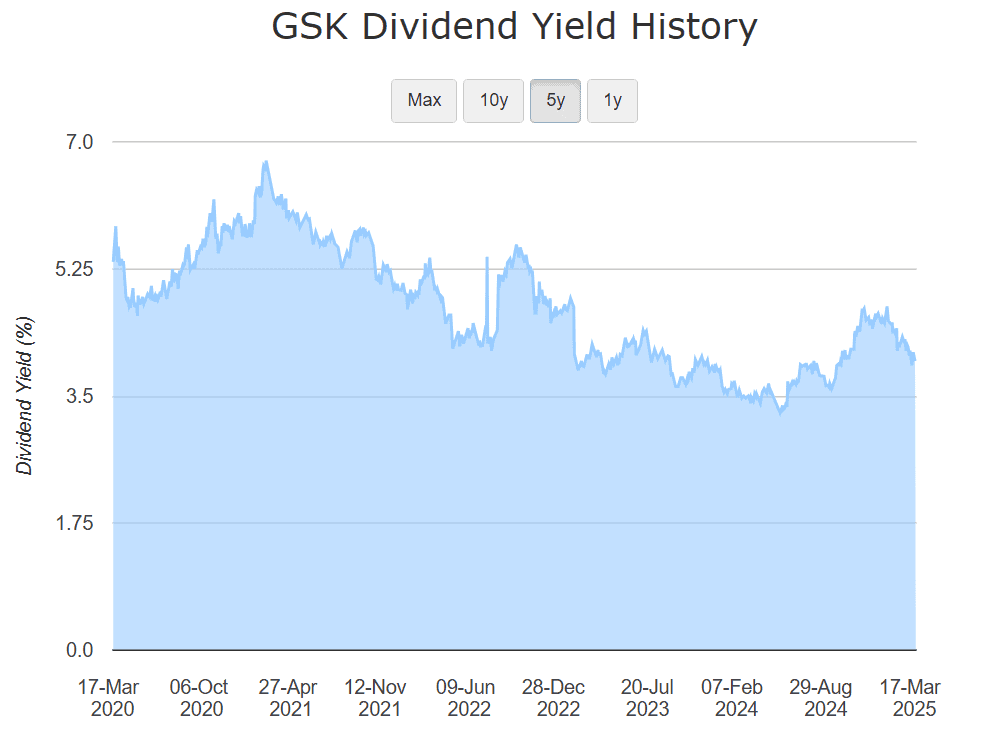
Let’s take the popular multinational pharmaceutical company GSK as an example. It tends to focus on dividends more than growth, so the price has seen little action in five year (up 4.6%).

However, it pays a reliable and consistent dividend with a yield between 4% to 6%. 

In 2022, the post-Covid market decline combined with the Zantac lawsuit wiped 27% off the share price in a matter of months. Consequently, it was forced to reduce dividends by 27.8%. Prior to that, they had held steady at 80p per share for eight years.

Screenshot from dividenddata.co.uk

In the same year, it demerged its Consumer Healthcare business to form the company Haleon. Now, GSK focuses purely on pharmaceuticals and biotechnology.

During periods of high inflation, cash-strapped consumers often opt for cheaper alternatives. Offloading its consumables division may help it avoid losses in the event that inflation rises again.

But now another risk looms. The Trump administration’s appointment of vaccine-skeptic Robert F Kennedy Jr could impact GSK’s bottom line. It’s heavily-focused on vaccine development and the US is one of its largest markets.

Still, through it all, it’s maintained a steady price and decent dividend. That type of resilience makes for a good defensive stock to consider.

Financial News

Daily News on Investing, Personal Finance, Markets, and more!

Financial News

Policy(Required)