Is this the FTSE 100’s best dividend share?

Like many investors, I appreciate a good blue-chip income share tucked away in my portfolio, quietly generating passive income streams year after year. One FTSE 100 share I own has a stellar track record when it comes to dividends.

Could it be the best FTSE 100 share for an income investor to consider?

High yield but a mixed share price track record

The share in question is British American Tobacco (LSE: BATS). Its dividend yield stands at 7.5%.

That is some distance from being the highest yield in the FTSE 100 index. Phoenix Group (LSE: PHNX) yields 9.2% and this week announced another increase in its annual dividend per share.

Still, British American’s yield puts it among the higher-yielding shares in the index even if it is not top of the board. At a 7.5% yield, £20k invested today would hopefully earn an investor £1,500 in passive income annually.

Outstanding track record of dividend growth

In reality, the passive income could be even higher than £1,500 each year.

British American has grown its dividend per share annually for decades. It has committed to keep doing so. As dividends are key to the investment case, I think the board sees this progressive dividend policy as being of primary importance.

A few other FTSE 100 members, such as Diageo and Spirax, have longer streaks of annual dividend growth. But, again, British American is among the index’s best-performing shares on this metric. Phoenix, incidentally, has grown its dividend over each of the last few years, but cut it less than a decade ago.

Mixed long-term income outlook

No dividend is ever guaranteed to last.

While British American’s track record of regular annual raises is impressive, it is not necessarily indicative of what to expect in future.

The business is highly cash generative. British American owns premium brands like Lucky Strike that give it pricing power. The addictive nature of nicotine also means that British American has pricing power. It has other strengths too, including a global distribution network.

But there is a big caveat here – cigarette demand is declining in many markets. While non-cigarette products like vapes may help British American offset that to some extent, the long-term volume outlook remains unclear – as does the question of whether profit margins can come anything close to, let alone match, those of cigarettes.

An income share to consider, with risks

That matters because it could impact cash flows at the FTSE 100 firm.

If that happens, it could mean the dividend comes under review. Rival Imperial Brands slashed its payout per share in 2020. British American could yet be forced to do the same at some point in future.

So, while its yield and record of dividend growth put it in the top tier of FTSE 100 dividend shares as far as I am concerned, there are significant risks here.

Based on that, I do not think that British American is definitely the best dividend share in the FTSE 100.

One of the best? Maybe.

I do see significant attractions. I continue to see this as a share income-focussed investors should consider.


Down 27% in 3 days! Should I buy the dip in this FTSE 250 defence stock?

With European military spending set to soar in the years ahead, defence stocks have been on fire. BAE Systems, from the blue-chip FTSE 100 index, is up 41% in three months, while the FTSE 250‘s Babcock International has rocketed 50% over that time.

Unfortunately, shares of QinetiQ Group (LSE: QQ) haven’t kept pace. In fact, they’ve crashed 27% in just the past three days!

Now, I’m bullish on European defence stocks. It’s hard not to be when Germany has just voted to massively increase its military budget in response to wavering US commitment to European security.

So, is this an opportunity to add QinetiQ shares to my portfolio? Let’s take a look.

What’s happened here?

The chief culprit for the stock’s recent slump was a trading update released on 17 March. In this, the company warned that “tough market” conditions would impact its financials for the full year ending 31 March.

Specifically, there have been delays to a number of contracts being awarded in the US and UK. Also, it said “recent geopolitical uncertainty has impacted our usual fourth quarter weighting to higher margin product sales from the US”. 

As a result, QinetiQ expects full-year organic revenue growth of about 2%, roughly £1.95bn in total revenue. That was lower than the £2.04bn analysts had pencilled in.

Meanwhile, the firm is restructuring its US business to support future growth, which will result in a £140m impairment charge. Additionally, there were £35m-£40m in one-off, non-cash charges, mainly in legacy US operations.

For next year, the company is guiding for revenue growth of about 3%-5%, with an underlying profit margin of 11%-12%. That growth figure is also lower than previously expected.

Some good bits

On a more positive note, its UK Defence Sector business (50% of group revenue) continues to perform well due to long-term contracts. And it announced a share buyback programme of up to £200m over two years, starting in May.

The stock now looks quite cheap. It’s trading at about 13 times expected earnings for 2025, while offering a 2.3% dividend yield. That’s a significant discount to other defence stocks.

Plus, the firm still sees solid long-term growth opportunities ahead: “Within the evolving threat environment, our customers’ spending priorities, which are well matched to our capabilities, have been boosted by commitments to increased spending in the UK and Europe.”

Looking ahead to the next few years, there is every chance that the firm secures a flurry of defence contracts in the UK and Europe. That could spark a turnaround in investor sentiment.

Should I buy QinetiQ stock?

QinetiQ generates most of its revenue from the UK. The government plans to increase defence spending to 2.5% of GDP by April 2027, up from the current 2.3%. It might even go higher, but money is tight and there will have to be cuts elsewhere. 

Consequently, the firm’s growth outlook looks somewhat murky, while the ongoing efficiency drive is creating a challenging backdrop across the pond. I fear that keeping, let alone winning, US defence contracts could get more challenging in the years ahead.

Weighing things up, I’m not going to buy the dip in this FTSE 250 stock. I’m happy to stick with BAE Systems and Rolls-Royce for exposure to defence in my ISA portfolio.

Is ITV a screaming FTSE 250 bargain hiding in plain sight?

Lately, investors in ITV (LSE: ITV) have had more reason for cheer than in a while. The FTSE 250 broadcaster issued a decent set of annual results this month, helping push the ITV share price up.

Indeed, it now stands 9% above where it began the year and over five years has increased by more than a quarter.

Still, the long-term picture has been less attractive, to put it mildly.

Over the past decade or so, ITV has lost more than two-thirds of its value.

That means that it now trades on a price-to-earnings ratio of under eight.

The share also offers a dividend yield north of 6%.

In the results, ITV’s management retained its commitment to an annual dividend of at least 5p per share and also said there are prospects for growth in the payout over the medium term. Dividends, though, are never guaranteed to last at any company.

That makes the broadcaster sound like a potential bargain for an investor to consider for their portfolio. Is it?

ITV operates in a rapidly evolving marketplace

Only time will tell.

The past decade’s share price performance has, however, been instructive when it comes to understanding why some investors continue to have doubts about the long-term investment case here.

A decade or two back, legacy television was a far bigger force than today – with few broadcasters on the scale of ITV. Advertising spending was more heavily skewed towards television than it is now. Social media is a much more important part of most advertisers’ marketing spending than it used to be.

That sounds like a license to print money – and for a long time it was.

In fairness, the FTSE 250 firm remains solidly profitable. But what has haunted its investment case and share price is the rise of digital media.

That could be bad for ITV in two key ways.

It means traditional television may attract less ad money than it used to. It also leads to a more fragmented viewing landscape, where instead of a handful of rivals, any part-time content creator with a phone can effectively steal viewers away from old-school broadcasters like ITV.

All is not lost

ITV, with a strong brand, decades of experience, and lots of know how, has not been standing still in the face of such threats.

It has been focused on ramping up digital output, while milking the cash cow of legacy television. Digital viewing on its platform grew 12% last year and digital ad revenue was up by 15%.

It also has a sizeable production business, meaning that the growing number of content providers actually works to its commercial advantage. It can rent them studio space and help produce content.

If it can keep growing the digital business while generating big ad revenues from its legacy business, I think the ITV share price could potentially be a bargain.

But its long-term decline points to ongoing uncertainty about how viable such a strategy is.

What happens, for example, when legacy television viewing gets to a point where its economics become far less favourable than now? The FTSE 250 share may be a bargain in the end, but I think it reflects risks imposed by a fast-changing media landscape. Not all investors will be comfortable with such risks.

Is this FTSE 100 AI growth stock beginning to run out of steam?

Measured over any time frame, the Relx (LSE: REL) share price has lived up to its reputation for being a growth stock. Driving the momentum over the past couple of years has been its growing AI offerings. But I am starting to see some potential chinks in the armour that could derail its rise.

Diversified business model

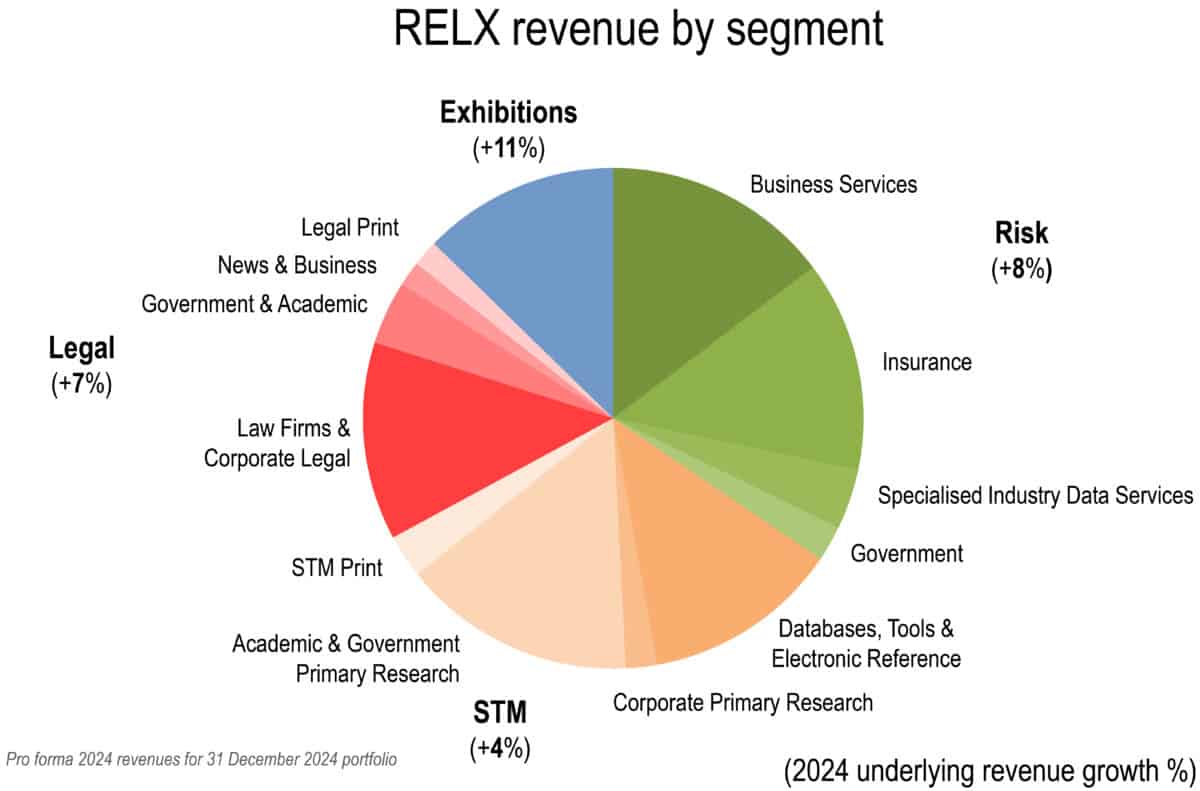
Relx is an information and data powerhouse. Virtually every knowledge sector of the economy relies on its analytics and decision-making tools. This includes government, law, academia, science, and insurance. The figure below highlights the sheer diversity of its revenue streams is highlighted.

Source: Relx presentation

One area that has seen tremendous growth is its legal offering. Lexis+AI is helping lawyers automate their workflows.

The business has a distinct competitive advantage here. Its databases host over 161bn legal documents and its AI model is back checked against the legal citation service, Shephard’s. This ensures that its content remains accurate and up to date, a given for any lawyer.

Scientific journals

Another area that’s seen explosive growth is in the Scientific, Technical and Medical (STM) division. Primary academic research and publications has seen incredible volume growth. In FY24, the number of articles submitted across the portfolio grew by over 20%, and the number of articles published was up 15%.

The sheer volume of published article growth since Covid has not gone unnoticed in the academic community, though. Many are beginning to question whether volume is more important than quality. The issue of scientific or research fraud has shot up the agenda.

Scientific fraud

Last December nearly every member of the editorial board of the pre-eminent Journal of Human Evolution resigned from Elseiver, the company’s publishing arm. They cited a dramatic downturn in quality as the main reason.

Something is clearly afoot here. In a recent open letter, a group of scientists accused Springer Nature of failing to “protect…scientific literature from fraudulent and low quality” research.

So what?, you might say. Why does this matter to a company with a market cap of £70bn, one of the largest in the FTSE 100?

Evolving subscription model

The traditional payment model for academic output involves institutions (such as universities) paying a flat fee for a bundle of journals. However, this model is being rapidly supplanted by open access models.

The description ‘open access’ is something of a misnomer. What the industry calls ‘processing charges’ have become standard. A quick look at Open Access Oxford quotes anywhere as much as £10,000 per paper. Although Relx does not report on such fees, estimates are that they were $583m in 2023.

My fear is that the entire business model propping up a huge slice of the company’s revenues is simply not sustainable. A model based purely on article volume will inevitably lead to a dilution of quality.

All this matters to a company with some very rich valuation metrics. Its trailing price-to-earnings ratio currently stands at 37; price-to-book is 20. The stock is priced for perfection. Its share price could be clobbered if growth slows.

For me, I see little margin of safety here, and therefore I am staying well clear for now.

Up 12% today, here’s a great FTSE 250 growth share to consider!

So far, 2025 has proved a miserable year for tech stocks. But Softcat (LSE:SCT) sprung back to life today (Wednesday) after the FTSE 250 share upgraded profit expectations for the full year.

At £18.18 per share, Softcat’s share price is up 12% in midweek trading, and back within striking distance of last June’s record peaks of £18.55.

Like other tech shares, the information technology (IT) specialist remains at the mercy of broader economic conditions and potentially crushing global trade tariffs.

But given its strong momentum, should investors consider buying Softcat shares today?

Record profits

Softcat — an expert in multiple IT segments including networking, cyber security, and cloud computing — saw gross invoiced income jump 19.3% in the six months to December, to £1.51bn. Revenue, meanwhile, rose 16.8% over the period, to £545.6m.

The company says these increases reflected “broad-based success across technology areas and customers“. Its customer base rose 1.4% over the period to around 10,300.

Profits also hit new record half-year peaks, with gross profit and operating profit up 12.1% and 10.4% respectively, at £220.2m and £73.7m.

This estimate-topping performance means Softcat today upgraded its full-year forecasts.

For the 12 months to June, it says “we continue to expect to deliver another year of double-digit gross profit growth… with operating profit growth now expected to be low double-digit, up from high single-digit previously“.

Room for growth

Softcat’s momentum remains impressive despite the challenging economic backcloth. Its success has been helped by ongoing recruitment — and especially in its technical, specialist, and sales support departments — to nurture relationships with existing customers.

Group head count grew 6% in the first half, and Softcat is tipping full-year growth of 6% to 8%.

Encouragingly for investors, Softcat has said it is targeting “further targeted strategic investment to underpin future growth“. A strong balance sheet gives the company plenty of scope to flex its muscles and grow staff numbers.

Cash conversion rose to 110.9% in the first half from 101.1% a year earlier. This in turn meant cash and cash equivalents increased by £28.5m over the period, to £141m.

Softcat’s decision to raise the interim dividend 4.7%, to 8.9p per share, further underlines its strong financial foundations.

Expensive but exceptional

Softcat, then, clearly has the wind in its sails. But it’s important to consider that its share price’s high valuation has increased further following Wednesday’s jump.

City analysts think group earnings will rise 8% in financial 2025, meaning the firm trades on a forward price-to-earnings (P/E) ratio of 28.3 times. That’s more than double the FTSE 250 average, and could leave Softcat shares vulnerable to a correction if market jitters resurface.

Yet despite this, I believe the business is worth serious consideration from long-term investors. Given its strong record of success across the public and private sectors, and expectations of further growth in the digital economy, it’s still one of London’s most attractive growth shares in my book.

Prediction: in 1 year, the easyJet share price could be as high as…

Over the past year, the easyJet (LSE:EZJ) share price has dropped by 8%. This contrasts with some other airline stocks, like International Airline Group shares, which are up a whopping 82% over the same time period. Yet investors can have reasons for optimism when it comes to easyJet. I predict gains over the next year. Here’s why.

How we got here

Let’s first run through sopme of the reasons for the underperformance in the last year. Even though the fiscal 2024 results showed an improvement in profit from 2023, it missed analyst expectations. Part of this was due to a £40m hit from the Middle East conflict, as well as dealing with elevated oil prices and the impact this has on jet fuel.

easyJet is more heavily reliant on the UK consumer than some more international airlines. As a result, weak consumer confidence in the past year, partly due to continued high interest rates, has meant demand hasn’t been as strong as some expected.

These points remain as risks going forward, but I believe investors can find plenty of positives as well.

Reasons for optimism

The business posted an impressive 24% increase in headline profit before tax per seat versus last year. This means that the firm is becoming more efficient and bodes well for the future.

Operations are continuing to diversify, with the Holidays division posting a profit before tax of £190m, a jump of 56%! This should please investors as it helps to balance the risk of poor performance from the aviation side. It also opens up a larger potential target market, allowing future revenue to be higher than previously anticipated.

Finally, the current share price looks cheap. The price-to-earnings (P/E) ratio is 7.9, below the benchmark of 10 that I use when trying to pin a fair value on a company.

My prediction

The current P/E ratio for the FTSE 100 is 16.7. Over the next year, I think it would be reasonable for the easyJet P/E ratio to move closer to the index average. This is based on the expectation of good quarterly updates and strong earnings.

easyJet shares trade at 487p, with headline earnings per share of 61.3p. If the earnings per share figure stayed the same but the ratio increased to 16.7, it would put the share price at 1,023p!

Or let’s say that the ratio stays the same at 7.9. I expect earnings this year to increase to 71p. In this case, the share price could be 560p. I think this is a reasonable level for the stock to be at by this time next year, with the best case being 1,023p.

Of course, this is just my calculations based on valuation metrics. This is not guarenteed. But I do feel that the company is undervalued and so it’s worthy of consideration for investors at the moment.

Up 21% with dividends on top! See the stunning Shell share price forecast for 2025

The Shell (LSE: SHEL) share price has been low on gas lately. It’s inched forwards just 5% over the last year. 

Those who invested five years ago are still reeling from an exhilarating ride. Shell shares are up nearly 150% in that time, with dividends on top.

March 2020 was the month when Covid struck and the world went into lockdown, sending the oil price below $30 a barrel. Tankers were adrift, searching for buyers. Oil stocks were also adrift. It was a brilliant time to fill up on Shell, for those brave enough to do so.

Why has this FTSE 100 stock floundered?

The 2022 energy shock following Russia’s invasion of Ukraine provided a significant boost. Yet oil prices are sliding again, currently hovering around $70 a barrel.

Sluggish economic growth in major markets, notably China, has hit demand, while oil output has climbed and the global push towards renewables has driven up overall energy supply.

As ever, oil price movements remain impossible to second guess. Peace in Ukraine, an Israeli attack on Iran, or an OPEC+ production surprise could send it whizzing off in any direction.

Shell is still making billions, just not as many of them as before. Full-year 2024 profits fell 16% to $23.7bn, which the board pinned on lower prices and reduced margins in liquefied natural gas (LNG). 

Despite this, the company announced a 4% increase in its quarterly dividend and unveiled another $3.5bn quarterly share buyback programme.

That’s incredibly generous. Arguably, too generous. Shell’s share buybacks totalled $22.5bn in 2024, consuming all but $1.2bn of 2024’s profits. How long can its largesse continue?

Shell watered down its green transition plans in a strategy update on 14 March, as CEO Wael Sawan pledged to keep building its LNG business while holding oil production steady until 2030.

Brokers remain optimistic about Shell’s prospects. The 19 analysts offering one-year share price forecasts have produced a median target of 3,247p. If correct, that’s an increase of just over 20% from today’s 2,693p. 

Combined with a forecast dividend yield of around 4.2%, this would give investors a total return of around 25% in 2025. If the share price growth comes through, that is.

Investors can expect more volatility

Equally impressively, 23 brokers have rated Shell as a Strong Buy, with another four recommending Buy and four suggesting Hold. That’s a pretty solid consensus. None advise selling.

Shell has a modest valuation, with a price-to-earnings ratio of just 9.2. The shares are well worth considering for investors looking to increase their exposure to the oil and gas sector, but there are plenty of risks.

Climate concerns aren’t going away. While “drill, baby drill” could boost the oil sector, it could also backfire by boosting supply and driving down the price.

There’s gloom in green circles about the pace of the transition, but there’s also an awful lot going on behind the scenes. China is going to deliver an endless flow of cut-price electric vehicles.

I still think the world will take time to get over it’s reliance on fossil fuels, but I’m not quite as sure of Shell as I used to be.

£10,000 invested in AstraZeneca shares 1 year ago is now worth…

It’s up 15.6% so £10,000 invested in AstraZeneca (LSE:AZN) shares one year ago, would now be worth approximately £11,560. Clearly, this isn’t a bad return for investors who would have also received around £240 in the form of dividends.

What’s behind the rise?

AstraZeneca’s share price surge is attributed to its robust financial performance, particularly in 2024, where total revenue and core earnings per share (EPS) grew by 21% and 19%, respectively. The company’s oncology segment led the charge with a 24% revenue increase. Other areas like cardiovascular and respiratory therapies also contributed to growth.

However, it’s not been a gentle rise. The stock has dipped on several occasions, particularly in late 2024 due to challenges in China. The arrest of AstraZeneca’s country president and other executives, coupled with a probe into alleged illegal data collection, led to sales falling in the region. This caused a temporary decline in the share price.

More broadly, the company’s long-term potential is a big plus for investors. The company aims to deliver $80bn in total revenue by the end of the decade, up from $54bn, driving improved earnings during the period. Moreover, AstraZeneca’s focus and positioning on oncology is undoubtedly a strategic strength, as the company continues to advance innovative treatments that address critical unmet needs in cancer care.

Dig deeper and it looks undervalued

Despite the China issue — which may have limited financial repercussions but could harm its in-country reputation — many analysts view AstraZeneca as undervalued. Morgan Stanley recently initiated coverage with an Overweight rating, citing the stock as a “compelling entry point” due to its strong pipeline and exposure to high-value markets like oncology, cardiovascular/renal treatments, and next-generation immuno-oncology. The bank anticipates double-digit bottom-line (net income or profit) expansion in 2025, driven by key drugs such as Imfinzi, Enhertu, and Teszpire.

From a valuation perspective, AstraZeneca may appear more expensive than some of its mega-cap pharma peers. For example, its forward price-to-earnings (P/E) ratio of 17.5 times is far high than Pfizer at 8.6 times. However, it’s a different picture when we use growth-adjusted metrics. AstraZeneca’s strong growth projections lead us to a price-to-earnings-to-growth (PEG) ratio of 1.3 versus Pfizer’s 3.3. More broadly, this PEG ratio represents a 23% discount to the healthcare sector average.

The bottom line

AstraZeneca’s revenue aim is reliant on the company launching 20 new medicines and investing in disruptive innovation and sustainable practices. Yet things are never straightforward in pharma and biotech. In fact, companies can spend billions only to achieve trial data that doesn’t show a significant improvement against the benchmark treatment. This introduces a degree of risk for investors.

Nonetheless, with a robust pipeline and strong portfolio, I’m backing AstraZeneca to succeed over the long run. Simply, I’m considering adding to my position, which is mainly in my SIPP, and leaving it for a decade. There may be ups and downs, but its focus on oncology and investments in disruptive innovations are long-term drivers.

What’s going on with Nvidia stock?

Nvidia (NASDAQ:NVDA) stock is down 15% year to date, and even more from its highs. The sell-off has reflected several things including, I feel, the currenlty-much-talked-about end to US exceptionalism, concerns about valuations in the artificial intelligence (AI) segment, and developments in China, notably DeepSeek’s efficient AI models. Let’s take a closer look.

Demand fears persist

Investors are increasingly wary that advancements like DeepSeek’s compute-efficient models could slow demand for Nvidia GPUs. DeepSeek is a Chinese AI lab and its ability to train high-performance AI models on cheaper hardware has raised concerns about the sustainability of Nvidia’s growth trajectory, particularly as the initial wave of AI infrastructure build-out potentially slows.

The release of DeepSeek R1 in January 2025 triggered a significant market reaction, with Nvidia’s market cap plummeting by nearly $600bn, marking the stock’s worst performance on record. Despite these fears, demand from hyperscalers remains robust, with major tech firms like Microsoft, Google, and Meta projected to significantly increase their capital expenditures, which could continue to drive Nvidia’s revenue growth into 2025.

Losing the Midas touch

At Nvidia’s GTC keynote on 18 March, CEO Jensen Huang focused on expanding AI’s real-world applications, particularly in robotics and physical AI systems. He introduced the Rubin AI chips and emphasised the potential for AI to transform industries through automation and intelligent systems. Huang’s vision highlighted a future where AI moves beyond data centres into everyday life, with robotics playing a central role.

Despite the ambitious announcements and focus on new opportunities, Nvidia’s shares remained relatively flat during the keynote. This suggests investors are cautiously evaluating the company’s long-term prospects amid broader market uncertainties. Huang‘s speeches have previously provided the stock with additional momentum.

Are investors looking at an opportunity?

Nvidia stock is cheaper today than it was two months ago. It’s trading at 26 times forward earnings, representing a 23% premium to the information technology sector. However, it’s a lot cheaper than Nvidia’s long-term number. Over the past five years, Nvidia’s price-to-earnings (P/E) ratio has stood at 46 times on average.

Nonetheless, growth expectations for Nvidia remain incredibly strong. Earnings growth is expected to average around 30% annually over the next three to five years. In turn, this gives us a price-to-earnings-to-growth (PEG) ratio of 0.81. According to famous fund boss Peter Lynch, this is a clear sign of undervaluation.

But it’s not that straightforward. The forecasts are bullish and the price targets are bullish too. However, it all comes back to that idea of more efficient AI models. There’s certainly some concern that these models will impact long-term demand for Nvidia’s GPUs. And while many analysts have suggested that this will democratise AI, potentially leading to more demand outside the hyperscaler market, the concerns are weighing on the stock.

Personally, having built a sizeable position in Nvidia, I’m simply holding and watching. However, with robotics potentially leading Nvidia higher in the long run, I’m constantly evaluating my position.

Starting at 46, how much would need to be invested in the FTSE 100 to have £445k by retirement?

The retirement age in the UK is currently 66, but it will likely rise in the future. Regardless of the age at which one retires, if an investor had at least a couple of decades before hitting the official age, one consideration is likely to be building a retirement pot. One strategy could be to buy FTSE 100 stocks that could provide dividend income and share price appreciation. Here’s how this could be possible and one specific idea to consider.

The strategy

There are various types of stocks in the FTSE 100. Yet, with a 20-year time horizon, I’d be leaning towards having the most exposure in growth stocks (maybe 60%-70%). Even though growth stocks can be risky, over the long term the returns tend to be higher than value stocks. So if this strategy were just to run for a couple of years, I’d reduce the allocation. But given we’re talking about decades, I feel more comfortable targeting this area.

For the other 30%-40%, I’d suggest adding dividend stocks. One reason for this is the income element it provides. Over the coming years, an investor will likely add more cash to the portfolio. Yet having an income stream from dividend stocks at the same time provides cash that can be immediately reinvested.

Alongside this, dividend shares tend to be more mature companies. This can help to offset some of the volatility from growth shares. However, it’s important to remember that dividends aren’t guaranteed, so it’s always best to be conservative when forecasting the potential income from here.

Money in the bank

One example of a growth stock (but one that’s also quite mature) is NatWest Group (LSE:NWG). The share price has rallied by 93% over the past year, putting it in the spotlight.

There have been several reasons for the surge over this period. One has been strong financial performance. Profit before tax for 2024 hit £6.2bn, and although this was only modestly above the 2023 figure, 2023 was a standout year for the company. It made progress with other metrics, such as having 79% of retail customers banking entirely digitally.

NatWest has been expanding, with deals struck last year with Metro Bank and the Sainsbury’s banking arm. This provides a larger footprint that it can grow from in the coming years.

Finally, the UK government has been progressively selling its shares in the bank. Investors have received this continued reduction positively, signalling increased confidence in the firm’s autonomy and future prospects.

One risk with this stock is that if UK interest rates fall this year, it could negatively impact revenue. That’s because the margin it makes between the deposit rate and the lending rate shrinks.

The end goal

If an investor put away £750 a month in a portfolio that was assumed to grow at 8% a year (via a mix of dividend yield and share price appreciation), the pot could quickly grow. By age 66, it could be worth just over £445k. If the retirement age is later, the pot could be worth more. At the official retirement age, the investor could look to take some of the money or let the portfolio keep growing. It’s important to remember that these are just projections, but it goes some way to showing what could be possible.

Financial News

Daily News on Investing, Personal Finance, Markets, and more!

Financial News

Policy(Required)