This re-energised FTSE 250 ultra-high-yield star looks packed with value to me now!

The FTSE 250 investment manager formerly known as abrdn has not only added a few more vowels to its name recently. The newly-renamed aberdeen group (LSE: ABDN) has also turned a 2023 £6m IFRS loss before tax into a 2024 £251m profit.

According to the 4 March results, this included an adjusted operating profit of £255m against last year’s £249m. It also incorporated a £92m gain on the sale of its European private equity business and a 34% drop in restructuring expenses to £100m.

This restructuring focuses on cutting costs (mainly in middle management) and improving product offerings for clients.

I think the key risk here is that this restructuring falters at some point for some reason. That said, the firm now targets increasing profit by 18% within two years.

A passive income machine

I bought shares in the firm after its demotion from the FTSE 100 in September 2023. This automatically triggered heavy selling from tracker funds and those only able to invest in top-tier stocks.

As a share’s yield moves in the opposite direction to its price, this meant a huge rise in its dividend return. Looking at its dividend history and financials, I thought it highly likely that aberdeen would keep paying 14.6p a year.

After all, it had done so every year since 2020, including during another stint in the FTSE 250 in 2022. And analysts forecast it would continue to pay 14.6p in annual dividends from 2024-2027.

It did precisely that this year, which gives a yield on the current £1.74 share price of 8.4%. By comparison, the average FTSE 250 yield is 3.4% and the FTSE 100’s is 3.5%.

So, investors considering a £10,000 holding in the firm would make £13,096 after 10 years if the yield averaged the same. After 30 years on the same basis, this would rise to £113,200.

The total value of the aberdeen stake would be £123,200 by then. This would generate £10,349 a year in annual passive income by that point!

It is important to note that these returns are also based on the dividends being reinvested back into the stock. This is a standard investment practice known as ‘dividend compounding’.

Could there be a share price bonus too?

I never expected to make much money quickly on a rising aberdeen share price as well as on the dividends. But this has happened and there is much more room for appreciation in my view.

The firm’s 0.6 price-to-book ratio is very undervalued compared to its competitors’ average of 2.2. These comprise RIT Capital Partners at 0.7, M&G at 1.4, Bridgepoint Group at 2.7, and Legal & General at 4.1.

aberdeen group’s 13.2 price-to-earnings ratio is also very undervalued against its 41.5 peers’ average. And the same applies to its 2.3 price-to-sales ratio compared to the 3l.8 average of its competitors.

The discounted cash flow analysis I ran to ascertain the stock’s fair value shows it is currently 48% undervalued. Therefore, its fair value is £3.35, although market vagaries might push it lower or higher.

As I already have a large position in aberdeen from a much lower price, I will stick with that. However, if I did not have this, I would buy the stock as quickly as possible for its big yield and major share price potential.


These 5 FTSE growth stocks are stinking out my SIPP! Time to sell?

Growth stocks are supposed to deliver excitement and reward patience. But right now, five are stinking out my Self-Invested Personal Pension (SIPP). So let’s name and shame them: Diageo, JD Sports Fashion (LSE: JD), Glencore, Ocado Group and Aston Martin.

I bought them accoss 2023 and early 2024 while consolidating three old pensions into a single pot. My SIPP contains 20 UK stocks and has done well overall, thanks to a steady stream of dividends and some big winners that have doubled in value. But these five have been dead weight.

Glencore‘s down 25% over the last year, Diageo -27%, and JD Sports -30%. Ocado has slumped 45% and Aston Martin has tumbled nearly 55%. These last two have plunged into the FTSE 250.

So what went wrong? And should I cut my losses?

These UK shares smell bad

Diageo’s once-reliable premium spirits business has hit a rough patch, with sales slowing in key markets such as the US and Latin America.

Inflation has made high-end brands harder to shift, while China’s post-Covid reopening hasn’t sparked the hoped-for recovery. The shares look tempting at today’s lower price, but I’m not expecting a quick shot of growth.

Commodity stocks rise and fall with the global economy and, right now, Glencore’s on the wrong side of that cycle. The slowdown in China has hit demand for key materials while its successful coal business is under fire from net zero campaigners. The stock could bounce back when economic sentiment improves but, for now, it’s a waiting game.

I had doubts about Ocado Group even when I bought in, but the dream of a tech-driven logistics powerhouse was too enticing. As yet, its partnerships with global supermarkets haven’t delivered the expected returns, although Ocado Retail is picking up. I can see a scenario where Ocado turns things around, if I use binoculars.

I bought Aston Martin despite its messy financials, eye-watering debt and bumpy history. The latest models look fantastic, but the company still needs to prove it can operate profitably. Right now, I’m not convinced.

JD Sports is a real pain

Of the fateful five stinkers, JD Sports hurts the most. I had high hopes, and even averaged down as the price dropped. But it’s been a disaster. The company’s ambitious US expansion is backfiring, with the American economy struggling and trade tariffs threatening footwear imports. British consumers aren’t feeling much richer either, which doesn’t help.

JD Sports has a solid business model. It dominates the UK sports retail market and its brand is strong. But the barely-there 0.77% yield makes recent struggles even harder to bear. My faith in the recovery’s fading, but I’m not selling.

The JD Sports share price now looks brilliant value with a price-to-earnings ratio of just 6.4. When sentiment shifts, I think the share price could fly. As with all of these stocks, I’m willing to put up with the stink a while longer.

Aston Martin and Ocado could take years to recover, if they ever do. And while JD Sports, Glencore and Diageo have clearer paths to a rebound, there are no guarantees. For now, I’ll hold my nose and wait. And pick my growth stocks more carefully in future.

5 S&P 500 ‘sell-off stocks’ Fools have added to their watchlist

After an impressive run in recent years, the S&P 500 has seen sharp declines since February highs.

However, Foolish investors embrace volatility as it often means being able to acquire shares of quality companies at reduced prices.

Here’s a handful of stocks that are catching the eye of some of Fool.co.uk’s contract writers today!

Adobe

What it does: Adobe is a software company with products that are used in the creative and digital marketing industries.

By Stephen Wright. Shares in Adobe (NASDAQ:ADBE) have fallen almost 25% over the last 12 months. And that’s enough for me to start taking an interest in it. 

Huge margins, strong returns on invested capital, and an ongoing share buyback programme have historically attracted a high price-to-earnings (P/E) multiple. But that’s starting to change.

At a forward P/E ratio of 17, it’s in the kind of territory where I’m starting to take a look at it. Tech isn’t my strongest sector, but there might be enough margin of safety at these prices.

Artificial intelligence (AI) could be either a risk or an opportunity. It might power the company to new heights, or it might give the competition a boost.

I’m not quite sure which I think is the more likely outcome just yet. But I’ve added Adobe to my list of shares to take a closer look at.

Stephen Wright does not own shares in Adobe.

Alphabet

What it does: Alphabet is the parent company of internet search giant Google.

By Ben McPoland. I reckon Alphabet (NASDAQ:GOOG) (NASDAQ:GOOGL) stock looks attractive after a 22% fall since early February. This leaves it trading at just 18 times forward earnings, which is cheaper than both the wider S&P 500 and ‘Magnificent Seven’ peers.

However, the US Justice Department is trying to dismantle Google’s search dominance by making it sell the Chrome browser. While antitrust lawsuits are an occupational hazard for Big Tech, a forced breakup of the group is still a theoretical possibility and adds risk.

For now though, Alphabet continues to be a money-printing machine. Revenue rose 14% last year to $350bn, while operating profit soared 33% to $112bn.

Search advertising remains the cash cow, but Google Cloud and YouTube exited 2024 at a combined annual revenue run rate of $110bn. Its Waymo robotaxi business is now doing over 200,000 paid rides a week, while Google is making advances in artificial intelligence and quantum computing.

Finally, Alphabet just snapped up cybersecurity group Wiz for a cool $32bn (its largest ever acquisition, assuming regulatory approval).

Alphabet has many avenues of growth left. As such, I think it deserves a place on any investor’s radar.

Ben McPoland has no position in any shares mentioned.

Amazon

What it does: Amazon is a US-based technology company with numerous divisions including e-commerce, cloud computing and artificial intelligence.

By Paul Summers. Despite setting a new all-time high in February, it’s been a rough few weeks for US titan Amazon (NASDAQ: AMZN). The broader tech sector sell-off on fears of a recession has clearly pushed some investors to bank some profit. 

There might be worse to come. Consumer sentiment remains fragile and the company has already warned of weaker Q1 sales and higher spending on its artificial intelligence (AI) infrastructure.

All that said, I just can’t see Amazon’s stock cratering given just how diversified this business has become. It remains utterly dominant in online retail and a market leader in cloud computing. And while the frenzy surrounding AI was always destined to moderate at some point, it would be a brave person to say that this investment theme won’t recover its mojo in time.

If the share price does keep falling, I’ll find it hard to resist buying in.

Paul Summers has no position in Amazon.

ServiceNow

What it does: A cloud-based digital workflow automation platform that helps businesses streamline operations and boost efficiency.

By Zaven Boyrazian. With businesses looking to maximise efficiency and bolster profit margins, ServiceNow (NYSE:NOW) has had little trouble attracting customers. The firm offers a varierty of tools to help automate the digital workflow of businesses. And it’s something that’s proving quite popular with over 8,100 clients now relying on its technology – including 85% of the Fortune 500.

Lately, management has been taking things a step further with aggressive investments into AI-powered upgrades like predictive analysis, natural language processing, and virtual agents. Sadly, that also meant the stock got swept up by the AI hype train, making its valuation far too rich.

ServiceNow is not short on competition who are similarly trying to stay ahead of the curve with their own AI investments. And with the company expanding its reach into customer relationship management (CRM), it’ll soon be facing off against industry titans like Salesforce which have far deeper pockets.

Nevertheless, with recent market volatility causing the stock to fall by a third, the temptation to buy is rising.

Zaven Boyrazian does not own shares in any of the companies mentioned.

Super Micro Computer

What it does: Super Micro Computer supplies IT products, including servers and storage systems, to industries including AI.

By Alan Oscroft. Super Micro Computer (NASDAQ:SMCI) has been hit by the big US stock market sell-off. And more that that, we’re looking at a fall of around 60% over the past 12 months.

But I think we could be approaching the end of the big shakeup that saw the stock boom and bust in 2024. An investigation into allegations regarding accounting practices didn’t help. But management sees no need to restate any previous financials, which helps with confidence.

Suspicions have also been aired about supplying Nvidia-powered servers to Malaysia, from where they could end up in China contrary to US export restrictions.

With this going on, what do I like about Super Micro? In short, it’s forecasts and the forward valuations they imply.

Analysts expect earnings to climb steadily in the next few years. And that could push the forward 2025 price-to-earnings (P/E) ratio of 17 down as low as 10.5 in 2026. That looks cheap.

Alan Oscroft has no position in Super Micro Computer.

I’m buying more of this beaten-down FTSE 250 stock before it takes off!

Kainos Group (LSE: KNOS) is a FTSE 250 information technology company specialising in digital transformation services and Workday solutions. 

Founded in 1986 in Northern Ireland, it’s grown to operate in 22 countries worldwide, employing over 2,900 people. It operates through three primary divisions: Digital Services, Workday Services, and Workday Products.

Among them, they cover the digitalisation of various clients in the public, commercial and healthcare sectors. Services include digital advisory, cloud systems, artificial intelligence (AI), user experience design and managed services. 

But the key selling point is the company’s partnership with Workday, a US software system for Human Capital Management (HCM) and Financial Management. Kainos builds on Workday’s offerings by developing proprietary software that complements its functionality and enhances the user experience. 

Years of problems

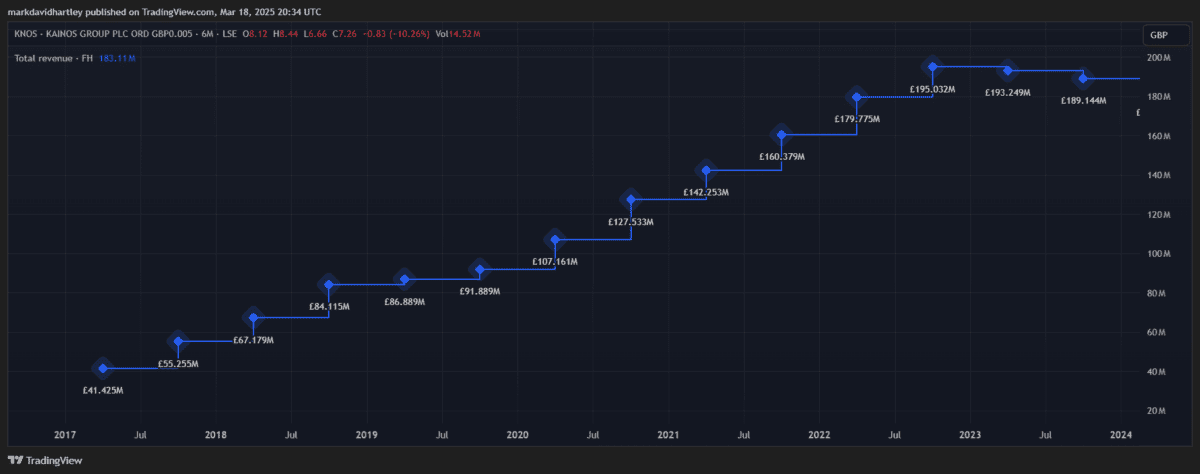
Despite consistent revenue growth over the past five years, a slew of issues have dragged down the company’s stock price. It’s currently hovering around £7.27, a 65% drop from its all-time high of £20.52 set in November 2021.

This suggests it’s undervalued, with a price-to-earnings ratio of 17.4 — below the industry average of 20.7.

Several factors have contributed to the decline, including a weak economy, a sudden leadership change and, most recently, the threat of US trade tariffs.

The issues have led to subdued revenue guidance for the year ending March, further impacting sentiment. The sudden and unexpected reappointment of ex-CEO Brendan Mooney brings a wealth of experience back in but has still irked investors. These issues may continue to limit price growth in the short term.

It also faces a barrage of competitors vying for a share of the growing digitisation market. This has led to more aggressive pricing among partners, putting pressure on its profit margins and market share.

Why I expect a recovery

Kainos has established itself as a leader in UK-based digital transformation and proprietary Workday services. Despite growing competition, it still commands a large section of the market across various sectors and has a solid pipeline of upcoming projects that promise long-term demand for its services. 

It has overcome recent financial struggles and maintains a strong balance sheet with significant cash reserves. This financial stability positions it well to take advantage of expansion opportunities. It also supports its dedication to shareholder returns, with a 4% dividend yield and 68.5% payout ratio.

Its Workday Products division has enjoyed particularly impressive growth, accounting for 19% of total revenue. The strategic move is already proving profitable and could reduce reliance on service-based income.

Screenshot from Tradingview.com

A renewed growth strategy

With Mooney back at the helm, I think his experience and knowledge could reignite the business and reassure stakeholders.

His guidance will likely refocus the business on emerging technologies such as AI. This is critical to meet evolving client needs and capitalise on new market opportunities. 

With a solid business and substantial cash reserves, Kainos has the flexibility to invest in growth initiatives, pursue strategic acquisitions, or simply satisfy shareholders.

It has all the trappings of a business ready to adapt (and thrive) in today’s rapidly evolving economic landscape. That’s why I’m stocking up on the shares while the price is good!

Could the ‘Pepsi Paradox’ make this FTSE 100 stock a buy?

When it comes to brand recognition, of all the FTSE 100 stocks, I reckon there’s one that stands head and shoulders above the rest. Do you know of anyone who hasn’t heard of Coca-Cola HBC’s (LSE:CCH) eponymous beverage? I don’t.

However, I’ve never understood why it remains so popular. In my opinion, PepsiCo‘s Pepsi is far better. Indeed, numerous blind taste tests have found it to be the preferred one, yet Coke remains the world’s best-selling soft drink by miles.

Scientists have called this the ‘Pepsi Paradox’. Although the majority of people choose Pepsi when they don’t know which of the two beverages they are drinking, when they see the labels they generally prefer Coca-Cola’s offering.

The people in white coats have attributed this to the power of branding and the persuasive impact of advertising.

In good company

I’m not sure what first influenced Warren Buffett’s investment vehicle, Berkshire Hathaway, to take a stake in The Coca-Cola Company. But the world’s most famous investor also prefers the drink (and the stock). In his 1991 letter to shareholders, he described himself as a “happy consumer” of five cans a day of Cherry Coke.

At 31 December, the soft drinks giant was Berkshire Hathaway’s fourth-biggest equity holding. Buffett’s company doesn’t own any shares in PepsiCo.

But the company listed on the London Stock Exchange isn’t the same as the one that’s popular with the American billionaire.

The Footsie version bottles and sells the famous drink in 29 countries across Europe, as well as Egypt and Nigeria. The US-quoted stock owns the worldwide rights and has a 21% shareholding in the Swiss-based company.

The investment case

In my opinion, there are plenty of reasons to consider investing in Coca-Cola HBC. It remains the industry leader in the non-alcoholic ready-to-drink sector. And as part of its strategy of having “a beverage for each consumer moment around the clock”, it has many brands and different types of drinks in its portfolio.

Despite its dominance, the group claims there’s plenty of room to grow, including in the countries where it’s more established, such as Italy and Greece.

In addition, it says it has a “relentless focus on cost and efficiency”, although I’d like to think that all the companies I invest in have a similar approach to cost control.

To try and woo income investors, the group’s been steadily increasing its dividend in recent years. We don’t yet know what its payout (if any) will be for 2024. However, for 2023, it was $0.93 a share. At current exchange rates that’s 71.67p, and implies a yield of 2.1%. However, it has to be said, this is well below the FTSE 100 average of 3.6%.

Encouragingly, its share price has done well of late. Since March 2024, it’s risen 40%.

Final thoughts

However, I don’t want to invest. And given that the company appears to have so much going for it, I accept this might sound like another paradox.

But it’s not that I don’t rate Coca-Cola HBC highly, I just think there are better opportunities elsewhere.

Due to intense competition and changing tastes, I’m not convinced there’s as much potential for growth as the company thinks. And its dividend isn’t high enough to get me excited.

Is the share price slump of this FTSE 250 defence stock a warning sign for others?

On Monday (17 March), the share price of QinetiQ Group (LSE:QQ.), the FTSE 250 defence contractor, slumped nearly 21% after it issued a profit warning. Previously, it was predicting “high single digit organic revenue growth” for the year ending 31 March (FY25). Now, it’s expecting 2%.

To try and soften the blow for shareholders, the company unveiled an “extension to our share buyback programme of up to £200m over the next two years”. Following the announcement, this money will go a lot further. But I suspect it’s small comfort for investors.

Strong growth

Like many in the sector, the group’s grown in recent years. Comparing FY24 with FY20, revenue nearly doubled and underlying earnings per share increased by 47%. As a result, since March 2020, its share price has risen over 40%.

However, it now appears as though this rapid growth has stalled. And at first glance, this doesn’t make sense. Recently, there have been many announcements from European countries promising to spend more on their armies, navies and air forces.

Last month, the UK pledged to increase spending to 2.5% of Gross Domestic Product, with effect from April 2027. Yesterday (18 March), Germany’s parliament voted to exempt military spending from its strict debt rules. And the European Union has announced plans that could see up to €800bn spent in the sector over the next four years.

Yet against this apparently positive backdrop, QinetiQ has issued a gloomy trading update. Could this be a warning for other defence stocks, whose share prices have done so well lately?

Troubled times

I’ve long thought that President Trump’s insistence that NATO members spend more on defence is a double-edged sword. As part of his ‘America First’ policy, he wants to stop subsidising the protection of other countries. This means the United States will end up spending less.

However, given the recent share price rallies of many in the sector, I suspect this hasn’t been factored in. Indeed, QinetiQ’s blaming many of its current problems on America. As a result of a restructuring in the country, the group expects to take a £140m hit to its bottom line. Monday’s press release also referred to “challenging US market conditions”.

However, it’s important to note that there’s always a time lag with defence contracts. It takes several years for the procurement process to conclude. With all investments it’s important to take a long-term view but, in my opinion, this is particularly good advice when it comes to defence stocks.

This could explain why QinetiQ remains positive. It says: “Longer term, the underlying strength of the Group coupled with the relevance of our mission critical capabilities to the national security needs of our customers in the UK, US and Australia as well as NATO allies, positions us well for long term future growth”.

However, I don’t want to invest in QinetiQ or the defence sector at the moment. There’s too much uncertainty for my liking. And generally speaking, in my view, valuations are on the high side.   

It’s also important to acknowledge that, on ethical grounds, some are reluctant to buy into the sector. Having a smaller pool of potential investors could weigh on share prices over the longer term.

For these reasons, I’m going to look elsewhere for my next investment.

Will the FTSE 100 follow the S&P 500’s 10% correction? I don’t think so, and here’s why

The S&P 500 recently hit a technical correction, meaning it fell by 10%, and the US index is down 4.5% year to date. In contrast, the FTSE 100 has held up and has risen 6.3% at the time of writing (19 March).

The following chart shows how the indexes compare. The Vanguard S&P 500 UCITS ETF tracks the S&P 500, while the iShares Core FTSE 100 UCITS ETF (LSE: ISF) follows the FTSE 100. It seems the S&P 500 clearly had further to fall.

Bigger, biggest

The US index does include Apple, Microsoft, and Nvidia, three of the big AI-related stocks hit by the downturn. And even now, Nvidia alone is still worth a bit more than the entire FTSE 100.

The escalating US trade war with, well, just about everyone, doesn’t help. It does seem more likely to damage US companies than anyone else.

But there are other things that lead me to see the UK stock market as potentially more resilient. It’s mainly about valuation and volatility.

Higher, lower

The S&P 500 price-to-earnings (P/E) ratio is traditionally higher than the FTSE 100. Right now, we’re looking at a value of around 27 compared to approximately 18 — though they vary depending on who we ask. So there’s more valuation to lose.

And US stocks do tend to show a lot more volatility than in the UK. On the FTSE 100, it’s rare to see the biggest daily winners move more than 3% or 4%. But the S&P 500 leaderboard is regularly headed by 10%, 20%, or even bigger movements.

Lower overall valuations and generally smaller daily movements surely have to lower the risk of buying into a FTSE 100 index.

What to do?

That’s why I think something like the iShares Core FTSE 100 is an option that every stock market investor should consider. I think it can be an especially good choice for people just getting started. And for folks getting close to retiring.

A young person with their first Stocks and Shares ISA could be burned and put off for life if they pile into an individual stock and see it quickly fall. And those wanting regular retirement income will usually prefer to minimise their short-term risk.

The iShares Core FTSE 100 UCITS ETF has a complex name, but it really couldn’t be much simpler. The ‘ETF’ part of the name stands for ‘exchange-traded fund‘. And that just means we can buy shares in it directly, like any other stock.

The key difference is that it effectively spreads out our money to mimic the entire index. And that means we’re far less exposed to an individual stock crash, or something like the banking crisis, which hit a whole sector.

Bad spells

Even with the safety we get through diversification, we should still expect stock market falls from time to time.

But for someone starting their very first ISA, I really do think the iShares FTSE 100 tracker is a good one to consider. And maybe the Vanguard S&P 500 fund as a later pick, to get a taste of those growth stocks.

Warren Buffett’s Berkshire Hathaway stock is surging… here’s why

Berkshire Hathaway (NYSE:BRK.B) shares have been a beacon of stability in an otherwise turbulent market. While the S&P 500 has slumped 10% from its all-time high, Berkshire’s stock has surged, hitting record highs. This performance is no accident. It’s the result of a combination of strategic foresight, robust earnings, and a disciplined investment approach. So, here’s why Berkshire Hathaway shares are continuing to attract investors despite trading at all-time highs.

Record cash and strategic positioning

One of the most striking aspects of Berkshire’s recent performance is its record cash reserves. These now stand at an astonishing $334.2bn. This massive war chest has been built up over the past year, as Warren Buffett and his team sold off significant holdings in companies like Apple and Bank of America. While some analysts have questioned the wisdom of holding such a large cash position, it has proven to be a masterstroke in the current market environment.

Buffett’s strategy of maintaining a substantial cash reserve allows Berkshire to capitalise on market downturns by acquiring undervalued assets. And while the market has largely returned to levels seen before Donald Trump’s election, some stocks have slumped. And it’s these corrections and retracements that may be presenting Berkshire with buying opportunities. Interestingly, however, Buffett’s most recent purchases have been in Japan.

The business is outperforming

Berkshire’s recent financial results have also contributed to its stock surge. The company reported a 71% increase in fourth-quarter operating earnings. This was driven by higher interest rates — improving returns on US Treasuries — and a significant improvement in its insurance operations. Insurance investment income rose by 48%. Meanwhile underwriting earnings saw a notable uptick, particularly from subsidiaries like GEICO.

These strong earnings underscore the resilience of Berkshire’s diversified business model, which includes insurance, energy, and transportation sectors. This diversification has helped the company weather market volatility and deliver consistent returns to shareholders. What’s more, the huge cash reserves add to this diversification.

A track record

Despite the massive cash pile, Buffett has reiterated that Berkshire remains heavily invested in equities. And not just any stocks, but particularly in American companies with significant international operations. This long-term focus on stocks aligns with Buffett’s belief in the enduring value of well-run businesses, even in uncertain times.

What’s more, Buffett and Berkshire Hathaway have a pretty good track record. With six decades of outperformance based on an evolving strategy that puts America first, investors likely have a lot of confidence in the conglomerate.

There’s no dip to buy

Buffett tells us to be greedy when others are fearful and vice versa. Ironically, that could mean avoiding surging Berkshire shares. However, investors seem keen to buy Berkshire shares and back Buffett to buy the dip elsewhere on the market.

However, Berkshire Hathaway isn’t a risk-free investment. Risks including leadership succession post-Buffett, limited tech exposure, and sensitivity to interest rate cycles. Its concentrated equity investments, primarily in five companies, amplify exposure to market fluctuations. Additionally, environmental disasters, cyber risks, and potential declines in insurance profits pose challenges.

Nonetheless, it’s a risk millions of investors are willing to take. In fact, I’ve just topped up on my position.

Where could IAG shares go in the next 12 months? Here’s what the experts say!

In 2024, IAG (LSE:IAG) shares nearly doubled in value and the airline group was crowned the FTSE 100‘s highest flier. Thanks to earnings that beat market expectations, the company awoke from its prolonged, pandemic-induced slumber with a bang.

However, the owner of British Airways and Iberia has made a turbulent start to 2025. Down nearly 20% since its peak in February, is the party over for the IAG share price? Or is it simply refuelling for another leg up?

Here’s what City analysts reckon with the stock trading at £2.94 today (19 March).

The stock’s next destination

Promisingly, the consensus forecast for IAG shares is positive. Although share price growth is generally expected to slow compared to last year, brokers’ median 12-month price target for the stock is £4.03. That would be a healthy 37% increase from today’s level.

However, beneath the headline consensus figure, there’s a wide range of opinions among institutional analysts covering the company. The table of expert recommendations below illustrates those differences.

Recommendation Number of analysts
Buy 6
Outperform 7
Hold 4
Sell 1
Strong sell 0

At the upper end, Panmure Liberum analysts believe IAG shares could rise to £5 next year, citing resilient travel demand and lower jet fuel prices as reasons for optimism. If this prediction came to fruition, the airline stock would finally eclipse its pre-Covid level, marking a complete recovery from the pandemic.

On the other hand, Barclays analysts slashed their price target to £2.50 last week from a previous forecast of £4.20. Competition risks from low-cost carriers and recent profit warnings issued by multiple leading US airlines underpinned this gloomier view.

What’s evident from these wildly different outlooks is that no analyst has a crystal ball. Broker forecasts aren’t gospel. Investors should weigh expert opinions against their independent research and convictions.

My verdict

More bullish forecasts for IAG shares chime with my own view. A £5 share price target might be a bit steep, but I believe there’s a strong chance further growth could be achieved over the coming months.

The stock looks cheap, which bodes well for future returns. Trading at a forward price-to-earnings (P/E) ratio below 5.5, the business is attractively valued relative to the FTSE 100 average and the airline sector as a whole. Other UK-listed aviation shares, such as easyJet and Wizz Air, trade for higher multiples of 6.9 and 7.1, respectively.

Furthermore, the firm’s beginning to reap the rewards from a £7bn modernisation investment in British Airways. This two-year plan involves a significant cash injection in IT infrastructure and hiring extra staff.

In FY24, IAG delivered a 22% increase in operating profit to reach a record €4.3bn, exceeding analysts’ expectations for €3.7bn. A stellar performance for the UK flag carrier underpinned the group’s excellent earnings.

However, the company faces risks from weak business travel demand. In a world where virtual meetings have become commonplace, the group doesn’t expect corporate travel to ever return to pre-pandemic levels. Whether IAG can continue to fill business and first-class seats with leisure passengers remains to be seen.

Nonetheless, with a fresh €1bn share buyback programme to be implemented over the next 12 months and the resumption of dividends last year, there’s plenty to keep prospective investors interested.

The Eurasia Mining (EUA) share price is up 181% this year! What’s going on?

Imagine investing £20,000 at the start off January and it now being worth over £56,000! That is the growth some investors in Eurasia Mining (LSE: EUA) have seen in under three months, thanks to the share price soaring 181% since the turn of the year.

Over five years, though, the share price has tumbled 64%.

Looking back even further (I am a long-term investor, after all), the share has traded in pennies since before the turn of the century, but in the years leading up to that, had been trading north of a couple of pounds per share.

So, while Eurasia has boomed in 2025, over the long term, it has destroyed significant value for shareholders.

What is going on – and has the tide turned?

A new year, a new geopolitical environment

The tide has turned in one way.

Eurasia has spent the past several years looking for a buyer for its key assets, which are mining sites in Russia.

That process had been going at a slow pace. Eurasia had raised some cash along the way, without which its ability to continue as a going concern would be doubtful.

The past several months have seen a shift in the international geopolitical environment, with the potential of Russia being better integrated once more into the global financial system than it has been since it launched its full-scale war on Ukraine.

That could make it easier for Eurasia to find a buyer for its assets, or potentially a way to utilise them itself.

Zero substantial company news, yet a 181% share price rise

Still, is that on its own enough to explain the 181% increase in the share price seen so far this year?

The answer appears to be yes, which suprises me.

Eurasia has not issued any substantive news updates this year. To date, there is no change in the known progress of the company’s attempts to offload its assets than there was at the end of last year.

As far as I can tell, the soaring share price reflects investor hopes that a changing geopolitical reality and its implications for international investment in Russia will help the company unlock value from its mining assets – but no concrete agreed sale plan as of yet.

I’m going nowhere near this share

The Eurasia Mining share price is still in pennies and this year’s performance has certainly grabbed my attention.

But I have no plans to invest. The price increase feels speculative to me in the absence of any concrete news about progress towards an asset sale.

Eurasia’s mining rights could potentially be valuable in the right hands. Combined with the speculative atmosphere, that could potentially push the share price even higher from here.

But as an investor, I see a loss-making company with a weak balance sheet, no commercial revenues to speak of, a large geographic concentration of risk, and – as of now at least – no confirmed exit plan for selling its assets.

I would not touch Eurasia shares with a bargepole right now.

Financial News

Daily News on Investing, Personal Finance, Markets, and more!

Financial News

Policy(Required)