Up another 35% in 2025 – can the Rolls-Royce share price keep climbing forever?

The Rolls-Royce (LSE: RR) share price just won’t stop. The FTSE 100 aerospace stock has rocketed 772% in just three years. Over the past year, it’s soared 102%. 

Many investors assumed it would run out of puff. Some held back from buying. Others took profits too soon. Either way, they’ll be kicking themselves, as Rolls-Royce has risen another 35% so far in 2025.

Of course, my headline is rhetorical – no share price climbs forever. But once momentum sets in, a stock can soar for much longer than seems feasible. The big question is: does Rolls-Royce still have fuel in the tank, or is a correction on the way?

Number one FTSE 100 flyer

2025 has brought plenty of good news. In January, Rolls-Royce landed the biggest Ministry of Defence contract in its history, a £9bn deal for nuclear submarine engines.

February results showed 2024 operating profits jumped 49% to £2.9bn, while the group hiked mid-term targets, reinstated its dividend, and announced a £1bn share buyback for good measure.

Civil aviation remains a big profit driver, with Rolls-Royce engines in high demand as long-haul air travel continues to recover post-pandemic. Now defence is getting in on the act. The shares spiked again earlier this month, as European nations ramp up military spending to deter Vladimir Putin.

Rolls-Royce’s move into small modular nuclear reactors (SMRs) could further drive growth. These so-called ‘mini nukes’ are still in development, but if they take off, Rolls-Royce has a big opportunity.

Despite all that optimism, there are plenty of risks. With a price-to-earnings ratio of 40, it trades at a massive premium compared to the FTSE 100 average of 15. That’s justified if earnings keep climbing, but if growth stumbles at any point, the share price could take a big hit.

There’s also the risk that European nations could cool on buying US defence equipment due to Trump’s perceived unreliability as an ally. While that could benefit Rolls-Royce in Europe, it could also hurt its US defence trade if America retaliates. 

Growth, dividends, and a buyback

And what about Trump’s trade war? If tariffs increase, Rolls-Royce’s engines and power systems could become more expensive for American buyers, denting sales.

If the US falls into recession, long-haul air travel may slow. That’s a worry because Rolls-Royce’s engine maintenance contracts are based on miles flown.

If those mini-nukes fail to live up to expectations or get a thumbs down from governments, disappointed investors could start bailing out.

The 16 analysts covering Rolls-Royce have produced a median one-year target of 780p. If correct, that suggests a small drop of around 2% from today.

Forecasts are slippery things, but it’s easy to see the stock slowing from here. Then again, I’ve been saying that for the last 18 months.

I eventually stopped worrying and joined in the fun, buying Rolls-Royce shares on 6 August for 455p during a brief summer dip. At today’s price of 795p, I’m up around 75%. But at some point, someone will get burned. I’ve got a nice safety net now. New buyers won’t have that.

Rolls-Royce is now a £66bn company. It’s a lot bigger than it was, but could be bigger still. I think it still has bags of potential and long-sighted investors should still consider buying it, especially on a dip.


Up 170% in the past year, I think this penny stock might not stay below 4p for much longer

When it comes to penny stocks, the risks are high, but the rewards can be even higher. Typically, these stocks are characterised by having a market-cap below £100m and a share price below £1. One of these came across my radar this week catching my attention due to the nature of operations and share price pop. Here’s the lowdown.

On the rise

I’m talking about Quadrise (LSE:QED). The business is a UK-based energy technology company focused on developing and commercialising alternative fuel solutions. When we’re talking about alternative fuel, we’re primarily looking at low-cost, low-emission alternatives to heavy fuel oil. Some of the sectors that would most benefit from this are marine shipping, power generation, and other industrial areas. In short, this is a huge target market.

The business makes money mainly by licensing out its proprietary technology to refineries and power plants. It’s not an exploration firm or direct producer, but it has these types of companies partnering with it to use its technology. Sometimes, deals are structured in such a way that it gets a margin on the end fuel sales.

Good momentum building

The share price has rocketed 170% in the last year, currently trading at 3.64p. Most of this jump came late last year following big news releases. One was an agreement with Sparkle Power, a thermal power producer in Panama, to supply a manufacturing unit at the power plant. This was the first trial on that specific engine type, giving investors optimism that the tech can be used in a much broader range.

At the start of this year, it also announced an agreement with the European Climate Agency (CINEA) to help work on reducing greenhouse gas emissions and energy efficiency for marine vessels. The potential for grants, contacts and new deals from this is large.

I believe more deals like these will put the business in a really strong position to grow in coming years. As the world pivots to renewable energy, Quadrise has an advantage in providing an alternative for key sectors that simply can’t flip to using something like wind or solar energy.

Risks to note

Like most penny stocks, the main risk I see for Quadrise is the volatility in the share price. It hit 8p at the start of this year. So even though it’s up 170% in a year, some investors that bought at the top would be down over 50% right now. Given the low market-cap, even relatively small market orders can cause a large stock reaction.

Another concern is that Quadrise might get bought out by a larger company. Even though it has patents, big producers or refiners could find ways to tweak and replicate the technology with a more extensive research and development budget.

Even with these concerns, I think it’s a stock worthy of consideration for investors who are comfortable with the risk of owning penny stocks.

How much second income could be made from the dozen highest-yielding FTSE 250 shares?

There are hundreds of companies in the stock market that pay a dividend in some form. Choosing the right ones is where an investor’s skill comes into play.

Sometimes, an investor might want to target high-yielding options and build a second income that way. So if they included the dozen stocks with the highest yields, here’s what the numbers could look like.

Starting from the ground up

I’ll use the FTSE 250 as a filter for the highest options. At the moment, the top stock is the SDCL Energy Efficiency Income Trust, with a yield of 13.02%. The last share to make the cut is the Diversified Energy Company, with a yield of 8.99%

The average dividend yield would be 10.69% if an investor bought the full dozen. This is very impressive. Initially, some might wonder what’s the point in buying all the companies instead of just buying the SDCL trust and getting an enhanced yield. The issue here is that it’s not diversified. In owning one stock, the yield’s higher but what if the company cuts the dividend? Then the average yield falls to… 0%.

However, if an investor holds the 12 and SDCL cuts the income payments, the impact’s still there but nowhere near as large. In fact, the average yield falls to 9.6% in this case. So the benefits of owning a balanced portfolio can’t be underestimated, especially when it comes to dividend income.

Assuming that an investor initially puts £250 in each stock and then adds an extra £50 a month in each share, the income will pick up over time. After a decade, this could pay out £1,115 a month in passive income, even without additional money being put in beyond this. Of course, there’s no guarantee the average yield of 10.69% could be maintained in years to come. In reality, the yield could be higher or lower.

An idea to put in the mix

Whether an investor is thinking of pursuing this exact strategy or not, one FTSE 250 share that I think is worthy of consideration is Renewables Infrastructure Group (LSE:TRIG). The stock’s down 27% over the last year, with a dividend yield of 10.35%.

It owns and operates a portfolio of renewable energy assets across Europe, including wind farms, solar power plants, and more. It makes money from selling the energy to end users, getting government subsidies and making capital gains from asset sales over time.

One reason why the stock’s dropped over the last year is due to interest rates in the UK staying higher for longer. As some of the large projects are funded by debt, it makes it more expensive for the group to refinance existing loans or take on new funding at cheaper rates. This is a risk going forward.

Given its operations and steady cash flow, it seems like a stable dividend payer for the future.

2 beaten-down UK shares I’m avoiding in today’s stock market

The UK stock market offers plenty of fallen shares for investors to run the rule over. However, some don’t appeal to me, despite the potential value on offer.

Here are two stocks from the FTSE 250 that I’m avoiding today.

A car crash

The first is Aston Martin Lagonda (LSE: AML). After falling 28% year to date, shares of the iconic luxury carmaker are languishing near an all-time low.

Now at 76p, the stock has lost a shocking 98% of its value since listing in 2018!

I’m a big fan of the brand, the heritage, James Bond and all that. And over the years, I’ve looked for reasons to invest in a potential turnaround. But Aston Martin just isn’t giving me anything to pin my hopes on.

Last year, total wholesale volumes dropped 9% to 6,030, due to supply chain disruptions and weak demand in China. The adjusted pre-tax loss was £255.5m, worsening from a £178.8m loss the year before.

Meanwhile, net debt increased 43% to £1.16bn. The ongoing losses and balance sheet continue to be the main risks here.

On the positive side, the company has introduced several new models. New CEO Adrian Hallmark says these represent the “strongest product portfolio in our 112-year history“.

Also, the company is aiming to generate positive free cash flow in the second half of 2025. Perhaps this is something that can reignite investor enthusiasm.

And while we can’t value the stock on earnings, as there aren’t any, the price-to-sales ratio of 0.46 looks pretty low.

However, management is only guiding for mid-single-digit percentage growth in wholesale volumes for 2025. That’s not enough to tempt me to buy shares, especially when a UK — or even potentially US — recession might be on the cards later this year.

An uphill battle for eyeballs

The second FTSE 250 stock I’m avoiding is ITV (LSE: ITV). While a five-year chart shows the stock is up around 27%, that’s slightly misleading. In March 2020, we had the Covid market crash that briefly brought nearly all stocks to their knees.

Zooming further out, the stock is down 36% in six years and has lost over 65% of its value across a decade.

Now, I do see ITV as far less risky than Aston Martin. For starters, the broadcaster is profitable and appears in no danger of going bust.

Moreover, it sports a low price-to-earnings multiple of 7.8 and offers a 6.2% dividend yield. So I certainly appreciate why it might appeal to value investors.

But I worry about the ultimate growth potential of ITVX, the company’s streaming platform, in today’s digital landscape. From Netflix and Disney to YouTube and TikTok, it has massive competition for eyeballs. I only see that intensifying in future.

Meanwhile, the writing has long been on the wall for ITV’s traditional linear television business. Apparently less than half of Gen Z viewers regularly watch TV, while Coronation Street is getting just 10% of the audience compared to its 1987 heyday.

Finally, there’s the production arm (ITV Studios), which is behind international hits like Love Island and Line of Duty. I do like this side of the business, but reports suggest it might be sold off. That makes me even less inclined to invest in ITV long term.

Here’s how many British American Tobacco shares I need for £1,500 a year in passive income

British American Tobacco (LSE: BATS) shares have done really well over the past year, rising around 32%. That’s not including the high-yield passive income on top.

The combination of share price appreciation and dividends has made this a great stock to own since I bought it 12 months ago.

Here, I’ll consider whether I should buy more shares for my portfolio, and how many I might need to generate £1.5k a year in dividends.

Passive income potential

When I bought this FTSE 100 share, the forward-looking dividend yield was an eye-popping 9.9%. It’s currently lower due to the higher share price, but it still comes in at 7.7% for this year and around 8% for 2026.

Year Dividend per share Dividend yield
2024 236p 7.5%
2025 244p 7.7%
2026 252p 8%

Of course, these are just forecasts and no payout is set in stone. But the tobacco firm generates plenty of surplus cash, and I’m encouraged that these prospective payouts are covered around 1.5 times by forecast earnings.

Put another way, British American pays out roughly two-thirds of its earnings as dividends. Personally, I’d be very surprised if the payout was cut in the near term.

Assuming the £2.52 dividend per share is met, this means I’d need to own roughly 595 shares to aim for £1,500 in passive income next year. I’m using 2026’s forecast figure because I don’t own that many shares yet, and there are other things beyond yield for me to consider here.

Falling volumes

The forward-looking price-to-earnings ratio is around 8.8, which means the stock still appears cheap. But on a price-to-sales basis, the stock looks more pricey at 2.7.

Either way, many would argue that a low valuation is warranted. After all, the company still generates around 80% of its revenue from cigarettes brands such as Dunhill, Lucky Strike, and Rothmans. And cigarette volumes fell by around 5% in 2022, 2023 and 2024. They’re projected to keep falling too.

British American is offsetting these volume declines with price increases, which supports the lofty dividend yield for now. But at some point its smokeless products like vapes, heated tobacco and nicotine pouches will have to start taking up some of the slack.

The company’s vision is one where smokers have migrated from cigarettes to smokeless alternatives. It aims for at least 50% of revenue from these next-generation products by 2035, up from 17.5% last year.

However, we don’t know whether they will prove anywhere near as profitable as cigarettes, especially as they have much lower production and distribution barriers. This means there’s a lot more competition. 

If these smokeless products don’t prove to have much pricing power, I suspect there might be some backsliding on targets. We’ve seen this dynamic play out recently with BP, which is reducing investments in renewable energy and increasing focus on oil and gas production. In other words, its bread and butter.

Should I buy more shares?

Upon reflection, I’m happy with the size of my holding in this stock for now. If it sells off, I may reconsider.

The next quarterly payment of 60p per share is due on 7 May. What I will do is reinvest that cash into other dividend stocks in my portfolio, probably Legal & General or Aviva.

Could buying Nvidia stock now be like buying Amazon for pennies in 2000?

It has been an incredible few years for chipmaker Nvidia (NASDAQ: NVDA). Not only have sales grown exponentially, but Nvidia stock has boomed. Over five years, the share price has grown by 2,186%. Wow!

Even after a recent fall (the stock has tumbled 16% in the past month alone), the price-to-earnings ratio is 40. That is not cheap, but it has got closer to a valuation where I would be willing to invest.

I am still concerned that the price does not factor in risks fully, like a potential slowdown in demand for pricey AI chips once the initial sales boom fizzles out, or a competitor bringing down costs dramatically.

But am I looking at this from the wrong perspective? Might Nvidia stock, even after its stellar recent performance, still be a generational bargain?

It might just be getting started

That may sound like a weird way to look at things.

But consider Amazon (NASDAQ: AMZN) 25 years ago.

The Internet was the exciting tech investment theme of the day, just as AI has been over the past several years.

Amazon’s business was growing quickly. While there were plenty of rivals (as there still are), Amazon already stood out just as Nvidia does in its field today. Both had substantial and fast-growing sales, a large customer base and proprietary technology.

In 1997, Amazon was trading for 7c a share. By late 1999, it had surged over 6,700% and traded at $4.70.

Then what happened? By late September 2001, it was down to 30c a share. Since that point, it has risen over 65,000%! Yes, 65,000%!

I think Nvidia now looks a bit like Amazon in late 1999. An initial surge of investor enthusiasm has pushed Nvidia stock up to what seems like a very high level by its historical standards. Now it is falling back.

The long-term potential remains massive

Historical performance does not tell us what a stock may do in future.

But we do know that, from here, Nvidia stock will ultimately go up, down or sideways.

Amazon went up (by a long, long way) because it was able to convert an early advantage in a market with massive potential into a long-term one thanks to its business model, customer base and points of differentiation compared to rivals.

I reckon Nvidia may ultimately be able to do the same.

I mentioned some of the risks above, but it also has a lot of advantages. Like Amazon’s market, chip-making is a sector where success can breed success thanks to economies of scale, installed user bases and unique technological know how.

The risks still concern me and, for now, I am holding off investing. Just because Nvidia reminds me of Amazon in 1999 does not mean I can shed my normal approach to risk and reward out of the window.

However, the valuation is getting close to a point where I would be willing to add Nvidia stock to my portfolio. I will keep watching the business and its share price closely.

Down 73%, can the ITM Power share price ever recover?

It has been a miserable five years for shareholders in renewable energy company ITM Power (LSE: ITM) and the share price has tumbled 73% during that period.

Could things get worse from here, or might this be a bargain price at which to add the share to my portfolio?

Business performance is getting much better

In January the company released its interim results.

Revenues for the first half grew 74% to £15.5m and the company recorded a contract backlog of £135m. It has signed multiple sales contracts since the period under review ended.

Not only that, but at the end of October, net cash was £203m. in the months since then I expect it has got smaller. Still, the current market capitalisation of £175m is actually below what the company forecast its cash position would be when its financial year ends next month.

In other words, the market is effectively now placing no value on the company’s business including its impressive hydrogen energy storage technology.

With the finance boss dipping into her own pocket last month to buy some shares, I am wondering whether at its current price ITM might be a bargain for my own portfolio.

There’s one big question I still have

With revenues growing, I think ITM has a foundation on which it could build and succeed.

Bigger turnover can help absorb fixed costs, an important step for a company as it grows and seeks to move from heavy losses to breaking even. If it can break even, I reckon the share price could move far above where it stands today, possibly back to where it used to be and even beyond.

But despite that, I am not ready to invest yet.

The reason for that is simple: profitability. It has long been elusive for ITM — and that remains the case.

Yes, the company’s interim results included exceptional items, which made thing worse than they may be in future. However, even before those exceptional accounting items, the loss from operations was as bad as in the prior year period. At £20.7m, it was very significant (and substantially larger than revenues).

ITM’s strategy of focusing on certain product lines and carefully controlling costs, combined with higher sales, ought to mean that losses get smaller. That may happen over time, but the first-half performance was not reassuring on this score.

The fact remains that this is a heavily loss-making business that continues to bleed cash. Until it proves that its business model can be profitable, I do not plan to invest.

I’m taking a cautious approach

If that happens, the ITM Power share price may leap, meaning I would need to pay more to invest than if I buy now.

That does not bother me, as I see risks in buying today given that ITM has still not proven the long-term viability of its business model to my satisfaction.

Once it does, it may merit a higher share price. For now, I think it merits a sizeable risk premium.

In my opinion, that helps explain why the stock market is effectively valuing the business at zero for now.

The Prudential share price continues its recovery after 2024 profits rise 10%. Where’s it heading this year?

The Prudential (LSE: PRU) share price looks likely to continue recovering after its full-year 2024 results were released last night (19 March).

The stock has already made a spectacular 22% recovery this year after falling 56% throughout 2023 and 2024. Now, with revenue beating estimates for the first time in years, I suspect it will continue climbing.

Here’s why I think it’s a stock worth considering in 2025.

Full-year 2024 results

Adjusted operating profit before tax increased 10% to $3,13m, with adjusted operating profit after tax up 7% to $2,58m.

Earnings per share (EPS) came in at 89.7c, far surpassing estimates of 80c per share. Revenue followed a similar pattern, at $6.42bn — smashing estimates of $3.98bn. The company’s revenue has been on a steady decline for several years now, down from $44.67bn in 2018. This is the first time since 2018 that revenue came in ahead of estimates.

Promisingly, a final dividend of 16.29c was announced, raising the full-year dividend by 12.99% to 23.13c per share. This equates to a 2% yield on price with a sustainable payout ratio of 64.9%.

In addition, it completed over $1m in share buybacks, progressing its $2bn program announced in June 2024. The remaining buybacks are expected to be completed this year.

Focus on Asia

Prudential is a British multinational insurance and asset management company, headquartered in London and Hong Kong that relies heavily on the Chinese market. Recently, the firm has undergone a significant restructuring, including a demerger from UK and US operations. Now largely focused on Asia and Africa, there’s a risk this strategy may not pay off. 

Slow growth in the region has been impacting its performance lately. Although it reported an 11% increase in new-business profit to $3bn, this is notably lower than the 45% rise achieved in 2023.

In today’s report, CEO Anil Wadhwani highlighted the significant opportunities Asia has to offer. It’s a region with low insurance penetration and a growing demand for long-term savings, wealth management and retirement planning. Yet despite these prospects, when accounting for changes in interest rates and exchange rates, new-business profit actually declined by 2% in 2024.

Restrained growth potential

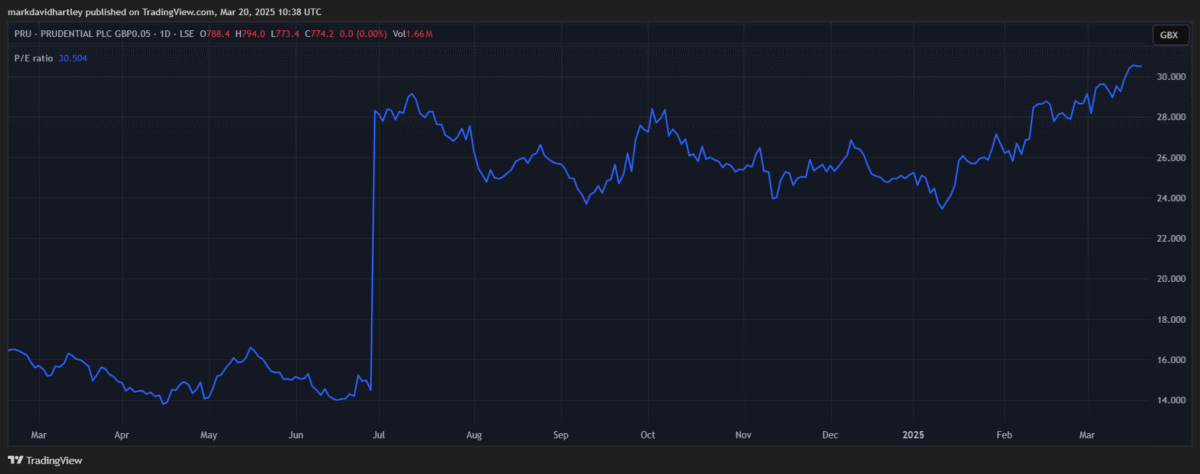
Creating on TradingView.com

Everyone loves a rising price but with it comes the increasing potential for a pullback. The stock’s price-to-earnings (P/E) ratio has now surpassed 30 — almost double the FTSE 100 average of 18. That could limit the number of new investors interested in buying the stock at such a high price. Even with earnings forecast to grow 23% in the coming year, there’s no guarantee this will pass on to the share price. 

Any small hiccup could send things south.

Overall, the company appears to be operating well despite profits subdued by growth limitations in Asia. Analysts remain overwhelmingly optimistic about the stock, with 12 out of 17 maintaining a Strong Buy rating. The average 12-month price target is 1094p, a 41.3% rise from current levels.

I think the share price has a good chance of climbing between 20% and 25% this year – particularly as it edges ever closer to its 52-week high. After today’s results, it’s firmly on my watchlist for 2025.

As Warren Buffett ramps up investments in Japan’s trading houses, here’s what I’m doing

We don’t always know which Berkshire Hathaway (NYSE:BRK.B) moves are down to Warren Buffett specifically. But it’s fairly clear the recent investments in Japanese trading houses are. 

Investors like me, however, don’t have the ability to match Buffett’s Japanese deals. But I’m looking to follow a similar principle when it comes to my own portfolio.

Berkshire’s Japanese investments

Since 2019, Berkshire Hathaway has been buying shares in each of Japan’s five major trading houses. And it has recently received permission to increase its stake in each to above 10%.

This, however, isn’t the most interesting part of the deal. Despite having huge cash reserves, Buffett’s company has been financing the investments using debt.

More specifically, it has been using bonds denominated in Japanese yen that pay between 1% and 2.6% in interest. And the reason for this is extremely interesting.

Buffett’s stated plan is to make money by receiving more in dividends than it pays out in interest. But if it uses US currency, there’s a risk exchange rates might move.

A weaker yen could make the value of Berkshire’s dividends fall. But using bonds denominated in Japanese currency means that if the yen falls, Berkshire’s interest payments also drop.

This is a move that exploits Berkshire’s unique strengths — not many have the balance sheet to structure an investment in this way. In a similar spirit, I’m also looking to stick to areas where I have a similar advantage.

UK stocks

Berkshire has a unique ability to operate at scale, which is why I’m pleased to be a shareholder. But its size is also its biggest challenge – and the main risk with the stock over the long term.

That, however, isn’t a problem for someone like me. And while Berkshire’s balance sheet gives it some advantages, being based in the UK gives me some valuable insights.

Despite the S&P 500’s recent challenges, UK shares generally trade at lower valuations than their US counterparts. And some of them have very strong competitive positions.

Rightmove is a world away from Japanese trading houses but it’s a good example of my point about investors maximising advantages. It’s the first place buyers and sellers in the UK housing market go and I think this competitive position is going to be difficult to disrupt.

There are important risks, including the possibility of interest rates not falling as quickly as expected. And weighing these against the company’s impressive margins isn’t straightforward.

In 2024, the firm generated £389.9m in sales, which is about $507m. That makes it far too small to be on Berkshire Hathaway’s radar, but it’s been on mine for a long time.

Sticking to strengths

Warren Buffett’s investments in Japan are about taking advantage of situations where Berkshire Hathaway has an advantage. And I’m looking to take the same approach with my own investing.

That means looking at stocks like Rightmove, where I have first-hand experience of the business. It might not be big enough for Buffett, but that’s no problem for me.

It’s not the only stock I’m considering at the moment. But when I’m next in a position to invest, I’ll see where the share price is and take a view about buying it.

Down 20% since February despite excellent 2024 results, is IAG’s share price set to soar again?

International Consolidated Airlines’ (LSE: IAG) share price has dropped 20% from its 7 February one-year traded high of £3.68.

This might indicate that a business is worth less than it was before. Or it could result from market speculation over the short-, medium, or long-term outlook for a company.

As a long-term investor I am not particularly concerned about shorter-term market worries. My key investment concern for a growth stock is whether there is substantial value in it over time.

I did a deep dive into the numbers behind the British Airways-owner’s business to see if this is true here.

How do the core business numbers look?

IAG’s 28 February-released 2024 annual report looked very good to me, with revenue up 9% year on year to €32.1bn (£27.02bn). Operating profit jumped 22.1% to €4.283bn and profit after tax increased 2.9% to €2.732bn.

Net debt dropped 17% over the year to €7.517bn, and adjusted earnings per share jumped 12.3%, to 56.8 euro cents.

These strong numbers enabled IAG to raise its total dividend to 9 euro cents, generating a current yield of 2.6%. It also announced a €1bn share buyback to be completed in the coming 12 months. These tend to support share price gains.

Analysts forecast IAG’s earnings will rise 6.9% each year to the end of 2027. It is this growth that powers a firm’s share price and dividends over time.

Why did the shares drop?

The airline’s share price dropped largely because of market fears of weakening in the US economy. These stem from the country’s recent imposition of a range of tariffs on key trading partners.

The US’s Delta Air Lines cut its Q1 profit estimates by half on 10 March due to such uncertainty.

Market analysts fear the same could happen with European airlines, given their significant transatlantic business.

A risk to IAG is that this scenario does indeed play out.

Are the shares undervalued right now?

My view is that no economic pullback has occurred in the US so far. Even if it does, I think it extremely unlikely it will persist long term.

As it stands, IAG’s 6.1 price-to-earnings ratio is very cheap compared to the 9.3 average of its peers. These comprise Jet 2 at 6, easyJet at 8.2, Singapore Airlines at 10.1, and Wizz Air at 12.8.

The same applies to IAG’s 0.5 price-to-sales ratio compared to its competitor average of 0.7.

I ran a discounted cash flow analysis to ascertain where IAG’s share price should be, based on future cash flow forecasts.

This shows the stock is 57% undervalued at £2.96. Therefore, the fair value for the shares is £6.88, although market vagaries might push them lower or higher.

Will I buy the stock?

I am aged over 50 now so am in the latter part of my investment cycle. As such, my focus has shifted to stocks that pay very high dividends. I aim to increasingly live off these while reducing my working commitments.

IAG’s dividend yield does not meet my minimum 7%+ a year requirement, so I will not be buying it now.

However, if I were even 10 years younger I would. I think on the back of its strong earnings growth potential its shares will soar over time.

Financial News

Daily News on Investing, Personal Finance, Markets, and more!

Financial News

Policy(Required)