Putting £500 a month into a SIPP from the age of 40 could lead to over £500k by retirement

It’s never too late to contribute to a Self-Invested Personal Pension (SIPP). Even if you start contributing in your 50s or 60s, you could potentially build significant wealth for retirement.

However, for those starting to contribute to a SIPP in their early 40s, the results can be remarkable (due to the power of compounding). Here’s a look at how much £500 invested a month starting at the age of 40 could lead to by retirement age.

Multiple advantages

From a wealth-building perspective, SIPPs have several advantages. For starters, contributions come with tax relief. This is essentially a reward from the government for saving for retirement.

For basic-rate taxpayers, the relief on offer is 20% (it’s higher for those earning more). This means for every £80 contributed, the government will add in another £20, taking the total contribution to £100.

Please note that tax treatment depends on the individual circumstances of each client and may be subject to change in future. The content in this article is provided for information purposes only. It is not intended to be, neither does it constitute, any form of tax advice. Readers are responsible for carrying out their own due diligence and for obtaining professional advice before making any investment decisions.

Secondly, investments can grow free of Capital Gains Tax (CGT) and Income Tax. So for example, generating a profit of £10,000 on a stock or fund, would see no CGT payable.

Third, SIPPs tend to offer access to a wide range of investments including funds, ETFs, stocks, and investment trusts. With these types of investments, it’s possible to generate returns of 8% a year or more over the long term.

Achieving high returns

It’s worth pointing out that high returns aren’t guaranteed. But to achieve attractive returns, it’s best to build a properly diversified portfolio. Investors also need to be patient and remain comfortable with short-term market fluctuations.

In terms of building a portfolio, there are many different approaches that can be taken. Personally, I’m a fan of combining funds (both active and passive) and individual stocks.

Funds can be a great foundation for a SIPP portfolio as they typically offer access to a wide range of stocks. This ensures the investor’s eggs aren’t all in one basket.

Individual stocks meanwhile, offer the potential for higher returns. Take Amazon (NASDAQ: AMZN), for example. Over the last decade, its share price has risen from around $19 to $195. That translates to a return of about 26% a year.

There are not many funds that have generated that kind of return for investors. Had an investor put $10,000 into Amazon stock a decade ago, that would now be worth more than $100,000.

I’ll point out that I believe Amazon stock is still worth considering as an investment today, despite its huge gains over the last decade. To my mind, the company has significant long-term potential given its exposure to cloud computing and artificial intelligence (AI).

That said, there are plenty of risks to consider, such as a drop in consumer and/or business spending. Concerns over these risks can lead to share price volatility at times.

£635k by 65?

Let’s say an investor was able to achieve a return of 8% a year over the long term with a mix of funds and individual stocks. If they started investing £500 a month at 40, and received tax relief of 20%, I calculate they’d have around £535,000 by the age of 65.

If they were able to achieve a return of 9% a year, they’d get to around £635,000 by 65. These figures show what’s possible by saving early and puts together a decent investment strategy.


Are BAE Systems shares still a bargain near a 52-week high?

BAE Systems (LSE:BA.) shares thrive in an uncertain world. With Ukraine’s future tragically hanging in the balance and the Trump Administration calling into question NATO’s Article 5 on collective defence, many investors are flocking to shares in Europe’s largest military contractor.

But after skyrocketing nearly 250% in five years, is the BAE Systems share price still good value? Or is the FTSE 100 aerospace and defence company now an expensive stock to buy as it changes hands near a record high?

Here’s my take.

According to the International Institute for Strategic Studies (IISS), global defence spending exploded last year to an eye-watering $2.46trn. While the international post-war order crumbles, defence contractors have a key role to play in rearmament efforts.

BAE Systems shares are well-positioned to benefit from rising government demand. The company’s core offering is heavy-duty military apparatus, including fighter jets, naval vessels, armoured vehicles, missile launchers, and munitions.

Understandably, ESG-conscious investors will have ethical concerns about investing in a weapons manufacturer. However, in an increasingly insecure environment, I believe that debate is becoming more nuanced. After all, BAE Systems makes a massive contribution to national (and international) security.

Sales breakdown

Digging into the firm’s revenue, four countries emerge as the lifeblood of the business.

Country Percentage of FY24 sales
United States 44%
United Kingdom 26%
Saudi Arabia 10%
Australia 4%
Other international markets 16%

In three of those markets — the UK, Saudi Arabia, and Australia — defence expenditure is expected to rise further. The sticking point’s the crucial US market. Elon Musk and his Department of Government Efficiency (DOGE) are putting the Pentagon’s military budget under the microscope. At first glance, this could be a potential headache for BAE Systems shareholders.

Most of the cuts thus far may be politically inspired, focusing on diversity initiatives and academic research. That said, the share prices of leading US defence stocks, such as Lockheed Martin and Northrop Grumman, have suffered as a consequence.

By contrast, the BAE Systems share price continues to surge, thanks to the group’s more diversified geographic footprint and smaller reliance on US government contracts. Nonetheless, it’s worth watching developments on this front closely.

A premium valuation, with justification

Trading at a price-to-earnings (P/E) ratio above 26, BAE Systems shares certainly aren’t the cheapest FTSE 100 stock. But I think there are solid reasons for the high multiple.

In its FY24 results, the business excelled across a multiple metrics. Some highlights included an £8bn uptick in the order backlog to £77.8bn, operating profit growth of 4% to nearly £2.7bn, and a 10% hike in the dividend per share to 33p. In short, it’s a company in great financial health.

Growth opportunities are abundant too. Advances in artificial intelligence are increasingly shaping the group’s defence strategies and the acquisition of Ball Aerospace last year has strengthened the firm’s capabilities in the space sector.

A downside of this takeover was an increase in net debt from £2.4bn to £6.8bn, which leaves the balance sheet in a weaker position. This increase in leverage is a risk for investors to monitor.

Overall though, I still see good value in the share price today and think it’s worth considering. I’ll continue to be a happy shareholder for the foreseeable future.

What on earth’s going on with the Unilever share price?

The Unilever (LSE: ULVR) share price may be up 18% in a year, but scratch the surface and things are not all well at this consumer goods giant. The previous CEO was barely in the job 18 months when the board fired him last month. With a change of direction afoot, is now the right time for me to consider investing?

Misfiring strategy

At the heart of the company’s recent problems is a baffling, complicated strategy. A few years ago, star investor Terry Smith accused it of being more interested in sustainability credentials than building shareholder value.

The ‘woke’ agenda may have been expunged since then but its overarching strategy didn’t change much. Unlike its bitter rival Procter & Gamble, it still relies heavily on a number of food brands and volatile emerging markets.

The new CEO looks determined to cull the company’s behemoth portfolio. In an interview in early March he stated that the business has identified around €1bn of local brands in Foods Europe that “don’t fit well with the portfolio” and are not “strategic priorities”. His intention is to act on these at “pace”.

Back to basics

I believe that the intention behind the new strategy is to replicate a similar one P&G undertook some time ago.

Wind the clock back 10 years and P&G was in the same boat Unilever finds itself in today. It was losing market share to smaller more nimble rivals. I remember the issues Gillette had when the Dollar Shave Club was launched, to provide one example.

What did it do? It went back to basics, to its core brands. Its new strategy of ‘irresistible superiority’ was so simple that many analysts at the time saw it as nothing more than a meaningless mantra. But it worked. Since 2015, its share price has doubled and its market cap is now much bigger than its main rival.

Consumer squeeze

One of the biggest challenges the company faces in the next few years is one of cash-strapped consumers tightening their belts. In some instances this means switching to cheaper brands.

The US is by far its biggest market, accounting for nearly 40% of its entire turnover in 2024. The US stock market might be booming, but its consumers are not. The cost of living in the US has shot up recently. Elevated inflation has meant that the value of the dollar is 30% less than it was four years ago.

Now with the talk of tariffs and trade wars, people fear that the US is heading for a recession. To me, the company cannot afford to stand idly by doing nothing as it is likely to get steam rolled in the coming years.

There is definitely value in Unilever. Its many world-leading brands speak for themselves. The new CEO may be known as the hair brand guy, but I expect a cull at virtually every category of its portfolio. He has, after all, done it before.

At the moment, I have significant exposure to a much smaller consumer goods business, PZ Cussons, so I won’t be buying. If I didn’t, I wouldn’t hesitate to snap some up.

Here’s the dividend forecast for Rolls-Royce shares up to 2028

Right now, shares in Rolls-Royce (LSE:RR) come with a dividend yield of 0.74%. That’s not particularly high, but analysts are expecting some strong growth over the next few years.

I think, however, there’s a lot of uncertainty around the amount the firm is going to return to shareholders. And that means investors should be very wary about relying on forecasts. 

Dividend growth

This year, Rolls-Royce looks set to distribute 6p per share (that’s strictly the 2024 dividend). With the stock at £8.15, that’s doesn’t exactly stand out.

Yet analysts are expecting the dividend to reach 10.03p per share by 2027 (paid in 2028). That would be a substantial increase from the current level. 

Year Dividend per share Change (%) Yield (£8.15 share price
2024 6p 0.74%
2025 7.8p 30% 0.96%
2026 9.01p 16% 1.11%
2027 10.03p 11% 1.23%

I suspect income investors are unlikely to be particularly moved by a prospective yield of 1.23% three years from now. But I don’t think relying solely on these forecasts is a good idea.

Rolls-Royce has a slightly tricky dividend policy. The aim is to distribute between 30% and 40% of underlying pre-tax profits as dividends, but this means a couple of things for investors. 

Dividend policy

A range of between 30% and 40% leaves quite a lot of scope for variance. If someone sets an expectation at the mid point, the eventual result could be 16% lower or 12.5% higher. 

On top of this, underlying pre-tax profit is an adjusted measure. In other words, the number Rolls-Royce reports is partly the result of excluding costs it thinks distort the overall picture.

That makes forecasting somewhat difficult and while there are estimates for pre-tax earnings, one thing stands out. By 2027, the figure is set to increase by 41% – less than the dividend.

Year Pre-tax profits
2024 £2.25bn
2025 £2.86bn
2026 £2.76bn
2027 £3.18bn

This tells me analysts are expecting Rolls-Royce to distribute a higher percentage of its profits in 2027. That is possible, but I think it’s important to note this is what’s being priced in. 

Outlook

Of course, all of this depends on how the underlying business fares over the next few years. And I think there’s reason for potential investors to be optimistic.

Rolls-Royce has several potential growth opportunities ahead. These include expanding into narrow-body aircraft, a transition to sustainable fuels, and the rise of small modular reactors.

Investors should be mindful, though, of the fact that things can go wrong quickly with this type of business. A recession weighing on travel demand could cause profits to fall away sharply. 

If that happens, then shareholders can forget the current projections for future earnings and dividends. So this is something investors need to assess carefully. 

Dividend forecasts

When it comes to dividends, analyst forecasts can be useful. But I think with stocks like Rolls-Royce, investors have all the tools they need to try and come to their own conclusions.

The company has specified a dividend policy of between 30% and 40% of its pre-tax profits. And I’m not sure it’s possible for anyone to be more precise than that.

After that, the question is what those profits will be, which is about threats and opportunities. But I think investors should judge this for themselves, rather than relying on analysts.

I think these shares could skyrocket if the US stock market enters a new bull run

Donald Trump’s presidency hasn’t driven the American stock market higher. In fact, the S&P 500 is down around 9% since the America-first president took office. This pullback is arguably based on legitimate concerns about the impact of tariffs, a slowing US economy, and a threat to American supremacy in artificial intelligence (AI).

And this pullback has impacted some stocks more than others, notably those valued strongly on forward growth expectations, such as technology and innovation-driven sectors. Companies like Tesla, which soared in the wake of Trump’s election, have been particularly hard hit by waning optimism and market volatility.

However, if the market stabilises and enters a new bull run, these same stocks could experience a resurgence. Historically, growth stocks tend to outperform during periods of economic recovery and bullish sentiment.

Investors may look to sectors like AI, renewable energy, and biotechnology, which are poised for long-term growth despite recent setbacks. Additionally, smaller U.S. companies, which could benefit from Trump’s America First policies, may also see significant gains if the market rebounds.

Stocks in my rally watchlist

As with any pullback, I’ve put together a list of companies that I’ve always been interested in and believe may have been unfairly sold off. Let’s have a look at some of the companies on that list.

1 month stock performance Forward P/E Forward PEG
Alphabet -11.5% 18.2 1.1
AppLovin -39.9% 38.9 0.9
Celestica -30% 18 0.6
Marvel -37% 24.8 0.5
Vertiv -17% 24.4 0.9
Uber (NYSE:UBER) -10% 22 0.6

So, why have I chosen these stocks? Well, one connecting factor is the price-to-earnings-to-growth (PEG) ratio. Popularised by fund manager Peter Lynch, the ratio typically suggests a stock is undervalued if the ratio is below one. However, in the current environment, it can be more useful to compared a stock’s PEG ratio to the sector average. And that’s what links these stocks. They’re all considerably cheaper than their peers.

A closer look at Uber

Uber Technologies stock has dipped 10% over the past month. This pullback comes despite cheaper forward valuations, improved profit margins, and a healthier balance sheet. However, these are factors that could help the company outperform in a bull market.

A key driver of Uber’s potential growth is its partnership with Waymo. The partnership with the Alphabet company has seen the rollout of robotaxi services in Austin, Texas, since early March. This move, combined with its expanding technical capabilities and vehicle supply, strengthens its ecosystem. Additionally, Uber’s diversified revenue streams, including Mobility, Delivery, and Freight segments, provide a robust foundation for sustained growth.

However, risks remain. The company’s heavy reliance on autonomous technology investments could face regulatory hurdles or technological setbacks. Market sentiment also plays a crucial role, and while Uber’s fundamentals are strong, the timing of a market bottom remains uncertain.

For me, it’s a stock that I’m watching incredibly closely. It’s very cheap based on projections, but I appreciate that autonomous driving offers both massive opportunities and risks. I’m considering adding it to my portfolio based on the current forecasts.

2 FTSE 100 bargains to consider before the 5 April ISA deadline!

Investors don’t need to buy shares in their ISA to utilise any annual allowance they may have remaining. Just depositing cash in a Stocks and Shares ISA or Lifetime ISA is enough to secure the tax benefits for the funds.

But with so many brilliant bargains out there, individuals may wish to strike straight away instead of waiting to invest. The FTSE 100 share index alone is choc full of dirt cheap quality shares following the recent stock market mini crash.

Here are two I’m considering buying before the 5 April ISA deadline.

Standard Chartered

Source: TradingView

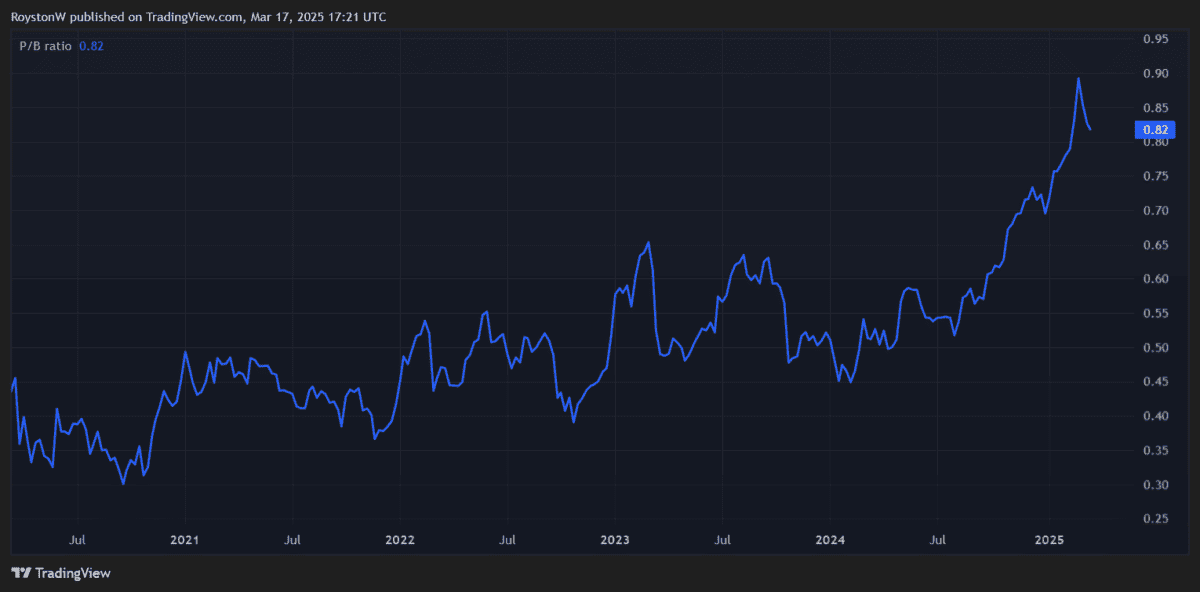
With a price-to-book (P/B) ratio below 1, Standard Chartered (LSE:STAN) still trades at a discount to its book value (total assets minus total liabilities). This suggests the emerging market bank’s shares have further scope for price appreciation — they’re up 79.4% over the past year.

This isn’t all, with StanChart shares also looking mega cheap relative to expected earnings. A predicted 14% bottom-line rise leaves the firm trading on a forward price-to-earnings (P/E) ratio of 7.3 times.

Meanwhile, its price-to-earnings growth (PEG) multiple registers at 0.6. Like the P/B ratio, a sub-1 ratio illustrates supreme value.

Intensifying trade wars could have significant ramifications for the bank’s Asian and African operations. However, Standard Chartered’s resilient performances during recent tough times provide reasons for encouragement.

Operating income soared 16% in the fourth quarter, to $4.5bn. This was also a good $300m better than analyst forecasts.

I also like Standard Chartered’s shares because of the strength of the balance sheet. Its CET1 capital ratio was 14.2% as of December, moving further ahead of its target range of 13-14%.

This puts the bank in good shape to keep investing in growth while also returning decent amounts of cash to shareholders. In 2024, it hiked the total dividend 37% year on year, and also recently announced plans for a $1.5bn share buyback programme.

Vodafone

Telecoms giant Vodafone (LSE:VOD) also offers great value across a variety of metrics. Like StanChart, it trades on a sub-1 P/B ratio, at 0.4. It also looks cheap in relation to expected profits for the upcoming financial year (commencing March).

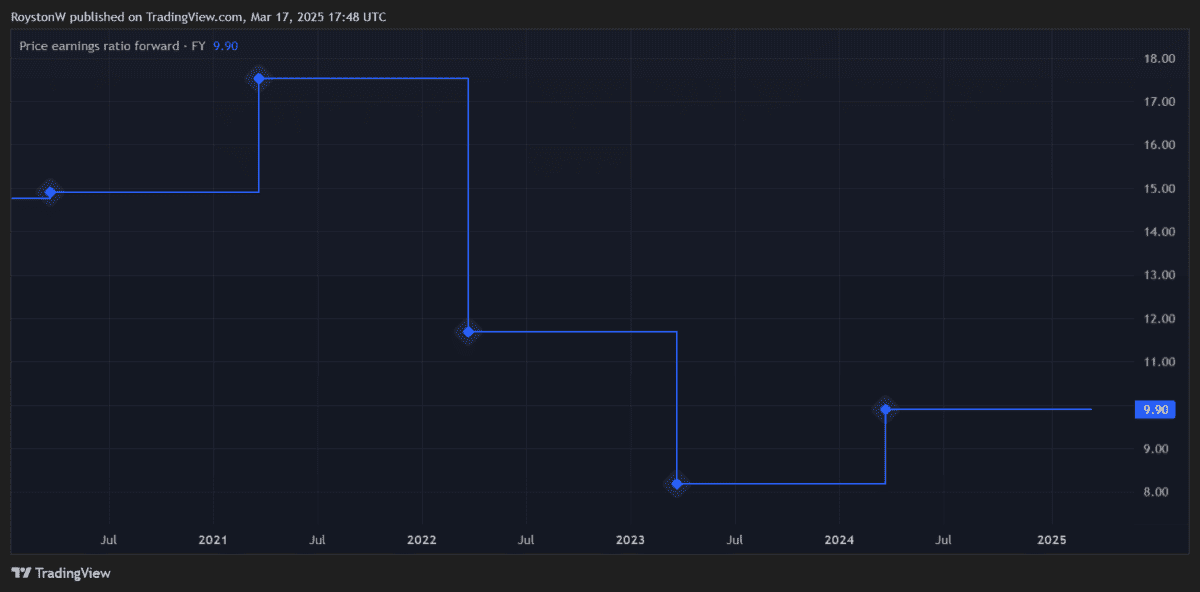
Vodafone shares carry a P/E ratio of 9.9 times and a PEG multiple of 0.6. That’s based on predictions of a 16% earnings jump for the period.

P/E ratio
Source: TradingView

Finally, the dividend yield on Vodafone shares for fiscal 2026 is a robust 5.7%. That comfortably beats the FTSE 100 forward average of 3.6%.

The immense sums Vodafone’s spent to chase growth in the 5G and broadband markets have weighed heavily on shareholder returns. This reflects a blend of share price weakness and dividend cuts.

While high capital expenditure will remain a problem, on balance, I believe the long-term outlook here remains compelling.

I like Vodafone’s significant exposure to fast-growing developing markets like Africa (turnover here grew a robust 4.1% in the December quarter). And more broadly, its broad regional footprint means it’s placed to capitalise on the booming digital economy.

With restructuring cutting costs and refocusing on lucrative areas (like Vodafone Business), I think the share price could recover strongly after years of disappointment.

Is £500,000 enough to generate a second income?

If I had £500,000 in my Stocks and Shares ISA, I believe I could comfortably earn £25,000 annually as a second income. That would be achieved by investing in bonds and dividend-focused stocks that give me an average yield of 5%. That’s about the equivalent of a £30,000 salary after tax. It’s not bad, but it might not be enough for some people.

How’s it done?

The maximum annual contribution to a Stocks and Shares ISA is £20,000. As such, it would take a while to build up to £500,000 through contributions alone. Of course, that excludes the main reason people invest… to make their money work and grow.

In short, there are lots of ways to turn an empty portfolio into £500,000. One way would be to invest £500 a month for 22.5 years — this assumes 10% annualised growth. The issue here is that a £25,000 second income wouldn’t go as far in 22 years, plus the return rate might end up being lower.

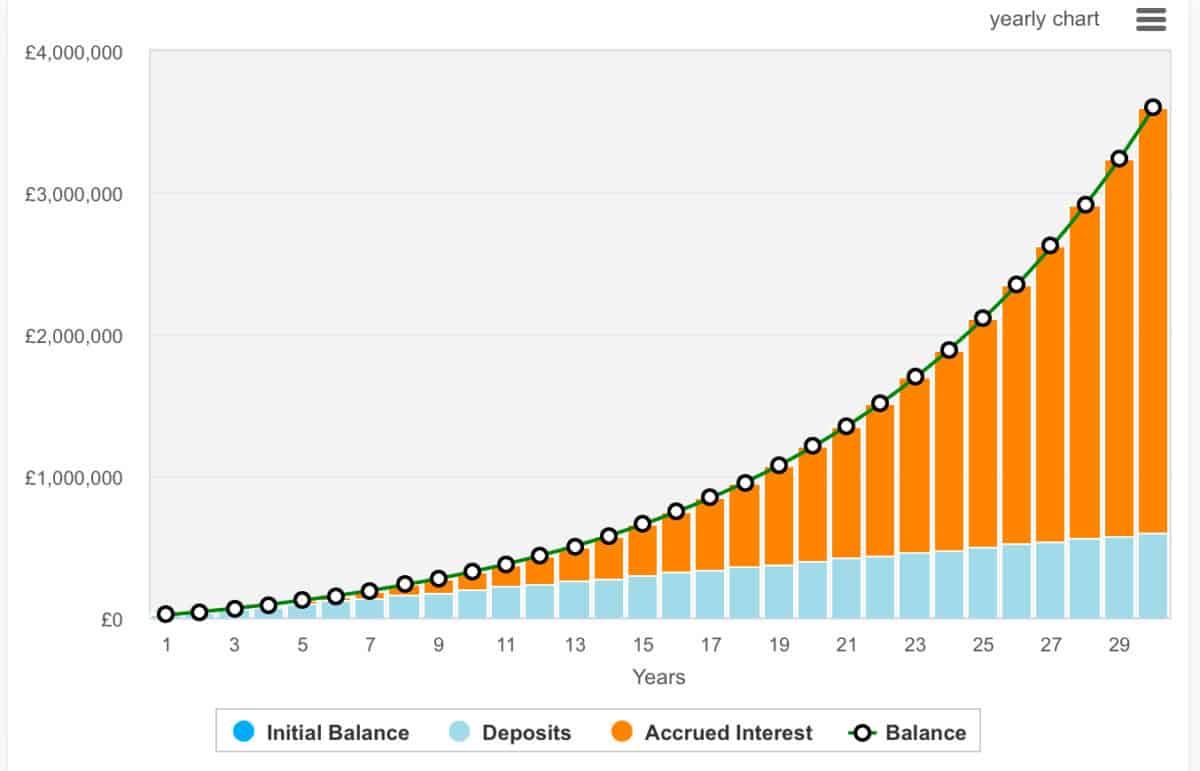
However, higher contributions could mean this £500,000 figure is achieved sooner. The below chart shows what could be achieved when an investor maxes out their ISA allowance. In such a case, and assuming a strong 10% annualised growth rate, this £500,000 would be achieved in just 13 years. But check out that compounding impact in the later years!

Source: thecalculatorsitesite.com

A reality check

There is, however, an issue. And that issue is that many novice investors lose money. They go chasing mega returns on risky investments and, more often than not, incur sizeable losses.

And this is why many advisors simply recommend investing in index-tracking funds. These are funds that aim to track the performance of an index like the FTSE 100. This also provides instant diversification.

Other options to consider

In addition to such funds, investors may want to consider trusts like Scottish Mortgage Investment Trust (LSE:SMT) to deliver diversification and exposure to growth-oriented stocks in tech.

Managed by Baillie Gifford, Scottish Mortgage focuses on high-growth companies, including both public and private firms. It has significant holdings in tech giants like SpaceX, Nvidia, Amazon, and Meta.

Many investors will also point to the trust’s excellent track record. From its first investments in Amazon in 2004, Scottish Mortgage often picks the next big winner before they’ve become household names.

However, it’s worth noting that the trust employs gearing (borrowing to invest), which can amplify gains but also increase losses, making it a higher-risk strategy. As of April 2024, gearing stood at 13%, down from 17% the previous year. 

Despite this risk, I’ve recently topped up on Scottish Mortgage as the shares dipped. Personally, I believe its long-term growth potential, particularly with tailored investments in artificial intelligence (AI) and disruptive technologies, outweigh the short-term volatility.

Moreover, it does have investments in the luxury sector that provide a degree of shelter from the volatility of tech.

Accenture is DOGE’s first corporate casualty as shares dive on warning contracts will be cut

  • Shares of Accenture tumbled nearly 8% on Thursday after the consulting firm said that tighter federal spending efforts are starting weigh on its revenues.
  • Accenture is among the first of U.S. corporate giants to get hit by the Trump administration’s Department of Government Efficiency.
  • “As you know, the new administration has a clear goal to run the federal government more efficiently,” said Accenture CEO Julie Spellman Sweet on an earnings call. “During this process, many new procurement actions have slowed, which is negatively impacting our sales and revenue.”
Accenture signage is pictured in Warsaw, Poland, on Aug. 7, 2024.
leksander Kalka | Nurphoto | Getty Images

Shares of Accenture slid Thursday after the consulting firm said tighter federal spending efforts have begun to weigh on its revenues.

Shares tumbled nearly 8% in Thursday trading after Accenture’s chief executive officer said in a fiscal second-quarter earnings call that the company’s Federal Services business has lost contracts with the U.S. government after recent reviews.

“Federal represented approximately 8% of our global revenue and 16% of our Americas revenue in FY 2024. As you know, the new administration has a clear goal to run the federal government more efficiently. During this process, many new procurement actions have slowed, which is negatively impacting our sales and revenue,” chief executive Julie Spellman Sweet said in the Thursday call to several Wall Street analysts.

Accenture is among the first of U.S. corporate giants to get hit by the Trump administration’s so-called Department of Government Efficiency, an effort headed by billionaire Elon Musk to downsize federal agencies and consolidate their office spaces.

Sweet added Accenture’s Federal Services was also affected by guidance from the U.S. General Services Administration to all federal agencies to review their contracts with the top 10 highest paid consulting firms contracting with the U.S. government, and then end contracts that are not considered mission-critical to relevant agencies.

“While we continue to believe our work for federal clients is mission-critical, we anticipate ongoing uncertainty as the government’s priorities evolve and these assessments unfold,” Sweet said.

Sweet added, “We are seeing an elevated level of what was already a significant uncertainty in the global economic and geopolitical environment, marking a shift from our first quarter FY 2025 earnings report in December. At the same time, we believe the fundamentals of our industry remain strong.”

Other consulting companies fell in sympathy. Booz Allen Hamilton shares slid 7.5% on Thursday.

Accenture shares have plunged 22% over the past month, bringing the stock down nearly 15% year to date.

Could this finally revive the sickly Vodafone share price?

Recent years haven’t been kind to the Vodafone Group (LSE: VOD) share price and long-suffering shareholders. Nor have the past 10, 20, and 30 years, to boot. In fact, owning Vodafone stock has been a pretty thankless job for most of this century.

Vodafone’s volatility

As I write, Vodafone shares trade at 75.62p, valuing this well-known telecoms group at £19.2bn. This is a mere fraction of its peak market value. In fact, during the dotcom bubble that burst in spring 2000, Vodafone was Europe’s largest listed company.

But time has taken a toll on this one-time corporate Goliath. Though Vodafone stock is up 12.3% over 12 months, it has slumped by 32.8% — almost a third — in the past half-decade. Even worse, the share price is at the same levels today as in September 1995, almost 30 years ago. Wow.

What’s more, this FTSE 100 share has got stuck in a rut over the past year. Vodafone shares have traded from a low of 63.06p on 8 August 2024 to a high of 79.5p on 17 September 2024, with no signs of any coming breakout.

Another loser

Over the years, I’ve heard brokers and analysts refer to the European telecoms market as ‘the graveyard of value’. With Vodafone, this certainly seems to ring true, especially after the group halved its cash dividend last year.

For the record, my wife and I bought this stock in December 2022 for its high dividend yield. We paid 90.2p a share for our holding, so we are nursing a capital loss of around a sixth (-16.2%). However, Vodafone’s juicy dividends have cushioned the blow of this decline, making things better than they seem.

Good news at last?

However, with €33.2bn (£28bn) of net debt on Vodafone’s balance sheet, turning this tanker around will be a tough task. But perhaps, at long last, there is light at the end of the tunnel for shareholders?

First, Vodafone’s proposed merger with rival Three UK was approved by UK competition regulators in December. This will allow the merged entity to invest up to £11bn into 5G upgrades with increased confidence.

Second, while the firm is failing to grow revenues in its core European markets (notably the UK and Germany), it is expanding in emerging markets. These fast-growing regions include Africa, the Middle East, and Turkey, with Africa now accounting for a fifth of group revenue.

Third, Vodafone is in talks to sell its stake in Dutch joint venture VodafoneZiggo to its 50/50 partner Liberty Global for over €2bn (£1.7bn). Although VodafoneZiggo was created in 2016, it failed to lead to a bigger deal between these two telecoms Titans. Liberty also bought a 5% stake in Vodafone itself in 2023.

Summing up, I was unhappy with Vodafone’s decision to slash its dividend, but the group must generate cash to invest in future growth. Merging with Three UK will create a British giant with 29m customers, making it the UK’s #1. Telecoms is a scale business, so I welcome this move.

Finally, despite our capital loss, we intend to hold onto our Vodafone shares. I highly rate current CEO Margherita Della Valle, but she needs more time to bring new life to this limping behemoth!

BlackRock’s head of digital assets says staking could be a ‘huge step change’ for ether ETFs

foreground of header

Watch Daily: Monday – Friday, 3 PM ET

Omar Marques | Lightrocket | Getty Images

Appetite for ether ETFs has been tepid since their launch last July, but that could change if some of the regulatory wrinkles holding them back get “resolved,” according to Robert Mitchnick, head of digital assets at BlackRock.

There’s a widely held view that the success of ether ETFs has been “meh” compared to the explosive growth in funds tracking bitcoin, Mitchnick said at the Digital Asset Summit in New York City Thursday. Though he sees that as a “misconception,” he acknowledged that the inability to earn a staking yield on the funds is likely one thing holding them back.

“There’s obviously a next phase in the potential evolution of [ether ETFs],” he said. “An ETF, it’s turned out, has been a really, really compelling vehicle through which to hold bitcoin for lots of different investor types. There’s no question it’s less perfect for ETH today without staking. A staking yield is a meaningful part of how you can generate investment return in this space, and all the [ether] ETFs at launch did not have staking.”

Staking is a way for investors to earn passive yield on their cryptocurrency holdings by locking tokens up on the network for a period of time. It allows investors to put their crypto to work if they’re not planning to sell it anytime soon.

But Mitchnick doesn’t expect a simple fix.

“It’s not a particularly easy problem,” he explained. “It’s not as simple as … a new administration just green-lighting something and then boom, we’re all good, off to the races. There are a lot of fairly complex challenges that have to be figured out, but if that can get figured out, then it’s going to be sort of a step change upward in terms of what we see the activity around those products is.”

The Securities and Exchange Commission has historically viewed some staking services as potential unregistered securities offerings under the Howey Test – which is used to determine whether an asset is an investment contract and therefore, a security. But a more crypto friendly SEC is moving swiftly to reverse the damage done to the industry under the previous regime. Its newly formed crypto task force is scheduled to kick off a roundtable series Friday focused on defining the security status of digital assets.

Ether has been one of the most beaten up cryptocurrencies in recent months. It’s down more than 40% year to date as it has struggled with conflicting and difficult-to-comprehend narratives, weaker revenue since its last big technical upgrade and increasing competition from Solana. Standard Chartered this week slashed its price target on the coin by more than half.

Mitchnick said the negativity is “overdone.”

“ETH … at the second grade level is easier to define … but at the 10th grade level is a lot harder,” he said. “Second grade level: it’s a technology innovation story. … Beyond that, it does get a little more vast, a little more complicated. It’s about being a bet on blockchain adoption and innovation. That’s part of the thesis as we communicate it to clients.”

“There are three [use cases] that we focus on that have a lot of resonance with our client base: it’s a bet to some extent on tokenization, on stablecoin adoption, and on decentralized financing,” he added. “It does take a fair bit of education, and we’ve been on that journey, but it’s going to take more time.”

BlackRock is the issuer of the iShares Ethereum Trust ETF. It also has a tokenized money market fund, known as BUIDL, which it initially launched a year ago on Ethereum and has since expanded to several other networks including Aptos and Polygon.

Don’t miss these cryptocurrency insights from CNBC Pro:

Financial News

Daily News on Investing, Personal Finance, Markets, and more!

Financial News

Policy(Required)