Here are the updated forecasts for Nvidia shares out to 2028

Nvidia (NASDAQ:NVDA) shares have wobbled in 2025 in the great Nasdaq sell-off, and they are down 12% year to date at the time of writing (21 March).

The company has just concluded its GPU Technology Conference (GTC) in San Jose, California. It’s an annual event that attracts the big players in the artificial intelligence (AI) game.

Nvidia’s new-generation Blackwell Ultra chip is the key technology event, with next-generation Rubin chips advancing through the pipeline. We heard of even more powerful AI workstations, moves into robotics, and there was a fair bit of starry-eyed dreaming too.

But the market reaction was lukewarm. Possibly because there were few real surprises, with chip rollout schedules leaked well before the event.

Broker upgrades

If investors weren’t too excited by the big AI get-together, analysts seem more enthused.

Jefferies restated its Buy recommendation on the strength of the conference, with a price target of $185. That’s an expected gain of more than 55% on the current price. Broker views can often look mainly at the short term. But Jefferies is peering further ahead, saying “Rubin will only mark an incremental upgrade in 2026, with Rubin Ultra expected to be the most significant leap forward to come in 2027“.

In the same week, UBS reiterated its own $185 target for the Nvidia share price. JP Morgan followed with a more modest goal of $170, though that still implies a gain of more than 40%.

The range of price forecasts reaches as high as $220, with Bank of America repeating its $200 prediction as recently as 12 March. Even at the low end, the most bearish is still $125. Even the biggest pessimist still sees gains, and that can’t be bad.

The real fundies

This is all encouraging. But I always urge caution regarding broker targets. They can sometimes change direction faster than a flag on a windy day. And even though we see some far-sightedness, the short-term still often dominates Wall Street.

They’re still useful, as we should make the most of all stock market opinions to help us form our thinking. And at the end of the day, that can help us make our own decisions as smarter investors.

Longer-term fundamental forecasts can be more telling. And the outlook for Nvidia based on those out to 2028 is also bullish.

They expect Nvidia’s earnings per share (EPS) to grow 47% this year, and by 120% between the year just ended, January 2025, and January 2028. If they’re close to the mark, that could drop the price-to-earnings (P/E) ratio as low as 18 by 2028.

Highly competitive

The main threat I see is rising competition. And restrictions on the export of technology to China can only give added impetus in my mind. Look how China is overhauling the US lead in electric vehicle technology. And homegrown competition from the likes of Intel, Advanced Micro Devices, and others might not be far behind.

Despite the uncertainties, I really don’t see Nvidia shares as overpriced today. I think anyone who’s bullish on AI could do well to consider the stock.

How much would an investor need in an ISA for a £500 monthly income?

Earning a passive income from dividend shares can be a low maintenance strategy to generate cash from investments.

However, there are no fixed rules about what size investment pot’s needed to generate a certain level of income. Here, I’ll look at some example scenarios, based on a target income of £6,000 a year, or £500 a month.

I’ll also take a look at a FTSE 100 dividend heavyweight with a 9.5% yield that could make a useful contribution to an investor’s income goals. For these examples I’ll assume the shares are held in an ISA, meaning that dividend income will be tax-free.

Please note that tax treatment depends on the individual circumstances of each client and may be subject to change in future. The content in this article is provided for information purposes only. It is not intended to be, neither does it constitute, any form of tax advice. Readers are responsible for carrying out their own due diligence and for obtaining professional advice before making any investment decisions.

How much cash is needed?

The level of income received from a share portfolio will depend on the average dividend yield of the stocks in the portfolio and the rate of dividend growth.

For a long time, the standard advice used by financial advisers has been the 4% rule. This states that if an investor withdraws 4% from their investments each year and increases this with inflation, there should be very little chance of running out of cash in a 30-year period.

I reckon that’s a useful guide for a conventional retirement, but it’s not the only option.

One alternative is to start withdrawals at a higher rate, but keep the amount fixed each year. The real value of your income will decline over time due to inflation. But having more income upfront might be useful in some circumstances.

Here are some examples of how much cash might be needed for a £500 monthly income, based on different withdrawal rates:

Withdrawal rate Investment required
4% £150,000
5% £120,000
6% £100,000
7% £85,715

What else should an investor consider?

The withdrawal rate makes a big difference to the size of the investment pot required to hit an income target.

But there are also some other things to consider. One important thing to remember is that dividends are never guaranteed and can always be cut. Dividend safety’s important. A cut will mean a reduction in income and will often also trigger a nasty share price slide.

Safety depends on factors including a company’s profitability, spending needs and debt levels. Ultimately, the question is whether a business generates enough surplus cash each year to support its payout. If it doesn’t, then its dividend may be living on borrowed time.

A safe 9.5% yield?

One company at the high-yield end of the income market is life insurer Phoenix Group (LSE: PHNX). Shares in this FTSE 100 firm currently boast a forecast dividend yield of 9.5%.

Some investors avoid this sector because of its complex accounts. Investors have no real choice but to trust that the company’s done its sums correctly. There’ll always be a risk of surprise problems.

However, Phoenix’s cash generation and its dividend have proved reliable through some tricky times. The shareholder payout has risen from 31p in 2010 to 54p in 2024 and hasn’t been cut since the company’s 2009 flotation.

My analysis shows Phoenix’s cash generation covered its dividend comfortably last year, leaving room for some debt repayment and growth investment.

I see this as a good quality high-yield stock to consider for investors whose main requirement is a high income.

A £10 Rolls-Royce share price! How soon might that happen?

The Rolls-Royce Holdings‘ (LSE: RR.) share price spike on results day at the end of February took me by surprise. After what the company has achieved in its recovery, I was expecting something good. But not that good.

Have you ever thought that waiting for a share price to fall and give us a better buying opportunity might sometimes be a bit silly? Well, that’s what I was doing. And with hindsight, silly is exactly how it looks now.

I’d have done better if I’d remembered billionaire investor Warren Buffett‘s words: “It’s far better to buy a wonderful company at a fair price than a fair company at a wonderful price.” He said that as long ago as 1989. You’d think I might have learned by now.

£10, really?

With Rolls-Royce shares hovering close to the £8 level, at the time of writing, is it realistic to hope for £10 any time soon? There are some experts out there who seem to think so.

In early March, investment bank UBS reiterated its Buy recommendation on the stock. And it lifted its target price to exactly what we’re talking about, bang on £10. That’s a further 25% gain on top of the 40% year-to-date climb we’ve already seen in 2025.

In fact, the range of broker price targets reaches as high as £11.50 in one case, with a majority of forecasters rating the stock a Buy.

But there’s always one party pooper, isn’t there? In this case it’s Berenberg, with a Sell rating and a price target of a tiny 240p. Yes, it expects the Rolls-Royce share price to crash 70%. And it’s not just an out-of-date rating either, as we often see. No, Berenberg repeated its Sell stance on results day.

That lowball call drops the average price target to only about where the stock is now. But the wide range shows that using just that figure really doesn’t tell us much.

Even higher?

I’ll tell you one expert whose views I value above these City folk with their short-term horizon. It’s my Motley Fool colleague Simon Watkins. Simon’s a whizz when it comes to discounted cash flow analysis. That’s a technique that estimates the future stream of cash expected from an investment, and works out what it could be worth today.

On that basis, he believes Rolls shares could be undervalued at anything up to around £12.40. Whether it works out like that in practice will depend on a lot of things, not the least of which is the dependability of forecasts. But it can be an objective way to try to cut through the hype that so often clouds the headlines.

So might the share price reach £10? Based on fundamentals and forecasts, I really do see a good chance of it, although it isn’t guaranteed and it could go in the opposite direction.

In the short term however, I think sentiment could send it either way, even against the current momentum. Still, I reckon anyone who can put that aside could do well to consider Rolls-Royce for its long-term potential.

Is Helium One a good penny stock to buy?

Helium One Global (LSE:HE1) is a penny stock that, during the first 21 days of March, issued seven stock exchange notices. To paraphrase Jane Austen, it’s a truth universally acknowledged that a company in possession of a struggling share price must be in want of a good news story.

Since listing in December 2020, Helium One’s share price has fallen 76%. Largely due to a need to raise cash, more and more shares have been issued. Just after it made its stock market debut, there were 497m in circulation. Now, over 5.9bn have been issued.

In August 2021, the share price peaked at 28p. Today (21 March), the stock changes hands for a tiny bit over 1p.

Fortunately, for long-suffering shareholders, the recent flurry of press releases have all been positive.

The company has a 50% interest in a helium project in Colorado, US. And over the past few weeks, development drilling has been underway to establish how much helium is under the ground. Formal test results are awaited but the early signs are encouraging.

In other news…

Shareholders will also be hoping for good news about its other — so-called “flagship” — project in Tanzania.

On 3 March, the group announced that it had received an offer of a mining licence from the government. It didn’t go into details about the proposed terms but I suspect there’s a negotiation underway about how to share the proceeds when the mine becomes fully operational.

The press release said “the offer letter and terms are now under detailed review by the Company and further announcements will be made in due course”.

The company hopes to be generating revenue from its American project in the first half of the year. Income from Tanzania is then expected before the end of 2025. This optimism has helped push the share price 12% higher since 1 January.

And assuming both projects are fully commercialised, it shouldn’t have too much difficulty selling the gas. There’s a growing market for helium. And it’s worth over 100 times more than natural gas.

But…

However, there’s one major hurdle that needs to be overcome before the investment case becomes clearer. Namely, the group’s going to have to raise more money.

Shareholders will be keeping their fingers crossed that the directors are able to secure some sort of bank (or other debt) finance. Alternatively, the company might be able to find an industry partner with deep pockets. But in either scenario, I suspect further shares will also have to be issued.

And if I’m right, there can only be two outcomes for shareholders. To avoid dilution, they will have to buy additional shares and part with more of their hard-earned cash. Otherwise, they will own a smaller proportion of the company than previously. Neither of these options is palatable to me.

Therefore, until the situation becomes clearer, I will not contemplate taking a stake.

This FTSE 100 stock has 34 years of dividend increases and trades at a 52-week low

Every business goes through ups and downs, but not many can increase their dividend every year since 1991. But that’s the case with one FTSE 100 stock that’s trading at a 52-week low.

Croda International (LSE:CRDA) is a chemicals company that’s been going through tough times of late. But this is a firm that has seen it all before.

Cyclical lows

Croda’s increased its dividend per share every year since 1991, which is almost as long as I’ve been alive. And a lot has happened in that time. The last 34 years have included the dot-com crash in 2000, the 2008-2009 Great Financial Crisis, and – of course – Covid-19. But none of these have stalled the FTSE 100 firm’s dividend growth.

What makes this even more impressive, in my view, is the underlying business is quite cyclical. Demand for its products can fluctuate substantially in different economic environments.

With this type of business, the stock market can be prone to overreactions. So the key is to find a way to buy it when it’s cheap and avoid it when it’s expensive. 

By most metrics, the stock looks like it’s unusually good value at the moment. It’s at a 52-week low and the dividend yield’s the highest it’s been in a decade. As a result, I think investors should consider adding the stock to their watchlists. At the very least, I think it’s worth a closer look. 

Cyclical valuation

Croda International makes chemicals for the cosmetics, agriculture, and life sciences industries. So demand can wax and wane depending on how these end markets are faring.

The company’s ability to influence this is obviously limited. And that makes the cyclical nature of its end markets a risk for investors, which has been manifesting itself recently. Over the last couple of years, Croda’s been battling elevated inventory levels, especially in the agriculture sector. As a result, sales and profits have been falling.

The stock currently trades at a price-to-earnings (P/E) ratio of around 27. That looks high – and it is – but if earnings per share get back to their 2017 levels, that will fall to around 17.

Croda’s patents and the fact its products are often specified by regulation mean I expect this to happen sooner or later. And while investors wait, there’s a dividend with a 3.75% yield.

Importantly, the dividend is well-covered by the company’s earnings. And I think that means there’s a good chance of the long track record of rising distributions continuing this year.

Long-term investing

In the short term, there are macroeconomic indicators investors look at to try and work out when demand will pick up. But with a stock like Croda International, I’m not sure it’s worth it.

I think the better move for investors is to take the long-term view. This is a business that has seen it all before and kept moving forward throughout. On top of this, the company has durable competitive strengths and operates in an industry where demand is at a cyclical low. At a 52-week low, I think it’s worth considering.

With growth stocks falling, this FTSE 100 company has caught my attention

When the stock market gets choppy, growth stocks often get hit the hardest. And this is no accident – their future cash flows are often less certain than value shares or dividend stocks.

In general though, these things tend to be fairly cyclical. I don’t know exactly when things will turn around, but I think this is a good time to be looking at growth stocks for when they do.

Growth vs value

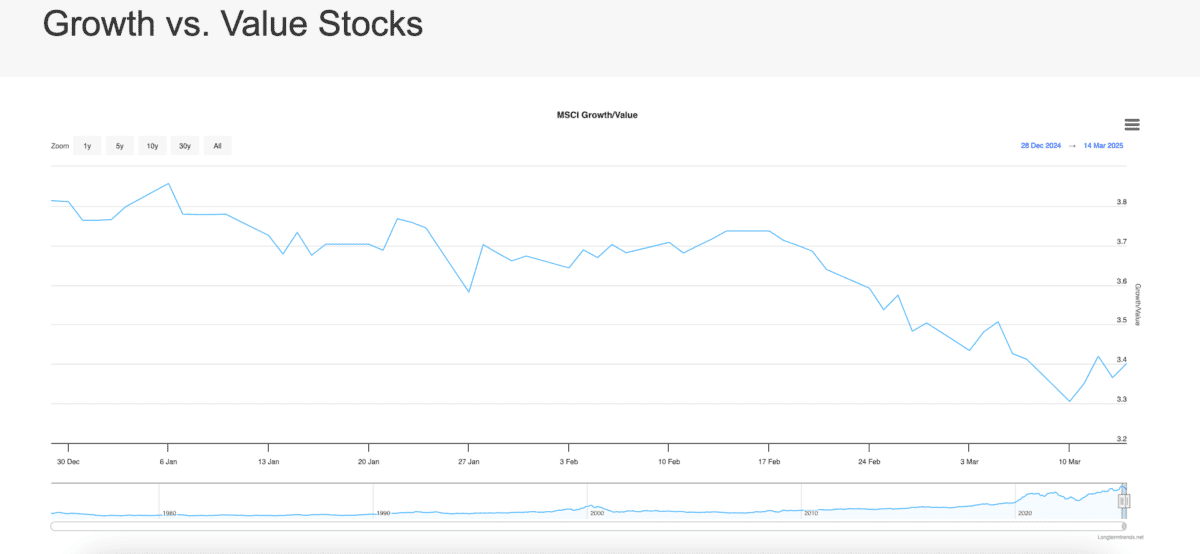
So far this year, the ratio of the MSCI US Growth Index to the MSCI US Value Index has fallen from 3.8 to 3.4. In other words, US growth stocks have underperformed value shares.

Source: Longtermtrends

The same general trend has been true elsewhere. The FTSE 100 has outperformed the S&P 500 in 2025, but a big reason for this is the concentration of growth stocks in the US index.

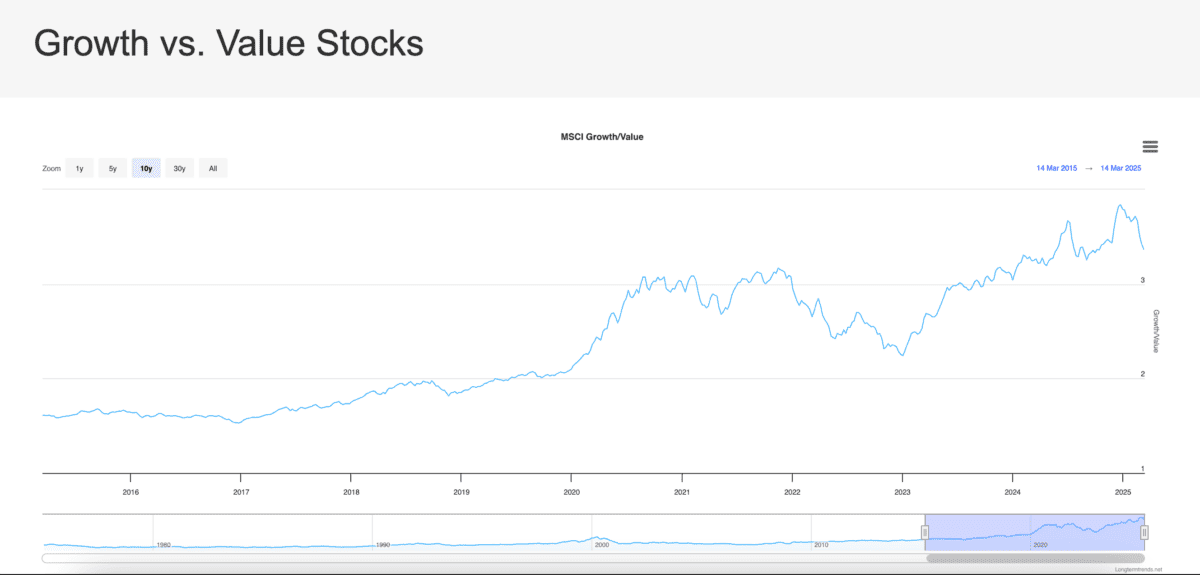
Investors however, should be careful. The gap between growth stocks and value shares has been closing, but it’s still towards the higher end of where it’s been over the last decade.

Source: Longtermtrends

As a result, I don’t see the latest downturn in the stock market as a time to go buying growth stocks hand over fist. But I do think it’s a chance to look for some specific opportunities.

A FTSE 100 grower

Compass Group (LSE:CPG) is a stock that has been catching my eye recently. Shares in the FTSE 100 contract catering firm have fallen 13.5% in the last month. 

Despite this, I think there’s a lot to like about the underlying business. The company’s scale gives it a clear competitive advantage when it comes to negotiating bulk prices from suppliers.  

On top of this, the most recent trading update reported some strong revenue growth. Organic sales were up over 9% and the firm is expecting this to stay above 7.5% for the rest of 2025.

Looking ahead, I think there’s also good potential below the top line. The debt level and the share count are both still high following the pandemic and reducing these should boost profits. 

What’s the problem?

Despite this, the stock’s been falling sharply. And the most recent cause of this has been a double downgrade from Outperform to Underperform by BNP Paribas Exane.

The reason is that job reductions in the US – especially in the healthcare sector – could be set to weigh on demand. And that’s a legitimate cause for concern with the business.

I think however, investors need to keep things in perspective. Healthcare & Senior Living in the US makes up just over 18% of the firm’s total revenues. Given this, a decline of over 13% seems like a big drop and the current share price of £24.25 is below BNP’s revised price target of £25. As a result, I’ve added it to my watchlist.

Finding shares to buy

Growth stocks may have performed worse than value shares since the start of the year. But as a group, I don’t think they’re obviously in bargain territory just yet.

Individually though, I think there are some stocks that have fallen to attractive levels. Compass Group isn’t my top stock to buy just yet, but it’s one that I’m keeping a close eye on.

At 108p, is this one of the best ex-penny stocks to consider buying today?

Penny stocks are enormously popular among investors with a high tolerance for risk and volatility. That shouldn’t be surprising, given all it takes is for one of these tiny companies to erupt into success to unlock skyrocketing returns. And that’s exactly what’s happened with Filtronic (LSE:FTC) over the last two years.

In March 2023, shares of this avionics enterprise were trading close to 12p with a market cap of around £25m. Today, they’re at 108p with a £235m market cap. That’s an 800% return in the space of two years. And to demonstrate just how explosive this is, a £10,000 investment two years ago would now be worth around £90,000!

Considering the UK stock market only averages around 6% to 8% returns each year, this level of growth is pretty phenomenal. But with so much growth already under its belt, is it too late to hop on the gravy train?

Making waves

The primary catalyst behind Filtronic’s current success is its newly formed relationship with Elon Musk’s SpaceX. The company has secured a collection of multi-million-dollar contracts that sent its top line flying, with half-year revenues surging from £8.5m to £25.6m.

With SpaceX planning on drastically expanding its mega-constellation of satellites, demand for Filtronic’s electronic components isn’t likely to subside any time soon. And with management using the proceeds of these new contracts to expand its production capacity in the future, Filtronic may soon find new customers from the aerospace industry knocking on its door.

Analyst forecasts currently predict sales in its 2025 fiscal year (ending in May) will come in just over the £50m threshold, with earnings rising to £4.8m. Assuming these projections are accurate, that’s a notable increase from the £16m and £0.24m of sales and profits reported in its 2023 fiscal year. And it’s easy to understand why there’s a lot of excitement surrounding this enterprise right now.

Too late to buy?

Even if Filtronic meets analyst expectations this year, today’s share price puts the forward price-to-sales ratio at 4.7 and the forward price-to-earnings ratio at 49. These aren’t the sort of figures that can typically be used to describe a cheap stock. And it’s clear that investors are baking in a lot of future long-term growth into the current valuation.

Should Filtronic fail to keep up with investor expectations, the small-cap enterprise could begin behaving like a penny stock again. That would mean enormous share price volatility. So, what could go wrong?

Beyond the usual challenges of supply chain disruptions that many electronic firms have to navigate, Filtronic’s revenue and earnings are currently almost entirely dependent on SpaceX. And this customer concentration risk is problematic.

Given Filtronic’s current dependence on SpaceX, the firm likely doesn’t hold much pricing power when negotiating contracts. And if Filtronic starts falling behind on its existing obligations, the chances of signing future deals could be negatively impacted.

Combining this with the stock’s rich valuation, I’m not rushing to add any Filtronic shares to my portfolio today. The risk is simply too high for my tastes.

Is it time to forget about the Footsie and look to the FTSE 250 for dividend shares?

As a fan of dividend shares, I was surprised to learn the FTSE 250 is currently yielding more than the FTSE 100. According to data from the London Stock Exchange, at 28 February, the yield of the UK’s second tier of listed companies was 3.44%, slightly above the Footsie’s 3.38%.

Based on amounts paid over the past 12 months, there are 27 stocks (10.8%) on the index that are presently yielding 7% or more. By contrast, there are only seven on the FTSE 100 offering this level of return.

But although the yield might be better, when it comes to growth, there’s a big variation in performance. From 1 March 2020 to 28 February 2025, the FTSE 100 (with dividends reinvested) increased by 59.9%. Over the same period, the FTSE 250 returned 20.3%.

A ray of sunshine

A disappointing share price performance is one reason why NextEnergy Solar Fund (LSE:NESF), which owns and operates solar PV and energy storage assets, has the second-highest yield on the FTSE 250. Since March 2020, it’s fallen 20%.

Based on its current stock price (21 March), it’s yielding 12.2%.Turn the clock back to September 2022, when the fund’s shares were at their five-year high, the yield was a more modest 5.9%.

However, in cash terms, its dividend is now 22% higher than it was for the year ended 31 March 2020. And with the demand for electricity continuing to rise, as long as the sun shines it should be able to continue to steadily grow its earnings and its dividend. In fact, since listing in 2014, it’s increased its payout every year.

The fund has 101 operating assets spread across the UK (around 85%) and Europe. These are enough to power over 300,000 homes for a year. At 30 September 2024, its portfolio had a remaining weighted asset life of 25 years. In my opinion, a steady stream of earnings therefore seems assured.

Future prospects

Because of what it does, I suspect NextEnergy Solar Fund is unlikely to deliver spectacular growth. Most of its revenue comes from long-term contracts and government subsidies. To increase its asset base significantly, it would probably need to borrow. As a result, its finance costs would rise, offsetting some of the additional income.

Encouragingly, the fund recently consolidated £205m of debt into one facility, at a lower rate of interest.

At the moment, the shares trade at a 28.4% discount to the fund’s net asset value. Although this is common for similar investment vehicles — valuing unquoted assets can be subjective — it’s bigger than average, which could suggest the recent sell-off has been overdone.

However, some of the differential could be explained by investor concerns. If interest rates stay higher for longer, earnings will be impacted. Also, despite increased investment in renewables, energy prices remain high. This could result in political pressure to cut subsidies.

It’s important to remember that dividends are never guaranteed. But with its focus on renewable energy — and its steady and reliable earnings stream — I think NextEnergy Solar Fund is well positioned to maintain its above-average payout. For this reason, I think it could make an excellent dividend share for income investors to consider.

3 FTSE 100 shares with low P/E ratios and brilliant dividend yields!

A recent weakening in UK share prices gives investors a great chance to go bargain shopping. The FTSE 100 alone has long been considered a great hunting ground for value shares by analysts. This recent fall has only enhanced its reputation.

Right now I’m seeking blue-chip companies that trade on low forward price-to-earnings (P/E) ratios. I’m also looking for Footsie shares with high dividend yields. It’s a combination that could deliver healthy capital appreciation when market confidence recovers. In the meantime, there’s a solid passive income.

Here are three of my favourites today.

M&G

Financial services businesses like M&G (LSE:MNG) can deliver underwhelming returns during periods of poor economic growth and higher inflation. Both of these remain risks looking ahead, and particularly as new trade tariffs loom.

But I still believe this company’s long-term outlook remains undimmed, making it a solid stock for patient investors to consider. The rising importance of financial planning, combined with ageing populations in its markets, provides enormous earnings opportunities.

In the meantime, M&G can use its cash-rich balance sheet to continue investing for growth and paying large dividends. As of the end of 2024, its Solvency II capital ratio was 223%, up a whopping 20% from a year earlier.

With a P/E ratio of just 9.3 times and a 9.4% dividend yield, I think M&G shares offer excellent all-round value.

HSBC

HSBC (LSE:HSBA) faces the same macroeconomic threats as M&G. On top of this, it may have to endure a drop in net interest margins if (as expected) global interest rates keep falling.

Yet I believe these threats are reflected in its low P/E ratio of nine times. I’m also encouraged by its continued resilience in tough conditions, as illustrated by its forecast-beating results for the fourth quarter (when pre-tax profit rose 6% to $32.3bn).

I think profits and dividends here could rise strongly as banking product demand heats up in emerging markets. HSBC is steadily winding down its Western operations and prioritising capital in high-growth Asia to capitalise on this opportunity, too.

With a CET1 capital ratio (a measure of solvency) of 14.9%, HSBC also looks in good shape to pay another large dividend. The yield here for 2025 is 5.7%.

Londonmetric Property

Real estate investment trusts (REITs) like Londonmetric Property (LSE:LMP) are designed to provide maximum dividends to investors. In exchange for tax perks, they must pay a minimum of 90% of annual rental profits out in dividends.

As a consequence, the dividend yield on this Footsie share is currently 6.7%.

Please note that tax treatment depends on the individual circumstances of each client and may be subject to change in future. The content in this article is provided for information purposes only. It is not intended to be, neither does it constitute, any form of tax advice.

That’s not the only thing that’s attracted my eye. With a P/E ratio of 13.8 times, it’s also cheaper based on predicted earnings than peers Tritax Big Box (16.1 times), Warehouse REIT (17.7 times), and Urban Logistics (18 times).

Londonmetric’s assets straddle four main industries: logistics, leisure, convenience retail, and healthcare. This provides earnings resilience across all points of the economic cycle, a key quality for long-term dividend income.

Higher-than-usual interest rates are currently a drag on asset values. But I still think it’s worth a close look at current prices.

£10,000 invested in Diageo shares 1 year ago is now worth…

Diageo (LSE:DGE) shares are down 26% over the past 12 months. And that compounds losses over the pervious year. In fact, Diageo, once one of the largest companies on the FTSE 100, has seen its share fall by almost 50% from its highs.

So, clearly an investment made a year ago would have been a losing one, with £10,000 being worth just £7,400 today. However, an investor would have received around £300 in the form of dividends during the period.

What’s behind the pullback?

Diageo shares have struggled recently due to a combination of global economic pressures and shifting consumer behaviors. The cost-of-living crisis, global inflation, and economic downturns have led to a noticeable downgrade from premium spirits, as consumers increasingly opt for cheaper alternatives.

This trend has been exacerbated by challenges in China, a critical market for growth, as well as the fact that younger generations — notably in the UK — are drinking less alcohol overall, raising concerns about long-term demand. In fact, over a quarter of students don’t drink alcohol, and a further 30% of students drink alcohol less than once a week.

US President Donald Trump hasn’t helped matters. His threats to impose a 200% tariffs on European alcohol exports are a potential challenge to brands like Smirnoff and Baileys. Likewise, tariffs on Mexico and Canada may damage brands like Don Julio. However, UK-made products, and of course, those made in the US, will be exempt from the tariffs.

Diageo is getting cheaper

Tariffs certainly won’t make drinks cheaper, but Diageo stock is more affordable than it used to be. The stock is now trading at 17.4 times forward earnings. That’s down from around 25 times in 2022 when market sentiment was clearly very bullish.

Looking forward, analysts expect earnings to grow at a strong pace over the medium term. The price-to-earnings (P/E) ratio is expected to fall to 15.7 times in 2026 and 14.5 times in 2027.

I think there are several things to unpack here, however. Firstly, the forecast may need adjusting given the threat of Trump’s tariffs. And a dividend-adjusted P/E-to-growth (PEG) ratio still points to a small overvaluation, especially when we include the company’s sizeable net debt.

However, analysts will point to the sheer importance of brand value. I run a small soft drinks company called Sumacqua, and I can attest to the challenges of pitching your product when nobody has heard of you before. That’s not an issue Diageo has. Because people in every corner of the world have heard of Guinness and Johnnie Walker.

The bottom line

Diageo’s shares have flopped due to a mix of market downturns and unforeseen political risks. But that doesn’t mean the business won’t recover in the long run. Its brands remain aspirational in large parts of the world despite Gen Z sticking to the soft stuff. Personally, it’s not a stock I’m particularly interested in buying right now, but I’ll keep watching. Undeniably, it has a very strong moat.

Financial News

Daily News on Investing, Personal Finance, Markets, and more!

Financial News

Policy(Required)