David Tepper says Fed could cut a few more times, but easing too much risks entering ‘danger territory’

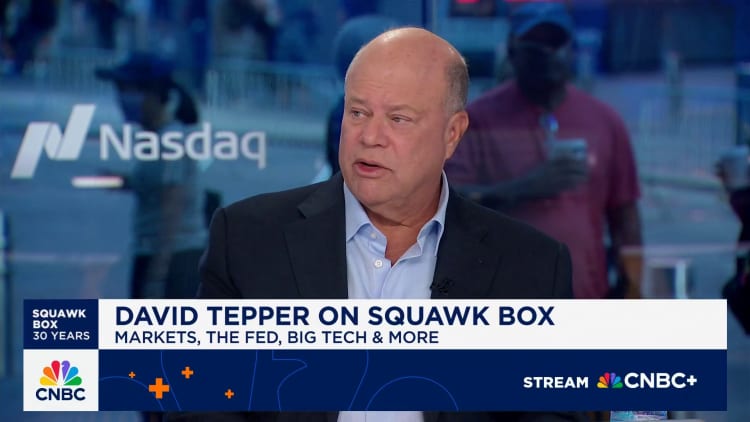
Hedge fund billionaire David Tepper said the Federal Reserve could cut rates a bit more, but then risks more inflation and other dangers to the economy and markets if the central bank goes further than that.

In other words, be careful what you wish for.

“If they go too much more on interest rates, depending what happens with the economy … it gets into the danger territory,” Tepper said on CNBC’s “Squawk Box” Thursday.

His comments come after the central bank lowered interest rates by a quarter point Wednesday, the first cut this year, while signaling two more reductions are coming this year. Fed Chair Jerome Powell characterized the cut as “risk management” rather than something more directed at shoring up a weak economy. President Donald Trump has been pressuring the chief to slash the fed funds rate quickly and aggressively.

Tepper feared that if the Fed cuts rates while inflation hasn’t been fully tamed, demand can pick up faster than supply, reigniting price pressures. Meanwhile, too-easy monetary policy could potentially create asset bubbles as investors keep flocking into riskier corners of the markets.

“My view has been that one easing or two easings or even three easings don’t matter because we’re still in a little restrictive territory with a little bit too high inflation, even without the tariff induced inflation. So they should be a little bit restrictive,” Tepper said. “Beyond that, you’re really risking a lot of things, a weaker dollar, more inflation and those sort of things.”

‘Don’t fight the Fed’

The founder and president of Appaloosa Management noted valuations are high, but he wouldn’t bet against stocks yet while the Fed is still in easing mode.

“I don’t love the multiples, but how do I not own it?” Tepper said. “I’m not ever fighting this Fed especially when the markets tell me… one and three quarter more cuts before the end of the year, so that’s a tough thing not to own.”

The S&P 500 is trading at almost 23 times forward earnings, near the highest level since April 2021, according to FactSet. Valuations for some of the megacap tech names have become sky-high. Nvidia’s price-to-earnings ratio is at 30 times, while Microsoft trades at nearly 32 times forward earnings.

“I’m constructive because of the easing right now, but I’m also miserable because of the levels,” he said. “Nothing’s cheap anymore.”

Tepper, also the owner of football team Carolina Panthers, revealed he’s been trading his Nvidia position. At the end of June, Appaloosa held about $277 million worth of the chip stock, owning it as the fund’s seventh biggest bet.

“I do own Nvidia, but I go back and forth a little bit… trade a little bit,” Tepper said. “We’ve always had some Nvidia position, but not the same size.”

Click here to watch the full interview.

Top Wall Street analysts bet on the potential of these 3 stocks for the long haul

Jaque Silva | Nurphoto | Getty Images

The latest earnings season has addressed investors’ concerns about the artificial intelligence boom, thanks to the robust growth outlook and capital spending projections of many tech companies.

Investors seeking exposure to companies that are well-positioned to capture AI-led growth can track the recommendations of top Wall Street analysts, who can help pick the stocks that can deliver attractive returns over the long term.

Here are three stocks favored by the Street’s top pros, according to TipRanks, a platform that ranks analysts based on past performance.

Broadcom

Semiconductor company Broadcom (AVGO) reported impressive fiscal third-quarter results and issued solid guidance, thanks to AI tailwinds. AVGO stock rallied following the results, as the company stated that it has secured a new $10 billion customer. 

Citing strong fundamentals, JPMorgan analyst Harlan Sur reaffirmed a buy rating on Broadcom stock and boosted the price target to $400 from $325, saying that AVGO remains a top pick in semiconductors. Likewise, TipRanks’ AI Analyst has an “outperform” rating on AVGO stock with a price target of $396.

Sur attributed Broadcom’s strong results and solid revenue outlook for the October quarter to accelerating AI demand, stabilizing non-AI semiconductors, and impressive momentum in the VMware business.

The 5-star analyst noted the 18% sequential growth in AVGO’s Q3 FY25 AI revenue, with the company guiding a 19% quarter-over-quarter growth to $6.2 billion for the fiscal fourth quarter. He added that Broadcom is on track to deliver about $20 billion in AI revenue in fiscal 2025.

Sur believes that the new customer from whom Broadcom secured orders worth $10 billion is OpenAI, considering the AI inference use case and his prior research. The analyst now expects AI revenue to increase by 125% to $45 billion in fiscal 2026, followed by a 60% increase in fiscal 2027. Sur said the strength in AVGO’s AI revenue supports his view that the company’s internally developed custom AI chips offer meaningful differentiation, efficiency and improved economics.

“Despite macro volatility, Broadcom’s diversified portfolio and product cycles support a solid revenue growth profile,” concluded Sur.  

Sur ranks No. 39 among more than 10,000 analysts tracked by TipRanks. His ratings have been profitable 67% of the time, delivering an average return of 26.1%. See Broadcom Statistics on TipRanks.

Zscaler

Next on this week’s list is Zscaler (ZS), a cybersecurity company that recently delivered strong results for the fourth quarter of fiscal 2025, driven by demand for its Zero Trust and AI security solutions.

Impressed by the Q4 FY25 print, Stifel analyst Adam Borg reiterated a buy rating on Zscaler stock and raised the price forecast to $330 from $295. Interestingly, TipRanks’ AI Analyst has a “neutral” stock on ZS stock with a price target of $298.

Borg stated that Zscaler delivered solid results, consistent with Stifel’s positive checks. He added that the company’s Q4 FY25 performance was strong across key metrics, driven by strong execution and demand for the company’s broadening Zero-Trust portfolio. Borg was particularly pleased with robust growth in billings and remaining performance obligations. Notably, RPO growth (31%) accelerated for the fourth consecutive quarter.

The 5-star analyst is optimistic about the adoption of Zscaler’s offerings across emerging areas, like AI security. Borg is also upbeat about the company’s newer solutions like Z-Flex. He continues to believe that “Zscaler’s leading-portfolio helps improve an organization’s security posture, drives vendor consolidation, and reduces costs.”

Bord expects Zscaler to sustain at least high-teens top-line growth and margin expansion in the coming years, driven by multiple drivers.

Borg ranks No. 324 among more than 10,000 analysts tracked by TipRanks. His ratings have been successful 77% of the time, delivering an average return of 16.9%. See Zscaler Ownership Structure on TipRanks.

Oracle

Database software maker and cloud infrastructure company Oracle (ORCL) saw its stock spike this week, as the company’s robust cloud growth projections overshadowed its Q1 earnings miss. The company surprised the market by reporting a 359% year-over-year growth in its remaining performance obligations, a measure of contracted revenue, to $455 billion.

Oracle’s robust outlook made Jefferies analyst Brent Thill increase his price target to $360 from $270 while reiterating a buy rating on the stock. TipRanks’ AI Analyst also has an “outperform” rating on ORCL stock with a price target of $264.

“RPO stole the show in F1Q,” stated Thill. The 5-star analyst added that Oracle’s Q1 RPO crushed estimates and reinforced his confidence in the company’s narrative about acceleration in its growth.

Thill highlighted that Oracle added $317 billion sequentially in RPO, nearly five times the fiscal 2026 total revenue estimate of $67 billion, which supports growing AI optimism. He noted that this massive growth can be mainly attributed to four multi-billion-dollar contracts across three customers, with more such deals expected to close soon and drive RPO beyond $500 billion.

The analyst also pointed out that the Oracle Cloud Infrastructure (OCI) business is expected to grow by 77% to $18 billion in fiscal 2026 and then jump to $144 billion by fiscal 2030. Thill added that this impressive growth forecast indicates the rising demand for AI inference and training workloads, which management sees as a massive total addressable market that the company can capture.

Additionally, Thill mentioned the impressive surge in Oracle’s multicloud database revenue, though off smaller numbers, suggesting rapid adoption of the company’s multicloud strategy. In fact, Oracle now expects notable growth in multicloud revenue every quarter for the next several years while expanding to 71 (net addition of 37) data centers across hyperscaler peers.

Thill ranks No. 128 among more than 10,000 analysts tracked by TipRanks. His ratings have been successful 67% of the time, delivering an average return of 14.9%. See Oracle Insider Trading Activity on TipRanks.

Don’t miss these insights from CNBC PRO

More investors want public and private assets in their portfolio. Now there’s a benchmark to track this combo

  • The Morningstar PitchBook US Modern Market 100 Index, or the Modern Market 100, is the first to combine public and private equity exposure in one index.
  • The benchmark is meant to capture the performance of 100 of the largest U.S. companies, broken down to 90 public firms and 10 venture-backed companies, the firm said.
Traders work on the floor at the New York Stock Exchange (NYSE) in New York City, U.S., August 14, 2025.
Brendan McDermid | Reuters

With the desire to have private market exposure alongside publicly traded stocks gaining traction among investors, Morningstar has developed a benchmark to reflect the trend.

The Morningstar PitchBook US Modern Market 100 Index, or the Modern Market 100, is the first to combine public and private equity exposure in one index, the investment research company announced Wednesday. The benchmark is meant to capture the performance of 100 of the largest U.S. companies, broken down to 90 public firms and 10 venture-backed companies, the firm said.

The 90/10 skew is designed to reflect what Morningstar considers the modern asset universe, which is one where opportunities are expanding in the private markets and companies such as OpenAI and Stripe are able to stay private for longer.

“Companies don’t feel the urge to go public because they can raise a lot of capital,” Sanjay Arya, head of innovation, index products, at Morningstar. “So, to ignore them, I think you’re missing out on some of the fastest, most dynamic companies out there.”

Retail investors’ growing access to private markets in Europe could be a double-edged sword

The private equity universe is dwarfed by the value of publicly held companies. The U.S. public stock market is worth roughly $60 trillion, while the U.S. private equity universe is roughly $8 trillion, Arya said. However, private companies may reflect where the economy is heading.

“The indexes are supposed to give you an indication about what the economy is, or the market sentiment is, or where people investors should be looking for opportunities,” Arya said. “And you can’t do that on public markets alone if a big chunk of it is outside public markets.” 

The trend may become even more pronounced. Alternative asset managers notched a big win this summer after President Donald Trump in August signed an executive order clearing the path for alternative assets to be added into 401(k)s. 

Yet exposure to private assets has been growing for years. According to Morningstar, since 2021, crossover investors including sovereign wealth funds, private equity buyout firms, and hedge funds have been involved in roughly 5,000 private market transactions totaling $450 billion. Arya is hoping the Modern Market 100 will give investors a framework to benchmark performance across both asset classes.

It isn’t without its challenges, however. The work started roughly four years ago, Arya said, explaining that the firm needed to develop a rules-based process for a public-private benchmark, given the challenge in pricing securities for private assets. He said his team relied on secondary trading platforms such as Caplight and Zanbato to aggregate pricing transaction data. The index also applies liquidity screens, quarterly rebalances and daily calculations.

More risk

The index is also tracking companies with inherently more risk given their preference for the largest cap companies, which tend to skew toward big tech. The top 10 public constituents in the modern market index include Microsoft, Nvidia, Apple, Amazon and Meta Platforms. The top 10 private constituents include SpaceX, OpenAI, xAI and Stripe.

In other words, there’s a preference for growth companies with more inherent risk. That could mean the index is vulnerable to a pullback if the tech sector starts to falter — especially at a moment when many investors fear the megacaps are priced for perfection.

On the other hand, it could mean the benchmark is poised to capture more outperformance. In a white paper, Morningstar showed that the 1-year return for the Modern Market index is 28.2%. Over the same time period, the S&P 500 jumped 20%.

According to Arya, the index allows investors to track a very different opportunity than what is captured in major benchmarks. After all, OpenAI, a company reportedly valued at $500 billion, is bigger than Exxon Mobil, Palantir or Procter & Gamble, and yet it’s a name that most investors have little exposure to in their portfolios.

He noted that benchmarks have evolved over time to better reflect the drivers of economic growth, starting with the railroad companies that defined the Dow Jones Industrial Average at its inception in the late 1800s to the innovation economy of today.

“We have this big component of innovation economy, and not being able to fully capture that, which is mostly right still in the late-stage venture space, I think it just kind of provides a fuller picture.” Arya said.

“That actually helps you understand how these contours are kind of shifting over time,” he continued. “I think, provides great insights for investors.”

Top Wall Street analysts prefer these 3 dividend-paying stocks for consistent income

Two drilling rigs are pictured in Midland, Texas, U.S., Oct. 8, 2024.
Georgina Mccartney | Reuters

Many pundits are expecting major indices to be volatile due to macro uncertainty. Moreover, on average, September has historically been the worst month for U.S. stocks.

Investors seeking consistent income despite a volatile market can consider adding dividend-paying stocks to their portfolios. To this end, they can rely on the recommendations of top Wall Street analysts, who with their expertise can help select attractive dividend stocks with strong fundamentals.

Here are three dividend-paying stocks, highlighted by Wall Street’s top pros, as tracked by TipRanks, a platform that ranks analysts based on their past performance.

Archrock

This week’s first dividend pick is Archrock (AROC), an energy infrastructure company with a primary focus on midstream natural gas compression. The company paid a dividend of 21 cents per share for the second quarter, an increase of about 11% over the first-quarter dividend. At an annualized dividend of 84 cents, AROC offers a yield of 3.3%.

In a recent research note, Mizuho analyst Gabriel Moreen updated the models and price targets for master limited partnerships (MLPs) and midstream companies. Moreen reiterated a buy rating on Archrock stock and modestly raised the price forecast to $32 from $31. Interestingly, TipRanks’ AI Analyst has an “outperform” rating on AROC stock with a price target of $27.

Moreen said AROC continues to “distinguish itself with exceptional balance sheet flexibility,” which allows it to deliver not only solid capital returns like its $28.8 million share repurchase in the second quarter, but also supports higher capital spending and dividend expansion.

Notably, the 5-star analyst highlighted that AROC indicated that it expects its dividend to increase consistently with recent dividends per share growth, if the business performs. Consequently, Moreen increased his dividend per share estimates for fiscal 2025, 2026, and 2027 to 83 cents, 93 cents and $1.02, reflecting a year-over-year growth of 20%, 12% and 10%, respectively.

The analyst stated that AROC demonstrated strong operational momentum by raising its adjusted EBITDA (earnings before interest, taxes, depreciation, and amortization) guidance for the second consecutive quarter, although there were some one-time items. Moreover, Moreen believes that Archrock’s aggressive capex outlook stands out, as it clearly indicates that the company is seeing solid demand for new orders despite the volatility following “liberation day.”

Moreen ranks No. 112 among more than 10,000 analysts tracked by TipRanks. His ratings have been profitable 76% of the time, delivering an average return of 13.9%. See Archrock Ownership Structure on TipRanks.

Brookfield Infrastructure Partners

Next up is Brookfield Infrastructure Partners (BIP), a leading global infrastructure company that owns and operates diversified, long-life assets in the utilities, transport, midstream and data sectors. BIP declared a quarterly distribution of 43 cents per unit payable on Sept. 29, reflecting a 6% year-over-year increase. BIP stock offers a dividend yield of 5.6%.

Recently, Jefferies analyst Sam Burwell resumed coverage of Brookfield Infrastructure stock with a buy rating and a price target of $35. In comparison, TipRanks’ AI Analyst has a price target of $34 but a “neutral” rating.

Burwell stated that BIP remains a “unique beast” with an expanding footprint. He noted three significant acquisitions since April – the Colonial Pipeline, rail car leasing with GATX, and the Hotwire fiber-to-home business, all of which were U.S.-focused and highly contracted. Additionally, all three have strengthened BIP’s midstream, transport, and data businesses, respectively.

“While BIP’s broad footprint remains complex, we tend to view positively that the YTD acquisitions have been in the US and that most of the divestitures have been ex-North America,” said Burwell.

The top-rated analyst contended that while BIP stock has stagnated over the last few years, its upcoming investor day provides an opportunity to help the market better understand the transactions made in 2025. Burwell expects BIP’s funds from operations (FFO) to grow at a nearly 9% compound annual growth rate (CAGR), excluding to-be-announced capital recycling. Burwell also expects solid distribution growth at about 6.5% CAGR through 2027.

Burwell ranks No. 848 among more than 10,000 analysts tracked by TipRanks. His ratings have been successful 64% of the time, delivering an average return of 15.7%. See Brookfield Infrastructure Statistics on TipRanks.

Permian Resources

Another dividend-paying energy stock is Permian Resources (PR). It is an independent oil and natural gas company having assets in the Permian Basin, with a concentration in the core of the Delaware Basin. The company declared a base dividend of 15 cents per share for the third quarter of 2025, payable on Sept. 30. At an annualized dividend per share of 60 cents, PR stock offers a dividend yield of 4.3%.

Recently, Goldman Sachs analyst Neil Mehta reaffirmed a buy rating on Permian stock with a price forecast of $17. Likewise, TipRanks’ AI Analyst has an “outperform” rating on PR stock with a price target of $16.50.

Mehta highlighted that Permian Resources continued to ramp its operations in the second quarter across the acquired assets from APA Corp. and other smaller bolt-on acquisitions. Moreover, the company announced new transportation and marketing agreements to enhance oil and natural gas netbacks, which are estimated to drive incremental free cash flow of over $50 million in 2026 compared with 2024.

Despite the uncertainty around oil prices, the 5-star analyst remains bullish on Permian Resources, given its cost optimization efforts and focus on delivering higher free cash flow per share. The analyst noted management’s commentary about PR’s solid balance sheet, which allows it to make strategic investments without disrupting its capital allocation priorities, such as increasing cash on the balance sheet, share repurchases, and debt reduction.

“We believe PR’s focus on opportunistically acquiring high-quality assets along with consistent grassroots acquisitions can drive long-term shareholder value,” said Mehta.

Mehta ranks No. 670 among more than 10,000 analysts tracked by TipRanks. His ratings have been successful 59% of the time, delivering an average return of 9%. See Permian Resources Insider Trading Activity on TipRanks.

Pepsi shares jump 4% after WSJ reports Elliott planning major activist campaign

Pepsi soft drinks are displayed at a convenience store in San Francisco, California.
Justin Sullivan | Getty Images

PepsiCo shares popped Tuesday after the Wall Street Journal reported Elliott Investment Management has taken a significant stake to become the consumer giant’s top five active investors excluding index funds.

Shares of PepsiCo climbed 4.5% in premarket trading. The stock is down about 2% this year, significantly lagging the broader market.

Loading chart…

The Paul Singer-founded Elliott’s bet in Pepsi is worth about $4 billion, the Journal reported, citing people familiar with the matter. Elliott’s plan to push for changes at Pepsi is unclear at this time, the Journal said.

Elliott didn’t immediately respond to CNBC’s request for comment.

Pepsi has been cutting costs and trying to improve its profit margins. The company closed two manufacturing plants for its North American food business during the quarter. Pepsi said it is trying to make its transportation and logistics more efficient. The company is also evaluating how it spends its marketing dollars to make sure it is getting the best return on its investment.

In July, Pepsi reported quarterly earnings and revenue that topped analysts’ expectations, as the company projected that weak North American demand will rebound as strategy changes take hold.

Elliott has a history of activism that has at times yielded strong returns for investors. It’s a large holder of Phillips 66 and Southwest Airlines and has been driving changes at those two companies.

— Click here to read the original WSJ story.

Top Wall Street analysts recommend these 3 stocks for long-term investors

Dado Ruvic | Reuters

Concerns about an artificial intelligence (AI) bubble and macroeconomic uncertainties are affecting the stock market. Investors can look beyond short-term fluctuations, however, and focus on buying stocks that can deliver attractive returns over the long term.

With their thorough research and in-depth analysis, top Wall Street analysts can help identify stocks with solid fundamentals and lucrative growth potential.

Here are three stocks favored by the Street’s top pros, according to TipRanks, a platform that ranks analysts based on their past performance.

Palo Alto Networks

Cybersecurity company Palo Alto Networks (PANW) is this week’s first stock pick. The company recently reported better-than-expected results for its fourth quarter of fiscal 2025. PANW also issued upbeat guidance for its fiscal first quarter and coming full year.

Following the results, RBC Capital analyst Matthew Hedberg reiterated a buy rating on Palo Alto with a 12-month price forecast of $232. Interestingly, TipRanks’ AI Analyst has an “outperform” rating on PANW stock with a price target of $197.

“The punchline is that we believe the quarter and outlook demonstrate the proposed CyberArk acquisition is coming from a position of strength, debunking the organic weakness concern,” said Hedberg.

The 5-star analyst highlighted that Palo Alto ended fiscal 2025 on a strong note, with results and outlook surpassing estimates across the board. Hedberg noted management’s commentary about momentum being driven by strength in Palo Alto’s XSIAM offering, AI demand driving software firewall needs and growth in Secure Access Service Edge (SASE) solutions.

Hedberg also cheered the company’s Fiscal 2028 target to generate more than 40% in free cash flow margins for the combined Palo Alto/CyberArk company. Overall, Hedberg finds the stock’s risk/reward attractive at current prices, especially as he sees PANW as an AI beneficiary and believes that it is insulated from broader risk around AI disruption in other software categories.

Hedberg ranks No. 94 among more than 10,000 analysts tracked by TipRanks. His ratings have been profitable 65% of the time, delivering an average return of 19.2%. See Palo Alto Statistics on TipRanks.

MongoDB

This week’s next pick, database software maker MongoDB (MDB), rallied after reporting better-than-expected results for the second quarter of fiscal 2026 and giving a solid forecast.

Impressed by the results, Stifel analyst Brad Reback reaffirmed a buy rating on MongoDB and raised his price target to $325 from $275, saying the company posted one of its strongest quarters ever. By comparison, TipRanks’ AI Analyst has assigned a price target of $241 and an “outperform” rating on MDB stock.

Reback highlighted that MongoDB’s Q2 FY26 revenue exceeded the consensus by about 7%, with upside coming from outperformance in both its cloud database service Atlas and Enterprise Advanced (EA)/non-Atlas businesses. The analyst added that revenue upside and continued focus on operational efficiencies helped deliver Q2 FY26 operating profit margin of 14.7%, surpassing expectations by more than 4 percentage points.

The top-ranked analyst was mainly impressed by the growth in MongoDB’s Atlas offering, driven by a healthy increase in consumption across its installed base, impressive new customer additions of 2,800 and emerging AI workload gains.

Overall, Reback believes that “Atlas is positioned to sustain 25%+ revenue growth,” fueled by stabilizing consumption, enhanced sales execution and a growing set of core and emerging product drivers.

Reback ranks No. 760 among more than 10,000 analysts tracked by TipRanks. His ratings have been successful 52% of the time, delivering an average return of 10.2%. See MongoDB Ownership Structure on TipRanks.

International Flavors & Fragrances

Finally, we look at International Flavors & Fragrances (IFF), a company that provides flavors, scents and ingredients for industries including food, beverage and personal care. As part of its strategy of focusing on high-return businesses, IFF announced the divestiture of its soy crush, concentrate and lecithin business.

In a research note dated August 26, Tigress Financial analyst Ivan Feinseth reiterated a buy rating on IFF with a price target of $105. However, TipRanks’ AI Analyst has a “neutral” rating on IFF with a price objective of just $65.

Feinseth discussed IFF’s progress in its strategic initiatives, bolstered by a focus on innovation in high-margin products and efforts to optimize its product portfolio and balance sheet. The 5-star analyst highlighted the company’s expanding profit margins and long-term revenue and cash flow growth potential.

Additionally, Feinseth believes that IFF is well-positioned to capitalize on secular, health-focused growth trends in food and nutrition, thanks to its “robust pipeline of functional ingredients, expertise in sensory science and biotechnology, and deep relationships with global brands.”

The analyst noted that through its strategic initiatives, IFF is creating significant shareholder value. Feinseth mentioned that IFF paid $102 million in dividends in Q2 2025 and announced a new $500 million share repurchase authorization.

Feinseth ranks No. 205 among more than 10,000 analysts tracked by TipRanks. His ratings have been profitable 64% of the time, delivering an average return of 14.9%. See International Flavors & Fragrances Technical Analysis on TipRanks.

Trump’s Cook firing will likely end up in the Supreme Court’s hands

  • President Donald Trump’s attempt to fire Fed Governor Lisa Cook will likely end up before the Supreme Court, Wall Street economists and analysts say.
  • The Federal Reserve Act allows presidents to remove Fed governors “for cause,” but the statute is ambiguous about what this means.
  • If Trump successfully ousts Cook, he would be on a path to gain a Fed majority and reshape the Federal Open Market Committee, giving him more influence over rates.
The U.S. Supreme Court is shown March 17, 2025 in Washington, DC. 
Win Mcnamee | Getty Images

President Donald Trump’s unprecedented attempt to fire Federal Reserve Board Governor Lisa Cook will likely end up in the hands of the Supreme Court, according to Wall Street economists and analysts.

Trump on Monday evening claimed to fire Cook “for cause” effectively immediately over allegations she made false statements on applications for home mortgages.

It is the first time a president has attempted to fire a Fed governor since Congress established the central bank in 1913, Evercore ISI told clients in a note Tuesday.

“Although we think it could go either way, our guess is that SCOTUS will uphold this move,” Wolfe Research head of U.S. policy and politics Tobin Marcus told clients Tuesday. “The legal protections for the Fed chair and for non-chair governors are the same, so a SCOTUS ratification of this move would sharply erode Fed independence, and even the attempt to fire Cook raises obvious concerns.”

For cause, or not for cause

Cook said she would not leave her post, arguing that Trump had no cause under the law to fire her. Cook’s lawyer Abbe Lowell said Tuesday that they “will be filing a lawsuit challenging this illegal action.”

The case will likely wind its way through the courts and end up before the Supreme Court, Raymond James Washington policy analyst Ed Mills told clients Monday. This is because the Federal Reserve Act gives the president the authority to fire board governors “for cause” but what that means exactly is left ambiguous in the statute, Mills said.

FILE PHOTO: Lisa DeNell Cook, nominee to be a member of the Board of Governors of the Federal Reserve System, testifies during a Senate Banking nominations hearing on June 21, 2023 in Washington, DC.
Drew Angerer | Getty Images

“The alleged mortgage fraud occurred before Cook became Governor, and ‘for cause’ protection is often believed to be limited to causes occurring during one’s tenure in office,” JPMorgan chief U.S. economist Michael Feroli told clients Monday, though he noted that “for cause” removals do not have much precedent.

Trump path to Fed majority

In the near term, Cook will seek an injunction against Trump’s move and the U.S. District Court for the District of Columbia will likely grant her one, Marcus said. This would preserve the status quo at the Fed until the Supreme Court weighs in, the analyst said.

If Trump gets his way and forces Cook out before the year is over, he will be on a path to gain a majority on the Fed’s board before it votes on regional presidents in January, TD Cowen policy analyst Jaret Seiberg told clients on Tuesday. 

Trump’s replacement for Cook would join appointees Fed Vice Chair Michelle Bowman and Fed Governor Chris Waller — and nominee Stephen Miran, who is expected to fill the vacancy left by Adriana Kugler after she resigned earlier this month.

“This matters as the President’s majority could reject the picks from the reserve banks in favor of picks that support lower rates,” Seiberg said. “This would face hurdles, but if it works it would give Trump more influence over the FOMC and interest rates.”

Top Wall Street analysts favor these 3 dividend stocks for steady returns

Customers shop at a Home Depot store on August 19, 2025 in Chicago, Illinois.
Scott Olson | Getty Images

Investors seeking steady returns amid macro uncertainties ought to consider adding dividend-paying stocks to their portfolios.

Given the vast universe of dividend-paying stocks, it can be challenging for investors to identify the most attractive ones. To this end, the recommendations of top Wall Street analysts could make the task easier, as the decisions of these experts are based on in-depth financial analysis.

Here are three dividend-paying stocks, highlighted by Wall Street’s top pros, as tracked by TipRanks, a platform that ranks analysts based on their past performance.

MPLX LP

We begin with MPLX LP (MPLX), a diversified, master limited partnership (MLP) that owns and operates midstream energy infrastructure and logistics assets and provides fuel distribution services. The company recently announced an agreement to acquire Northwind Delaware Holdings LLC for about $2.38 billion. The deal is expected to enhance the company’s Permian Basin natural gas and natural gas liquids (NGL) value chains.

Meanwhile, MPLX reported distributable cash flow (DCF) of $1.4 billion for the second quarter, enabling the return of $1.1 billion of capital. MPLX offers a current dividend yield of 7.5%.

Recently, Stifel analyst Selman Akyol reaffirmed a buy rating on MPLX stock and increased the price forecast to $60 from $57. The analyst explained that while MPLX’s Q2 results fell short of his expectations, he remains encouraged by the company’s growth, further bolstered by its recent Northwind acquisition and its gathering and downstream operations. The analyst added that it may take 12 to 18 months to see the full impact as expansions roll out.

“Management remains confident in its ability to grow its distribution at 12.5% for the next several years,” said Akyol. The analyst highlighted that MPLX has grown both its EBITDA (earnings before interest, tax, depreciation, and amortization) and DCF at a compounded growth rate of 7% over the last four years. He expects this trend to continue with assets that produce durable cash flows coming online.

Overall, Akyol is bullish on MPLX, thanks to its diverse asset base and the Northwind acquisition. Interestingly, TipRanks’ AI Analyst has an “outperform” rating on MPLX with a price target of $55.

Akyol ranks No. 319 among more than 9,900 analysts tracked by TipRanks. His ratings have been profitable 66% of the time, delivering an average return of 10.6%. See MPLX Ownership Structure on TipRanks.

EOG Resources

Oil and gas exploration and production company EOG Resources (EOG) is the next dividend pick this week. The company paid $528 million in dividends and repurchased $600 million shares in the second quarter. EOG has declared a quarterly dividend of $1.02 per share, payable on Oct. 31. With an annualized dividend of $4.08 per share, EOG offers a dividend yield of 3.4%.

Recently, RBC Capital analyst Scott Hanold reiterated a buy rating on EOG stock with a price target of $140. TipRanks’ AI Analyst is also upbeat about EOG and has an “outperform” rating with a price target of $133.  

EOG is bolstering its position in the Utica shale with the acquisition of Encino Acquisition Partners. Hanold expects the company’s solid track record of improving operations to reflect in the Utica region over the upcoming quarters. “The Utica should garner a lot of investor attention moving forward, as we think it can become a foundational asset for EOG in fairly short order,” said the analyst.

Hanold also expects EOG’s first mover activity in the Gulf Nations (Bahrain and UAE), targeting unconventional activity to present longer-term value opportunities. Moreover, Hanold expects EOG’s growing natural gas exposure to exceed 3 Bcf/d (billion cubic feet per day), on a net basis, by the end of 2025, thanks to the company’s Dorado pure-gas focused development and the opportunity in the Utica.

The analyst added that the long-term secular outlook for natural gas remains robust and EOG is well-positioned to capitalize on that opportunity. Given that EOG was an early mover to secure premium gas commercial agreements, Hanold thinks its two gas plays could attract attention from hyperscalers due to their massive scale.

Finally, Hanold pointed out that EOG’s solid balance sheet, which remains best in class across the energy spectrum, enables management to generate high levels of shareholder returns, despite macro uncertainty. He stated that increasing the fixed dividend at a leading rate continues to be a “core tenet” and is supported by the company’s lower break-even level.

Hanold ranks No. 26 among more than 9,900 analysts tracked by TipRanks. His ratings have been successful 66% of the time, delivering an average return of 28.9%. See EOG Resources Statistics on TipRanks.

Home Depot

Finally, let’s look at home improvement retailer Home Depot (HD). While the company’s Q2 adjusted earnings and revenue fell short of Wall Street’s expectations, it maintained its full-year guidance. Home Depot said that momentum continued to improve in its core categories throughout the quarter. At a quarterly dividend of $2.30 (annualized per share dividend of $9.20), HD stock offers a yield of 2.2%.

Following the Q2 print, Truist analyst Scot Ciccarelli reiterated a buy rating on Home Depot stock and increased his price forecast to $454 from $433, citing improving underlying trends in the core business. In comparison, TipRanks’ AI Analyst has a price target of $458 with an “outperform” rating on HD stock.

Ciccarelli noted that Home Depot witnessed its broadest sales growth across categories and geographies in over two years. He added that the company delivered its third consecutive quarter of comparable sales growth in the U.S., with accelerating trends as weather normalized.

The analyst contended that while large (financed) project spending remains subdued, demand continues to rise, with big-ticket (over $1,000) transactions growth accelerating to 2.6% in Q2 FY25. Moreover, Home Depot is experiencing a double-digit increase in sales to professionals, who use their new trade credit and leverage the same/next-day delivery services.

Additionally, Ciccarelli noted that Home Depot is more insulated from tariff-led volatility than other companies in Truist’s coverage. The analyst attributed HD’s ability to sail through the ongoing tariff challenges without raising prices to its buying power and diversified sourcing model.

Ciccarelli ranks No. 11 among more than 9,900 analysts tracked by TipRanks. His ratings have been profitable 76% of the time, delivering an average return of 19.2%. See Home Depot Insider Trading Activity on TipRanks.

Ether surges, trading close to its record again after Powell speech teasing rate cuts

foreground of header

Watch Daily: Monday – Friday, 3 PM ET

Omar Marques | Lightrocket | Getty Images

The price of ether tried for a new record on Friday after Federal Reserve Chair Jerome Powell hinted at upcoming rate cuts and investors returned to risk-on mode.

The second-largest cryptocurrency was last higher by nearly 14% at $4,817.61, according to Coin Metrics. Earlier, it traded as high as $4,856.61, nearing its 2021 all-time high of $4,866.01.

Bitcoin rose 4% to $116,820.01.

Stock chart icon

hide content
Ether (ETH) bounces after Powell’s Jackson Hole speech

The moves came during Powell’s annual address from Jackson Hole, Wyoming. “With policy in restrictive territory, the baseline outlook and the shifting balance of risks may warrant adjusting our policy stance,” said Powell.

“Traders seem to have been caught completely off-sides by Powell’s dovish comments today,” said Jordi Alexander, CEO at crypto trading firm Selini Capital. “The market positioning in recent sessions has seen clear risk-off moves in assets like crypto and tech, and today’s setting up of a September rate cut is causing a panicked repositioning, which could continue through the illiquid weekend as shorts get squeezed.”

“Momentum is back on the menu with the administration and the Fed seemingly aligned on easing,” he added.

Around the time of the speech, ETH saw about $120 million in short liquidations in a one-hour period, according to CoinGlass. When traders use leverage to short ether and the coin’s price rises, they buy ETH back from the market to close their positions. In turn, this pushes the coin’s price even higher and results in more positions being liquidated.

Shares of companies focused on accumulating ether, which were some of the hardest hit this week when investors rotated out of tech names, bounced with the coin Friday. Bitmine Immersion and SharpLink Gaming jumped nearly 12% and 15%, respectively. Bitmine fell almost 8% on the week, its first down week in three.

Shares of Peter Thiel-backed ETHzilla tumbled more than 31% at one point Friday after the ether treasury company offered up to 74.8 million of its shares for resale. It ended the session off 31.4% following Powell’s Jackson Hole remarks.

Elsewhere, Solana-focused treasury firm DeFi Development surged 21%, and crypto exchange Coinbase and bitcoin proxy Strategy advanced 6% each.

Don’t miss these cryptocurrency insights from CNBC Pro:

Crypto stocks tumble on Tuesday as investors go into risk-off mode

foreground of header

Watch Daily: Monday – Friday, 3 PM ET

The Coinbase logo is displayed on a mobile phone screen with stock market percentages in the background.
Idrees Abbas | Sopa Images | Lightrocket | Getty Images

Crypto stocks suffered on Tuesday as investors fled tech stocks and riskier corners of the market.

Among crypto exchanges, Coinbase and eToro fell more than 5% each, while Robinhood and Bullish both dropped more than 6%. Crypto financial services firm Galaxy Digital dropped 11%. In the burgeoning sector of crypto treasury firms, Strategy lost 7%, SharpLink Gaming slid 8%, Bitmine Immersion slumped 12% and DeFi Development tumbled 15%. Stablecoin issuer Circle lost 5%.

Meanwhile, the price of bitcoin pulled back nearly 3% to just over $113,000. Ether was down more than 4% to the $4,100 level, according to Coin Metrics.

Stock chart icon

hide content
Bitcoin over the past day

Investors appeared to rotate out of tech names on Tuesday. The sector had seen a boost last week as traders weighed the prospect of more interest rate cuts. Also, bitcoin touched an intraday all-time high near $125,000 last week.

On Tuesday, the Nasdaq Composite was down more than 1%, weighed down by declines in Nvidia and other tech heavyweights.

The crypto market tends to be vulnerable to moves in tech stocks due to their growth-oriented investor base, narrative-driven price action, speculative nature and tendency to thrive in low-interest rate environments.

This week, investors are watching the Federal Reserve’s annual economic symposium in Jackson Hole, Wyo. for clues around what could happen at the central bank’s remaining policy meetings this year. If Fed Chair Jerome Powell signals more dovish policy could be ahead, crypto may bounce.

“With Powell speaking at Jackson Hole, we typically see profit-taking ahead of his remarks,” said Satraj Bambra, CEO of hybrid exchange Rails. “Any time there’s communication uncertainty from the Fed, you can generally expect some profit-taking as traders de-risk their positions.”

Crypto stocks have had a solid run in recent months — thanks to the addition of Coinbase in the benchmark S&P 500 index, the successful IPO of Circle and the GENIUS Act stablecoin framework becoming law. However, investors expect a pullback in August and through the September Fed meeting, where they hope to see central bank policymakers implement rate cuts.

Don’t miss these cryptocurrency insights from CNBC Pro:

Financial News

Daily News on Investing, Personal Finance, Markets, and more!

Financial News

Policy(Required)