As the ISA deadline looms, here are 2 dividend-paying stocks I have been loading up on

With less than two weeks until the 2024/25 Stocks and Shares ISA allowance runs out, I have been squirreling away as much cash as I can lay my hands on. As with previous deadlines, my firm choice remains blue-chip FTSE 100 stocks paying inflation-busting dividends.

The reason is simple. I believe that a growing number of investors are beginning to appreciate the importance of high-quality dividend-paying stocks in helping to build long-term wealth. And with both the US and UK economies treading on particularly shaky ground at the moment, I really don’t expect this trend to change anytime soon.

Please note that tax treatment depends on the individual circumstances of each client and may be subject to change in future. The content in this article is provided for information purposes only. It is not intended to be, neither does it constitute, any form of tax advice. Readers are responsible for carrying out their own due diligence and for obtaining professional advice before making any investment decisions.

Sprinkle of gold

One stock that I have been loading up on recently is leading Mexican gold and silver producer Fresnillo (LSE: FRES). Its share price may have more than doubled over the past year, but it’s the dividend that is becoming increasingly attractive to me.

Following a blow out set of results in FY24, shareholders are in line for a bumper set of returns in the next month. On top of a final ordinary dividend, it intends to pay out a one-off special dividend of 41.8 cents in April. Excluding the already paid interim dividend, the yield for 2024 is 5.6%.

In sync with rising gold prices, which recently surpassed $3,000, I expect silver to really make a move in 2025. The gold-to-silver ratio currently stands at nearly 90, one of its highest in history. I expect that ratio to fall in the coming years. This means higher silver prices will likely further enhance the company’s margins.

The miner does face plenty of risks. Soaring labour and energy costs have been a major contributor of poor profits recently. But it has faced bigger challenges over its 500-year mining history.

Insurance giant

I have long been an admirer of Aviva (LSE: AV.). The problems that beset the company for several years are well behind it now. A leaner, more focused business has been a cash cow for investors since Amanda Blanc took the reins.

As with Fresnillo, the share price has had a good run up as of late. However, unlike with the miner, I don’t expect much forward action in 2025. But the juicy forward dividend yield of 6.8% highlights its stalwart income credentials.

Its share price may be fairly valued today, but that doesn’t mean that the stock doesn’t have bags of growth potential in order to support its growing dividend.

The recent acquisition of Direct Line Group is a real coup. It brings together two highly complementary businesses, both with leading positions in personal lines of insurance. DLG has a very impressive portfolio of brands including Direct Line, Churchill, and Green Flag.

The buyout will also provide Aviva with significant cost savings. These include a merger of back-office functions and consolidation of support services, in particular call centres.

But any large acquisition does bring with it significant risks. Some of them might not seem so obvious at first sight. Take merging IT systems. There are plenty of examples in the past of it actually costing companies a lot more than they initially envisaged. Nevertheless, I see Aviva as a no-brainer for my Stocks and Shares ISA.

Here’s how Bitcoin could help an investor earn a £10,000 monthly passive income

Earning £10,000 of passive income per month requires a large pot of money. And ideally, it would all be in a Stocks and Shares ISA as both the capital gains and income would be entirely free from tax.

In fact, my calculations suggest that, in order to potentially earn £120,000 annually, an investor would need £2.4m in an ISA. Clearly, that’s a large chunk of money, and with a maximum annual contribution of £20,000, it would take some time to achieve.

But is it achievable? Potentially. It just takes time, consistency, and a strong investment strategy.

Please note that tax treatment depends on the individual circumstances of each client and may be subject to change in future. The content in this article is provided for information purposes only. It is not intended to be, neither does it constitute, any form of tax advice. Readers are responsible for carrying out their own due diligence and for obtaining professional advice before making any investment decisions.

Doing the maths

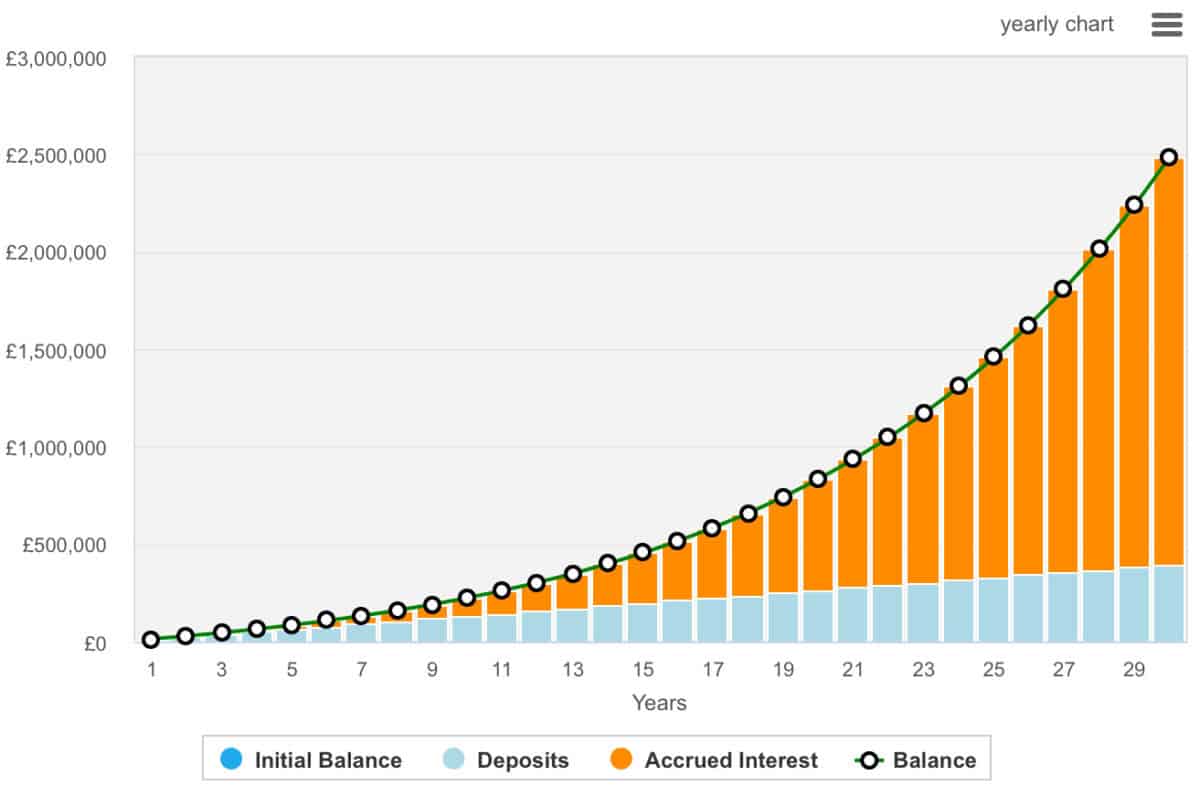
There are lots of ways to reach the same outcome. However, here’s one way of running the maths. Let’s assume monthly contributions of £1,100, or £13,200 annually over 30 years, and a 10% annualised return. At the end of the period, an investor would have a little more than £2.4m. Of course, not everyone can achieve a 10% annualised return over the long run. Although, many investors have done so simply by investing in index tracking funds.

Created at thecalculatorsite.com

However, it’s important to remember that many novice investors lose money. They may throw money after bad trying to get rich quick… many of us have been there. Instead, investors are better off take a diversified approach, perhaps opting to put the majority of their money towards index funds and reinvesting their dividends. This steady approach will leverage compounding and hopefully avoid costly losses.

Where does Bitcoin come in?

Well, I’ve typically avoided Bitcoin, and I can’t hold it within an ISA anyway. However, I can invest in companies that deal with Bitcoin or mine Bitcoin, like MARA Holdings (NASDAQ:MARA).

So, what’s so great about MARA Holdings? Honestly, it’s not a stock I love, but I appreciate it may be of interest to investors who are bullish on Bitcoin. It’s one of the largest Bitcoin miners globally, holding around 46k BTC as of February, valued at approximately $3.9bn. 

The company mines Bitcoin and strategically purchases additional coins, with its reserves growing significantly over the past year. For instance, in 2024, MARA mined 9,457 BTC and acquired 22,065 BTC at an average price of $87,205.

MARA has also diversified its operations by lending 7,377 BTC (16% of its reserves) to third parties, generating modest single-digit yields. This lending strategy aims to offset operational costs while maintaining its Bitcoin holdings. MARA also operates a network of data centres powered by renewable energy, including a wind farm in Texas and multiple facilities in Ohio.

Despite its impressive long-term growth — up 2,463% over five years — the stock is volatile. In fact, it’s down 60% over three months. That’s perhaps unsurprising as Bitcoin is now cheaper than its average procurement price above. Moreover, investors should note that it’s becoming hard to mine Bitcoin, and long-term investors should be wary of regulatory changes. Mara also uses debt to fund Bitcoin investments.

It’s not a stock that I’m looking to add to my portfolio in the near term. However, I’m going to keep watching.

$500 or $100: how much is Tesla stock really worth in 2025?

Tesla (NASDAQ: TSLA) stock has been on a wild ride recently. Over the last year, it has traded as low as $169 and as high as $488 (it’s currently back at $249).

The question is: how much is the stock really worth? Let’s crunch the numbers.

Working out the true value

There are a number of ways to calculate a stock’s true value. One common strategy is to use a discounted cash flow (DCF) model. This involves forecasting the company’s future cash flows. These cash flows are then discounted using a certain interest rate to obtain a present value and added together to obtain a stock price.

Developing a DCF for Tesla is not easy though. For a start, its cash flows are extremely volatile (free cash flow in 2024 was $1.02 per share in 2024 versus $2.17 per share in 2022). Secondly, this is a disruptive technology company that is working on multiple projects including electric vehicles (EVs), autonomous vehicles, battery storage, humanoid robots, and artificial intelligence (AI). So its future cash flows are very hard to predict.

Using earnings per share

A simpler way to obtain an idea of a stock’s true value is to look at the company’s earnings per share (EPS) and then apply an earnings multiple to get a stock price. The earnings multiple is essentially a price-to-earnings (P/E) ratio – one of the most common valuation tools for stocks.

This approach has its flaws (working out the right earnings multiple to apply is hard). But it can be a good place to start, so let’s do it for Tesla.

The right price

For 2025, the consensus analyst forecast for Tesla’s EPS is $2.68. This may not be accurate but I’ll use this figure in my calculations.

Below, I’ve applied five different earnings multiples to this EPS figure. For context, the median earnings multiple across the S&P 500 index is about 18 today while the average multiple across the ‘Magnificent 7’ is around 35 (this has been boosted by Tesla’s high valuation).

Earnings multiple  Stock Price
30 $80
40 $107
50 $134
60 $161
70 $188

I think Tesla deserves to trade at a premium to the S&P 500. After all, it has a lot of long-term growth potential due to its exposure to AI and autonomous vehicles.

That said, its EV business is a bit of a car crash at the moment (sales are plummeting worldwide due to increased competition and attitudes to CEO Elon Musk). So, I’m not convinced the stock deserves a sky-high multiple.

For me, an earnings multiple of around 40 is about right for this stock. That’s over twice the US market average (and higher than Nvidia, which is on 26).

That gives a stock price of $107. To my mind, that’s what Tesla stock is really worth today. That’s a little over 50% below the current share price. In other words, I see Tesla as overvalued at present.

It’s worth noting that the EPS forecast for 2026 is $3.64. And applying an earnings multiple of 40 to that takes us to $146. That’s a significantly higher price but it’s still well below the current stock price. So, I won’t be buying Tesla shares at current prices.

Fully using the £20k ISA allowance could make this much passive income

In less than two weeks, the deadline for the current Stocks and Shares ISA year will have passed. Currently, the maximum amount an investor can put in the ISA is £20k a year. From there, they are free to buy and sell stocks as they please, with certain tax benefits. Assuming the target was purely to build up passive income, here’s what the numbers could look like over time.

Active over passive

Before we get to the specific numbers, let’s run through the process of how this would all work. Cash gets moved to the ISA, where it then becomes available to invest. By selecting shares that pay out dividends, the investor can benefit from a source of income. Typically, these dividends get paid out a couple of times a year, in line with half-year or full-year accounts.

Please note that tax treatment depends on the individual circumstances of each client and may be subject to change in future. The content in this article is provided for information purposes only. It is not intended to be, neither does it constitute, any form of tax advice. Readers are responsible for carrying out their own due diligence and for obtaining professional advice before making any investment decisions.

The ISA protection means that dividend tax isn’t payable, allowing the full amount to be banked. When a dividend is received, it can buy more of the same stock. This can compound future dividends, growing a second income at a faster pace.

To keep things easy, some might just buy a FTSE 100 fund that distributes the income, using the average dividend yield of 3.54%. This is an idea, but I feel that with more active stock-picking, a much higher yield can be achieved without taking on a huge amount of risk.

For example, an investor could achieve an average yield of 7% by including a dozen shares from the FTSE 100 and FTSE 250. This would include stocks from a range of sectors, with different dividend payment dates throughout the year.

Real estate options

One example that might be considered for inclusion in such a portfolio could be Land Securities Group (LSE:LAND). The firm is one of the largest commercial property owners. This ranges from office spaces right through to shopping centres.

It makes money primarily through the rental income that it gets from renting out the buildings. The relatively stable nature of this cash flow makes dividends consistent. It’s also classified as a real estate investment trust. This means it has to pay out a set amount as dividends in order to keep this status.

Over the past year, the share price has been down 13%. Part of this reflects the ongoing concern around commercial property, such as the continued desire for some to work from home. Another factor is the 34.9% loan-to-value ratio from the latest results. With interest rates staying higher than expected for longer, refinancing existing loans or taking on new loans is going to cost more than previously expected.

Even though these remain risks going forward, I think it’s a good stock for an income investor to consider. The current dividend yield is 7.11%, with a dividend cover of 1.27. Any coverage figure above 1 shows that the company can pay the dividend from the latest earnings, which is a good sign.

Running the numbers

If someone were to invest £1666 a month (£20k a year) in a portfolio yielding 7%, the numbers could add up quickly. If this was kept up for seven years, then in year eight, it could make £1,154 a month in passive income.

Nvidia stock is a ‘generational opportunity’ right now, according to this Wall Street analyst

Nvidia (NASDAQ: NVDA) stock is well off its highs at the moment. Currently, it can be snapped up for $118, about 23% below its all-time high of $153. Is there a major opportunity to consider here? One major Wall Street analyst seems to think so.

A ‘generational’ opportunity

The analyst I’m referring to is Dan Ives from Wedbush Securities. A regular CNBC contributor (known for his colourful attire), Ives is one of the best-known tech analysts on Wall Street.

Last week, he told CNBC that he believes Nvidia is currently offering a ‘generational opportunity’ for investors. He believes a whopping $2trn will be spent on the artificial intelligence (AI) buildout in the next three years. And he sees Nvidia – which designs AI chips – as the primary beneficiary. “We’re going to be talking about Nvidia at $4trn, $5trn over the coming years,” he said. For context, the company has a market cap of $2.9trn today.

In 25 years doing this, I can count the times that have been almost generational opportunities relative to what the stock’s doing. That’s where I think Nvidia is here.
Wedbush Securities tech analyst Dan Ives

My view

Do I agree with Ives? I’m not sure, to be honest.

On one hand, I remain very bullish on the AI theme. I think this technology is here to stay and I expect Nvidia to benefit from the growth of the industry in the years ahead.

Meanwhile, I think Nvidia stock trades at an attractive valuation today. Currently, the price-to-earnings (P/E) ratio here is only 26. This is not high given that the company’s earnings are forecast to jump 53% this year. The price-to-earnings-to-growth (PEG) ratio is just 0.5.

On the other hand, I do think there’s a possibility that near-term AI spending could be lower than anticipated (which could result in lower-than-expected revenues for Nvidia). Since the arrival of low-cost AI model Deepseek a few months ago, I’ve been a little less bullish on the AI buildout theme than I was previously.

I also think there’s a chance that Nvidia’s share price could go lower before it goes higher. I wouldn’t be surprised to see the stock hit $100 again given all the chaos in the market right now (due to tariffs) and the negative sentiment towards tech stocks.

How I’m playing Nvidia

As for how I’m playing Nvidia myself, I am invested in the company. Currently, it’s one of my largest holdings.

However, I recently sold a few shares near the $140 mark. This was mainly to reduce risk in my portfolio.

I’m not in a rush to buy the shares back at $118 given the size of my holding. But if the stock was to fall to $100 or below, I could be tempted to start adding to my position again.

That’s where I’d be looking to buy. And that’s where I think investors should be considering the stock if they don’t yet own it.

The 2025 stock market sell-off: an incredible opportunity to build wealth?

The stock market’s been volatile in recent months. While the UK’s FTSE 100 index has held up well, America’s S&P 500 and Nasdaq Composite indexes have fallen 8% and 12% respectively from their highs (meaning the latter’s in ‘correction’ territory).

Has this volatility created an opportunity for long-term investors? I think so. Here’s why.

Significant uncertainty

It’s easy to see why stocks have been volatile lately. For starters, Donald Trump’s tariffs on Europe, China, Canada, and Mexico have created a lot of uncertainty for investors. As a result of these tariffs, it’s become significantly harder to forecast companies’ earnings (earnings are what drive share prices).

Secondly, there’s a huge amount of geopolitical uncertainty. There’s Trump’s stance on Ukraine, there’s the conflict in the Middle East, and there’s increasing tension between China and Taiwan.

There’s also a bit of a growth scare. Right now, many investors are worried that the US – the world’s largest economy – could be heading towards a recession.

Overall, there’s a lot for investors to process.

The big picture

I still expect many companies to grow significantly in the years ahead however. Especially those in the technology space.

Today, the world’s in the midst of a major tech revolution, powered by technologies such as artificial intelligence (AI), cloud computing, and electronic payments. And I expect this revolution to continue for many years – driving strong growth for the companies powering it.

Share price weakness

I think now could be a good time to take a closer look at the stocks of some of these tech companies. Because a lot have seen double-digit share price drops in the last few months.

Here are some examples:

Stock Drop from 2025 high
Amazon 19%
Alphabet 21%
Microsoft  13%
Snowflake  19%
CrowdStrike  21%
Shopify  20%
Nvidia 23%

A stock to look at now

One stock I believe is worth considering today is CrowdStrike (NASDAQ: CRWD), a stock I’ve been buying recently. CrowdStrike is a leader in the cybersecurity space. Offering one of the most advanced cybersecurity platforms in the world (designed for the cloud era), it protects tens of thousands of major businesses worldwide and is growing at a rapid rate (revenue growth of 21% is forecast this year).

One reason I’m bullish here is that cybersecurity spending is non-negotiable for businesses. In a recession, firms can cut marketing or CRM spend, however they can’t afford to cut cybersecurity spending. Ultimately, the risks associated with cyberattacks are too high. Especially now that criminals are using AI to launch more sophisticated attacks.

In mid-February, CrowdStrike shares were trading for around $450. Today however, they can be snapped up for around $360.

I see appeal at the current share price. Even if the price-to-earnings (P/E) ratio on the stock’s still very high at around 100 (the company’s earnings are still quite low because it’s focusing on growth).

It’s worth noting it was CrowdStrike that accidentally caused the global IT outage last year. Another similar outage is a risk with this stock. Another risk is competition from rivals such as Palo Alto Networks. It has recently been pivoting to a ‘platformisation’ strategy to compete with CrowdStrike.

All things considered however, I like the risk/reward set-up (from a long-term perspective). Over the next decade, I expect this company to get much bigger as the world becomes more digital and the cybersecurity industry expands.

A 9% yield? Here’s the dividend forecast for a gem hidden in plain sight

As income investors, sometimes we search too hard to find unusual dividend shares. Yet when considering the dividend forecast for a well-known FTSE 250 company, I realised there’s a lot of potential in stocks that already get a lot of publicity. Here are more details for investors to consider.

Forecasts indicate growth

I’m talking about Investec (LSE:INVP). The FTSE 250 firm is down a modest 7% over the past year, with a current dividend yield of 7.26%. The yield already makes it well above the 3.53% index average.

It typically pays out two dividends a year. The main one gets declared in May with the annual results, with the smaller one announced in November. For 2024, the payments were 19p and 16.50p, totalling 36.5p. For this year, the projected total is 37p. Next year it’s forecast to rise again to 41p and 44p in 2027.

I don’t think there’s much point trying to forecast beyond the next two years, given that the income potential relates mostly to how the company performs. Given the amount of uncertainty about the banking landscape years down the line, it’s tough to accurately predict how things could go.

If we assume that the share price of 489p stays the same, the 44p total payment for 2027 would give a dividend yield of 9%. Of course, the stock might be higher or lower for this time period. This will mean the yield could be greater than 9% or indeed less.

Backed up by drivers

When I consider the financials, the potential for dividend growth is definitely there. Last week’s latest full-year trading update detailed how adjusted operating profit is on track to grow by 5-12% versus the previous year.

Some might have been concerned that basic earnings per share are forecasted to drop by 30-36%. However, this is mainly due to the prior year being skewed by a significant net gain. This came from the implementation of the Wealth & Investment division coming together with Rathbones.

Interestingly, the South African business is expected to post 5% adjusted profit growth. This is good, as it reduces reliance on UK operations. The diversified revenue stream not only geographically but also from the different client segments (private, corporate and institutional) is another appealing reason why some might consider buying the stock.

Risk and reward

There are risks involved with Investec. The business isn’t investing heavily in new technology, in order to push customers to bank digitally as other UK banks do. This could come to be a problem, as other peers can achieve greater cost efficiencies from reducing manual touch points.

Despite this, I don’t see any immediate risk to the dividends in coming years. On that basis, I think it’s a good income stock for investors to think about.

Prediction: 12 months from now, AstraZeneca’s share price could be…

After rising by over 20% since November, the AstraZeneca (LSE:AZN) share price is on a good run. And now management has just signed a $1bn deal to acquire EsoBiotec and further secure its long-term cancer therapy product portfolio. So, with the pharma giant making waves, investors are naturally beginning to ask, how much higher can this stock climb over the next 12 months?

Let’s dig into the latest forecasts.

Delivering results

While the acquisition of EsoBiotec is leading the headlines, the deal itself isn’t likely to generate a return for investors for a while. After all, EsoBiotec is still in its early days with products still undergoing clinical trials, which can take years.

Instead, this takeover is more about positioning AstraZeneca for the long run. In the meantime, its existing portfolio of products will continue to drive sales and earnings. And looking at the latest results, that’s exactly what they’re doing.

Total revenue in 2024 jumped another 21% to $54.1bn, with earnings per share enjoying a massive 29% surge to $4.54 in constant currency terms. That’s a particularly encouraging result considering the troubles AstraZeneca has been having in one of its main growth markets – China. As a quick reminder, a few months ago, one of the firm’s top executives was arrested for suspected fraud and illegal drug imports.

Progress in its clinical trials has also been quite encouraging. Nine phase-three trials were successful in 2024, with seven trials on track for completion in 2025. Beyond delivering favourable results and paving the way to new revenue streams, it also provides investors with more clarity over the quality of AstraZeneca’s pipeline of new drugs and treatments.

Quality comes at a price

Given the continued streak of success AstraZeneca has delivered in recent years, it’s not surprising investors are willing to pay a premium. Even more so given the encouraging guidance for 2025, signalling more growth is around the corner.

However, at a forward price-to-earnings ratio of 17.4, the shares are far from cheap. For reference, GSK shares are currently trading close to 9 times forward earnings, while Hikma Pharmaceuticals is closer to 11.6. Nevertheless, forecasts for AstraZeneca remain quite bullish.

Of the 27 institutional analysts following this business, 23 currently rate it as a Buy or Outperform with an average 12-month share price target of 14,100p. Compared to today’s valuation, that’s roughly an 18% potential gain by March 2026.

Yet as with all forecasts, this projection depends on AstraZeneca delivering on expectations with no unexpected disruptions, such as a failure in one of its ongoing clinical trials. Given the cost associated with drug development, any failures could have a significant impact on the firm’s expected future earnings. And with the shares priced at a premium, that naturally invites volatility.

Personally, I feel the risk may be worth the potential reward. My portfolio already has sufficient exposure to the healthcare industry, so I’m not rushing to buy any shares. However, for investors seeking to capitalise on biotech tailwinds, this enterprise may be worth considering.

Prediction: 12 months from now, National Grid’s share price could be…

Since the unveiling of National Grid’s (LSE:NG.) £60bn overhaul project in May last year, the share price has delivered some robust returns. In fact, the energy infrastructure stock is up by around 15% so far. Lately however, analysts have started getting bullish about incoming growth. So much so that price targets are actually on the rise, along with Buy recommendations from institutional analysts.

So, what’s driving this new wave of optimism? And how high can the National Grid share price climb over the next 12 months?

Changing tactics

As a quick reminder, last year management announced a pretty massive restructuring of its business. The firm has long struggled to deliver meaningful growth, and with a steadily weakening balance sheet, a change of strategy was needed.

Given this involved diluting equity shareholders by £7bn to raise capital, the stock unsurprisingly plummeted on the news. However, volatility aside, the move has improved the state of the balance sheet, with total debt down by over £2bn between March and September last year. And with dividends taking a haircut, the extra cash is also earmarked for further debt reduction moving forward.

However, in December, the company released more details of its business plan for moving forward. Some of the key highlights that seem to have grabbed investor attention are a doubling of UK electrical transfer capacity and 35GW of energy storage for renewables. Apart from reducing emissions by 50% compared to 2019 levels, the modernisation of Britain’s energy grid could lower maintenance expenses moving forward, resulting in superior free cash flow generation.

What does this mean for the shares?

It may still be a while before growth materialises for shareholders. After all, revamping infrastructure doesn’t happen overnight. Yet analysts have started recognising the long-term potential of this enterprise. In January 2025, the stock was rated as a Buy or Outperform by 11 analysts. Skip ahead to March, this has increased to 16 with no one marking the shares down as a Sell.

At the same time, share price forecasts for National Grid have also been updated, with numerous institutions raising their expectations, like Bernstein, which increased its price target from 1,040p to 1,120p. Overall, the average consensus indicates that National Grid shares could rise to 1,145p by this time next year. That’s roughly the equivalent of an 18% gain. And when paired with a 4.7% rebased dividend yield, buying the shares today could enable investors to reap market-beating returns over the next 12 months.

Of course, nothing is set in stone. Large infrastructure projects have a habit of getting delayed with spiralling costs if mismanaged. And if National Grid can’t deliver on its growth promises, the share price could remain stagnant for years to come.

With this risk in mind, I’m staying on the sidelines for now. At least until more tangible progress has emerged.

Prediction: 12 months from now, ITV’s share price could be…

It’s been a shaky couple of years for the ITV (LSE:ITV) share price. Since reaching its peak in 2021, shareholders have been patiently waiting for management’s aggressive multi-billion pound investment in content creation and its new-ish ITVX platform to pay off. Yet looking at the latest results, this might be just around the corner. And with the stock trading at just 7.7 times earnings, investors could be about to witness a welcome surge.

With that in mind, let’s explore just how much higher ITV’s share price could climb over the next 12 months.

Investments are starting to deliver

ITV’s revenue growth in 2024 was fairly mediocre. However, considering the company’s studio segment was heavily disrupted by the actor and writer strikes, this wasn’t entirely a surprise. Yet while the top line failed to impress, the same can’t be said for underlying earnings.

The firm’s profits were up by double-digits on the back of margin expansion driven by a bigger than expected £60m annualised saving as well as a more favourable product mix. Consequently, management has announced its investment in ITVX is now on track to break even by the end of 2025, ahead of the original timeline.

Speaking of ITVX, the ad-driven streaming service is still rapidly expanding, with monthly active users now sitting at 14.3m. That’s just over 20% of the British population, steadily catching up to BBC iPlayer’s popularity. Unsurprisingly, with the number of viewers rising by 1.8m, total streaming hours have increased from 1.5bn to just shy of 1.7bn. And with more people on the platform for longer, ITV has more opportunities to serve high-margin digital ads.

ITV’s share price forecast

Needless to say, this is all rather positive. So, what are analysts projecting over the next 12 months?

Right now, the most optimistic forecast is for the ITV share price to rise to 105p by March 2026. Compared to where the stock is trading right now, that’s a roughly 33% increase. So investing £1,000 right now could grow into £1,330 by this time next year.

However, not everyone is convinced that ITV has proven itself yet. Looking into 2025, management is actually guiding for a slight hit to profit margins as it plans to develop more scripted shows next year. These projects are indeed more expensive to produce. But they’re also how the world enjoyed blockbuster hits like Mr Bates vs The Post Office.

Another successful show of this scale could attract even more viewers to ITV’s streaming service. Of course, that’s far easier said than done. And if 2025 proves to be a year of duds, then the shares could actually slide by 11% to 70p based on more pessimistic analyst opinions.

Time to buy?

All things considered, I’m cautiously optimistic about what the future holds. There are obviously no guarantees, and ITV’s continued success will depend on its ability to produce popular shows that attract new viewers to its platform. That does add risk to an investment. But given its recent track record, management seems to have its finger on the pulse for now.

My portfolio already has sufficient exposure to this sector, so it’s not an opportunity that I’m rushing to buy right now. But for investors keen to capitalise on the rise of ITVX, now might be an excellent time to take a closer look.

Financial News

Daily News on Investing, Personal Finance, Markets, and more!

Financial News

Policy(Required)