£10,000 invested in Shell shares 1 year ago is now worth…

Shell (LSE:SHEL) shares are up just 4% over the past 12 months. As such, an investment made a year ago would be worth £10,400 today. However, an investor would have also received around £400 in the form of dividends. So, 8% total returns. Not bad but not great.

What’s been going on?

Shell’s share price gains have been modest, despite the company’s efforts to streamline operations and improve financial performance. This sluggish performance can be attributed to several factors.

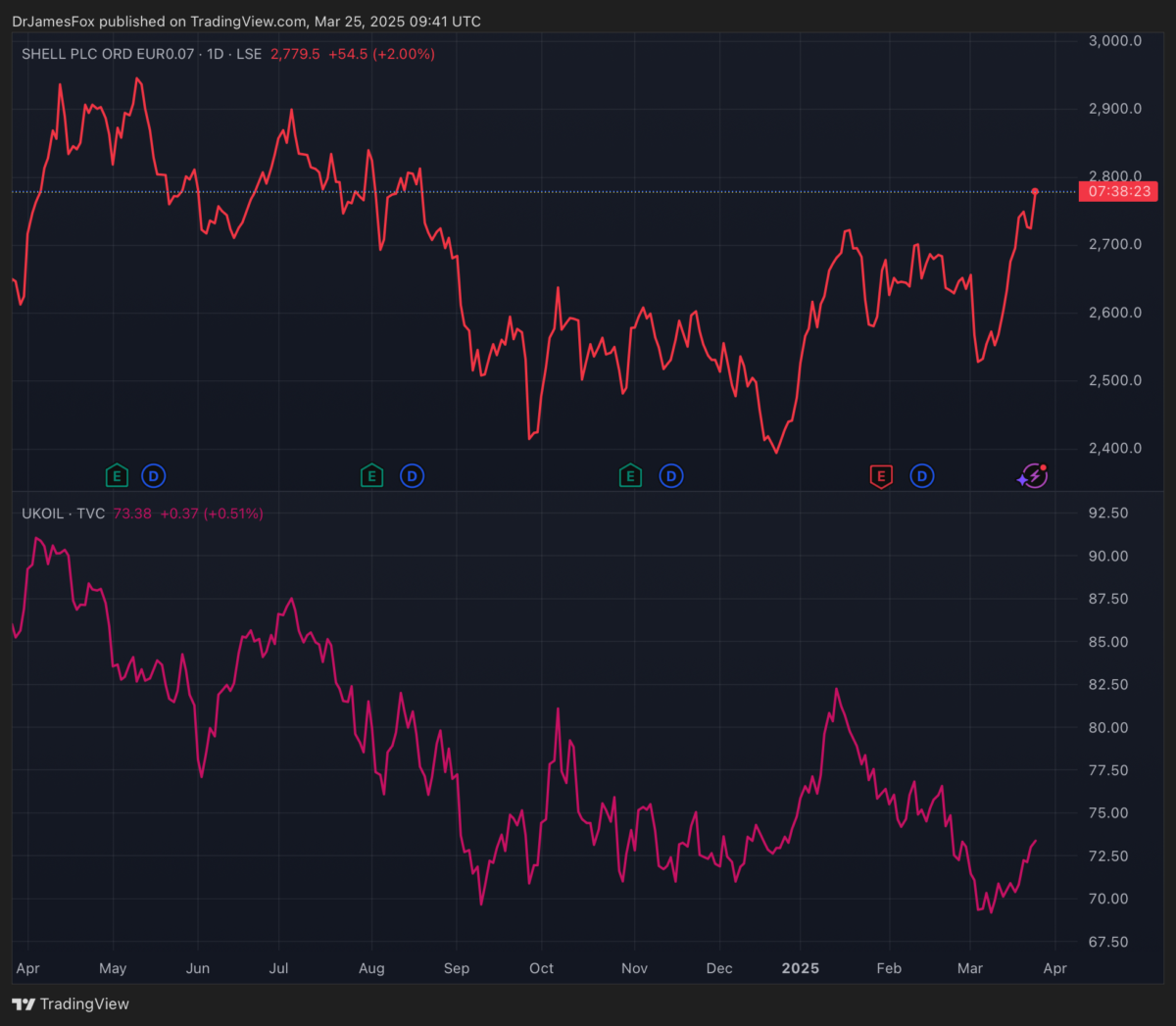
Firstly, oil prices have fluctuated over the past 12 months, but the general direction is downwards. As I write, Brent Crude prices are down 8.5% over the year, and this will have an impact on the bottom line.

Source: TradingView: Shell share price vs Brent Crude (1 Year)

While Shell has managed to expand its production by 2%, falling oil and gas prices have also squeezed downstream margins, resulting in a 17% decrease in income attributable to shareholders in 2024. This has dampened investor enthusiasm and limited share price growth.

Macroeconomic uncertainties have also played a role. China, the world’s largest oil importer, has experienced economic slowdowns, creating uncertainty regarding future energy demand. Additionally, geopolitical tensions and the lingering effects of the Russia-Ukraine conflict have contributed to market volatility.

Despite these challenges, Shell has made progress in improving its financial position. The company has reduced its capital expenditure and net debt, while maintaining strong cash flows from operating activities. This has allowed Shell to launch a new $3.5bn share buyback program and increase dividends by 4%.
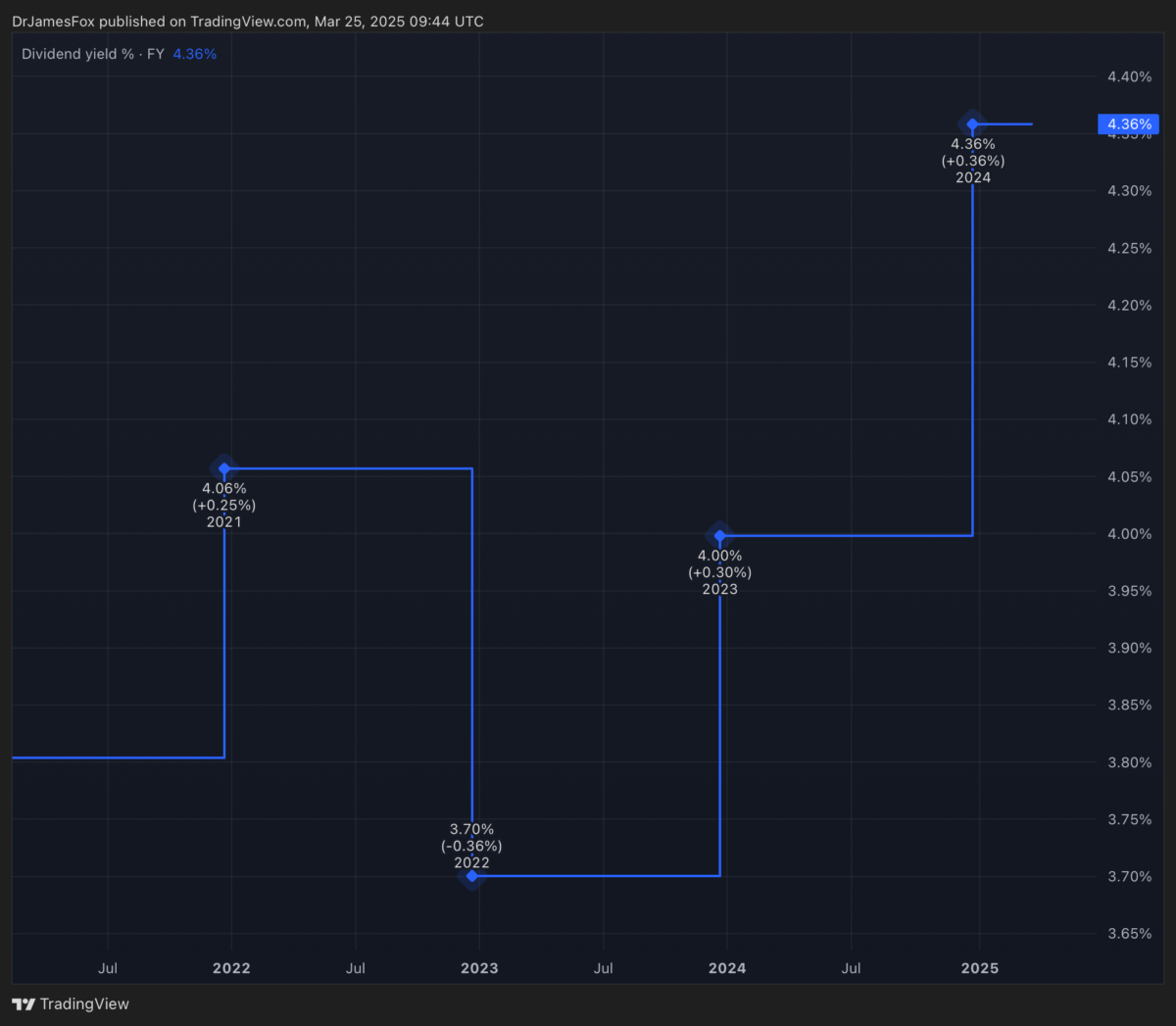
Source: TradingView: Dividend Yield

But what’s next?

Ahead of its Capital Markets Day on March 25, Shell said it would look to focus on delivering more value to shareholders while reducing emissions. The company revealed plans to increase shareholder distributions from 30-40% to 40-50% of cash flow from operations, while maintaining a 4% annual progressive dividend policy.

Shell also raised its structural cost reduction target from $2bn-$3bn by the end of 2025 to a cumulative cost saving of $5bn-$7bn by the end of 2028, compared to 2022 levels. The company also plans to lower its annual capital expenditure to $20bn-$22bn for 2025-2028 — down from $22bn-$25bn — the range for 2024 and 2025 guided back in 2023.

Moreover, the company aims to grow free cash flow per share by over 10% yearly through 2030 while maintaining a stable liquids production of 1.4m barrels per day. Meanwhile, CEO Wael Sawan sees LNG sales growing by 4-5% annually through 2030.

Nonetheless, Shell remains dependent on oil and gas prices. We’re now two months into the presidency of Donald Trump, a man who promised to keep oil prices low. An end to the war in Ukraine, which is also on his agenda, would likely see the normalisation of supply routes and place downward pressure on energy prices.

In short, there are several reasons I’d expect oil, and possibly gas, prices to remain lower over the next year and perhaps through Trump’s presidency. Despite the business lowering capex and raising returns, the broader economic outlook concerns me. That’s why I’m passing on Shell shares for now.


Here’s why Tesla stock just jumped 11% on the Nasdaq index!

The Tesla (NASDAQ: TSLA) share price popped 11.9% to $278 on the Nasdaq Composite index Monday (24 March). Despite this, the stock remains around 41% lower than three months ago.

What caused this rapid acceleration skywards? And is it game-changing news that makes me want to invest in the electric vehicle (EV) giant? Let’s take a look.

What’s going on?

From what I can gather, there appears to be a few reasons for the share price jump. For starters, it was a great day for all tech stocks as it emerged that President Trump’s stance on tariffs might be softening. Some reciprocal tariffs that were meant to go ahead on 2 April might not now happen. In response, the tech-heavy Nasdaq jumped 2.27%, as easing fears of a global trade war reassured investors.

Second, Reuters reported that Tesla’s paused Full Self-Driving (FSD) feature in China would now be released following regulatory approval.

In January however, CEO Elon Musk said Tesla was in “a quandary” in China. The country doesn’t allow the firm to transfer training videos (ie data) abroad, while US policies restrict AI training within China. So Tesla’s working with tech firm Baidu to advance its FSD system there.

Despite the name, Tesla’s FSD isn’t truly autonomous. The driver must still remain attentive and in control at all times.

Game-changing news?

I’m not taking the latest tariff news too seriously. Trump’s policies seem to change by the day, and I risk whiplash trying to keep up with the latest developments. For me, the game-changing news will be when Tesla finally deploys robotaxis and they’re safely ferrying paying customers around. We still don’t know when that will be (genuine FSD was originally meant to be 2017).

Having said that, if Tesla can pull it off, it would be a huge deal. That’s because its vision and AI-based approach could give it an incredible scalability advantage. By skipping detailed mapping and LIDAR approaches, Tesla could theoretically roll out self-driving capabilities globally with far less effort than rivals.

But there is a serious risk that the technology isn’t ready yet. So the stakes are very high for Tesla, but high stakes are exactly what gets Musk out of bed in the morning.

Should I buy Tesla stock?

Speaking of Musk in the morning, where does he head after breakfast these days? Is it Tesla? SpaceX? The offices of social media platform X or one of the other start-ups? For now, it seems to be the Department of Government Efficiency (DOGE), a demanding role that he says is making it “very difficult” to run his companies.

My fear here is that Musk is spreading himself too thinly at a critical time for Tesla. Competition’s mounting, especially from Chinese EV giant BYD, and Trump’s administration will likely abolish EV subsidies. Meanwhile, sales have reportedly been falling sharply across Europe this year.

Even after the recent crash, the stock’s far from cheap. It’s still trading at 100 times sales and 136 times earnings. That’s an extreme valuation that assumes robotaxi success.

Given these challenges, I would want Musk at the helm full time if I were a Tesla shareholder. Because he doesn’t seem to be there right now, I have no intention of investing.

Down 18% in a week, should I buy the dip in this well-known growth stock?

It hasn’t been an excellent week for Trustpilot (LSE:TRST). The growth stock has experienced an 18% drop in the share price in the last week. Even with this, it’s still up 20% over the last year. I’m deliberating whether to invest in the popular customer review platform on this potential dip. Here are my thoughts!

Factors at play

Last week, the 2024 annual results came out. Trustpilot reported its first annual pre-tax profit of £5.2m. Despite this positive milestone, the market reacted negatively because some investors had higher expectations. When looking to the future, the business expects revenue growth percentage for 2025 in the high teens. Given that revenue grew by 19% for 2024, some would have been disappointed that this is seen as a slower rate of growth.

Another factor is broader market uncertainty. Concerns about the impact of President Trump’s tariffs and economic growth in the UK have made the UK stock market volatile. In these scenarios, growth stocks like Trustpilot often fall more than value stocks or defensive shares.

A dip worth considering

Despite these reasons, I think there’s good potential for the stock to recover in coming months. Even though the results didn’t quite meet the high expectations some had, it was a really solid set of earnings. The fact that the company has flipped to being profitable is a big milestone that bodes well going forward.

The CEO spoke about how it was a year “delivering record bookings, profitability and cash generation”. For the year ahead, he noted, “we will continue to deliver product innovation to embed trust across commerce, as trust becomes even more important in the age of AI”.

I think the last point is important. Trustpilot should see continued demand from users wanting to get clarity on companies using AI and which ones are trustworthy. AI can sometimes be smoke and mirrors, making it harder to spot potential scams. Trustpilot can help to clear the murkiness in this area, and I believe this could be a source of growth for the company.

High growth potential

A risk going forward is that investor expectations might still be too high. So even if the company announces a new product, partnership, or trading update, it might not be enough to excite people. Yet I think that the size of the drop in the past week likely resets some of the optimism. I’d struggle to see it fall another 18% in the coming week on this basis.

Putting everything together, I’m seriously thinking about buying the stock shortly for my portfolio. It has a unique business model that’s clearly doing very well. With growth in the UK, Europe, and America, it’s well set to scale further in the coming year and beyond.

FTSE shares: an opportunity to secure generational wealth?

The lingering effects of Brexit compounded by the pandemic led to years of low returns for FTSE shares. But recently the UK market has made an impressive recovery, hitting new highs this year. While some companies continue to accept takeover bids from US firms, there are those that are beginning to see the advantage of remaining in the UK.

President Trump’s trade tariff war has sent fear through the US market, making the UK look even more appealing for long-term stability. This presents new opportunities for UK investors to take advantage of undervalued shares with promising growth potential.

To find undervalued shares, I look at key valuation ratios like price-to-earnings (P/E) and compare them to industry peers and historical averages. Strong cash flow, debt reduction and consistent profitability are also signs of value.

Here are two examples of well-established UK companies with shares that look cheap right now. They may be worth considering.

Centrica

As the owner of British Gas, Centrica (LSE: CNA) is exposed to today’s challenging energy market. Regulatory pressure on energy prices is a constant threat to profitability, not to mention fluctuations in wholesale gas prices and competition from smaller, more agile providers.

However, the exposure to energy security and renewables provides long-term growth potential.

Recently, Centrica has benefitted from higher gas prices, resulting in a 25% gain over the past six months. This growth has been driven by improved efficiency, helping to bolster its balance sheet.

Despite the price appreciation, the stock still looks undervalued, with strong cash flow and a low P/E ratio of 5.74. Debt has been reduced from £5.3bn in 2020 to £3.47bn in its latest 2024 results. Meanwhile, free cash flow has almost doubled, from £778m to £1.12bn.

Add to this an attractive 3% dividend yield and it’s an appealing choice for value investors. 

Overall, the stock appears cheap relative to earnings and assets. I think investors seeking long-term stability and income would be wise to consider it.

International Consolidated Airlines Group

International Consolidated Airlines Group (LSE: IAG) is the parent company of British Airways, Iberia and Aer Lingus. Despite gaining 76% in the past year, the stock still appears undervalued with a low P/E ratio of 6.6.

That said, the airline industry has been somewhat unstable in recent years. Not only is it highly cyclical but oil price volatility and geopolitical issues present an ongoing threat to profitability. This is further compounded by competition from low-cost carriers like easyJet and Ryanair.

Despite these challenges, demand for travel continues to improve, helping the company achieve solid revenue and profit growth. Recently, it’s been laser-focused on cost-cutting and debt reduction, helping recover some Covid-era losses. Debt from the pandemic remains somewhat high at £14.34bn, which poses a moderate financial risk but overall, the recovery has been impressive.

It maintains a solid market position in transatlantic and European routes and could benefit further from a potential long-term recovery in business travel. As fuel costs stabilise and economic conditions improve, the stock could really take off.

For investors looking to secure long-term wealth, it’s certainly one worth thinking about.

As the Kingfisher share price falls 12% on FY results, is it too cheap to ignore?

Kingfisher (LSE: KGF) reported a 7% fall in full-year profit before tax (PBT) on Tuesday (25 March), and the share price promptly slumped 12% when the market opened.

The home improvement retailer saw sales dip 1.5% in the year to 31 January 2025, with bottom-line adjusted earnings per share (EPS) down 5.2%. But the owner of the UK’s B&Q and Screwfix, and Castorama and Brico Depot in France, reckoned its core categories were resilient.

Big-ticket spend on things like kitchens and bathrooms has been under pressure. CEO Thierry Garnier said: “Recent government budgets in the UK and France have raised costs for retailers and impacted consumer sentiment in the near term.”

Market share

The boss told us: “For the first time in over six years, we grew our market share in all key regions. We delivered profit and free cash flow in line with or ahead of our initial guidance, with strong delivery against our strategic objectives.”

Does that suggest we could be looking at one of the stronger players in an overall tough market? I’ve always believed an economic squeeze can provide one of the best times to separate the long-term winners from the also-rans.

It’s easy to look good when people are spending big and margins are fat all round. But it can be a lot harder to maintain efficiency and cash flow in a dip.

Kingfisher recorded free cash flow of £511m in the year, down just 0.5% from the previous year’s £514m. That’s good enough for me. And the board held the total dividend at 12.4p per share, for a 4.4% yield on the previous day’s close.

The year ahead

When a sector is under pressure, I look to liquidity. And that cash flow figure is a decent start. But the company expects to see a dip in the 2025-26 year, to around £420m to £480m. It does, though, aim to get it back above £500m annually from 2026-27.

The company also launched a new £300m share buyback, which shows confidence under pressure. I’m always in two minds over buybacks when there’s net debt on the books. And Kingfisher’s year-end net debt stood at £2bn. Still, it’s modest compared to £12.8bn in sales.

The board expects adjusted PBT between £480m to £540m this year. So it seems we’re in for a tighter time. Is management, with its new share buyback, trying to keep investors sweet before things pick up again? I’m getting that feeling.

The investment case

Analysts expect EPS to grow in the current year and beyond. And with the mid-point of that suggested PBT range being slightly ahead of the FY figure just reported, they might be right. But it’s only 1% up and the range is wide.

That profit uncertainty could be the biggest risk at the moment, and it could throw forecasts off. Do projected price-to-earnings (P/E) multiples of around 12 to13 provide enough safety margin? If Kingfisher maintains its dividends, they might. We could see share price weakness ahead, but I rate it as one for investors looking past today’s economy to consider.

Investing this much from 35 could generate a £1m UK stocks portfolio by retirement

There are good reasons why it’s worth investing from an early age. The benefits of compounding via buying UK stocks means that if someone started when they were 18, they’d have a considerable head start on the rest of us.

Unfortunately, very few are financially literate at that age! Yet even from the age of 35, big things can develop over the years with consistency and discipline.

Choosing where to allocate cash

A lot will focus on the end goal of £1m and miss the point that to potentially hit that figure, the strategy needs to be sound. I’m talking about deciding what to invest in.

For an investor aged around 35, they’ll likely be working for several decades more. So they’re less reliant on stocks that provide income and likely can take on more growth stock exposure.

Growth shares indeed have a higher risk, as the share prices can be more volatile. That’s why if someone is close to retirement age, these aren’t the best type of shares to own. Yet, with a multi-decade time horizon, growth stocks in sectors likely to be the future (eg renewable energy, AI, tech) should do well.

As a result, I believe an investor should allocate 80% of funds to growth stocks and regularly buy more each month as funds permit. It’s hard to perfectly forecast capital appreciation, but based on historical performance, an annual growth rate of 8-10% is reasonable.

The remaining 20% can be used for some dividend shares and value plays. Don’t get me wrong, there are some great dividend shares with yields of 8-10%. This can act as a buffer during future market corrections when the growth part of the portfolio slows. During this time, the income from dividends can help keep the portfolio progressing.

A FTSE 250 case study

In terms of an example, an investor could consider Plus500 (LSE:PLUS). The FTSE 250 business provides an online trading platform geared around the retail market.

It makes money based on client activity, making a small commission each time someone buys or sells a stock, bond, cryptocurrency or something else. As a result, it does well when markets are volatile, with big price swings.

Due to the good tech interface and wide range of trading products, it’s grown significantly over the past few years. The share price is up 53% over the past year, with strong gains evident over a longer period too.

Looking forward, I think this can be maintained. Certainly, I think markets will be volatile over the coming year based on tariff uncertainty, central bank actions and geopolitical conflicts.

One risk is that competition in this area has increased recently. CMC Markets and IG Group are two other FTSE 250 companies with similar offers and will target Plus500 clients.

The million-pound idea

I don’t know the exact retirement age for someone aged 35, but I’m going to assume it will be 67. On that basis, investing £600 a month in a portfolio that grows on average by 8% could be worth £1.07m by that finishing point.

Of course, a variety of factors could cause this end figure to be lower or higher. But it certainly gives an investor a ballpark of the amount and target return to try and aim for.

A 9.2% yield but down 9% despite a strong 2024, is it time for me to buy more of this passive income superstar?

M&G (LSE: MNG) has been a foundation stock in my passive income portfolio for some time now.

These shares generate very high dividends for me without too much effort on my part – hence the ‘passive’ label. In fact, all I need do is pick the right shares initially and then monitor their progress periodically after that.

A key quality I want in my passive income picks

It is a company’s earnings growth that determines its dividend and share price over time.

A risk to M&G’s is another surge in the cost-of-living crisis that may cause customers to cancel their investment policies.

That said, consensus analysts’ estimates are that the firm’s earnings will increase a stunning 44% every year to end-2027.

What might this mean for the dividend yield?

Its 2024 results released on 19 March saw it move to a progressive dividend policy. This is where a dividend is expected to rise at least in line with increases in earnings per share. However, if this falls, the dividend will not be reduced.

In M&G’s case, this policy began with a 2% rise in dividend to 20.1p. This gives a yield of 9.2% on the current share price of £2.18.

On this average yield and with ‘dividend compounding’ used, investors considering a £10,000 stake in M&G would make £15,005 in dividends after 10 years. After 30 years on the same basis, this would rise to £146,344.

At that point, the holding would be worth £156,344, generating £14,384 a year in passive income! But that is not guaranteed, of course.

However, analysts project the dividend will rise to 20.6p in 2025, 21.3p in 2026, and 22.2p in 2027. These would generate respective yields of 9.5%, 9.8%, and 10.2%. By comparison, the average FTSE 100 yield is 3.5%.

What are the potential share price implications?

One part of my standard stock price assessment is to compare its key valuations with its competitors.

M&G’s 0.9 price-to-sales ratio looks extremely cheap compared to its peers’ average of 4.3. This group comprises Legal & General at 1.2, Man Group at 2.2, Hargreaves Lansdown at 6.9, and Intermediate Capital Group at 7. The firm’s 1.6 price-to-book ratio also looks a bargain against the 3.7 average of its competitors.

The second part of my assessment establishes where a stock’s price should be, based on future cash flow forecasts. The resulting discounted cash flow analysis for M&G shows it is 54% undervalued at its present £2.18 price.

Therefore, the fair value for the stock is £4.74, although it could go lower or higher due to market forces.

How does the business look right now?

I think M&G’s 2024 results released on 19 March saw significant progress made on all three of its key strategic objectives.

Beginning with financial strength, its adjusted operating profit before tax jumped 5% year on year to £837m. This reflected a 19% increase from its Asset Management division and stable results from the Life and Corporate Centre segments.

In terms of simplifying the business, the firm reduced its managed costs by 2% due to £188m cost savings.

And towards delivering growth, it saw assets under management and administration rose £2bn to £346bn.

In sum, given its extremely high earnings growth forecasts and the implications for price and yield, I will buy more M&G shares very soon.

Legal & General has supercharged second income potential with a forecast yield of 9%!

The FTSE 100 has some incredible opportunities for investors looking to build a second income stream right now.

One that leaps right out at me is insurer and asset manager Legal & General Group (LSE: LGEN). With a forecast yield of a mind-boggling 9%, it’s set to pay one of the most attractive passive income streams on the blue-chip index in 2025. 

While there’s plenty of dividend income on offer, share price growth has been in short supply. But after a rough few years, that’s starting to show some life too.

Can this FTSE 100 dividend hero thrive?

Legal & General shares may have climbed 14% over the last three months, although they’re still down around 5% over the past year.

It’s been a bumpy few years for financial stocks in general. Many investors expected interest rates to drop sharply as inflation cooled last year, but that hasn’t happened. 

Higher-for-longer rate expectations have weighed on stock markets, with volatility further fuelled by Donald Trump’s tariff threats. That hurts Legal & General, which has a mighty £1.2trn of assets under management.

It also means that cash and bonds are still offering attractive returns. That makes riskier assets like Legal & General shares less immediately appealing. But at some point, interest rates will start to fall, and when they do, that ultra-high yield will look even more attractive.

So is the dividend sustainable? One concern is that earnings cover remains on the thin side, at 1.1 times earnings. Ideally, I’d like it covered around twice. But despite my concerns, Legal & General remains committed to rewarding shareholders.

The company’s full-year results published on 12 March included plans to buy back £500m of shares this year. That’s part of the group’s wider strategy to return more than £5bn to shareholders over the next three years in total.

Core operating profits rose 6% to £1.62bn, in line with guidance, as growth in the retail and institutional retirement divisions offset a decline in asset management profits.

Dividends, share buybacks and possibly growth

Dividend growth will slow though. Legal & General hiked its full-year 2024 payout by 5% to 21.36p, but between 2025 and 2027 it will increase by just 2% a year.

Another concern is that Legal & General’s price-to-earnings ratio has surged past 80, largely due to falling earnings per share. They’ve suffered large double-digit drops in each of the last three years. That’s super-high but hopefully a little misleading and it will reverse itself. It’s a risk though.

Operating margins are forecast to rise from 8.6% to 13.2%, suggesting profitability may be on the mend.

So what does the future hold for the share price? The 16 analysts covering the stock have set a median target price of 265.3p. If accurate, that suggests a 10% rise from today. Combined with its high yield, that could push total returns towards 30% over the next 12 months.

Of course, forecasts are never guaranteed, and an economic shock or weak results could easily knock the share price down 10%, or more.

Legal & General shares are well worth considering, but investors should look beyond the next 12 months. They should aim to hold for years, potentially decades, to give those dividends and any growth time to compound. When they finally retire, they can hopefully let the second income flow.

Here’s the dividend forecast for Lloyds shares

The dividend forecast is important for any investor. It tells us how much we can expect to receive in the form of typically biannual payments if we purchase shares in the company.

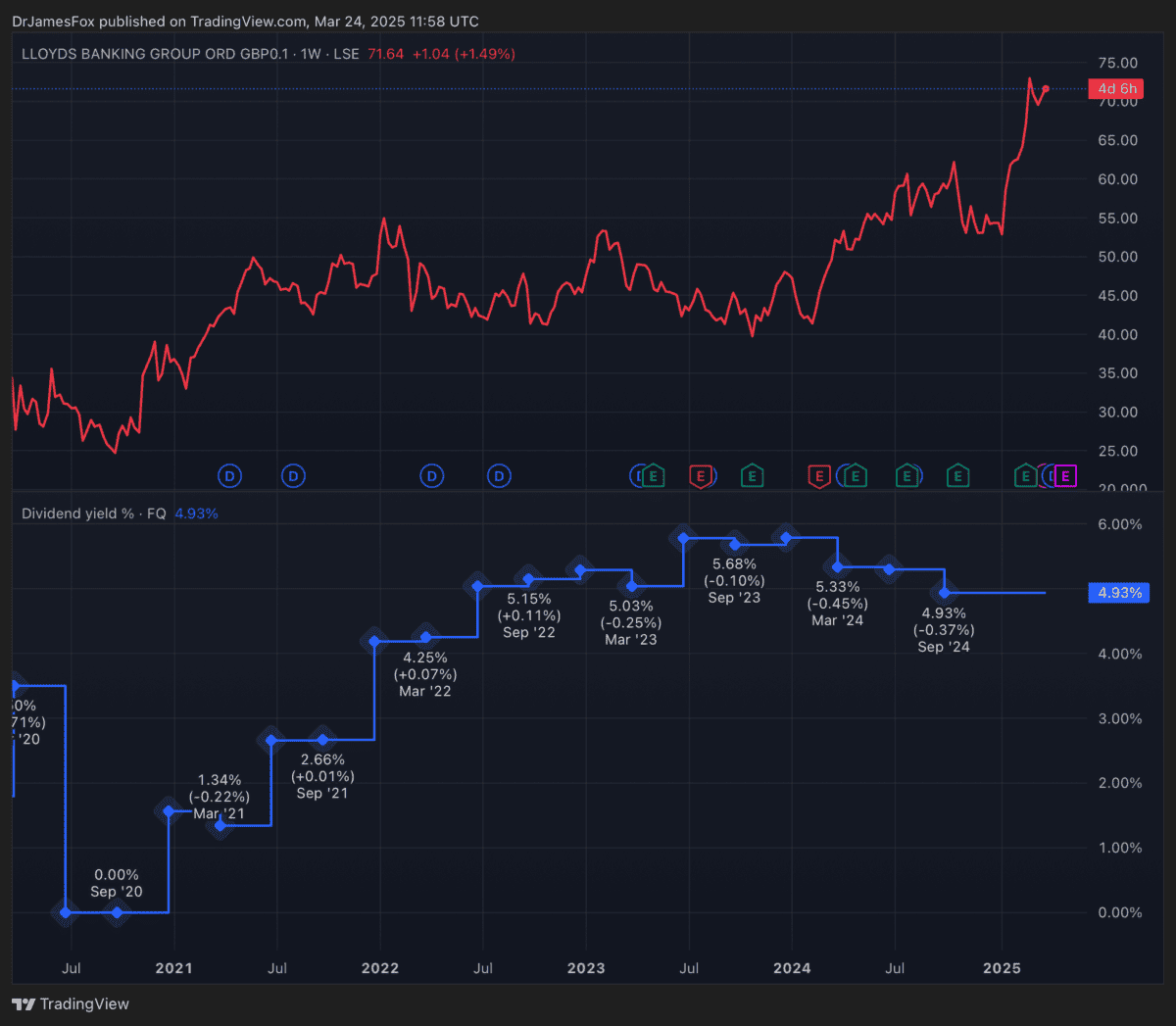
So, today I’m looking at Lloyds. The stock has surged over the past 12 months, and as a result, the dividend yield has fallen somewhat. Looking at the forward yield — the dividend yield an investor could expect to receive based on forecasts over the next 12 months — is 4.9%.

That’s quite strong compared to the FTSE 100 average, but it’s actually lower than the 6% yield I received in my first year when I entered the stock around 24 months ago.

Where’s it going next?

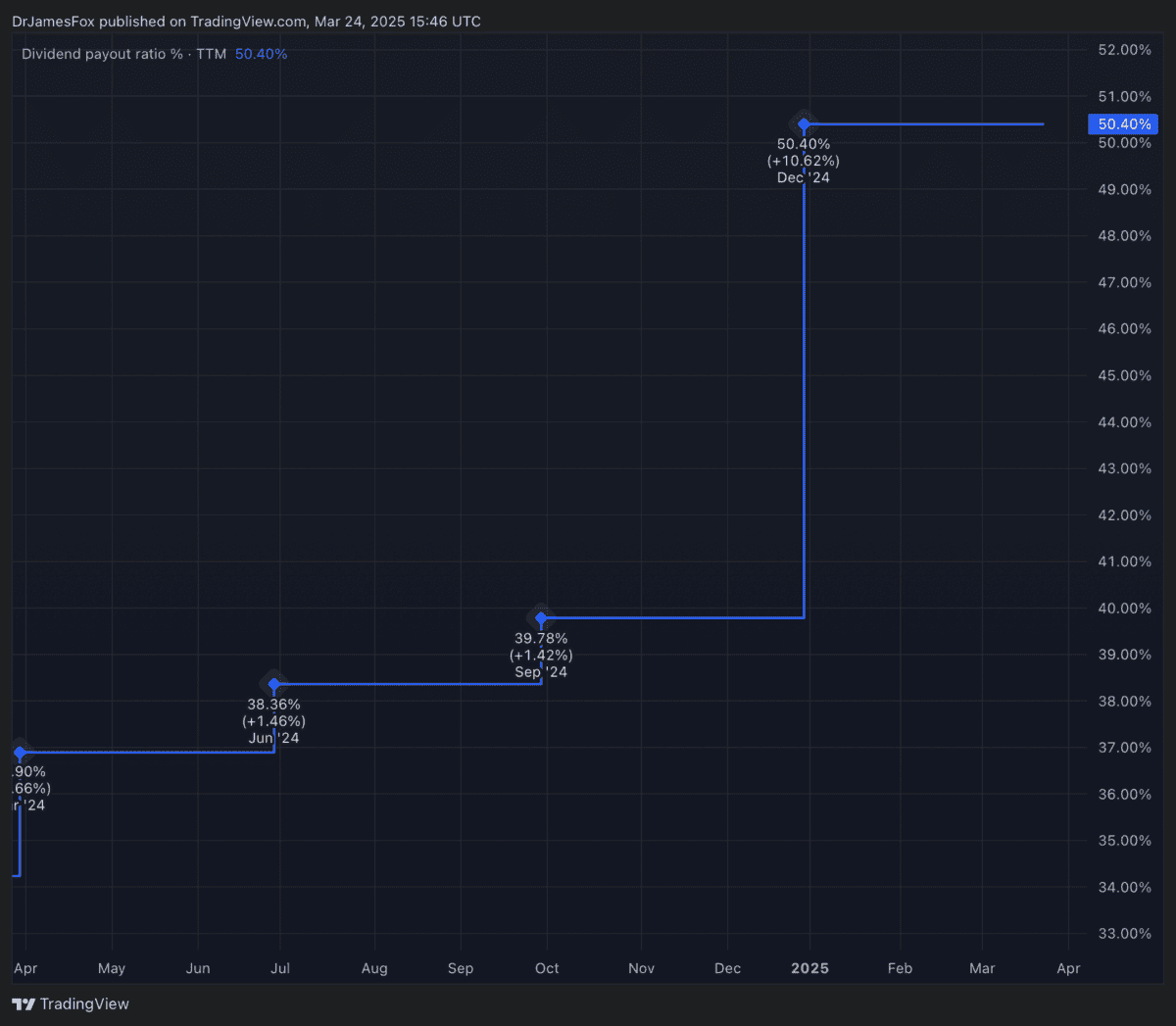
Interestingly, the data suggests that Lloyds is much more generous than some of its peers. It’s giving away more than half of earnings to shareholders. The currently coverage ratio of 2025 — this is based of earnings projections and dividend forecasts — is 1.95. It’s strong, but could be a little stronger.

Source: TradingView: Dividend Payout Ratio — Equivalent to Coverage

Thankfully, both earnings and dividends are expected to improve throughout the medium term. In fact, earnings are expected to jump from around 6.6p per share in 2025 to 8.8p in 2026, and then to 10.6p in 2027. This isn’t purely organic, as 2025 will likely see large impairments related to motor finance mis-selling.

Nonetheless, this earnings growth is good for dividends and their sustainability. The dividend payments are expected to increase from 3.4p in 2025 to 4p in 2026, and then to 4.6p in 2027. This equates to a 5.8% yield for 2026 and a 6.6% yield for 2027 if an investor bought the stock today.

Growing earnings will also see the dividend coverage ratio rise to around 2.2 by 2027. That’s a good sign.

Source: TradingView: this chart shows the movements in the share price and dividend yield

Things to consider

While the bank’s dividend forecast looks promising, potential risks loom. The impact of motor finance mis-selling could be more significant than anticipated, with Lloyds already setting aside £1.2bn for compensation. This issue may continue to affect profitability.

Additionally, the UK economy faces growth challenges under the Labour government, with GDP growth forecasts for 2025 ranging from 1.2% to 1.5% — lower than it has been. These economic issues could impact Lloyds’ performance, damaging demand for loans and increasing bad debt. Investors should monitor these developments closely when evaluating Lloyds as a dividend stock.

A lesson for later

Not every stock goes up in value and not every dividend rises. However, I, and my fellow Fool analysts, especially John Choong, had a lot of conviction when Lloyds shares were trading around 40p. And with my weighted cost around 40p, my forward dividend yield is around 8% for this year. That jumps to 10% in 2026 and 12% in 2027. While this isn’t a Warren Buffett and Coca Cola story — his initial investment now yields over 50% — it’s an important lesson in investing. Personally, having already built a sizeable position in Lloyds, I’m not buying more right now.

Hunting for passive income? Here’s a top FTSE 100 dividend growth share to consider!

Successful passive income investing requires more than just picking high-yield stocks. On the London stock market, the FTSE 100 and FTSE 250 provide many opportunities to make a winning second income. But focusing solely on a dividend yield can be risky.

Dividend growth stocks can offer more stability than shares with higher yields. They are often a signal of strong financial foundations. They provide inflation protection and they can provide superior overall returns through a combination of dividend income and capital appreciation.

Over the long term they can be far better ways for investors to grow their wealth.

A top dividend stock

With this in mind, let me talk about one of my favourite Footsie dividend growth shares to consider right now: Ashtead Group (LSE:AHT). The rental equipment provider has one of the strongest dividend growth records on the FTSE 100, dating back well over a decade.

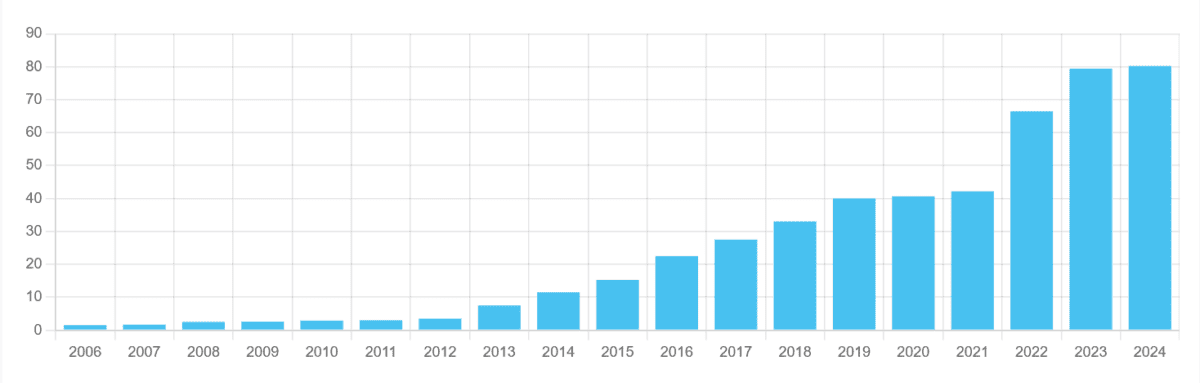
Supreme cash generation has allowed it to shower shareholders with cash, delivered through a blend of stock repurchases and annual payout increases:

Ashtead’s dividend record. Source: Dividendmax

Past performance isn’t always a reliable guide to the future however. Shell‘s shock dividend cut during the pandemic — the first such move since World War Two — illustrates how even the most reliable income stock can disappoint.

Yet barring some catastrophe, I’m expecting dividends on Ashtead shares to keep marching higher. Incidentally, it’s worth mentioning that dividends here continued to climb even during the Covid-19 crisis.

In good shape

Why am I so optimistic? While it’s suffering severe market challenges today, the increased earnings tipped for the next couple of years are well covered by expected earnings. This provides a cushion in case profits fall off a cliff.

For fiscal 2025 and 2026 respectively, dividend cover’s a sturdy 3.5 times and 3.5 times respectively. Any figure above 2 times is considered strong.

I’m also encouraged by the continued robustness of Ashtead’s balance sheet. Its net debt to adjusted EBITDA ratio fell to 1.7 times as of January from 1.9 times a year earlier. This pulled it further within the firm’s target range of 1 to 2 times.

A strong outlook

As I say, Ashtead isn’t having the best of times right now. Latest financials showed operating profit down 7% in the January quarter, reflecting lower equipment usage and higher costs. And conditions could remain tough in 2025 if economic uncertainty continues.

But I still believe the Footsie firm will remain a top share to consider for the long term. It’s well placed to capitalise on a spending boom on US infrastructure this decade. And supported by that strong balance sheet, it has considerable room to further grow its market share through acquisitions or organic investment.

Ashtead shares don’t have the largest dividend yields, at 1.8% and 2% for this year and next respectively. But on balance, it’s still a great passive income share, in my opinion.

Financial News

Daily News on Investing, Personal Finance, Markets, and more!

Financial News

Policy(Required)