A FTSE 100 share to consider in April for growth AND dividends!

The FTSE 100 is a popular destination for share investors seeking passive income. More than other international indices, the UK blue-chip index is famed for its large collection of dividend shares with high yields and long records of payout growth.

It’s less recognised for its growth prospects however, given its high exposure towards mature industries such as banks, oil and mining. Yet the Footsie index can also be a great place to pick up top growth shares.

Here’s one top FTSE 100 stock I think is great for both capital growth and dividend income. So much so, I recently topped up my existing holdings just last Friday (21 March).

Shooting star

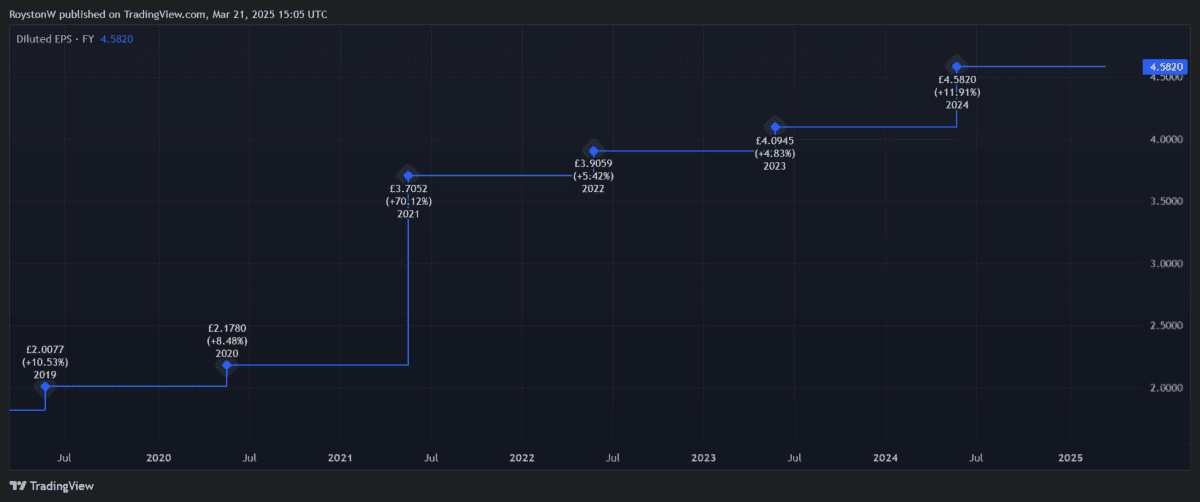
Games Workshop‘s (LSE:GAW) shares have shot through the stratosphere as earnings have ignited. Since 2020 its share price has risen 260%, driven by a sharp bottom-line rise as the tabletop gaming boom has grown.

Source: TradingView

Soaring earnings have also delivered a splendid rise in dividends per share over the time. The dividend of 145p per share paid in fiscal 2020 is dwarfed (no pun intended) by the 420p reward the business doled out last year.

City analysts are expecting both profits and dividends to continue rising over the short term too. A 15% earnings per share rise is tipped for this financial period, leading to predictions of an 10% hike in the full-year dividend, to 460.3p per share.

This leaves Games Workshop shares with a solid 3.2% dividend yield.

Cash king
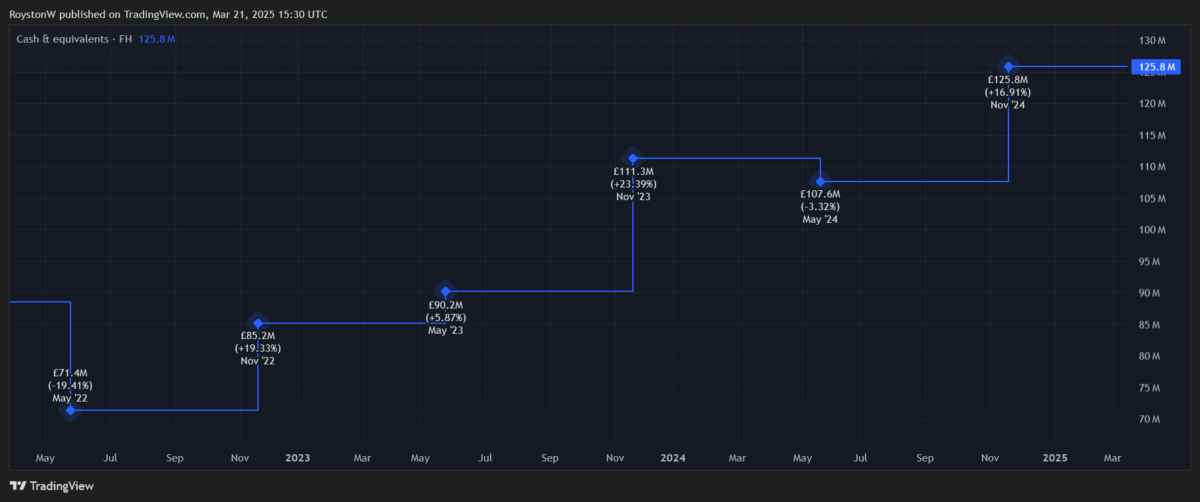
Games Workshop cash and equivalents
Source: TradingView

The strong returns it’s delivered is thanks in large part to Games Workshop’s position as a cash-generating machine.

In the six months to December, cash and cash equivalents here rose by more than £18m to almost £126m. This was even after the payment of dividends, tax, and on asset purchases (like land) and product development.

This impressive cash creation is thanks in large part to its huge profit margins, with gross margins tending to range between 65% and 70%. The strong brand power of Warhammer means the company can charge premium prices, and production costs are relatively low.

But past performance is not a guarantee of future returns. And today there are significant risks to future revenues and cash flows, like a potential weakening in consumer spending if economic conditions worsen.

The business could also face higher costs and lower Stateside demand if US trade tariffs are slapped on the UK. Its plastic miniatures roll off conveyor belts in its factory in Nottingham, UK.

Looking good

But on balance, I’m optimistic that earnings and dividends will continue growing at Games Workshop, and certainly over the long term. ith With new manufacturing facilities and ongoing global store expansion, it’s well-positioned to continue capitalising on surging interest in fantasy wargaming.

I’m also encouraged by the company’s steps to supercharge licencing revenues. The blockbuster TV and film deal it’s signed with Amazon alone could take profits to the next level.

Games Workshop shares aren’t cheap on paper. They currently command a price-to-earnings (P/E) ratio of 27.7 times for this financial year. However, I think this is a fair valuation given the company’s proven quality as both a growth and dividend share.


Just released: our 3 best dividend-focused stocks to buy before April [PREMIUM PICKS]

Premium content from Motley Fool Share Advisor UK

Our monthly Ice Best Buys Now are designed to highlight our team’s three favourite, most timely Buys from our growing list of income-focused Ice recommendations, to help Fools build out their portfolios.

“Best Buys Now” Pick #1:

B&M European Value Retail (LSE: BME)

  • A recent profit warning and departure of the company’s CEO have compounded the sell off in the company’s shares and led its one year share price decline to 48%. 
  • While weak consumer demand doesn’t bode well for general merchandise spending and the reduction in profits is unwelcome, we view this sell-off as more of an opportunity than reason to panic. 
  • Full year 2025 adjusted EBITDA guidance is now £605m-£625m, down from the prior range of £620m-£660m. That’s unfortunate but doesn’t represent a material change and at worst suggests a minor year-on-year reduction from the £616m posted in FY24 (adjusted to exclude the extra week that landed in FY24). 
  • Were B&M more leveraged the combination of weak same store sales and leadership turmoil would give us pause. But net debt at the end of H1 was just £788m, so leverage remains within reasonable limits and suggests there is more than enough cash to make whatever investments the new CEO deems necessary as well as continuing to return significant sums to shareholders. 
  • B&M’s trailing dividend yield now sits at 5.3% and the company’s plan to move its legal HQ from Luxembourg is advancing. Once that’s complete it will be able to begin share buybacks – which we believe at the company’s current valuation of 8x consensus forward earnings would be a great use of cash. 

“Best Buys Now” Pick #2:

Redacted

Want The Full Recommendation? Enter Your Email Address!

GameStop to invest corporate cash in bitcoin, following in footsteps of MicroStrategy

A general view of the GameStop logo on one of its stores in the city center of Cologne, Germany.
Ying Tang | Nurphoto | Getty Images

Video game retailer GameStop announced Tuesday its board has unanimously approved a plan to buy bitcoin with its corporate cash, a move that MicroStrategy became well-known for.

The meme stock jumped more than 6% in extended trading following the news. The announcement confirmed CNBC’s reporting in February on GameStop’s intention to add bitcoin and other cryptocurrencies to its balance sheet.

GameStop would be following in the footsteps of software company MicroStrategy, now known as Strategy, which has bought billions of dollars worth of bitcoin in recent years to become the largest corporate holder of bitcoin. The move prompted a rapid, but volatile, rise for Strategy’s stock.

GameStop’s foray into cryptocurrencies marks the latest effort from CEO Ryan Cohen to revive the struggling brick-and-mortar business. Under Cohen’s leadership, GameStop has focused on cutting costs and streamlining operations to ensure the business is profitable even though it is not growing.

Investors also cheered a rise in GameStop’s fourth-quarter results. The firm reported net income of $131.3 million, a jump from the $63.1 million figure from the same quarter last year.

This is breaking news. Please check back for updates.

Earning passive income from the stock market is plagued with myths. These 3 are busted!

Passive income from stocks and shares sounds great, right? But so many naysayers trot out all the reasons why it will only ever be a pipe dream.

I can’t cover all their claims. But today I want to stomp on a few common ones.

Myth 1: It takes a lot of money

Some passive income ideas might indeed cost big money to set up. Rental real estate is a common one, but that means having enough cash for a property or taking out a big mortgage. Actually, even that might not be true, and I’ll come back to it.

The stock market’s just for well-healed investors, yes? Well, no. I’ve just done a quick online search. And I see with a Stocks and Shares ISA from AJ Bell, we can invest as little as £25 monthly or make a one-off £250 transfer. That’s not unusual and it’s not a recommendation, it’s just the very first one I found.

Other ISA platforms are similar. As well as costing very little to get started, they’re easy to open. The more we can invest, the better we’re likely to do. But we really can start with modest amounts of money.

Myth 2: It’s very risky

The thought of putting our money into a company that goes bust is scary. It can happen, but we can greatly reduce the risk.

All we need to do is consider shares in a stock market tracker, like the iShares Core FTSE 100 UCITS ETF (LSE: ISF).

But don’t fear, the name is more complicated than the thing itself. It’s just an exchange-traded fund (that’s what the ETF bit means), and it spreads the cash across the FTSE 100.

Over the past five years the tracker share price is up 51%. That’s a shade below the 53% the Footsie has managed. And once we take the fund’s modest charges into account, it’s pretty much bang on.

Over the past 20 years the FTSE 100 has returned an average of 6.9% annually. If that continues, I reckon investors should expect something similar from the iShares tracker. And that, compounded for a few decades, could deliver some nice passive income.

Of course, a tracker fund shares the overall market risk. And we can lose money on them when the market falls. But the diversification should mean far less risk than from individual stocks.

Myth 3: It takes talent

Stock market investing has long been shrouded in mystery. We have to understand all sorts of big words and do complicated financial sums to have a clue, don’t we? Well, that myth has also been shattered these days. I think it’s pretty clear that investing in a simple tracker fund doesn’t require egg-head brains.

Considering investment trusts, which spread out cash using specified strategies is a common next move. Want income from UK dividend stocks? Look for one that does that. No genius required. Oh, remember that thing about real estate income? There are investment trusts that do that too.

And there’s a bonus — the more we widen our investing horizons, the smarter we can get at it.

Is this the last chance to buy this dirt-cheap S&P 500 stock at a discount?

Many UK investors choose to buy FTSE 100 or FTSE 250 stocks over S&P 500 shares. Since they may be more familiar with UK equities and have currency risk concerns, there’s logic behind a degree of home bias.

However, backing Britain alone can come at a cost. Despite the recent sell-off, the S&P 500 index has outperformed leading UK benchmarks in recent years. Plus, the premier US index represents over 50% of the total global stock market. British investors who ignore it are significantly limiting their potential investment choices.

With that in mind, here’s one S&P 500 tech giant that looks particularly cheap to me right now.

An undervalued stock

I’m talking about the conglomerate Alphabet (NASDAQ:GOOG) (NASDAQ:GOOGL), better known as the parent company of Google and YouTube. Based on several valuation metrics, I think the stock looks like a potential long-term bargain today.

The firm’s price-to-earnings (P/E) ratio of 21.1 and forward P/E of 19.1 are currently the lowest among all Magnificent Seven stocks. In addition, Alphabet’s forward enterprise value/EBITDA ratio of just 11 means investors can buy the stock for the same multiple as 10 years ago. After a decade of strong growth, that’s an enticing prospect.

The Alphabet share price has slumped nearly 10% this year, impacted by wider market panic that gripped the S&P 500 as a whole. With recession risks looming for the US economy and uncertainty arising from Trump’s coercive, tariff-fuelled statecraft, further dips could be on the horizon.

However, I wouldn’t be surprised if Alphabet’s low for the year is in. The S&P 500 has rebounded in recent days, and should investor confidence fully return, I’d back the stock to climb higher as 2025 progresses.

The outlook for Alphabet shares

Alphabet stock faces several risks. Among the most prominent are two anti-monopoly lawsuits being pursued by the US Department of Justice. With regulatory focus on the group’s search business and advertising technology, the company could potentially face a forced breakup. This could spell trouble for shareholders.

That said, there are many good reasons for investors to be positive. Foremost is Alphabet’s human capital. An army of world-class artificial intelligence and machine learning engineers work for the company. It has a compelling offering to attract the best and the brightest. This provides the business with a wide moat despite fierce competition.

Furthermore, Google Cloud’s a particularly bright area for the business. Revenue for this division advanced 30% to $12bn in the fourth quarter. YouTube’s potential also shouldn’t be overlooked. With a rich dataset of text, audio, and video to tap into, Alphabet has a wealth of resources to deploy when developing new AI-powered models.

Finally, there’s the jewel in the company’s crown. Internet search is an area where Alphabet reigns supreme, and while it’s a more mature area of the business, it continues to exhibit strong growth. Search revenues climbed 12.5% to $54bn in Q4, demonstrating Google’s rising to the challenge posed by large language models (LLMs) like ChatGPT.

My investment manoeuvres

I bought more Alphabet shares in the recent S&P 500 downturn. It’s one of my core portfolio holdings and will likely remain so for many years. The stock’s worth considering today as it may not remain this cheap for long.

At a 52-week low, this under-the-radar UK dividend stock is 1 to consider buying

James Halstead (LSE:JHD) isn’t the most famous or widely-covered stock on the market. But it has an excellent record when it comes to dividends and it’s trading at a 52-week low.

The firm manufactures and distributes industrial flooring. And while things are tough in the industry at the moment, this could be the time to consider buying shares in a quality business.

Industrial flooring

Industrial flooring doesn’t seem particularly exciting. And compared with a lot of things – or indeed, almost all other things – it isn’t, but this can be a good thing when it comes to dividend stocks.

Sometimes, businesses that aren’t particularly high-octane can be durable and resilient investments. And that’s been the case with James Halstead. 

The company’s Polyflor brand sets the standard in industrial flooring. Its products are known for their high levels of slip-resistance, durability, and the ability to withstand regular clearing.

In some cases, such as hospitals, these characteristics are even specified by regulation. This creates a barrier to entry for competitors and helps James Halstead maintain its leading market position.

Why has the stock been struggling?

Despite some clear strengths, James Halstead’s share price has been struggling in 2025. And the reason for this is that sales have been unusually weak. 

In its January trading update, the firm reported a decline in revenues compared to the year before. Management attributed this to weak customer confidence in a difficult environment.

Despite this, the company did offer some encouraging guidance for investors. It identified a backlog of repairs and renewals in healthcare and education as strong signs for future growth.

I think that gives some reason for optimism going forward. Specifically, it suggests that the challenges James Halstead is facing are cyclical, rather than permanent. 

Long-term investing

From a long-term perspective, I’m not concerned about the current environment – in fact, I see it as a potential buying opportunity. But there is something else that I’m mindful of.

Over the last 10 years, James Halstead has distributed roughly 75% of its net income. Given this, the fact it has managed to increase its dividend by around 60% is quite impressive.

There is, however, something that I think is worth keeping an eye on. Since 2015, the return on equity (ROE) the company generates has been declining steadily from 33% to 23%.

This is a sign the firm hasn’t managed to be as efficient with the cash it has retained as it was a decade ago. And that’s something investors should keep an eye on.

A stock to consider buying

To my mind, James Halstead is a quality business that doesn’t get the attention it deserves. And that’s a good combination from an investment perspective. 

As far as I can see, only one analyst covers the stock and has a price target 117% above the current level. I’m not sure I’d go that far, but I definitely think it looks attractive.

The dividend yield is approaching 6% and that’s unusually low for this stock. With that in mind, I think passive income investors should seriously consider buying it at today’s prices.

Here’s why the Rolls-Royce share price has jumped 88% in a year, breaking record highs!

Some say the FTSE 100 lacks good growth stock opportunities, but a glance at the Rolls-Royce (LSE:RR.) share price chart tells a different story. Returns for investors in the aerospace and defence pioneer over recent years have been exceptional.

Under Tufan Erginbilgiç’s leadership, the jet engine maker has roared into action with a remarkable turnaround from its pandemic woes. As the company upgrades its mid-term outlook, Rolls-Royce shares continue to smash through new highs in 2025. Consequently, I’m a very happy shareholder.

Let’s explore the reasons underpinning the stellar performance and where the share price could go next.

Beating market expectations

Rolls-Royce’s FY23 results were exceptional, but its FY24 earnings might be even better. Operating profit soared 55% to hit £2.5bn, and free cash flow nearly doubled to £2.4bn. The balance sheet has also fully recovered. The firm now enjoys a net cash position of £0.5bn compared to a net debt burden of £2bn the year before.

Furthermore, shareholders were treated to a surprise £1bn share buyback plan for 2025 and the resumption of dividend payments for the first time since Covid-19 almost wrecked the business. Looking at these numbers together, it’s little wonder the Rolls-Royce share price is booming.

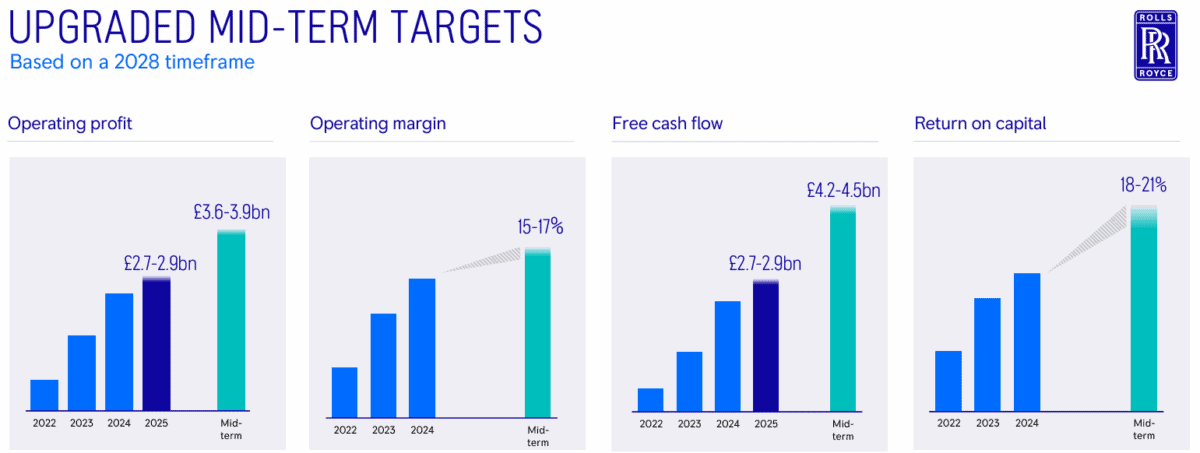
Having achieved some of its 2027 targets two years in advance, the board has also raised its ambitions across a variety of key metrics.

Source: Rolls-Royce

Can the growth continue?

A surging share price has pushed Rolls-Royce’s valuation higher. The blue-chip stock’s currently trading at a price-to-earnings (P/E) ratio of 26.5 and a forward P/E of 36.8. Those aren’t cheap multiples, which raises questions about the future growth trajectory.

However, the company’s forward guidance suggests these concerns might be unfounded. Large engine flying hours are expected to reach 115% of 2019 levels this year, driven by robust international travel demand. That’s crucial considering over 50% of the firm’s revenues comes from the civil aerospace division.

The outlook for the defence arm is equally rosy. Prime Minister Sir Keir Starmer’s committed to boosting UK defence spending to 2.5% of GDP by 2027. As one of the government’s preferred military contractors, this bodes well for Rolls-Royce shares.

Hopefully, we’ll see further good news following the firm’s biggest ever MoD contract win earlier this year. The eight-year deal is valued at £9bn. Rolls-Royce will provide design, manufacturing, and support services for nuclear reactors to power Britain’s submarine fleet.

Technological advances for the power systems unit provide further encouragement. Rolls-Royce has established itself as a market leader in small modular nuclear reactors. Potential growth opportunities for applications in space missions and energy-hungry data centres add another string to the company’s bow.

These reasons for optimism should be balanced against supply chain disruption for Trent 1000 engine parts, which could prevent the business from achieving its goals. In addition, recent technical faults for the firm’s engines raise safety concerns and reputational risks.

What I’m doing

Further growth in the Rolls-Royce share price isn’t guaranteed, but I see few reasons to sell my shares just yet. I’ve enjoyed some spectacular gains from my investment thus far, and I’m hopeful there will be more to come in the future. For investors who don’t own the stock, I think it deserves serious consideration.

2 macro investment themes and associated stocks to consider for a 2025/26 ISA portfolio

When I started investing five years ago, I would literally pick either household names or recovery plays. The results in my Stocks and Shares ISA portfolio ended up being somewhat hit or miss. For example, I made money on International Consolidated Airlines but lost a bucket on boohoo.

Today, I very much apply a thematic approach to investing. Firstly, I’ll research across a broad number of mega themes. Secondly, I will then break down each theme into a number of distinct sub-themes. Finally, I will look for individual stocks to invest in.

Climate change and the push for net zero is one of the biggest macro themes in investing today. However, investors are only starting to wake up to the many challenges of how to make it a reality.

In our push to move toward cleaner sources of energy to power our homes, transport, and the like, we have forgotten one very important thing – the need for vast quantities of copper.

On average, an EV requires over twice as much copper as one powered by the internal combustion engine. But that’s just the tip of the iceberg.

As we electrify our world, ageing electricity grid infrastructure will need upgrading too. In the UK, our grid was build back in the 1960s. Across the globe, the International Energy Agency predicts some $11trn will be needed to invest in the grid to make net zero a reality.

Copper is a metal with growing demand. My favoured pick is Glencore. It currently mines nearly 1m tonnes a year. But it has capacity to double that in the years ahead.

Copper is a key part of the company’s future portfolio, but today the vast majority of its revenues still come from coal. Depressed prices lately have resulted in lower profits, hitting its share price.

Ageing demographics

One of the biggest challenges facing Western society’s today is a growing ageing population. In the UK alone, the number of people over 65 is expected to grow 35%, to over 15m, by 2040. The challenges are enormous. From healthcare provision to retirement savings, the insurance sector is set to grow.

But the real growth opportunity in this arena, I believe, lies in emerging markets. A growing, aspirational middle class across both India and China dwarfs the mature markets of the UK or US.

My standout pick is Prudential (LSE:PRU). It holds top three positions in 10 Asian life markets today. Asia alone accounts for approximately 30% of global wealth.

Demand for life, insurance, and savings-related products is expected to boom in the coming decades. Single-digit life insurance penetration rates together with limited pension and social security provision have created huge health, protection, and mortality gaps in Asia.

What individuals take for granted in the West, including health protection, needs to be accounted for out of a huge chunk of Asian people’s own pockets.

Prudential’s share price has taken a beating lately as a result of a sluggish Chinese economy, post-Covid. But when I look beyond the short-term noise, I believe that Prudential makes for one of the most compelling growth stories in the FTSE 100.

The Tesla share price has halved. It could halve again!

The past half-year has been a wild roller-coaster ride for the Tesla (NASDAQ: TSLA) share price. For three months, Tesla stock was a big winner, soaring to new heights before end-2024. However, the shares have since collapsed, leaving investors on a round trip and back to the start.

Tesla stock skyrockets

On 23 September 2024, Tesla stock closed at $250, 80% above the low of $138.80 on 22 April. It then drifted sideways, but took off after closing at $242.84 on 4 November.

When Donald Trump was re-elected as US president, this triggered a so-called ‘Trump bump’. Shares in companies with links to the president and his policies exploded in value.

For Tesla, Elon Musk’s closeness to Trump paid off handsomely. The stock soared like a SpaceX rocket, peaking at a record of $488.54 on 18 December 2024.

On a road to nowhere

However, like the failed SpaceX Starship launch on 7 March, the Tesla share price came crashing back to Earth. As it plunged, I gave this ultimate meme stock a firm thumbs-down on 18 February.

My hunch was right, as Tesla’s share slide continued. On 7 March, the stock closed at $222.15, down more than half (-54.5%) from a pre-Christmas high. On Friday, 21 March, it closed at $248.71, down 0.5% from its 23 September 2024 close.

In summary, Tesla’s Trump bump was followed by an equal and opposite Trump slump, leaving its share price unchanged over six months. Whoa.

What next for this stock?

Lacking a crystal ball, I cannot forecast the future fluctuations of Tesla shares. However, I see two powerful opposing trends at work here.

First, Tesla is far and away the most popular S&P 500 stock among day traders and short-term speculators. Thus, when its price falls, fanboys often rush in, buying the dip en masse. This has contributed to a 12% rise in the share price since its 7 March close.

Second, sellers and doubters (including me) feel that Elon Musk’s political and personal antics may permanently tarnish his brand. Here in the UK, this is known as ‘doing a Ratner’, after ill-advised remarks by Gerald Ratner in 1991 almost brought down jeweller Ratners Group.

Right now, Tesla’s market cap of $779.3bn puts its on a rating of 122 times earnings and a 0% dividend yield. As a fundamental/value investor, this stock looks far too richly valued for my blood. Of course, I could be wrong and Tesla bulls could send this stock soaring again.

Then again, I could never buy any products linked to Musk, as it would be incompatible with my personal beliefs. Also, Musk is a serial over-promiser, with countless failed launches and soon-to-come upgrades dating back to 2017.

In addition, with Tesla sales plunging in European markets, 46,000 Cybertrucks being recalled in the US, and Tesla vehicles being vandalised worldwide, JPMorgan has just lowered its end-2025 price target for Tesla from $135 to $120 a share. That’s a fall of more than half (-51.8%) from here.

Finally, Tesla’s value might lie elsewhere, having committed to spending many billions on artificial intelligence, robotics, and self-driving vehicles. Whatever the outcome, I’m sure exciting times await Tesla and its shareholders!

An activist thinks the Smiths Group share price is too low. These first-half results might show why

Smiths Group (LSE: SMIN) posted a 9.5% jump in first-half headline operating profit on Tuesday (25 March), but the share price didn’t do much in response.

As I write, we’re looking at a rise of just 1.6% on the day. But Smiths shares have climbed 22% in the past 12 months and 81% in five years.

Pressure to move

The global engineering firm has been under pressure to consider a move to list on the New York stock market. US activist investor Engine Capital has been urging that as one possible way to maximise shareholder value. And US-listed stocks do often command higher price-to-earnings (P/E) valuations than their London sector rivals.

In a recent interview with Reuters, CEO Roland Carter said: “We never say never. We’ve been listed for over 110 years on the London Stock Exchange. So… we intend to remain a FTSE 100 company for now.

But this new results update does seem to be heavy on the shareholder value theme. As an example, Carter also said: “Our strong cash generation enables us to continue to invest in the business… whilst being able to distribute significant capital to shareholders. We believe this will deliver substantial value creation.”

Strategic change

The company reminded us of “strategic actions to unlock significant value announced in January“, adding that “separation processes for Smiths Interconnect and Smiths Detection” are underway. Those divisions are involved in electronic component supplies and airport baggage screening.

The focus now is going to be on “high-performance industrial technology businesses of John Crane and Flex-Tek with significant opportunities to enhance growth, improve the financial profile and deliver strong returns.”

Smiths Group is clearly going through a time of transition. And I do think this investor activism has possibly got the board a bit rattled. But does the stock really look undervalued?

Valuation

That operating profit rise came from a 6.7% increase in revenue. And at the bottom line, it translated into earnings per share (EPS) of 55.5p, up 14%. Again, this is on a non-standard headline basis. Assuming it doubles for the full year, we’d be looking at a P/E of 18 based on the previous closing share price.

Using the statutory EPS figure of 48.8p would take the P/E to a bit over 20. And that’s largely in line with analyst forecasts of 21 for the current year. They also see it dropping as low as 16.5 by 2027.

That isn’t obviously cheap compared to the long-term FTSE 100 average. But for a company with strong earnings growth on the cards it could look a bit feeble. Then compare that with typical P/E values for similar companies listed in New York… and I think I’m starting to see what this Engine Capital investor is on about.

What next?

I feel the uncertainty resulting from ths ongoing transition could keep the share price down for some time. Still, analysts have a consensus price target of 2,300p, up 13%. For investors who understand the long-term prospects, Smiths surely could be worth considering at today’s valuation.

Financial News

Daily News on Investing, Personal Finance, Markets, and more!

Financial News

Policy(Required)