2 bargain-basement value shares around 52-week lows

Finding cheap value shares isn’t easy. Just because a stock is falling doesn’t always mean that it represents a good buying opportunity. However, I have a filter that flags up stocks that are close to (or are at) 52-week lows. From there, I can then assess whether the move is warranted or if it’s becoming undervalued. Here are two on the radar right now.

Demand from easing monetary policy

The first one is Marshalls (LSE:MSLH). Last week, the stock hit the lowest level in a year at 229p. Currently, the share price is down 10% over the past year.

The UK-based landscaping and building products company has struggled in the past year, mostly due to subdued activity in the housing sector. As interest rates have stayed higher for longer, mortgage rates have done the same. This has made it tricky for people to buy houses. Further, with economic growth rather sluggish, some are feeling the pinch on finances and so are putting off home improvement projects. This remains a risk going forward.

However, February inflation data showed a fall from 3% the previous month to 2.8%. This could allow the Bank of England committee to start cutting the base rate faster if inflation keeps showing signs of falling. In turn, this should help to boost client demand for Marshalls.

Further, the latest annual results showed strong cost discipline as the management team focuses on efficiency. Net operating costs were down 10% versus the year before. So even if the company needs to contend with another slow year for revenue, lower costs can offset this impact.

I think the stock is now cheap as the price-to-book ratio is 0.93, the lowest level in a decade. This valuation metric can help investors to assess the market price relative to the book value.

A potential German boost

A second idea is Essentra (LSE:ESNT). Down 39% over the past year and currently at 52-week lows, this reflects a much larger move than Marshalls.

The industrial components manufacturer recently posted 2024 annual results showing a 4.4% decline in revenue to £302.4m. Adjusted operating profit fell 7.2% to £40.1m, with the management team citing “softening market conditions” for the overall fall. The business had been guiding towards lower results, hence the move lower in the stock price over several months.

With a price-to-earnings ratio of 12.4, it’s below the FTSE 250 average, making it potentially undervalued from that angle. Yet the other big factor relates to a possible surge in demand from European clients. Recently, Germany announced plans for a huge £420bn infrastructure investment package. With nearly half of firms revenue coming from the continent, it stands to win big if this fund takes off soon. I don’t believe this potential is reflected in the current share price, making it cheap in comparison.

Of course, one risk is that market conditions remain weak for longer than expected, causing the share price to fall further before recovering. This is true, but ultimately an investor should have a multi-year long-term investment horizon.

I think both value ideas are worth considering by investors at the moment.

2 fantastic US growth stocks to consider for a fresh ISA this April

The past two months haven’t been kind to US growth stocks, as trade tariff turmoil sent many into freefall. Automakers and banks were among the worst hit, with Chrysler owner Stellantis losing 10% in a single day in March.

Now analysts are eyeing a recovery following news that the Trump administration may ease tariffs this week. The result could be great news for stocks that had a tough start to the year and are now trading at a discount.

For UK investors looking to add some diversity to their ISA this April, here are two promising US growth stocks to consider.

Uber Technologies

The ride-hailing and food delivery platform Uber (NYSE: UBER) is more often in the news for controversy than its stock performance. Yet despite several security issues — including data breaches and safety concerns — it remains the most popular ride-hailing app in the world.

Founded in 2009 and headquartered in San Francisco, its operations span across the Americas, Europe, the Middle East, Africa and the Asia Pacific.

The stock’s currently trading around $76, up 180% after five years of volatile price action. Investors who caught the $20 low in mid-2022 would have almost quadrupled their investment by now.

But several ongoing risks threaten continued volatility. Regulatory challenges are a key issue, with some regions attempting to ban the app on grounds of unfair competition. It also faces stiff competition from a plethora of lower-priced rivals like Bolt.

By adding additional revenue streams like food and freight delivery, Uber has successfully expanded its business. Adding to this is its recent partnerships with autonomous vehicle companies like Waymo, positioning it to benefit from the robo-taxi market.

Analysts expect revenue to reach $50bn by the end of 2025, with an average 12-month price target of $90.

Dell Technologies

Dell‘s (NYSE: DELL) a well-recognised name in the tech world, providing a broad range of IT products and services. The multinational tech giant sells everything from personal computers and servers to storage systems and networking products. Its varied customer base includes individual consumers, small businesses and large enterprises.

The stock currently trades at around $100 a share, up 410% in the past five years. Lately, performance has been underwhelming, with the stock down 44% from its May 2024 all-time high of $180.

Despite moderate revenue growth, it has struggled recently with declining profit margins. This has been attributed to the high costs associated with artificial intelligence (AI) server components like Nvidia GPUs. Competition from other major players in the AI-server market is also threatening its market share and profitability.

In its fiscal fourth quarter ended January, Dell reported an 18% increase in adjusted earnings of $2.68 per share and a 7% revenue increase to $23.93bn. This surpassed earnings expectations but fell short of sales projections.

Demand for AI infrastructure has been a key driver of growth recently, with Dell enjoying significant interest in its servers and networking segment. Reports indicate the company’s AI server backlog is around $9bn.

The growth’s reflected in its annual cash dividend, which climbed 18% this year, supported by a $10bn share buyback programme. These developments reinforce the company’s commitment to returning value to shareholders.

Analysts are overwhelmingly optimistic about the stock, expecting an average 36.5% increase in the coming 12 months.

Up 67% in a year, here’s why the Barclays share price might still be a bargain

Typically, when a stock rallies hard over the space of a year or more, it has the potential to become overvalued. So when some investors see the 67% jump in the Barclays (LSE:BARC) share price over the last year, some might discount it as a viable investment. However, this isn’t always the case!

Reasons for the rally

Barclays did well in 2024, and has been outperforming ever since the Bank of England base rate started to rise to deal with the post-pandemic-induced inflation bump. To begin with, rising interest rates helped to increase the net interest margin for the bank. This refers to the difference between the rate it lends out at versus the rate it pays on deposits.

Last year, interest rates stayed higher than many expected. The UK economy was resilient and towards the end of the year inflation started to move higher again. This meant that the share price increased as investors had to factor in the net interest margin staying higher than previously thought.

The business has been working hard to reduce costs. Evidence of this is the £1bn+ cost-saving plan involving some job cuts and an efficiency drive. This has been received positively by shareholders. Even if revenue stays the same but costs decreaase, it should boost profits. Given that the share price is impacted by profitability, a higher figure on the bottom line of the accounts helps to increase the stock price.

All of this has pushed the stock to the highest level in a decade.

Can it still be considered cheap?

When looking at some valuation metrics, Barclays shares might not be expensive. For example, consider the price-to-earnings (P/E) ratio relative to some other global peers.

The Barclays P/E ratio is 8.52. Before we even do a comparison, this is below the fair value benchmark figure of 10 I use, suggesting it’s still undervalued. Goldman Sachs has a ratio of 14.17, Bank of America at 13.25 and Citigroup at 12.86. Barclays is still valued much lower than these similar global banks.

Next, let’s take the price-to-book ratio. For Barclays, the ratio’s 0.63. A normal figure would be 1. This would mean the market value of the stock is the same as the book value. For a bank, I’d expect this to be at 1, given the book value is largely made up of conventional assets and liabilities (eg cash, loans, etc) that can be valued easily. The low ratio currently means I feel the share price could rally in order for the ratio to move closer to 1.

A holitisic vision

Of course, valuation metrics need to be used along with other information when making a financial decision. It’s true that the bank has risks, such as the recent reputational damage caused by multi-day outages and payment issues. If this keeps happening, it could seriously undermine trust in the company.

Yet overall, I think the stock is verging on being a bargain and is one for investors to consider.

Despite the takeover rumours, I don’t want anything to do with this FTSE 250 stock

ASOS (LSE:ASC) is a FTSE 250 stock that’s been attracting a lot of interest lately. That’s because the online retailer’s two largest shareholders have both decided to increase their stakes.

On 17 March, Anders Holch Povlsen, and his father, Troels Holch Povlsen, increased their combined interest from 27.1% to 28%.

Two days later, Frasers Group raised its shareholding from 24.21% to 25.1%.

Both are now close to owning 30% of the company. Once this threshold is reached, City rules require an offer to be made for all of the remaining shares.

A bit of a mystery

The intention of both parties is unclear. However, inevitably it’s led to speculation that a takeover bid is imminent.

During the week ended 21 March, this helped the group’s shares soar 20.7%. This was a welcome relief for long-suffering shareholders. Since March 2020, the value of the company’s stock has fallen 73%.

Frasers has a history of buying businesses that are struggling. Whether ASOS meets this definition is a matter of opinion. But the owner of Sports Direct has been steadily increasing its stake over the past three years or so, although it tends not to launch hostile takeovers.

I suspect the Povlsen family is contemplating taking the business private, believing that investors are undervaluing the true value of the group. However, looking at the recent performance of the business, I disagree.

Some numbers

During the 52 weeks ended 1 September 2024 (FY24), ASOS reported a loss after tax of £338.7m. Despite this, it has a current (26 March) market cap of £365m.

Yet the company’s most recent trading update was positive. For the first half of FY25, it’s expecting a “significant improvement” in profitability. It’s forecasting adjusted EBITDA (earnings before interest, tax, depreciation and amortisation) of around £34m.

But ASOS has a lot of interest, depreciation, amortisation and impairment charges. In FY24, these totalled £340m. So even if the group has a positive EBITDA, it’s still a long way from being profitable at a post-tax level. And these costs are important. Depreciation and amortisation are non-cash items but the assets to which they relate are going to have to be replaced at some point in the future.

Uncertain outlook

Despite its woes, I believe ASOS is going in the right direction. It’s now focusing more on its bottom line than revenue.

Its ‘Test & React’ business model appears to be working. This seeks to get new products on its website within a few weeks, placing orders in small batches and then using data-led forecasting to determine how much to reorder. This encourages the “fashion-loving 20-somethings” (its core market) to keep coming back for more.

Despite this, I don’t see a clear path to profitability. Assuming a price-to-earnings ratio of 10 is reasonable, to justify its current market cap, it would need to report a profit after tax of £36.5m. Even if the various adjusting items were removed from its numbers, that would require a £160m improvement on FY24. And that’s a lot of clothes in an industry where margins are wafer thin.

And buying a stock on the basis of takeover speculation is never a good idea.

I’m therefore going to leave is to Messrs Povlsen and Ashley to determine the future ownership of ASOS and watch from the sidelines with interest.

2 investment trusts to consider for a Stocks and Shares ISA before 5 April

The deadline to shelter up to £20k in a Stocks and Shares ISA is fast approaching. For long-term investors, I think these two very different investment trusts are worth a look for anyone aiming to invest some ISA money soon.

Value and dividends

First up is BlackRock World Mining Trust (LSE: BRWM), which pretty much does what it says on the tin (pun intended).

Mind you, tin doesn’t make up too much of the global mining trust’s portfolio. Today, it has a large weighting to copper, iron ore and steel, which should all experience steady long-term demand due to global trends like decarbonisation, electrification, and infrastructure modernisation.

The FTSE 250 trust also has a 27% allocation to gold, the price of which has surged to record highs amid rising geopolitical tensions and a weakening US dollar. So there is good diversification, especially through top multinational holdings like BHPRio Tinto, and Glencore.

The risk here is that mining is cyclical and commodity markets can be volatile. The trust’s value can fall quickly if the global economy tanks.

Despite this, I think now is a good time to consider picking up some shares. Down 22% in two years, they’re offering a 4.6% dividend yield and are trading at a near-10% discount to net asset value (NAV).

Longer term, we expect mined commodity demand growth to be driven by increased global infrastructure build out, particularly related to the low carbon transition and increased power demand.

BlackRock World Mining Trust.

High growth

Next up is Baillie Gifford US Growth Trust (LSE: USA). Again, no prizes for guessing what this one focuses on.

The reason I like this one is because it offers investors exposure to some very exciting growth companies not listed on the stock market. Chief among these are internet payments giant Stripe (recently valued at $91.5bn) and rocket pioneer SpaceX (the world’s most valuable private firm at $350bn).

Many other holdings dominate their respective industries, including Amazon (e-commerce and cloud computing), Meta Platforms (Facebook, Instagram, and WhatsApp), Duolingo (language learning), Netflix (streaming), and Nvidia (AI chips).

Recent performance has been impressive. In the six months to 30 November, the trust’s NAV and share price returns were 29.4% and 40.9%, respectively. This significantly outperformed the S&P 500‘s 15.3% return (in sterling terms). 

One risk to be aware of here is that the portfolio has significant AI exposure. If AI spending slows, the technology doesn’t fulfil its exciting potential fast enough, or individual companies struggle, the trust’s value could suffer.

Longer term though, I expect it to do very well as the world becomes more digital and AI likely permeates every sector. It also has holdings in potentially revolutionary smaller companies like PsiQuantum (quantum computing) and Runway AI, a generative AI video platform for creative artists.

Some of these smaller growth companies could drive fantastic returns. As the trust points out, only 10 years ago, Tesla and Nvidia were mid-cap companies with market caps in the $10bn-$30bn range. Look at them now! 

Finally, the discount to NAV here is 12%, which means the shares might prove to be a bargain at 237p. I think they’re well worth considering for long-term growth investors with a stomach for volatility.

Up 16% in March but still down 71% since 2021! Is it time I bought this UK stock?

One UK stock that I’ve been following is Fevertree Drinks (LSE: FEVR). Yesterday (25 March), it jumped 4.4% to 778p after the premium mixers maker released its preliminary 2024 results.

This means the share price is up 16% so far this month, but still down 71% since late 2021.

Should I invest? Let’s look at some details.

Recovering profits

Fevertree’s profitable growth came to a shuddering halt in 2022 when the business was hit by surging glass and transatlantic freight costs. Its gross margin fell sharply, causing the share price to plummet.

However, there are signs that things are getting back on track. Group revenue rose 3% at constant currency to £368.5m last year, while core Fever-Tree brand revenue growth accelerated 7% in the second half of the year.

This resulted in full-year brand revenue growth of 4% as the firm capitalised on growing demand for non-alcoholic drinks.

In the key US market, Fevertree recorded impressive constant currency revenue growth of 12%, with the brand outpacing all of its competitors. And it extended its market-leading share in both the tonic and ginger beer categories.

However, UK sales fell 3% due to subdued consumer spending, while there was also softness in Europe. The rest-of-the-world region did much better, growing 22% on a constant currency basis, but it remains a small part of the overall business (around 8% of sales).

Even more encouraging, the company’s gross margin improved by 540 basis points to 37.5%, largely due to lower glass and freight costs. This resulted in adjusted EBITDA of £50.7m, a 66% increase. Normalised earnings per share surged 82% to 28.01p.

The stock currently carries a 2.1% dividend yield.

Potential game-changing deal

In January, Fevertree signed a strategic partnership with Molson Coors, the North American drinks firm that owns beer labels like Carling, Staropramen, and Coors Light.

This grants Molson Coors exclusive rights to sell, distribute, and produce the brand in the US. As part of the deal, Molson Coors acquired an 8.5% stake for £71m, along with the US trading entity for $23.9m.

Fevertree plans to use the proceeds to increase its share buyback programme by £29m, adding to the £71m announced in February.

The company will benefit from Molson Coors’ massive distribution network, with significantly more marketing investment going into the brand. Meanwhile, Molson Coors will manage the on-shoring of US production, reducing exposure to volatile transatlantic freight costs.

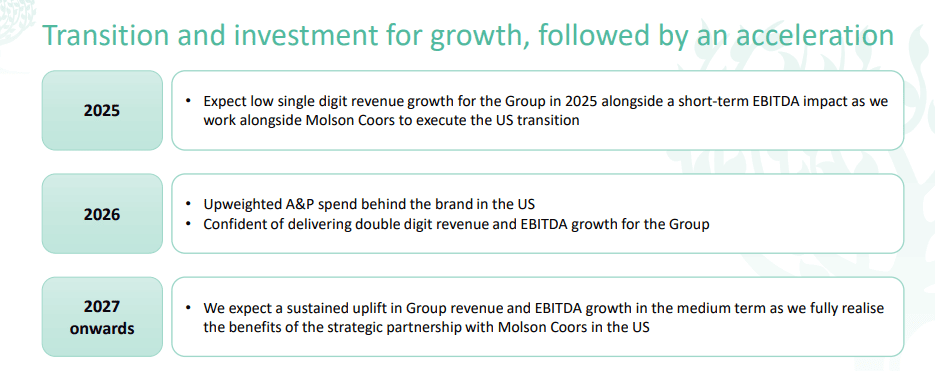
The company will recognise a guaranteed share of profits through royalty fees between 2026 and 2030. And from 2027 onwards, management expects a “sustained uplift in group revenue and EBITDA growth” as it fully realises the benefits of the partnership.

Source: Fevertree

My move

The Molson Coors deal could eventually prove to be a gamechanger for Fevertree’s profitability. If so, the stock today may prove to be a bargain, despite trading at 31 times forward earnings.

However, I’m mindful that consumer spending remains weak in the UK and Europe, while the US could still enter a recession. These are risks to growth here.

Meanwhile, management has warned that 2025 will be a “transition” year, with low single-digit revenue growth and a short-term impact on margins.

I’m not ready to invest in Fevertree yet, but I’m going to keep the stock on my radar. I reckon it has big turnaround potential.

A 6.2% yield but down 10%! Is it time for me to buy this FTSE broadcaster on the dip?

FTSE media firm ITV (LSE: ITV) has dropped 10% from its 22 July 12-month traded high of 88p.

This might signal the business is worth less than before. Or it could indicate a stock undervaluation and therefore a bargain to be had.

I did a deep dive into the firm and ran some key numbers to find out which is the case here.

Are the shares undervalued?

ITV trades at a price-to-earnings ratio of just 7.4 against an 11.9 average for its competitors. These comprise Atresmedia Corporación de Medios de Comunicación at 9.7, Métropole Télévision at 10.1, MFE-Mediaforeurope at 11.6, and RTL Group at 16.4.

So, Britain’s biggest free-to-air broadcaster looks very undervalued on this measure.

The same is true of its price-to-sales ratio of 0.9 compared to the average 1.1 of its peers.

However, its 1.7 price-to-book ratio looks overvalued against its competitors’ 1.2 average.

To get to the bottom of its valuation, I ran a discounted cash flow (DCF) analysis. This shows where any stock should be priced based on future cash flow forecasts.

Using other analysts’ figures and my own, the DCF shows ITV is 62% undervalued at its current price of 81p.

So the fair value for the shares is £2.13, although market unpredictability could push them lower or higher.

Does the business support this bullish view?

A risk for the firm is the cut-throat competition in its sector, which could squeeze its margins over time.

It also warned in its 2024 results that its Studios’ margins would fall this year because of the 2023 US writers’ and actors’ strikes. These have delayed £80m of revenue from 2024 to 2025.

It added that its Media & Entertainment advertising revenue would also be hit this year for two reasons. The first is the introduction of tighter advertising restrictions on less healthy foods in October. And the second is the lack of a major football tournament in the summer.

That said, its 2024 results showed earnings rose 11% year on year to £542m. Positively as well, its ITVX digital streaming service saw viewing up 12% and advertising revenue rise 15%.

Is the dividend yield set to rise?

ITV kept its annual dividend at 5p, which yields 6.2% on the current 81 p share price. Analysts forecast this will stay the same in 2025.

Consequently, investors considering a stake in shares of £11,000 (the average UK savings) would make £9,416 in dividends after 10 years. After 30 years, this would rise to £59,324.

It should be noted here that these returns are based on an average 6.2% over the periods.They also assume that the dividends are reinvested back into the stock – known as ‘dividend compounding’.

That said, analysts forecast ITV’s dividend will rise to 5.17p in 2026 and to 5.66p in 2027. These would give respective yields of 6.4% and 7% based on the present stock price.

Will I buy the stock?

Aged over 50, I focus on shares paying 7%+ a year in yield, which this is not as yet. So, I will not buy it on that basis.

Even if it did have that yield, I would not buy it currently, given the volatility risk inherent in its sub-£1 price. Every penny in the stock represents 1.23% of its entire value.

Up 33% in a month! Is this soaring ex-penny stock a hidden gem on the UK stock market?

Care REIT‘s (LSE: CRT) a relatively small real estate investment trust (REIT) that has surged over 33% in the past month. In late February, it was trading near a five-year low at around 78p. Now it’s escaped penny stock territory, boasting the impressive price of £1.08 per share.

Prior to the jump, it had barely made any gains in the past five years, so I had to find out what was going on — and will it keep going? Let’s take a look.

Real estate investment trusts

REITs are publicly traded companies that own, manage and develop income-generating property portfolios. These can include a wide variety of properties such as offices, retail spaces, warehouses and residential buildings. 

They operate under favourable rules that offer corporation tax exemptions on rental income. In return, they must distribute at least 90% of rental profits to shareholders as dividends. Naturally, this makes them a popular option among income investors.

Please note that tax treatment depends on the individual circumstances of each client and may be subject to change in future. The content in this article is provided for information purposes only. It is not intended to be, neither does it constitute, any form of tax advice.

They’re also a great way to gain exposure to real estate without the need to own physical property. On the downside, higher borrowing costs put pressure on REIT valuations, as property values typically fall when interest rates rise.

Evaluating Care REIT

Formerly Impact Healthcare REIT, Care REIT specialises in acquiring, renovating and managing high-quality healthcare facilities such as care homes. 

It leases these properties on long-term, full repairing and insuring leases to established healthcare operators, aiming to provide shareholders with sustainable returns through dividends and potential capital growth.

In March, the stock experienced a significant 33% surge following the announcement of a £448m takeover deal by American care home provider CareTrust. The offer, priced at 108p per share, represented a 32.8% premium over Care REIT’s prior closing price, reflecting investor optimism about the acquisition’s potential benefits.

Unfortunately, the deal means one more promising UK company will be assimilated into a US conglomerate. So investors hoping to benefit from the company would need to consider the NYSE-listed CareTrust — or look at other REITs.

Fortunately, there’s a similar healthcare-focused REIT on the FTSE 250 I’m optimistic about.

Primary Health Properties

Primary Health Properties (LSE: PHP) specialises in the healthcare sector, primarily via GP surgeries, medical centres and pharmacies. The company benefits from long-term, government-backed leases, providing reliable rental income. 

Its portfolio spans both the UK and Ireland, with a focus on modern, purpose-built facilities that support community healthcare services.

As a REIT, its key attraction is the consistently high dividend yield, currently around 7.3%.  It has also maintained 26 consecutive years of dividend growth, making it a great addition to a passive income portfolio.

But as always, there are some risks to consider. Rising interest rates are my main concern as they could ramp up borrowing costs, squeezing the company’s margins. Additionally, while government-backed leases offer security, funding cuts to healthcare could impact future rental growth.

Anybody watching the stock will know it has faced price weakness over the past two years, reflecting investor concerns about how inflation impacts the property sector.

Despite all this, I think PHP makes a solid defensive investment, offering exposure to an essential sector with stable, inflation-linked income. For investors seeking long-term dividends with lower volatility, its an appealing option to consider.

Is Shell’s bargain-basement share price set for take-off after its key 25 March strategy reset?

Shell’s (LSE: SHEL) share price has tracked the benchmark Brent oil price higher this month. However, the stock is still down 6% from its 13 May one-year traded peak of £29.56.

I think even that 12-month high is nowhere near the fair value of the energy giant. And I think a turning point in realising its full potential may be yesterday’s (25 March) strategy update.

What’s the new idea?

At its Capital Markets Day, it broadly announced its aim to become the world’s leading gas and liquefied natural gas (LNG) business.

Gas is the key energy source in transitioning from fossil fuels to greener alternatives. And LNG became the world’s emergency energy form after Russian oil and gas were sanctioned following its 2022 Ukraine invasion.  

Unlike oil and gas moved through pipelines, LNG can be sourced, bought, and moved quickly anywhere in the world.

Given this, Shell forecasts global LNG demand will rise 60% by 2040. It already has major LNG projects in 10 countries and 38m tonnes of its own capacity from 11 liquefaction plants.

But it now plans to increase its LNG sales 4%-5% — and production 1% — a year in the next five years.

Boost for shareholder returns

A risk here is that these market projections do not pan out due to long-term changes in supply and demand.

However, Shell also pledged to enhance shareholder distributions to 40%-50% from 30%-40% of cash flow from operations. This will focus on share buybacks, which tend to support share price gains.

At the same time, it will maintain its 4% a year progressive dividend policy. This is where a dividend is expected to rise at least in line with increases in earnings per share. However, if this falls, the dividend will not be reduced.

The dividend for 2024 was actually raised 7.8% — to $1.39 (£1.07) from $1.29. This gives a current yield on the £27.71 share price of 3.9%.

Analysts forecast the yield will rise to 4.1% in 2025, 4.2% in 2026 and 4.5% in 2027.

They also project that Shell’s earnings will rise by 6.2% a year to the end of 2027. It is this growth that ultimately drives a stock’s price and dividend higher over time.

However, to further boost its capital base, it will target cost reductions of $5bn-$7bn by end-2028 versus 2022.

Are the shares a bargain?

Shell’s 13.6 price-to-earnings ratio is bottom of its group of competitors, which average 15.4.

These comprise ConocoPhillips at 14.2, ExxonMobil at 15, Saudi Aramco at 16, and Chevron at 16.5.

So, Shell looks a bargain on this measure.

The same applies to its 1.2 price-to-book ratio compared to its peers’ average of 2.5. And it is also true of Shell’s 0.8 price-to-sales ratio compared to the 2.2 average of its competitors.

I ran a discounted cash flow analysis to put all this into share price terms. Using other analysts’ figures and my own, this shows Shell shares are 39% undervalued at their present £27.71 price.

Therefore, the fair value is £45.43, although they may go lower or higher than that.

Given its earnings growth forecasts and the positive effect these should have on its share price and yield, I will buy more Shell shares very soon.

Here’s why I won’t touch these FTSE 100 dividend stocks with a bargepole

There are some tempting dividend stocks on the Footsie right now. But big dividend yields can lead us into danger. And I really think there are some I should avoid.

Long-term disappointment

Vodafone (LSE: VOD) is one, despite a tasty-looking 7.8% yield. I’m turning away at a time when the company is on the final €0.5bn tranche of a €2bn share buyback programme.

For years, Vodafone was paying out silly huge dividends while watching its share price slide. The company finally saw some sense and slashed the annual payout for 2025 in half.

A share price chart might not carry a lot of information. But it does show what the market thinks of a stock. And it doesn’t look like the market is yet convinced of Vodafone’s turnaround.

Watch the cash

Vodafone has some things I like a lot. The rebased dividend, coupled with forecasts, suggest cover by earnings of close to two times by 2027. That’s a huge improvement from the years when Vodafone couldn’t get close to cover.

And the buybacks show a company awash with cash, which is surely what dividend investors look for. I also know I could be making a mistake by avoiding Vodafone shares — this really could be the buying opportunity I’ve been waiting for.

The trouble is, a big chunk of that cash comes from the €8bn disposal of Vodafone Italy. And what the company will look like when it completes its Three merger, expected in the next few months, is a major uncertainty.

In February’s trading update, CEO Margherita Della Valle said that by then “we will have fully executed Vodafone’s reshaping for growth“. I risk getting the timing wrong. But I just don’t see the plain mobile phone business going anywhere exciting. I’d want to see the long-term shape first.

Make up my mind

I can’t look at Vodafone without thinking about BT Group (LSE: BT.A) and its forecast 4.9% dividend yield. I’ve been on the fence about this one for some time, as it’s been a reliable dividend payer for many years.

Again, though, the board has watched over a long-term share price slide. And we’ve seen the same lack of dividend cover by earnings that trashed the Vodafone share price.

But then came a key event in mid-2024, when BT told us it had passed its peak broadband capital expenditure. The share price started climbing again, up over 50% in the past 12 months.

Elephant still in the room

Like Vodafone, we even see forecasters expecting future dividends to be covered. I could forget everything else, look at the dividend track record, and just buy the shares and pocket the cash every year. I do think that could be a profitable approach, and investors who buy today could do very well from it.

But it would mean ripping up one of my key investing rules, one that’s served me well. I’ve always avoided companies with large amounts of debt.

BT’s net debt stood at £20.3bn at 30 September, which is significantly more than its market capitalisation. I just can’t ignore that, so I’m finally off the fence and I’m not buying.

Financial News

Daily News on Investing, Personal Finance, Markets, and more!

Financial News

Policy(Required)