GameStop shares drop, reversing Wednesday’s rally, on planned debt issue to buy bitcoin

Traders work at the post where GameStop is traded on the floor at the New York Stock Exchange on June 12, 2024.
Brendan McDermid | Reuters

GameStop shares are set to give back much of Wednesday’s rally after the video game retailer announced plans to raise debt to buy bitcoin.

The meme stock tumbled more than 7% in premarket trading Thursday, following an almost 12% rally the previous session. The reversal came after the video game chain announced plans to raise $1.3 billion through the sale of convertible senior notes due in 2030 to buy bitcoin.

Loading chart…

On Tuesday, the GameStop board unanimously approved a plan to buy cryptocurrencies using corporate cash or future debt and equity proceeds, echoing a move made famous by MicroStrategy.

Under the latest sale, a round of convertible debt will require issuing 46 million additional shares of GameStop, bringing the company’s cash to $6.1 billion, up from about $4.8 billion, according to Wedbush analyst Michael Pachter.

“We suspect that GameStop’s share price will drift lower prior to the issuance of the convert, particularly given that a convert investor will receive a zero coupon and will be required to have faith that the GameStop meme phenomenon will persist for another five years,” Pachter, who has an underperform rating on GameStop, said in a note to clients.

The analyst is doubtful that GameStop’s foray into bitcoin following MicroStrategy’s playbook will be as successful because of the stock’s already-high valuation.

GameStop is currently valued at $12.7 billion, more than twice the cash balance after the convertible is issued. By contrast, MicroStrategy trades at less than two times the value of its bitcoin holdings.

“With GameStop already trading at more than 2x its cash holdings it is unlikely that its conversion of cash into Bitcoin will drive an even greater premium,” Pachter said.

Get Your Ticket to Pro LIVE
Join us at the New York Stock Exchange!

Uncertain markets? Gain an edge with CNBC Pro LIVE, an exclusive, inaugural event at the historic New York Stock Exchange.

In today’s dynamic financial landscape, access to expert insights is paramount. As a CNBC Pro subscriber, we invite you to join us for our first exclusive, in-person CNBC Pro LIVE event at the iconic NYSE on Thursday, June 12.

Join interactive Pro clinics led by our Pros Carter Worth, Dan Niles and Dan Ives, with a special edition of Pro Talks with Tom Lee. You’ll also get the opportunity to network with CNBC experts, talent and other Pro subscribers during an exciting cocktail hour on the legendary trading floor. Tickets are limited! 

Don’t miss these insights from CNBC PRO

Here’s what the Trump auto tariffs could mean for the UK stock market

Yesterday (26 March) President Trump announced that he’d be imposing 25% tariffs starting next week on all foreign-made cars. Not just the finished products, but it also applies to some car parts and components. As a result, it doesn’t surprise me that stock markets around the world are trading lower today. Here are the potential implications.

Taking the hit for exports

The immediate concern that comes to mind relates to the impact on UK car manufacturing. For example, consider Aston Martin (LSE:AML). The luxury car manufacturer exports to the US, so a 25% tariff would make the cars significantly more expensive in that market, potentially reducing sales volumes.

Unlike mass-market brands, Aston Martin operates in the luxury niche. The 2024 results showed wholesale volumes of 6,030 cars, which is small in comparison to more mainstream firms. As a result, having fewer cars sold could have a disproportionate impact on revenue, given the size of the market.

To offset the tariff, management at Aston Martin could decide to absorb the cost. Even though this would act to keep demand as normal, it would reduce profit margins. Last year it recorded a gross margin of 36.9%, so a 25% hit on this clearly wouldn’t be great.

Finally, the business has no assembly plants in the US. So it’s not as if it can ramp up production in the country, avoiding tariffs that way. The stock is already down 57% over the past year, and I don’t think this latest news will help it going forward at all.

However, the US is just one market. With a strong new line-up of vehicles, boosted marketing from Formula 1 and a higher average selling price (ASP), the business could shift focus to other geographical regions instead to offset the tariff impact. In this case, things might not actually be that bad.

Other market impacts

Aside from Aston Martin, there are other impacts on the stock market more generally. For example, there are many businesses involved in some way in the automotive supply chain. This includes parts suppliers and logistics firms, meaning that they may experience operational challenges due to increased costs and trade barriers.

The continued tariff uncertainty isn’t great for investor sentiment. The broader market may witness heightened volatility as investors react to the escalating trade tensions and their potential impact on the UK economy. As a case in point, there could be UK job losses with car manufacturing plants in the UK, like Nissan’s Sunderland operations. This could sour sentiment further, causing investors to move to defensive stocks or choose to sit in cash.

The flipside is that we don’t actually know whether this tarfiff decision will be enforced. Already this year we have seen tariff delays, with some being dropped altogether. It’s a moving picture, so investors shouldn’t panic and make rushed investment decisions. Keeping a long-term view of the market should help to cut through the noise in the coming weeks.

Record £1bn profit gives the Next share price a boost. Is it still cheap?

The Next (LSE: NXT) share price jumped 10% in early trading Thursday (27 March), on the back of results for the year ended January 2025. It dropped back a bit, showing a 6% gain on the day at the time of writing.

The high-street fashion chain hit the £1bn profit-before-tax milestone for the first time ever. At £1.01bn, it’s up 10% over the previous year. Total group sales increased by 8.2% with full-price sales up 5.8%. Earnings per share (EPS) rose 9.9%, benefiting from the company’s share buyback programme.

Sector pressure

The highly-competitive fashion business has been under the squeeze for some time. Shares in Burberry Group, for example, are down 40% in the past five years. And the 87% drop at Debenhams Group (formerly boohoo) over the same period is almost too painful to look at. The Next share price, going well against that trend, has climbed 164% in five years including the spike on results morning.

CEO Lord Wolfson said it was unusual “to begin a year on an optimistic note, yet that was our stance this time last year.” He added that “the worst of the retail-to-online structural shift appeared to be behind us, the pandemic was well and truly over, and the cost of living crisis was abating.

The sector isn’t out of the woods yet though, as the boss warned: “We expect the UK tax rises in April to weaken the UK employment market and negatively impact consumer confidence as the year progresses.” It’s going to add around 1% to prices, he said.

Guidance lifted

Despite the problems the fashion retail business still faces, Next has upped its guidance for the current year. Full-price sales for the first eight weeks are already ahead of expectations. The board now expects a full-year full-price sales rise of 5%, with pre-tax profit up 5.4%.

Taking into account the effects of anticipated further buybacks, we could be on for an 8.5% increase in EPS by January 2026.

I almost forgot the dividend. At 233p total it represents a yield of 2.3% on the previous closing share price. It might not be one of the biggest on the FTSE 100. But the outlook for this year indicates cover by earnings of 2.8 times. And that boosts my confidence in progressive future rises.

Bullish consensus

Is a forecast price-to-earnings (P/E) ratio of 16 good value? If Next can keep up its impressive profit trajectory, I think it could be. But if I’ve learned anything from the past few horrendous years for the retail business, it’s that I need a safety margin in any shares I consider buying.

By contrast, Marks & Spencer is on a forecast P/E of only 12 even after its spectacular recovery. And it has diversification into food, househould goods and all the rest, which helps protect the business against single-sector weakness.

Still, I think anyone looking for the UK’s best long-term fashion business with possibly the strongest management in the sector (rather than Debenhams/boohoo, which I actually bought), should consider Next.

“£10,000 invested in Tesla stock a fortnight ago is now worth…” [VIDEO]

Tesla (NASDAQ:TSLA) stock fell sharply at the beginning of the month. Investors who thought they were picking up a bargain then were engaging in a challenging investment activity: trying to catch a falling knife.

Note: return data correct as of time of recording.

Transcript:

CHRIS: Hi Fools, Chris Nials here and I’m joined by Motley Fool analyst Zaven Boyrazian. Morning Zaven!

ZAVEN: Morning Chris, I’m very well thank you.

CHRIS: We’re going to be talking about Tesla today, and how some retail investors have been trying to catch the proverbial ‘falling knife’ with its stock, but many have had their fingers nicked… Zaven, what’s been happening?

ZAVEN: Well Chris, the headline figure is that Tesla stock is down 17% over a fortnight. As such, a £10,000 investment then would be worth just £8,300 today.

Investors who thought they were picking up a bargain then were actually engaging in that incredibly challenging investment activity that you mentioned: trying to catch a falling knife.

We believe Tesla’s decline is attributed to a combination of weak global sales, leadership concerns, and analyst downgrades. Additionally, broader market volatility and Tesla’s fundamental challenges, such as declining deliveries and increased competition, have further eroded investor confidence.

While some remain optimistic about the company’s long-term potential, as reflected by brief rallies, the current trend suggests caution is warranted.

CHRIS: Now, I don’t think we can really talk about Tesla without mentioning its founder Elon Musk, who, and I don’t think this is unfair to say, cuts something of a divisive figure now, due to his involvement in US politics. Is this also having a bearing on Tesla’s downturn?

ZAVEN:  Yes so Tesla’s stock has faced a steep selloff since Elon Musk’s move to Washington, D.C., to assume a key role in the Trump administration.

But it’s important to remember that this decline is attributed to several factors beyond Musk’s political involvement. Weak global sales, particularly in key markets like Germany and China, have raised concerns about Tesla’s growth trajectory. This has led to analysts downgrading delivery forecasts, further unsettling investors.

Additionally, market volatility driven by President Trump’s tariff policies and broader economic uncertainty has weighed heavily on Tesla and other tech stocks.

But Musk’s leadership distractions, including his role in the Department of Government Efficiency, have also fuelled doubts about his focus on Tesla. And despite his optimistic reassurances, the selloff reflects a combination of operational challenges, market dynamics, and investor skepticism.

CHRIS: Now, when we see a significant dip in a company’s share price, particularly one that has performed so admirably over a multi-year period, it can sometimes present investors with a more attractive buy-in price. So how’s the valuation now looking?

ZAVEN: Well, in my opinion, Tesla’s valuation metrics reveal a significant disconnection with reality.

The forward price-to-earnings (P/E) ratio of 82.9 times represents a staggering 450% premium to the consumer discretionary sector average. What’s more, the company doesn’t appear to have the growth to back this valuation up, with the price-to-earnings-to-growth (PEG) ratio sitting at 4.8 — a 235% premium to the sector average.

This overvaluation persists largely because some analysts and investors continue to tout Tesla’s long-term prospects in autonomous driving and robotics. However, in autonomous driving, competitors like Waymo appear to already have a substantial headstart.

Waymo, a subsidiary of Alphabet, has already launched commercial robotaxi services in multiple cities. This is leveraging years of testing and regulatory approvals, while Tesla’s Full Self-Driving (FSD) technology remains in beta and faces scrutiny over safety and reliability. You can also, as of just a few weeks ago, now hail a Waymo in Austin on Uber. That’s a big step.

In robotics, Tesla’s Optimus project aims to revolutionise automation with humanoid robots, targeting deployment in factories and eventually consumer markets. However, Optimus is still in its infancy, with plans to scale production to 10,000 units by 2025. This is a far cry from the ambitious 100m units Musk envisions long term.

So while I think Tesla’s AI and robotics initiatives are promising, there are significant execution risks. This makes the company’s current valuations, in my opinion at least, appear disconnected from its near-term realities.

And given the current volatility, I’m keeping my powder dry. And I say this as someone that actually wants Tesla to succeed, because its long-term focus is really exciting. However, I simply can’t put my money behind it at these valuations.

CHRIS: Ok great – thanks so much for the insight Zaven.  Any final thoughts before we  sign off?

ZAVEN: Underestimating Tesla’s ability to innovate has historically resulted in a lot of investors missing out on growth. And long-term I actually think there’s a lot of potential value this business can deliver for investors and the world in general.

But as previously mentioned, the current valuation, even after all the recent volatility, is still pretty demanding. As such, all it likely takes is one small stumble for the shares to correct sharply. So, for investors considering this business today, I think taking a cautious approach with dollar cost averaging is likely a sensible idea.

CHRIS: Thanks so much again Zaven, and thanks so much to everyone watching. Fool on!

Up 16% in a day on a thrilling new forecast – can this FTSE 250 stock make investors rich again?

Grocery delivery and warehouse robotics specialist Ocado Group (LSE: OCDO) is one of the most unpredictable stocks on the entire FTSE 250. It’s seen massive highs and crushing lows over the years, but lately it’s mostly been the latter. Until yesterday…

I remember when the Ocado share price shot up around 500% in a couple of years, fuelled by excitement over its futuristic tech. Investors made fortunes, then lost them again. The shares are down 38% over the last 12 months, and 76% over five years.

While its retail partnership with Marks & Spencer has performed solidly (despite legal spats), its cutting-edge grocery fulfilment centres have struggled to gain enough customers, despite the genius tech. The company remains years away from banking a profit and fell out of the FTSE 100 in June last year.

I haven’t given up on my Ocado shares

As a true contrarian, I saw the peak-to-trough 90% drop in Ocado shares as a buying opportunity. Unfortunately, the pain wasn’t over, and my stake continued to fall. 

But yesterday’s staggering 16.29% surge has softened the blow, thanks to a really bullish stock update from JP Morgan Cazenove.

It upgraded Ocado from Neutral to Overweight, and hiked its price target from 340p to 400p. If that came to pass, it would mark a 36% increase from today’s 295p. And just about put me back in the black.

JP Morgan believes Ocado’s global prospects are improving as traditional supermarkets finally realise they can’t ignore online grocery demand forever.

For years, retailers have been hesitant to fully commit to online shopping, fearing it would eat into their margins. Instead, they relied on inefficient store-picking systems to fulfil online orders. But as digital-first supermarkets and giants like Walmart gain market share, traditional grocers may be forced to invest in scalable tech like Ocado’s. That’s the theory anyway.

Huge growth potential but risky

JP Morgan also highlighted that Ocado’s margins are improving in both its retail and solutions divisions. It could even generate positive free cash flow by the end of next year. That’ll come in handy, given that Ocado needs to refinance around £500m in convertible bonds in 2025/26.

The optimist in me says Ocado’s finally turning a corner. But if new deals for its robot centres don’t materialise soon, investor patience could wear thin again.

Also, I’ve been here before. Ocado shares have jumped by double digits several times in the last year, typically after a positive update from the retail arm, only to slide back down.

I’m holding on to my shares, but I’m under no illusions. This will be a long and bumpy recovery. Ocado’s potential is still huge, but the company needs to start delivering on its potential. There are no dividends to ease the pain while we wait.

For investors considering piling in today, my advice would be tread carefully. This could be a turning point, but it might just be another temporary spike. 

Despite yesterday’s exciting update, one thing hasn’t changed. Ocado shares will remain a wild ride. This is one stock in my portfolio that really could go either way.

£10,000 invested in Tesla stock just 1 week ago is now worth…

Prime minister Harold Wilson famously quipped that “a week is a long time in politics”. The same can be said about Tesla (NASDAQ: TSLA) stock. 

Just seven days ago, the share price was $235. Now, it’s up at $272, representing a 15.5% gain. This means that any brave soul who invested £10k in the stock a week ago would now have about £11,550.

Tesla defies logic

Sticking with prime minister theme, let me trot out one last quote (from Winston Churchill): “You will never reach your destination if you stop and throw stones at every dog that barks.”

To me, this sums up Tesla under Elon Musk. From day one, the firm has been surrounded by barking dogs — critics, short-sellers, sniping auto executives, and media sceptics. Even the late Charlie Munger once laid out all the ways that Tesla would fail, according to Musk.

Many said electric vehicles (EVs) would never be fashionable, production was impossible to scale, and that vertical integration couldn’t work with cars. Tesla would inevitably go bankrupt.

They were wrong. Tesla’s current market-cap is a massive $852bn!

However, the stock’s forward price-to-earnings ratio of 103 is sky-high. To many, this valuation doesn’t make any logical sense. But the whole Tesla story so far has essentially defied logic.

Breaking things down

While not official, I think the company can essentially be divided into five parts. There is the automotive segment, which currently accounts for about 74% of revenue and has slowed dramatically.

Last year, Tesla delivered 1.79m vehicles worldwide, a slight decrease from 2023. But reports say that year-to-date sales across most of Europe have fallen off a cliff. So 2024 might be a slog too.

By contrast, Chinese rival BYD is having no such growth problems. Last year, it recorded a 29% rise in revenue to $107bn — higher than Tesla’s $97.7bn!

Second, there’s the energy business, which includes products like solar panels and energy storage for homes and utilities. This rapidly growing segment reported $10bn of revenue last year (67% growth).

Third, there is Full Self-Driving (FSD) software, which still needs supervision from drivers. This currently costs $8,000 for a one-time purchase or $99 a month for a subscription. If robotaxis become viable, this segment could explode as owners upgrade to make passive income from their cars.

Speaking of robotaxis, this is where a lot of the company’s market value (and risk) lies today. Musk envisions a fleet of autonomous taxis, comprising both purpose-built vehicles and privately-owned Teslas integrated into the network.

Tesla bulls predict this is a $1trn+ market opportunity long term, eventually making the automotive and energy storage segments less important.

However, the technology’s unproven and might never scale. Also, large swathes of liberal voters in the US might avoid Tesla robotaxis because of Musk’s outspoken political views.

Finally, there are Optimus robots, which Musk thinks could one day be a $10trn business. Personally, I suspect Chinese competition in the global robotics space will be extremely fierce.

My move

To consider owning Tesla stock, an investor has to be very confident that robotaxis — and probably humanoid robots too — will be slam-dunk successes. While fascinated by both, I’m not sure enough about their success to put my money into them.

But perhaps I’m just being too logical…

Down 44% from its 12-month high, is this FTSE 250 fast-food favourite an irresistible bargain to me now?

FTSE 250 fast-food retailer Greggs (LSE: GRG) is one of those companies whose share price I find difficult to square with its fundamental worth.

I think many firms in the FTSE 100 and FTSE 250 are undervalued to one degree or another. This is largely down to a broad-based devaluation of British firms following the country’s withdrawal from the European Union, in my view.

The idea behind this was that Great Britain’s gross domestic product (GDP) would grow less than the eurozone’s. This in turn would lead to lower growth in British companies than would occur in those of the single currency area.

However, since 2016’s Brexit decision the eurozone’s average annual GDP growth has been 1.5% and Great Britain’s 1.7%. So much for that theory.

I also think that Greggs suffers from being seen by the market as unfashionable and, yes, unsexy. As a former senior investment bank trader, I know market perception plays a significant part in a stock’s price. And great though many think its steak bakes are, the firm is not seen in the same bracket as Rolls-Royce.

Its 2024 results are a case in point

On 4 March, Greggs released its 2024 results, and the share price dropped 8%. I seriously double-checked to make sure I had indeed seen the right set of figures.

The results started with the headline that total sales broke the milestone £2bn barrier for the first time. They featured an 11.3% year-on-year rise to £2.014bn and an 8.3% pre-tax profit jump to a record £203.9mn. And Greggs opened a record 226 new shops over the year.

The firm added that its 2021 target of doubling sales by 2026 remains on track. I think it worth noting here that it overtook McDonald’s as the UK’s top breakfast takeaway in 2023 and retains that position.

The only possible reasons for the share price drop I could see were comments about weather conditions and inflation.

More specifically, the firm said there were challenging weather conditions in January for sales – perfectly understandable, as this is Britain. And it said it can “manage inflationary headwinds” – inflationary headwinds in the country cannot be news to anyone.

So is it a bargain now?

There is no reason to expect the market’s perception of Greggs to suddenly change in the short term. This remains a key risk for the share price, in my view. Another is a surge in the ongoing cost-of-living crisis that causes customers to reduce food-to-go spending.

However, in my experience a firm’s share price does eventually align closer to its fundamental value over time. And in Greggs’ case, I see a lot of value.

The acid test is how its price looks compared to where it should be based on future cash flow forecasts.

Using other analysts’ numbers and my own, the resultant discounted cash flow analysis shows Greggs is 53% undervalued at £17.95.

Therefore, the fair value for the stock is £38.19, although market perceptions of the stock may keep it lower.

If I were not focused on 7%-yielding stocks, Greggs would be an irresistible bargain for me based on its huge fundamental value. It is only on the basis of its sub-7% yield that I am not buying it.

Where’s the S&P 500 headed in 2025? Here’s what the experts have to say

The S&P 500 remains a focal point for investors hoping to navigate a confusing mishmash of political developments and tumultuous markets in 2025.

To get a grip on what’s happening, I’ve looked at the advice of finance gurus from Reuters, Moody’s and the London Stock Exchange Group (LSEG), plus various brokers. They offer a complex and often contrasting view of the market’s potential direction.

Conflicting figures

As Reuters notes, the US economy presents a paradoxical scenario. Despite forecasts of a slowdown in growth for 2025, Wall Street analysts project record-high corporate profits. 

According to the LSEG, the S&P 500’s estimated earnings per share (EPS) for 2025 stand at a record $269.91. That’s 10% up from last year — and a further 14% is anticipated for 2026.

US politics aren’t helping. Moody’s recently issued a warning about the state of the country’s fiscal outlook, citing worries about trade tariffs, unfunded tax cuts and other economic risks. The federal budget deficit has already increased to $1.8trn, prompting understandable concern among market participants. ​

Low confidence

In 2024, the US stock market enjoyed a spectacular rally, with the S&P 500 rising 28% to record highs. This momentum was driven by a strengthening economy, lower interest rate expectations and anticipated policy changes from the Trump administration. 

Unfortunately, the new year began on a sour note, with trade tensions and overvaluation concerns shaking market confidence.

Compounding these concerns is a notable drop in US consumer confidence. A recent Conference Board survey indicates it’s at its lowest in four years. The tariff situation continues to be volatile and talks with the EU remain unresolved.

What does it mean for the S&P 500 this year?

Analysts offer varied forecasts for the S&P 500’s performance in 2025. Deutsche Bank projects an optimistic end-of-year target of 7,000 for the index, while BMO Capital Markets forecasts a 6,700 target — an 11% gain. These projections are based on expectations of earnings growth and potential Federal Reserve interest rate cuts. 

Amid all this uncertainty, some investors are turning their attention to international markets. The FTSE 100, for instance, is projected to potentially outperform the S&P 500 in 2025. This belief is largely supported by favourable valuations and certain UK sectors that may benefit from shifting global economic trends.

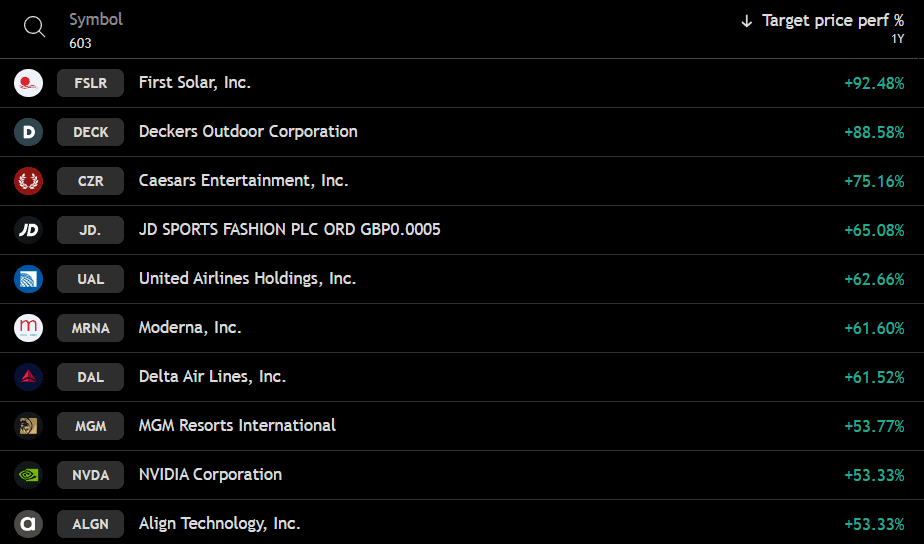
JD Sports Fashion (LSE: JD.) is one example of a Footsie stock worth considering in 2025. It’s down 37% over the past year, suggesting it’s now heavily undervalued with a price-to-earnings (P/E) ratio of 11.7. The sportswear market is projected to grow at an annual rate of 6.6% over the next five to seven years, hinting at a potential recovery.

The popular UK retailer is forecast to rise 65% on average in the coming 12 months. That’s higher than 99.5% of stocks on the S&P 500. Only First Solar, Decker’s Outdoor and Caesars Entertainment are expected to perform better.

Created on TradingView.com

But challenging market conditions continue to pose a risk, with a 1.5% decline in sales in the recent festive season prompting the company to lower its annual profit forecast. And with Nike accounting for approximately 45% of sales, any disruption in its supply chain could seriously hurt JD’s performance.

But recent acquisitions, such as an 80% stake in Australian retailer Next Athleisure and 80% of Cosmos Sport in Crete, could also drive growth.

If an investor put £10,000 in Barclays and Lloyds shares 3 months ago here’s what they’d have now… 

Everything’s relative, so while my Lloyds (LSE: LLOY) shares put on a solid show last year, I couldn’t help but feel a twinge of disappointment. FTSE rivals Barclays (LSE: BARC) and NatWest did an awful lot better, doubling in value. 

Barclays’ impressive surge following a strategic overhaul which included cutting £2bn of costs to boost shareholder payouts by £10bn within three years. Snapping up Tesco Bank further boosted its domestic retail banking presence.

At the same time, Lloyds got bogged down in the motor finance mis-selling scandal. This, according to some estimates, could cost it £3bn in compensation.

So it goes. Investing’s a long-term game, and I can’t expect my stock picks to be top dog every year.

Can these FTSE 100 stocks soar in 2025 too?

Despite Barclays’ remarkable performance, I chose not to chase past performance. And I remained loyal to Lloyds, anticipating a catch-up this year.

I decided the motor scandal was priced in, and may not be as bad as we all fear. While February’s £1.7bn share buyback showed Lloyds was good for it, boosting confidence.

My faith has been rewarded, so far. Over the past three months, Lloyds’ share price has risen by 36%, outperforming Barclays, which grew 18%. An investment of £10,000 in Lloyds three months ago would now be worth £13,600, whereas the same sum in Barclays would be £11,800. That’s a difference of £1,800.​ GoThe Black Horse Bank!

Lloyds still has lost ground to recover though. Its shares are up 40% over the last year and and 60% over two. Barclays has surged 70% and 130% over the same periods.​

Barclays’ diversified operations, including a significant presence in the US, have contributed to its robust performance. However, the US economy faces potential and financial uncertainties under Donald Trump.

Lloyds is almost exclusively exposed to the UK economy, which has its own set of challenges as growth slows, inflation proves sticky and trade wars threaten. Higher interest rates could protect net interest margins all round though.

One’s cheaper, the other yields more

For income seekers, Lloyds has a trailing yield of 4.3%, forecast to hit 5.5% this year. Barclays’ yield is lower at 2.75%, and expected to hit 3%.​ Over time, Lloyds’ higher dividends may shrink the performance gap.

Both banks anticipate improved operating margins. Lloyds’ margins are forecasted to jump from 17.4% to 40.7%, while Barclays’ are expected to increase from 30.3% to 38.3%.

Brokers are more optimistic about the outlook for Barclays’ shares, forecasting they’ll lift 17% over the next 12 months to around 359p, with Lloyds projected to increase a more modest 4.5% to 76.7p. While forecasts aren’t guarantees, that’s an interesting insight into market expectations.​

Despite its weaker showing, Lloyds is more expensive with a price-to-earnings ratio of 11.6, higher than Barclays at 8.56. The price-to-book (P/B) ratio for Lloyds is 1.0, indicating fair value, while Barclays appears undervalued with a P/B ratio of 0.6.

I may have backed the wrong horse here, but I won’t be switching. It’s like jumping queues at the supermarket, it almost never works out as you hope.

An investor comparing these two stocks today faces a tough choice. On balance, I’d favour Barclays, but the easiest move is to split the difference and consider buying both.

£20k inheritance? Don’t blow it: target a second income that pays £1k a month!

A £20k inheritance could be used to build a decent second income stream. Here, I provide an example of how a beginner investor could try to put £20,000 to good use.

Getting started

Opening an investment account is the first port of call on this journey. I think the best plan is to go with a Stocks and Shares ISA.

This enables investments in a diverse selection of assets, allowing for decent risk protection. It also means up to £20k can be invested a year with no tax levied on the capital gains. 

Please note that tax treatment depends on the individual circumstances of each client and may be subject to change in future. The content in this article is provided for information purposes only. It is not intended to be, neither does it constitute, any form of tax advice. Readers are responsible for carrying out their own due diligence and for obtaining professional advice before making any investment decisions.

Slow and steady gratification

Unlike a wild holiday to Ibiza, the gratification from stock market investing isn’t quite as immediate. However, those who are patience will find the long-term returns are well worth the wait.

By building a carefully constructed portfolio of shares, it’s realistic for a prudent investor to expect average annual returns of 7%. That means a portfolio worth £20k would return about £1,400 in the first year.

Only £1.4k? Don’t worry, it gets better. Thanks to the miracle of compounding returns, the annual returns grow exponentially over time. By the fifth year, it could be almost £2,000 and by the 10th year, over £2,700.

After 25 years, the investment could have ballooned to £114,000, returning over £7,700 a year — or £641 a month. However, withdrawing this each year would slowly reduce in value as inflation increases, so that should be accounted for.

One could also start withdrawing an extra £400 a month from the pot. Over time, this would reduce the pot and subsequent returns (but would still provide sufficient income for well over a decade). Yet the pot could also be shifted into a portfolio of high-yield dividend shares that provide a steady income without drawing down from the nest egg.

And of course, there’s the impact of adding more money to the investment regularly to boost the returns, plus the State Pension to take into account. Both of those would boost an individual’s income overall.

Shares to pick

It’s important to pick the right shares, or the average annual return could be below 7%. There is a risk that the portfolio could even return a loss in certain years. Many investors find that a good strategy to defend against this is to diversify into a mix of growth, defensive and income stocks.

One stock to consider is Diploma (LSE: DPLM), a multinational FTSE 100 company that specialises in the supply and distribution of technical products and services. Its diverse operations cover three sectors, including life sciences, seals and controls.

The price is up 157% in five years, indicating a strong history of growth.

Income-wise, its been increasing its dividends consistently for 23 consecutive years. However, its yield seldom rises above 2%, which is slightly below the average for the UK market. ​

It can also be highly sensitive to market expectations. The price fell 8% following recent results, despite solid financial performance. One possible reason is that a significant portion of the company’s growth is driven by acquisitions. When shareholders notice any missteps in integration or identification of targets, it can have a notable impact on the price.

Bolstering its defensive qualities, it spans multiple industries and geographies, providing a buffer against sector- and regional-specific risks.​ In the latest results, revenue rose 14% to £1.36bn and operating profits jumped 20% to £285m.

Financial News

Daily News on Investing, Personal Finance, Markets, and more!

Financial News

Policy(Required)