I just bought this 9.3% yielding FTSE 100 stock before it goes ex-dividend on 3 April!

I love it when a FTSE 100 stock that’s been nesting quietly in my self-invested personal pension (SIPP) suddenly chirps into life.

That’s just happened to insurer Phoenix Group Holdings (LSE: PHNX). I bought its shares twice in 2023, but they didn’t do much. Just sat there snoozing away in my SIPP.

Occasionally, Phoenix would stir into life and squeeze out a dividend, which was greeted warmly chez moi. Phoenix yields a whopping 10% a year, the highest on the entire blue-chip index.

I had two concerns, though. Was the dividend really sustainable? And would the sleepy Phoenix share price ever spread its wings?

Can the Phoenix share price fly?

I was worried that all my dividends would be wiped out by capital underperformance. Then, on 17 March, I got a nice surprise.

The group published full-year results showed operating cash generation jumped 22% to £1.4bn in 2024, hitting its 2026 target two years early. 

Phoenix also raised its final dividend by 2.6% to 27.35p per share. While that’s not a huge hike, I won’t complain given the size of that yield.

Over the last month, Phoenix shares have jumped almost 15%. They’re up just 8% over 12 months, though, and a meagre 3% over five. That shows how they struggled before.

After the share price bounce, I was hungry to up my stake in Phoenix, but held off. Stocks often dip after a sharp rally as investors lock in profits. 

But I had a deadline approaching: Phoenix goes ex-dividend on 3 April. If I wanted my next payout, I had to put down the money. So, on Tuesday (25 March) I bought more.

Now, I’m looking foward to a bumper payout on 21 May, which will be bigger than the last one for two reasons. First, the dividend has been increased, and second, I hold more shares, having reinvested my last payout AND topped up my holding.

What’s next for this FTSE 100 income hero?

I’m still not expecting fireworks from the share price. The 15 analysts tracking the stock have set a median 12-month target of 603.5p, suggesting modest growth of 4.3%. But with Phoenix forecast to yield 9.7% in 2025 and 9.97% in 2026, I can live with that.

Total return is what really matters, and with my Phoenix shares already up 12%, my overall return stands at 27% with reinvested dividends. And these are very early days. I plan to hold Phoenix for years and years.

Of course, there are risks. While the dividend looks sustainable at the moment, there’s no guarantee that will continue. Phoenix needs to keep generating plenty of cash to fund it. It started off by buying up legacy ‘closed’ policies from insurers, with the aim of running them more efficiently.

While it’s branching out into other financial services sectors, it still needs to keep finding new sources of revenues in a competitive market. Any share price volatility could easily wipe out my income gains.

Naturally, I haven’t put all my eggs in one basket. My SIPP holds around a dozen income stocks. Most have lower yields than Phoenix, but higher growth prospects. I think I’ve got the balance roughly right. Now roll on 21 May – I’m ready for my next Phoenix dividend.


With 1 week until the Stocks and Shares ISA deadline, here are 2 big mistakes to avoid

A Stocks and Shares ISA has some big tax benefits for investors. But there’s only one week left to add money and any contribution room that hasn’t been used can’t be carried forward. 

That’s not a long time, but investors still need to be careful. There are still some important mistakes that it’s important to try and avoid even though time is running out.

Please note that tax treatment depends on the individual circumstances of each client and may be subject to change in future. The content in this article is provided for information purposes only. It is not intended to be, neither does it constitute, any form of tax advice. Readers are responsible for carrying out their own due diligence and for obtaining professional advice before making any investment decisions.

Mistake one: being in a rush

When it comes to investing, the most important thing is doing enough research to get a proper understanding of the underlying business. That’s as true in April as it is at any other time. 

According to Warren Buffett, risk comes from not knowing what you’re doing. And investors need to be careful to avoid letting the impending deadline rush them into a bad decision.

Figuring this out involves thinking carefully about companies in a couple of different ways. The first is qualitatively (ie, non-numerically) and the other is quantitatively (ie, numerically). 

Take Tesco (LSE:TSCO) as an example. Its key strengths as a business include the fact it’s the leader in the UK grocery market, which gives it good negotiating power with suppliers. 

On the other side of the equation is the fact that it’s not hard for customers to start shopping elsewhere if they want to. And this shows up in some of the firm’s financial metrics. 

Tesco’s margins are generally very narrow – usually below 3% – and returns on invested capital are also low. And that means there’s a constant risk of inflation cutting into profits.

Mistake two: ignoring valuation

A big part of investing is being selective about when to invest. That doesn’t mean figuring out where share prices are going, but it does mean trying to figure out what a stock is worth.

With only a week to go before the ISA deadline, it might be tempting to overlook the fact a stock isn’t really trading below its intrinsic value. But this is a big mistake. 

Investing isn’t about buying stocks in order to sell them to someone else. It’s about finding opportunities where the underlying business generates enough cash to provide a return.

With Tesco, the entire company has a market value of just over £22bn. And there’s another £15bn or so in debt that will have to be either managed or paid off eventually. 

At the moment, the business generates around £2.5bn per year in cash. That amounts to a return of around 6.75%, just over half of which comes back to investors as dividends. 

Does that make the stock cheap? It might do – if interest rates don’t go up, I think investors should be pleased with a 6.75% return, as long as Tesco can maintain its current profitability.

Stick to the basics

Even at times like this, investors need to be sure to focus on the basics. That means sticking to companies they can understand in enough detail and being attentive to valuations.

With only a week left to use this year’s ISA contribution limit resets, I think Tesco shares are worth a look. But the deadline is only for adding money, not getting it into the stock market.

A tight deadline therefore isn’t a reason to start buying stocks without due care and attention. Mistakes made in a hurry can still have long-term implications.

I just sold Unilever and bought this bombed-out UK stock. Am I mad?

Last Wednesday, I finally did something I’d been mulling for months, selling my shares in defensive UK stock Unilever (LSE: ULVR).

The FTSE 100-listed consumer goods giant had been squatting in my Self-Invested Personal Pension (SIPP) for several years without generating much excitement. Suddenly, I’d had enough.

Unilever shares have actually done well over the last 12 months, rising 17%, but longer-term performance has been underwhelming. Over five years, they’re up just 10%. That’s hardly thrilling for a company of its size and reputation.

The consumer goods giant’s sprawling operations had led to a lack of focus. It’s now trying to fix that by concentrating on its 30 ‘Power Brands’, but progress has been patchy.

Was I crazy to sell a solid blue-chip today?

Given today’s economic uncertainty, Unilever should be a Buy not a Sell. People will always buy essentials like soap and ice cream, right? But I started to question whether the Unilever share price has room to grow much.

With a price-to-earnings (P/E) ratio of around 24, the company really needs to ramp up sales and profits to justify further share price growth. The dividend yield of 3.25% is decent but nothing special. Even Unilever doesn’t seem entirely convinced by its direction. After just 18 months, CEO Hein Schumacher is being replaced. Hardly a vote of confidence.

Another minor but annoying issue was that, despite having around £4,500 invested, my trading platform wouldn’t automatically reinvest my dividends due to Unilever’s chunky share price of £45.52.

The 21 analysts offering one-year Unilever forecasts have set a median target of 5,020p. That’s a modest increase of around 10% from today. Forecasts can’t be relied upon, but I think that’s about as much as we can expect. And with no spare cash in my SIPP, selling Unilever was the only way to fund my next feckless move.

I’ve lost a lot of money on JD Sports Fashion

Enter JD Sports Fashion (LSE: JD). It’s a stock I already own, to my cost. JD Sports shares have been hammered, crashing 55% in the last two years, with 35% of that slump coming in the past year. They’re still sliding.

Sales and profits have taken a big hit, while key partners like Nike are also struggling. US tariffs are a fresh concern and the American economy’s slowing just as JD makes a big push Stateside with $1.1bn acquisition Hibbett. A recovery isn’t guaranteed.

But when I look at my portfolio and see the massive paper loss I’m sitting on, I can’t shake the feeling that JD Sports will stage a big comeback at some point.

It looks brilliant value, with a P/E ratio of just 6.2. But doubling down on a struggling stock is always a gamble. In fact, the day after I bought more JD Sports shares, they dropped another 5%. An instant rebuke.

The 16 analysts covering JD have set a median target of 122p. If correct, that’s a whopping 62% upside from today. I find that number pretty unbelievable. But I’ve gone big on this stock now, so let’s hope it delivers. If it does, this might turn out to be one of my best-ever moves. If not? I’ll avoid checking how well Unilever has done.

3 things to remember ahead of the new 2025-26 ISA year

As we approach the new 2025-26 ISA year, it’s time for newcomers and savvy investors alike to prepare their strategies. Let’s explore how investors can get ahead.

The basics

First, investors should ensure they’ve used as much of their £20,000 ISA allowance for the 2024-25 tax year as possible. Remember, the Junior ISA, for those of us with kids, has a maximum annual contribution of £9,000.

Moreover, this transition period presents an excellent opportunity to review existing investments. Investors should assess whether their current portfolio aligns with their goals and risk tolerance. Rebalancing might be necessary, but it’s crucial to be aware of potential capital gains tax implications for investments outside the ISA wrapper.

For those with multiple ISAs across different providers, consolidation could simplify management and potentially reduce fees. And while ISAs offer tax-free growth, some investors might also consider other tax-efficient investments like Venture Capital Trusts (VCTs) — this certainly can be a riskier area.

Please note that tax treatment depends on the individual circumstances of each client and may be subject to change in future. The content in this article is provided for information purposes only. It is not intended to be, neither does it constitute, any form of tax advice. Readers are responsible for carrying out their own due diligence and for obtaining professional advice before making any investment decisions.

Diversify and dream a little

It pays to diversify a portfolio. This means investors should spread their investments across different sectors, geographical regions, and asset classes. A degree of diversification can often be achieved by investing in index-tracking funds, or even more focused trusts like Scottish Mortgage Investment Trust (LSE:SMT).

With Scottish Mortgage shares delivering near-90% growth over five years, and tripling in value over a decade, it’s easy to start dreaming. In fact, with a compound annual growth rate of 10% and maxed-out ISA contributions, a trust like Scottish Mortgage could turn an empty portfolio in £1m in 19 years.

The trust’s performance has been driven by its tech-focused investments. This strategy has capitalised on transformative trends, with stakes in artificial intelligence (AI) leaders such as Nvidia and Amazon, as well as private companies, including SpaceX, which doubled in value last year. For long-term investors, the potential’s compelling. 

However, risks remain. The trust employs gearing (borrowing to invest), which can magnify both gains and losses. While its current gearing levels are moderate, any market downturn could amplify losses. 

Nonetheless, Scottish Mortgage could be an exciting option for those seeking exposure to cutting-edge innovation and long-term growth potential. While diversification is key to managing risk, the trust’s track record and focus on future-defining technologies make it relatively unique for UK investors.

It’s about long-term performance

Scottish Mortgage is one stock that has demonstrated quite a lot of volatility in recent months. However, as with most well-thought-out investments, it’s the long-term performance that truly matters.

Despite recent turbulence, the trust’s 10-year returns remain impressive, with a 309.8% share price total return and a 377.2% NAV total return as of 31 December. This outperformance against the FTSE All-World index (215.6%) over the same period underscores the potential rewards for patient investors who can weather short-term fluctuations.

And this is the case for any investment. Investments built on strong fundamentals and a robust thesis should perform over the long run. However, near-term volatility may damage an investor’s conviction… we’ve all been there.

Going back to Scottish Mortgage. For me, it’s an investment I’ll continue to top up on. It can be volatile, but well-timed investments have helped my weighted buy-in price.

Here’s why the S&P 500 may tank

The S&P 500’s recent volatility reflects several things, many of them connected. The index has shed 10% since mid-February 2025, driven primarily by President Donald Trump’s aggressive tariff policies. His March 2025 decision to impose 20% tariffs on Chinese imports and levies on Canadian goods triggered a $4trn market value wipeout. More tariffs will be announced next week.

These protectionist measures have heightened fears of a global trade war, and the S&P 500 briefly erased all post-November 2024 gains. At the time of writing (26 March), we’ve seen a small rally. However, the stocks are still cheaper than when they were when Trump took office.

Mixed signals

Volatility has become endemic as investors grapple with conflicting signals. Trump’s admission of a potential “period of transition” post-tariffs contrasts with the Federal Reserve’s stabilising commentary. 

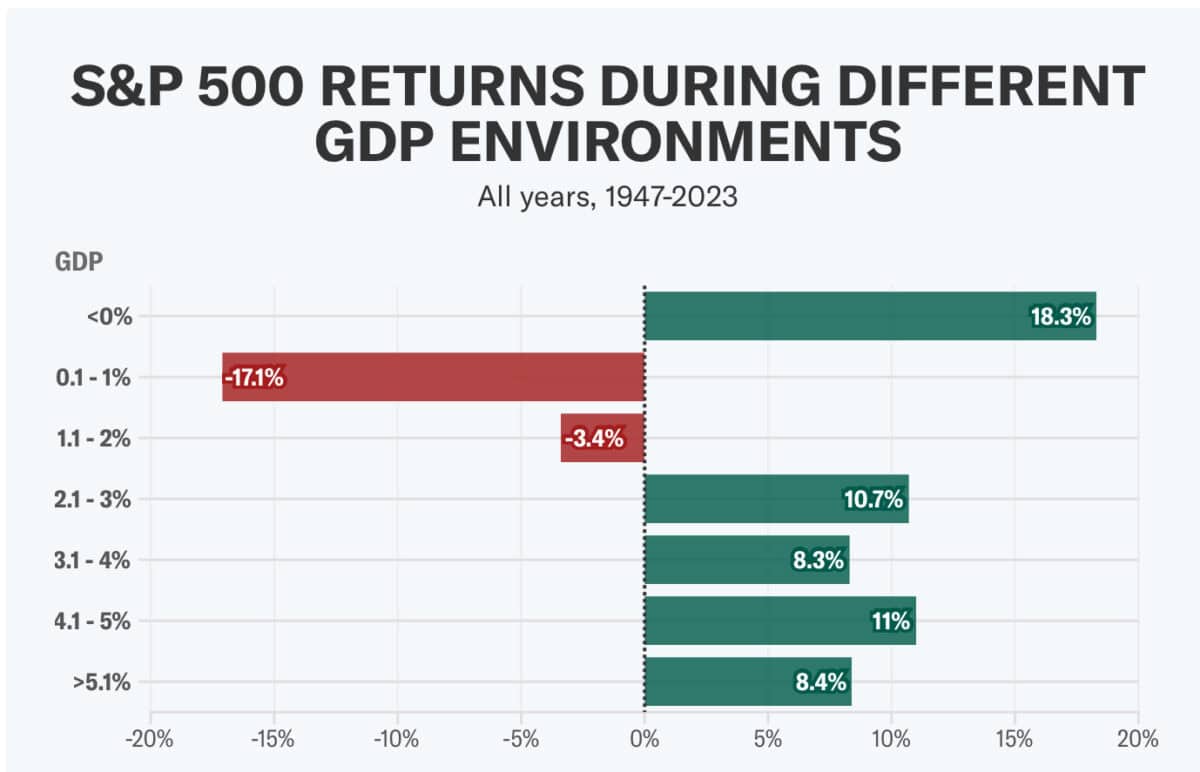
This policy whipsaw has compressed valuations, with the S&P 500’s forward price-to-earnings (P/E) ratio retreating from 21.5 times to 20.6 times. Goldman Sachs consequently revised its 2025 year-end target to 6,200 (from 6,500). The bank cited reduced GDP growth forecasts (1.7% vs 2.4%) and weaker earnings expectations.

Source: RBC Capital Markets

And it’s these earnings forecasts that are actually the important bit. Earnings projections have deteriorated sharply. S&P 500 profit growth estimates for the first quarter of 2025 have nearly halved from 12.2% to 7.7% since January. Full-year earnings growth forecasts now stand at 10.5%, down from 14%, as tariff impacts ripple through supply chains.

And this is very important for our investment theses. Because if a stock was trading at 14 times forward earnings with a 14% forward growth rate, it may look like fair value. But if that earnings expectation falls to 10.5% for the current year and medium term, investors will start to think it’s overvalued. That’s what the P/E-to-growth (PEG) ratio tells us.

Technical signals — mathematical calculations based on historical price and volume — suggest Oversold conditions. However, technical signals aren’t forecasts and can’t account for things like a bad earnings report. Personally, I’m tempted to hold off until the next earnings season. This typically starts a few weeks after the end of March. It could be a bad earnings season, much worse than the market is pricing in. The index could tank.

This one is bucking the trend

Berkshire Hathaway‘s (NYSE:BRK.B) stock has surged while the S&P 500 has faltered. Shares of Warren Buffett’s conglomerate reached new all-time highs, outpacing the broader market by a significant margin. This outperformance can be partially attributed to Berkshire’s strong performance, but also it’s substantial cash position, which stands at an impressive $334bn.

Despite holding major stakes in S&P 500 companies like Apple and Bank of America, Berkshire’s cash reserves provide a buffer against market volatility and potential opportunities for acquisitions during market downturns. This strategy could prove even more advantageous if the stock market experiences a further pullback.

However, investors should be aware of the risk associated with Berkshire’s heavy US focus. This US focus has been a strength in recent decades but some may argue it’s over concentrated geographically.

Nevertheless, the company’s track record and Warren Buffett‘s investment acumen make it an attractive long-term holding. I’ve added the stock to both my daughter’s portfolio and mine.

Here’s a starter portfolio of FTSE 250 shares to consider for growth, dividends, and value!

The FTSE 250 is a great place for individuals to go shopping for both growth and dividend shares. But with literally hundreds of companies to choose from, the index can be a tough place for new investors to navigate.

With this in mind, here’s a selection of three top shares to consider when starting off.

Diversification is an important feature of any portfolio. So these FTSE 250 stocks span multiple industries and provide exposure to multiple regions, providing investment opportunities while also spreading out risk.

As well, this portfolio provides a balance of growth, value, and passive income. The first two phenomena can deliver strong capital gains over time, while the final one can provide a stable stream of dividends.

Growth

The Allianz Technology Trust (LSE:ATT) provides investors with extra diversification straight off the bat. Like any investment trust, it invests in a basket of other assets, in this case tech-focused businesses (as its name implies).

In total, it has positions in 47 companies, of which the most dominant holdings are US technology beasts like Nvidia, Microsoft, Apple, and Meta. This gives investors exposure to market-leaders with strong records of innovation and considerable cash resources to keep dominating.

Allianz Technology Trust has considerable growth potential thanks to fast-growing phenomena like artificial intelligence (AI), robotics and cloud computing. But be aware that its performance could be especially volatile during economic downturns.

Value

Commercial broadcaster ITV (LSE:ITV) offers solid value based on both predicted earnings and expected dividends.

For 2025, its price-to-earnings (P/E) ratio is 8.4 times, well below the FTSE 250 average of 12.9 times. Meanwhile, its corresponding dividend yield of 6.3% blows the index average of 3.6% to smithereens.

Okay, some low valuations often reflect a company’s high risk profile and/or poor growth prospects. In the case of ITV, it faces severe competitive pressures, and especially from streaming services like Netflix and Amazon‘s Prime.

But I think these dangers are more than baked into the broadcaster’s share price. In fact, I’m encouraged by the soaring popularity of its own ITVX streaming platform. Its ITV Studios production arm also has considerable profits opportunities as demand for content heats up.

Dividends

One of the best categories of shares to consider for reliable passive income are real estate investment trusts (REITs). In exchange for tax perks, these trusts are obligated to pay at least 90% of annual rental earnings out to shareholders.

Please note that tax treatment depends on the individual circumstances of each client and may be subject to change in future. The content in this article is provided for information purposes only. It is not intended to be, neither does it constitute, any form of tax advice.

This doesn’t guarantee a market-beating dividend income for investors, though. If earnings fall — for instance, on slumping occupancy levels or rent collection issues — dividends could suffer badly.

But I believe Target Healthcare (LSE:THRL) carries far lesser risk to investors. Its focus on the defensive residential care home sector means rental income remains ultra stable across the economic cycle. What’s more, its tenants are locked down on long-term contracts (the weighted average unexpired lease term here was 26.1 years as of December).

The forward dividend yield here stands today at a tasty 6.2%.

At a 52-week low, is this penny stock the bargain of the year?

Penny stocks can be appealing investments thanks to their low share prices and potential for high returns. However, investing in these speculative small-cap shares carries greater risk than buying equities listed on the FTSE 100 or FTSE 250 indexes.

Volatility is a key concern. Investors considering these high-risk investment propositions need the stomach to endure massive share price movements in pursuit of portfolio gains. In short, they’re not for the faint-hearted.

One company that’s no stranger to volatility is Creo Medical (LSE:CREO). This AIM-listed healthcare device business specialises in minimally invasive surgical endoscopy. Trading at a 52-week low after a prolonged losing streak, is today the perfect time to buy this beaten-down penny stock?

A falling share price

Creo Medical has seen its market cap evaporate in recent years as its share price has taken a battering. Today, the stock market minnow’s valued for less than £52m.

There are some worrying signs in this penny stock for potential investors to monitor closely. The firm’s FY24 revenues failed to meet market expectations. The group total of £30.4m represented a 1.3% decline compared to the prior year’s figure of £30.8m. Frankly, it’s concerning to see the company going into reverse gear on such a crucial metric.

Creo Medical has also yet to turn a profit. The board expects FY25 will be another loss-making year. I’m worried more cash will need to be raised before the business becomes a profitable enterprise, which may not be easy given that it has historically experienced fundraising difficulties.

That said, in February, the company secured £25m in net inflows from divesting a majority stake in its European consumables business to a Chinese medical device manufacturer. Coupled with a £12.1m equity raise last year, Creo Medical has some financial headroom for the near future at least.

Recovery potential

On the bright side, this month marked the commercial launch of a new product — the SpydrBlade Flex — in the UK and EU. This could provide a much-needed boost for the company’s bottom line. The multi-modal endoscopic device has promising applications for minimally invasive treatment of colorectal cancer.

In addition, the potential of Creo Medical’s core offering can’t be understated. Its flagship Speedboat product suite uses remarkable technology. These tiny surgical instruments offer surgeons a one-stop shop to carry out incision, dissection, and coagulation procedures without needing to change devices.

The market opportunity is considerable. Some analysts believe the gastrointestinal endoscopic technologies market could be worth between £2.32bn and £2.48bn. If Creo Medical can successfully realise the commercial potential of its products, the shares could ultimately prove to be a lucrative investment at this early stage.

A penny stock to consider?

Like all penny stocks, Creo Medical faces significant risks. The fact that the shares were once changing hands for nearly £2.30, compared to 12.5p today, proves as much.

Nonetheless, the company’s risk/reward profile looks attractive to me right now at this low valuation. Improvement will be needed across a range of core financial yardsticks, but the firm’s unique patented technologies show significant promise.

So, is Creo Medical a bargain stock? Quite possibly! Bargain of the year? That’s probably a stretch. But for investors with sufficient risk appetites, I think this penny share deserves consideration.

Up 46% in a fortnight! Is this soaring ex-penny stock still a FTSE gem at 59p?

I think it’s fair to say that SRT Marine Systems (LSE: SRT) has proven to be a hidden gem for savvy investors who bought a year ago. It’s doubled in that time and exploded 30% higher in the FTSE AIM All-Share Index today (27 March).

In fact, since bottoming out as a 19p penny stock in May, it has jumped 200%! This gives the company a market cap of £149m, meaning its still a relative stickleback within the overall UK stock market.

Should I buy this small-cap stock? Let’s explore.

On the crest of a wave

SRT makes advanced maritime surveillance and navigation transceivers. Its systems are used by coast guards, fisheries, and national agencies to improve maritime security, environmental protection, and regulatory compliance.

The share price has been boosted by a steady flow of new contract wins. In October, it secured a $213m contract with the Kuwait Ministry of Interior to provide an advanced maritime surveillance system over 12 years.

For context, SRT generated revenue of £8m in its 2022 financial year. So this was clearly a transformational deal for the firm.

Then in December, it signed a 10-year contract worth $9m with an existing Middle East coast guard client, followed by the commencement of the second phase of a project with an undisclosed nation’s coast guard, valued at $15m.

Why has the stock just surged 30%?

Today, the firm just released its half-year report for the six months to the end of December, and it was incredibly strong.

Revenue skyrocketed to £26.2m, up from £5.5m, and the gross profit margin improved to 46%, up from 37%. And SRT swung from a £4.6m loss in the same period last year to a pre-tax profit of £2.8m.

Meanwhile, its high-growth systems business now has £320m of active projects, all of which are scheduled for implementation over the next two years. Some have ongoing data and support contract periods of five to 10 years, providing long-term recurring revenue.

Chair Kevin Finn commented: “The future of our systems business is increasingly bright, driven by a long-term global trend of sovereigns wanting to digitise and dramatically enhance their understanding, oversight and management of their marine domains.”

Massive pipeline

Back in September 2023, I wrote that SRT’s “total addressable market appears very large…The stock is an interesting play on the long-term digitisation of the global maritime surveillance industry“.

I still think this. However, I sold my SRT shares in 2024 to invest in Windward (another maritime tech firm). I didn’t want to own both. But Windward was recently snapped up at a sizeable premium to what I paid.

SRT’s update was very encouraging, but multi-year projects in emerging markets carry execution and delivery risks. Political shifts in client countries could impact payments, while the business is still barely profitable. 

Also, based on last year’s revenue of £14.8m, the price-to-sales ratio is around 10. That’s pricey. However, I’m reading speculation that full-year revenue could now reach more than £80m. That would roughly be a 450% year-on year increase and make the valuation appear more attractive.

Looking ahead, the company sees a pipeline of opportunities from existing and new customers worth up to £1.2bn. This means the stock could still be a gem and I’m considering adding it back into my portfolio.

Here’s how much passive income a £10,000 investment in Greggs shares could generate in 2026

Greggs (LSE:GRG) shares are down 37% since the start of the year. But lower share prices can often mean better returns for investors over the long term.

In the case of the FTSE 250 food retailer, the dividend yield is 3.86%. Going forward, however, analysts are wary about how sustainable that return is.

Dividend yields

A year ago, £10,000 would have bought 360 Greggs shares. And with the company distributing 69p per share in dividends, this equates to £248 in passive income.

At today’s prices, however, the equation looks very different. Analysts are expecting the dividend to drop to 68p per share, meaning a 360-share investment is set to generate £244.

That’s not good for anyone who bought the stock a year ago. But the share price today is 36% lower than it was a year ago, which more than offsets the anticipated fall in the dividend.

As a result, a £10,000 investment in Greggs today would buy 556 shares – enough to generate £384 in passive income. And the forecast is better for 2026.

Year Dividend per share Growth % Yield (£17.91 share price)
2024 69p 3.85%
2025 68p -1.44% 3.80%
2026 70.7p 3.97% 3.95%

Analysts are expecting the challenges of this year to be short-term in nature. As a result, the expectation is for the dividend to reach 70.7p – above its 2024 levels – in 2026. 

That would imply a 3.93% dividend yield based on today’s prices (enough to make a £10,000 investment generate £393 in passive income). That’s not bad, but how likely is it?

Outlook

I think investors have good reason to expect growth over the next couple of years. I thought the most recent earnings report was quite bad, but I don’t see this as a problem in the short term. 

The challenge Greggs has been facing recently has been weak like-for-like sales growth. This has fallen from 13.7% in 2023, to 5.5% in 2024, and now to 1.7% in the first nine weeks of 2025.

That’s quite the decline. And while some of it can be put down to difficult trading conditions, it suggests Greggs might not be as resilient in a weak economy as some investors might hope. 

Nonetheless, in the short term, I think investors have reason to be positive. While like-for-like sales might be weak, I expect this to be offset by the company opening more stores. 

This isn’t sustainable over the long term. But it happened in 2025 and I expect something similar in 2026 as Greggs continues to make progress towards its target of 3,000 outlets.

As a result, the forecast of 70.7p per share in 2026 looks plausible. And a 3.85% dividend yield at a time when 10-year UK government bonds yield 4.75% implies expectations of growth.

Long-term investing

From an income perspective, I think Greggs shares look good over the next couple of years. But with my own investing, I aim to look past this to the longer term.

Eventually, Greggs will reach its final capacity in terms of stores. From then, growth will have to come from higher like-for-like sales, so the weakness in this metric is a genuine concern.

In my view, the question is whether the share price is cheap enough to be a good investment despite this. I’m undecided, and there are other opportunities that stand out to me more, so I’ll not be buying now.

This FTSE 100 fashion icon just broke the £1bn profit ceiling! What’s next?

There aren’t that many FTSE 100 companies that can claim to have posted £1bn in annual profit. But that’s exactly what this popular high street fashion retailer did when it posted its full-year results this morning.

Next

Next (LSE: NXT) is a well-loved and recognisable high street fashion brand, specialising in clothing, footwear and home products. Established in 1982, the company has grown to become a staple on the UK high street, operating over 500 stores nationwide. 

Beyond its physical presence, it’s developed a successful online platform catering to customers both domestically and internationally. The retailer offers a wide range of products, including men’s, women’s, and children’s fashion, as well as home furnishings and accessories.​

For the fiscal year ending January 2025, Next just managed to cross the £1bn profit milestone, posting pre-tax profit of £1.011bn. This equates to a 10.1% increase in annual profits

Meanwhile, group sales rose by 8.2% to £6.32 bn, driven by expectations-beating sales in the initial eight weeks of the fiscal year. As a result, the company has revised its sales growth forecast for the first half of the year from 3.5% to 6.5%, leading to an anticipated annual growth rate of 5%.

Additionally, the retailer increased its pre-tax profit guidance by 5.4% to £1.066bn.

Tariff chaos continues 

In other news this morning, President Donald Trump plans to impose a 25% tariff on all imported automobiles to the US. The announcement sent ripples through global financial markets, with the FTSE 100 taking a minor hit. The UK supports several major automotive manufacturers and related industries, all of which could suffer as markets take on the impact of declining car exports to the US. 

Of course car tariffs aren’t an issue for the firm, but while upcoming changes to de-minimis customs thresholds are, they’re expected to have little impact on the company’s overall sales and profits. In the EU, most of the company’s business already runs through a local subsidiary, meaning it won’t be affected by the rule change. The remainder, sold via a UK entity and imported by consumers, will face additional duties from 2028. However, the financial impact is expected to be minimal, with an estimated net cost of under £1m.

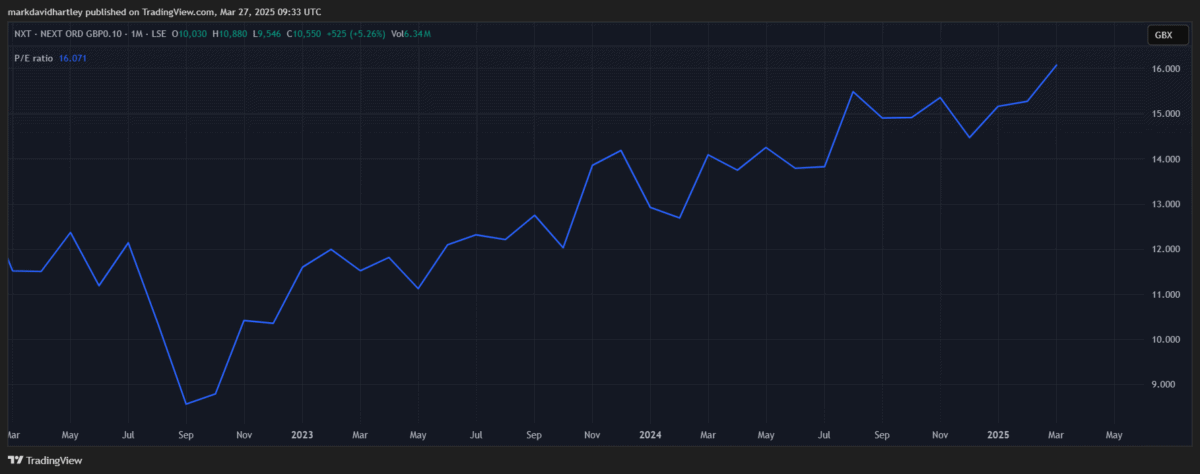
Still, the risk of losses from a broader economic downturn remains a possibility. It’s also moving towards overvalued territory, with a price-to-earnings (P/E) ratio rising from 8.5 to 16. Add to this shifting consumer behaviour and increasing competition from the likes of Marks & Spencer, ASOS and Debenhams Group.

Created on TradingView.com

While these specific trade policies may not directly impact the retailer, rising geopolitical tensions and market fluctuations remain a cause for concern. All these factors could influence the company’s overall operations and business conditions.​

On the right track

Looking at today’s numbers and financial performance, there are notable signs of strong management and a resilient business model. The company’s successful integration of online and physical retail channels positions it well in the evolving retail landscape. 

It’s doing well to reaffirm its position as a leader within the British fashion retail sector. Today’s results reveal its ability to boost sales through market adaptability. Despite the economic challenges, I think this strategic approach, combined with a strong market presence, could equate to a promising future for the firm.

Overall, I think it’s a good stock to consider as part of a portfolio aimed at leveraging UK growth and sidestepping the impact of US trade tariffs.

Financial News

Daily News on Investing, Personal Finance, Markets, and more!

Financial News

Policy(Required)