2 FTSE 250 shares to consider for growth, dividends, AND value!

Here are two top FTSE 250 stocks I think savvy investors should take a close look at today.

NCC Group

Tech shares aren’t typically renowned for their potential to deliver a decent dividend income. This is because any spare capital they generate tends to be prioritised for expensive activities like R&D and manufacturing.

But cybersecurity specialist NCC Group (LSE:NCC) has been paying cash rewards for more than a decade. So it’s a great passive income share to consider in my book.

With cost savings and non-core divestments boosting its balance sheet, dividends are tipped to rise this financial year (to September 2025) following recent freezes. And so the dividend yield is 3.5%, roughly in line with the FTSE 250 average.

Predictions of further strong earnings growth boost predictions of progressive dividends returning. City analysts think NCC’s bottom line will swell 53% this fiscal year.

This leaves NCC’s shares trading on a forward price-to-earnings (P/E) ratio of 25.8 times. This is high on paper, but it’s also worth noting the company’s P/E-to-growth (PEG) ratio is also a rock-bottom 0.5.

Any reading below one suggests that a share is undervalued based on its anticipated growth journey.

NCC’s a share that, due to the rapidly growing digital economy — and the subsequent rise in cyber attacks — has substantial investment potential in my book. Researchers at Statista think the cybersecurity market will grow at an annualised rate of 7.6% between now and 2029.

NCC faces ongoing competition from larger US operators including CrowdStrike and Palo Alto. But its record of success in this tough market should serve as a confidence booster for investors.

Revenues rose 31.3% at constant currencies in the 16 months to September, latest financials showed.

Bloomsbury Publishing

Bloomsbury Publishing (LSE:BMY) — best known for the Harry Potter series of books — is another attractive ‘all rounder’ that offers investors growth and dividends at low cost.

For the current financial year (to February 2026), annual earnings are tipped to spike 12%. This leads to predictions of further dividend growth and a handy 2.7% yield.

In addition to this, an expected profits rise leaves Bloomsbury shares looking cheap from an historical perspective.

Its forward P/E ratio currently sits at 14.7 times. That’s a good distance below the five-year average of around 20 times.

JK Rowling’s Harry Potter franchise transformed Bloomsbury into today’s major player on the publishing stage. And while revenues here remain significant, it’s by no means the only game in town, and especially in its money-spinning segment of fantasy fiction.

The company’s footprint here is deep, and strong sales from other major authors like Sarah J Maas meant revenues at the firm’s Consumer division surged 47% between March and August.

Aside from its long catalogue of bookshop staples, Bloomsbury also has a successful academic publishing unit and online digital resources division for students, teachers, and librarians.

Though trading has been hampered by weaker US academic budgets more recently, the long-term outlook remains extremely bright. And Bloomsbury’s plans to keep building its position here with more shrewd acquisitions like that of Rowman & Littlefield last May.


Here’s what £10,000 in Lloyds shares could be worth a year from now

Over the past 12 months, Lloyds Banking Group (LSE: LLOY) shares would have turned £10,000 into £14,300. What might the same amount today be worth in another year? Let’s try a bit of informed guesswork.

Broker forecasts

Price targets attached to broker forecasts are the first things to check. There’s no date on them, but they’re generally seen as fairly short-term things. And they’re frequently changed, usually because of a few key things.

Company results can make analysts rethink their outlook, and other news releases can shift opinions. But often, forecasts appear to change just because the share price changes.

So, we shouldn’t treat them too seriously. But they can help quantify market sentiment. We can use them as one factor to help guide our longer-term thinking.

Expert uncertainty

The average from all the brokers I can see is 76p.That’s just 2p above the Lloyds share price at the time of writing. It would only be enough to turn £10,000 into £10,270. That assumes the price-to-earnings (P/E) ratio doesn’t change, currently 12.3 based on 2024 results.

Such a low price seems a bit strange, considering close to half the analysts I can find have Lloyds as a Buy. And only one out of about 20 sees it as a Sell.

It seems as if these wise heads of the City are contradicting themselves. And that’s an important lesson — the so-called experts frequently pull in different directions.

Wide spread

The lack of agreement shows in the range of price targets. The highest at 90p would be enough to turn £10,000 into £12,160. But the most bearish at only 54p would drop us all the way down to just £7,300.

There’s a reminder for us there. Even if we think we see a tide of approval for a stock, always check what the bears have to say.

Lloyds is entirely at the mercy of the UK economy, which isn’t exactly sparkling. And it’s big in mortgages at a time when high interest rates are keeping demand in check. I’m generally upbeat about Lloyds and I’m happy to hold. But it’s far from a risk-free option for anyone to consider.

Further ahead

Broker price targets are a bit too short-term for me. I do use forecasts as part of my analysis, but I prefer to look at the predicted fundamentals as far out as they go.

Forecasts for Lloyds’ earnings per share (EPS) for 2025 suggest an 8.4% rise over 2024. If the share price moves to keep the P/E steady, that could turn £10,000 into £10,840. If the results come out as forecast, that is.

Looking further ahead, EPS forecasts for 2026 could get us up to £14,260. And if 2027 also goes as predicted we could be sitting on £17,230 by then.

Be cautious

Finally, I just want to urge caution when using forecasts and price targets. Analysts generally have a short-term horizon and they’re pretty much forced to put numbers on things were the evidence might not be strong. There’s nothing remotely precise here. And we need to do our own research and make up our own minds.

Tesla stock has crashed. Could it be a long-term bargain?

Long-term shareholders in electric vehicle maker Tesla (NASDAQ: TSLA) are used to turbulence. With a 693% gain over the past five years alone, many of them probably do not care. But recently, Tesla stock has been on a wild run even by its own unconventional standards.

Since mid-December, it has lost 43%.

That is a big percentage fall for any share. But bear in mind that this is a huge company. Even after that share price crash wiped hundreds of billions of pounds off its stock market capitalisation, Tesla is still valued at around £660bn.

Clearly, then, the market still attaches a huge potential value to Tesla’s future business value. Given that, does it make sense for me to add some Tesla stock to my portfolio for the first time, at a far cheaper price than I would have paid just a few months ago?

After all, as billionaire investor Warren Buffett says, the time to be greedy is when others are fearful.

Knowing what kind of investor you are

But while I understand the logic in the Sage of Omaha’s comment, it does not mean that any situation where investors are fearful offers an opportunity.

Far from it. No matter how far a share falls, it can always fall further as Buffett himself has experienced many times in his career.

He changed his approach early on from looking for shares that looked cheaper than their value when focused on things like the balance sheet, to trying to buy into great business at attractive prices.

That is different to the approach some investors take. Some are hardened value investors, for example, while others like long-term growth stories and tend to focus on the business potential more than the current share valuation, in the hope that a fast-growing business can transform a share price.

Tesla’s valuation still looks unjustifiable to me

That is not my approach, although I would note that Tesla’s revenues last year barely shifted and its car sales volumes fell for the first time, albeit only slightly.

So I think the growth story at Tesla has become less compelling than it was five years ago. With stronger competition from rivals like BYD, I reckon that could be a structural change in the market, not just a statistical blip.

I approach the valuation issue more from the perspective of Buffett (incidentally, a long-term BYD shareholder). The question I ask when considering whether to add Tesla stock to my portfolio is whether it is a great business trading at an attractive price.

Despite its current challenges – and boss Elon Musk’s vocal political participation is a risk to car sales, in my view – Tesla is a great business.

It has proprietary technology, a large installed user base, and a powerful albeit increasingly polarising brand. Its vertically integrated business model has given it strong profit margins even as competitors rack up losses.

On top of all of that, vehicles are only one part of the offering. Power generation is a fast-growing part of the Tesla offering that I reckon has huge potential.

But the risks I mentioned above could see earnings decline further after a sharp fall last year – and Tesla stock already trades on a price-to-earnings ratio of 133. That looks very high to me. I will not be investing.

Here’s how an investor could target a £1,027 monthly second income by investing £80 a week

One common way to earn a second income does not involve taking on a second job. Simply by buying and owning shares that pay dividends, someone could hopefully earn a stream of cash.

How much depends on what they invest and in which shares. Not all shares pay dividends and some suddenly stop doing so. So diversification is important – and so is knowing about the shares one is buying.

From a standing start and putting aside £80 per week to invest, here is how an investor could target a second income of over £1,000 each month on average.

Planting the seeds for future returns

I use £80 as an example here although an investor could tailor the amount to their own situation. Everyone is different.

The principle, though, is the same: getting into a regular saving habit can help build a base of capital that can be used to purchase dividend shares. They will hopefully lay the foundation for future passive income streams.

A good place to start could be looking at the different share-dealing accounts and Stocks and Shares ISAs on the market to see which one seems most suitable.

Over £1,000 each month without working for it

How much income the approach generates depends on the size of the investment and the average dividend yield.

Yield is the amount earned in dividends annually, expressed as a percentage of the cost of the shares. So a 5% yield, for example, means that for each £100 invested, the investor would hopefully earn £5 in dividends annually.

Putting in £80 a week at 5% and reinvesting the dividends, after 20 years the portfolio would be generating a second income of around £586 per month.

If an investor could achieve a higher yield – say 7% — then that monthly second income would be approximately £1,027.

Finding dividend shares to buy

So, even a small-seeming difference in yield can make a big difference to the size of the second income.

However, higher yields can sometimes indicate higher perceived risks. You see, 5% is already well above the average FTSE 100 dividend yield, while 7% is around double it.

In the current market, though, I think it is possible for an investor to target a 7% yield while sticking to quality blue-chip shares.

FTSE 100 member Legal & General (LSE: LGEN), for example, has a storied brand that stretches back centuries – but continues as a financial powerhouse today.

Its market, of retirement-linked financial services, is huge and I expect it to remain that way. Legal & General has a large customer base and proven business model.

It has raised its dividend annually in recent years and plans to keep doing so, albeit at a lower rate than before.

But past performance is no guarantee of what may happen in future: dividends are never assured. A planned US business sale will reduce the size of Legal & General’s business, potentially hurting profit levels.

However, I see it as a share an investor should consider when aiming to build a second income.

2 potential S&P 500 bargains!

After years of barnstorming growth, the S&P 500 has hit one of its occasional sticky patches. Uncertainty around a potential global trade war and the direction of the US economy has led to a 7.3% decline in the index in just over a month.

For long-term investors though, this might simply mean cheaper prices for high-quality stocks. Here are two that could prove to have been bargains a few years down the road.

Uber

Speaking of roads, I think ridesharing giant Uber Technologies (NYSE: UBER) stock is worth considering. It’s down 13.3% since mid-October.

While Uber is no spring chicken these days, the company continues to grow very strongly. In 2024, revenue jumped 18% year on year to $44bn, and the firm ended December with 171m monthly active platform customers.

More importantly, Uber is now very profitable, which de-risks the investment case. It reported $2.8bn in operating profit last year, a vast improvement from the cash-incinerating days of yore.

Current projections indicate that Uber’s operating profit will surpass $10bn by the end of 2027! 

One risk here though is the rise of robotaxis. If Alphabet‘s Waymo or Tesla manage to scale their own consumer apps, that could hurt Uber’s growth trajectory and could even disrupt its business.

That said, there are lots of firms working on autonomy now. I find it unlikely that consumers will want multiple robotaxi apps downloaded. For companies then, it’ll be much easier to tap into the network effects of the Uber platform than to go it alone.

I think Uber will ultimately become the partner of choice for most, if not all. It already works with many, including Waymo, whose autonomous vehicles are booked exclusively through the Uber app in Austin, Texas (and soon Atlanta, Georgia). 

Source: Uber

If robotaxis start replacing human drivers, then Uber’s labour costs would start falling dramatically. Margins could expand meaningfully.

This potential makes the stock look cheap at around 18 times forecast adjusted EBITDA for 2025.

Cheap tech giant

After being uncertain about Nvidia (NASDAQ: NVDA) for over a year, I think the stock has reached a price ($111) where it’s also worth considering.

Down 24% in two months, it’s now trading at just 24 times this financial year’s forecast earnings. That multiple quickly falls below 20 next year, based on current forecasts.

For a fast-growing company whose chips remain integral to advances in artificial intelligence (AI), that looks like a potential bargain to me.

So what’s the catch? Well, one issue is that Nvidia currently gets 13% of its revenue (around $17bn) from China. But the US is tightening restrictions on chips entering the world’s second largest economy.

China is also actively encouraging domestic technology firms to reduce reliance on Nvidia’s AI chips and instead adopt local alternatives. Nvidia is piggy in the middle and this could impact sales growth.

Despite this risk, I was encouraged by the company’s long-term vision set out at its recent technology conference. AI is moving from the training stage to inference (being deployed and able to deliver more data), which could need exponentially more computing power. Nvidia’s chips have more competition in this space, but its offerings remain cutting-edge.

Meanwhile, the company is systemically positioning itself to be at the centre of multiple megatrends, from self-driving cars and humanoid robots to AI-driven healthcare and the metaverse.

Here’s the boohoo share price forecast for the next 12 months as the Debenhams rebrand begins

Over the past year, the boohoo (LSE:BOO) share price has fallen by 26%. The bulk of this move has come in the past three months, with a strategy overhaul under way to try and turn the company around. With the recent changes, including rebranding the group to Debenhams, analysts at top institutions have been revising their share price targets for the firm. Here’s what it means for investors.

The view from the City

At the moment, the boohoo share price is at 26.5p. Of the 11 analysts with a current projection, six have a Sell rating, four suggest it’s a Hold and only one has a Buy rating. In terms of specific numbers, the average target price based is 26.56p. The team at Barclays has the lowest view at 21p, with Singer Capital Markets the highest at 36p.

As a disclaimer, these forecasts are subjective and simply the view of the research analysts who put them out. It doesn’t mean that the stock will hit that particular price.

The average price forecast is basically the same as the current price. This is interesting as it suggests the worst of the drop is now over. However, the fact that there’s a range of views highlights that there could be volatility throughout the next year.

Why the forecast could be correct

One reason why the stock might steady and stop falling is due to the raft of changes being brought in. For example, earlier this month boohoo announced its rebranding to Debenhams Group. This move reflects a strategic shift to leverage the established Debenhams brand, (which boohoo bought in 2021) and to adopt a marketplace model similar to Debenhams’ increasingly successful operations.

This could be a smart play because the rebranding means a broader variety of brands’ products will be sold, alongside boohoo’s existing offerings. Plus it move sit away from competing quite so directly with Shein.

Alongside the strategic overhaul, boohoo appointed Phil Ellis this month as the new Group Finance Director, replacing Stephen Morana. Ellis had been involved in the turnaround of the Debenhams business, indicating a leadership focus on replicating that success with boohoo.

Finally, the company is implementing cost-cutting initiatives, including the closure of a warehouse in the US and a reduction of hundreds of jobs at the Manchester office. If investors can be content that lower costs and stable revenue projections can last this year, then it should help to get the business back to making a profit.

Limited interest right now

A risk to the view is that financial performance this year is worse than currently expected. Even though the forecast is for a loss, if updates reveal that it’s likely to be larger than previously thought, the stock could fall as investors recalibrate their view of the company.

Based on the view from the experts, I’m not in any rush to buy the stock. However, if it continued to fall, I’d consider it as an undervalued purchase.

Here’s a starter portfolio of S&P 500 shares to consider for growth, dividends and value!

The S&P 500 index of US shares provides a world of investment opportunities for individuals. The problem is that identifying the best stocks to buy among its many hundreds of listings can be a tough ask for new investors.

So here I’ll identify three great shares to consider buying today. With exposure to various industries and regions, they allow investors to achieve effective diversification — and with it the benefits of risk management and greater opportunities for wealth creation — that this provides.

With a mix of growth, dividend and value shares, this mini portfolio offers added advantages to stock pickers. Growth shares can rise strongly in price if earnings continue to soar. Meanwhile, value stocks can also deliver robust capital gains as the market becomes aware of their cheapness. And dividend shares provide a steady flow of passive income.

Growth

The S&P 500 is packed with high-growth technology shares. But the elevated valuations of many of these leave them in danger of further share price weakness.

However, the cheapness of Dell Technologies (NYSE:DELL) leaves it (in my opinion) at less risk than other more expensive tech businesses. Its forward price-to-earnings (P/E) ratio sits at just 10.3 times.

By marketing a broad range of computer services and products, Dell shares provide multiple ways for investors to capitalise on the booming digital economy. I’m especially encouraged by its potential in the field of artificial intelligence (AI) — it’s expecting AI server sales of $15bn this financial year alone.

City analysts think total earnings will soar 110% in the 12 months to January 2026.

Value

Adding the iShares S&P 500 Value ETF (LSE:0JFT) to a portfolio has two significant advantages. Firstly, as an exchange-traded fund (ETF) it invests in a basket of assets, providing extra diversification benefits. Today, the fund has holdings in 398 US companies.

Secondly, it provides “exposure to large US companies that are potentially undervalued relative to comparable companies“. This can provide superior capital gains potential than a standard S&P 500-related ETF.

The cheapness of the fund can be seen in the following table:

Be aware however, that this value ETF is denominated in US dollars. This can leave investors more exposed to unfavourable movements on forex markets.

Dividends

Real estate investment trusts (REITs) like Crown Castle International (NYSE:CCI) can be excellent long-term dividend providers. Under REIT rules, annual dividends need to equate to at least 90% of profits from their rental operations.

Please note that tax treatment depends on the individual circumstances of each client and may be subject to change in future. The content in this article is provided for information purposes only. It is not intended to be, neither does it constitute, any form of tax advice.

This doesn’t theoretically make them reliable dividend payers from one year to another. During tough economic times, earnings can suffer if they have problems collecting rents and/or occupancy issues arise.

However, Crown Castle’s focus on the defensive telecommunications industry substantially reduces this risk. The business provides shared communications infrastructure, including 40,000 cell towers across the country and around 85,000 miles of fibre.

The dividend yield here is a healthy 4.7%. I think it’s a top REIT to consider despite the problem of rising costs.

Should I buy Nvidia stock for my ISA at $111?

Nvidia (NASDAQ: NVDA) stock has fallen 17% this year. Now at $111, it’s trading at the same price it was back in May. Yet the company continues to put up huge growth rates and reckons the artificial intelligence (AI) revolution is still in its infancy.

This leaves me wondering if there’s a buying opportunity here for my Stocks and Shares ISA.

Attractive valuation, on paper

On the one hand, it’s a bit strange that Nvidia stock is flat after 10 months. After all, the firm looks nailed on to continue growing strongly due to the colossal AI investments that Big Tech’s already confirmed it will make this year.

Amazon Web Services (AWS) plans to invest over $100bn in AI infrastructure to enhance its cloud services. Microsoft has earmarked more than $80bn, Alphabet (Google) $75bn, and Meta Platforms as much as $65bn. Then there’s Oracle, Tesla, OpenAI, and so on.

Wall Street analysts expect Nvidia’s revenue to grow 57% to $204bn this year, with earnings per share (EPS) increasing by 52%. Based on this, the price-to-earnings (P/E) ratio is 24.5. That’s not a daft multiple for a company still at the centre of the AI boom.

By 2028, the firm’s revenue is tipped to reach almost $300bn, with EPS at about $6.70. That translates into a forward P/E ratio of just 17. Seen from this angle, Nvidia stock looks a bit of a no-brainer buy for my portfolio.

But I do have some concerns.

DeepSeek doubts

One is that Nvidia’s growth is heavily reliant on those Big Tech customers previously mentioned. While sales for its latest Blackwell chips are very strong, demand could always taper off next year as some large customers start deploying their own custom-developed chips.

Meanwhile, Chinese AI firm DeepSeek reportedly developed a cost-efficient large language model (LLM) that doesn’t run on a load of high-end chips. In theory, this might eventually mean reduced demand for Nvidia’s AI hardware. 

DeepSeek misunderstanding

But am I thinking about things in the wrong way? Nvidia CEO Jensen Huang thinks so. Speaking to CNBC about DeepSeek’s R1 model, he said: “This reasoning AI consumes 100 times more compute than a non-reasoning AI… the exact opposite conclusion that everybody had.”

At its recent annual technology conference, Nvidia reiterated that we’re moving towards AI agents and long-think reasoning models. Put simply, agentic AI refers to models that can understand, plan, and take action. In other words, AI with agency.

The planning part means back-and-forth reasoning to thoughtfully take the best course of action. To do that quickly will need much more computing power, not less.

This kind of intelligence lays the groundwork for physical AI, such as useful humanoid robots.

I’m expecting volatility

Looking forward, I have less concerns about competition. That’s because Nvidia says its next AI superchip, Rubin Ultra in 2027, will have 400 times the performance of its 2022 Hopper architecture!

I suspect Big Tech firms will continue to rely on the best chips (ie Nvidia’s). The stakes appear too high, creating a sort of ‘Prisoner’s Dilemma’, where holding back risks being left behind in the AI race.

I’m expecting further market volatility due to tariffs and worries about restricted Nvidia chip sales to China. If the stock moves near $100, I’ll buy it.

Just released: the latest Hidden Winners ‘sell’ recommendation [PREMIUM PICKS]

Premium content from Motley Fool Hidden Winners UK

In this service, we highlight what we believe to be the very best small-cap businesses listed on the UK market. Typically these will be companies valued at between £200m and £500m, and many of them could be listed on AIM, the so-called junior market run by the London Stock Exchange.

“[This stock] has been a disappointing re-recommendation and a warning to ourselves and members that a company expanding outside of its core competencies … is a risky proposition and something to watch out for.”

Ian Pierce, Hidden Winners

Our latest ‘Sell’ recommendation:

Redacted

Want The Full ‘Sell’ Recommendation? Enter Your Email Address!

This 10p penny stock just jumped 9.9%! Should I buy more?

DP Poland (LSE: DPP) shares rose 9.9% Thursday (27 March), bringing their one-month gain to 13%. The five-year return is 82%, though it’s been a predictably bumpy ride for this penny stock.

DP Poland is the operator of Domino’s Pizza stores and restaurants across Poland and Croatia. What just sent the share price up? And does the news make me want to invest more money?

Strategic acquisition

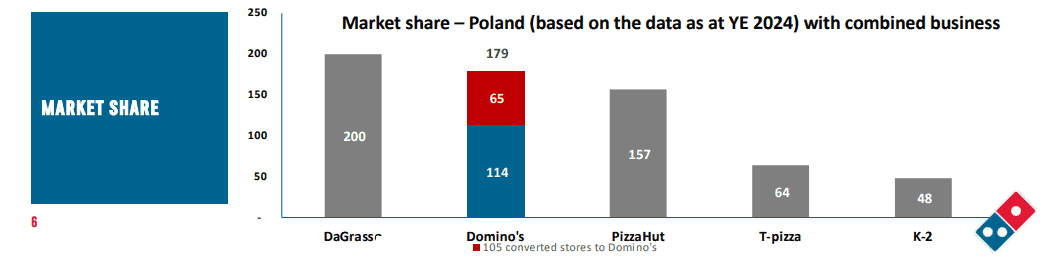
Yesterday, the firm announced that it had acquired Pizzeria 105, the fourth largest pizza restaurant brand in Poland, for around £8.5m. Pizzeria 105 is a franchised business that operates 90 locations across the country.  

CEO Nils Gornall commented: “This acquisition fast-tracks our transition to a predominantly franchised, capital-light model, with over half of our stores set to be franchise-operated from completion. By welcoming 76 experienced franchise partners, we expand our presence into 31 new Polish cities.”

Pizzeria 105’s main source of income was sales of goods to its franchisee partners and royalty fees. The founder will remain a shareholder to ensure a smooth transition and bring valuable local expertise, the buyer noted. 

Long-term plans

DP Poland says Pizzeria 105 is profitable and the deal is expected to be immediately earnings enhancing from completion.

That said, the numbers are pretty small here. Revenue was £1.7m last year, with £1m in EBITDA, from £30.8m of system sales at the franchised stores. But DP Poland says they will benefit from Domino’s brand and marketing support, which will provide a path to drive a 56% higher order count.

The deal also accelerates the company’s plan to have 200 Domino’s stores in Poland by 2027, with half of the outlets franchise-owned. Longer term, the company aims to have 500+ locations in Poland. Croatia is a much smaller part of the business for now.

Still loss-making

In 2024, like-for-like system sales grew 17.9%, marking the third consecutive year of double-digit growth. Before this acquisition, the firm was tipped to increase revenue to around £65.8m this year, good for 23% growth. A first profit might be also eked out.

However, while recent reductions in net losses and improvements in EBITDA indicate a positive trajectory, DP Poland hasn’t yet officially achieved net profitability. At the end of 2024, it had £13.4m in cash and was debt-free. But the fact that it’s still loss-making adds some risk here. 

Also, new shares are being issued as part of the deal. Further shareholder dilution cannot be ruled out.

Should I order in more shares?

This acquisition fits in nicely with the company’s plan to turn Domino’s into the leading pizza brand in Poland. So I think it could turn out to be a smart move.

Source: DP Poland.

Unlike many parts of Europe, Poland’s economy is growing strongly. GDP growth was 2.9% last year, beating forecasts, and it’s expected to accelerate to at least 3% this year, then 3.6% in 2026. That’s a supportive backdrop for consumer spending, dining out, and pizza deliveries. 

If the company continues taking market share and turns profitable, I think the stock could trade much higher than 10p in the years ahead. For context, the market-cap today is just £92m.

Given the risks though, I’m going to keep this as a small but potentially high-reward holding in my portfolio.

Financial News

Daily News on Investing, Personal Finance, Markets, and more!

Financial News

Policy(Required)