Down 16% in a month, is this ultra-luxury stock now a no-brainer buy for my ISA and SIPP?

One share I have in both my Stocks and Shares ISA and SIPP portfolios is Ferrari (NYSE: RACE). While the iconic Italian sportscar company likely needs no introductions, it’s far from any old car stock.

No, Ferrari is valued as an ultra-luxury brand. This is why the stock is often ranked among peers like Hermès International and LVMH (Moet Hennessy Louis Vuitton) rather than grubby carmakers like Stellantis and Ford.

While the stock has raced 185% higher in five years, it’s fallen 16% in just over a month. This pullback has prompted analysts at both Barclays and ​Kepler Cheuvreux to upgrade Ferrari stock to Buy from Hold.

Barclays said the company retains relative “safe-haven” status compared to other European automakers hit by US tariffs. Starting on 2 April, Ferrari will hike prices by up to 10% on some models in the US. This demonstrates the company’s pricing power.

Meanwhile, Kepler said: “This is the pit stop we were long awaiting to turn more positive.”

But should I buy more shares on the dip?

Safe haven

For starters, I agree that Ferrari stock is somewhat of a safe haven. President Trump’s 25% tariffs on auto imports aims to encourage more US car manufacturing. But Ferrari exclusively manufactures its supercars in Maranello, northern Italy, and that won’t be changing.

Customers value the fact that the cars are largely hand-assembled in the same historic factory in Italy. This craftmanship and heritage is an important part of the brand’s appeal.

Meanwhile, the company limits production to maintain exclusivity. As a result, the order backlog extends into early 2027 due to incredible demand.

In other words, you can’t just go out and buy a new Ferrari, even if you have the money. And existing owners have a far better chance of securing limited-edition models than newbies.

The result is extraordinary earnings visibility, which investors value highly. As long as the order book extends two years into the future, I think the stock will carry a significant premium to the wider market.

Of course, we can grumble about how large that premium should be, but the fact the company deserves one is hardly in doubt. Right now, the forward price-to-earnings ratio is 43, which is lower than a few months ago (just over 50).

Marginal margin pressure

Last year, revenue rose 11.8% to €6.7bn. Shipments totalled 13,752 units, up just 1%, yet net profit jumped 21% to just over €1.5bn. 

Source: Ferrari

The main risk I see is some sort of damage to the brand. Ferrari takes incredible care of its reputation, but no brand is entirely immune.

It’s also worth noting that management sees a potential 50 basis point hit to margins this year due to tariffs. Then again, Ferrari’s operating margin was 28.3% last year, so it has a fair bit of flexibility.  

My move

Whether we’re comfortable with it or not, the rich are getting richer around the world. And that is undoubtedly a very supportive trend for ultra-luxury brands like Ferrari.

I already have a somewhat large position across my ISA and SIPP. The 16% dip isn’t large enough to justify me making it even bigger.

But for investors wanting to invest in the rising global wealth theme, I think Ferrari stock is still worth considering as a long-term holding.


3 undervalued UK shares to consider for an ISA this April

With the new tax year approaching, investors may be looking for opportunities in UK shares to optimise their Stocks and Shares ISA

By getting the most out of the £20k annual allowance, investors can aim to maximise their tax-free returns each year.

Please note that tax treatment depends on the individual circumstances of each client and may be subject to change in future. The content in this article is provided for information purposes only. It is not intended to be, neither does it constitute, any form of tax advice. Readers are responsible for carrying out their own due diligence and for obtaining professional advice before making any investment decisions.

The UK market continues to offer excellent value, with several stocks trading below their intrinsic worth. 

Here are three shares that appear undervalued heading into April.

Vodafone

Years of high inflation and shrinking budgets has put pressure on Vodafone’s (LSE: VOD) revenues recently. Cash-strapped consumers have been drawn away by lower-priced rivals, leading to a significant fall in the mobile operator’s share price.

Now with a price-to-earnings (P/E) ratio of 9.3, it has a decent amount of room for growth.

But if it can’t provide competitive pricing, it risks losing further business. With an eye-watering £46.4bn in debt, that’s a risk it can’t afford to take.

Addressing this issue, a swathe of strategic overhaul initiatives promise to turn things around. The company has been streamlining processes and divesting underperforming assets such as the sale of its Spanish unit. This indicates a strong drive by management to revive earnings and shore up the flailing stock.

Even after slashing its dividend last year, the yield is still 7.75%, making it an attractive option for income investors to consider.

Curry’s 

Despite being one of the UK’s leading electrical retailers, Curry’s (LSE: CURY) has had a rough time recently. The stock has been very volatile, gaining 20% early this year only to lose it all the following month. 

Declining consumer spending and supply chain disruptions are key factors that remain significant risks for the company going forward.   These issues may be compounded by conflicts in the Middle East and the economic impact of US trade tariffs.

For now, a stabilising retail sector and an improving economic outlook make it well-positioned for a recovery in the second half of the year. Like Vodafone, it’s focusing on cost efficiencies to help recover losses, along with key expansions in specific regions like Norway.

With a low P/E ratio of only 5.3, I think it’s worth considering. There’s a strong chance the overhaul could lead to a notable price recovery.

ITV

ITV (LSE: ITV) is another UK stalwart hit by declining revenues recently as traditional TV advertising incurs losses. Major US competitors like Netflix and Amazon continue to corner the lion’s share of the global market for movies and TV series.

But the broadcaster is working hard to adapt to the evolving media landscape, with its digital ITVX streaming service making impressive headway. 

The company’s focus on content creation and direct-to-consumer revenue streams is promising, reaffirming a resilient business model. Despite these positive developments, the shares still look cheap for now. With a P/E ratio of 7.8, it’s well below industry peers. 

With solid financials and an aggressive drive to produce top-notch media, I like its chances for recovery.

Plus, it has a great 6.2% yield and strong commitment to dividend payments. That makes a stock worth considering in my books.

FTSE 100 stocks to consider buying in April

There isn’t too much news from FTSE 100 companies coming our way in April. But two key events from a couple I’m watching could make it a good month to consider them.

Retail rebound?

On Wednesday 9 April, JD Sports Fashion (LSE: JD.) is due to bring us a fourth-quarter update for the year to February 2025. The share price has taken a bit of a bashing in the past few years. And it’s down 47% in just the past 12 months.

The company’s US expansion looks like it maybe couldn’t have come at a worse time. And investing in a downtrodden stock can be a risky business. Especially if it’s in as competitive a market as discretionary clothing retail.

Valuation plunge

Forecasts suggest a big fall in earnings per share (EPS) for the year, down around 25%. But analysts already expect to see a 50% rebound in 2026, followed by another 13% the year after. If that comes off, it could drop the JD Sports price-to-earnings (P/E) as low as 5.5 by 2027.

At this stage, much of these predictions have to be speculative. A lot can happen to a sector like this in two years, especially with President Trump’s enthusiasm for tariffs and trade war.

In announcing its Q4 update, JD Sports told us it will include “initial guidance for FY26 and an update on our medium-term plan“. That’s what I most want to see.

Building back?

Wednesday 16 April brings a third-quarter trading update from Barratt Redrow (LSE: BTRW), in its first full year since the merger of Barratt Developments and Redrow completed in August 2024.

The share price is down 10% in the past 12 months. But at least we’re looking at only a 6% decline over five years. That’s perhaps not too bad for a sector under so much pressure.

Looking forward, February’s first-half report told us: “Whilst our full year out-turn remains dependent on how the market evolves through the Spring selling season, based on solid reservation activity since the start of January, we expect to deliver total home completions of between 16,800 and 17,200 in FY25 (including c. 600 JV completions).”

Guidance needed

I’d really like to see some update on how that spring selling season is shaping up. And if the company sees the year turning out the way the City analysts do, we could be on for something good.

Forecasts suggest a return to EPS growth this year, almost doubling from 2024’s depressed level. After that, they have another near-doubling on the cards between 2025 and 2027. That would still leave us short of Barratt’s 2023 earnings. But a long-term recovery has to start somewhere.

These forecasts put the P/E down at less than 10 by 2027. We can’t ignore the pressure the house builders will still face while the economy is weak and mortgage rates are high. But I think this has to be a good time to consider Barratt Redrow.

3 penny share myths busted!

When I started my first job I was invited to join a penny share investment group. When I asked why they only went for penny shares, the answer was that they obviously have far greater potential than shares that have already risen. I didn’t join.

Myth 1: biggest gains

It might seem like intuitive sense that a share priced at a few pennies has a lot more profit potential than one priced in pounds. But a bit of thought can show that’s nonsense. I see a good example in Aston Martin Lagonda (LSE: AML).

It’s not technically a penny stock as it has a market capitalisation of £676m — and in the UK, a penny stock is usually taken to mean market cap of less than £100m. But the 67p share price is well under the £1 limit, and this myth is about share prices.

One way to look at Aston Martin is as a low-priced stock with big potential future gains. Another way is as a company that had a high-flying IPO but whose business just didn’t cut it and the shares collapsed. The share price chart shows that clearly.

If Aston Martin were to have a 1-for-10 share consolidation tomorrow, the shares would be worth 670p and there would be a tenth the number in circulation. It wouldn’t be a penny stock any more. But the company wouldn’t have changed in the slightest. And its potential for gains and losses would be completely unchanged.

Myth 2: lowest losses

The other side of that coin is, in my opinon, an even more dangerous myth. With the share price so low, it goes, there’s a lot less to lose. If we buy a share for a few pennies we only have a few pennies to lose. But a share up in the pounds could lose us pounds.

And, well, on one level that’s true. If we only buy one share, we only stand to lose the price of one share. But who does that?

We don’t choose a set number of shares and then see which are the cheapest. No, we choose the amount of money we want to invest. Invest £1,000 and our biggest potential loss is £1,000, no matter what the share price.

I’m reminded of a tiny oil stock whose shares 10 years ago were worth about 5p. Today we’re looking at 0.015p. Less to lose? That looks like a 99.7% wipeout to me.

Myth 3: avoid like the plague

With those two myths busted, maybe the bright thing to do is avoid penny shares altogether? I’d say for those who haven’t really got their heads round share prices and valuations yet, that might be a good stop-gap idea.

But when we know how to avoid the hype and look at the actual underlying company, avoiding penny shares could mean we miss out on some great opportunities.

The key point is to remember what we’re buying and what we’re not buying. We’re not buying a share price, penny or otherwise. We’re buying a part-ownership of a company. And we should evaluate it the same way as any other company, no matter the share price.

In 12 months, the Diageo share price could be…

I’m struggling to get my head around the Diageo (LSE: DGE) share price. I can scarcely believe it’s fallen 45% over the last two years, and 30% in the last 12 months.

Isn’t this supposed to be one of the most solid UK blue chips? A defensive stock that holds firm in tough times and thrives in the good? Don’t people like a drink anymore?

Well, to a degree, they don’t. Or at least, they can’t afford the premium brands that Diageo sells. Many consumers have traded down to the rough stuff as the cost-of-living crisis bites. Sales have taken a hit in Latin American and the Chinese economic slowdown hasn’t helped. The US has been a drag for similar reasons. Gen Z are a sober bunch, it seems.

Can this FTSE 100 star shine again?

Now Diageo faces a fresh challenge in the shape of US trade tariffs. It faces uncertainty over the cost of exporting premium spirits like tequila from Mexico and whisky from Canada.

The board recently declined to provide forward guidance, citing “macroeconomic and geopolitical uncertainty”. That spooked investors further. If the board can’t say what’s going to happen next, how are investors supposed to get a handle on the stock?

As a contrarian investor myself, this should feel like a prime buying opportunity. A battered former stock market darling, now trading at a more attractive valuation amid wider disarray. Diageo’s price-to-earnings ratio sits just above 15, in line with the FTSE 100 average. Historically, it has commanded a premium valuation. The dividend yield has also nudged up to 4%, a rare sight for this stock. So, could this be the bottom of the glass?

There are reasons for hope. Overstocking issues in Latin America, a key force behind last year’s profit warning, appear to have been resolved. And Guinness remains the drink of our times, with the board swiftly sinking rumours of an £8bn sale.

Could it be a brilliant recovery stock?

CEO Debra Crew has a challenge on her hands. In the second half of 2024 operating profits fell 5% to $3.16bn, despite a small 1% rise in sales.

She’s outlined plans to improve working capital efficiency, which could ease balance sheet concerns. Still, the share price remains on a relentless downward spiral. I bought after the initial drop, averaged down twice since, and I’m still sitting on a 30% loss.

So where will the shares be this time next year? Now here’s the positive bit. The 21 brokers covering the stock have produced a median one-year target of 2,541p. If correct, that’s a 25% gain from today’s levels. A tempting prospect, but forecasts are just that – forecasts.

As one who’s taken a beating at the hands of Diageo, I can’t bring myself to believe in such a quickfire recovery. Some of these price targets may have been set when Diageo was trading at higher levels and before the tariff threat escalated.

I’m hunkering down and holding onto my shares, hoping the market turns in my favour. If I sell now, I’ve a nagging suspicion the Diageo recovery party will start without me. In 12 months, the Diageo share price could be anywhere. Now, that is something I can get my head round.

Could the FTSE 100’s newest addition be a great passive income investment?

After the latest reshuffle, Coca-Cola Europacific Partners (LSE:CCEP) is the latest addition to the FTSE 100. And it has a lot of the hallmarks of a quality passive income investment.

The company distributes US giant Coca-Cola‘s products in the UK, Europe, and Australia. While the dividend yield is only 2.5%, I think there’s a lot to like about the business.

Invaluable assets

On the face of it, the process of manufacturing and distributing soft drinks isn’t particularly attractive. It involves a lot of machinery and equipment and this costs money.

That means inflation can be a significant issue. As costs rise, companies that have a lot of machinery to maintain could find themselves with increased pressure on margins.

Fortunately, Coca-Cola Europacific Partners doesn’t just make any old soft drinks. It makes Coca-Cola products and it benefits from rights to some of the most iconic brands in the world.

These days, the Coca-Cola range extends well beyond carbonated beverages. It includes Costa coffee, Innocent smoothies, and Powerade energy drinks. 

The right to distribute these products specifically puts Coca-Cola Europacific Partners well ahead of other manufacturers. But it doesn’t have any of the associated marketing costs. 

All it has to do is buy concentrates from the Coca-Cola company, turn them into drinks, and sell them. And despite being capital-intensive, it earns a decent return on the cash it invests.

Dividends

The current dividend yield is only around 2.5%. But I think there’s reason to believe this can grow quite substantially in the future.

Over the last five years, the company has distributed just over 30% of its net income to shareholders. The vast majority has been retained within the business.

This means a couple of things. Most obviously, it means there’s scope for the firm to increase its dividend by distributing more of the cash it generates. 

To my mind though, there’s a more important benefit. As long as the business earns good returns on invested capital, the cash it retains should help earnings grow.

That means the company should be able to increase its dividends simply by making more money. And the longer this can go on, the better it will be for investors. 

No business can grow forever. But the Coca-Cola brands have proven to be a durable asset and investors shouldn’t underestimate the opportunities this gives Coca-Cola Europacific Partners.

Coca-Cola ecosystem

It’s easy to think of stocks like this as inferior alternatives to the Coca-Cola company. After all, they were historically spun out from the US firm. 

I think however, it’s important to treat these businesses on their own merits. And the newest addition to the FTSE 100 isn’t one to be underestimated. 

It’s a business with extremely valuable intangible assets that earns strong returns on invested capital. And this has resulted in some impressive dividend growth in recent years.

All of this adds up to a company that investors should take a close look at. I think it has a lot of the hallmarks of a stock that can provide passive income for a long time.

Here’s what Warren Buffett looks for in growth stocks

If history is anything to go by, growth stocks can generate spectacular returns. But it’s not just about how much earnings per share (EPS) are going to increase in future.

In the 1977 letter to Berkshire Hathaway shareholders, Warren Buffett identified a key metric for investors to pay attention to. And it shows there’s more to growth than a rising EPS.

Earnings per share

On the subject of EPS, Buffett said the following:

“Most companies define ‘record’ earnings as a new high in earnings per share… [But] even a totally dormant savings account will produce steadily rising interest earnings each year because of compounding.”

A firm that retains part if its profits (rather than using them for dividends) should be able to generate EPS growth. It can do this by keeping the income in cash and earning interest.

Investors, however, should expect companies to do better than just earning interest on cash. With this in mind, Buffett proposed a different metric for assessing growth. 

Return on equity

Rather than focusing solely on earnings, Buffett suggested looking at return on equity (ROE):

“Except for special cases (for example, companies with unusually high debt-equity ratios or those with important assets carried at unrealistic balance sheet values), we believe a more appropriate measure of managerial economic performance to be return on equity capital.”

When companies retain earnings (rather than using them for dividends) it increases their equity base. And the company’s ROE measures its net income against the value of its equity.

This helps distinguish firms that grow just by retaining cash from ones that are investing at good rates of return. And it’s the second type that make the best great growth stocks. 

An example

I think FTSE 100 stock Halma (LSE:HLMA) is a great illustration of Buffett’s point. Since 2020, the company has retained around 70% of its net income and reinvested it to generate growth. 

During that time, the firm’s EPS have increased by around 45%. But this isn’t just the result of retaining cash – it has been using the cash well and earning strong returns on its investments. 

Year Return on Equity
2020 17.4%
2021 17.7%
2022 19.0%
2023 15.6%
2024 16.1%

The firm has maintained an ROE above 15%, which suggests it has managed to invest its retained cash at good rates of return. In Halma’s case, this has often involved acquisitions.

Investors will need to think about the risk of the company’s opportunities to keep doing this being more limited in the future. But I think its record so far has been very impressive. 

Growth investing

Businesses in growth mode generally look to invest their profits into opportunities that can boost future earnings. But not all of them are the same. 

A company that needs £100 to increase its earnings by £1 is different to one that can do this with £10 while returning £90 to shareholders. And this is what the ROE helps investors assess. 

Halma’s one of a few UK growth stocks that shapes up well on this front. It looks expensive to me at the moment, but I think it’s definitely one to keep an eye on in future.

How much would an ISA investor need to earn a £777 monthly passive income?

Investors looking to generate passive income from FTSE 100 shares might wonder how much capital they need to hit their target. So let’s crunch the numbers.

Generating a second income of £777 a month would add up to £9,324 a year. That’s would give the State Pension a handy boost. 

The amount of capital required to produce that income depends on the yield of the investor’s portfolio. I believe it’s reasonable to aim for an average yield of 6% from a diversified mix of UK dividend stocks. Under this assumption, an investor would need a total of £155,400 invested to reach their goal.

FTSE 100 stocks pay heaps of dividends

That sounds like a hefty sum, but it can be built over time. Someone investing £200 a month could surpass this milestone in 25 years. Sounds too slow? Then invest more.

Assuming an average total return of 7% a year, they could potentially amass £162,423. That’s roughly in line with the long-term FTSE 100 average total return, which combines both capital growth and reinvested dividends. Buying individual stocks can potentially offer a superior return, plus more income (albeit with more risk).

British American Tobacco (LSE: BATS) has long been a favourite for income seekers to consider. The cigarette giant may be operating in a declining industry, but it remains highly profitable and continues to reward shareholders with generous dividends.

Its shares have surged 33% over the last year. However, the stock’s seen plenty of volatility, and despite this recent surge, it actually trades at similar levels to three years ago. 

The company’s full-year 2024 results, released on 13 February, disappointed the market, putting an end to its recent stellar share price run.

Profits from operations grew a modest 1.4% to £2.7bn, but free cash flow before dividends shrank 5.5% to £7.9bn. The board only hiked the dividend by 2% to 240.24p per share. At least it increased it though.

It isn’t risk-free

There are risks. The tobacco industry remains under constant regulatory pressure, and British American Tobacco faces tough competition from global giants such as Philip Morris and Imperial Brands

Crucially for income investors, the stock offers a highly attractive dividend yield of 7.45%. It also trades at a relatively modest price-to-earnings ratio of 8.7 and I feel it’s worth considering.

Some people won’t want to invest in tobacco stocks and I totally get that. I don’t. But there are loads more FTSE 100 shares that offer both growth and dividends. I suggest building a portfolio of at least a dozen, and probably around 15-20, to spread risk.

Generating £777 a month in passive income is achievable with a patient, long-term approach. Better still, it should rise over time, as companies increase shareholder payouts. Most aim to do that every year, provided they generate enough cash to do so. No guarantees though.

Our investor shouldn’t just stick to tucking away £200 a month. They should aim to increase that in time to keep pace with (or beat) inflation, and throw in lump sums when they have money to spare.

The more they invest, the more financial freedom they’ll have in later life, thanks to the twin miracles of compounding and passive income.

How £10,000 invested in this little-known FTSE stock could generate £34,400 of passive income a year!

Many investors are attracted to the stock market by the prospect of generating a healthy level of passive income. But when a high-yielding stock’s also growing rapidly, the potential returns can be even more impressive.

Take M.P. Evans Group (LSE:MPE), the Indonesian palm oil producer, as an example.

Good for income and growth

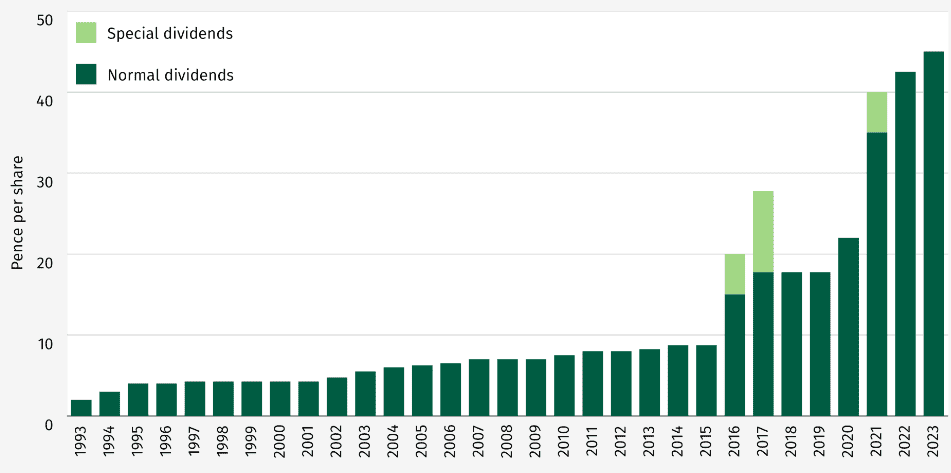
In respect of its 2024 financial year, the group’s declared a dividend of 52.5p a share, an increase of 17% on the previous year. This means the stock’s presently yielding a very respectable 5.3%.

The company first paid a dividend in 1993. Since then, it’s increased (or maintained) its payout every year. More recently — since 2020 — it’s grown by an average annual rate of 24.3%.

Source: company website

Also, over the past five years, its share price has risen by an annual average of 17%.

This is an impressive combination.

Assuming the stock continues to yield 5.3%, and its share price performance over the past five years is repeated for another two decades, a £10,000 investment made today would grow to £649,060. This assumes all dividends are reinvested, buying more shares.

At this point, the stock would be generating annual passive income of £34,400.

However, this type of analysis comes with some health warnings. There’s no guarantee that history will be repeated. Almost inevitably, its rate of growth will slow. And it’s never a good idea to put all of your money into one stock.

But it does give an idea of the potential return available from a high-yielding growth share.

And now could be a good time to invest. That’s because, despite its impressive rate of growth, the company appears to be undervalued compared to its peers, including some of its larger Asian rivals.

In 2024, M.P. Evans Group reported earnings per share of 129.6p. This means its historical price-to-earnings (P/E) ratio is 7.8. In contrast, Sime Darby has a P/E ratio of 13.6. Wilmar International trades on a multiple of 10.1.

Some concerns

But the production of palm oil is controversial. Historical allegations of widespread deforestation and the exploitation of labour have damaged the reputation of the industry. M.P. Evans Group has sought to overcome this by promoting its sustainable credentials. It’s been certified by the Round Table on Sustainable Palm Oil (RSPO). 

Also, it’s entered into a number of partnerships with local producers. In return for offering land to the group, members of these cooperatives receive compensation, a wage, and a share of the revenue.

Like other commodities, the price of palm oil can be volatile. It spiked after Russia invaded Ukraine, although it’s been relatively stable since the summer of 2022.

Crucially, weather conditions can affect a crop. In 2024, the group’s production was 1% lower than in the previous year. However, this was more than compensated for by a 13% increase in the average price earned.

Other potential problems include pests, disease, and floods.

But I think the stock has lots going for it.

Palm oil is used in half of the packaged products found in a typical supermarket. And the trees from which it comes are highly productive. The group’s track record of steadily increasing its dividend is also encouraging. On balance, I think it’s a stock that long-term investors could consider adding to their portfolios.

2 top UK passive stocks to consider before 5 April

The deadline to shelter up to £20,000 in a Stocks and Shares ISA for this tax year is looming. And right now, I think this pair of FTSE 100 dividend stocks are worth considering to aim for tax-free passive income. 

Please note that tax treatment depends on the individual circumstances of each client and may be subject to change in future. The content in this article is provided for information purposes only. It is not intended to be, neither does it constitute, any form of tax advice. Readers are responsible for carrying out their own due diligence and for obtaining professional advice before making any investment decisions.

Imperial Brands

First up is Imperial Brands (LSE: IMB). Shares of the multinational tobacco company have been on fire, surging 58% over one year and 111% across five. And that’s without factoring in dividends!

Yet the good news for income seekers is that this hasn’t dented the stock’s high-yield credentials. Based on forecasts, it’s sporting a 6.1% dividend yield for its next financial year (starting October). That’s well above the average for UK stocks.

The strong share price performance might surprise some. After all, cigarette sales have been steadily falling worldwide for years, supposedly pushing tobacco companies towards long-term oblivion. Yet the company has just committed to growing its annual operating profits by 3%-5% per year and announced an “evergreen” annual share buyback programme through to 2030.

Imperial is behind brands like John Player Special, Lambert & Butler, and Davidoff. It also owns backy brands Golden Virginia, Drum, and Rizla. Many smokers have downgraded to rolling tobacco due to affordability issues with cigarettes.

By concentrating on key core markets like the US, UK, Germany, Spain, and Australia, Imperial Brands has managed to enhance its profitability and market share.

Of course, the company faces obvious risks with increasing regulation and falling cigarette volumes. It might not achieve its financial targets. And I appreciate that tobacco stocks might not be ethical in the eyes of some investors.

But the dividends look affordable, as the forecast payouts are covered twice over by anticipated earnings. In short, this doesn’t appear to be a company in obvious decline.

Meanwhile, the stock still looks decent value, trading at around nine times earnings.

HSBC

The second stock is banking giant HSBC (LSE: HSBA). The FTSE 100 company’s share price has also done very well, rising 42% over the past year.

Again, though, this hasn’t resulted in a low yield or particularly high valuation. The forecast yield for 2026 is 6.2% and the forward price-to-earnings ratio is 8. So I think HSBC stocks still offers decent value.

What could go wrong? Well, interest rates are due to come down, which could squeeze the bank’s lending margins and dampen earnings growth. To offset this, HSBC has been restructuring and cutting costs, but we don’t know whether that will be enough.

Taking a longer-term view though, I think the bank’s pivot to higher-growth markets in Asia will pay off. Fuelled by rising disposable income and large populations, this region is tipped for very strong long-term growth.

Meanwhile, HSBC’s dividend cover looks strong and its CET1 capital ratio — a key measure of a bank’s financial strength — was a solid 14.9% at the end of 2024. So the company looks in great shape to me.

Of course, it goes without saying that no individual dividend is ultimately guaranteed. But I think these two UK stocks are solid long-term picks for investors seeking passive income to consider.

Financial News

Daily News on Investing, Personal Finance, Markets, and more!

Financial News

Policy(Required)