£100 daily passive income? With the right shares in a Stocks and Shares ISA, it’s possible!

Each year, when April rolls around, British stock market investors start thinking about their Stocks and Shares ISAs.

The new tax year allows a fresh £20,000 of tax-free investments into a wide range of assets. From investment trusts and exchange-traded funds (ETFs) to gold and bonds, the options seem endless.

Please note that tax treatment depends on the individual circumstances of each client and may be subject to change in future. The content in this article is provided for information purposes only. It is not intended to be, neither does it constitute, any form of tax advice. Readers are responsible for carrying out their own due diligence and for obtaining professional advice before making any investment decisions.

However, for income-minded investors, the go-to option is almost always dividend shares. These fantastic stocks pay out a regular income in the form of cash or shares, which can then be withdrawn or reinvested.

Over time, a large accumulation of dividend-paying shares can result in a significant amount of daily passive income. With an extra £100 a day, an overworked employee could reduce their workload and spend more time with family. Unattached adventurers could quit their day job and hit the road, enjoying a life of freedom, fun and travel!

But while that dream’s possible, it requires dedication to a strict investment strategy. Depending on each individual’s financial situation, it may take several decades to achieve.

Let’s have a look at how a well thought-out investment strategy can deliver financial freedom.

Calculating yields

Dividend income can be calculated as a yield, or percentage of an investment. The average on the FTSE 100 is 3.5%, but many dividend-focused portfolios achieve 7% or more.

One example I think investors should consider is the UK property developer Taylor Wimpey (LSE: TW.). Its yield is around 8.6%, typically fluctuating between 6% and 9%. 

Unfortunately, it was forced to pause dividends during the 2008 financial crisis. This shows its sensitivity to market downturns, and there’s a risk that it may have to cut dividends again in a similar situation. The highly competitive UK housing market’s another risk, with rivals like Barratt Redrow and Persimmon vying for a larger market share.

However, since reinstating dividends in 2011, they’ve increased from 0.38p per share to 9.46p — a growth rate of almost 20% a year! That reveals an impressive dedication to shareholder returns, and with the shares down 12% this year, it has an attractive forward price-to-earnings (P/E) of 13.2. 

By combining several shares with yields between 5% and 9%, an investor could achieve an average of 7%.

Doing the maths

To earn £100 a day (£36,500 a year), an average 7% portfolio would need to hold £521,000. Woah! With that kind of money, an investor could buy and rent a property for £100 a day. But a portfolio is far easier to manage and with much lower overheads.

So how would a beginner investor hope to build up that much money? Research shows that over the past decade, the average rate of return on a Stocks and Shares ISA is over 9%. This includes both dividends and price gains combined.

If an investor invested £400 a month (or £4,800 a year) in a 9% portfolio, it would take almost 26 years to reach £521k. At that point, the money could be rebalanced into a dividend portfolio with an average 7% yield, paying regular income without denting the pot.

This is a realistic timeframe for an investor with an appropriate long-term mindset, taking into account that actual returns may vary wildly from this example.


9% income a year! Are these 3 FTSE dividend shares no-brainer buys to consider for an ISA?

As the end of the tax year looms, many investors will be hunting for dividend shares to add to their Stocks and Shares ISA. 

Three FTSE 100 passive income stocks stand out: M&G (LSE: MNG), Phoenix Group Holdings (LSE: PHNX), and Legal & General Group (LSE: LGEN).

They offer incredible passive income of around 9%. But are their yields too good to be true?

M&G shares pay massive income

Wealth manager M&G has a trailing yield of 9.88%, the highest on the FTSE 100. But it’s not the full story. When buying shares, capital is at risk. And the returns on M&G shres have been volatile.

The share price has dipped 7.76% over the past year. However, it has climbed an impressive 50% over five years.

Throw in that yield and long-term investors have doubled their money. But past performance figures are slippery things. Five years ago, the first pandemic lockdown was in full swing, and markets were in a slump. That flatters subsequent growth.

I hold M&G stock — in fact — I hold all three of these. They’re all in the financial sector, which puts them on the front line of today’s stock market volatility, which could hit assets under management and customer inflows.

That could impact profits and potentially the dividend. M&G also faces competition from lower-cost passive investment providers, which could erode its client base over time.

Phoenix stock may struggle to fly

Phoenix Group is close behind M&G with a trailing dividend yield of 9.46%. The life insurer has done well out of acquiring and managing closed books of business from financial services firms. However, it needs to keep chasing new business to keep the cash flowing and the dividend alive. It’s done well so far, but there are no guarantees.

The Phoenix share price climbed 4% over the last year, boosted by a strong set of 2024 results, with operating cash generation up 22% to £1.4bn. That should help support the dividend.

However, the shares are down 14% over five years, and the capital loss must be offset against the dividend income.

It’s no coincidence that the final ultra-high yielder is also in the financial sector, asset manager and insurer Legal & General.

This is a mature and competitive sector, which has been squeezed by higher interest rates and volatile markets. While there has been profit growth, it’s hardly been spectacular.

Legal & General’s trailing yield of 8.76% is eye-catching but its shares have disappointed, falling 4% in the past year but up a modest 16% over five. With dividends, long-term investors are still doing nicely.

Earning per share have fallen in recent years, though, and this has bumped up the price-to-earnings ratio to a pricey 84 times. It’s the most expensive of the three.

Yet the board recently announced plans to buy back £500m of shares this year after a strong 2024. In total, it aims to return more than £5bn to shareholders within three years.

I think all three dividends look sustainable, but don’t expect them to grow much, especially given today’s economic worries. 

I think any of them are worth considering for a well-balanced portfolio, but I wouldn’t suggest newbie investors buy all three because there’s a lot of crossover. I wouldn’t quite call them no-brainers. As ever, there are risks as well as rewards.

The HSBC share price is down 7% in a month and looks dirt cheap with a P/E of just 9!

Even the high-flying HSBC (LSE: HSBA) share price couldn’t withstand recent stock market turbulence. It’s slumped just over 7% in the last week. That’s a modest drop, with the shares still up 40% over the last 12 months, and 90% over five years (plus a heap of dividends on top). But is it still worth taking advantage of it?

HSBC shares have looked cheap for several years, judging by its price-to-earnings (P/E) ratio. That’s still the case today, with the P/E now at a lowly 9.03 times and well below long-term average FTSE 100 P/E of around 15 times.

Is now a good time to buy this FTSE 100 star?

It’s not as much of a bargain when measured by price-to-book value, which sits at exactly one, suggesting fair value. But with operating margins of 44.6% set to rise to 48.7% next year, there’s room for profits to grow.

HSBC has long been one of the FTSE 100’s most generous income stocks, and 2025 looks no different. The bank is forecast to yield 5.9% this year, rising to a juicy 6.33% in 2026. Better still, those payouts are comfortably covered twice by earnings. 

On top of that, HSBC has been rewarding investors with share buybacks, announcing plans for another $2bn programme in February.

While HSBC’s long-term strategy has served it well, new CEO Georges Elhedery has set out to streamline the business. He plans to cut $1.5bn in costs by the end of next year.  As part of this, the bank’s winding down its investment banking and equity capital markets business in the West, doubling down on corporate and institutional clients in Asia and emerging markets.

Dividends, share buybacks and growth

Q4 results were mixed, with reported revenues dropping 11% to $11.6bn. That was largely down to FX-related losses from divesting its Argentine unit, presumably a one-off. Profit before tax still rose $1.3bn to $2.3bn, beating expectations. 

HSBC can’t escape today’s geopolitical uncertainty, as the recent share price dip shows. But it’s proving surprisingly nimble. HSBC’s splitting operations into Western and Eastern divisions, but there’s no question where its heart lies.

A couple of years ago I resisted buying HSBC because I feared it risked getting ripped apart by the US/China superpower rift. That seems less of a worry now that it’s taken sides. This is a play on the BRICs, not the West.

The 17 analysts covering HSBC have produced a median 12-month price target of 948p. This suggests just an 8.5% rise from current levels. Obviously, forecasts can’t be relied upon, but this confirms my view that investors can’t expect another stellar year. A quick glance at the news headlines confirms that.

I still think HSBC’s well worth considering for investors who hope to turn today’s stock market volatility to their long-term advantage. But they should also accept that their capital is at risk. And the next few years will be bumpy as globalisation wanes and the world retrenches into different trading blocs.

HSBC will have to remain nimble to survive that tectonic shift. Iinvestors can quietly reinvest their dividends while they wait for it to play out.

With BP’s huge Iraq oil deal formally approved, will its share price soar?

BP’s (LSE: BP) share price has fallen 19% from its 12 April one-year traded high of £5.40. Much of its price movement has reflected the benchmark Brent oil price pattern. But more recently it has also factored in market perceptions of a change in its energy transition strategy.

Specifically, the market has expected a moderation of its green energy targets and an acceleration of oil and gas production. Analysts believe this shift could redress the valuation gap between BP’s share price and those of its fossil fuel-focused competitors.

Following through on its strategic reset

When BP announced such a strategic reset in its 2024 results, its share price surged 7%. This was despite broadly poor numbers in the annual report. That said, I think the stock has struggled to capitalise on those gains for lack of follow-up news on specific fossil fuel projects.

However, 18 March saw Iraq’s Council of Ministers approve BP’s US$25bn+ contract to develop five Kirkuk oil fields. These are estimated to contain 20 billion barrels of reserves. The cost of removing a barrel of oil in Iraq is $1-$2 per barrel – the joint lowest in the world. I believe that as positive news of this development continues to emerge, BP’s share price will benefit.

The same applies to other oil and gas projects as new development milestones are announced. In this context, the firm recently said it expects to increase its oil production to 2.3m-2.5m barrels per day (bpd) by 2030. Currently, it produces around 1.1m bpd.

Are the shares a bargain now?

The key factor driving a company’s share price is its earnings growth. A risk to this for BP is a reversion to a more rigorous energy transition strategy, perhaps as the result of lobbying. However, consensus analysts’ estimates are that its earnings will now increase a stunning 24.7% a year to end-2027.

Despite this, its 0.5 price-to-sales ratio is at the bottom of its competitor group, which averages 1.8. These comprise Shell at 0.8, ExxonMobil and Chevron each at 1.5, and Saudi Aramco at 3.5. So BP looks a bargain on this measure.

The same is true of its 1.16 price-to-book ratio against a peer average of 2.3. So I ran a discounted cash flow analysis to ascertain where its price should be, based on cash flow forecasts. This shows BP’s shares are 59% undervalued at their current price of £4.36. Therefore, their fair value is £10.63, although stocks move up and down in price all the time.

A good dividend bonus

Its strong projected earnings growth should also power its dividend higher. It paid a total of 31 cents (24p) a share in 2024, which currently yields 5.5%. So investors considering a £10,000 holding in BP could see dividends of £7,311 after 10 years and £41,874 after 30 years.

These numbers are based on an average 5.5% yield and ‘dividend compounding’ being used. However, analysts forecast the payment will increase to 25.4p in 2025, 26.5p in 2026, and 27.6p in 2027. These would generate respective yields based on the current share price of 5.8%, 6.1%, and 6.3%.

I expect its strong earnings potential will cause its share price to soar over time. It should also push its dividend much higher. Consequently, I’ll buy more of the shares very shortly.

This FTSE 100 insurer’s 6.8% dividend yield is forecast to keep rising. Is it time to add it to my passive income portfolio?

I own several shares specifically to generate a very high passive income. This is money made with minimal effort on my part, aside from choosing the stocks and monitoring their progress periodically.

These stocks have already enabled me to live a much better life than I would have done otherwise. And they should also allow me to enjoy an extremely comfortable retirement when I decide the time is right.

 My core passive income portfolio consists of M&G (current dividend yield 10.2%), Phoenix Group Holdings (9.5%), aberdeen (9.4%), Legal & General (8.8%), and British American Tobacco (7.4%).

There are other stocks I bought because I expect their dividend yield to soon rise above the 7%+ I require. Why this figure? Because I can get 4.8% from the risk-free rate (the 10-year UK government bond yield) and shares are not risk-free.

That said, my attention has been drawn to a new potential candidate for inclusion in this key portfolio for me.

What’s the new prospect?

FTSE 100 insurer Admiral (LSE: ADM) almost ticks my minimum dividend yield requirement box already. It paid a 192p dividend in 2024, which yields 6.8% on the current £28.41 share price.

Crucially though, analysts forecast this payout will rise to 206p in 2025, 209p in 2026 and 221p in 2027.

These would generate respective dividend yields of 7.3%, 7.4% and 7.8% — all well above my 7%+ floor.

Undervalued share price?

It also ticks my second criterion for inclusion in my passive income portfolio, which is an undervalued share price. This decreases the likelihood of my losing money on the share price if I ever sell it. Conversely, it increases the chance of my making a profit in that event.

A discounted cash flow analysis using other analysts’ figures and my own shows the stock is 49% undervalued right now.

That means the fair value for the shares is £55.71, although prices can (and do) go down as well as up.

Strong core business?

Admiral also ticks the third and final requirement box for me, which is a strong core business. It is earnings growth that ultimately powers a stock’s price and dividend higher over time.

And in this insurer’s case, analysts forecast its earnings will rise 6.7% a year to the end of 2027.

This looks a conservative figure to me, given its excellent 2024 results. However, a risk to its earnings does remain the cut-throat competition in the insurance sector.

That said, its 2024 pre-tax profit of £839.2m was nearly double 2023’s £442.8m. As a result, earnings per share soared 95% to 216.6p and the dividend was increased 86% to its current 192p level.

How much passive income can be made?

Investors considering a £10,000 stake in Admiral would make £9,701 in dividends after 10 years on the average 6.8% yield. This would rise after 30 years to £66,465 on the same average yield. These numbers also factor in ‘dividend compounding’ being used to turbocharge these dividend returns.

Adding in the £10,000 initial stake and the Admiral holding would be worth £76,465 by then. On the same 6.8% yield, this would pay £5,200 a year in passive income by that point.

Consequently, I have seen enough to say that I will buy the shares very soon indeed.

Why are investors ignoring this FTSE 250 dividend stock with a near-10% yield?

Based on amounts declared for its 2024 financial year, Harbour Energy (LSE:HBR) is a dividend stock that’s currently (31 March) yielding 9.8%.

Admittedly, some of this above-average yield has been caused by a disappointing share price performance. Since March 2024, it’s fallen by a quarter. But even if the stock was changing hands close to its 52-week high, it would still be yielding over 6%. The average for the FTSE 250 is 3.4%.

I’m convinced that softening energy prices have contributed to the share price fall. For example, over the past 12 months, Brent crude has fallen 16%. But I think this is only part of the story.

Until recently, Harbour Energy was entirely dependent on the North Sea. As a result, all of its profit fell within the scope of the energy profits levy (‘windfall tax’). The effective tax rate for those extracting oil and gas from UK waters is 78%.

Better prospects

But following a “transformational” deal which, towards the end of 2024, saw the group acquire the upstream assets of Wintershall Dea, more of its profit will escape the British tax authorities. The group now has operations in Norway, Germany, Denmark, Argentina, Mexico, Egypt, Libya, and Algeria.

Comparing 2025 — the first full year post-deal – with 2023, the group’s expected to be producing 2.5 times more, at a cost of $4 a barrel (oil equivalent) less.

Just before the deal completed, Harbour Energy’s market cap was £2.2bn. Now, it’s just under £3bn. In my opinion, this doesn’t reflect the scale of the enlarged group. It also ignores the advantages of having a wider geographical footprint.

And although it’s impossible to guarantee future dividends, the group’s planning to return $455m to shareholders for its 2025 financial year. This is based on an anticipated free cash flow (FCF) of $1bn (before dividends and buybacks).

A challenging environment

But we live in difficult times. Regional conflicts and an uncertain global economic outlook are damaging confidence, which could impact commodity prices.

Indeed, the group’s FCF outlook assumes a Brent crude price of $80 a barrel – it’s currently around $72. To compensate a little, the European gas price is slightly above the group’s assumption of $13 per mscf (thousand standard cubic feet). However, at the moment, it looks as though the group’s $1bn forecast is on the high side.

Also, the move towards ethical investing means the oil and gas sector is out of bounds for an increasing number of funds and private investors.

But the demand for hydrocarbons is expected to increase for several years to come. Most experts seem to agree that even when peak demand is reached, it’s unlikely to fall rapidly thereafter.

And even if Harbour Energy’s FCF falls below the level expected, I still think there’s still plenty of headroom before the dividend has to be cut.

Encouragingly for shareholders like me, the average 12-month price target of the 10 analysts covering the stock is 296p (206p-379p). This implies a 42% upside to today’s share price of 208p.

On reflection, I plan to hold on to my shares in the group. I feel the present dividend on offer is sufficient to compensate me for the risks associated with investing in this particularly volatile sector.

What’s stopping the Helium One share price from going higher?

The Helium One Global (LSE:HE1) share price had an eventful day yesterday (31 March). Before the start of trading, the company announced the news that shareholders have been patiently waiting for. Namely, that the company has formally accepted the terms of the mining licence offered by the government of Tanzania.

The first annual fee has been paid. And the necessary legal work to finalise the various contracts will now follow. A formal assessment of the helium reserves will then be undertaken.

Not surprisingly, the news helped drive the share price 9.5% higher. After all, it represents an important milestone on the road to full commercialisation. But then it started to fall and it was below its opening level by early afternoon.

Shareholders are probably wondering what has to happen for the group’s share price to take off. Despite all the good news that’s been released lately — development drilling at its joint venture site in America is also going to plan — the share price is 53% below its 52-week high.

Be calm

But I don’t think there’s any need to panic.

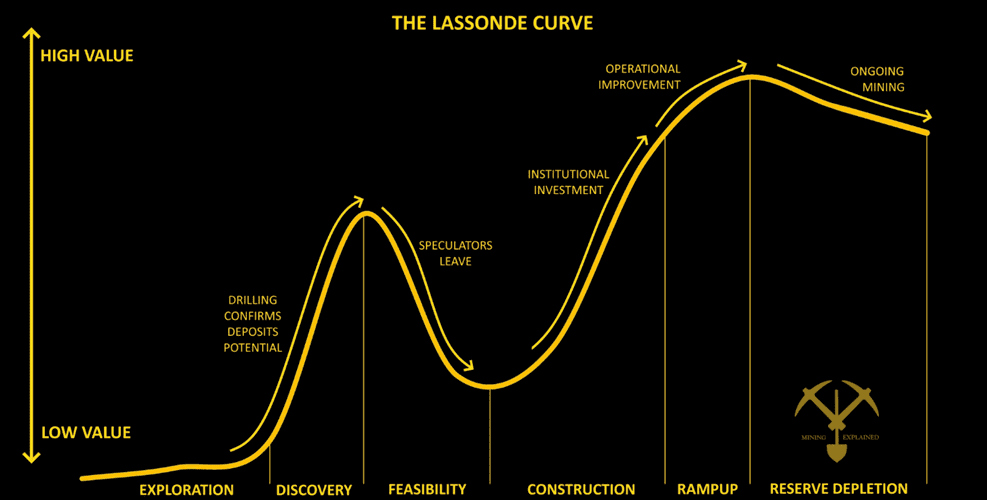
That’s because, over 30 years ago, Pierre Lassonde looked at the life cycle of a typical mining company. Using the ‘Lassonde Curve’ (see below), he put forward the idea that investors will sell up after an initial surge of interest, leading to a pull back in a miner’s stock market valuation. A period of treading water will then follow as the company moves through the feasibility stage and into the construction phase.

I think this is where the Helium One share price is currently at. And I suspect it’s likely to remain in the doldrums until it becomes clearer how the development of its flagship project will be funded. Once clarified, Lassonde predicts that the market cap of the company will start to increase.

Source: Mining Explained

Ongoing discussions

In December, at Helium One’s annual general meeting, Graham Jacobs, the company’s finance and commercial director, said “initial – moving on towards detailed – engineering studies” had been completed. Based on these, he believed the cost of developing the mine in Africa is likely to be “somewhere in the region of” $75m-$100m.

He also said that the company was in discussions with banks about providing the necessary finance. Also, Jacobs didn’t rule out entering into offtake financing, where customers pay in advance for gas.

But he also cautioned that there will be an “element of equity” to go along with whatever financing arrangement the company (hopefully) secures.

And that’s a problem for me. At current exchange rates, the funding required is more than the market cap of the company. The amount involved is therefore not trivial. And due to the specialised (and risky) nature of any lending, I think there will be a relatively small pool of debt providers willing to come forward. This means they will be in a position to demand very favourable terms, at the expense of existing shareholders.

There’s also a chance that nobody will want to fund the company. In these circumstances, who knows what will happen.

That’s why I don’t want to invest. Despite the attractive market characteristics for helium – there’s a finite supply and demand is rising – I suspect any investment made now will soon be diluted. It’s just too risky for my liking.

Is Tesla stock a recipe for disaster?

The ingredients for a stock market disaster are a high share price, a company set for disappointing news, and a falling market. So, let’s talk about Tesla (NASDAQ:TSLA).

The stock’s down 25% since the start of the year. But investors thinking about piling into a discounted stock should be very careful.  

High expectations

There’s no question Tesla shares come with high expectations. Earnings per share have fallen almost 41% since 2022, but the share price is up 50% over the last two years. That suggests investors are optimistic that the issues that have been weighing on profits recently are going to be temporary. And they may well be right about that. 

The stock currently trades at a price-to-earnings (P/E) ratio of 141. But if its earnings can get back to where they were in 2022, this will fall to 71 without the share price going anywhere. That’s still a lot, but the point is investors seem to think Tesla has a relatively straightforward route to at least doubling its profits in the near future, which reflects a degree of optimism. 

Disappointment potential

By themselves, high expectations aren’t a problem. But in terms of car manufacturing, Tesla’s recent results indicate its competitive position might be under threat. The latest news from Europe indicates that delivery numbers aren’t encouraging. Tesla’s sales have been going backwards while electric vehicles (EVs) generally have been on the up.

That means the company is losing market share to its rivals. And the latest news from BYD is that it has a meaningful advantage when it comes to charging speeds. 

All of this points to the potential for disappointment when Tesla reports its Q1 earnings later this month. But the imminent issues with the stock don’t stop there.

A falling stock market

The last cause for concern is the US stock market’s recent decline. For several reasons, some of which are linked to import tariffs, investors are concerned about inflation. 

As a result, the S&P 500’s around 6% off its highs. So investors might reasonably expect Tesla – along with US stocks in general – to be heading lower even without its own bad news.

This isn’t to do with the company specifically, but it doesn’t help. A falling stock market can amplify the effects of disappointing results from the underlying business. 

All of this makes a case for thinking Tesla shares could be a recipe for disaster right now. But while I’m not buying the stock right now, the long-term picture might be quite different.

Robotaxis

As I see it, what matters most to Tesla over the long term is its robotaxi network. Unlike car sales, this doesn’t show up anywhere in the income statement, but this could be about to change. 

The biggest obstacle is regulation, but I think Elon Musk’s role in the government might help with this. And if so, the game could change considerably.

I wouldn’t be surprised to see Tesla shares struggle this month as the firm reports its quarterly earnings. But I don’t think this is what long-term investors should be focusing on.

In my view, the viability of the stock comes down to autonomous vehicles. There’s too much risk for my money, but for investors looking to be more adventurous, it might be worth considering at today’s prices.

Could the Rolls-Royce share price hit £11 within 4 years?

The Rolls-Royce Holdings (LSE:RR.) share price performance over the past five years has been remarkable.

Those who followed Warren Buffett’s advice in the early days of the pandemic – “Be fearful when others are greedy and be greedy when others are fearful” – have been handsomely rewarded. Since March 2020, its share price has risen six-fold.

The group’s market cap received another boost in February, when the company reported its 2024 results

These revealed an underlying operating profit of £2.46bn, earnings per share (EPS) of 20.29p, and free cash flow of £2.43bn. This helped propel the share price above £7 for the first time. And it has continued to rise since.

But, in my opinion, this meteoric increase means its shares aren’t cheap.

Based on a current (31 March) price of around £7.50, the group trades on a historic earnings multiple of 37. This puts it on a par with some members of the ‘Magnificent Seven’ which, on paper at least, makes it hugely expensive.

Looking forward

However, it’s the future that counts. And encouragingly, the directors were positive about the group’s prospects. On results day, they said: “Our upgraded mid-term targets include underlying operating profit of £3.6bn-£3.9bn and free cash flow of £4.2bn-£4.5bn. These mid-term targets are a milestone, not a destination…”.

Although ‘mid-term’ isn’t defined above, it’s been confirmed to mean 2028.

Even at the lower end of the range quoted, if the anticipated increase in operating profit of 46% is translated into an identical improvement in EPS, the group’s share price could hit £10.96 within four years. At the top end, it would be £11.88.

If that isn’t enough to get shareholders excited, the directors also see “strong growth prospects beyond the mid-term“. Much of this is expected to from its civil aerospace and defence divisions.

According to the International Air Transport Association, the world’s airlines will be carrying another 4.1bn passengers by 2043. More flights mean additional engine flying hours, a key driver of profit.

Also, an increasingly unstable world is likely to lead to more military spending. The European Union recently announced plans to spend an additional €800bn on defence. The propulsion solutions developed by Rolls-Royce are used across the globe but, to date, Europe remains a relatively untapped market. This could soon change.

Looking further ahead, I think the group’s development of small modular reactors (factory-built mini nuclear power stations) could be highly lucrative.

Pros and cons

But the group faces some challenges. It’s difficult to continually innovate and come up with new solutions.

And in 2024, the share price wobbled when Cathay Pacific had to cancel some flights over fears of engine component failure.

Also, its dividend isn’t particularly generous. At the moment, the group’s shares are yielding 0.8%. But as long as the share price continues to rise, investors are likely to ignore this.

Despite these risks, I see no reason why the Rolls-Royce share price couldn’t reach £11 (or more) over the next few years. The group’s post-pandemic recovery reflects well on the management team. And it demonstrates how a company with a strong brand and a reputation for engineering excellence can survive even the most difficult of circumstances.

On balance, I think it’s a stock that investors could consider adding to their portfolios.

Down 27% in 3 months and yielding 6.5%! Is this beaten-down UK share perfect for a high-risk ISA?

WPP (LSE: WPP) shares continue to take a battering, sliding 27% in the last three months. That’s painful for long-term investors, with the stock down 20% over the past year and a brutal 42% over three.

Stocks and Shares ISA investors wanting to inject a bit of excitement into their portfolio might want to consider buying this bad boy. They should tread carefully though.

What went wrong with this stock?

WPP’s never really kicked on from the departure of inspirational/controversial CEO Martin Sorrell after 33 years in 2018.

The pandemic hit advertising hard, as clients slashed marketing spend to conserve cash. Then came the economic slowdown, rising interest rates and, more recently, concerns over Donald Trump’s tariffs.

While under-pressure CEO Mark Read has worked to simplify the sprawling agency network, the WPP share price just keeps falling.

Two years ago, Read was bullish on artificial intelligence-powered advertising, claiming it would be key to WPP’s future growth. Yet, so far, AI hasn’t delivered the transformational boost investors were hoping for.

Revenues down, rivals up

Full-year 2024 results, published on 27 February, dealt WPP yet another blow. Read warned revenues could fall by up to 2% this year, after a 1% decline in 2024. That’s not great, but the real alarm bells came from its 20% revenue slump in China and weak performance in the UK and US.

WPP’s French rival Publicis has pulled ahead, forecasting up to 5% revenue growth this year. To make matters worse, US ad giants Omnicom and Interpublic announced a $31bn merger, creating a new mega-rival.

Investors weren’t impressed. Especially with Read admitting he was “cautious” about the outlook, citing economic uncertainty and pressure on corporate spending. 

Selling off

He’s been making moves to stabilise the business, including hiving off assets like a stake in PR firm FGS Global for $775m, and possibly divesting its Kantar Worldpanel unit. However, some planned sales, like in-flight entertainment provider Spafax, might only fetch £50m-£75m. Small change for a company that’s still valued at £6.5bn.

The 13 analysts covering WPP have set a median target of 742p, implying a 23% upside from today’s levels. Add in that 6.5% yield, and we could be looking at a total return of nearly 30%, if those forecasts hold up.

But that’s a big if. Some of those predictions may not yet reflect the latest share price slump, and further downgrades are possible.

Frozen dividend

I’ve always seen WPP as a growth stock, but today it resembles a high-risk dividend play. The payout’s covered 1.4 times, which is reasonable but not totally comforting. However, the 2024 final dividend was frozen at 24.4p, same as in 2023. So we may not expect much progression from here. 

WPP’s cheap after its recent tumble, but it’s cheap for a reason. More volatility seems baked in, I’m afraid, so it’s clearly not a ‘perfect’ share for everybody’s ISA.

But it could be an interesting ISA pick for investors with an appetite for risk. If WPP stabilises and gets back on track, the combination of dividends and a potential rebound could pay off, over time. Plenty of patience is required though. Plus a tin hat.

Financial News

Daily News on Investing, Personal Finance, Markets, and more!

Financial News

Policy(Required)