These 3 dividend shares may be better buys than FTSE 100 income stocks!

The FTSE 100 is the main arena for investors who are seeking to make an above-average passive income. The likes of Lloyds, Shell, Legal & General, and Taylor Wimpey are among the London stock market’s best-loved dividend shares.

Many Footsie companies have qualities that make ideal dividend candidates. These include market-leading positions in mature industries, wide geographic footprints, and rock-solid balance sheets.

This is all great, but today I’m not interested in talking about FTSE 100 dividend heroes.

I think there may be better UK shares to buy for dividends right now.

Small talk

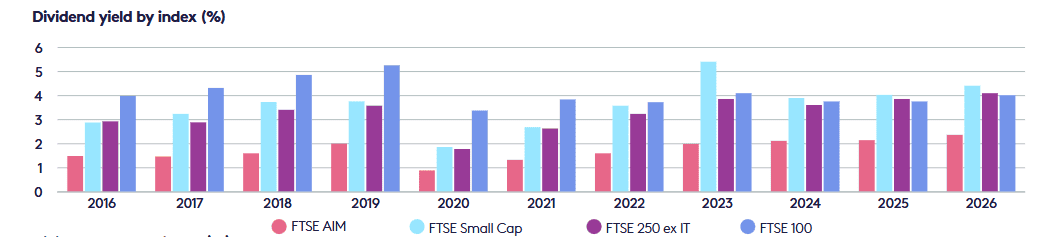
A fresh report from Octopus Investments has caught my eye this week. It shows that the prospective dividend yields on the FTSE 250 (when excluding IT stocks) and the FTSE Small Cap index beat that on offer from the FTSE 100:

Source: Octopus Investments, Factset

Yet, this yield superiority is nothing new. As you can see, the dividend yield on small-cap shares has beaten that of the broader Footsie for the past two years.

And dividends among FTSE Small Cap companies are tipped to grow strongly between 2025 and 2026, resulting in yields of 4.03% and 4.41% respectively.

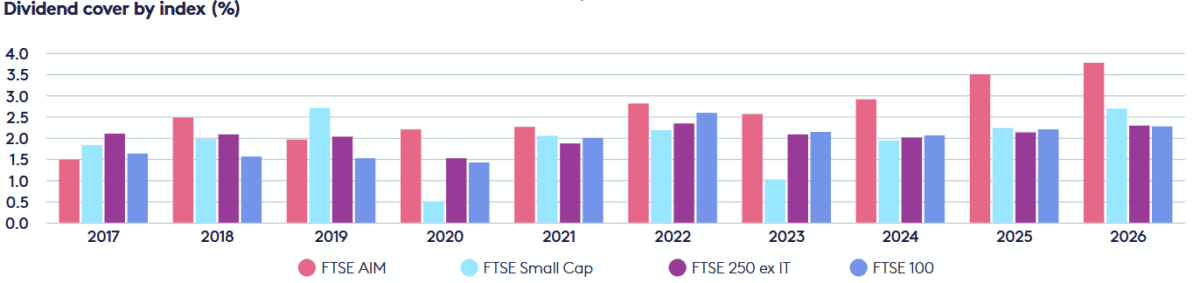
Of course yields are based on broker projections that aren’t set in stone. However, high dividend cover for the next two years provides payout estimates with plenty of steel.

In fact, as you can see, dividend coverage for the FTSE Small Cap, FTSE 250 (ex IT), and FTSE Alternative Investment Market (AIM) indexes also surpass that of the FTSE 100:
Source: Octopus Investments, Factset

These superior yields and dividend coverage reflect expectations that profits outside the FTSE 100 are about to take off. According to Octopus Investments: “both the FTSE AIM index and the Deutsche Numis Smaller Companies Index are expected to deliver 22% compounded annual earnings growth for the two years to December 2026.”

Three top dividend stocks

I own several Footsie shares in my own portfolio for passive income. But Octopus’ research shows it can also pay to consider dividend stocks from outside the FTSE.

Radiator manufacturer Stelrad — with its forward yield of 5.9% and strong dividend cover of two times — is one small cap I’m looking at. I’m also considering pawnbroker Ramsdens — the dividend yield and dividend cover here are 5.1% and 2.3 times, respectively.

But Social Housing REIT (LSE:SOHO) is at the top of my shopping list today. The dividend yield here for 2025 is 9.2%.

Please note that tax treatment depends on the individual circumstances of each client and may be subject to change in future. The content in this article is provided for information purposes only. It is not intended to be, neither does it constitute, any form of tax advice.

Dividend cover is far less impressive, at 1.3 times. In theory, this could see the company undershoot dividend forecasts if earnings disappoint.

However, Social Housing’s focus on the stable residential property market greatly reduces (if not totally eliminating) this threat. What’s more, tenants often receive financial help from central and local governments, providing rent collection with added robustness.

Under real estate investment trust rules (REIT), at least 90% of the firm’s annual rental earnings must be paid out in dividends. With its strong growth potential, I’m confident eye-catching dividends at Social Housing will continue to climb.


Want to invest in an ISA but scared of a stock market crash? Consider this

All the headlines suggest we’re heading for a stock market crash, or rather, that we’re in the middle of one.

With the Stocks and Shares ISA allowance deadline fast approaching on 5 April, many will be wondering whether now is the right time to invest. 

Fears over Donald Trump’s tariffs are spooking investors, making it a worrying time to commit fresh cash.

Despite the headlines, the FTSE 100 is actually doing okay. In fact, it’s up around 5% this year. Wall Street has taken a bigger hit, with the S&P 500 down 5% amid US recession fears. So, let’s not panic just yet.

Still a good time to buy UK shares

Some may be tempted to swerve the stock market altogether and opt for a Cash ISA. That’s understandable, but history shows stocks tend to outperform cash over the long run, despite periods of volatility.

The ISA allowance is issued on a use-it-or-lose-it basis, but here’s some good news. Most investment platforms allow clients to park cash inside the Stocks and Shares ISA. 

This buys time to decide which shares to purchase, without losing the valuable allowance. Most platforms pay a bit of interest too

That said, I wouldn’t leave funds sitting in cash too long. The stock market works best when given time to grow, and leaving money uninvested means missing out on potential gains and dividends.

A more exciting but riskier option is to take advantage of current uncertainty by picking up shares that have been oversold. 

One example? Budget airline easyJet (LSE: EZJ). Its shares have tumbled 18% in the last three months and are down a whopping 47% over the past year.

As a result, the easyJet share price now looks seriously cheap, trading at a price-to-earnings ratio of just 7.7. That’s roughly half the FTSE 100 average of around 15.

EasyJet is risky but may be rewarding

Airline stocks are naturally volatile, facing risks from fuel price swings, economic downturns, geopolitical tensions and even unexpected disruptions like natural disasters or power outages. Heathrow’s recent blow-out was just the latest setback.

Despite these challenges, easyJet is showing resilience. The board reported a 13% rise in revenue to just over £2bn for the three months to 31 December. It also managed to halve its pre-tax losses to £61m, down from £126m the year before. Summer bookings are holding up.

The 20 analysts covering easyJet have produced a median price target of 695p for the next year. If correct, that’s a staggering 50% jump from today’s price.

Of course, forecasts are just that – forecasts. Many were made before recent volatility and may not fully reflect today’s challenges.

But for those willing to consider a bit of risk, there could be long-term opportunity here. There’s even a 2.4% dividend yield, which should grow over time.

Navigating a volatile stock market can be nerve-wracking, but that doesn’t mean investors should shy away completely. 

The key is to secure that ISA allowance, keep a level head and focus on long-term opportunities. EasyJet is just one FTSE 100 stock to consider. I can see plenty more out there for investors willing to turn today’s turbulence to their long-term advantage.

Up 300% in 5 years! Is this overlooked FTSE star the best share to buy in an ISA today?

So what’s the best share to buy for a Stocks and Shares ISA at the moment? Should investors consider one that has taken a beating during recent market volatility? Or one that’s defied it?

Investors who prefer to buy winners, rather than go bargain hunting among the losers, might want to consider FTSE 100-listed African telecoms operator Airtel Africa (LSE: AAF). Its shares have climbed 15% in the last month, making it the second-best performer on the FTSE 100, trailing only gold miner Fresnillo

Over the past year, the Airtel Africa share price has jumped 55%, and over five years it’s soared an astonishing 300%. Only Rolls-Royce (540%) and private equity firm 3i Group (356%) have done better in that timeframe.

Can Airtel Africa shares continue to fly?

Despite these gains, Airtel Africa remains a stock many investors overlook, possibly due to its volatility. It was hit hard by the slide of the Nigerian naira, which shrank revenues from one of its key markets, once converted back into sterling. The naira’s been sliding against the pound for 15 years, although it does seem to have stabilised in the last six months.

I took a closer look at Airtel Africa back in February when it was already surging on the back of a strong set of Q3 results, with revenue growth of 20.4% in constant currency. That translated to a 5.8% drop on a reported basis, due to FX shifts.

Airtel Africa was expanding at pace. Its total customer base grew 7.9% to 163.1m last year, with data subscribers surging 13.8% to 71.4m. Mobile money services were a major growth driver, with revenues jumping 29.6% in constant currency.

The company has also been rewarding shareholders, having launched a second $100m share buyback. I saw vast potential here, but as with any high-growth stock, there were plenty of risks too. 

Share buybacks and a modest dividend

One concern I flagged in February was its rising debt, which had climbed from $3.28bn to $5.27bn in a year. The board also has to invest heavily in its network and digital services, as it looks to build smartphone penetration and data usage, both growing fast.

Telecoms is an inherently high-risk sector, judging by the ups and downs of FTSE 100 operators BT Group and Vodafone.

Despite Airtel Africa’s rapid rise, analysts aren’t convinced the rally will continue. The 11 analysts covering the stock have produced a median target of just over 157p. That’s about 5% below today’s 165p. Forecasts are often little more than educated guesses, but this suggests the excitement may be cooling.

With a modest trailing dividend yield of 2.88%, this stock’s primarily a growth play. And while I remain impressed by its performance, my view hasn’t changed much since February. It’s all too uncertain for me.

The stock has momentum, and for investors who believe in riding strong trends, Airtel Africa’s well worth considering. I wouldn’t say it’s the very best share to buy today though. It may have done rather too well for its own good, and the growth could slow for a while. There’s an exciting opportunity here, but it’s potentially volatile and as a contrarian investor, I feel I may have missed the boat.

5 days to the ISA deadline, this cash machine is my standout FTSE 100 stock

On 5 April the window to shelter up to £20,000 in the 2024/25 tax year ends. But once I have parked my proceeds in a tax-free vehicle, my attention then turns to where to invest. One of my standout stocks is this FTSE 100 cash cow.

Please note that tax treatment depends on the individual circumstances of each client and may be subject to change in future. The content in this article is provided for information purposes only. It is not intended to be, neither does it constitute, any form of tax advice. Readers are responsible for carrying out their own due diligence and for obtaining professional advice before making any investment decisions.

A touch of gold

Despite posting a blow-out set of results in FY24, Fresnillo (LSE: FRES) still remains pretty much under the radar of most private investors. A year ago I could pick up shares in the company for 435p. Today, they are trading at 948p.

In the very recent past, most investors wouldn’t touch precious metals miners with a bargepole. But when a business boasts net cash of $458m, sees its revenues grow 26% and EBITDA more than double, then its little wonder that I have become increasingly excited about the growth potential here.

Gold prices have remained above $3,000 now for a number of weeks. I have no idea if they can push higher from here; but I do know that for every ounce of gold it mines, its profit margin is a $1,000. In 2025 and 2026, it expects to produce around 580 koz a year. That gives it a gross profit from gold production alone of $580m.

Despite a surge in gold prices, the real reason why I remain so bullish on the stock is because of its silver play.

Silver has a history of moving explosively. In March last year the metal price surged 50% in a matter of months. And that is nothing compared to some of the moves of the past.

In the early 1980s, at the peak of a decade-long inflationary cycle, its price literally went parabolic, topping out at $50. It repeated the feat again 2011, in the aftermath of the global financial crisis.

I am becoming increasingly of the view that we are potentially on the cusp of another major explosive move. One fact is for sure: never in history has there been a gold cycle where silver has not participated.

Risks

The last few years has been extremely tough for Fresnillo. Rising energy, labour and explosives costs really hit the bottom line. The spectre of greater regulation over the mining industry is, and will continue to be, an undoubted threat for the viability of its operations.

Many years ago it entered into a contract with Peñoles (the ‘Silverstream’ contract), whereby it would receive a net cash settlement from its Sabinas silver mine. However, last year it received notice that the life of that mine has been significantly reduced, thereby resulting in lower future cash flows. At the moment, the exact amount is unknown.

Fresnillo remains one of my riskier plays in my Stocks and Shares ISA. But the chance for outsized returns in a sustained precious metals bull market is very real.

In 2024 cost savings and efficiencies totalled $40m. If it can sustain and build on these kind of savings, then the share price could get a further boost if metal prices stay anywhere near where they are now. For me, I can never own enough of the stock, which is why I bought more in the last month.

2 value stocks from the FTSE 100 to consider buying in April

Much of the Footsie remains very cheap, especially after its mini-dip that started at the beginning of March. Indeed, arguably half of the index is made up of value stocks. So there are plenty of options.

Here are two cheap FTSE 100 stocks that I think are worth a look right now.

Lobbying Trump

British American Tobacco (LSE: BATS) is a classic value stock. Founded in 1902, the veteran company owns established cigarette brands like Lucky Strike, Dunhill, and Rothmans. It has slow growth rates, but a large global customer base and dependable profits supported by strong pricing power.

All this helps generous dividends, with the yield currently sitting at a market-thumping 7.5%. That’s even after the share price has risen 32% over the past year. While dividends aren’t guaranteed, the firm’s current earnings comfortably cover the prospective payouts.

Rounding out its value credentials, British American stock is trading cheaply at around 9 times earnings.

However, global cigarette volumes have been declining almost like clockwork by around 5% a year. This clearly adds risk to the company’s long-term profitability and dividend growth prospects.

To offset this, the tobacco giant has been building up its non-combustible division (vapes, heated tobacco, and nicotine pouches). Last year, smokeless products accounted for 17.5% of group revenue, while the target is for at least 50% by 2035.

Whether this will be a profitable transformation remains to be seen, but the strategy might be given a shot in the arm under President Trump. That’s because Reuters has reported that Big Tobacco is lobbying the Trump administration to crack down on illegal vapes, especially those imported from China.

These cheap unregulated alternatives have stunted the growth of British American’s vaping brands, notably Vuse. And while tobacco firms have been lobbying for stricter enforcement for some time, it’s possible that the Trump government might take it more seriously.

This could boost the company’s share of this growth market in future. I think the high-yield dividend stock is worth considering for income investors.

Nike headaches

JD Sports Fashion (LSE: JD) might not appear to be a value stock at first glance. But it is also an established brand, with over 4,500 stores worldwide. The sportswear retailer is also profitable and pays a dividend, although the yield is only 1.4% as the firm is still prioritising expansion.

The real value appears to come from the share price. At 68p, JD stock is trading at just 5.5 times earnings, based on FY26 forecasts.

Why does it appear so cheap? Well, earnings are under pressure, with the firm delivering a profit warning in January. Weak consumer spending remains a key risk here.

Also, key strategic partner Nike, whose products tend to have higher margins for JD, has been losing market share to smaller competitors. Consequently, Nike stock has suffered one of its worst drawdowns ever — slumping 62% since the start of 2022.

JD’s share price performance in this time? Down 68%, as it broadly tends to mirror that of Nike’s.

However, Nike has new management and is actively refocusing on innovation and its wholesale channels. Any progress could see a sharp bounce back for both.

Longer term, I think JD’s position as a leading sportswear seller will remain intact, making its cheap stock worthy of consideration.

1 crucial thing to do as the 2024/25 ISA deadline approaches

The 2024/2025 ISA deadline is 5 April. So, now’s the time to make any last minute contributions and make the most of your annual allowance.

If you’ve got a Stocks and Shares ISA, now’s also a good time to check your investment strategy to make sure it’s robust. Are you diversified enough?

The importance of diversification

The last few years have shown why it’s vital to be diversified.

In both 2023 and 2024, UK stocks underperformed relative to other markets. In 2023, the FTSE 100 delivered a total return of just 4.7%. The following year, it returned 7.9%. Over the same period, America’s S&P 500 index returned 26.3% and 25% (in US dollar terms) – much higher returns.

Of course, this year the S&P 500 has struggled, falling about 5% (and 9% from its highs). But plenty of other geographic markets have done well. Year to date, Europe’s Euro Stoxx 50 index is up about 8%. Meanwhile, Germany’s DAX index is up about 11%.

The takeaway here is that different geographic markets often don’t move in sync. Sometimes, returns will be very uncorrelated.

By taking a diversified approach, and building a portfolio that has exposure to many different geographic regions (and different industries), investors can minimise the impact of underperformance in specific areas of the market. This can potentially smooth out their returns and lead to better performance over the long term.

An ETF to consider

If an investor is looking to diversify their portfolio, one fund I think could be worth considering (especially for those with a lot of exposure to US stocks) is the iShares Edge MSCI Europe Quality ETF (LSE: IEFQ). This is an ETF that offers access to European stocks (and includes UK stocks).

What I like about this particular ETF is that it’s focused on the ‘quality’ factor. In other words, it’s focused on companies that have strong and stable earnings and solid balance sheets.

Over the long term, companies with these attributes (high-quality companies) tend to provide higher returns for investors than low-quality businesses do. This is illustrated by the performance of this ETF – over the 10 years to the end of February 2025 it returned about 95% (in euro terms) versus 73% for the regular iShares MSCI Europe ETF.

It’s worth pointing out that there are some brilliant companies in the ETF. Some names worth highlighting include ASML, AstraZeneca, Nestlé, London Stock Exchange Group, LVMH, Novo Nordisk, and L’Oréal.

Overall, there are about 120 different stocks. The sectors with the largest weightings are Financials, Industrials, and Healthcare.

Now, there are plenty of risks to take into account with this product, of course. Donald Trump’s tariffs on Europe are one – these could lead to lower earnings across the continent.

Political turmoil and geopolitical instability are other issues worth highlighting. These could lead to negative sentiment towards European stocks.

Yet I think this ETF has a lot of appeal as a portfolio diversifier. With its low annual fee of 0.25%, I see it as a long-term winner to consider.

How much would an investor need in a Stocks and Shares ISA to generate £20k a year in passive income?

Creating a passive income stream is a common financial goal for many Britons today and it’s easy to see why. With this form of income, one gets cash flow without having to work for it.

Now, building up savings in a Stocks and Shares ISA and investing in dividend stocks can be a good way to create a passive income stream. But how much capital would someone need in an ISA to generate income of £20k per year?

What yield could be achieved?

This answer to this question depends on the yield the investor would be targeting.

On the London Stock Exchange, there are plenty of dividend stocks that offer yields of 8%, 10%, or more. But generally speaking, these stocks are quite risky.

History shows that high-yield dividend shares often turn out to be poor investments in the long run. With these stocks, there’s often something fundamentally wrong, and it’s not uncommon to experience both share price losses and reduced dividends.

A high yielder that bombed

A good example here is Vodafone (LSE: VOD)

Two years ago, it was trading for around 90p and offering a yield of about 9%. That yield wasn’t sustainable though. And the dividend payout was cut (quite significantly).

The market didn’t like this. And by early 2024, the share price had fallen to around 65p. So, not only were investors faced with lower-than-expected dividend income but they were also hit with substantial share price losses. Not a good result.

Personally, I think cutting the dividend was the right move. At the time, the company needed to conserve cash as its balance sheet was quite weak.

Today, the company is in a stronger financial position as a result of the cut and the shares are almost 73p each. That said, I’m still not convinced the stock is a Buy as its debt is pretty high (net debt of €32bn at the end of September 2024) and growth is quite underwhelming.

Taking less risk

If an investor was targeting passive income, I think they should probably aim for an overall yield of 5%-6%. This would result in a less risky portfolio.

For a 5% yield, they’d need £400,000 to generate £20k per year in income. For a 6% yield, they’d need about £333,333.

When choosing dividend stocks to buy, they should be selective. I wouldn’t just invest in a stock simply because it had an attractive yield.

Instead, I think investors need to look for companies with substantial long-term growth potential. I’d also look for businesses with competitive advantages and strong financials.

These kinds of companies often increase their dividends over time (resulting in increased income for investors). And they can produce share price growth too.

HSBC is an example of the type of dividend stock worth considering. It currently sports a dividend yield of around 5.75%.

There’s no guarantee it would do well, as banking is a cyclical industry. But with its exposure to Asia and wealth management, I think it has quite a bit of long-term potential.

The Diageo share price is down 32%. Is now the time to buy the dip?

Trading at an eight-year low, things look dark and stormy for the Diageo (LSE:DGE) share price. The FTSE 100 alcoholic drinks manufacturer behind Bailey’s, Guinness, and Captain Morgan has lost nearly a third of its value in the past year. As a shareholder, I’m dismayed that Diageo shares are weighing on my portfolio with my position firmly in the red.

Investor confidence is evaporating thanks to falling alcohol demand, successive weak financial results, and the company’s vulnerability to US tariffs. But might the stock now be in deep value territory, offering investors an opportunity to consider buying on the cheap?

Here’s my take.

Low spirits

Looking at Diageo’s interim results, some disappointing numbers jump out. Reported net sales of $10.9bn marked a 0.6% decline. Reported operating profit‘s also heading in the wrong direction, down 4.9%. Worryingly, the group abandoned its medium-term target for 5% to 7% organic sales growth.

A key factor underpinning the revised outlook is the Trump Administration’s love affair with tariffs. The current suspension on 25% duties for US imports from Canada and Mexico is due to be lifted tomorrow (2 April). Considering Diageo sells huge volumes of Mexican tequila and Canadian whisky stateside, this is no late April Fool’s joke for the company’s share price.

Unfortunately, the conglomerate’s woes don’t end there. There’s evidence that declining alcohol consumption may be a structural phenomenon rather than a cyclical one. According to a World Finance report, Millennials are less fond of a tipple than previous generations. Gen Z, even less so. For Diageo, overcoming a dwindling consumer base is a mighty challenge.

Furthermore, the firm’s losing prominent backers. Veteran investor Terry Smith, often dubbed ‘Britain’s Warren Buffett‘, dumped the stake in Diageo last year from Fundsmith Equity‘s portfolio — a position previously held since inception. Notably, Smith’s exit was accompanied by barbed comments aimed at the new management team. CEO Debra Crew’s less than two years into the job.

A glass half full

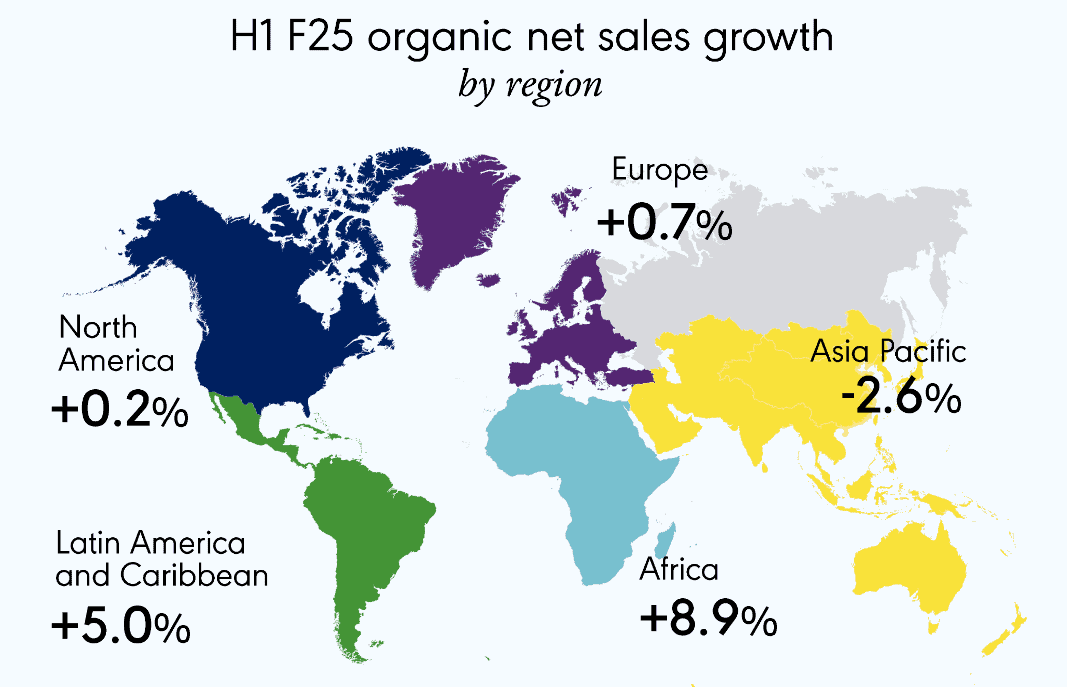
That said, Diageo’s interim results showed some glimmers of light. Although reported net sales suffered due to an adverse foreign exchange impact, organic net sales returned to growth with a 1% improvement. Encouragingly, the firm’s moving in the right direction in four of its five global regions on this benchmark.

Source: Diageo

Another attractive point is the valuation. Following a significant slump in Diageo’s share price, the company’s price-to-earnings (P/E) ratio has compressed to 16.1. That compares favourably to an average multiple of 23.1 over the past decade, suggesting the stock is possibly undervalued.

Finally, it’s also good to see that a widely feared dividend cut didn’t materialise. Diageo maintained interim payouts at 40.5 US cents per share, providing comfort for passive income investors. The stock’s dividend yield has crept up to nearly 4% today, well above recent historical averages.

Time to buy?

Although the Diageo share price appears cheap today, I’m wary of the risks facing the business. In a challenging trading environment, there’s a strong chance things could get worse before it’s happy hour again.

I’ll continue to hold my shares for the handy dividend payouts, but I’m reluctant to add more exposure right now. Overall, I prefer the risk/reward profile of other FTSE 100 shares today.

Prudential: the FTSE 100 insurance stock making a huge comeback in 2025

Prudential (LSE: PRU) shares have been out of favour for years. All of a sudden however, they appear to be making a huge comeback. Since 13 January, they’ve risen around 39%. That makes them one of the best performers in the FTSE 100 index over that timeframe.

I’m in the red

I’m an investor in Prudential. And I’ve been underwater for a while now due to the stock’s lousy performance. But I was never tempted to sell. Because I continue to believe that this insurer – which is focused on Asia and Africa – has a ton of long-term potential.

Growth potential

This potential was discussed by CEO Anil Wadhwani in the company’s recent 2024 results. He highlighted the growing demand for long-term savings and protection products across the company’s markets, and the need for wealth management and retirement planning, particularly in the higher income Asian markets.

Insurance penetration rates in Asia are low. There is continued, and growing, demand for long term savings and protection products across our markets, alongside a need for wealth management and retirement planning, particularly in our higher income Asian markets,” said the CEO.

Great 2024 results

It’s worth noting that the 2024 results were strong. For the period, the group reported adjusted operating profit before tax of $3.1bn, up 10% year on year. Prudential also increased its dividend by 13% to 23.13 cents (giving a trailing dividend yield of 2.2% today).

Including the $785m spent on share buybacks, total shareholder returns for the year were $1.4bn (a total shareholder return yield of around 5% today).

The long-term growth trends inherent in our Asia and Africa markets are reasserting themselves, creating significant opportunities for us. We are well positioned to capitalise on this growth opportunity.
Prudential CEO Anil Wadhwani

Two reasons to be bullish

Looking beyond the potential from Asia and Africa, there are a number of other reasons I’m bullish on this stock. One is that it remains cheap. Currently, the price-to-earnings (P/E) ratio here is about 10. However, if we strip out its Indian asset management business IPAMC – which it’s thinking about selling – the stock’s even cheaper.

Another is that the stock looks good from a technical analysis perspective. Recently, it formed a bullish ‘golden cross’ pattern – where the short-term moving average crossed the long-term moving average (this can be a sign that a new uptrend has started).

The China risk

Of course, China’s struggling economy does remain a risk here. This is what has dragged the stock down over the last few years. However, analysts at UBS have pointed out that only around 10% of Prudential’s earnings are directly driven by China. This is encouraging as it means that further weakness in the country may not be a disaster for the insurer.

Worth buying?

Overall, I’m quite bullish on Prudential shares right now. With the attractive long-term story, the low valuation and the strong technicals, I think they’re worth considering today.

A £10,000 investment in AstraZeneca shares last Christmas is now worth…

My AstraZeneca (LSE: AZN) shares have made moderate gains of 7% since Christmas — slightly above the 5% gain of the FTSE 100.

A £10,000 investment back then would have returned about £755 (including returns from the 2.2% dividend yield). It’s not much to write home about, but not bad for such a short period. 

And it’s certainly a nice change from the 27% drop suffered in late 2024. That came as a bit of a shock, especially since I bought the shares as a hedge against volatility.

Now, at approximately £11 a share, it’s edging ever closer back to its all-time high of £13.38. But should I keep holding on to them or is more volatility on the cards?

To answer those questions, I need to consider several factors.

Still a safe bet?

I bought the shares as a key part of the defensive segment in my portfolio. As a company that usually maintains steady revenue during times of economic upheaval, it should help keep my profile stable. Defensive stocks play a key role in avoiding risk and securing long-term gains.

But lately, it’s made some unusually large price moves. If it were a strong dividend-payer, this wouldn’t be a huge issue but the 2.2% yield only adds minimal value.

When calculating gains over a decade, these short periods of volatility seem less extreme. It’s up 140% from 10 years ago, when it was trading at £46.45 a share. That’s an annualised gain of 9.19% per year — notably higher than the FTSE 100 average.

But past performance isn’t indicative of future results, so I should dig deeper for answers to my questions.

Recent developments

A few recent developments might help catapult the stock back up to new highs.

On 31 March 2025, AstraZeneca’s Imfinzi treatment for bladder cancer was approved in the US. Trials have shown evidence that the drug could lead to a 25% reduction in the risk of death compared to chemotherapy.

Brazil has also approved the drug but applications in Japan and the European Union remain pending.

Another of its cancer-fighting drugs, Calquence, has received positive reviews from an EU panel. The drug treats a rare type of blood cancer and, when combined with other drugs, could help reduce the risk of death by 27%.

These are both notable developments for the pharmaceutical company, bolstering its chances of more promising growth in 2025.

Financials

With a market cap of £177bn, AstraZeneca is the largest company on the FTSE 100. That in itself makes it a relatively safe investment. Its debt has remained fairly stable around £23bn for the past four years, while its free cash flow has been slowly increasing. And at £62.4bn, its long-term assets far outweigh its long-term liabilities.

Created on TradingView.com

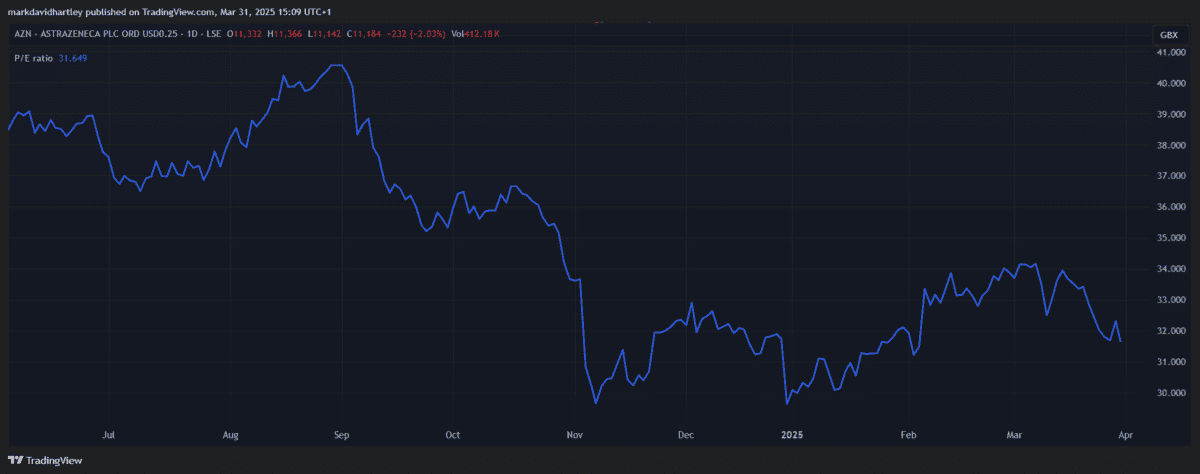
However, it might be slightly overvalued with a price-to-earnings (P/E) ratio of 32.3 and price-to-sales (P/S) of 4.2.  Both these metrics are above average, which limits room for further growth. There’s a risk the stock could fall this year if the high price deters new investors.

Overall, I’m confident the stock will continue to add defensive qualities to my portfolio, and I think investors looking for the same should consider it.

Financial News

Daily News on Investing, Personal Finance, Markets, and more!

Financial News

Policy(Required)