This 10.6% yielding dividend share goes ex-dividend tomorrow (3 April)!

Ithaca Energy (LSE: ITH) is the fifth-highest yielding dividend share on the FTSE 250. With a huge 10.6% yield, it makes an attractive proposition for income investors.

What’s more, it goes ex-dividend tomorrow (3 April). That means any shares bought after that day won’t qualify for the next payout.

So should income investors consider sinking some cash into the stock before tomorrow? 

Let’s have a look.

A promising energy stock

Ithaca Energy is a UK-based oil and gas company and subsidiary of the Israeli-owned Delek Group. It operates in the North Sea off the coast of Scotland, where it has headquarters in Aberdeen. It’s one of the largest energy firms on the FTSE 250 with a market cap of £2.63bn, slightly behind rival Harbour Energy at £3bn.

For a relatively new company, it financials look good. Although revenue slipped slightly in 2024, it still managed to post a pre-tax profit of $334.3m — up 11% from 2023.

This may have been boosted by the recent acquisition of assets from rival Eni UK. This helped ramp up production by 14.2% to 80,200 barrels of oil equivalent per day (boepd). It now expects to reach 115,000 boepd in its 2025 full-year results.

Although the stock is down 30% since listing two and half years ago, recent performance has been promising. Since hitting a low of approximately 96p per share in mid-November last year, it’s climbed 67% to 161p.

That’s an impressive recovery — but does that mean investors missed out on the best gains?

Maybe not.

Growth potential and risks

Oil and gas is a famously volatile industry, plagued by unpredictable supplies and a multitude of environmental risks. Revenues can be difficult to predict and consequently, share prices can fluctuate wildly.

But Ithaca seems on track to enjoy a good year. After posting its most recent results for 2024, the stock surged 9%, reflecting positive investor sentiment. This was likely attributed to confidence in its next development, the Rosebank project. Despite environmental challenges, it now feels certain the project will continue as planned.

But these plans could still be derailed by further regulatory hurdles. Plus, with a 10% streamlining reduction planned for its workforce, developments could be delayed. 

It also continues to face profit risks from the UK government’s energy profits levy, with the company projecting cash tax payments between $235m and $265m for 2025.

The main point: dividends

Which brings us to the key point in question: dividends. 

With the stock going ex-dividend tomorrow, it seems logical to consider investing in some today. It all but guarantees an immediate 10% return on the investment — barring any price changes between now and 25 April, when the payment is made.

But buying a stock purely for the next dividend doesn’t meet the Foolish ideology of investing for the long-term. Ithaca may have an attractive yield but its only been paying dividends for two years.

In the investment world, that’s no time at all — and it’s already made a 44% reduction in that short time.

That simply isn’t sufficient to confirm its reliability as a dividend stock. While I like its prospects and think it may eventually be a top dividend contender, I wouldn’t consider investing in it today.

I’m backing FTSE blue-chip stocks to outperform the S&P 500 in 2025

Over the past 15 years, how many times could one say that the FTSE 100 had outperformed the S&P 500? Probably as many times as the weather is hotter in the UK than in Ibiza. Yet year to date, shares in the blue-chip index are up 5%, while the US index is down 5%. This is no blip to my mind but could be the beginning of a golden era for UK shares.

Concentration risk

I’m sure you’ve heard it all before: the FTSE 100 is packed with dinosaurs, relics of the old economy like banks, miners and energy stocks. The S&P 500, on the other hand, is full of dynamic entrepreneurial, tech businesses that permeate every aspect of our lives.

The problem for the major US index, however, is that its fate is inextricably tied to a handful of stocks. Today, the top 10 holdings account for 35% of the entire index.

What’s more alarming though is the weighting US stocks have on the international stage. Some 73% of the MSCI World Index is composed of US equities, predominantly the so-called Magnificent 7 tech giants.

American exceptionalism is over

To my mind, the US stock market has simply got too big. And the mighty US dollar has suffocated the global economy.

The consequence of the currently-much-discussed US exceptionalism over the past 15 years may have been good for stock prices, but the public debt mountain has grown every larger. It’s little wonder that the US Central Bank, the Federal Reserve, is desperate to lower interest rates, despite the fear of stoking another wave of inflation. Interest expense on government debt is now bigger than the entire defence budget.

History can teach us a lot. Back in the early 1970s, a group of 50 stocks (nicknamed the Nifty Fifty) spearheaded US global stock market supremacy. Procter & Gamble, IBM, Xerox. All great names making huge profits. However, that didn’t stop the S&P 500 crashing 50% in the 1973/74 bear market. Just as back then, concentration risk magnifies losses. Look at the effect Nvidia‘s recent fall had on the US index, as a stark example.

Dividend stocks

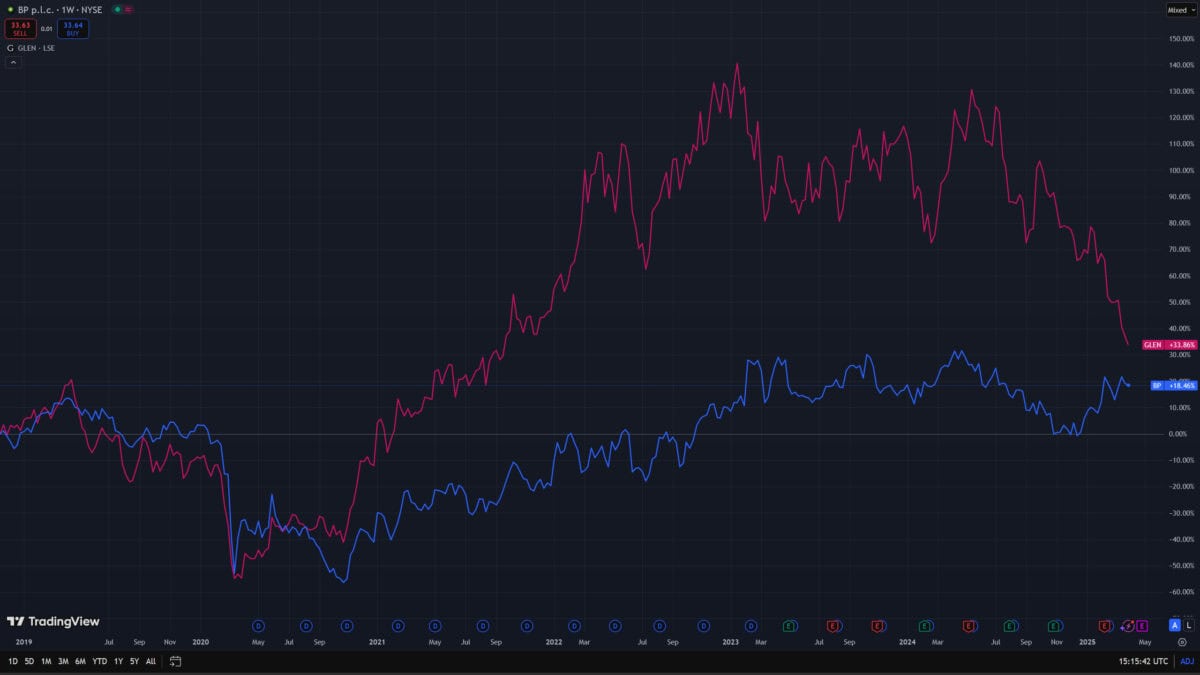
In times of uncertainty, investors turn to reliable dividend-paying stocks, and the FTSE 100 is packed with them. In 2025, analysts expect BP (LSE: BP.) to increase its dividend by £197m and Glencore (LSE: GLEN) by £232m.

Looking at a 5-year share price chart of both stocks, one would assume they are businesses in decline. On the contrary, I believe their rock bottom valuations don’t match the long-term growth story.

Source: TradingView.com

As electricity demand grows in the coming decade from the likes of EVs, heat pumps and data centres, Glencore is set to profit handsomely from an explosion in demand for copper.

It’s a similar story over at BP where demand for oil and natural gas is rising and energy security has gone right to the top of every country’s agenda.

And as for them being dinosaurs? Well, these companies deploy some of the most innovative, cutting-edge technologies across any industry in order to obtain, at scale, the commodities that power every facet of modern life. Both are a core part of my Stocks and Shares ISA portfolio and will remain so for many years.

Down 25% in a month, but experts forecast the IAG share price is set for a mega-rally!

I thought I’d missed my moment with the International Airlines Group (LSE: IAG) share price. After all, it doubled last year, and I didn’t buy it.

Yet British Airways-owner IAG has suddenly hit turbulence, with the shares plunging 25% in the past month. Normally, that sort of thing happens after I buy a stock, not before.

I’ve dodged a bullet but have I also landed on a second buying opportunity?

What went right for this FTSE 100 flier?

Despite the recent dip, IAG shares are still up 47% over 12 months. Last year’s stellar performance was powered by the post-pandemic travel boom and, crucially, a vibrant US economy. Now both are imperilled.

British Airways is a major player on transatlantic routes, and with Americans eager to travel and spend, the airline was in the perfect position to cash in. That gave IAG an edge over smaller European-focused carriers as the continent’s economy ground through the lower gears.

This translated into bumper results for 2024, published on 28 February, with operating profits soaring 22% year-on-year to €4.3bn as traveller numbers recovered at pace. The group paid €435m in dividends and launched a €1bn share buyback, both signs of financial confidence.

We live in a different world today. Donald Trump is shaking global markets, and with its huge fixed costs and sensitivity to global events, the airline sector hates uncertainty more than most.

There will be plenty of that in coming months. The longer-term picture for IAG is promising, but the short term could bring anything. We can’t rule out further share price volatility in the weeks ahead.

Yet IAG’s stock is rocketing back into deep value territory. Its price-to-earnings (P/E) ratio has slipped back to just 5.6. At the start of last year’s blistering run, its P/E was down to around 4 times. Investors may be getting a whole new buying opportunity.

Can this stock start growing again?

The 26 analysts covering IAG have a median 12-month target of 393p per share. That would be a 49% gain from today’s price, a brilliant rally if it materialises. 

Many of those forecasts will have made before the recent share dip, so I’m viewing them with extreme caution. But even accounting for market jitters, the upside potential is hard to ignore. The dividend should continue to recover, with analysts expecting a 3.2% yield this year, rising to 3.6% in 2026. Again, that’s not guaranteed.

IAG’s still sitting on more than €6bn in net debt. The airlines sector is forever at the mercy of factors companies can’t control, everything from fuel prices to extreme weather or even volcanoes. Which brings us back to Trump. If trade tensions escalate, transatlantic travel could suffer.

The travel sector is cyclical, and history suggests downturns don’t last forever. But investors will need strong nerves while they wait for clearer skies.

With a dominant market position, strong cash flow and a dirt cheap valuation, IAG looks well-placed if today’s storms pass.

I’m not buying for now and investors considering buying this dip must take a long-term view. IAG’s a hugely exciting opportunity, but it’s also right on the front line of whatever the world throws at us next.

Could Aston Martin’s share price explode over the next 12 months? These analysts think so!

Aston Martin Lagonda‘s (LSE:AML) share price continues to crash and, at 69.7p per share, is down 36.1% since the start of 2025.

This takes total losses over the last year to just shy of 60%. Someone who parked £10k in the FTSE 250 company would now have just £4,308 sitting in their account.

Weak sales to China, supply chain disruptions, and high debts have left Aston’s shares floundering. To add to the automaker’s woes, new tariffs of 25% on US car imports threaten to cripple sales in a critical market.

Yet none of this seems to faze City analysts. Forecasters are unanimous that James Bond’s favourite car manufacturer will rise in value over the next 12 months.

So how realistic are Aston Martin’s share price estimates? And should investors consider buying buying this beaten-down share for their portfolios?

Good value on paper

The most bullish broker believes Aston Martin shares will rise 151% over the next year, to £1.75. This is significantly higher than the least optimistic estimate of 79p, though this is still up 13.5% from current levels.

The average price target among eight brokers who study the share is £1.18 per share. That’s up 69.3% from today’s levels.

As I’ve mentioned, Aston has a lot of obstacles to try and overcome. However, the motormaker’s fans may argue that this is more than baked into the current valuation, leaving room for a price rebound if performance stabilises or even improves.

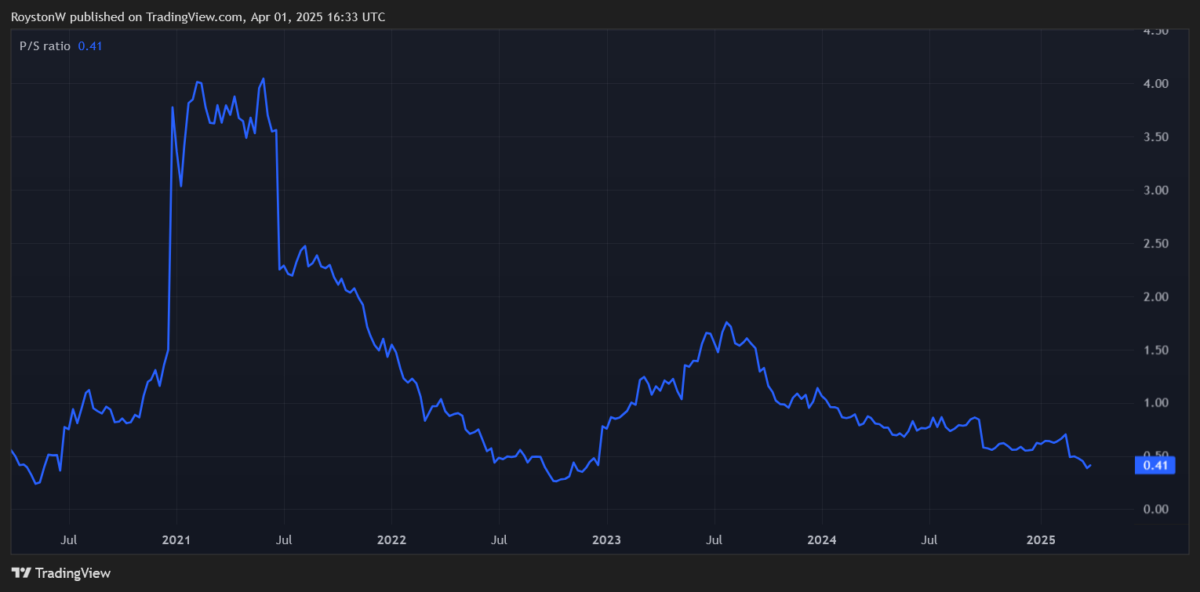
The business is expected to remain loss-making though to 2026, so let’s use the price-to-sales (P/S) ratio instead of the price-to-earnings (P/E) to ascertain its value.

With a sub-1 score of 0.4, Aston shares score extremely well on this value metric.

Source: TradingView

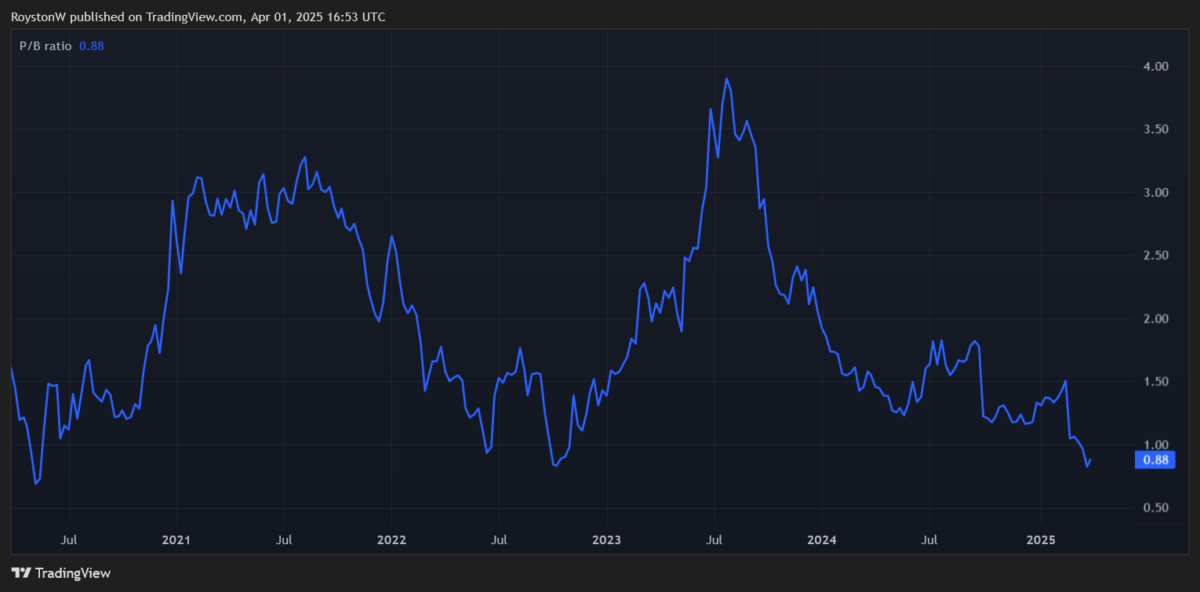
Let’s also consider the company’s price-to-book (P/B) ratio to work out how cheap it is. This is based on Aston’s book value, which is equal to its assets minus its liabilities.

Again, this comes in at below 1.

Aston Martin's P/B ratio
Source: TradingView

Are Aston shares a potential Buy then?

Yet while the City’s extremely chipper over Aston Martin’s share price prospects, I’m not so optimistic. Not even those low P/S and P/B ratios are enough to win me over.

As a car enthusiast, I love the Warwickshire company’s luxury products. To me, Aston symbolises speed, elegance, and exclusivity. The trouble is that these aren’t qualities that set it apart from the competition. It has to go wheel to wheel against other famous marques like Ferrari, Porsche, Bentley and Lamborghini to win market share.

Tough economic conditions in its key US and Chinese markets — which could be made considerably worse by the rollout of global trade tariffs — make Aston’s task of growing sales even more challenging.

All this is especially concerning given the huge debts Aston has. Net debt was a gigantic £1.2bn at the end of December.

The company will be hoping new product launches light a fire under sales numbers. Chief executive Adrian Hallmark has said its Valhalla hybrid scheduled for launch this year “will help us reposition Aston Martin again.”

But I’m not so sure. On balance, I think Aston’s share price could remain locked in reverse, so I’d rather buy other UK shares.

2 dividend shares to consider in what could be a bumpy April!

Global stock markets recorded their biggest monthly fall in March since September 2022. Swathes of growth and dividend shares have slumped in value as tension over ‘Trump Tariffs’ have grown.

None of us have a crystal ball to predict market movements in April. But with new trade tariffs set to begin merely hours from now, and worries over the geopolitical landscape also growing, traders and investors should be braced for more turbulence.

I don’t believe investors should head for the hills though. Here are two dividend shares to consider. I think they could still deliver great returns in the current climate.

The PRS REIT

Real estate investment trust The PRS REIT (LSE:PRSR) isn’t totally immune to the impact of import taxes. A trade war between the US and UK could fuel inflation which, consequently, means interest rates remain higher for longer.

But on balance, I think its focus on the residential rentals sector makes it attractive safe haven to consider. We all need a roof over our heads, so income streams remain resilient at all points of the economic cycle.

Indeed, PRS REIT collected 99% of the rents it was owed in the six months to December. Occupancy was also extremely high at 97% (including reserved homes).

The company’s focus on family homes — a market segment which is especially undersupplied — gives it added strength to grow earnings even in tough times. Rent hikes meant corresponding revenues rose £26.6m in the second half of 2024, up 16% year on year.

Government plans to supercharge UK housebuilding could temper future rent growth. But I’m optimistic they will continue rising at a strong rate, driven by the booming domestic population.

PRS REIT’s dividend yield is 3.7% for this financial year (to June), rising to 3.9% for fiscal 2026.

Please note that tax treatment depends on the individual circumstances of each client and may be subject to change in future. The content in this article is provided for information purposes only. It is not intended to be, neither does it constitute, any form of tax advice.

Primary Health Properties

Another REIT stock worth consideration in uncertain times is Primary Health Properties (LSE:PHP). Like PRS, it operates in an extremely stable industry, namely the development and letting of medical facilities.

What’s more, almost 90% of the rents it receives are guaranteed by government bodies like the NHS, providing earnings visibility with added strength. Rent collection and occupancy levels were both above 99% in 2024.

Robust demand for Primary Health’s modern properties also reflects severe market shortages across the UK and Ireland. In Britain, around a third of first-contact medical centres are designated unfit for purpose.

This chronic problem has seen dividends here rise for 28 straight years, including a 3% hike in 2024 to 3.9p per share.

There’s another good reason why both Primary Health and PRS REIT are reliable dividend payers. Under REIT rules, total dividends must represent at least 90% of annual rental profits each year.

Primary Health’s robustness could be compromised by changes to health policy. But I’m optimistic government strategy will remain favourable to the company, given the lower patient costs that primary care involves versus secondary care.

For 2025, Primary Health’s dividend yield is a large 7.4%.

Cliff Asness’s AQR multi-strategy hedge fund returns 9% in the first quarter during tough conditions

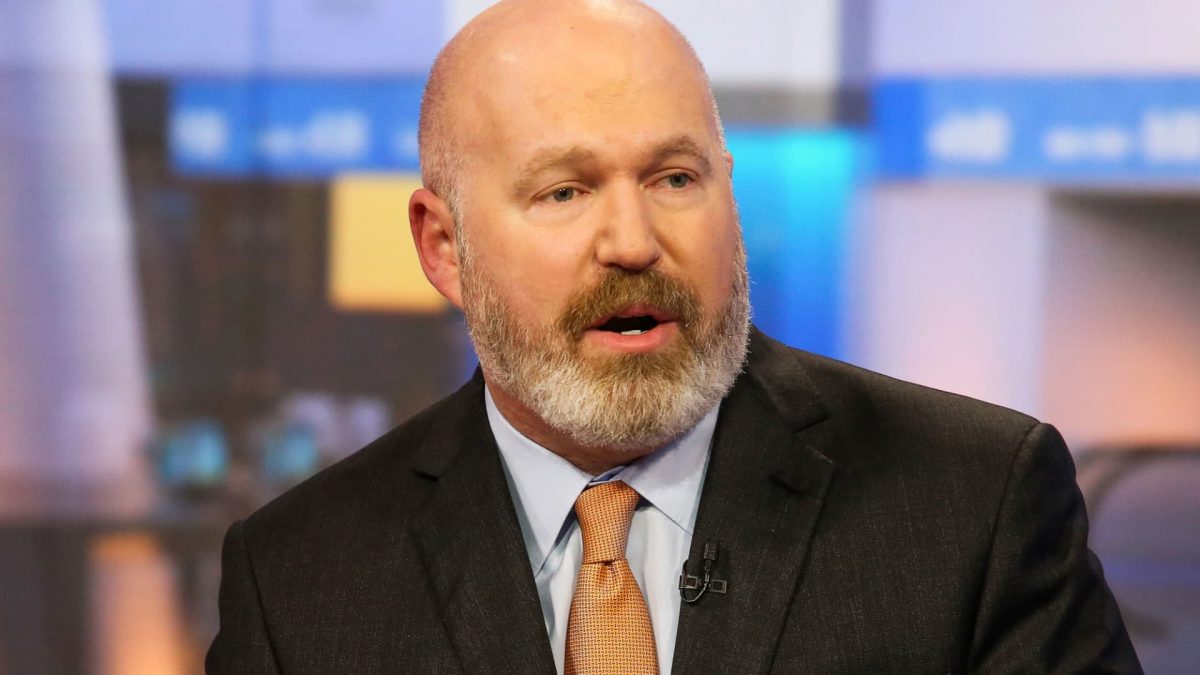
Cliff Asness.
Chris Goodney | Bloomberg | Getty Images

AQR Capital Management’s multistrategy hedge fund beat the market with a 9% rally in the first quarter as Wall Street grappled with extreme volatility amid President Donald Trump’s uncertain tariff policy.

The Apex strategy from Cliff Asness’ firm, which combines stocks, macro and arbitrage trades and has $3 billion in assets under management, gained 3.4% in March, boosting its first-quarter performance, according to a person familiar with AQR’s returns who asked to be anonymous as the information is private.

AQR’s Delphi Long-Short Equity Strategy gained 9.7% in the first quarter, while its alternative trend-following offering Helix returned 3%, the person said.

AQR, whose assets under management reached $128 billion at the end of March, declined to comment.

The stock market just wrapped up a tumultuous quarter as Trump’s aggressive tariffs raised concerns about an severe economic slowdown and a re-acceleration of inflation. The S&P 500 dipped into correction territory in March after hitting a record in February.

For the quarter, the equity benchmark was down 4.6%, snapping a five-quarter win streak. The tech-heavy Nasdaq Composite lost 10.4% in the quarter, which would mark its biggest quarterly pullback since a 22.4% plunge in the second quarter of 2022.

2 rock-solid growth shares to consider as economic storm clouds gather!

Global growth shares are losing their lustre as ‘Trump Tariffs’ (and reciprocal action from US trade partners) threaten the economy. The impact of fresh import taxes could be devastating across a variety of industries.

I’ve lost none of my appetite for UK shares, although I’m more cautious with what I buy today. One way to protect myself is to choose counter-cyclical shares — and companies in traditionally defensive industries — whose earnings forecasts are boosted or unaffected by current economic conditions.

With this in mind, here are two great growth stocks I’m considering right now.

H&T Group

Pawnbrokers like H&T Group (LSE:HAT) tend to thrive during tough times like these. In fact, this Alternative Investment Market (AIM) operator said last month that “demand for our core pawnbroking product continues to grow, with particularly strong lending demand in the final ten weeks of the year, including record levels of new customers borrowing from us for the first time“.

With the cost-of-living crisis dragging on, City analysts are expecting earnings at H&T to rise 5% in 2025. Incidentally, this also leaves the company trading on a low price-to-earnings (P/E) ratio of 7.1 times.

The trading landscape is especially favourable for H&T today thanks to the gold price surge. Bullion hit new record highs above $3,151 per ounce earlier today, and is tipped by many to keep climbing as fears over the economic and geopolitical landscape rise.

On the downside, retailers like this face fresh cost pressures as the National Living Wage and National Insurance contributions rise. H&T thinks NI changes alone will result in a £2m hit each year.

But on balance, I still think the pawnbroker’s a great stock to consider in these tough times.

Chemring Group

Along with the broader defence sector, shares in Chemring Group (LSE:CHG) have increased in value following Russia’s invasion of Ukraine in 2022.

This specific FTSE 250 contractor has also rose strongly in February and March following a £1bn-plus takeover approach from Bain Capital. Yet based on current earnings forecasts it still offers decent value for money.

City analysts think earnings will rise 27% in the current financial year (to October 2025). This leaves it trading on a forward P/E ratio of 18.5 times and a P/E-to-growth (PEG) ratio of 0.7.

Any PEG below one suggests that a share is undervalued.

The stable nature of arms spending has made defence stocks traditional lifeboats in tough times like these. But the sector’s appeal is even greater today (in my opinion) as industry consolidation ramps up and global rearmament accelerates.

Chemring’s own order intake rose 187% in the year to stand at a record £1.4bn.

The company has commented that “with the new administration in the US pushing for significant increases in NATO defence spending and with EU member states recognising the critical need to scale up and co-ordinate defence production across Europe, the market opportunity for Chemring continues to grow“.

Reduced arms spending from the US remains a threat. But I believe on balance it’s worth serious consideration in geopolitically-uncertain times.

Here’s why the IAG share price fell 26% in March

The International Consolidated Airlines (LSE: IAG) share price was on what looked like a cracking recovery. But then, in March, the shares dropped by 26%.

And it’s actually a bit worse than that, as IAG shares are now down 29% from the 52-week high of 368.4p set in early February. I saw worse, but that’s relative and might only matter to short-term traders. Though 2025 isn’t off to a great start, the shares are still up 48% over the past 12 months.

Strong 2024 results

With full-year results released on 28 February, CEO Luis Gallego said: “We are particularly pleased to announce that IAG is proposing a final dividend which takes our total dividend for the year to €435m and intend to return up to a further €1bn of excess capital to shareholders in up to 12 months.

The company saw a 9% rise in revenue, with operating profit before exceptionals up 26%. And it reported €3,556m of free cash flow, after investing €2,816m into the business.

Who wouldn’t be happy with that? Well, the tumbling share price since that day shows the possibly unexpected answer.

As well as 28 February being results day, it’s also the day I saw a quote that will stick with me. It’s from David Dimbleby at the BBC, who said: “I thought the free market was with us forever — then Trump came along.

Tariff pain

If there’s one economic lesson that politicians have learned from economists, it’s that free trade benefits everyone. And import tariffs hurt everyone. That approach has played a large part in the huge rises in global wealth since the end of World War II.

Some new predictions suggest US inflation could push back up above 5% now. And Goldman Sachs just upped its estimate of the chance of recession to 35%.

International Consolidated Airlines is due to report first-quarter figures on 9 May. Could we see a bit of caution creeping in? Falling demand? Luxuries like air travel are among the first to go when people are feeling the pinch.

Virgin Atlantic has already told us it’s started to see signs of slowing US demand. I fear it might just be the start.

Broker outlook

Deutsche Bank has just reiterated its Buy stance on the stock with a 400p price target. That’s a 53% premium to the price at the time of writing. Some individual targets are higher, though they might be getting a bit stale now.

But Barclays issued a downgrade a couple of weeks ago to Underweight. That seems to be jargon for ‘nah, we think it might go down.’

Someone ignoring the headline hype and just looking at forecasts could see the IAG share price as cheap. Forecasts put the shares on a price-to-earnings (P/E) ratio for the current year at only five. Net debt of €7.5bn takes the edge off that, but it still looks low.

I do think investors could do well to consider the stock at this valuation. And I reckon it’s trade-war fear that’s knocking the share price down now. My take? The airline business is open to just too many risks for me.

As the stock market wobbles, here are 2 shares I’ve got my eye on

The US stock market has been all over the shop recently. In fact, the S&P 500‘s 4.6% drop in the first quarter of 2025 was the index’s largest quarterly loss since 2022. 

Given this, I’ve been weighing up a few options for my Stocks and Shares ISA. Here are two stocks I’ve got my eye on.

Out-of-favour AI stock

The first — Nvidia (NASDAQ: NVDA) — needs no introductions. The chipmaker is the world’s third-largest firm and remains central to advancements in artificial intelligence (AI). Demand for its latest Blackwell AI chips is very strong, according to management.

Yet Nvidia’s share price has fallen 27% in less than three months. This puts the stock on a forward price-to-earnings (P/E) ratio of 24, which is an undemanding multiple for a top-notch growth company.

Investors seem to be worried about a few things here. First, there is uncertainty around tariffs, which admittedly may impact Nvidia’s operations. And the chance of a US recession has risen considerably, according to most economists. An economic downturn would be bad all round.

Meanwhile, some doubts have crept in about Nvidia’s position in the inference stage of generative AI. While its chips reign supreme in the training phase, the competition may be far stronger in inference (i.e., when a trained model spits out a Shakespearean sonnet on the fly).

While these concerns are warranted, I currently see no evidence that Nvidia won’t keep benefitting from rising AI infrastructure spending. The market still expects Nvidia to post strong double-digit growth over the next three years.

Indeed, the AI chip king’s revenue is forecast to top $300bn by 2028, up from $130bn last year. Net profit is tipped to exceed $155bn by then!

Of course, these forecasts could change. But as the stock moves closer to $100, I think the risk/reward setup is starting to look more favourable. As such, I’m very tempted to invest in some shares.

Transport disruptor

The second stock I’ve got my eye on is Joby Aviation (NYSE: JOBY). It’s fallen 41% to $6 in less than three months.

Joby Aviation is aiming to commercialise electric vertical take-off and landing aircraft (eVTOLs). In lay terms, flying electric taxis that take off vertically and travel without emissions in near silence.

Joby’s aircraft can currently do a 100-mile trip at speeds of up to 200mph. But it’s still working towards full certification, which means there is a lot of regulatory and operational risk here.

However, the company is making rapid progress and expects to start a commercial service in Dubai in late 2025 or early 2026. The first of four ‘vertiports’ is currently being built at Dubai International Airport. It aims to zip four passengers to Palm Jumeirah island in just 12 minutes rather than 45 minutes by car. 

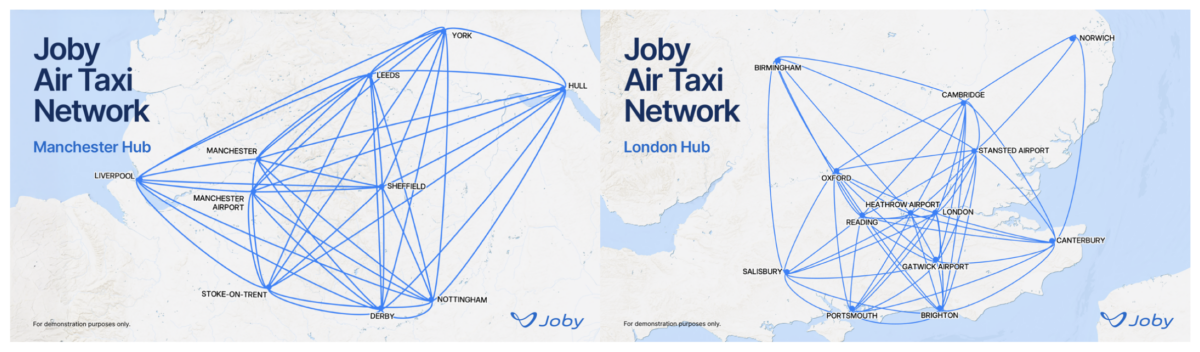
In the UK, Joby has partnered with Virgin Atlantic to roll out air taxis, starting with regional and city connections from the airline’s hubs at Heathrow and Manchester Airport.

Source: Joby Aviation.

Yesterday (31 March), China became the first country to approve commercial air taxis. So rather than being merely science fiction, this is a massive new emerging market.

Joby has over $1bn in cash to fund its commercial launch, but the stock is still very much in the high-risk, high-reward category.

Is buying gold stocks the best way to capitalise on bullion’s bull run?

A new day has brought another record high for the price of gold. Bullion values hit new peaks above $3,151 per ounce earlier on Tuesday (1 April), pulling a wave of gold stocks higher in the process.

Investors today have various ways to try and capitalise on the precious metals boom. They can go down the old route of buying physical gold like bars and coins. Individuals can also choose to buy an exchange-traded fund (ETF) that tracks movements in the yellow metal.

A better way to capitalise on the bull run, however, might be to buy gold mining stocks instead. A fresh report from Edison analysts explains why this could be the best path to consider.

Will gold miners shine?

According to executive director Neil Shah, “We believe gold mining equities are entering their most rewarding phase, with the foundation of strong gold prices now established“.

Looking at gold’s performance since 2019, Shah says that — following a rise in metal prices at the start of previous bull markets — the prices of large-cap miners tends to pick up around nine months later.

After this point, the performance of mid-tier producers accelerates “as major producer outperformance wanes“. This is followed by “the final and often most explosive phase of outperformance [from] from the juniors“, the analyst notes.

Beyond being in this ‘sweet spot,’ Shah suggests now may also be an ideal time to buy gold stocks as sector consolidation accelerates. He notes Gold Fields’ bid last month for Gold Road Resources, which was made at a 28% premium to the Australian company’s then-closing price.

Shah says that, “With major producers facing challenges in replacing reserves through exploration alone, acquisitions of advanced
developers and smaller producers become increasingly attractive at current gold prices
“.

A top fund

It’s important to remember, however, that buying gold stocks rather than bullion itself adds an extra layer of risk for investors.

Operational problems are common across the mining industry and sometimes devastating for future earnings. Underwhelming exploration results can cause share prices to sink, and especially for junior miners. Production issues that drive up costs and hit revenues can be severe for even the largest of gold producers.

But investors can reduce (if not totally eliminate) such threats to overall returns by purchasing an ETF that tracks gold stocks. The iShares Gold Producers ETF (LSE:SPGP) is one I think merits serious consideration today.

It invests in 64 different mining companies, allowing it to absorb problems at one of two companies and still deliver a solid return. In the 12 months to February it delivered a decent return of 52.7%.

This ETF invests in some of the industry’s biggest players like Newmont, Agnico Eagle Mines, and Wheaton Precious Metals, providing it with extra robustness. But it also has holdings in dozens of mid-tier and junior miners, which in turn provides it with terrific growth potential.

Investors here pay an ongoing charge of 0.55%. But given its risk management qualities and the potential to provide stunning returns, I think it’s a great way for investors to consider investing in gold stocks.

Financial News

Daily News on Investing, Personal Finance, Markets, and more!

Financial News

Policy(Required)